 by
Tom Gurney
Tom Gurney BSc (Hons) is an art history expert with over 20 years experience
Email:
tomgurney1@gmail.com
/ Phone:
+44 7429 011000
Guido Bentivoglio Seated: Introduction
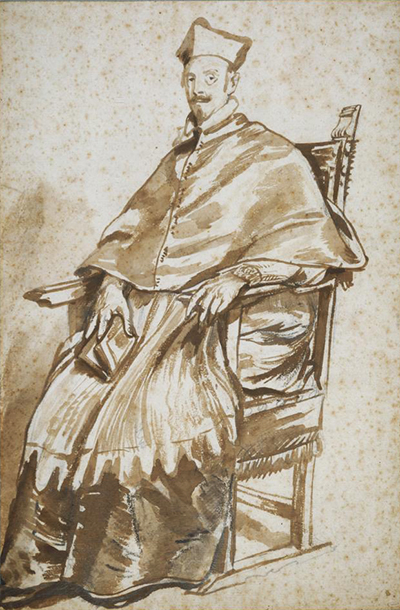
A pointed cap, a narrow face and a great sweep of robes give this seated churchman an immediate presence. Traditionally associated with Cardinal Guido Bentivoglio, Van Dyck's drawing invites comparison with his painted portrait of the cardinal. The identification and preparatory connection remain tentative. [1]
At a Glance
- Artist Anthony van Dyck. [2]
- Subject A seated ecclesiastic, traditionally identified as Cardinal Guido Bentivoglio. [1]
- Date About 1623. [2]
- Medium Black chalk and bistre wash on paper. [2]
- Dimensions 39.6 × 26.2 cm, as recorded by the Petit Palais. [2]
- Collection Petit Palais, Musée des Beaux-Arts de la Ville de Paris; inventory DDUT1034. [2]
This work across Anthony van Dyck’s career
Entry of Christ into Jerusalem
about 1617Frans Snyders
about 1620Rinaldo and Armida
1629–1632; Louvre commentary proposes late1631–spring1632Charles I in Three Positions
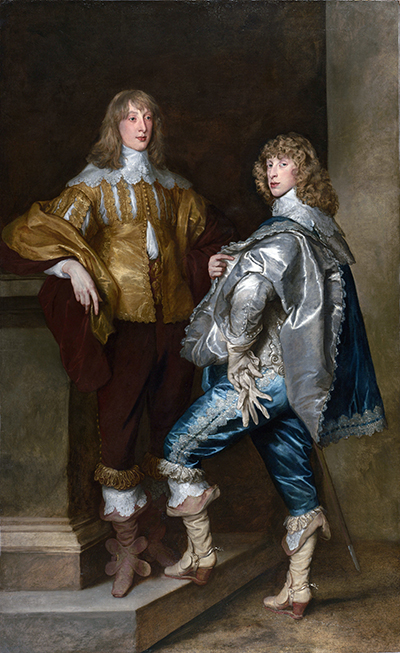
1635–before June 1636Lord John Stuart and his Brother
about 1638Cupid and Psyche
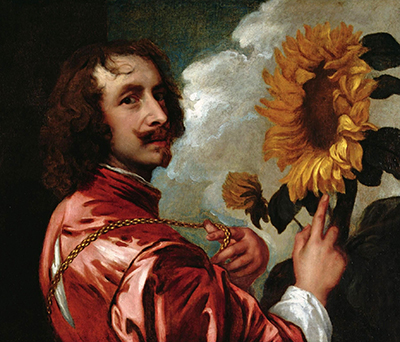
1639–40Self Portrait
c. 1640Contents
- A figure held between movement and stillness
- Why the sitter's name carries a question mark
- A possible design for the painted portrait
- Costume, rank and a change of pose
- The drawing in Paris
A figure held between movement and stillness
The seated man nearly fills the sheet. His chair establishes a firm vertical at the right, while his clothing spreads towards the lower left. The result is a slightly off-centre balance: the chair holds him upright, but the long folds carry the eye away from that rigid support. His head, set high against an expanse of pale paper, remains easy to find amid the busy brushwork below.
Look first at the shoulders. Broad brown strokes run across the cape in uneven bands, leaving light strips between them. Some strokes taper; others widen into pools of shadow. These changes make the fabric seem to turn and settle over the body without every fold receiving a continuous outline. The pale spaces do much of the work. Across the chest they suggest light striking raised folds; farther down, they open into the much larger area of the white garment.
The hands occupy a particularly active band across the middle. On the left of the image, elongated fingers descend towards an angular form in the lap. The other hand reaches over the chair arm, its fingers indicated by spare, separate lines. Neither hand feels isolated: each belongs to the network of diagonals joining sleeve, armrest and robe. The pose becomes legible through those connections.
Below them, long strokes pull the fabric downwards. The serrated edge of the pale garment interrupts that fall, and dark washes gather near the feet. At the right, the chair is more exposed. Its upright, curved support and lower bars let us see the structure that the clothing conceals elsewhere. The seated body's weight is suggested as much by this meeting of cloth and furniture as by the outlines of the figure.
Why the sitter's name carries a question mark
The Petit Palais calls the sheet Portrait du Cardinal Bentivoglio . [2] The Frick's 2016 exhibition used Guido Bentivoglio, Seated (?) , linking the face and lace edging to the painted cardinal while acknowledging the different pose. [1]
A more specific alternative has also been proposed. In his account of the painting, curator Xavier F. Salomon asks whether the Paris drawing records a substantial change in the Bentivoglio composition or belongs instead to Van Dyck's lost portrait of Cardinal Barberini. [3] The Italian catalogue record for the Pitti painting likewise notes the older Barberini suggestion. [4] Similar costume and facial features do not settle the matter. The question concerns which commission the sheet served, as well as whom it represents; neither can be answered simply by giving the familiar name greater emphasis.
That caution leaves room to enjoy the face on its own terms. It is small beside the sweep of clothing, yet the dark marks around the eyes, moustache and beard give it considerable definition. The cap has a particularly economical construction: an angular brown perimeter encloses a largely pale interior. Beneath it, fine marks describe the features with far less tonal weight than the robes. Our attention can move from the broad silhouette to these tiny distinctions without losing the whole seated figure.
Watch: Van Dyck’s art and working methods
Choose a museum introduction, a specialist lecture or a conservation film to continue exploring Van Dyck’s work.
Stijn Alsteens: Drawing for Portraits
Stijn Alsteens explores how portrait drawings prepare and develop a likeness.
Watch on YouTubeA possible design for the painted portrait
The Frick proposes that this large sheet, with its chalk groundwork and bold brushwork, could have helped Van Dyck develop a composition and show a patron his intentions. There is no confirmation that Bentivoglio saw it. [1]
The associated painting is a separate work: Cardinal Guido Bentivoglio , an oil on canvas measuring 195 × 147 cm, now in the Galleria Palatina at the Palazzo Pitti, Florence. The Frick dates it to 1623 and places its execution in Rome. Bentivoglio was also a diplomat, historian and patron of the arts who had previously lived in Flanders. [5]
The Petit Palais associates the drawing with Genoa. [2] The painting's Roman setting therefore cannot establish where this sheet was made. [5] Their possible relationship belongs within the wider story of Van Dyck's Italian career .
Seen as a design, the sheet makes its decisions unusually visible. The robe forms a commanding shape, the chair gives the figure height, and the hands organise the centre. Those features would give a viewer a clear sense of a portrait's arrangement even while the surrounding room remained blank.
Costume, rank and a change of pose
Comparison with the Florence painting helps distinguish the sheet's broad arrangement from the more elaborate language of a finished portrait. Salomon identifies the painted cardinal's short cape as a mozzetta , worn over a white rochetto edged with Flemish lace. [3] These names make the layering in the drawing easier to follow: a wide shoulder covering ends above the lap, while a lighter garment continues downwards beneath it. The brown wash translates the contrast into areas of tone. The drawing gives no equivalent of the painting's saturated crimson, so its colours should not be reconstructed from that comparison alone.
The cap is a particularly clear difference. Here its projecting corners rise above the face; the painted Bentivoglio is bareheaded. Art historian Lydia Rosia Dorn places the Pitti portrait against an established type in which a cardinal sits obliquely, wearing his ceremonial cap and turning towards the spectator. She argues that the painting departs from this convention through its nearly frontal body and a head turned away. [6] The Paris figure gives a useful point of comparison: his face addresses us much more directly, while the chair and the spread of his knees establish the body's angle. The sheet and painting offer different kinds of encounter with a seated man.
The finished canvas also supplies a firmer clue to identity than a resemblance. Italy's national catalogue transcribes a French inscription on a letter that names Bentivoglio and his office as co-protector of French interests at the Roman court. [4] Dorn reads the portrait through that diplomatic role, arguing that its magnificent presentation communicates more than ecclesiastical rank. [6] No comparable identifying text appears in the Paris drawing. Its open background leaves the sitter dependent on face, costume, hands and chair. That absence helps explain why the painting can illuminate the sheet without securely naming its subject.
The drawing in Paris
The sheet bears the Dutuit collection mark at the lower right. It entered the Paris collection through the Dutuit bequest in 1902. [2] It offers a useful way into Van Dyck's drawings : a brush supplies broad masses of tone while finer marks preserve the articulation of face, fingers and chair. Following the changes in the marks is part of the pleasure of looking.
Its place in the museum reflects a much larger gift. The Petit Palais credits the brothers Eugène and Auguste Dutuit with founding its collection of older graphic art in 1902; drawings, prints and manuscripts remain distinct strands of that collection. [7] This sheet therefore reached a setting in which works on paper could be studied alongside other forms of graphic invention. The small collection mark belongs to that later history. It does not identify the churchman or document the circumstances in which Van Dyck drew him.
Artworks directory
A selected directory of paintings, drawings and prints, including works discussed in the articles and the Frick’s 2016 portraiture exhibition. It is not a complete catalogue of Van Dyck’s work. Print titles identify collaborators or later printmakers; disputed and workshop attributions are retained. The exhibition checklist supplies additional object records; current collection information governs the updated article entries. [8]
Frequently Asked Questions
The unwashed areas help describe light across the figure. They form bright bands in the cape and a broad pale surface below the waist. Around the head, the open background makes the cap's angular outline especially clear.
Discussion
Look again at the images and ideas explored in Guido Bentivoglio Seated. These editorial prompts invite your observations.
Reader Insights
Where does your eye settle first: the face, the hands or the broad pattern of the robes?
How does the visible chair affect your sense of the figure's weight and posture?
Which parts of this drawing would most clearly communicate a proposed portrait to a viewer?
Join the Conversation
Share a detail, comparison or question about Guido Bentivoglio Seated below.
References
- The Frick Collection , Guido Bentivoglio, Seated (?) , exhibition object 14, Van Dyck: The Anatomy of Portraiture , 2016. View source .
- Paris Musées , Petit Palais, Portrait du Cardinal Bentivoglio (Lugt 28) , DDUT1034. French collection metadata; Spanish interface. View source .
- Xavier F. Salomon , Van Dyck's Portrait of Cardinal Bentivoglio , The Frick Collection, 3 February 2016; reprinted from the Winter 2016 Members' Magazine . View source .
- Ministero della Cultura , Ritratto del Cardinale Guido Bentivoglio , national catalogue 0900129521, catalogue sheet compiled by D. Bodart, 1979, revised 2006, pp. 2–5 (in Italian). View source .
- The Frick Collection , Cardinal Guido Bentivoglio , exhibition object 15, Van Dyck: The Anatomy of Portraiture , 2016. View source .
- Lydia Rosia Dorn , Anthonis van Dycks Bildnis des Guido Bentivoglio. Das Porträt eines Diplomaten im Kardinalsgewand , Kunstgeschichte. Open Peer Reviewed Journal , 2011, §§3–5, 8–12 and note 13 (in German). View source .
- Petit Palais , Cabinet des arts graphiques (in French). View source .
- The Frick Collection, Van Dyck: The Anatomy of Portraiture, online exhibition checklist (2016). View source.