 by
Tom Gurney
Tom Gurney BSc (Hons) is an art history expert with over 20 years experience
Email:
tomgurney1@gmail.com
/ Phone:
+44 7429 011000
Anthony van Dyck in Italy, 1621–1627: Introduction
Anthony van Dyck spent six formative years in Italy, earning a living while studying the paintings he admired. Genoa became his principal base: its patrician families commissioned imposing portraits that gave visible shape to their wealth and standing. His journeys also brought Roman patrons, a memorable encounter with Sofonisba Anguissola and an unexpected role in Palermo’s response to plague. Across these different settings, looking and working belonged to the same career. [1] [2]
At a Glance
- Period Autumn 1621 to late 1627, with Genoa as his main base. [1]
- Work Individual and family portraits, alongside religious painting. [2] [3]
- Study Italian compositions, especially those associated with Titian, recorded in the surviving Italian Sketchbook. [4]
- Roman patron Cardinal Guido Bentivoglio, portrayed in 1623. [5]
- Palermo Van Dyck was there during the plague of 1624; his notebook dates his portrait of Sofonisba Anguissola from life to 12 July that year. [3] [6]
- Return Antwerp by the end of 1627. [1]
Contents
- A travelling painter with a Genoese base
- Elena Grimaldi: rank, colour and service
- A family portrait with an absent father
- The Brignole-Sale commissions: money, marriage and display
- What the Italian Sketchbook records
- Rome: an ecclesiastical patron and a working study
- Palermo: painting during the plague
- Sofonisba Anguissola’s advice
- What Van Dyck brought back to Antwerp
A travelling painter with a Genoese base
Van Dyck reached Italy in the autumn of 1621, following his first short period in England and a return to Antwerp. He was already a practising artist. Italian study offered fresh resources for his work, while Italian patrons offered commissions. Genoa’s established Flemish artistic community and the connections of Rubens helped him enter a wealthy market for portraiture. [1] [2]
Those connections had a practical address. Christopher Brown identifies Van Dyck’s Genoese hosts as Cornelis and Lucas de Wael, brothers from Antwerp who worked as painters, engravers and art dealers. Their house served as his base during the Italian years. [7] Accommodation within that community placed the newcomer among people whose work already connected making pictures with selling them. The social network was part of the infrastructure of his career.
His six years abroad should not be imagined as a continuous residence in one city. Matthias Depoorter’s chronology places him in Venice in 1622, associates his travels through northern Italy with the Countess of Arundel, and records commissions from the Duke of Savoy in Turin. Rome and Palermo were substantial further episodes. [8] These journeys brought him into contact with collectors and patrons as well as pictures. Yet Genoa repeatedly supplied the sustained work around which the travelling career could develop.
The distinction matters when we look at the portraits. They were made for particular households, with established ambitions and resources. A monumental canvas required the painter to organise much more than a likeness: clothing, architecture, attendants and family relationships all had to become intelligible at a distance. Studying Italian painting and answering these commissions could feed one another. A remembered arrangement of figures or a grand architectural opening was useful knowledge for a painter asked to give an individual a commanding presence.
The full-length format made that presence physical. A figure could occupy a painted space approaching the scale of a person in a room, while the surrounding canvas enlarged the sitter’s domain. Van Dyck’s Genoese patrons appear on terraces, beside columns and beneath heavy curtains. Looking across the surviving works, one notices how often a small, exposed hand or face gathers attention within a much larger expanse of dress and setting. The scale announces importance; the precisely placed human detail gives the viewer somewhere to approach it.
Elena Grimaldi: rank, colour and service
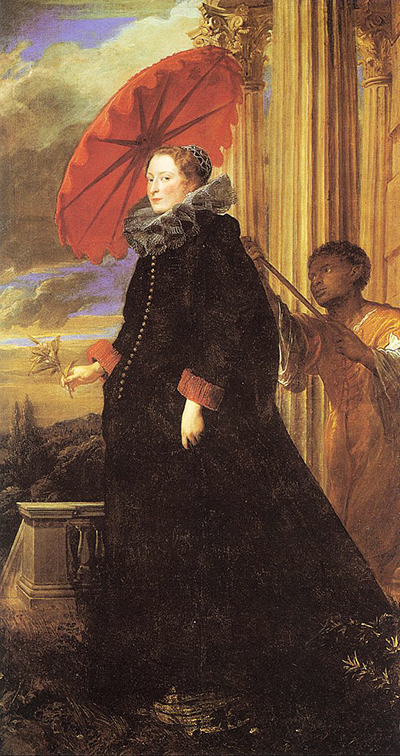
The portrait of Marchesa Elena Grimaldi Cattaneo , dated 1623, gives this approach an especially clear form. Now in the National Gallery of Art, Washington, it presents Elena in a dark dress beneath a red parasol held by an African attendant. The museum relates its grand terrace setting to Rubens’s portrait of Brigida Spinola Doria, painted in Genoa in 1606. [9]
The composition makes Elena seem both available to the eye and difficult to reach. Her face turns towards us, but her body occupies a broad, dark shape that widens towards the bottom of the canvas. Above her, the parasol spreads like a second frame around her head. Its diagonal ribs lead towards the small illuminated face, while the tall columns carry the eye upwards beyond it. A branch held at the left extends her presence into the open landscape. Her other hand hangs more quietly against the dress.
Red links her cuffs to the parasol. That connection makes the attendant’s labour integral to the colour structure: his hands sustain the object that crowns the marchesa’s position. He stands close enough to share her pictorial space, yet the arrangement assigns them sharply unequal roles. The image allows us to examine that hierarchy without supplying his missing biography. The National Gallery of Art does not establish whether he was free or enslaved. [9]
Ana Howie’s study of the portrait connects its represented textiles with Genoa’s involvement in global and colonial commerce. She proposes relationships between the black dress and logwood dye, and between the red parasol and cochineal. These are historically grounded interpretations of the pictured fabrics; the actual household garments have not been identified. Nor has cochineal been established as the dye in the painting’s red lake pigment. [10]
This reading opens the portrait beyond the terrace. The apparently self-contained display of status belongs to wider movements of goods and people. Its sumptuous colour and unequal service can be considered together. Howie also stresses the uncertainty surrounding the attendant’s legal position: wider histories of slavery do not identify this individual. [10] A responsible reading keeps him visible as a person while acknowledging how little the record allows us to recover.
A family portrait with an absent father
Van Dyck’s Genoese career also involved representing the household as a political and dynastic unit. In The Lomellini Family , painted about 1625–27 and now in the National Galleries of Scotland, five people occupy an expansive interior. They are Giacomo Lomellini’s two elder sons, his second wife Barbara Spinola and the couple’s two children. Giacomo himself was doge from 1625 to 1627. The museum explains his absence through regulations preventing the serving doge from promoting himself through portraiture. [11]
That absence makes the painting particularly revealing. A family could present its continuity and importance while its most prominent member remained outside the picture. The two standing men give the left side height and weight; Barbara’s seated figure carries the composition towards the smaller children at the right. Armour, dark clothing and the children’s brighter dresses distinguish different places within the group. The youngest figures participate in the display without needing to imitate the adults’ poses.
The architecture gives each person room, but the figures do not dissolve into five separate portraits. Hands, overlapping silhouettes and changes of height carry the eye across the family. The small dog near the lower edge adds another scale of life beneath the formal arrangement. These varied presences make the household feel inhabited, even as the large canvas presents it ceremonially.
The political explanation for the missing doge changes how we look at this apparent domestic gathering. The surviving family stands before us on terms shaped by public office. At the same time, Van Dyck allows children and adults different kinds of bodily freedom. Family status is expressed through that organised variety. The setting need not be identified as an actual room in a Lomellini palace to understand its work in the picture.
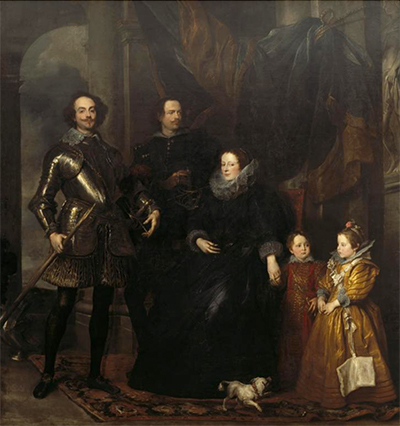
Anthony van Dyck, The Lomellini Family, about 1625–27. Oil on canvas, 269 × 254 cm. National Galleries of Scotland.
Watch: Van Dyck’s art and working methods
Choose a museum introduction, a specialist lecture or a conservation film to continue exploring Van Dyck’s work.
Van Dyck, The Anatomy of Portraiture
The Frick curators introduce Van Dyck’s portraits, drawings and prints.
Watch on YouTubeThe Brignole-Sale commissions: money, marriage and display
Another Genoese family shows how portraiture could accompany social advancement. The Brignole had risen through wool and silk enterprise; marriage into the Sale family brought wealth, property and a noble title to the next generation. Gio. Francesco Brignole’s commission of 1627 represented his wife Geronima with their daughter Aurelia, his son Anton Giulio, and Anton Giulio’s wife Paolina Adorno. The civic museum interprets their scale and luxurious clothing as expressions of the family’s acquired economic power. [12]
These paintings also preserve an unusually useful business detail. The museum reports a payment of 747 lire for the three paintings together , entered in the Brignole-Sale accounts in 1627. It is a group payment, not the price of Anton Giulio’s portrait alone or a general tariff for Van Dyck’s work. [13] [14] The account places an actual paid undertaking near the end of the Italian years, alongside the more elusive evidence of travel and study.
In Anton Giulio’s equestrian portrait , the white horse advances almost directly towards us. Its bright, flowing mane occupies the centre, below the rider’s small, steady face. Anton Giulio extends his hat to one side, opening the silhouette of his dark costume against the sky. The gesture seems courteous, yet the horse’s size and forward movement keep the encounter under his control. The Genoese museum connects this commanding equestrian type with Rubens’s portraits of Giovanni Carlo Doria and the Duke of Lerma. [13]
Paolina’s portrait uses a different balance of scale and detail. Her embroidered dress spreads below a carefully contained upper body; its gold patterns brighten the dark blue surface. A large ruff encloses her face, and the upright column beside her repeats the height of the standing figure. The chair and parrot at the left bring intricate, smaller forms into a setting dominated by broad verticals. Her lowered hand interrupts the decorated fabric with a pale, unadorned shape.
The museum records the two portraits as a surviving pair and dates both to 1627. [13] [14] Seen together, they show how flexible Van Dyck’s public language had become. Horse, hat and open sky give Anton Giulio a mobile presence; dress, chair and architecture give Paolina a more enclosed one. Each occupies a large domain, and each face remains legible within it.
Their present home can make this history seem deceptively continuous. Palazzo Rosso was built between 1671 and 1677, roughly fifty years after the portraits. The pictures preceded the palace and were subsequently brought into it. [12] Their original commission belongs to the family’s earlier expansion, before the later building supplied such an impressive setting for its collections.
What the Italian Sketchbook records
The Italian Sketchbook in the British Museum contains 121 numbered leaves. Titian’s name appears beside almost sixty designs. Van Dyck also studied other artists, including Veronese, Raphael, Annibale Carracci, Rubens and Dürer, working through prints and painted replicas as well as original paintings and frescoes. [4]
Written reminders of colour, texture and location accompany the mostly pen-and-brown-ink drawings. Italian predominates, with some Dutch; observations of daily life and preparatory ideas appear alongside the copies. [4] A print could preserve relationships between figures even when it could not transmit the original’s colour.
A written colour note supplied information that brown ink could not carry. Such a book could preserve the arrangement of a group and reminders of its appearance together on a portable page.
Its varied sources prevent an exact itinerary. [4] The drawings instead illuminate the painter’s work of selecting and remembering.
Rome: an ecclesiastical patron and a working study
The portrait of Cardinal Guido Bentivoglio, painted in Rome in 1623, shows Van Dyck working within another powerful network. Bentivoglio was a diplomat, historian and patron who had previously lived in Flanders. The Frick’s account suggests that Van Dyck probably stayed in his palace. The finished painting, now in the Galleria Palatina in Florence, belongs to this Roman encounter. [5]
A large drawing in the Petit Palais has traditionally been connected with the portrait. The Frick retains a question over the sitter’s identification and notes that the seated pose differs from the painting. Its combination of black chalk and bold brown brushwork has been interpreted as a way of developing a composition and possibly communicating an intended design. [15]
The connection is useful precisely because it leaves room for change. A working study need not predict the final painting in every detail. Van Dyck could test the disposition of a seated figure before settling the larger relationship of body, chair and surrounding space. The Bentivoglio drawing offers a possible glimpse of that process, while its tentative identification prevents it from serving as a secure record of a particular sitting.
Rome thus adds something distinct to the Genoese story. Van Dyck’s clients could be connected to the northern world he already knew, even when he encountered them in Italy. Patronage travelled through diplomatic and cultural relationships. His ability to organise a commanding portrait could serve an ecclesiastical statesman as readily as a merchant dynasty.
Palermo: painting during the plague
In 1624 Van Dyck was in Palermo when plague broke out and the city was quarantined. During the epidemic, remains believed to be those of the twelfth-century Saint Rosalie were rediscovered, and demand for her image grew. The Metropolitan Museum of Art’s Saint Rosalie Interceding for the Plague-stricken of Palermo , dated 1624, belongs to this setting. [3]
In that painting, Rosalie rises above the distant land and sea amid clouds and angels. Her uplifted face draws the eye towards the light, while her open hands remain directed outwards and downwards. The position joins two kinds of address: she looks towards heaven as her gesture opens towards the world below. The surrounding children turn, reach and tumble, making her relatively continuous figure the calm centre of a restless ascent.
The picture gives an earthly crisis an image of intercession. A viewer does not need to find a literal depiction of the sick to understand the appeal carried upwards by the saint. The separation between the dim landscape and the illuminated figure makes the distance legible; the gestures bridge it. Van Dyck’s skill in directing attention, so effective in portraits, here serves a devotional request.
The Met records that he painted this image over a self-portrait already sketched on the canvas. [3] That specific reuse gives a material glimpse of work in progress during the Palermo episode. It does not establish why he abandoned the earlier design. The larger change in his circumstances is clearer: alongside portrait commissions, he was producing religious images in response to an urgent local demand. The Rosalie painting belongs within that working career, without requiring a story of personal heroism in quarantine.
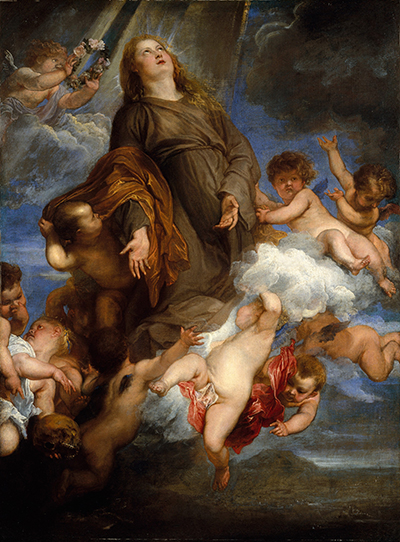
Anthony van Dyck, Saint Rosalie Interceding for the Plague-stricken of Palermo, 1624. Oil on canvas, 99.7 × 73.7 cm. The Metropolitan Museum of Art, New York, 71.41.
Sofonisba Anguissola’s advice
Palermo also produced an unusually direct personal record. Beside his sketch of Sofonisba Anguissola, Van Dyck wrote that he had drawn her from life there on 12 July 1624 . He gave her age as ninety-six: this is his reported figure, not independent proof of her birth date. His Italian account describes her alert memory, courtesy and continuing pleasure in looking closely at pictures despite impaired sight. [6]
He also recorded practical advice. While he portrayed her, she cautioned against placing the light too high, which would enlarge the shadows cast by the wrinkles of an older face. Van Dyck noted the steadiness of her hand and her distress at being unable to continue painting. [6]
The passage preserves an exchange about how to make a portrait. Light, age and the appearance of a face were matters on which the older artist could still advise the younger one. It is a small, concrete episode within years often described through the influence of famous paintings. Here knowledge passes through an artist’s judgement, expressed in relation to the person actually being portrayed.
What Van Dyck brought back to Antwerp
By late 1627 Van Dyck was back in Antwerp. The Brignole-Sale pictures mark the closing part of his Genoese production; the next phase brought substantial portrait and religious commissions in the Southern Netherlands. [1] [2] The Italian years had furnished him with experience of several markets, from the representation of patrician families to the devotional needs of a city in crisis.
His next patrons could call on a painter accustomed to giving very different subjects a sustained presence. The large portrait was now a particularly flexible resource: an individual could command the space through a quiet turn of the head as effectively as through an advancing horse. The Antwerp years take up the story after his return.
Artworks directory
A selected directory of paintings, drawings and prints, including works discussed in the articles and the Frick’s 2016 portraiture exhibition. It is not a complete catalogue of Van Dyck’s work. Print titles identify collaborators or later printmakers; disputed and workshop attributions are retained. The exhibition checklist supplies additional object records; current collection information governs the updated article entries. [16]
Frequently Asked Questions
His principal Italian period ran from autumn 1621 to late 1627. Genoa was his main base, with journeys elsewhere, including Rome and Palermo. The broad dates do not establish an exact schedule for every stop. [1]
The city’s civic museums connect these commissions with displays of family wealth and prestige. Monumental portraits could represent the household across generations, while individual sitters appeared in luxurious clothing and commanding settings. Flemish artistic connections and Rubens helped Van Dyck enter this patronage network. [2]
The British Museum identifies Titian’s name beside almost sixty designs in the sketchbook. Some derive from prints or replicas; the number is not a count of original Titian paintings that Van Dyck personally visited. [4]
His own inscription records drawing her from life in Palermo on 12 July 1624 and preserves her advice about lighting an older face. [6]
Discussion
Look again at the images and ideas explored in Anthony van Dyck in Italy, 1621–1627. These editorial prompts invite your observations.
Reader Insights
How does Elena Grimaldi’s portrait make the attendant essential to its display of rank?
What changes when we look at the Lomellini group knowing why the doge is absent?
Which offers the clearest insight into Van Dyck’s learning: the sketchbook copies, the finished commissions or Sofonisba’s advice?
Join the Conversation
Share a detail, comparison or question about Anthony van Dyck in Italy, 1621–1627 below.
References
- Frans Baudouin , “De laatste tien levensjaren van Antoon Van Dyck”, Streven , 66 (1999), pp. 328–339. Dutch. View source .
- Musei di Genova , “Antoon Van Dyck”. Italian. View source .
- The Metropolitan Museum of Art , Saint Rosalie Interceding for the Plague-stricken of Palermo , 71.41. View source .
- British Museum , Italian Sketchbook: overview and first leaf, 1957,1214.207.1. View source .
- The Frick Collection , Cardinal Guido Bentivoglio , Van Dyck: The Anatomy of Portraiture , online exhibition entry 15. View source .
- British Museum , Sofonisba Anguissola: leaf from Van Dyck’s Italian Sketchbook, 1957,1214.207.110. English record with Van Dyck’s Italian inscription. View source .
- Christopher Brown , “A Naturally Gifted Painter: The Work of Anthony van Dyck”, The Low Countries , 6 (1998–99), pp. 12–23. View source .
- Matthias Depoorter , Vlaamse Kunstcollectie, “Anthony van Dyck”. Dutch. View source .
- National Gallery of Art , Marchesa Elena Grimaldi Cattaneo . View source .
- Ana Howie , “Materializing the Global: Textiles, Color, and Race in a Genoese Portrait by Anthony van Dyck”, Renaissance Quarterly , 76, no. 2 (2023). View source .
- National Galleries of Scotland , The Lomellini Family , NG120. View source .
- Musei di Genova , “La Famiglia Brignole Sale”. Italian. View source .
- Musei di Genova , Anton Giulio Brignole-Sale a cavallo , PR48. Italian. View source .
- Musei di Genova , Ritratto di Paolina Adorno Brignole-Sale , PR51. Italian. View source .
- The Frick Collection , Guido Bentivoglio, Seated (?) , Van Dyck: The Anatomy of Portraiture , online exhibition entry 14. View source .
- The Frick Collection, Van Dyck: The Anatomy of Portraiture, online exhibition checklist (2016). View source.