 by
Tom Gurney
Tom Gurney BSc (Hons) is an art history expert with over 20 years experience
Email:
tomgurney1@gmail.com
/ Phone:
+44 7429 011000
Anthony van Dyck in Antwerp: Introduction
Antwerp was the city in which Anthony van Dyck learnt to paint, began an independent career and returned as an established artist after six years in Italy. Its collectors, fellow painters and religious institutions gave him opportunities that help explain the breadth of his work before his portraits of Charles I became so famous. [1]
At a Glance
- Birthplace Antwerp, 22 March 1599. [2]
- Training Hendrik van Balen’s workshop, beginning around 1609–10. [2]
- Professional standing Independent work survives from 1615–16; he became a master in Antwerp’s Guild of Saint Luke in 1618. [1] [2]
- Principal Antwerp phases His early career before the Italian journey of 1621–27, and the years following his return in 1627, before establishing himself at the English court in 1632. [1]
- Later connections Return visits continued after his English appointment. [2]
Contents
- A young painter with work of his own
- What collaboration with Rubens involved
- Portraits within an Antwerp network
- Returning in 1627: churches and new patrons
- Isabella’s court and the road to The Hague
- An Antwerp network carried into print
- Leaving in 1632 did not close the Antwerp story
A young painter with work of his own
Van Dyck began with Hendrik van Balen when he was about ten. He was producing independent paintings before admission to the guild made his professional standing official in 1618. His collaboration with Rubens developed alongside a separate practice. [3] In a 1618 letter, Rubens referred to a painting by his finest pupil, wording traditionally understood to identify Van Dyck. [2]
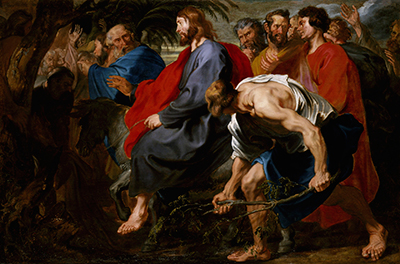
One early canvas makes that independence tangible. The Entry of Christ into Jerusalem , now at Newfields in Indianapolis, is dated about 1617. The museum associates its vigorous figures and restless crowd with the young Van Dyck’s response to Rubens. [4] Yet the picture has a particular way of bringing the event close. Christ rides into a tightly packed company, his blue and red clothing creating a steady centre. In front, a bare-shouldered man bends across the animal’s path with a leafy branch. His exposed arm, strained posture and turn of the head make the welcome feel like a sequence of physical actions.
The procession fills almost the entire image. Heads accumulate behind Christ; the tree and dark foreground leave little breathing room around the procession. The branch bearer occupies space that might otherwise have opened towards the viewer. We encounter the arrival through bodies, cloth and gestures. This is already a painter testing how a large religious story can be made immediate.
What collaboration with Rubens involved
Rubens’s Antwerp workshop offered experience on a very different scale. For the thirty-nine ceiling paintings of the Jesuit church, undertaken in 1620, Van Dyck carried out much of the painting from Rubens’s oil sketches. The ceilings were subsequently destroyed by fire. Walter Liedtke explains how such small painted designs could serve both as proposals for patrons and as instructions to assistants executing much larger works. [3]
That relationship allows several kinds of authorship to coexist: inventing a composition, developing a working model, enlarging it and painting its final surface. A young painter could contribute substantially to a work issued under an established master’s name. It also makes the surviving evidence especially important when scholars try to distinguish their hands.
The Lance Thrust , made for the high altar of Antwerp’s Minderbroeders church in 1620, offers a pointed example. At the Royal Museum of Fine Arts Antwerp, Nico van Hout has argued for Van Dyck’s fundamental role in its design and execution within Rubens’s enterprise. He draws attention to preparatory drawings and an oil model whose handling he associates with Van Dyck. His account also acknowledges the old inscriptions and early testimony naming Rubens, and a long history of disagreement. This is a museum scholar’s attribution argument, not an uncontested verdict shared by every authority. [5]
For understanding the early career, the interest lies partly in the question itself. How much freedom could an assistant exercise inside a celebrated workshop? Van Hout’s reading of this altarpiece suggests that the answer may be considerable. The wider problems of authorship, copies and shared execution continue in Van Dyck’s workshop and influence . [5]
Portraits within an Antwerp network
The people Van Dyck painted reveal another side of the city’s artistic life. Cornelis van der Geest was a prosperous spice merchant and an important collector. His portrait, now in the National Gallery, dates from about 1620. The museum records that the small painting was subsequently enlarged by another hand; its present frame conceals those additions. [6]
In the visible image, the white ruff forms an uneven ring around a face that seems remarkably near. Its folds open into small pockets of shadow, while a few loose hairs escape the firmer shape of the head. The mouth is slightly parted, and the eyes meet the viewer without the support of a hand gesture or an elaborate setting. Almost everything depends on the relationship between the lit face, the pale collar and the surrounding darkness. The portrait of Cornelis van der Geest shows how much presence Van Dyck could give a sitter within a restricted format.
The portrait of Frans Snyders , about 1620, expands that encounter. Snyders was a successful painter of animals and still lifes; he and Van Dyck also participated in joint projects. The Frick Collection connects his portrait with the pendant of his wife, Margareta de Vos , through their shared terrace setting and presentation of prosperity. [7]
Snyders sits beneath a large sweep of dark drapery, with a column rising behind his shoulder and a glimpse of greenery to one side. His clothes are black, but they register as a succession of different surfaces: long smooth folds, gathered sleeve fabric and the small bright interruptions of lace. One hand hangs over the chair; the other rests lightly on his knee. Together they give the expansive pose an easy rhythm. Beside the compact van der Geest, this portrait demonstrates the range already available to Van Dyck before Italy: the concentrated head and the spacious, socially assured figure.
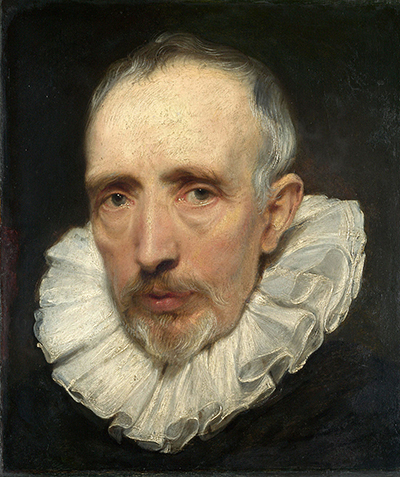
Anthony van Dyck, Portrait of Cornelis van der Geest, about 1620. Oil on wood, probably oak, 37.5 × 32.5 cm. National Gallery, London, NG52.
Watch: Van Dyck’s art and working methods
Choose a museum introduction, a specialist lecture or a conservation film to continue exploring Van Dyck’s work.
Alejandro Vergara: Van Dyck and the Problems of Youth
Alejandro Vergara examines the ambitions and problems of Van Dyck’s early career.
Watch on YouTubeReturning in 1627: churches and new patrons
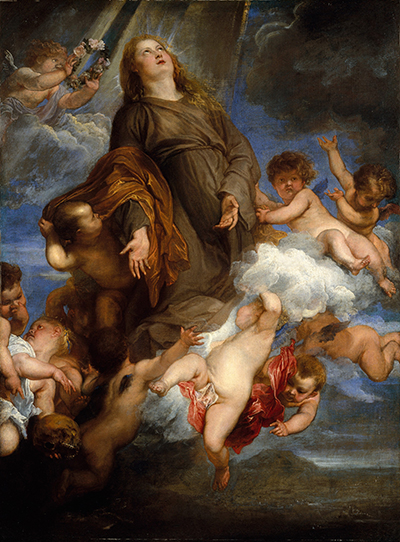
An initial English visit in 1620–21 preceded his Italian years . [3] Van Dyck returned to Antwerp late in 1627. [3] A prestigious church commission followed. In 1628, his Saint Augustine in Ecstasy occupied the left side altar of the Augustinian church; Rubens supplied the high altarpiece and Jacob Jordaens the painting for the right side altar. Three distinct careers were represented within one church. [2]
Rubens’s diplomatic absences during 1628–30 created further opportunities. Frans Baudouin describes Van Dyck’s widening portrait clientele, including rulers and courtiers alongside merchants and fellow artists. [8]
Religious painting remained a substantial part of this work. The Vienna Vision of the Blessed Hermann Joseph , dated about 1629–30, belonged to Antwerp’s Jesuit Marian congregation in 1630. Its subject is a Premonstratensian monk’s visionary union with the Virgin. [9] Here the action has become a close exchange of hands. The kneeling monk reaches forward while an angel guides the encounter, bringing the principal figures into a small, intensely focused group.
The change from the early Entry into Jerusalem is striking. There the branch bearer’s arm cuts across the foreground and the crowd presses towards Christ. In the Hermann Joseph , the monk’s pale mantle gathers around his lowered body, while the angel’s gold-coloured drapery rises behind him. One figure descends and another seems to billow upwards. The Virgin’s extended hand provides a quiet point of contact between these movements. Van Dyck gives the visionary episode a physical structure that a viewer can follow before knowing its story.
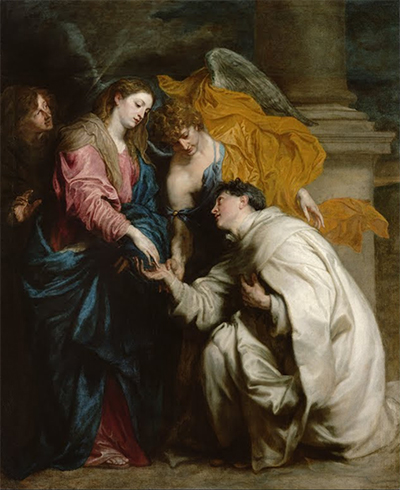
Anthony van Dyck, The Vision of the Blessed Hermann Joseph, around 1629–30, oil on canvas, Kunsthistorisches Museum, Vienna, GG 488.
Isabella’s court and the road to The Hague
Court service drew the Antwerp painter towards Brussels, the seat of government in the Southern Netherlands. In his Louvre catalogue, Blaise Ducos places Van Dyck’s appointment as painter to the Archduchess Isabella Clara Eugenia in 1628. Ducos reads her religious clothing in the portraits as part of a political image: Isabella had entered the Franciscan Third Order after her husband’s death, while continuing to govern. Her austere dress therefore belongs to the representation of an active ruler. [10]
The connection with Brussels should also be distinguished from Van Dyck’s visits north to The Hague. Baudouin reconstructs two stays there: a short visit in May–June 1631 and a longer period during the winter of 1631–32. His account draws on correspondence, payments and a diary entry by Constantijn Huygens recording that Van Dyck painted him on 28 January 1632. [8]
The Orange court wanted poetic subjects as well as portraits. Ducos associates the Louvre Rinaldo and Armida with Frederick Henry and Amalia van Solms, placing its completion near Van Dyck’s departure for England in spring 1632. [11] These commissions extend the picture of his second Antwerp period: his work reached beyond the city’s churches and collectors into neighbouring courts with different religious and political allegiances.
An Antwerp network carried into print
Portraiture could travel further through the project now known as the Iconography . The series brought artists, connoisseurs, scholars and political figures into a growing company of printed likenesses. KBR distinguishes Van Dyck’s own etchings from the engravings made by other printmakers after his designs, including Paulus Pontius and Lucas Vorsterman. Drawings in black chalk could connect a painted or observed likeness to the engraved plate. [12]
This gives a further dimension to the Antwerp portrait network. A face encountered in a painting could acquire a second life on paper, detached from the room in which the canvas hung. The image depended on several people’s skills, and its audience could grow through successive impressions and editions. The series continued to be published after Van Dyck’s death; the familiar date range extending into the 1640s includes that later activity. [12] The prints and drawings offer complementary ways into this collaborative work.
Leaving in 1632 did not close the Antwerp story
Van Dyck established himself at Charles I’s court in 1632, but subsequent travel kept his continental connections alive. [1] His stay in the Southern Netherlands in 1634–35 centred largely on Brussels, where he painted aristocratic patrons. Antwerp and Brussels should not be treated as interchangeable settings for those works. [8]
He was back in Antwerp in autumn 1640. A projected Martyrdom of Saint George for the cathedral remained unfinished, leaving the late career with an unrealised religious commission in the city where it had begun. [2] The English episode follows his court employment and final journeys. Antwerp, meanwhile, helps us see the enduring breadth of his ambitions: the intimate portrait, the large public altarpiece and the collaborative image made for circulation all belonged to the same working life.
Artworks directory
A selected directory of paintings, drawings and prints, including works discussed in the articles and the Frick’s 2016 portraiture exhibition. It is not a complete catalogue of Van Dyck’s work. Print titles identify collaborators or later printmakers; disputed and workshop attributions are retained. The exhibition checklist supplies additional object records; current collection information governs the updated article entries. [13]
Frequently Asked Questions
He trained with Hendrik van Balen from about the age of ten. By 1618 he had his own studio and pupil while also working with Rubens. [3]
Discussion
Look again at the images and ideas explored in Anthony van Dyck in Antwerp. These editorial prompts invite your observations.
Reader Insights
Compare the close framing of Cornelis van der Geest with Snyders’s seated figure. How does the space around each sitter affect your sense of encountering him? [7] [8]
In The Entry of Christ into Jerusalem and Hermann Joseph , follow the hands and arms first. How does each arrangement guide you towards its religious subject? [5] [9]
How might a portrait’s meaning or audience change when it becomes part of a series of printed likenesses? [12]
Join the Conversation
Share a detail, comparison or question about Anthony van Dyck in Antwerp below.
References
- National Gallery , Anthony van Dyck. View source .
- Matthias Depoorter , Vlaamse Kunstcollectie, Anthony van Dyck (Dutch). View source .
- Walter Liedtke , The Metropolitan Museum of Art, Peter Paul Rubens (1577–1640) and Anthony van Dyck (1599–1641): Paintings, 2003. View source .
- Newfields , The Entry of Christ into Jerusalem, 58.3. View source .
- Nico van Hout , Royal Museum of Fine Arts Antwerp, De lanssteek, van Rubens? (Dutch). View source .
- National Gallery , Portrait of Cornelis van der Geest, NG52. View source .
- The Frick Collection , Frans Snyders, Van Dyck: The Anatomy of Portraiture , online exhibition. View source .
- Frans Baudouin , De laatste tien levensjaren van Antoon Van Dyck, Streven 66 (1999), pp. 328–339 (Dutch). View source .
- Kunsthistorisches Museum , Mystische Verlobung des heiligen Hermann Joseph mit Maria, GG488 (German). View source .
- Blaise Ducos , Musée du Louvre, Portrait d’Isabelle Claire Eugénie (1566–1633), archiduchesse des Pays-Bas, en habit du tiers ordre des Clarisses, Antoon Van Dyck. Catalogue raisonné des tableaux du musée du Louvre , 2023, cat. 11 (French). View source .
- Blaise Ducos , Musée du Louvre, Les Amours de Renaud et Armide, Antoon Van Dyck. Catalogue raisonné des tableaux du musée du Louvre , 2023, cat. 12 (French). View source .
- KBR , De uomini illustri van Antoon van Dijck, 2020 (Dutch). View source .
- The Frick Collection, Van Dyck: The Anatomy of Portraiture, online exhibition checklist (2016). View source.