 by
Tom Gurney
Tom Gurney BSc (Hons) is an art history expert with over 20 years experience
Email:
tomgurney1@gmail.com
/ Phone:
+44 7429 011000
Anthony van Dyck in England: Introduction
Anthony van Dyck gave the court of Charles I an unusually varied public face. A king could advance on horseback beneath an arch, stand beside his horse in hunting clothes, or appear three times on one canvas for a sculptor working abroad. Around these royal commissions grew a London practice serving aristocrats, courtiers and friends. Its setting was a house at Blackfriars where making portraits, receiving distinguished visitors and collecting Italian paintings belonged to the same cultivated life. [1] [2] [3] [4] [5]
At a Glance
- First English visit Autumn 1620 to early 1621, during the reign of James I. [6] [7]
- Royal appointment Principal Painter to Charles I and Henrietta Maria in 1632; knighted that year. [8] [1]
- London base Blackfriars, with additional rooms at Eltham. [1]
- Principal work Royal and aristocratic portraiture, alongside continuing ambitions for narrative painting. [6] [9]
- Continental journeys The Southern Netherlands in 1634–35, Antwerp in 1640, and Paris in 1640–41 and again in 1641. [10] [8]
- Death London, 9 December 1641; buried in the old St Paul's Cathedral. [10] [8]
Contents
- Two arrivals, two different opportunities
- Blackfriars: studio, house and collection
- Several ways to picture a king
- The queen, courtiers and private patrons
- The work behind apparent ease
- An English base, with ambitions abroad
- Family and the final months
Two arrivals, two different opportunities
Van Dyck first arrived in England in autumn 1620. He stayed only a few months, returned to Antwerp and left for Italy in autumn 1621. This brief visit preceded his appointment by Charles I by more than a decade. [10] James I was still king, and Van Dyck entered his service. [6]
The intervening years changed what the young painter could offer an English patron. In Italy he developed the imposing portraits of Genoese patricians for which wealthy families valued him; after returning to the Southern Netherlands he worked again as a portraitist and painter of religious subjects. His art drew particularly strongly on Titian. When he settled at Charles's court in 1632, he brought the experience of several artistic centres and different kinds of patronage. [6] The Italian years help explain the confidence with which he could now give a full-length figure an expansive setting.
Charles's patronage established a lasting English base. Van Dyck became principal painter to the king and queen and received a knighthood in 1632. Royal favour included the promise of an annual £200 payment. [8] [1] That distinction mattered socially as well as professionally: the Antwerp-born artist was now Sir Anthony van Dyck, working within the court whose members sought his portraits.
Blackfriars: studio, house and collection
The Blackfriars house had a riverside garden and a landing stage accessible to Charles by water. Van Dyck also had rooms at Eltham. [1] Royal support involved practical provision as well as a title.
Inside the house, Van Dyck was also a collector. He brought Titian's The Vendramin Family to England during the 1630s and displayed it in his Blackfriars collection, which Charles visited. His pictures included works attributed to Raphael, Tintoretto and Bassano, while nineteen paintings then attributed to Titian made up approximately half the collection. Those historical attributions should not be mistaken for nineteen securely authenticated Titians today. [2]
The collection gives substance to the idea of a cultivated court painter. Van Dyck did more than adopt impressive clothes for his sitters: he surrounded himself with the paintings through which he understood his profession. A patron entering this house could encounter both a new portrait and the older Italian art that helped shape it. The English studio thus belonged to a wider European culture of collecting, looking and comparison.
Several ways to picture a king
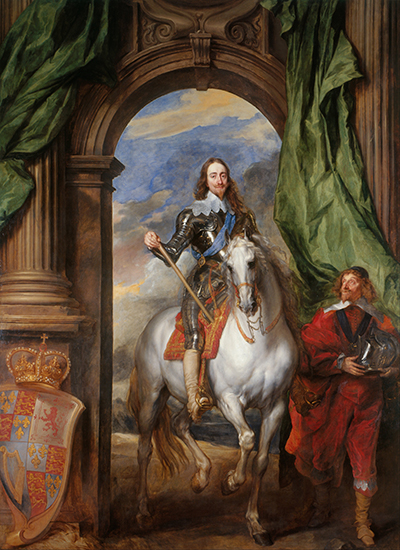
The monumental Charles I with M de St Antoine , dated 1633, makes mounted authority almost architectural. Charles approaches beneath a great arch; green curtains open above him, and a crowned shield stands below. His riding master, Pierre Antoine Bourdin, Seigneur de St Antoine, carries the helmet at the right. The Royal Collection suggests that the picture may originally have stood at the end of the gallery at St James's Palace. [3]
The white horse appears to step out of the deep opening towards us. Its lifted foreleg gives movement to the broad frontal arrangement, while the rider's upright body remains conspicuously composed. The attendant looks upwards towards Charles, directing attention back to the king. Even without knowing its first hanging place, we can see how effectively this design would command a long view.
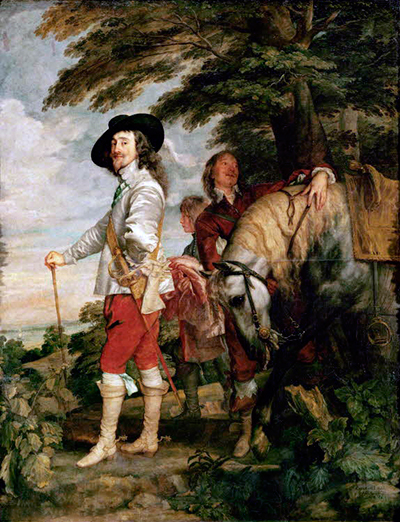
Charles I at the Hunt , painted around 1635–36, offers another kind of presence. Charles stands in a silver jacket and red breeches beside his horse, with a wide hat, a cane and an open landscape. The apparent pause in an outdoor excursion makes the encounter seem less ceremonial. Yet the angled elbow, the clear outline against the sky and the low viewpoint give him ample authority. The precise occasion and original destination remain uncertain. [4]
These pictures required different inventions. Mounted Charles fills an arch; standing Charles gains stature from the space around him. The hunting portrait lets the horse lower its head while the king looks outwards, separating his alert presence from the activity behind him. Informality becomes another means of making rank visible.
The triple portrait had a more specific practical task. Painted in 1635–before June 1636, it supplied Gian Lorenzo Bernini in Rome with different views for a marble bust of Charles. The sculptor could compare profile, frontal and three-quarter views without the king travelling to his studio. The bust was completed in 1636 and reached the royal couple the following year. [5] Van Dyck varied the colours and lace across the three appearances, giving a working model the visual pleasure of a finished painting. The repeated face demonstrates how portraiture could connect courts through objects as well as personal visits.
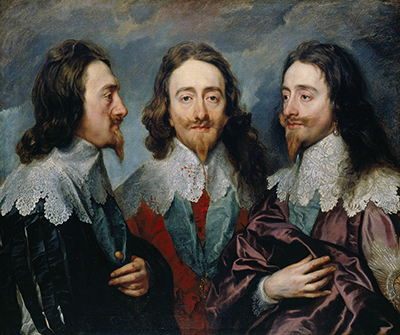
Charles I seen in profile, frontally and at a three-quarter angle.
Watch: Van Dyck’s art and working methods
Choose a museum introduction, a specialist lecture or a conservation film to continue exploring Van Dyck’s work.
Adam Eaker: Sitting for Van Dyck
Adam Eaker considers portrait sittings, courtly identity and Van Dyck’s English reception.
Watch on YouTubeThe queen, courtiers and private patrons
Henrietta Maria was a central subject of the English practice. In the 1633 portrait with Sir Jeffrey Hudson , her brilliant blue hunting dress occupies much of the tall canvas. The crown rests against a gold curtain; a column and potted orange tree frame the other side. Hudson, a fourteen-year-old court attendant with dwarfism, stands beside her. The queen touches the monkey he carries. [11]
The picture carefully distributes attention. Strong bands of blue, white and gold lead the eye down the queen's costume; Hudson's red clothing establishes a separate concentration of colour at the left. Their outward and upward glances bring different directions into the composition. His presence belongs to the queen's court and household, while the painting preserves him as an identifiable individual with his own face and gestures.
The wider clientele allowed other forms of aristocratic self-presentation. James Stuart, Duke of Lennox appears around 1633–35 in dark clothes and a richly spreading mantle, with a greyhound pressing its muzzle towards his hip. Garter insignia place him within the royal inner circle. The portrait may commemorate his admission to the Order in November 1633, although the insignia alone cannot establish a particular occasion. He received the additional dukedom of Richmond only in 1641. [12]
The dog's long neck and raised head connect the lowest part of the composition with the sitter's hand. Against this eager movement, Stuart's stance looks remarkably unhurried. The tension between animation and stillness helps make aristocratic ease persuasive: the dog acts, while the man seems to need no effort to hold the scene together.
In Philip, Lord Wharton , dated 1632, a nineteen-year-old nobleman holds a shepherd's staff amid sumptuous cloth and a rocky landscape. The pastoral identity offers an imaginative aristocratic role. [13] The costume makes leisure look abundant. Its yellow folds cross the torso, collect near the loosely hanging hand and continue beyond the lower edge, suggesting a figure too comfortably placed to require a rigid formal pose.
Individual portraits were only part of this aristocratic business. Philip Herbert, fourth Earl of Pembroke, commissioned the great family portrait at Wilton House. Wharton commissioned a series of family portraits for a gallery at Winchendon, while the poet Thomas Killigrew and dramatist Sir John Suckling also sat to Van Dyck. [14] Such commissions gave portraiture several scales of social use: a single person, a gathered family, or a succession of related faces occupying a room.
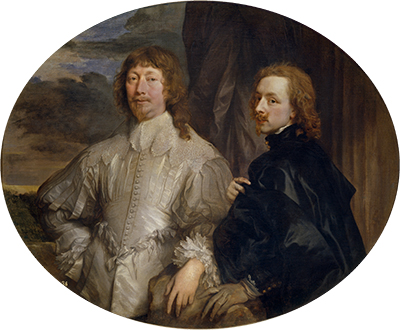
Friendship offered another approach. Van Dyck painted himself beside Sir Endymion Porter , a courtier and art agent with whom he had longstanding connections. The Prado dates the double portrait to about 1633; Jonathan Brown's encyclopedia account proposes spring 1635. Brown also discusses competing readings of the white-clad courtier and dark-clad painter: differences of rank, or the artist's cultivated identity. [15] The oval brings the two figures close. Their hands meet the same rock, but their bodies turn differently, leaving each a distinct presence. Such a picture shows why the story of Van Dyck in England needs friends and intermediaries alongside the royal family.
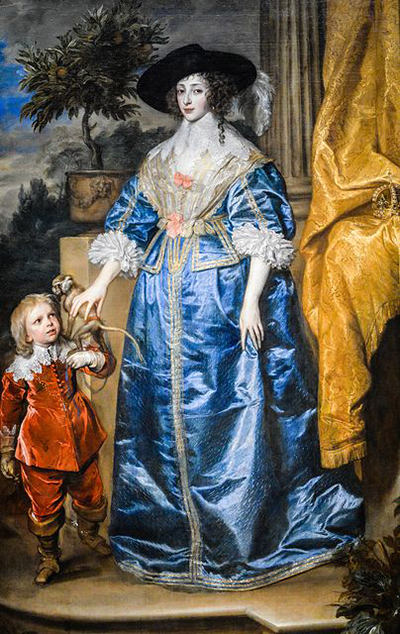
Anthony van Dyck, Queen Henrietta Maria with Sir Jeffrey Hudson, 1633, oil on canvas. National Gallery of Art, Washington, Samuel H. Kress Collection, 1952.5.39.
The work behind apparent ease
The finished portraits can make an exacting business look effortless. Stijn Alsteens counts more than 260 surviving portraits from the period between Van Dyck's arrival in 1632 and his death in 1641. That surviving output makes an efficient studio essential to understanding the English career. Alsteens also treats Bellori's later descriptions of lavish hospitality cautiously: entertainments may preserve something real about the house, but they cannot serve as a literal timetable for its work. [7]
Drawings and painted studies disclose parts of the process. The surviving material includes studies for poses and costume, as well as oil studies concentrating on heads. Alsteens's examples show procedures adapted to the demands of particular pictures; a large group portrait could require preparation different from a single figure. [7] The drawings preserve decisions that a finished surface can conceal.
Assistant participation also needs to be considered picture by picture. The National Portrait Gallery describes a portrait of Charles now at Chequers as having an autograph head that probably served as a studio model, with costume probably painted by assistants. Its discussion leaves open a different balance of participation in the accompanying portrait of the queen. [1] Such distinctions are more useful than assuming that every English portrait followed one division of labour.
The National Gallery's account of its great Equestrian Portrait of Charles I , dated about 1638, provides another instructive case. Technical examination revealed adjustments to the horse's rear leg and changes in the landscape, including a building subsequently painted out. The catalogue also argues that a smaller related painting in the Royal Collection is probably a studio reduction, despite its traditional identification as a preparatory model. [16] Revision in a principal picture and production of related versions could coexist. Neither tells us the share of an unnamed assistant in every other canvas.
An English base, with ambitions abroad
London never became Van Dyck's uninterrupted home from 1632 to 1641. He spent 1634–35 in the Southern Netherlands, painting aristocratic patrons there. His return to Antwerp in autumn 1640, after Rubens's death, brought a commission for an altarpiece of the martyrdom of Saint George. It was never completed. [8] England remained one part of a career whose relationships and possibilities crossed the Channel.
Nor had portrait success exhausted his interest in other subjects. Cupid and Psyche , now dated 1639–40, is the only surviving mythological painting from his employment by Charles I. Its connection with a projected decoration for the Queen's House at Greenwich has been proposed, but its precise commissioning circumstances remain uncertain. [9] That surviving work makes his narrative ambitions visible; the unrealised projects show how much of his intended late career cannot be represented by finished paintings.
In 1638 Van Dyck submitted a memorandum seeking payment for pictures and arrears of his pension. The hunting portrait appears in the account with a request for £200 reduced to £100. [4] Royal generosity in titles and accommodation therefore should not be read as proof of regular annual payments. The account exposes negotiation and delay within a celebrated relationship.
After Antwerp, Van Dyck went to Paris in 1640–41, seeking the Louvre's Grande Galerie decoration. The project did not result in a completed cycle. He returned to Paris later in 1641; a passport request of 16 November reported serious illness. Financial pressure may have encouraged his search for opportunities, but it cannot establish a single motive for all these journeys. [10]
Family and the final months
Around 1639–40 Van Dyck married Mary Ruthven, a maid of honour to Henrietta Maria from a Scottish Catholic family. Sources differ between 1639 and early 1640 for the marriage. [10] [17] This relationship placed his private household within the same courtly world that supplied so much of his professional work.
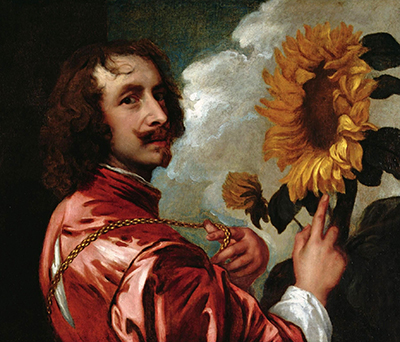
His small oval self-portrait of about 1640 turns attention back to the painter. He looks over his shoulder towards us; the carefully articulated face rises above a collar and doublet handled in broad strokes. The National Portrait Gallery allows that this difference of finish could indicate an unfinished picture or an experimental approach. [18] It gives a vivid impression of an artist turning in the course of work, although no brush or working hand is visible.
Mary gave birth to their daughter on 1 December 1641. Van Dyck made his will three days later. As transcribed in William Hookham Carpenter’s nineteenth-century edition, it provided for another daughter, Maria Teresa, through assets in Antwerp administered by his sister Susanna. His wife and newborn daughter were to share the English estate, including money owed by the king and other patrons. [19] His responsibilities, like his working relationships, extended across the Channel.
Van Dyck died in London on 9 December, aged forty-two. [8] Charles ordered his burial in the old St Paul's Cathedral. [10] His English career had ended before the Civil War began, leaving an extraordinary concentration of portraits in which the court still appears capable of sustaining its ordered, expansive life. [16]
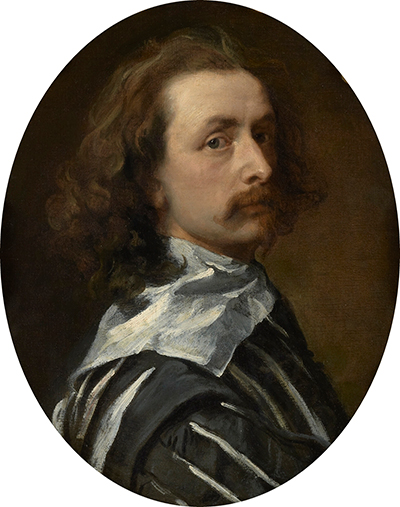
Anthony van Dyck, Self Portrait, about 1640. Oil on canvas, oval, 56 × 46 cm. National Portrait Gallery, London, NPG6987.
Artworks directory
A selected directory of paintings, drawings and prints, including works discussed in the articles and the Frick’s 2016 portraiture exhibition. It is not a complete catalogue of Van Dyck’s work. Print titles identify collaborators or later printmakers; disputed and workshop attributions are retained. The exhibition checklist supplies additional object records; current collection information governs the updated article entries. [20]
Frequently Asked Questions
Discussion
Look again at the images and ideas explored in Anthony van Dyck in England. These editorial prompts invite your observations.
Reader Insights
How do the mounted, hunting and triple portraits change the kind of access a viewer seems to have to Charles I?
What makes the apparent ease of James Stuart or Lord Wharton look convincing, and what reveals the painter's arrangement?
How might seeing Van Dyck's Italian collection have affected a patron's understanding of his new English portraits?
Join the Conversation
Share a detail, comparison or question about Anthony van Dyck in England below.
References
- National Portrait Gallery , Meet the King and Queen and their Principalle Paynter. View source .
- National Gallery , Van Dyck and Titian, Painters' Paintings . View source .
- Royal Collection Trust , Charles I (1600–1649) with M de St Antoine, RCIN 405322. View source .
- Blaise Ducos , Le Roi à la chasse, catalogue 18, Antoon Van Dyck: Catalogue raisonné des tableaux du musée du Louvre (2023); Musée du Louvre, collection record, INV 1236. French. View source 1 . View source 2 .
- Royal Collection Trust , Charles I (1600–1649), RCIN 404420. View source .
- National Gallery , Anthony van Dyck. View source .
- Stijn Alsteens , A Portraitist's Progress, published excerpt, in Van Dyck: The Anatomy of Portraiture (The Frick Collection, 2016). View source .
- Matthias Depoorter , Vlaamse Kunstcollectie, Anthony van Dyck. Dutch. View source .
- Royal Collection Trust , Cupid and Psyche, RCIN 405571. View source .
- Frans Baudouin , “De laatste tien levensjaren van Antoon Van Dyck”, Streven 66 (1999), pp. 328–339. Dutch. View source .
- National Gallery of Art , Queen Henrietta Maria with Sir Jeffrey Hudson. View source .
- The Metropolitan Museum of Art , James Stuart (1612–1655), Duke of Richmond and Lennox, 89.15.16. View source .
- National Gallery of Art , Philip, Lord Wharton. View source .
- Christopher Brown , A Naturally Gifted Painter: The Work of Anthony van Dyck, The Low Countries 6 (1998–99), pp. 12–23. View source .
- Jonathan Brown , Museo Nacional del Prado, Endymion Porter y Van Dyck; Museo Nacional del Prado, 3 horas en el Museo, painting entry. Spanish. View source 1 . View source 2 .
- Gregory Martin , assisted by Nina Cahill, with technical notes by Marta Melchiorre and Paul Ackroyd and contributions from Rachel Billinge and David Peggie, Equestrian Portrait of Charles I, NG1172, National Gallery (2024). View source .
- The Frick Collection , Mary, Lady van Dyck, née Ruthven. View source .
- National Portrait Gallery , Sir Anthony van Dyck, NPG6987. View source .
- Anthony van Dyck , will of 4 December 1641, transcribed in William Hookham Carpenter, Pictorial Notices (London, 1844), pp. 75–77. View source .
- The Frick Collection, Van Dyck: The Anatomy of Portraiture, online exhibition checklist (2016). View source.