 by
Tom Gurney
Tom Gurney BSc (Hons) is an art history expert with over 20 years experience
Email:
tomgurney1@gmail.com
/ Phone:
+44 7429 011000
Portrait Study of a Commander on Horseback Triumphing over Evil, Crowned by Victory: Introduction
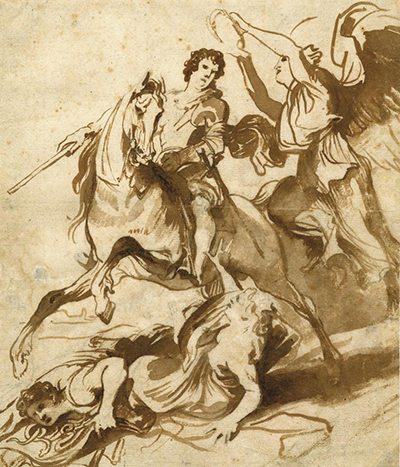
A horse surges towards the left edge while a winged figure reaches across from the right. Between them, the rider turns his face towards the descending wreath. Van Dyck compresses an elaborate celebration into an upright sheet, making the space around this small, comparatively still head seem to churn.
At a Glance
- Artist Anthony van Dyck
- Date 1621–about 1627, Italian period
- Medium Pen, brush and brown ink, with brown wash over black chalk
- Size 21.5 × 18.4 cm
- Collection British Museum, London [1]
This work across Anthony van Dyck’s career
Entry of Christ into Jerusalem
about 1617Frans Snyders
about 1620Portrait Study of a Commander on Horseback Triumphing over Evil, Crowned by Victory (current article)
1621–about 1627, Italian periodRinaldo and Armida
1629–1632; Louvre commentary proposes late1631–spring1632Charles I in Three Positions
1635–before June 1636Lord John Stuart and his Brother
about 1638Cupid and Psyche
1639–40Self Portrait
c. 1640Contents
- A rider held above the turmoil
- Fame, Victory and the defeated figures
- An emperor and an unnamed commander
- Building light with brown strokes
- A horse studied for a purpose
- What the design could settle
A rider held above the turmoil
The horse's head is almost frontal, although its body crosses the sheet obliquely. The narrow, pale face of the animal catches the eye beside the rider's own. Below, the projecting foreleg stretches towards the left margin, its hoof suspended above a fallen head. The rider's boot drops almost vertically near the centre. That firm downward accent gives him a point of stability amid the surrounding curves.
Look at how little empty space separates the figures. A bent arm at the bottom, the horse's leg and the rider's boot overlap in a crowded knot. At the top, the raised wreath almost touches the edge. The scene feels larger than its available space, with bodies and drapery pressing outwards. There is little room for a landscape or a distant army: the confrontation occupies nearly everything we see.
The rider's face remains lightly stated. Its small scale makes the claim to heroic status more immediately legible than any individual likeness. His elevation over the bodies and his place beneath the wreath already explain how we are meant to regard him.
The open paper at the upper left plays a quieter part in this movement. A long, thin diagonal extends across it from the rider's side, leaving room around the horse's pricked ears. On the opposite side, the wing and the flying cloth almost fill the corner. That uneven distribution keeps the design from becoming a symmetrical emblem. We follow a sequence of gestures across it: out towards the left, back through the horse and rider, then up to the hands holding the wreath.
Fame, Victory and the defeated figures
The Frick identifies two figures beneath the horse as personifications of evil, one carrying snakes, and the winged crowning figure as Fame. “Victory” belongs to the work's title. A particular military success may have prompted the design, but no commander or campaign is securely identified. [1]
The upper figure's sweeping drapery helps connect the crowning gesture with the action below. Its curves run down the right side, where a broad dark passage presses against the horse's flank. Across the bottom, the fallen figures spread horizontally. Their reaching arms and tipped heads make a low, unstable base for the upright rider.
This arrangement gives the violence a moral reading. The defeated bodies become the foundation of the commander's glory, while the wreath supplies recognition from above. Seen this way, the sheet asks us to accept his superiority before we know his name. The mixture of an individual face with impossible companions is central to its force as a portrait idea.
An emperor and an unnamed commander
A useful comparison is Van Dyck's painted Charles V on Horseback in the Uffizi. In his study of that picture, historian Dénes Haraí examines the eagle bringing laurel to the armoured emperor and the horse's commanding presence against troubled sea and sky. He also discusses this British Museum drawing within the chronology of Van Dyck's early equestrian designs, citing its Italian-period dating. The comparison places the sheet within a sustained exploration of mounted authority; it does not identify its rider as Charles V. [2]
The different bearers of the laurel change the relationship around each rider. In the painting, the eagle hangs above a broad interval of sky. Here the winged figure comes close enough for its extended arms to frame the commander's head. The wreath is almost within reach, and the rider's upward turn joins the action of the crowning. His success becomes an encounter between bodies, with very little surrounding atmosphere to soften it.
Below him, the fallen figures make his advantage immediate and physical. The horse's projecting legs connect the elevated man to the twisting bodies beneath. The drawing concentrates the claim of triumph into this compact stack of figures. Comparing it with the more spacious painted portrait helps explain how much the sheet achieves through proximity alone.
Watch: Van Dyck’s art and working methods
Choose a museum introduction, a specialist lecture or a conservation film to continue exploring Van Dyck’s work.
Stijn Alsteens: Drawing for Portraits
Stijn Alsteens explores how portrait drawings prepare and develop a likeness.
Watch on YouTubeBuilding light with brown strokes
The darkest marks gather beneath the horse's neck, around the saddle and in the folds at the right. Against them, the lightly touched breast and forequarters appear to catch a strong light. Along the horse's face, narrow brown accents describe features without closing every contour. The eye supplies the connected form.
The lower bodies are equally economical. Broad strokes turn around shoulders and bent limbs, while pale areas stand for exposed flesh. Some edges sharpen into dark lines; others dissolve into the paper. This variation lets the figures remain readable even where their outlines collide. Brown is doing several jobs at once: drawing an edge, suggesting a shadow and binding neighbouring forms together.
The brightest-looking passages are particularly easy to overlook as active parts of the design. Along the horse's neck and the upper edges of the lower figures, small pale intervals separate forms that would otherwise merge. Elsewhere a dark patch passes directly into the next figure. These changes in separation create a shifting sense of depth: the eye can pick out an individual limb, then lose its contour within the larger mass. The result feels mobile even before we follow the poses.
A horse studied for a purpose
An earlier sheet in the Rijksmuseum, Studies of a Horseman and the Head of a Horse , offers a more practical point of comparison. The museum dates it about 1617–21 and notes written colour instructions, including white for the muzzle, in a drawing probably intended for a painting. It also describes the rapid brushwork through which Van Dyck gives the horse volume and movement. [3]
That example helps distinguish two tasks a horse drawing could perform. A note about the muzzle preserves information that brown ink alone cannot supply. In this commander study, the horse is part of a larger arrangement whose success depends on the placement of every figure. Its face, chest and forelegs must remain legible where the surrounding bodies press close. The animal's pose becomes a question of how the whole group will hold together. Its broad chest anchors the rider, while the narrowing, extended leg carries the eye towards the disrupted foreground.
What the design could settle
Walter Liedtke, writing about Van Dyck's equestrian work for the Metropolitan Museum of Art, distinguishes drawings preparing particular portraits from small oil studies that could serve as models for horses and riders in several positions. He observes that Van Dyck generally preferred preparatory work in pen on paper to oil sketches. These distinctions matter when looking at a sheet as elaborate as this one: preparation can address the overall composition as well as the appearance of a single sitter. [4]
Here the head occupies a modest area within an already forceful arrangement. The relative heights of rider, wreath and defeated bodies, the projecting horse and the large sweep of drapery are much easier to grasp than the details of the man's features. A painter considering this design could judge its distribution of movement and stillness at a glance. Its roughness leaves many particulars open, but the main relationships are clear. The drawing lets us see how a portrait's public claim could take shape through the organisation of bodies while the individual features remained lightly indicated.
For a different equestrian arrangement, see the separate study of a man on horseback with his groom . More kinds of preparatory work appear among Van Dyck's drawings .
Artworks directory
A selected directory of paintings, drawings and prints, including works discussed in the articles and the Frick’s 2016 portraiture exhibition. It is not a complete catalogue of Van Dyck’s work. Print titles identify collaborators or later printmakers; disputed and workshop attributions are retained. The exhibition checklist supplies additional object records; current collection information governs the updated article entries. [5]
Frequently Asked Questions
His identity remains unestablished; the Frick entry names no sitter. [1]
The Frick considers it preparation for a painting that apparently was never executed. [1]
His relatively upright body and compact head sit between the horse's thrust to the left and the winged figure's reach from the right. The surrounding movement makes his pose appear steadier.
Discussion
Look again at the images and ideas explored in Portrait Study of a Commander on Horseback Triumphing over Evil, Crowned by Victory. These editorial prompts invite your observations.
Reader Insights
Where does your eye go first: the horse's face, the rider or the wreath?
How does the crowded lower half affect your response to the commander's triumph?
Which pale area most convincingly suggests light falling on a solid body?
Join the Conversation
Share a detail, comparison or question about Portrait Study of a Commander on Horseback Triumphing over Evil, Crowned by Victory below.
References
- The Frick Collection , Commander on Horseback, exhibition object 19. View source .
- Dénes Haraí , The Presence of the Imperial Past: Van Dyck's Equestrian Portrait of Charles V of Spain and the Crisis of Valtellina (1621–1622), Potestas 15 (2019), pp. 90–94; especially pp. 91 and 94. View source .
- Rijksmuseum , Studies of a Horseman and the Head of a Horse, RP-T-1884-A-302. View source .
- Walter A. Liedtke , Anthony van Dyck, The Metropolitan Museum of Art Bulletin 42, no. 3 (Winter 1984–85), p. 34. View source .
- The Frick Collection, Van Dyck: The Anatomy of Portraiture, online exhibition checklist (2016). View source.