


 by
Tom Gurney
Tom Gurney BSc (Hons) is an art history expert with over 20 years experience
Email:
tomgurney1@gmail.com
/ Phone:
+44 7429 011000
Frans Snyders: Introduction
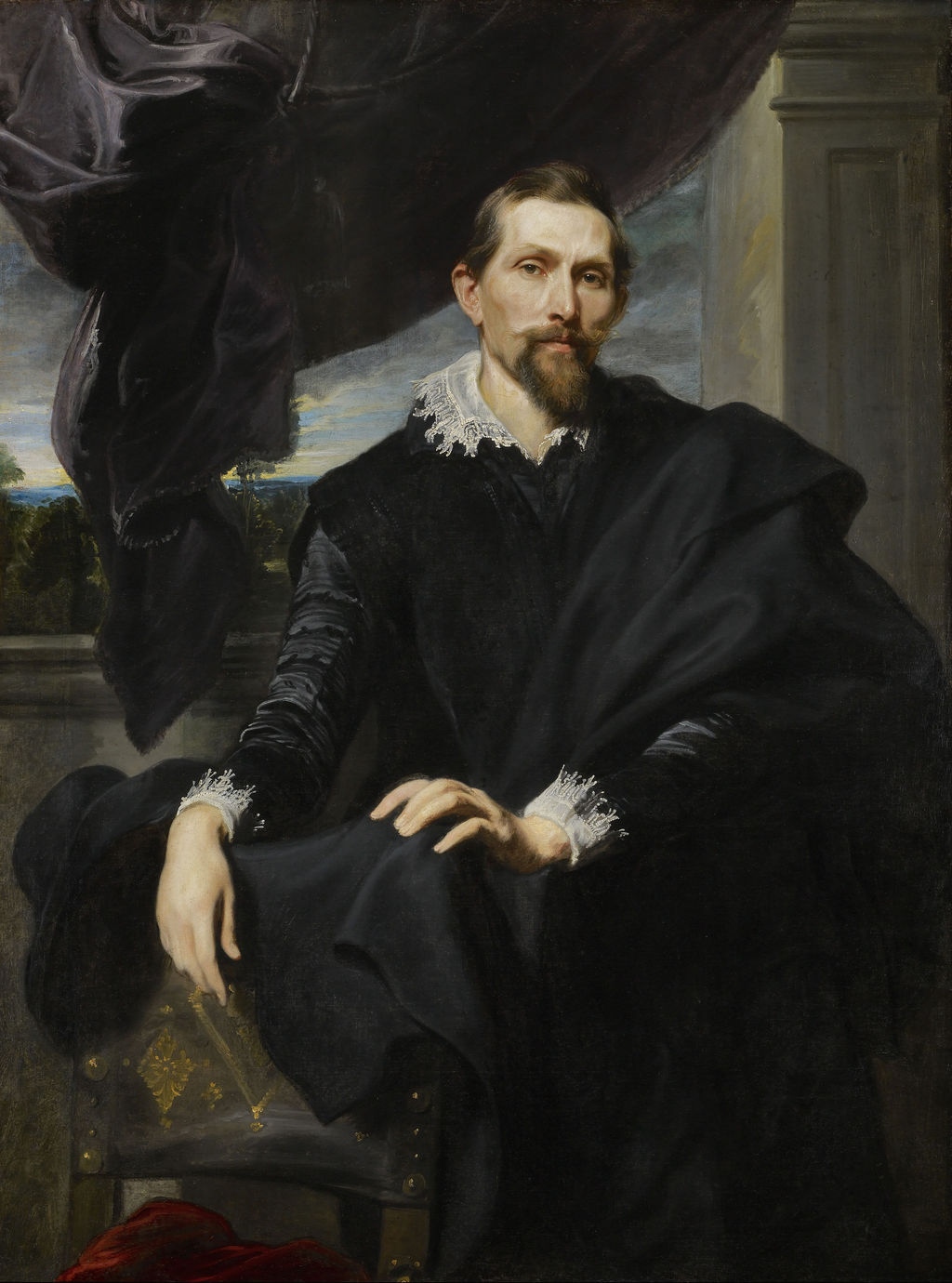
Frans Snyders sits beneath a sweeping dark curtain, his pale hands set against black cloth. Van Dyck's portrait, painted about 1620 and now in the Frick Collection, gives an Antwerp painter the spacious surroundings and assured presence of a prosperous gentleman. [1]
At a Glance
- Artist Anthony van Dyck
- Title Frans Snyders
- Date About 1620
- Medium Oil on canvas
- Dimensions 142.5 × 105.4 cm
- Collection The Frick Collection, Henry Clay Frick Bequest
- Companion portrait Margareta de Vos . [1] [2]
This work across Anthony van Dyck’s career
Entry of Christ into Jerusalem
about 1617Frans Snyders (current article)
about 1620Rinaldo and Armida
1629–1632; Louvre commentary proposes late1631–spring1632Charles I in Three Positions
1635–before June 1636Lord John Stuart and his Brother
about 1638Cupid and Psyche
1639–40Self Portrait
c. 1640Contents
- A painter among Antwerp's successful citizens
- How much can happen in black
- The face and the resting hands
- A terrace and a possible occasion
- Seeing the companion portrait
- Annotated details
A painter among Antwerp's successful citizens
Snyders made his reputation through still lifes and animal painting. Other artists called on his specialised skills, and his collaborators included Peter Paul Rubens and Cornelis de Vos. His work brought him success well beyond Antwerp. [3] The Frick suggests that joint projects with Van Dyck during the late 1610s may help explain the making of this portrait. [1] That possibility places the painting within a working artistic community, although it does not establish the terms of the sitting.
His interests extended to collecting. In 1616 he acquired five plaster casts from the estate of Cornelis III Floris, including busts of Marcus Aurelius and Hercules. [3] In 1619 he joined the Guild of Romanists, a select Antwerp society whose members had visited Rome. [4] These details give some substance to the cultivated standing conveyed by the portrait. The man seated before us belonged to circles in which making art, collecting it and cultivating social connections could overlap.
Nothing in the picture directly demonstrates Snyders's trade. There is no easel, palette or display of animals. The objects nearest his hands are his clothing and chair. For a viewer who does not already know his name, the portrait offers few clues that this man made pictures for a living.
Instead, Van Dyck makes his social presence immediately legible. The broad fall of fabric enlarges his body; the architecture gives him a substantial setting; the glimpse of distant trees grants the composition an opening beyond the room. These elements make a persuasive visual claim to ease and position. They do not depend on an inventory of possessions. Much of the effect comes from how comfortably Snyders occupies the available space.
His accomplishments help explain his standing, while the portrait presents that standing through dress, bearing and surroundings. A visitor could meet the successful citizen before discovering the artist. The working relationships behind such images form part of Van Dyck's Antwerp career .
How much can happen in black
At first the costume seems to form one continuous dark mass. Looking longer reveals several distinct surfaces. The sleeve on the left of the picture carries narrow, broken lights. The cloth drawn across the chest opens into much broader planes, with folds turning towards a muted blue-grey. Around the shoulder, the silhouette swells before descending along the right edge. Black gives the figure weight, but the variations within it keep that weight from becoming a flat shape.
The curtain develops the same dark colour on a larger scale. Its folds rise, gather and fall, with brighter ridges near the upper left. One long hanging section drops beside Snyders's arm, ending above the chair. The fabric seems heavy enough to belong to this imposing setting, while its irregular outline introduces movement around the comparatively still sitter.
The white lace marks three points within these dark areas: the neck and the two wrists. At the collar, a finely broken edge lies close to the face. Around the wrists, projecting threads make small, sharp interruptions in the black. These passages invite attention to the way the hand emerges from a sleeve and the face from its surrounding clothes. Their brightness also allows the costume to remain restrained in colour without losing definition.
Near the lower left, the chair's patterned upholstery supplies small touches of gold. A strip of red at the bottom edge is more abrupt. Such fragments matter because so little of the picture is strongly coloured. They give the lower part of the canvas something to answer the pale head above, yet neither competes with it. The eye can travel through these scattered accents and return to the sitter.
Annotated Details from Frans Snyders
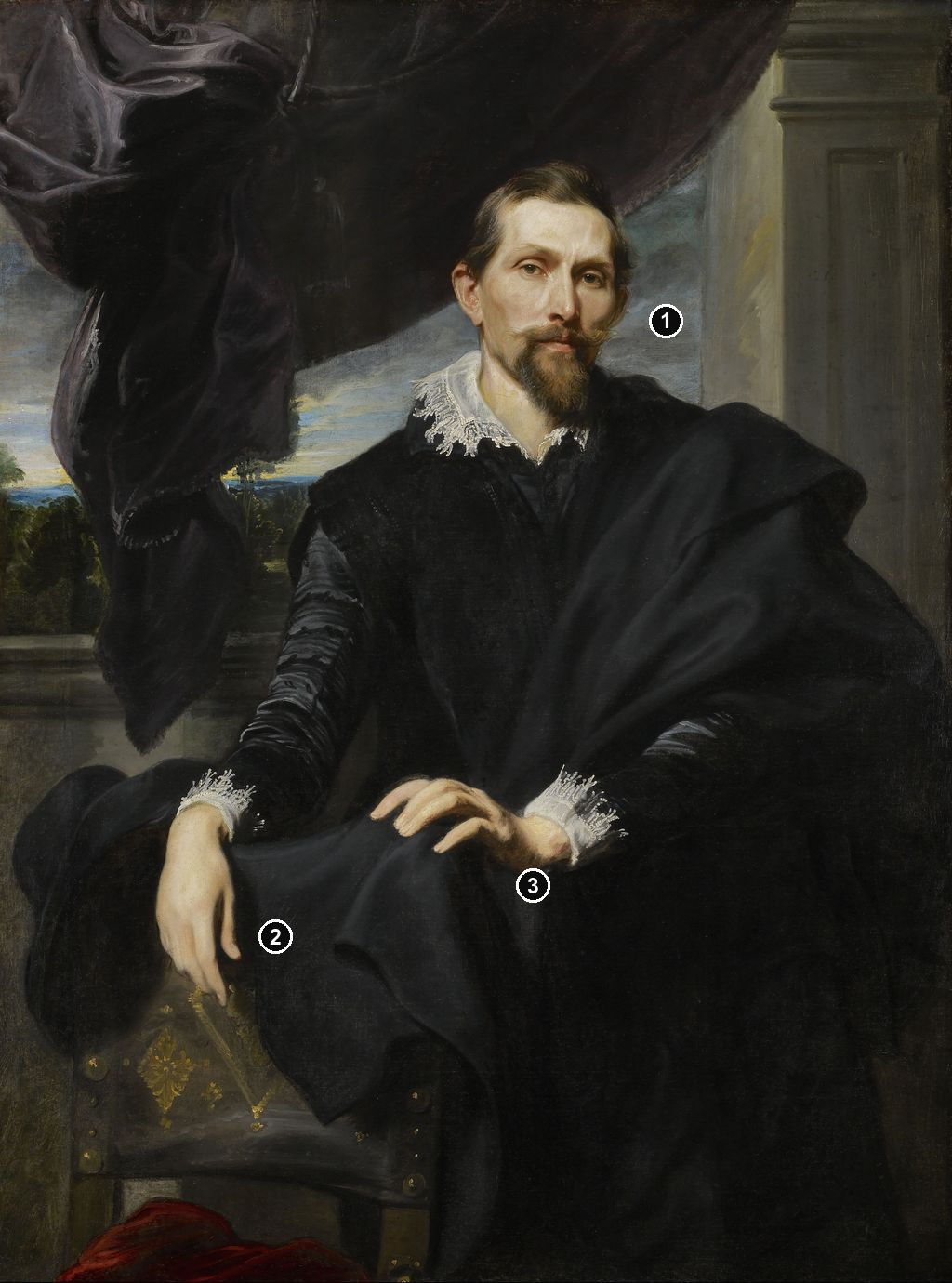
The numbered points identify visible features discussed in this article. Return from each detail to the whole composition. Anthony van Dyck, Frans Snyders, about 1620. Oil on canvas, 142.5 × 105.4 cm. The Frick Collection, Henry Clay Frick Bequest. Image source. Public domain.
Details from FRANS SNYDERS
Compare the cropped details with the complete images above. Notice how their colours, shapes and positions contribute to the larger compositions.
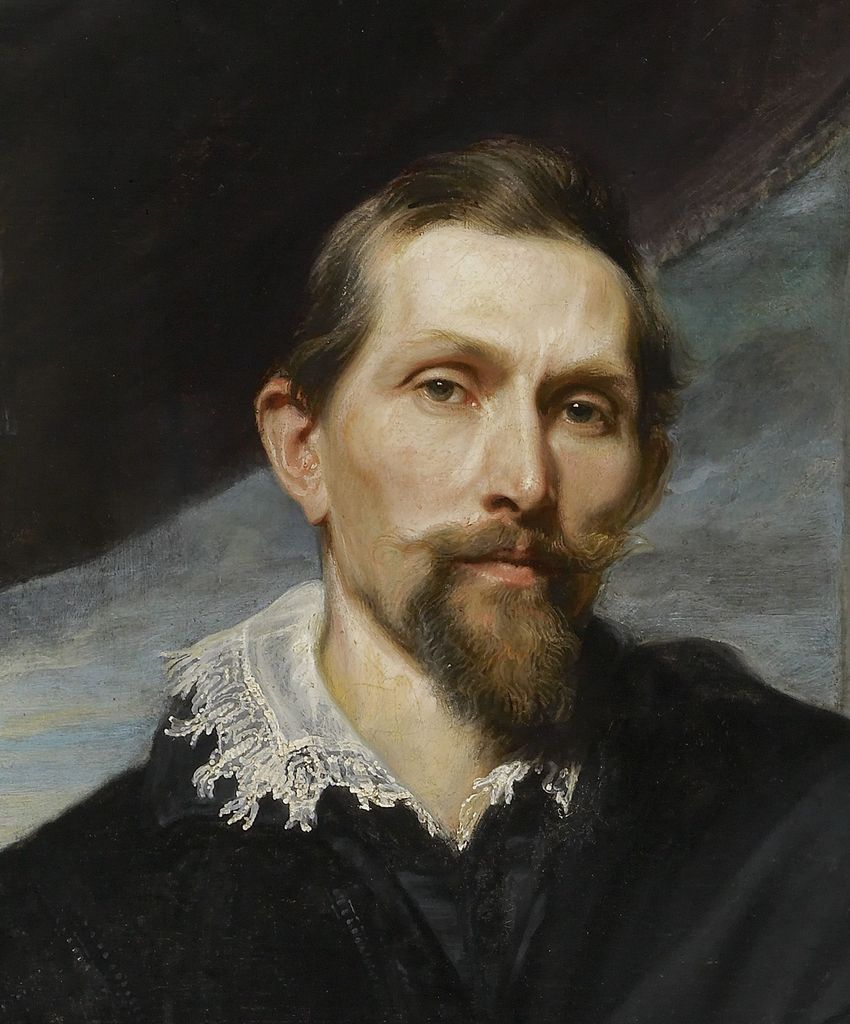
Head and lace collar
The face is closely articulated above the small white collar, while the dark cloak spreads across the body.
The lowered hand
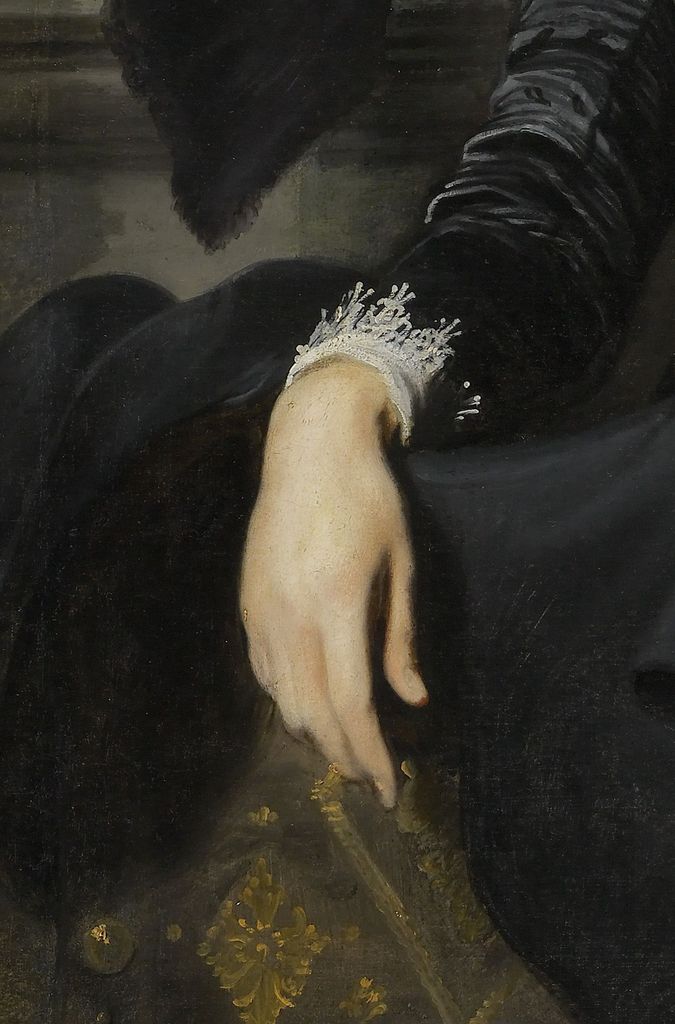
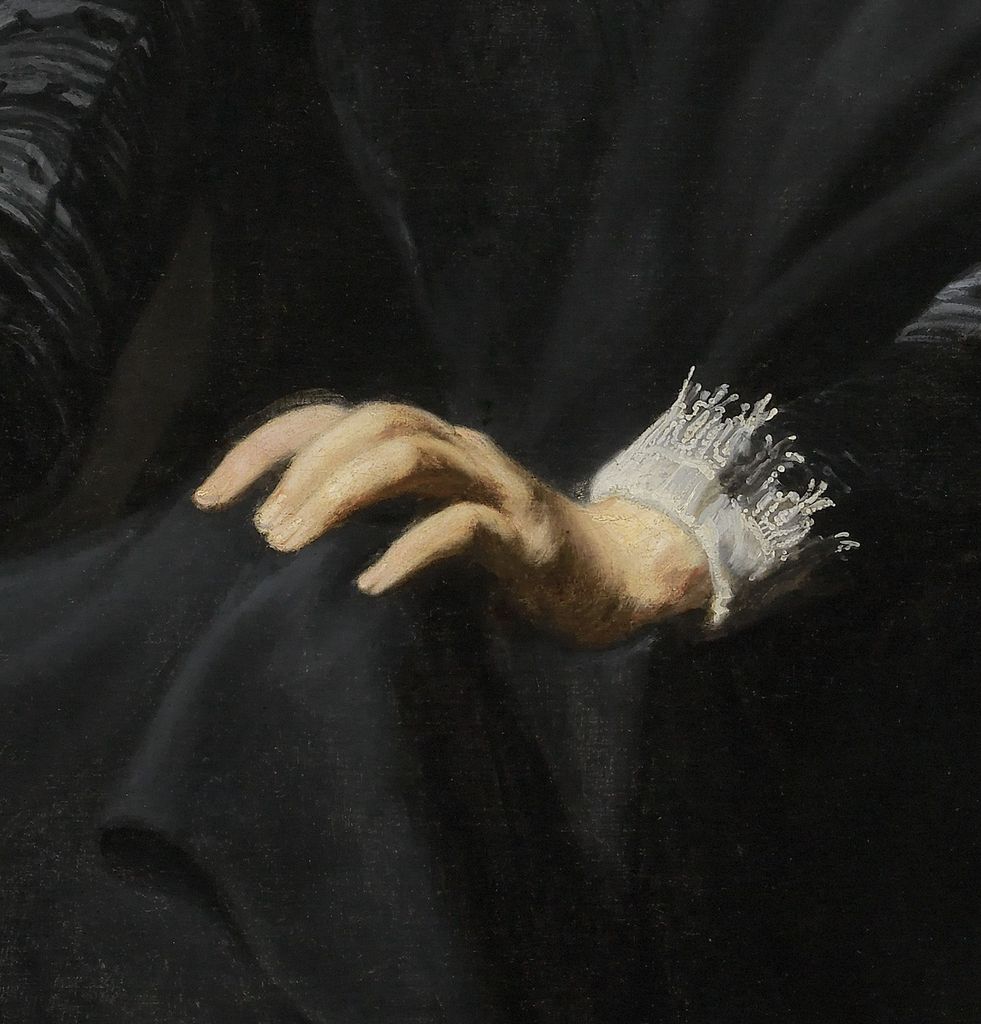
One hand hangs over the edge of the dark cloth, with pale fingers and a lace cuff interrupting the shadow.
The hand across the cloth
The other hand extends across the dark fabric. Its position gives the seated figure a second point of contact with the foreground.
Watch: Van Dyck’s art and working methods
Choose a museum introduction, a specialist lecture or a conservation film to continue exploring Van Dyck’s work.
Van Dyck, The Anatomy of Portraiture
The Frick curators introduce Van Dyck’s portraits, drawings and prints.
Watch on YouTubeThe face and the resting hands
Snyders's head is placed well above the centre of the canvas. The light catches the forehead, nose and cheeks, while the smoothly combed hair and pointed beard give the face a clear outline. His head turns slightly, but his eyes meet the viewer. The small difference between the direction of his head and the direction of his gaze gives the encounter a sense of adjustment: he seems to have acknowledged someone before him.
The mouth remains closed. A fine moustache spreads to either side, and the beard carries the eye down towards the open collar. There is enough asymmetry in the lit and shaded sides of the face to preserve its particularity. Terms such as proud, melancholy or suspicious would narrow an expression that the painting leaves open. We can describe the steadiness of the look more securely than assign a private feeling to it.
The hands extend this poised stillness through two different gestures. On the left of the picture, one hand hangs down beside the chair. Its long fingers follow gravity, with a slight separation that prevents them from merging into a single pale strip. The other hand rests across the dark cloth nearer the middle, its fingers bent and spread into a shallow arc. Neither grips a tool or makes an emphatic sign.
Together they give the lower half of the figure a gentle rhythm: one gesture descends, the other spreads across the lap. The wrists are turned differently, allowing light to fall on different planes of skin. This makes the pose varied without making it busy. The hands have a practical compositional task as well as an expressive one, breaking up a large area of black and linking the seated body to the chair.
For a portrait of a working painter, their inactivity is striking. The picture gives Snyders time to be looked at, extending the unhurried encounter established by his gaze.
A terrace and a possible occasion
The setting combines shelter with distance. A tall architectural support rises at the right, while a low stone barrier runs behind the sitter. Between these solid elements and the curtain lies a strip of landscape: dense trees, a low horizon and a cooler sky. The opening is narrow, but it changes the scale of the picture. Snyders occupies the foreground of a world extending beyond him.
The scene also holds two kinds of movement in balance. The curtain sweeps across the upper canvas and drops towards the left. The stonework supplies straighter, steadier lines. Snyders sits between them, his head framed by a lighter interval. The setting helps separate his face from the dark fabric without enclosing it in a sharply outlined window.
A documented change in the couple's circumstances gives this display of prosperity a possible context. Snyders and Margareta de Vos bought De Fortuyne, a house in Antwerp's Keizerstraat beside Nicolaas Rockox's residence, on 24 December 1620. They began living there in 1622. [4] The Frick proposes the purchase as a likely occasion for the portraits. [1] It remains a proposal: the house dates do not establish a commission agreement or identify the painted terrace as a view of De Fortuyne.
Seeing the companion portrait
The companion picture of Margareta de Vos shares the terrace and landscape conception. It is a separate canvas, measuring 130.7 × 99.3 cm, slightly smaller in both dimensions than Snyders's portrait. [2] The pair should be compared as two related compositions, with different proportions and different demands on the viewer's attention.
Snyders's picture places the dark curtain towards the left and architecture towards the right. Margareta's gives a large column to the left and gathers drapery overhead on the right. Landscape appears in each opening. These correspondences allow the viewer to imagine a setting continuing between the paintings, though they do not prove an exact original hanging arrangement.
Within that shared visual world, the figures are treated differently. Snyders's lace collar follows his neck closely, leaving his face exposed above a broad expanse of black. Margareta's large, pleated white ruff spreads around her head and projects towards us. Her gold-patterned bodice produces an intricate vertical band, whereas his chest is crossed by much quieter folds. His two pale hands appear against relatively simple dark areas; hers sit among more numerous changes of sheen, pattern and texture.
These differences affect the pace of looking. In Snyders's portrait, the eye moves readily from the lighted face to a hand and across the larger folds. Margareta's costume offers many smaller stops. Van Dyck finds variety within the relationship, giving each sitter a distinct distribution of light and detail.
The paintings belong to an established marriage. The couple married on 23 October 1611, roughly nine years before the Frick's approximate date for the portraits. [4] Reading them as wedding pictures would obscure that interval. Seen together, they offer a sustained presentation of two people sharing a prosperous household, while Snyders's individual canvas makes its own compact study of dress, bodily ease and direct attention.
Artworks directory
A selected directory of paintings, drawings and prints, including works discussed in the articles and the Frick’s 2016 portraiture exhibition. It is not a complete catalogue of Van Dyck’s work. Print titles identify collaborators or later printmakers; disputed and workshop attributions are retained. The exhibition checklist supplies additional object records; current collection information governs the updated article entries. [5]
Frequently Asked Questions
It belongs to the Frick Collection in New York, through the Henry Clay Frick Bequest. [1]
No palette, brush or other painting tool appears in his hands. One hand hangs beside the chair and the other rests on dark cloth. Their relaxed placement contributes to the portrait's impression of leisure.
Discussion
Look again at the images and ideas explored in Frans Snyders. These editorial prompts invite your observations.
Reader Insights
Which differences between the black curtain, sleeves and cloak are easiest to see, and how do they change your impression of the figure?
How would Snyders's identity appear to a viewer who knew nothing of his profession? Which details carry the strongest social message?
Compare the spacing of the head and hands in the two companion portraits. How does each arrangement guide your attention?
Join the Conversation
Share a detail, comparison or question about Frans Snyders below.
References
- The Frick Collection , Frans Snyders, Van Dyck: The Anatomy of Portraiture , object 10. View source .
- The Frick Collection , Margareta de Vos, Van Dyck: The Anatomy of Portraiture , object 11. View source .
- Snijders&Rockoxhuis , Wie is Frans Snijders (Dutch). View source .
- Snijders&Rockoxhuis , Historiek en Tijdslijn (Dutch). View source .
- The Frick Collection, Van Dyck: The Anatomy of Portraiture, online exhibition checklist (2016). View source.
- Splash image, Anthony van Dyck, Frans Snyders, about 1620. Oil on canvas, 142.5 × 105.4 cm. The Frick Collection, Henry Clay Frick Bequest. Image source. Public domain.


