 by
Tom Gurney
Tom Gurney BSc (Hons) is an art history expert with over 20 years experience
Email:
tomgurney1@gmail.com
/ Phone:
+44 7429 011000
Ernestine Yolande with Her Son: Introduction
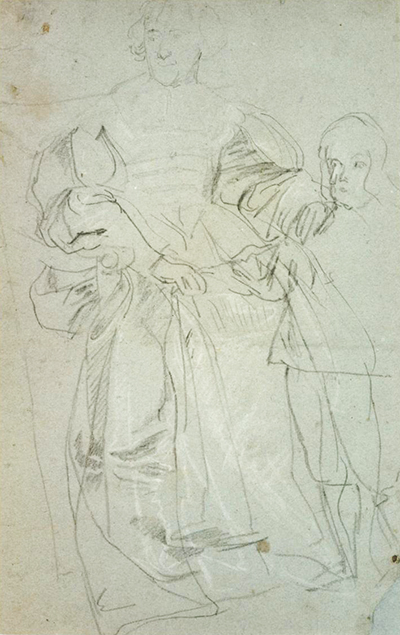
In Anthony van Dyck’s study of Ernestine Yolande and her son, the boy’s outline crosses folds already drawn in his mother’s dress. Around that small overlap, the whole portrait takes shape: a seated woman, a standing child and a spread hand joining their figures. The lightly indicated faces draw attention to decisions made elsewhere on the sheet.
At a Glance
- Artist Anthony van Dyck.
- Sitters Ernestine Yolande, Countess of Nassau-Siegen, and Johann Franz Desideratus. [1]
- Date About 1634. [2]
- Medium Black chalk heightened with white on blue paper. [2]
- Dimensions 44.3 × 28 cm. [2]
- Collection British Museum, London; registration number 1874,0808.139, recto. [2]
This work across Anthony van Dyck’s career
Entry of Christ into Jerusalem
about 1617Frans Snyders
about 1620Rinaldo and Armida
1629–1632; Louvre commentary proposes late1631–spring1632Charles I in Three Positions
1635–before June 1636Lord John Stuart and his Brother
about 1638Cupid and Psyche
1639–40Self Portrait
c. 1640Contents
- A dress that establishes the pose
- Bringing the child into the composition
- From this pair to a family portrait
- Two portraits on one sheet
- The family painting after Van Dyck
A dress that establishes the pose
The dress occupies most of the drawing. Its breadth gives Ernestine a substantial seated presence, even though the chair and surrounding room receive little attention. Her torso rises above the skirt in a relatively open area of paper. From there, the eye travels into the sleeves, where looping contours and short, angled strokes make the cloth swell around her arms.
Look especially at the sleeve on the left of the image. Its outline doubles back on itself, enclosing a succession of rounded folds. The darker marks inside these loops give the fabric depth without shading every surface. On the opposite side, diagonal strokes run towards the elbow and the hand near the child. The two sleeves have different rhythms: one gathers inward, while the other helps carry the composition out towards the boy.
Below the waist, the handling changes again. Long lines follow the skirt towards the floor; shorter patches of hatching interrupt them. A dark channel down the left portion of the skirt makes one fold seem to retreat behind another. Near the bottom, broad, slanting edges suggest cloth turning over itself. Much of the intervening paper remains exposed, allowing a few insistent marks to carry the weight of a large garment.
The face is exceptionally spare beside this concentration on clothing. The head has a direction, but its features never acquire the firm definition of the sleeve folds. That difference makes the drawing rewarding to study: we can see how convincingly a body can be placed before a face is fully described.
Black and white chalk work against the blue paper identified by the British Museum. [2] In the reproduction, pale accents are clearest among the more firmly worked folds. The gown therefore contains several kinds of information at once: the outline encloses its breadth, hatching opens shadows within it, and light touches pick out raised cloth. These marks describe a garment's changing surfaces without requiring a continuous, polished finish.
Bringing the child into the composition
Johann Franz Desideratus stands at the right edge of his mother’s dress. His head is small and more sharply bounded than hers, while the long, loose lines of his legs lead down towards the lower corner. The skirt spreads across the sheet; the boy supplies a narrower upright alongside it.
Where their figures meet, the lines become harder to separate. His body crosses marks belonging to the dress, and several hand and arm contours gather near the waist. The Frick’s account explains that Van Dyck roughly added the son over the dress study. This is evidence of how the drawing developed; it does not establish the order in which the sitters posed. [1]
The most immediately legible connection is the spread hand across the boy’s shoulder. Its descending fingers bridge the gap between the broad sleeve and his small figure. Follow the arm back towards Ernestine, and the child becomes part of the movement of her upper body. Follow his outline downwards, and he stands apart again. The overlapping strokes hold both effects together.
This mixture of attachment and separate outline gives the pair their compositional interest. The drawing does not need a detailed setting to relate them. Scale, touch and the crossing of contours already do that work.
Watch: Van Dyck’s art and working methods
Choose a museum introduction, a specialist lecture or a conservation film to continue exploring Van Dyck’s work.
Stijn Alsteens: Drawing for Portraits
Stijn Alsteens explores how portrait drawings prepare and develop a likeness.
Watch on YouTubeFrom this pair to a family portrait
Ernestine was the daughter of Lamoral, Prince of Ligne. This study prepared her place, with her son, in Van Dyck’s family portrait at Firle Place. The Frick notes that the finished painting includes a lapdog associated with marital fidelity. There is no dog in this drawing. [1] Here the visual emphasis falls on the dress and the contact between mother and child.
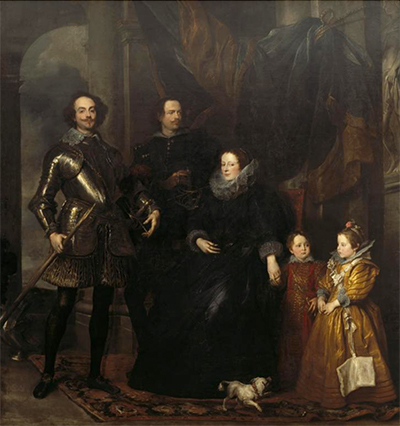
The completed picture places this small grouping within a much larger declaration of family presence. Firle dates the painting to 1634 and identifies the other sitters as Ernestine's husband and their four children. The couple had married in 1618; by the time of the portrait Johann was a general serving the Spanish Netherlands and wore the Order of the Golden Fleece. [3] Those circumstances make the family's formal presentation more specific than the isolated sheet initially suggests. Ernestine's broad seated figure would occupy one of the two adult positions around which the children were arranged.
Firle's reproduction shows how much changed when that arrangement became a painting. A tall column, a patterned hanging and an opening towards trees give the family an imposing setting. Ernestine wears a dark gown, with a wide pale collar surrounding the now carefully modelled face; the boy beside her wears red. Her skirt's breadth remains legible, but its contours are absorbed into the deeper tones around the seated couple. The small lapdog occupies her lap, close to the meeting of hands. [3] The painting adds colour, setting and attributes to relationships that the drawing explores through bodies and cloth.
The son's place also becomes more explicit within the family. The Frick reads the count’s altered hand in the finished painting as pointing towards Johann Franz Desideratus, his son and heir. [4] In the drawing of Ernestine, the boy is connected principally to his mother's arm and dress. In the canvas, he stands beside his mother, near the count’s pointing hand. Seen beside the painting, the sketch reveals a useful division of attention: it works out the mother-and-child pairing within an ensemble whose other connections could be developed elsewhere.
Another surviving study shows Johann of Nassau-Siegen seated . The British Museum records a matching watermark, read as IR4, in that separate sheet and Ernestine’s. Its curatorial account suggests that the drawings may belong to the same working session. [5] The correspondence brings them close without fixing an exact day or a sequence of sittings.
Two portraits on one sheet
Turn this particular sheet over and the subject changes: the reverse carries a portrait study of Quintijn Simons . Ernestine and her son occupy the recto, or front; Simons occupies the verso, or back. The British Museum acquired the sheet from the fifth Earl of Wicklow in 1874 and also records Hugh Howard among its previous owners. [2]
The two sides bring together different portrait commissions rather than two views of the same family. The museum relates the Simons verso to a Hague painting and Pieter de Jode’s engraving. [2] His standing figure does not supply another member of the Nassau group. The physical connection is nevertheless revealing: a sheet now valued for Ernestine's pose also preserves work on a second sitter, with its own destination beyond the drawing.
The family painting after Van Dyck
The finished portrait and this working sheet also followed different collecting histories. Firle records that the family painting returned to a Nassau relative in 1741, when Willem Maurits van Nassau d'Auverquerque bought it. It subsequently descended through the Cowper family. The owner leaves unresolved how it had first left the sitters' family. [3] That uncertainty matters: the canvas's later return should not be mistaken for uninterrupted inheritance from the commission.
A contemporary letter makes the 1741 transaction unusually vivid. In correspondence published by Geerte Broersma, the painter and dealer Philip van Dijk told Prince Willem IV on 18 April that the large Nassau-Siegen family picture had sold for 5,000 guilders and had been acquired by Count Maurits of Nassau. Broersma identifies the work as the Firle painting and the buyer as Willem Maurits. [6] The report belongs to the history of the canvas, not to this drawing's provenance. Together with the museum's separate record of the sheet, it lets us follow two kinds of survival: the formal family image retained its identity as a large painting, while a preparatory fragment entered a collection of drawings.
Artworks directory
A selected directory of paintings, drawings and prints, including works discussed in the articles and the Frick’s 2016 portraiture exhibition. It is not a complete catalogue of Van Dyck’s work. Print titles identify collaborators or later printmakers; disputed and workshop attributions are retained. The exhibition checklist supplies additional object records; current collection information governs the updated article entries. [7]
Frequently Asked Questions
They are Ernestine Yolande, Countess of Nassau-Siegen, and her son Johann Franz Desideratus. [1] The difference in their scale makes her seated figure the centre of the design, while his standing outline extends it towards the right.
It is a preparatory drawing for the family painting at Firle Place. [1] Its open contours, overlapping lines and uneven attention to different parts of the figures let us follow the construction of a pose.
The drawing gives much more definition to her clothing than to her features. This lets us see the pose and the arrangement of the dress clearly, but it cannot tell us why Van Dyck left this particular head so lightly indicated.
The British Museum identifies it as blue paper. [2] A reproduction’s colour should not be used to infer the original shade or explain changes to the sheet.
Discussion
Look again at the images and ideas explored in Ernestine Yolande with Her Son. These editorial prompts invite your observations.
Reader Insights
Which folds do most to make Ernestine seem securely seated?
How does the hand on the boy’s shoulder affect your reading of the pair?
Where do the overlapping lines help you see a decision taking shape?
Join the Conversation
Share a detail, comparison or question about Ernestine Yolande with Her Son below.
References
- The Frick Collection , Ernestine Yolande with Her Son, Van Dyck: The Anatomy of Portraiture , object 30 recto. View source .
- British Museum , Ernestine Yolande, Countess of Nassau-Siegen, seated, with her son; Quintijn Simons, registration number 1874,0808.139. View source .
- Firle Place , Emma Olver, Firle Treasures, “Count John of Nassau-Siegen and his Family”, including the owner's reproduction of the painting and detail. View source 1 . View source 2 .
- The Frick Collection , Johann of Nassau-Siegen, Seated, Van Dyck: The Anatomy of Portraiture , object 29. View source .
- British Museum , Johann of Nassau-Siegen, seated, registration number 1845,1208.4. View source .
- Geerte Broersma , “Een briefwisseling uit 1741 tussen prins Willem IV en zijn adviseur Philip van Dijk”, Oud Holland 125, no. 1 (2012), pp. 45–54, especially the letter of 18 April 1741, p. 53, and appendix note 2, p. 54 (Dutch). View source .
- The Frick Collection, Van Dyck: The Anatomy of Portraiture, online exhibition checklist (2016). View source.