


 by
Tom Gurney
Tom Gurney BSc (Hons) is an art history expert with over 20 years experience
Email:
tomgurney1@gmail.com
/ Phone:
+44 7429 011000
Rinaldo and Armida: Introduction
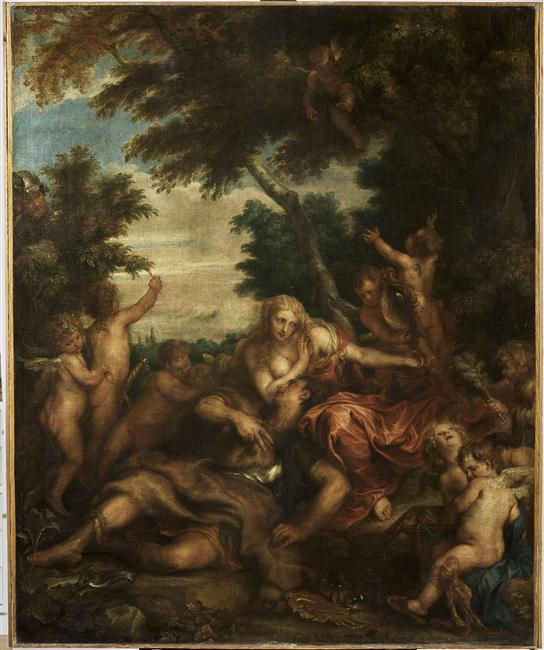
Rinaldo has put down his weapons and settled his head in Armida’s lap. Around them, winged children turn a soldier’s equipment and a woman’s dressing things into playthings. Anthony van Dyck’s Rinaldo and Armida in the Louvre makes this woodland intimacy seem almost complete. Two helmets, barely visible behind the foliage on the left, tell us that it is about to end. The painting draws its story from Torquato Tasso’s Jerusalem Delivered , holding the lovers in the brief interval before Rinaldo’s companions call him back to war. [1]
At a Glance
- Artist Anthony van Dyck, 1599–1641.
- Title Rinaldo and Armida , also known by the Louvre’s French title, Les Amours de Renaud et Armide .
- Date 1629–1632; the Louvre’s catalogue commentary proposes late 1631 to spring 1632. [1]
- Medium Oil on canvas.
- Dimensions 133 × 109 cm.
- Collection Musée du Louvre, Paris.
- Inventory number INV 1235.
- Subject Rinaldo and the enchantress Armida in her garden, observed by his companions Carlo and Ubaldo, from Canto XVI of Tasso’s Gerusalemme liberata . [1] [2]
- Related work The National Gallery’s smaller grisaille, NG877.2, is a separate painting on wood, dated 1634–1635 and probably made as a model for an engraving. [3]
This work across Anthony van Dyck’s career
Entry of Christ into Jerusalem
about 1617Frans Snyders
about 1620Rinaldo and Armida (current article)
1629–1632; Louvre commentary proposes late1631–spring1632Charles I in Three Positions
1635–before June 1636Lord John Stuart and his Brother
about 1638Cupid and Psyche
1639–40Self Portrait
c. 1640Contents
- A private world with two uninvited witnesses
- The episode in Tasso’s poem
- The mirror and the movement of looking
- Eleven Cupids and a warrior’s abandoned equipment
- Venetian colour in a northern wood
- A proposed commission for the House of Orange
- From the canvas to a small panel and an engraving
- How the painting reached Paris
A private world with two uninvited witnesses
The lovers occupy the lower centre of a tall woodland setting. Rinaldo stretches diagonally across the foreground, his knees bent and his upper body supported by Armida. His face turns upwards towards hers. She leans over him, her loose golden hair falling towards her bare shoulder and breast. The rich red folds of her dress spill down beside his brown clothing, giving the middle of the picture a warmth that the darker foliage encloses. [1]
Their bodies describe a relationship before any knowledge of the story is needed. He has given up an upright, independent pose; she provides the resting place towards which his whole body turns. His sword and shield are displaced from their usual purpose. The children can handle them because the warrior is occupied elsewhere. This bodily arrangement gives visible form to the condition Tasso describes: a knight whose attention has become entirely absorbed by his lover. [1] [2]
The scene opens behind them towards a pale, luminous distance. A tree curves across that opening, while the heavier trunks and leaves on the right shelter Armida and the mirror. Above, a small Cupid sits high in the branches, extending the lovers’ world vertically. The garden seems inhabited at every level, from the dressing things on the ground to the play overhead.
The helmets at the far left are easy to overlook. Once noticed, they alter the experience of the whole picture. These are Carlo and Ubaldo, Rinaldo’s fellow soldiers. Their concealment establishes a second kind of attention alongside his absorbed gaze: they watch the lovers while remaining outside their intimacy. The spectator can see both groups at once. We share the pleasure of the garden and possess information the couple has not yet acted upon. [1]
Van Dyck keeps the interruption small in physical scale. The soldiers remain at the edge, their arrival present as a possibility. That restraint gives the tenderness time to register before we consider its consequences.
The episode in Tasso’s poem
Tasso’s Gerusalemme liberata , published in 1581 and usually called Jerusalem Delivered in English, is a Renaissance epic set during the First Crusade. It combines the military campaign with enchantment, desire and the competing obligations of its characters. Within the poem’s Christian framework, Rinaldo’s withdrawal from the fighting becomes a failure of duty. Armida belongs to the opposing side and uses magic; their relationship nevertheless receives an extended, sensuous description. [1] [2]
In Canto XVI, Carlo and Ubaldo penetrate Armida’s garden and discover the pair through the leaves. Stanzas 17–19 supply several of Van Dyck’s central details: Armida’s disordered hair, her open clothing, Rinaldo’s head in her lap and the concealed witnesses watching them. Tasso’s description moves between what the soldiers see and the lovers’ exchanges. Van Dyck brings those successive details together within one sustained scene. [2]
The poem’s garden is itself an elaborate deception. Its artifice appears natural; flowers and fruit coexist in a perpetual abundance. Birds and the breeze contribute to an atmosphere that encourages love. Van Dyck’s trees, soft distance and crowded little inhabitants make that attraction tangible through a patch of woodland. [2]
The rescue comes later in the canto. Armida leaves the garden to attend to her affairs, and the two men reveal themselves to Rinaldo. Ubaldo turns a shining shield towards him. Seeing his own appearance, the knight becomes ashamed; his companions urge him to return to the campaign. He tears away the adornments associated with his life in the garden and prepares to depart. [2]
Van Dyck chooses the moment in which the relationship still governs Rinaldo’s senses, while giving us the witnesses who anticipate its dissolution. Knowledge of the subsequent rescue produces tension within the apparently peaceful encounter.
The poem also gives Armida a response to the impending separation. In the later passage she follows Rinaldo and appeals to him, her earlier command giving way to distress. Van Dyck leaves that reversal outside the frame. The woman who bends over the reclining knight still appears to occupy the centre of his world. [2]
Tasso’s judgements about religious allegiance, masculinity and military honour belong to the epic’s historical outlook. They explain the pressure placed on Rinaldo without requiring us to treat the lovers’ tenderness as worthless. The painting allows the attraction of the life he is about to lose to remain exceptionally clear.
The mirror and the movement of looking
The mirror gives the relationship a second, smaller image. A Cupid holds its convex surface beside Armida, and her reflected face can be made out within it. Blaise Ducos, in the Louvre’s catalogue, draws attention to this detail as an unusually subtle piece of painting. The reflection adds a miniature demonstration of the artist’s ability to represent the same person from another angle. [1]
Its narrative source is precise. In Tasso’s stanza 20, a mirror hangs at Rinaldo’s side. He holds it up for Armida, who looks at herself in the glass while he finds his own mirror in her eyes. The following stanzas develop his claim that the ardour she inspires expresses her beauty more fully than a small piece of glass can do. [2]
Van Dyck transfers the practical task of holding the mirror to a child. This frees Rinaldo to recline and helps the little attendants organise the image around the couple. The painter retains the poem’s contrast between Armida’s interest in her appearance and Rinaldo’s absorption in her, while giving the act of looking an additional physical presence. We can inspect the glass, the woman it reflects and the man who looks towards her within the same field of vision. [1] [2]
The mirror is part of the lovers’ play and a means of displaying beauty to the viewer. Tasso makes their unequal attention explicit; Van Dyck makes that attention circulate among bodies, eyes and a painted reflection. Armida’s long hair and exposed skin, the mirror’s bright rim and the gestures of its bearers all gather around the place where Rinaldo’s gaze comes to rest.
A second reflective object belongs to the continuation of the story: Ubaldo’s shield. In the poem, that polished surface makes Rinaldo see himself as his companions see him. The mirror serves the pleasures of the garden; the shield later helps interrupt them. Reading the two episodes together reveals how much the story depends upon changing the object of the knight’s attention. [2]
The overturned shield on the ground in Van Dyck’s painting belongs to the abandoned equipment around the lovers, in the earlier moment when military things have become available for other uses. [1]
Eleven Cupids and a warrior’s abandoned equipment
The little figures deserve patient looking. Ducos counts eleven Cupids in the Louvre painting, noting that some are easily missed: two appear behind the child supporting the mirror. Their partial concealment makes counting them a way of exploring the picture’s overlapping bodies, objects and foliage. [1]
They do more than form a decorative border. On the left, children play with the sword; in the foreground, one wears a red slipper and a ribbon around his ankle. Others occupy themselves with the mirror and the scattered possessions. High above, another throws small apples down from a branch. Their activities distribute the idea of pleasure through the entire setting. [1]
The mixture of objects is pointed. Weapons lie among jewellery, a comb, flasks and an ostrich-feather fan. A metal tray contains Rinaldo’s gloves. These things give love a material setting: dressing, grooming and handling beautiful possessions have displaced preparation for battle. The knight’s equipment still identifies who he is, but he has surrendered its immediate use to the children around him. [1]
Several details also carry an erotic suggestion. Ducos reads the children’s handling of the sword, the borrowed slipper and Armida’s bare foot as part of the painting’s insistence on physical love. The picture communicates this through small, playful substitutions. Adult possessions become children’s toys; the seriousness of the warrior’s role is suspended in a scene governed by the lovers’ bodies. [1]
The contrast with the two helmets is especially economical. Carlo and Ubaldo remain identifiable as soldiers behind the bush, while Rinaldo’s weapons lie in the open. Their distant military presence restores a purpose that the foreground has temporarily forgotten. A viewer can follow that opposition without assigning a fixed symbolic meaning to every flask or piece of fabric.
Tasso supplies the reclining lovers and the hidden witnesses; Van Dyck surrounds them with a busy community of love. Each small action invites the eye to linger, enlarging the episode’s pleasures beyond the couple at its centre.
Watch: Van Dyck’s art and working methods
Choose a museum introduction, a specialist lecture or a conservation film to continue exploring Van Dyck’s work.
Alejandro Vergara: Van Dyck and the Problems of Youth
Alejandro Vergara examines the ambitions and problems of Van Dyck’s early career.
Watch on YouTubeVenetian colour in a northern wood
The painting’s red drapery, warm flesh and shaded greenery place it within Van Dyck’s sustained engagement with Venetian painting. Ducos connects the Cupids particularly with Titian’s Bacchanal of the Andrians . The connection helps explain the painting’s mood: children, desire and a landscape can belong to a single atmosphere, with colour carrying much of their unity. [1]
The woodland is crucial to that effect. Armida’s dress gathers the strongest colour around her body, while the surrounding shadows allow faces, limbs and small objects to emerge at different levels of brightness. The sky opens the scene without removing its shelter. Our attention moves from the broad mass of foliage to the concentrated warmth of the lovers and then out towards the scattered children.
Ducos also finds an affinity with Correggio in the ease and delicacy of the woodland arrangement. He relates the Cupid in the branches to children and angels in trees painted by Rubens, including the apple tree in The Holy Family under the Apple Tree . These comparisons identify a painter thinking across familiar artistic resources rather than copying a single complete model. [1]
The mirror requires a different distinction. Although a woman looking into a glass may recall paintings of Venus, its presence here is directly supported by Tasso. Literary detail and painterly inheritance meet in the composition. The story tells Van Dyck what the lovers do; the arrangement of colour, limbs, foliage and playful attendants determines how long we want to look at them. [1] [2]
This is an important part of his work beyond portraiture. Among Van Dyck’s religious and mythological paintings , literary subjects offered room for an intimacy and imaginative setting that differed from the demands of a formal likeness. Rinaldo and Armida gives that freedom a particularly intricate expression.
A proposed commission for the House of Orange
The Louvre dates the canvas broadly to 1629–1632. Its catalogue commentary makes a more specific proposal: Van Dyck probably painted it between December 1631 and his arrival in England in April 1632, for Frederick Henry of Orange and Amalia van Solms. That narrower interval is an interpretation of the evidence, rather than a date inscribed on the painting. [1]
An inventory of 1632 is central to the argument. It describes a painting by Van Dyck intended for a chimneypiece, showing a reclining Mars with his head in Venus’s lap. The description includes a Cupid with a red velvet slipper and a ribbon around his ankle, details that correspond closely to the Louvre picture. The catalogue therefore identifies the inventory’s painting with Rinaldo and Armida , despite the different names given to the lovers. [1]
The historical title is understandable. A warrior relaxing beside a beautiful woman while Cupids play with his weapons could suggest Mars and Venus to someone recording its contents. The two hidden soldiers provide the more particular clue to Tasso’s story. They are Rinaldo’s companions, and their presence makes the narrative identification considerably more specific than the broad theme of love disarming a warrior. [1]
If the inventory identification is correct, the work was conceived for a domestic princely setting above a fireplace. Its crowded foreground and tall arrangement of trees belong to an image intended to occupy a defined architectural position. The inventory supports that proposed function; it does not tell us exactly how a visitor first experienced the painting or establish its original dimensions. [1]
Van Dyck had already treated Rinaldo and Armida for Charles I in a different composition associated with a commission of 1629. The painting now in Baltimore is generally connected with that royal acquisition, although the documentary identifications have generated debate. It represents an earlier episode and must be kept separate from the reclining lovers of the Louvre canvas. Similar titles do not establish identical subjects, commissions or ownership histories. [1] [3]
From the canvas to a small panel and an engraving
The National Gallery’s Rinaldo and Armida , inventory NG877.2, measures 57 × 41.5 cm and is painted in oil on wood. Dated 1634–1635, it repeats the Louvre composition in a restricted range of grey, brownish, yellowish and greenish tones. A visible grid divides the image. The National Gallery considers it more likely to have served as a model for Pieter de Jode the Younger’s engraving of 1644 than as a preliminary study for the Louvre painting. [3]
That distinction changes how we understand the small work. A reduced painting could preserve an established design and prepare it for translation into another medium. Its small size and limited colour do not automatically make it an early trial of the larger canvas. Here the grid offers practical evidence of a concern with transferring the composition. [3] [4]
Ashok Roy’s technical examination established an especially useful sequence. The grid lines were incised through most of the panel’s paint, but the final, thick white highlights cross those incisions intact. The squaring therefore preceded completion of the painting. Roy concluded that preparation for an engraving belonged to its original purpose, with the grid made by Van Dyck or a studio assistant, rather than added only when the print was produced years later. [4]
Roy’s findings describe the National Gallery’s wooden panel, a physically different object from the Louvre’s canvas. Its incisions and final highlights document a particular stage in the design’s transmission. [4]
The later print also needs to be identified carefully. Ducos corrects a recurring confusion about its direction: de Jode’s original engraving reverses the painted composition. A copy by the French engraver François Ragot returns it to the same direction as the painting and has sometimes been confused with de Jode’s work. The distinction affects any comparison of the lovers, the mirror and the concealed soldiers across reproductions. [1]
Both the grisaille and the engraving show more landscape above and below than survives in the Louvre picture. The National Gallery regards this as evidence that the canvas was cut down at some stage. It is a useful explanation of the differences, though it does not recover the canvas’s original measurements or establish when the alteration occurred. [3]
Through prints after Van Dyck , the composition became available well beyond the room containing the painting. Ducos identifies Michiel Cabbaey’s gouache on parchment of 1695 as an adaptation derived from the circulating engravings. He also notes a borrowing in Jan Steen’s The Doctor’s Visit at Apsley House, showing how the design could be quoted within a different painting. A reversed group in another painting may consequently reveal the circulation of the printed design rather than a painter’s direct access to the Louvre canvas. [1]
How the painting reached Paris
The Louvre’s catalogue reconstructs a history through the collections of the House of Orange, while preserving questions about its continuity. Later records place the picture with Amalia van Solms and her descendants, and connect it with Het Loo and Oranienstein before its presence in William V’s collection at The Hague. Identifying a work across these records involves more than following a stable title: names, attributions and descriptions changed. [1]
A proposed connection with a sale at Het Loo in 1713 has been disputed. Another interpretation identifies the Louvre canvas with a painting recorded in the Spanish royal collection. Ducos rejects that Spanish identification and discusses the difficulties surrounding the 1713 sale. The existence of other treatments, copies and apparently lost versions makes an unbroken, wholly certain early provenance difficult to claim. [1]
The later journey to France is more firmly documented. The painting was removed from the stadholder’s collection in 1795, during the Revolutionary period and following William V’s flight. It entered the Muséum central des arts in Paris on 31 January 1796, as a result of that wartime removal. [1]
The work was subsequently placed at Saint-Cloud under the Empire in 1804. It remained in France when the Allies recovered other displaced works in 1815. Its present place in the Louvre therefore belongs to the wider history of the movement and retention of artworks during the Revolutionary and Napoleonic years. [1]
Through the picture’s changes of setting and attribution, its central encounter remains legible: a warrior looking up at a woman, a mirror held among children, and two small helmets waiting behind the leaves. Those modest signs of another world give the lovers’ absorption its precariousness.
Artworks directory
A selected directory of paintings, drawings and prints, including works discussed in the articles and the Frick’s 2016 portraiture exhibition. It is not a complete catalogue of Van Dyck’s work. Print titles identify collaborators or later printmakers; disputed and workshop attributions are retained. The exhibition checklist supplies additional object records; current collection information governs the updated article entries. [5]
Frequently Asked Questions
The 1632 inventory associated with the painting describes the lovers as Mars and Venus. The reclining warrior, beautiful woman and playful Cupids could suggest that familiar mythological pairing. Carlo and Ubaldo provide the decisive clue to the more specific subject of Rinaldo and Armida. [1]
The National Gallery considers its 1634–1635 grisaille more likely to be a model for a later engraving. Technical examination showed that its transfer grid was incised before the final highlights were painted, supporting an intended role in print production. It should not simply be treated as the Louvre picture’s first draft. [3] [4]
He shows the lovers before that rupture. The hidden soldiers anticipate Rinaldo’s recall, but the couple remains together. Tasso’s later confrontation involves Ubaldo’s polished shield, Rinaldo’s shame and his decision to leave; these events follow the intimate scene represented here. [2]
Discussion
Look again at the images and ideas explored in Rinaldo and Armida. These editorial prompts invite your observations.
Reader Insights
How does discovering Carlo and Ubaldo behind the foliage change your first impression of the lovers?
Follow the Cupids’ activities around the painting. Which detail most clearly shows that Rinaldo’s military life has been suspended?
How might the composition feel different in a small monochrome panel or a reversed engraving, compared with the Louvre’s coloured canvas?
Join the Conversation
Share a detail, comparison or question about Rinaldo and Armida below.
References
- Blaise Ducos , “Les Amours de Renaud et Armide”, catalogue entry 12, Antoon Van Dyck. Catalogue raisonné des tableaux du musée du Louvre , Musée du Louvre, 2023. French. View source .
- Torquato Tasso , Gerusalemme liberata , Canto XVI, 1581; digital transcription on Wikisource. Italian. Relevant passages: stanzas 9–23, 26–35 and 36–53. View source .
- National Gallery , London, “Anthony van Dyck, Rinaldo and Armida”, NG877.2, collection entry. English. View source .
- Ashok Roy , “The National Gallery Van Dycks: Technique and Development”, National Gallery Technical Bulletin , vol. 20, 1999, pp. 50–83; section on NG877.2, p. 68. English. View source .
- The Frick Collection, Van Dyck: The Anatomy of Portraiture, online exhibition checklist (2016). View source.


