 by
Tom Gurney
Tom Gurney BSc (Hons) is an art history expert with over 20 years experience
Email:
tomgurney1@gmail.com
/ Phone:
+44 7429 011000
Anthony van Dyck’s Religious and Mythological Paintings: Introduction
Anthony van Dyck’s religious and mythological paintings make stories tangible through bodies: a man bends to welcome Christ, a sleeping warrior lies within reach of a blade, a mother spreads her arms above her dead son. These pictures belonged to an extensive practice that included church decoration, devotional commissions and courtly poetry alongside portraiture. Looking across them reveals how differently Van Dyck could organise an encounter between people, and between a picture and its audience. [1]
At a Glance
- Artist Anthony van Dyck, 1599–1641.
- Subjects Biblical narratives, saints’ visions and intercession, devotional portraits, classical mythology and Renaissance poetry. [2] [3] [4] [5] [6] [7] [8]
- Early examples The Entry of Christ into Jerusalem , about 1617, at Newfields; Samson and Delilah , about 1618–1620, at Dulwich Picture Gallery. [2] [3]
- Religious commissions The Lille Crucifixion was made for the Récollets; the Antwerp Lamentation , now dated about 1640, was commissioned for Cesare Alessandro Scaglia’s chapel. [9] [10] [11]
- Poetic paintings The Louvre’s Rinaldo and Armida and the Royal Collection’s Cupid and Psyche draw on different literary stories and survive in distinct patronage contexts. [6] [7]
- Attribution caution Vienna’s Thetis Receiving the Weapons of Achilles from Hephaestus is currently catalogued as a work of Van Dyck’s workshop. [8]
Contents
- Early drama: a body in motion, a body at rest
- The Crucifixion as a public devotional image
- After the cross: the weight of the dead Christ
- Palermo: intercession in a city under threat
- A vision organised around an offered hand
- Devotion and portraiture meet in the donors’ picture
- Rinaldo and Armida: pleasure interrupted
- Cupid and Psyche: rescue made visible
- Other myths, and the importance of the exact painting
Early drama: a body in motion, a body at rest
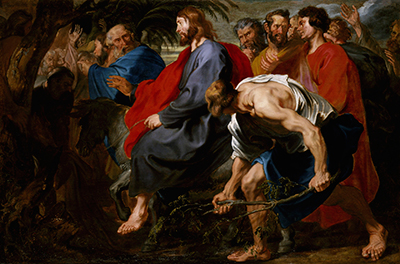
In The Entry of Christ into Jerusalem , dated about 1617, the crowd presses close around the mounted Christ. A man at the front bends almost across the direction of travel, holding a branch. His exposed shoulder and braced legs give the welcome a physical effort. Christ’s feet hang above the ground; the bending man’s feet grip it. The difference helps separate the principal figure from the movement that surrounds him. [2]
The painting offers little empty space in which to stand back from the event. Heads appear behind heads; a raised hand reaches in from the right; the animal’s dark body carries the procession through the lower left. Christ’s open hand gives the scene a point of calm that remains visible among these competing actions. His red and blue clothing gathers the eye before it returns to the faces around him. The welcome emerges through overlapping gestures, as though the crowd must continually rearrange itself to let him pass.
Samson and Delilah , painted about 1618–1620, uses an equally substantial male body to suspend the action. Samson sleeps across Delilah’s lap while a man prepares to cut his hair and armed men wait at the left. Dulwich places this early work in Van Dyck’s close engagement with Rubens’s Antwerp studio. [3]
Samson’s back fills the foreground. The arm folded beside his face makes his repose seem secure, yet the men above him can reach his head without meeting his eyes. Delilah’s lifted finger is small beside the broad body that depends on her silence. The shears, the waiting weapons and the pale cloth under Samson create different kinds of anticipation: an instrument about to act, force held in reserve, a surface on which the sleeping weight has settled.
Set beside the Entry , the scene shows how early Van Dyck could make strength serve different narrative purposes. One muscular figure acts conspicuously; the other cannot act at all. The surrounding people determine what each body means. Neither picture needs a procession of separate episodes to make its story unfold: the viewer sees the present arrangement and begins to imagine its consequences.
The Crucifixion as a public devotional image
The Lille Crucifixion belongs to a different scale of encounter. The canvas is four metres high and dates from about 1630. The museum’s teaching material identifies its original destination as the Récollets convent in Lille. Its tall, arched format and sharply separated groups make it possible to follow the scene from some distance. [9] [10]
Christ hangs high on the left, his pale torso exposed against the sky. Below him, Mary Magdalene bends towards his feet. Her gold clothing spreads across the foreground in a large, legible shape. At the right, the Virgin reaches towards her son while John raises his face. The figures describe several distances from the crucified body: contact at the feet, arms extended towards it, a gaze carried upwards. The museum’s record identifies this as the moment immediately after Christ’s death. [9]
The cross fixes the composition in place, but almost everything below it inclines or opens. Magdalene’s bowed back draws attention downwards to the feet; the Virgin’s reaching hand sends it back towards the torso. The dark blue of the Virgin’s clothing and John’s red robe form a more compact group opposite the cross. Between them and Christ lies enough sky to make the reach seem difficult. The distance is part of the image’s devotional force.
At the lower left, departing figures recede into a much smaller scale. Their movement away makes the mourners’ continued attention more conspicuous. The picture offers a viewer several positions from which to approach the death: through bodily closeness, through the mother’s reaching gesture, or through the disciple’s upward look. A church painting could address a congregation while concentrating on these particular acts of attention.
That combination of public setting and intimate response matters throughout Van Dyck’s sacred work. A large commission does not require every figure to proclaim the same feeling in the same way. Differences of posture allow the viewer to move between responses within a single composition.
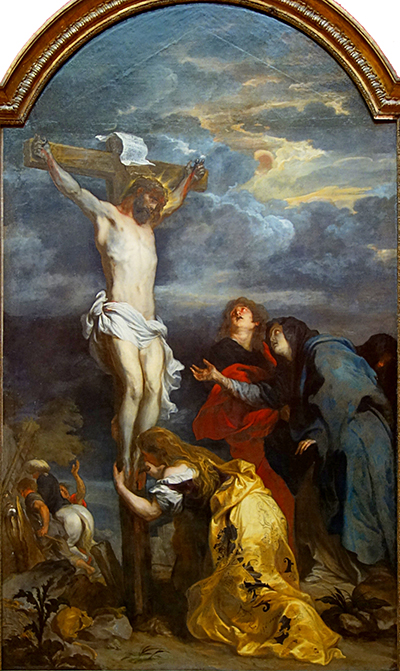
Anthony van Dyck, Crucifixion (Christ on the Cross, Calvary), about 1630. Oil on canvas, 400 × 250 cm. Palais des Beaux-Arts de Lille, P89.
After the cross: the weight of the dead Christ
In a Lamentation, attention shifts from the elevated body to the body received by others. The broad Antwerp painting now in the KMSKA, dated about 1640, was commissioned by the diplomat and cleric Cesare Alessandro Scaglia for the Chapel of Our Lady of the Seven Sorrows in the city’s Franciscan church. Although the chapel was consecrated in 1637, the museum records that the altar was erected only after Scaglia’s death in 1641. The picture’s late date should therefore be kept distinct from older descriptions that place it around 1635. [11]
Here Christ lies nearly the whole width of the canvas. His head rests at the left, against the Virgin’s lap, while his legs extend towards the right. Pale flesh, white linen and blue drapery make a continuous low sweep across the foreground. Above it, Mary opens her arms. Her gesture cannot lift the body; it directs attention beyond the immediate task of supporting it.
The other figures bring their faces and hands towards Christ. One contact after another interrupts the body’s long horizontal: a hand held, an arm supported, a face bent close. Against this concentrated group, Mary’s open arms create a wider space. The painting brings tactile nearness and an appeal beyond the scene into the same shallow foreground.
A surviving drawing helps connect such narrative painting with the study of a posed body. The Morgan’s Study for the Dead Christ , I, 243, dates from about 1635–1640 and is directly associated with the Antwerp Lamentation . The museum describes black and white chalk on blue paper and emphasises the study’s attention to light on flesh. It provides a specific example of preparation for a sacred figure; it does not identify the model or tell us how long the pose was held. [12]
The distinction between a Descent from the Cross and a Lamentation changes what the viewer looks for. The former centres on lowering the body; the latter on mourning and attending to it after removal. Van Dyck’s Deposition and Lamentation paintings offer several arrangements of that encounter. Their dates, attributions and formats need to be considered individually, rather than treated as a single continuous sequence of improvements.
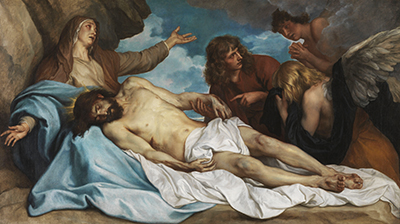
Anthony van Dyck, Lamentation of Christ, about 1640. Oil on canvas, Royal Museum of Fine Arts Antwerp, inventory 404.
Palermo: intercession in a city under threat
The Metropolitan Museum’s Saint Rosalie Interceding for the Plague-stricken of Palermo dates from 1624. Van Dyck was in Palermo during the plague and quarantine, when the rediscovery of Rosalie’s remains helped create urgent demand for her image. The Met also records that this painting covers a self-portrait he had begun on the canvas. Sacred painting here responded to an immediate civic and devotional need, with an existing support redirected to another purpose. [4]
Rosalie rises above a low, distant landscape. Her upturned face receives the light; one hand opens near her side, while the other descends towards the world below. A skull is held close to her body. Around her, winged children turn, reach and look in several directions. Their movement carries the eye between the saint, the cloud and the earth, while her long clothed figure holds the centre steady.
The people for whom she intercedes do not fill the foreground as they might in a crowded scene of illness. The viewer first meets the saint’s upward address. Below, the landscape is compressed into a narrow distance. This makes intercession itself the principal action: the picture connects a threatened place with a figure understood by believers to plead on its behalf.
The arrangement differs from the Lille Crucifixion . There, the gap between the mourners and Christ extends across the middle of the painting. Here, the clouds and ascending bodies create a route between earthly distance and heavenly light. In both, gesture helps establish a relationship with someone beyond easy reach. The particular religious stories give those gestures different purposes.
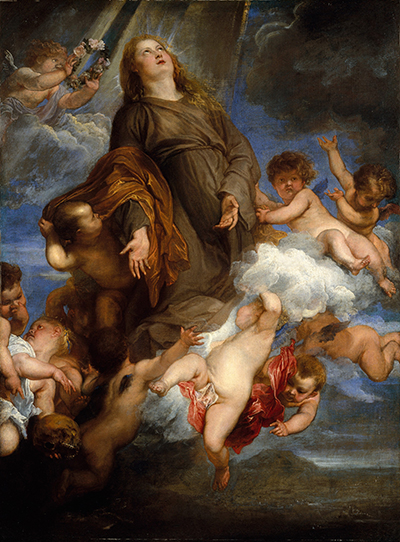
Anthony van Dyck, Saint Rosalie Interceding for the Plague-stricken of Palermo, 1624. Oil on canvas, 99.7 × 73.7 cm. The Metropolitan Museum of Art, New York, 71.41.
Watch: Van Dyck’s art and working methods
Choose a museum introduction, a specialist lecture or a conservation film to continue exploring Van Dyck’s work.
Alejandro Vergara: Van Dyck and the Problems of Youth
Alejandro Vergara examines the ambitions and problems of Van Dyck’s early career.
Watch on YouTubeA vision organised around an offered hand
In The Vision of the Blessed Hermann Joseph , about 1629–1630, a kneeling Premonstratensian monk encounters the Virgin in the devotional narrative of a mystical marriage. The Kunsthistorisches Museum records the painting with the Jesuit Marian congregation in Antwerp in 1630. Cäcilia Bischoff’s museum commentary identifies it as an altarpiece for the confraternity of bachelors, following another Marian commission. This is an institutional setting for a very closely observed exchange. [5] [13]
Hermann Joseph’s white habit occupies much of the right side. It falls in heavy folds around a figure who leans forward, with one hand drawn towards his chest and the other extended. The Virgin bends her head and lowers her hand. Between them, an angel joins the two movements. The contact is small enough to require attentive looking, yet the surrounding figures and fabrics direct the eye towards it.
The angel’s yellow drapery spreads above the monk’s shoulder, while the Virgin’s darker blue descends along the opposite side. These large shapes give the central hands a setting without overwhelming them. The angel’s exposed arm passes through the coloured cloth into the space of the encounter. The wing above establishes a different kind of being; the hand below makes that being useful within the story.
Bischoff explains the angel as mediator, physically guiding the monk’s hand towards the Virgin. The subject may have been chosen because the confraternity’s head shared Hermann Joseph’s name, but that remains a proposed explanation. [13] The scene’s persuasive detail lies in the difficulty and delicacy of approaching: an entire kneeling body commits itself to a contact measured in fingertips.
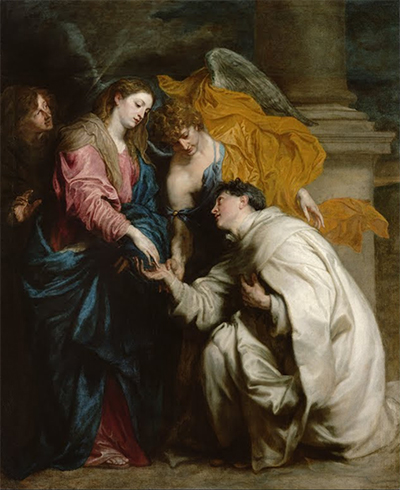
Anthony van Dyck, The Vision of the Blessed Hermann Joseph, around 1629–30, oil on canvas, Kunsthistorisches Museum, Vienna, GG 488.
Devotion and portraiture meet in the donors’ picture
The Louvre’s Virgin and Child with Two Donors , about 1630–1632, places recognisably individual worshippers within a sacred encounter. The older man kneels close to the Child; the woman remains slightly behind him. The Louvre’s collection record proposes a commemorative painting intended for a funerary monument in a chapel. [14]
The Child reaches towards the man’s cheek. This makes the meeting unusually direct: prayer is answered within the visible space by a touch. The man’s joined hands sit close to the Virgin’s clothing, while the woman’s hands remain within the darker shape of her own dress. White ruffs frame the two adult faces, and the Child’s bare arm crosses the interval between sacred and human figures. Portrait detail and religious narrative operate together.
The exact identities and occasion remain unsettled. In his 2023 catalogue, Blaise Ducos questions a secure funerary interpretation and proposes a possible thanksgiving offering connected with the Roettiers family, drawing on a much later account. He also records that the canvas was enlarged above and below after 1709. [15] Neither the couple’s gestures nor the present tall format can establish the original commission by themselves.
This uncertainty leaves an important distinction intact. Personal devotion describes a relationship within the image; it does not by itself establish private ownership, a domestic location or a particular family event. The painting gives its kneeling figures an access to the Child that viewers can contemplate, even while the circumstances behind their appearance remain open to discussion. Their faces matter as individual likenesses, and their arrangement matters as a model of prayer.
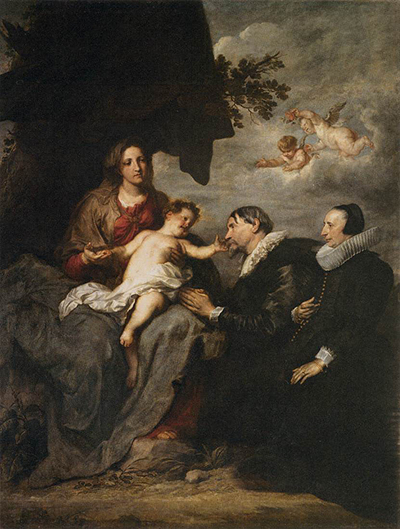
Anthony van Dyck, Virgin and Child with Two Donors, about 1630–32, oil on canvas, Musée du Louvre, Paris. The canvas includes later additions above and below the original composition.
Rinaldo and Armida: pleasure interrupted
Courtly narrative could depend on an equally close encounter while asking the viewer to recognise a literary situation. The Louvre’s Rinaldo and Armida , catalogued between 1629 and 1632, shows a knight absorbed in the enchantress who holds him in her garden. Ducos associates the canvas with Frederick Henry of Orange’s patronage and proposes execution in late 1631 or early 1632. [6]
The episode comes from Canto XVI of Torquato Tasso’s Jerusalem Delivered . In the poem, Carlo and Ubaldo discover their companion resting with his head in Armida’s lap. She looks at herself in a mirror; he finds his reflection in her eyes. The soldiers watch without being seen. These different acts of looking make the pleasure precarious before the lovers themselves recognise any interruption. [16]
Van Dyck’s composition places the companions’ helmets behind foliage at the left. Around the lovers, cupids occupy themselves with weapons and dressing accessories. Equipment that belongs to the warrior’s public role has entered the lovers’ play. The tension belongs to Tasso’s story of enchantment and military duty; it need not be read as a declaration of Van Dyck’s own beliefs about war or love. [17] [16]
The National Gallery’s smaller Rinaldo and Armida , NG877.2, is a separate painting on wood, dated 1634–1635. Its largely monochrome treatment and squared design are associated with the engraving made by Pieter de Jode in 1644. The gallery considers it more likely to have served that print than to have been a preparatory study for the finished Louvre canvas. [17]
That relationship adds another dimension to a narrative picture’s life. A composition made for an elite setting could become a model for an image circulated on paper. The chronology runs beyond Van Dyck’s death in 1641. Painting, reduced painted model and engraving give different audiences access to the same scene; their supports, dates and functions remain distinct. The wider history of these translations belongs with Van Dyck’s prints .
Cupid and Psyche: rescue made visible
The Royal Collection’s Cupid and Psyche , dated 1639–1640, brings another vulnerable body into a landscape. It is the surviving mythological painting from Van Dyck’s employment as Charles I’s court artist. The Royal Collection proposes connections with a Greenwich decorative project and, alternatively, the 1641 royal marriage celebrations. Its provenance also places the painting at Whitehall in 1639, so the later suggestion cannot establish a secure commission date. [7]
Apuleius supplies the necessary distinction between sleep and death. Psyche opens the forbidden box she has brought back from Proserpine, hoping to take some beauty for herself. It contains a sleep that overcomes her. Cupid finds her, gathers the sleep back into the box and wakes her with his arrow. The story describes a rescue from an apparently lifeless state, followed by further action; this is not the lovers’ final union. [18]
Psyche lies across the lower part of the canvas, with her head near the centre and her bare legs extending towards the right. Cupid approaches from the left. His bent leg, lifted wings and reaching arm make a sequence of movements towards her still face. One body occupies the ground; the other enters the space above it and begins to change the situation.
A dense tree canopy encloses much of the left and upper picture. At the right, a pale, sparsely branched trunk opens towards the sky. Between them, cloth and flesh establish the immediate encounter. Psyche’s loosened hand and extended limbs make it possible to see why the scene can recall the bodily arrangements of a Lamentation. Here, the viewer’s knowledge of Cupid’s action gives that stillness an approaching end.
The Royal Collection discusses Christian formal analogies as well as the influence of Titian. [7] Such comparisons help explain a shared pictorial vocabulary: a figure who reaches, a body that appears unable to respond, light falling on exposed flesh. The subject remains Apuleius’s story, and the direction of the action matters. Cupid arrives with the means to wake Psyche; the mourners around Christ attend to a death that has already occurred.
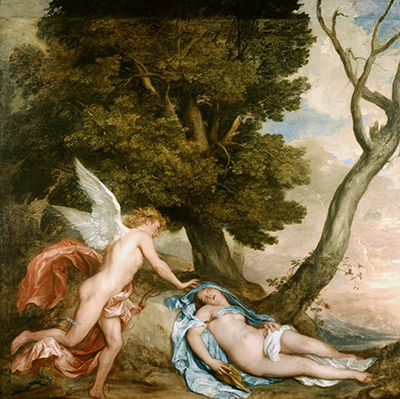
Anthony van Dyck, Cupid and Psyche, 1639–40, oil on canvas, 200.2 × 192.6 cm, Royal Collection, RCIN 405571.
Other myths, and the importance of the exact painting
Not every mythological body in Van Dyck’s orbit is youthful, graceful or self-possessed. Dresden’s Drunken Silenus , Gal.-Nr. 1017, dated about 1619–1620, compresses its group into an upright canvas. Silenus stoops in the centre, his head lowered beneath ivy, while the figures beside him support his arms and shoulders. A drinker raises a vessel behind him. His broad torso seems to push towards the viewer even as his weight falls into other people’s hands. [19]
The surrounding company sustains a gathering that continues around the central figure. The woman at the left and the red-clothed man at the right help enclose him, leaving little distance between their faces and his body. The composition allows physical awkwardness to carry the scene.
Dresden’s picture is distinct from London’s horizontal Drunken Silenus supported by Satyrs , NG853. The National Gallery currently labels the London work “possibly by” Van Dyck; its attribution and evidence cannot be transferred to the Dresden canvas. [19] [20]
Vienna’s Thetis Receiving the Weapons of Achilles from Hephaestus , about 1630–1632, requires another distinction. The Kunsthistorisches Museum’s current record identifies it as a work of Van Dyck’s workshop . Its description concerns Thetis obtaining armour for Achilles, with the goddess and armourers drawn into an exchange of looks and gestures. [8]
The breastplate stands between their bodies, its hard surface surrounded by bare arms, flesh and pink drapery. A small figure reaches up towards it; another lifts a helmet. The objects keep the action busy while the principal figures attend to one another. This workshop painting belongs in an account of the subjects and designs associated with Van Dyck, provided its attribution remains visible. Its scene should also be kept separate from representations of Venus obtaining weapons for Aeneas.
These distinctions make looking more rewarding. A title supplies a starting point, but the particular arrangement of bodies, the identity of the object and its intended use determine the encounter that follows. The painting collection and workshop history offer further ways into that larger range.
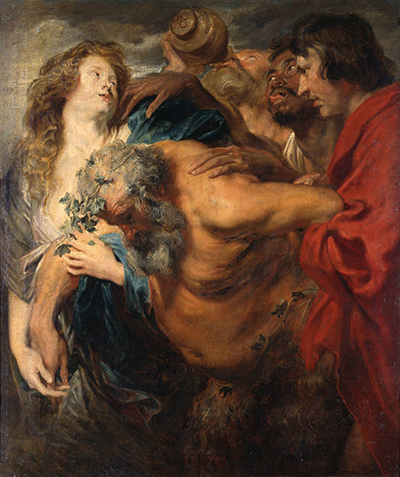
Anthony van Dyck, Silenus Drunk, about 1619–20. Oil on canvas, 107 × 91.5 cm. Gemäldegalerie Alte Meister, Dresden, Gal.-Nr. 1017.
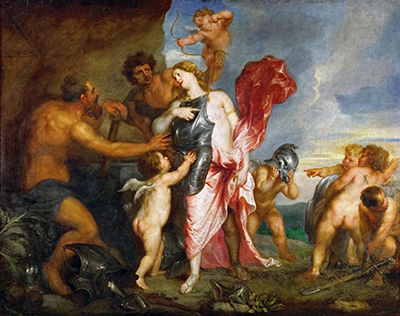
Workshop of Anthony van Dyck, Thetis Receiving the Weapons of Achilles from Hephaestus, about 1630–1632. Canvas, original dimensions 117 × 156 cm. Kunsthistorisches Museum, Vienna, GG 498.
Artworks directory
A selected directory of paintings, drawings and prints, including works discussed in the articles and the Frick’s 2016 portraiture exhibition. It is not a complete catalogue of Van Dyck’s work. Print titles identify collaborators or later printmakers; disputed and workshop attributions are retained. The exhibition checklist supplies additional object records; current collection information governs the updated article entries. [21]
Frequently Asked Questions
Their stories and purposes differ. A convent altarpiece served communal devotion; a saint’s image could answer demand during an epidemic; a courtly poetic scene invited recognition of a literary episode. Van Dyck could use related arrangements of bodies across those settings, making the context essential to interpretation. [10] [4] [16] [7]
Discussion
Look again at the images and ideas explored in Anthony van Dyck’s Religious and Mythological Paintings. These editorial prompts invite your observations.
Reader Insights
In the Entry into Jerusalem and Samson and Delilah , how does a strong body change meaning when the surrounding figures can either welcome it or act upon it?
Which encounter feels closest: the Child touching the donor’s cheek, the angel guiding Hermann Joseph’s hand, or Mary opening her arms above Christ?
How does knowing that Psyche will wake affect your response to her pose beside the still body in the Antwerp Lamentation ?
Join the Conversation
Share a detail, comparison or question about Anthony van Dyck’s Religious and Mythological Paintings below.
References
- Walter Liedtke , Metropolitan Museum of Art, Peter Paul Rubens (1577–1640) and Anthony van Dyck (1599–1641): Paintings, 2003. View source .
- Newfields , The Entry of Christ into Jerusalem, 58.3. View source .
- Dulwich Picture Gallery , Samson and Delilah, DPG127. View source .
- Metropolitan Museum of Art , Saint Rosalie Interceding for the Plague-stricken of Palermo, 71.41. View source .
- Kunsthistorisches Museum , Mystische Verlobung des heiligen Hermann Joseph mit Maria, GG 488. German. View source .
- Blaise Ducos , Les Amours de Renaud et Armide, in Antoon Van Dyck. Catalogue raisonné des tableaux du musée du Louvre , 2023, cat. 12. French. View source .
- Royal Collection Trust , Cupid and Psyche, RCIN 405571. View source .
- Kunsthistorisches Museum , Thetis empfängt von Hephaistos die Waffen für Achill, GG 498. German. View source .
- Palais des Beaux-Arts de Lille , Le Christ en croix (le Calvaire), P 89. French. View source .
- Palais des Beaux-Arts de Lille , Fiche œuvre: Peter Paul Rubens, Descente de croix, thematic comparison list identifying Van Dyck’s Lille commission. French. View source .
- KMSKA , Bewening van Christus, inventory 404. Dutch. View source .
- The Morgan Library & Museum , Study for the Dead Christ, I, 243. View source .
- Cäcilia Bischoff , Kunsthistorisches Museum, The Vision of the Blessed Hermann Joseph, museum commentary adapted from the 2010 brief guide, Google Arts & Culture. View source .
- Musée du Louvre , La Vierge aux donateurs ou La Vierge et l’Enfant avec deux orants à genoux, INV 1231. French. View source .
- Blaise Ducos , La Vierge aux donateurs (La Madone Roettiers ?), in Antoon Van Dyck. Catalogue raisonné des tableaux du musée du Louvre , 2023, cat. 14. French. View source .
- Torquato Tasso , Gerusalemme liberata, Canto XVI, especially stanzas 17–23, digital transcription. Italian. View source .
- National Gallery , Rinaldo and Armida, NG877.2. View source .
- Apuleius , The Golden Asse, translated by William Adlington, 1566, Psyche’s return from Proserpine and rescue by Cupid. English translation of Latin. View source .
- Staatliche Kunstsammlungen Dresden , Der trunkene Silen, Gal.-Nr. 1017. German. View source .
- National Gallery , Drunken Silenus supported by Satyrs, NG853. View source .
- The Frick Collection, Van Dyck: The Anatomy of Portraiture, online exhibition checklist (2016). View source.