 by
Tom Gurney
Tom Gurney BSc (Hons) is an art history expert with over 20 years experience
Email:
tomgurney1@gmail.com
/ Phone:
+44 7429 011000
Anthony van Dyck: Workshop and Influence: Introduction
A portrait can preserve Van Dyck’s invention while containing another painter’s brushwork. A print can carry his likeness across Europe through the work of an engraver. A later artist can borrow a pose and give it a new purpose. Following these different kinds of participation makes Van Dyck’s art more interesting to look at, and helps explain why the name beside a painting sometimes changes.
At a Glance
- Central distinction Designing an image, executing it and revising it are separate contributions.
- Early collaboration Van Dyck worked with Rubens while establishing his own career. [1]
- Workshop example Stockholm’s St Jerome with an Angel is currently catalogued as workshop of Van Dyck. [2]
- Print collaboration The Iconography involved Van Dyck and specialist printmakers. [3]
- Later influence Gainsborough borrowed from specific Van Dyck portraits, including the Villiers brothers. [4]
Contents
- What does “by Van Dyck” mean?
- A young collaborator in Rubens’s enterprise
- What technical examination can—and cannot—settle
- Assistants, unfinished portraits and repeated designs
- Why attributions change
- Printmakers carried the portraits further
- Gainsborough’s active study of Van Dyck
What does “by Van Dyck” mean?
The useful first question is what a name is claiming. Invention concerns the arrangement of the image. Execution concerns who applied the paint or worked the printing plate. Retouching intervenes in work already carried out. These contributions can belong to different people. [5]
Collection labels compress such distinctions. “Workshop of” allows substantial execution by assistants within the artist’s enterprise. “After” identifies dependence on a composition; it does not establish employment in the artist’s studio. A copy follows another picture, while a replica repeats a composition within the artist’s production. These terms describe relationships; the attribution of each object still needs examining. [6]
“Possibly by” preserves a question about authorship. It should remain attached to the work when the painting is reproduced or discussed. Dropping that small word changes the claim being made.
A young collaborator in Rubens’s enterprise
The Frick describes Van Dyck’s role with Rubens as assistant or collaborator, qualifying the familiar description of him as Rubens’s pupil. He had become an independent guild master in Antwerp in 1618. [1]
A striking reassessment concerns The Lance Thrust . In his KMSKA article, Nico Van Hout argues that Van Dyck designed and painted the altarpiece for Rubens’s enterprise. He compares its preparatory drawings and monochrome oil sketch with Van Dyck’s work, and discusses examination of the large panel. His argument challenges a long attribution to Rubens, supported by early written testimony and the inscription on Schelte Adamsz. Bolswert’s reproductive engraving. [7]
The disagreement reaches beyond identifying a few brushstrokes. If the design itself was Van Dyck’s, his contribution began before the large picture was painted. Yet an early statement naming Rubens remains evidence of how the altarpiece was understood. Van Hout’s case should therefore be identified as an attribution argument, with its reasoning available to the reader. [7]
What technical examination can—and cannot—settle
The National Gallery currently lists Drunken Silenus supported by Satyrs , NG853, as possibly by Anthony van Dyck . Its account places the picture in Rubens’s studio and describes collaboration, with Van Dyck proposed for important figure painting. Suggestions that Jan Wildens supplied the landscape and Frans Snyders the grapes remain qualified. [8]
Larry Keith’s 1999 study argues for Van Dyck as the principal painter, assisted by at least two others. Among its clues is a grape stem painted across an already finished hand: a small overlap that may reveal successive contributions. Keith also shows why apparent weakness can mislead. Faded red lake and altered indigo have changed passages of the painting. His wider caution is essential: shared studio materials and techniques limit their power to identify individual painters. [5]
Reconstructing the order of painting and naming its makers are different stages of an argument. Keith’s proposed principal authorship belongs beside the National Gallery’s continuing uncertainty; the collection’s qualification remains essential. [5] [8]
This London canvas is also distinct from the Dresden Silenus Drunk . An attribution discussion about one object cannot be transferred through a shared subject to another.
Assistants, unfinished portraits and repeated designs
The unfinished Portrait of a Woman , about 1640, in the Speed Art Museum offers a glimpse of work in progress. The Frick proposes that an assistant would probably have completed its background and drapery before Van Dyck’s final touches. This reconstructed procedure neither names an assistant nor documents that completion took place. [9]
That qualification gives the picture much of its value. It allows us to consider how different stages might fit together without turning an unfinished canvas into a complete account of the studio’s daily routine.
Repetition presents another problem. Nationalmuseum’s St Jerome with an Angel , NM404, follows the composition in Rotterdam closely. The Stockholm catalogue reports major revisions in the Rotterdam painting and far fewer in Stockholm, supporting the sequence of an evolving composition followed by a repetition. Examination found no evidence of mechanical transfer. Despite comparable materials and technique, the museum judges the Stockholm picture to involve more workshop participation than previously thought. Its present attribution is workshop of Van Dyck. [2]
The Tokyo Diego Felipe de Guzmán, Marquis of Leganés complicates any simple ranking by finish. The National Museum of Western Art notes simplified secondary passages but also revisions to the right arm, considered Van Dyck’s own. Its account proposes that this picture came before the closely related Madrid version, which may have served as a presentation portrait. The proposal rests on changes made during painting, rather than on the assumption that the more elaborate version must be the original. [10]
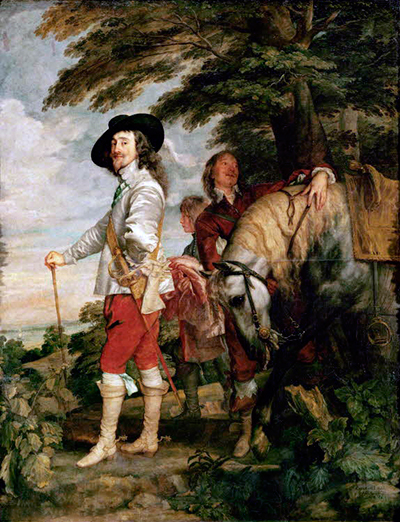
There are also cases where a familiar description needs reconsideration. The National Gallery’s 2024 catalogue discusses a smaller Royal Collection version of its Equestrian Portrait of Charles I . Often treated as a preparatory model, it is instead judged probably to have been produced in the studio alongside the large painting. The authors question both the quality of its execution and the supposed link to an early inventory description. [6]
Together, these examples suggest a practical way to compare versions: establish which objects are involved, examine their alterations and ask what supports the proposed sequence. “More finished”, “smaller” and “earlier” are different observations. None supplies a maker’s name on its own.
Watch: Van Dyck’s art and working methods
Choose a museum introduction, a specialist lecture or a conservation film to continue exploring Van Dyck’s work.
Adam Eaker: Sitting for Van Dyck
Adam Eaker considers portrait sittings, courtly identity and Van Dyck’s English reception.
Watch on YouTubeWhy attributions change
Sometimes two publications from one collection preserve different stages of thought. Parma’s online entry for Madonna and Child , GN357, adapts Caterina Limentani Virdis’s 1999 catalogue discussion, which treated it as Van Dyck’s own work. The Complesso della Pilotta’s 2026 loan statement explicitly assigns the same painting to his workshop. The later statement supplies no explanation for the change and names no assistant. The responsible description is therefore workshop of Van Dyck, with the earlier opinion acknowledged when its history is relevant. [11] [12]
Conservation can expose a different kind of complication. Bendor Grosvenor’s 2012 participant account describes the removal of extensive additions and overpaint from a portrait of Henrietta Maria as Saint Catherine. He reports Christopher Brown’s assessment at that stage: certainly unfinished and from Van Dyck’s studio, with a good prospect that parts, including the head, were autograph. Brown provisionally accepted “Attributed to Van Dyck”, pending comparison and research. That dated judgement should retain its provisional character. [13]
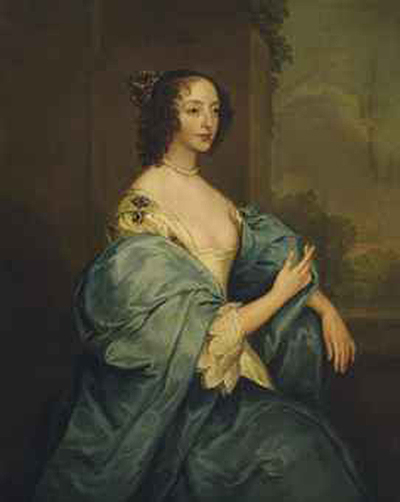
The before-and-after images make the transformation unusually clear. In the earlier view, blue fabric spreads across the seated figure and fills much of the lower picture; a landscape opens behind her. In the restored view, the figure is brought much closer. Her raised hand approaches her shoulder, and russet folds gather below it. The change affects the whole encounter with the sitter, not just the brightness of a cleaned face.
The images cannot, on their own, identify each original brushstroke. They do explain why judging the earlier surface as a single act of painting would have missed the object’s complicated construction. The fuller story belongs with the portrait as Saint Catherine .
Printmakers carried the portraits further
The Iconography made collaboration visible in another medium. KBR describes drawings in black chalk being passed to engravers including Paulus Pontius, Schelte Bolswert and Lucas Vorsterman . Van Dyck also etched portraits himself. The series developed through lifetime work and posthumous publication; its early editions contained around a hundred portraits. Calling all of these prints “etchings by Van Dyck” loses both the variety of processes and the people who made them. [3]
A preparatory sheet could serve as a working instruction. The Frick identifies incised outlines in Van Dyck’s drawing of Orazio Gentileschi and squaring in the portrait of Inigo Jones, evidence of preparation for transfer. Such marks belong to the passage between an image on paper and its next form. [14]
The Metropolitan Museum’s early state of Van Dyck’s etched Self-Portrait makes the changing object especially clear. Van Dyck’s head is developed, with lighter indications below. Jacques Neeffs subsequently added a sculptured bust and pedestal to the plate. The Met leaves open whether that solution reflected Van Dyck’s intention. A state records an alteration to the printing plate: impressions taken before and after an intervention can preserve different stages of the same plate’s history. The date of the design therefore does not automatically date every impression made from it. [15]
Later prints extended the relationship across generations. The Pushkin Museum lists Isaac Beckett’s mezzotints after Van Dyck’s Crucifixion and Bacchus , dated 1681–88 and 1687–88 respectively, and Robert Strange’s engraving after Charles I , dated 1782. Here Van Dyck supplied the painted source; Beckett and Strange made the prints. “After Van Dyck” can be a precise credit for this relationship, carrying no suggestion that either printmaker worked in his studio. [16]
The prints page follows these processes and the series in greater detail. Their importance to his influence is immediate: a portrait’s reach could expand through the skill and decisions of people who had never met its painter.
Gainsborough’s active study of Van Dyck
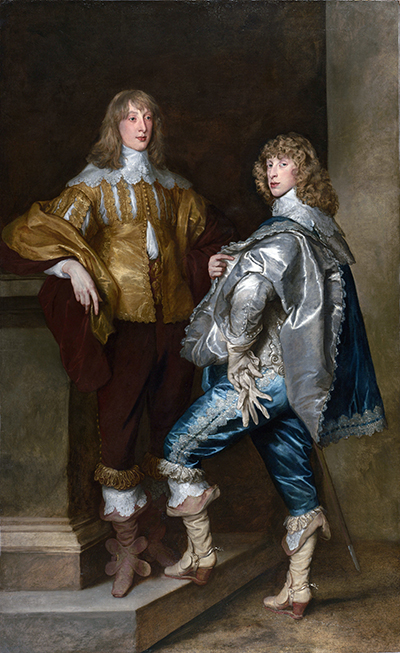
Gainsborough offers a particularly concrete example of later influence. The National Gallery identifies Van Dyck’s George Villiers, 2nd Duke of Buckingham and Lord Francis Villiers of 1635 as a direct source for The Blue Boy of 1770: Gainsborough borrowed George’s stance. He also made a close copy of Lord John Stuart and his Brother, Lord Bernard Stuart . [4]
These are two different kinds of engagement. Copying the brothers’ portrait allowed sustained attention to an existing composition. Borrowing a stance for a new portrait involved selection and adaptation. The National Gallery also connects the red, gold and blue of Gainsborough’s Mrs Siddons to Van Dyck, extending the comparison from pose to colour. [4]
Such examples give “influence” a useful shape. We can ask which painting was studied, what was retained and what happened when the borrowed element entered another picture. That makes influence something we can investigate in the pictures themselves.
Artworks directory
A selected directory of paintings, drawings and prints, including works discussed in the articles and the Frick’s 2016 portraiture exhibition. It is not a complete catalogue of Van Dyck’s work. Print titles identify collaborators or later printmakers; disputed and workshop attributions are retained. The exhibition checklist supplies additional object records; current collection information governs the updated article entries. [17]
Frequently Asked Questions
No. It assigns the work to his studio rather than claiming that he painted it entirely himself. Stockholm’s St Jerome with an Angel shows how a picture can be recognised as a high-quality repetition while receiving a workshop attribution. A claim of deception would require different evidence. [2]
Analysis clarifies materials and painting sequences. Identifying an individual hand still requires judgement, especially where studio practices were shared. [5]
No. An impression is an individual print taken from a plate. A new state follows a change to that plate. Many impressions may be printed without an intervening alteration, so these terms answer different questions. [15]
Through specific works and actions: Gainsborough copied the Stuart brothers and drew on George Villiers’s pose for The Blue Boy . These comparisons offer firmer ground than a general resemblance between elegant portraits. [4]
Discussion
Look again at the images and ideas explored in Anthony van Dyck: Workshop and Influence. These editorial prompts invite your observations.
Reader Insights
How would knowing that several painters contributed to a picture change the way you look at it?
When comparing two versions, which differences would help you investigate how they were made?
What makes a borrowed pose feel newly invented in a later portrait?
Join the Conversation
Share a detail, comparison or question about Anthony van Dyck: Workshop and Influence below.
References
- Stijn Alsteens , “A Portraitist’s Progress” and introductory catalogue excerpt, Van Dyck: The Anatomy of Portraiture , The Frick Collection, 2016. English; published excerpt. View source .
- Nationalmuseum , St Jerome with an Angel , workshop of Anthony van Dyck, NM404, including the reproduced 2010 catalogue entry and technical notes. English. View source .
- KBR , “De uomini illustri van Antoon van Dijck”, 18 June 2020. Dutch. View source .
- The National Gallery , Gainsborough’s Blue Boy , 2022 exhibition overview and painting highlights. English. View source .
- Larry Keith , “The Rubens Studio and the Drunken Silenus supported by Satyrs ”, National Gallery Technical Bulletin , 20, 1999, pp. 96–104. English. View source .
- Gregory Martin , Nina Cahill and Bart Cornelis, Equestrian Portrait of Charles I , The National Gallery, 2024, “Early Copies”. English. View source .
- Nico Van Hout , “De lanssteek, van Rubens?”, KMSKA. Dutch. View source .
- The National Gallery , Drunken Silenus supported by Satyrs , possibly by Anthony van Dyck, NG853. English. View source .
- The Frick Collection , Portrait of a Woman , exhibition object 90, Van Dyck: The Anatomy of Portraiture , 2016. English. View source .
- The National Museum of Western Art , Tokyo, Diego Felipe de Guzmán, Marquis of Leganés , P.1987-0002. Japanese and English; English collection text used. View source .
- Complesso della Pilotta , “Van Dyck l’Europeo”, 21 March 2026, loan statement for Madonna col Bambino , GN357. Italian. View source .
- Caterina Limentani Virdis , Madonna col Bambino , GN357, Complesso della Pilotta, adapted from the 1999 Galleria Nazionale di Parma catalogue. Italian. View source .
- Bendor Grosvenor , “Before ’n After”, Art History News , 1 October 2012. English; participant account. View source .
- The Frick Collection , “The Iconographie and Other Early Portrait Prints after Van Dyck”, 2016, selected entries for Orazio Gentileschi and Inigo Jones. English. View source .
- The Metropolitan Museum of Art , Self-Portrait, from the Iconography , 50.583.4. English. View source .
- The Pushkin State Museum of Fine Arts , Anthony van Dyck: works after his paintings in the British prints collection. Russian. View source .
- The Frick Collection, Van Dyck: The Anatomy of Portraiture, online exhibition checklist (2016). View source.