


 by
Tom Gurney
Tom Gurney BSc (Hons) is an art history expert with over 20 years experience
Email:
tomgurney1@gmail.com
/ Phone:
+44 7429 011000
Margareta de Vos: Introduction
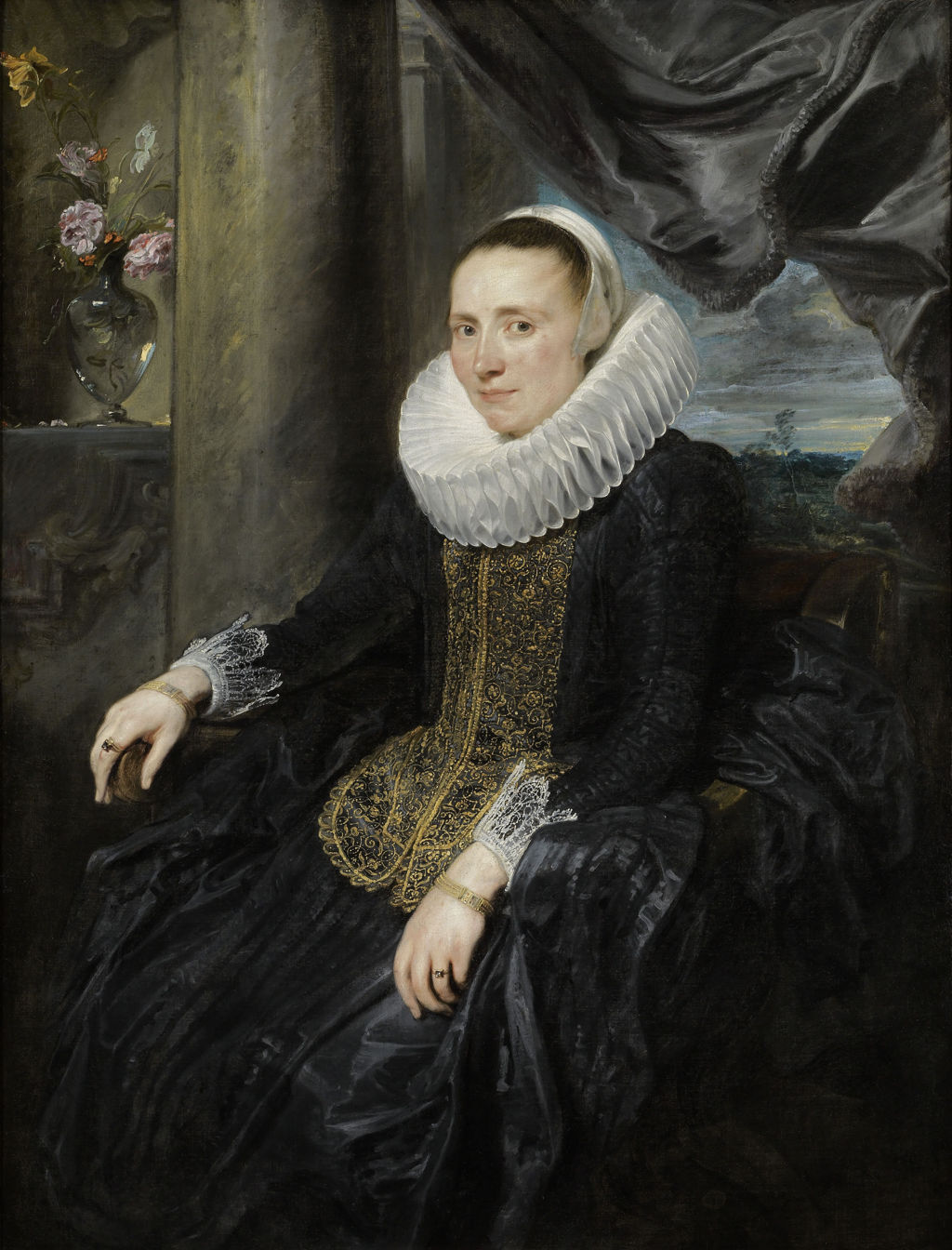
Margareta de Vos looks out from a great wheel of white linen. Its pleats catch the light around her face, while the dark dress below opens into a narrow field of gold pattern. Anthony van Dyck gives her a substantial seated presence: her hands lie well apart, her skirts fill the lower canvas, and her eyes meet ours across the elaborate display. Painted about 1620, the portrait belongs to The Frick Collection. [1]
At a Glance
- Artist Anthony van Dyck
- Title Margareta de Vos
- Date About 1620
- Medium Oil on canvas
- Dimensions 130.7 × 99.3 cm
- Collection The Frick Collection, Henry Clay Frick Bequest
- Companion portrait Frans Snyders , also at the Frick. [1] [2]
This work across Anthony van Dyck’s career
Entry of Christ into Jerusalem
about 1617Frans Snyders
about 1620Margareta de Vos (current article)
about 1620Rinaldo and Armida
1629–1632; Louvre commentary proposes late1631–spring1632Charles I in Three Positions
1635–before June 1636Lord John Stuart and his Brother
about 1638Cupid and Psyche
1639–40Self Portrait
c. 1640Contents
- Meeting Margareta
- The white collar and the gold bodice
- Two hands, two positions
- A small vase beside a large figure
- The head was revised
- A shared terrace, an individual presence
Meeting Margareta
The first encounter is with a face held unusually clear of its surroundings. Margareta's hair is drawn back beneath a pale covering; the exposed forehead, softly modelled cheeks and small mouth remain legible against the immense collar. Her head turns slightly towards the left of the picture, but her gaze comes forward. The direction of her body and the direction of her attention are different enough to animate the pose.
Van Dyck does not need a large movement. A small change in the line of the lips, the unequal light around the eyes and the gentle turn of the chin give the face its particularity. From a distance, the ruff supplies the portrait's most arresting shape. At closer range, the eyes draw attention back into the small area of flesh at its centre. The clothing amplifies her presence without swallowing the likeness.
Margareta belonged to an Antwerp family with strong connections to painting. The Frick identifies her as a distiller's daughter; the Snijders&Rockoxhuis names the painters Cornelis and Paul de Vos among her brothers. [1] [3] Her marriage to the animal and still-life painter Frans Snyders placed her within another artistic household. These connections help locate her socially, though the painted image makes no attempt to turn her into an illustration of an artistic profession. There are no tools in her hands. Her dress, bearing and gaze occupy the foreground.
The white collar and the gold bodice
The ruff has an almost architectural firmness. Its outer edge rises high beside the head, then sweeps down under the chin. Along that curve, repeated folds form little chambers of light and shadow. Some look nearly white; others turn grey as they recede. The rhythm makes a rigid article of clothing feel three-dimensional, with air between its layers.
Its scale also changes the apparent proportions of the sitter. The collar widens the upper body and holds the face above the dark shoulders. Beneath it, a long gold-patterned panel narrows the torso before spreading across the lap. White and gold thus organise the figure vertically: the broad bright oval above, the intricate taper below. The Frick associates the costly millstone collar with the sitter's prosperity. [1] Its visual work is equally striking. It makes even the smallest movement of her head conspicuous.
The dress rewards a slower look because its darkness contains several kinds of surface. The upper sleeves appear closely textured, while broader folds across the skirt pick up long, cool streaks of light. The gold pattern is concentrated into curling lines and small repeated shapes. Beside it, the large black folds can seem almost empty until their highlights reveal the volume beneath.
Van Dyck varies the scale of detail carefully. The bodice asks the eye to follow tiny ornament; the skirt is gathered into broad sweeps. The lace at the wrists has yet another rhythm, its pointed edges standing free against the sleeves. These differences make the costume readable as a collection of distinct things worn by a body, with weight, stiffness and softness distributed across it.
Two hands, two positions
Margareta's hands are separated by the breadth of her lap. At the left of the image, one rests on the chair arm with the fingers bending down. The other hangs lower against the folds of the skirt. Their pale colour carries the light from the face into the lower half of the portrait, and the gold at the wrists picks up the warmer ornament of the bodice.
Both hands are relaxed enough for the fingers to remain distinct. Neither grips an object or performs a conspicuous action. The difference in their height gives the seated figure a gentle asymmetry: one arm opens towards the edge of the canvas, while the other falls closer to the centre. The triangular arrangement of face and hands helps us understand the body beneath the dress.
The jewellery supplies small accents. Rings interrupt the fingers with dark and bright marks; the bracelets make thin gold bands at the wrists. These details are easy to miss at first because the ruff dominates the light. Once noticed, they encourage a closer inspection of the hands. The portrait's formal bearing grows from several such modest adjustments of placement and emphasis.
Watch: Van Dyck’s art and working methods
Choose a museum introduction, a specialist lecture or a conservation film to continue exploring Van Dyck’s work.
Van Dyck, The Anatomy of Portraiture
The Frick curators introduce Van Dyck’s portraits, drawings and prints.
Watch on YouTubeA small vase beside a large figure
At the upper left, a glass vase stands on a stone ledge. Flowers rise into the narrow strip beside the column, with pale and pink heads lower down and a yellow bloom near the top. Their thin stems and irregular spacing offer a looser pattern than the disciplined repetitions of the ruff. The vase is small within the composition, but it occupies a useful pause between the sitter and the edge.
The glass has enough darkness to belong to the shaded architecture around it. A few light touches make it appear rounded and reflective. The Frick draws attention to the blue and yellow strokes used for its reflections. [1] Looking from those touches to the white collar reveals how differently paint can suggest a hard transparent vessel and folded opaque linen. The glass depends on sparse, broken accents; the ruff gathers many adjacent light planes into a continuous form.
The flowers also allow the eye to travel upwards without leaving the portrait's intimate scale. Each small patch of colour can be read separately, then the whole arrangement resolves into a delicate counterweight to the sitter. There is no need to assign every bloom a moral or marital meaning to appreciate this contribution. The vase gives Margareta a richly appointed setting and gives Van Dyck another material to describe.
The head was revised
The Frick records an alteration to the composition of Margareta's head and notes that the changes have become visible. [1] Such a revision is often called a pentimento: a trace of an earlier painted decision showing through the finished image. Here the evidence adds a useful complication to the apparent assurance of the portrait. The alignment of face, head covering and ruff was something the painter worked out and adjusted.
The finished relationship is very precise. The face sits forward of the collar's high rim, while the pale covering follows the crown and turns down beside the head. A change in this small area would affect the balance of the whole upper figure. It is therefore worth looking at the head both as a likeness and as a set of interlocking shapes.
The reason for the alteration remains unknown. The visible change preserves a trace of the painter's decisions within a portrait whose completed pose feels settled.
A shared terrace, an individual presence
Margareta's portrait has a companion in Van Dyck's Frans Snyders . The Frick describes the terrace and distant landscape as linking the two pictures. [2] Look across them and the dark hanging fabric, pale architecture and low strip of outdoor light create a common visual environment. Within that setting, Margareta's enormous ruff and gold bodice give her a sharply different silhouette from Snyders's broad dark cloak and smaller lace collar.
The pairing invites comparison of their hands, too. Margareta's hands remain low and widely spaced, whereas Snyders brings one hand across the cloth near the centre of his portrait. Each figure has a distinct arrangement of light accents and dark masses. The shared setting holds the pictures together while allowing the two sitters to occupy it differently.
The chronology matters when considering the occasion. Margareta and Snyders married on 23 October 1611. They purchased the Antwerp house De Fortuyne on 24 December 1620 and began living there in 1622, according to the museum now incorporating their former home. [4] The Frick proposes the house purchase as a possible occasion for the portraits. [2] That remains a suggestion, and the approximate date of about 1620 should remain approximate. The painted terrace cannot be used as a measured view of De Fortuyne or a record of the pictures' original placement.
Seen on her own, Margareta still commands the entire composition. The column gives her figure a firm vertical neighbour; the curtain rises above her; the light beyond opens a little space beside her shoulder. Her gaze brings the attention back from these furnishings. The sitter is surrounded by costly things, yet the face that meets us remains small, particular and immediately readable.
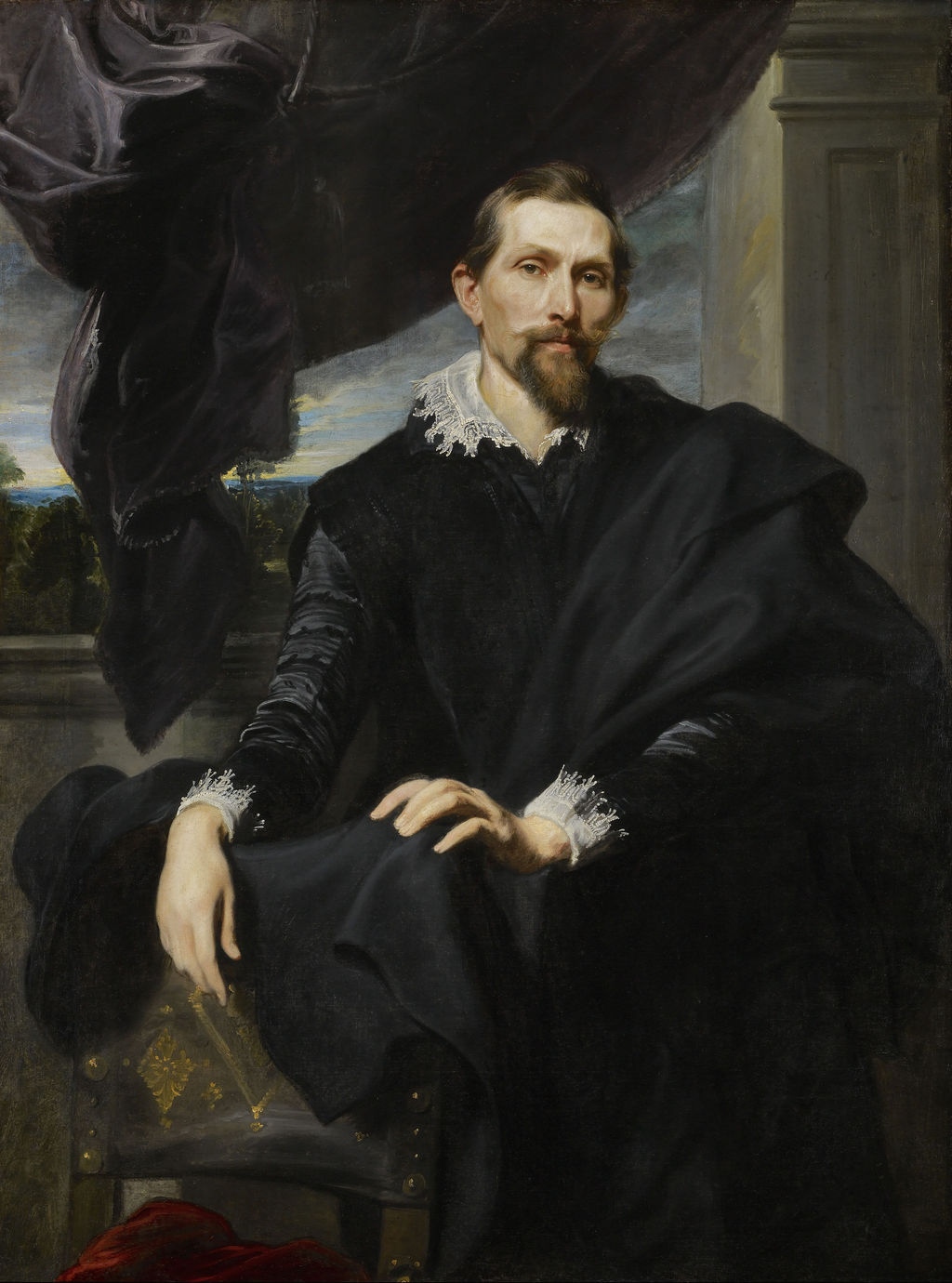
Anthony van Dyck, Frans Snyders, about 1620. Oil on canvas, 142.5 × 105.4 cm. The Frick Collection, Henry Clay Frick Bequest.
Image source
.
Public domain
.
Artworks directory
A selected directory of paintings, drawings and prints, including works discussed in the articles and the Frick’s 2016 portraiture exhibition. It is not a complete catalogue of Van Dyck’s work. Print titles identify collaborators or later printmakers; disputed and workshop attributions are retained. The exhibition checklist supplies additional object records; current collection information governs the updated article entries. [5]
Frequently Asked Questions
The Frick dates the painting to about 1620. This is an approximate date, rather than a documented day or year of completion. [1]
The flowers introduce small areas of colour and a light, irregular pattern beside the large column. They also give the painter an opportunity to show glass and reflections. A specific symbolic message for the individual flowers is not established by the evidence used here.
The Frick identifies a revision to the composition of the head, traces of which are now visible. Its online entry does not explain the painter's reason for making the change. [1]
Discussion
Look again at the images and ideas explored in Margareta de Vos. These editorial prompts invite your observations.
Reader Insights
Where does your eye go after meeting Margareta's gaze: to the ruff, the gold pattern, the hands or the flowers? How does the arrangement guide that movement?
Compare the light on the glass vase, lace cuffs and broad skirt folds. What makes each material appear different?
Looking at the two companion portraits, which features create a shared setting, and which give each sitter a distinct presence?
Join the Conversation
Share a detail, comparison or question about Margareta de Vos below.
References
- The Frick Collection , Margareta de Vos, Van Dyck exhibition object 11. View source .
- The Frick Collection , Frans Snyders, Van Dyck exhibition object 10. View source .
- Snijders&Rockoxhuis , Wie is Frans Snijders. In Dutch. View source .
- Snijders&Rockoxhuis , Historiek en Tijdslijn. In Dutch. View source .
- The Frick Collection, Van Dyck: The Anatomy of Portraiture, online exhibition checklist (2016). View source.


