


 by
Tom Gurney
Tom Gurney BSc (Hons) is an art history expert with over 20 years experience
Email:
tomgurney1@gmail.com
/ Phone:
+44 7429 011000
Anton Giulio Brignole-Sale on Horseback: Introduction
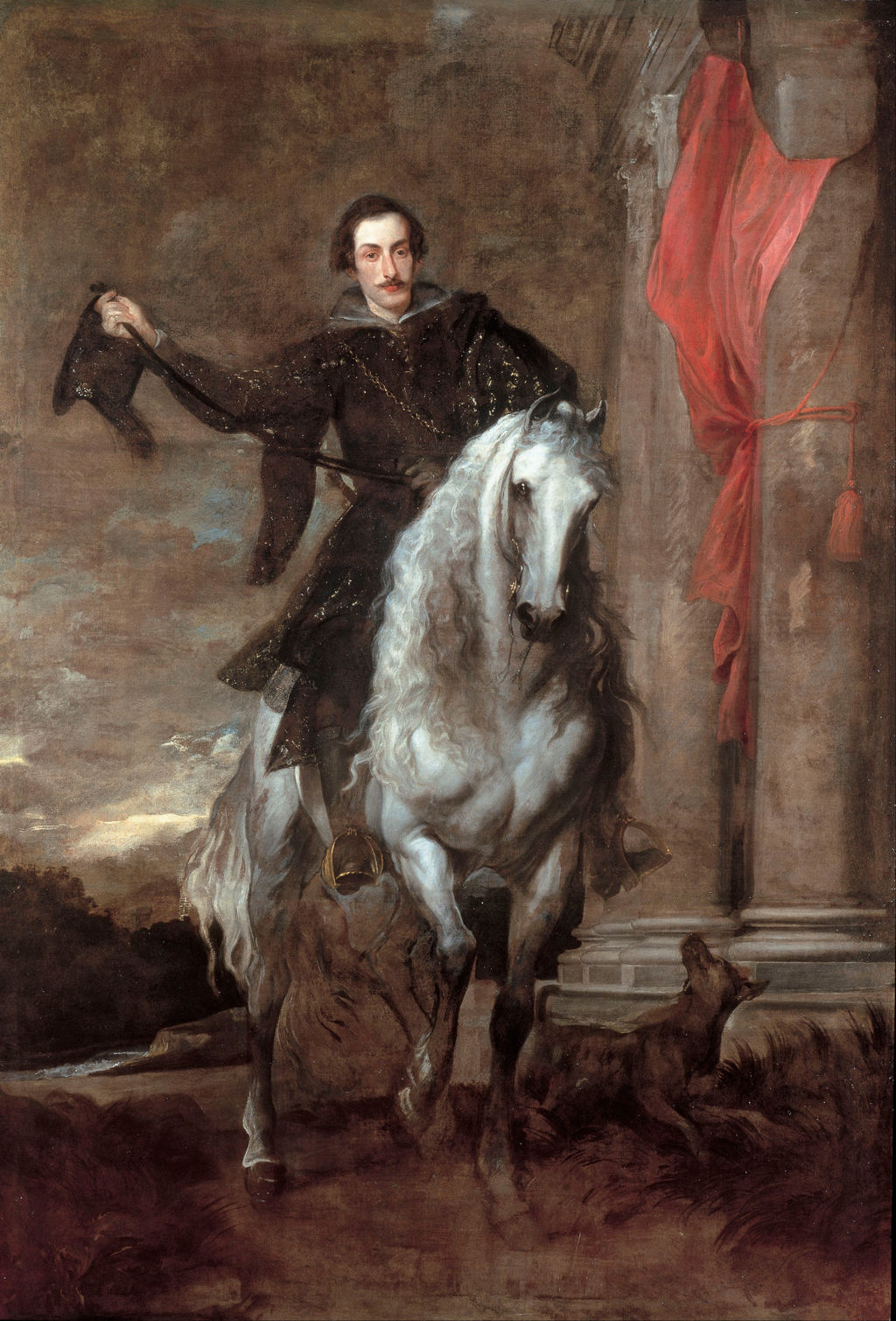
Anton Giulio Brignole-Sale rides towards us on a white horse, extending a black hat in greeting. The gesture opens a portrait built on imposing scale: the animal fills the foreground, a column rises beside it, and the young rider looks out from above. Painted by Anthony van Dyck in 1627, when Anton Giulio was twenty-two, this equestrian portrait gives a newly established nobleman the presence of a ruler. It belongs to the Brignole-Sale collection at Palazzo Rosso in Genoa. [1]
At a Glance
- Artist Anthony van Dyck, recorded by the museum as Antoon Van Dyck. [1]
- Title Anton Giulio Brignole-Sale on Horseback ; Italian title, Anton Giulio Brignole-Sale a cavallo . [1]
- Date 1627. [1]
- Medium Oil on canvas. [1]
- Dimensions 282 × 198 cm. [1]
- Collection Musei di Strada Nuova, Palazzo Rosso, Genoa; inventory PR 48. [1]
- Sitter Anton Giulio Brignole-Sale, 1605–1665. [2]
- Companion portrait Paolina Adorno Brignole-Sale , his wife, also painted in 1627. [3]
- Acquisition Donation of Maria Brignole-Sale De Ferrari, 1874. [1]
This work across Anthony van Dyck’s career
Entry of Christ into Jerusalem
about 1617Frans Snyders
about 1620Rinaldo and Armida
1629–1632; Louvre commentary proposes late1631–spring1632Charles I in Three Positions
1635–before June 1636Lord John Stuart and his Brother
about 1638Cupid and Psyche
1639–40Self Portrait
c. 1640Contents
- A horse approaching, a rider greeting
- The dark rider and the light horse
- New nobility on a monumental scale
- An inherited equestrian language
- A family commission and a companion portrait
- How the portrait reached Palazzo Rosso
A horse approaching, a rider greeting
The horse brings the portrait almost to the viewer's feet. Its chest occupies the centre of the canvas, its neck bends slightly, and one foreleg lifts across the other. The body turns back into the picture towards the left, but the head faces us. That combination makes the animal seem to approach through a narrow opening. There is little empty ground between its hooves and the lower edge.
Above this substantial body, the rider sits with remarkable ease. His torso turns towards us, and the outward reach of his right arm balances the horse's weight. The black hat hangs from his hand at the far left. Its feathers and soft outline make the gesture larger than the hand itself; the dark sleeve carries the movement back towards his shoulder. The pose is broad enough to be recognised at a distance.
The greeting also changes the terms of the encounter. Anton Giulio is physically elevated, yet he acknowledges someone outside the painting. We can read the offered hat as a courteous salutation without inventing a particular arrival, conversation or spectator. His gaze meets ours while his mouth remains closed. The face supplies a still point within the larger movement of arm, drapery and horse.
The animal participates in that address. Its ears rise close beneath the rider's elbow, its dark eye catches the light, and its muzzle stands out against the shadow beside the column. Van Dyck lets us register both the horse's mass and the smaller signs of its alertness. The bridle and reins draw fine lines across the broad pale head. Control is present as a light connection between rider and mount.
Near the lower right, a dog looks upwards towards the horse and rider. Its small head and long body provide another measure of the horse's size. The animal also carries the action across the foreground towards the column base. Following its upward look, the eye returns to the pale neck and then to Anton Giulio's face. The portrait's grandeur emerges through these relationships of bodies, heights and directions.
The dark rider and the light horse
Much of Anton Giulio's costume is black, but the clothing remains legible through scattered glints. Gold decoration picks out his chest and sleeves; a chain falls across the front of his body. The loose outline of the cloak expands his shoulders and follows the extended arm. His pale collar lifts the face away from the surrounding darkness. Below, the long boot and bright edge of the stirrup connect him to the saddle.
The horse answers these small flashes with a great area of broken light. Its coat moves between cool grey, cream and blue-white, with deep shadows around the chest and forelegs. The mane is especially active. Long, irregular waves descend down the neck, catching light in a succession of pale ridges. Their looseness differs from the ordered little marks of gold on the rider's clothing. One surface suggests flowing hair, the other costly patterned fabric.
The contrast gives the composition its clarity. Anton Giulio's dark figure is easy to find against the sky, while the white horse separates itself from his clothing, the column and the ground. Neither area is flat. Small shifts of light keep the black costume open, and the shadows give the pale animal its volume. Van Dyck can make the rider seem composed because so much visual movement has been entrusted to the horse beneath him.
At the right, a red drape gathers around the architecture. Its folds fall vertically and then curl into a knot or fastening beside the column. The warm colour sets off the horse's cooler tones. Its hanging shape also draws attention to the height of the stonework: the column continues upwards beyond the edge, leaving the viewer to imagine its full extent.
The architecture and landscape offer different kinds of space. The column is close, solid and emphatic. The opening to the left leads past low, dark land towards a narrow band of warm sky. Between them, the horse appears to pass from a shaded architectural setting into open air. This is an effective pictorial threshold; the painting alone cannot identify it as a particular part of the family's property.
The museum's curatorial account describes rapid handling and thin, glazed applications that suggest rich substance without a correspondingly thick paint layer. [1] This helps explain the visual economy of the portrait. A few light strokes can suggest a chain, a stirrup or a ripple of hair while the broader shapes retain their force.
Watch: Van Dyck’s art and working methods
Choose a museum introduction, a specialist lecture or a conservation film to continue exploring Van Dyck’s work.
Van Dyck, The Anatomy of Portraiture
The Frick curators introduce Van Dyck’s portraits, drawings and prints.
Watch on YouTubeNew nobility on a monumental scale
Anton Giulio's prominence had a recent and specific foundation. He inherited the fief of Groppoli and the title of marquis through his maternal family, and was formally enrolled in the Genoese aristocracy in 1626. [1] Van Dyck painted him the next year. The image therefore belongs close to the public recognition of his noble status.
The wider family story explains the resources behind the commission. The Brignole had risen through commerce and the production of wool and silk. The marriage of Anton Giulio's father, Gio. Francesco Brignole, to Geronima Sale joined that ascent to the Sale inheritance. The museum places the large family portraits within this sustained effort to give wealth an impressive visible form. [2]
Scale is crucial to that effort. At nearly three metres high, the canvas gives the rider a presence that an ordinary likeness could not command. The horse raises him, the column extends his surroundings, and the outstretched arm claims almost the full width of the upper composition. The spectator encounters an arrangement made for a substantial room and for viewing from below the rider's level.
The setting does not need a crowded display of possessions. Architecture, rich black dress, gold details and a fine horse provide a concentrated vocabulary of distinction. Anton Giulio's hand then animates these signs of rank. The gesture suggests that gracious conduct belongs with elevated position: the person who commands this space can also acknowledge the person entering it.
Van Dyck had arrived in Italy in 1621 and found a receptive audience among Genoa's wealthy families. The city's museum connects the Brignole commission to this demand for prestigious portraits, and places the three family paintings in the final year of his Italian stay. [4] The wider course of his Italian years helps explain that success, but here its result is concentrated in one young man's public appearance.
Later achievements should remain later. Gio. Francesco became doge in 1635, eight years after the portrait. Anton Giulio went on to literary and diplomatic activity and, after becoming a widower, entered the Society of Jesus around the age of forty-five. [2] Those events extend the sitter's history. They do not establish that Van Dyck intended the youthful face or the black clothing to foreshadow a religious vocation.
An inherited equestrian language
The Genoese museum identifies two portraits by Peter Paul Rubens as compositional precedents: Giovan Carlo Doria on Horseback , now at Palazzo Spinola in Genoa, and the Duke of Lerma in Madrid. [1] The comparison places Anton Giulio within an existing language of mounted authority. A white horse advancing towards the spectator could carry associations already established by powerful earlier sitters.
Rubens painted the Duke of Lerma in 1603. The Prado describes the duke's half armour, commander's staff and distant cavalry battle as elements of an emphatically military image. It also traces Rubens's composition to Titian's Charles V at Mühlberg . [5] Equestrian portraiture thus offered Van Dyck a chain of distinguished models, with connections to both sovereign and aristocratic power.
Anton Giulio adopts this commanding format in a different register. His most conspicuous action is the presentation of his hat. The extended hand makes social acknowledgement visible on the same scale as the horse's movement. Fine clothing takes the place occupied by armour in Lerma's portrait, and the near architecture provides the monumental frame. The result allows a young Genoese nobleman to inhabit the elevated form through elegance and courtesy.
The distinction is also a matter of pacing. The horse's lifted leg supplies forward movement, yet the rider's face and upright torso remain stable. His sleeve stretches across the canvas without appearing strained. The varied directions gather around a figure who seems able to sustain them easily. That apparent effortlessness is one of the portrait's strongest statements about social position.
The Doria precedent also gives that inheritance a local dimension: the equestrian language already had a distinguished Genoese example. [1]
A family commission and a companion portrait
Anton Giulio's portrait was part of a group commissioned by his father. Van Dyck also painted Geronima Sale Brignole with her daughter Aurelia, and Anton Giulio's wife, Paolina Adorno Brignole-Sale . [4] The museum reports a payment entered in the family accounts in 1627: 747 lire for all three paintings together. [3] That total cannot be used as the individual price of this equestrian portrait.
Paolina's canvas gives her a comparably monumental independent presence. It measures 286 × 198 cm, sharing Anton Giulio's width and standing slightly taller. She appears on foot in a blue dress with elaborate gold ornament, beside a chair and beneath great columns and red drapery. [3] Seen together, the pictures establish a shared visual world through scale, architecture and costly surfaces while allowing each sitter a distinct encounter with the viewer.
Their differences are particularly revealing. Anton Giulio's arm and horse drive the composition outwards. Paolina's long dress expands downwards and across the ground, giving weight to a standing figure. The bright horse provides a large light form in his portrait; her gold embroidery articulates a dark blue surface through many smaller accents. Both faces emerge above dark collars, and both sitters direct their gaze towards us.
The pair therefore rewards comparison beyond the fact of marriage. Each portrait must command a canvas of immense size. In one, the horse supplies the body and motion around which the sitter is organised. In the other, dress and architectural spacing perform much of that work. Their survival together lets us compare related but individual solutions for two people within the same commission. [3]
How the portrait reached Palazzo Rosso
Palazzo Rosso was built between 1671 and 1677, decades after these portraits were painted. The family history credits Anton Giulio's sons, Ridolfo and Gio. Francesco I, with carrying out the building project. [2] The palace's imposing rooms now give the pictures a fitting setting, but they were not the original rooms of the 1627 commission.
The museum associates their transfer to the new residence with Ridolfo. It also records an internal family repurchase in 1687, when Gio. Francesco I secured the portraits against their passing out of the family collection. [3] They had become inherited images of the house itself, valuable to descendants who had never known the young sitters represented in them.
In 1874, Maria Brignole-Sale De Ferrari, Duchess of Galliera, donated Palazzo Rosso and its collection to Genoa. [2] A portrait commissioned to proclaim a family's standing consequently became part of the city's public inheritance. Its association with the Brignole-Sale remains visible in its setting and history, while the horse, the extended hat and the meeting of gazes still give each visitor a direct way into the image.
Artworks directory
A selected directory of paintings, drawings and prints, including works discussed in the articles and the Frick’s 2016 portraiture exhibition. It is not a complete catalogue of Van Dyck’s work. Print titles identify collaborators or later printmakers; disputed and workshop attributions are retained. The exhibition checklist supplies additional object records; current collection information governs the updated article entries. [6]
Frequently Asked Questions
It belongs to the Musei di Strada Nuova at Palazzo Rosso in Genoa, where it is recorded as inventory PR 48. It is an oil painting on canvas, dated 1627, measuring 282 × 198 cm. [1]
The equestrian format gives him an elevated and authoritative presence. The museum relates that choice to his recent admission to the Genoese nobility and to earlier mounted portraits by Rubens. [1] His offered hat adds a courteous gesture to the imposing format.
The museum reports a recorded total of 747 lire in 1627 for three paintings: Anton Giulio's portrait, Paolina's portrait, and Geronima Sale Brignole with her daughter Aurelia. [3] The account does not provide a separate price for Anton Giulio's canvas in the museum's published description.
Discussion
Look again at the images and ideas explored in Anton Giulio Brignole-Sale on Horseback. These editorial prompts invite your observations.
Reader Insights
How does the extended hat affect your response to the rider's height and imposing horse?
Follow the light from the horse's mane to the rider's collar and face. Which details make the dark costume remain visible?
Compare Anton Giulio's mounted portrait with Paolina's standing figure. How does each command a canvas of similar size?
Join the Conversation
Share a detail, comparison or question about Anton Giulio Brignole-Sale on Horseback below.
References
- Musei di Genova , Anton Giulio Brignole-Sale a cavallo. Italian. View source .
- Musei di Genova , La Famiglia Brignole Sale. Italian. View source .
- Musei di Genova , Ritratto di Paolina Adorno Brignole-Sale. Italian. View source .
- Musei di Genova , Antoon Van Dyck: L’attività genovese. Italian. View source .
- Museo Nacional del Prado , Equestrian Portrait of the Duke of Lerma. English. View source .
- The Frick Collection, Van Dyck: The Anatomy of Portraiture, online exhibition checklist (2016). View source.


