 by
Tom Gurney
Tom Gurney BSc (Hons) is an art history expert with over 20 years experience
Email:
tomgurney1@gmail.com
/ Phone:
+44 7429 011000
Johann of Nassau-Siegen, Seated: Introduction
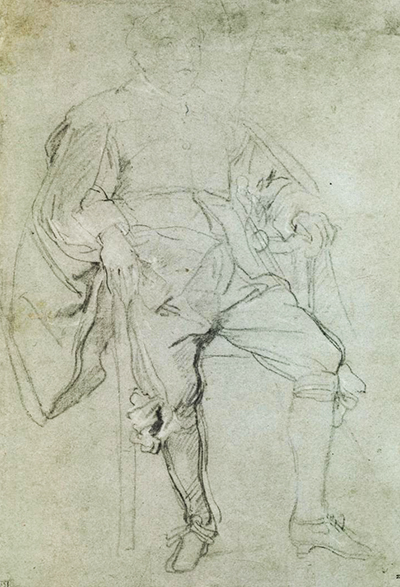
Johann's body has a convincing weight before his face has much definition. His knees spread across the lower half of the sheet, his sleeves gather at the elbows and his hands find support on a chair. In this study, Anthony van Dyck explores how a seated figure will occupy space. A change to one hand would later give that pose a more specific family meaning.
At a Glance
- Artist Anthony van Dyck
- Date About 1634
- Medium Black chalk with white heightening on blue laid paper
- Dimensions 46.1 × 31.5 cm
- Collection British Museum, London
- Museum number 1845,1208.4 [1]
This work across Anthony van Dyck’s career
Entry of Christ into Jerusalem
about 1617Frans Snyders
about 1620Rinaldo and Armida
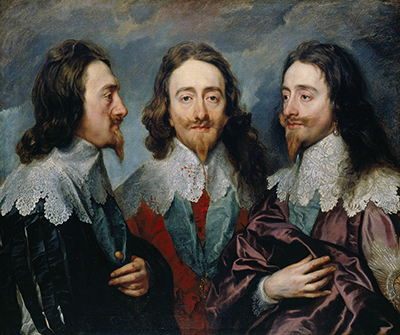
1629–1632; Louvre commentary proposes late1631–spring1632Charles I in Three Positions
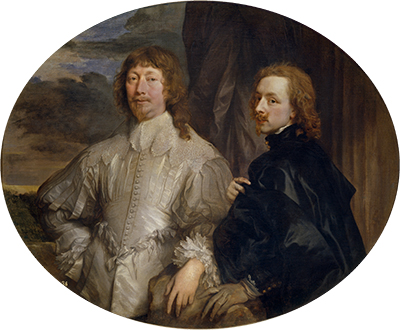
1635–before June 1636Lord John Stuart and his Brother
about 1638Cupid and Psyche
1639–40Self Portrait
c. 1640Contents
- How Van Dyck makes a seated body feel solid
- Clothes carry the movement
- The hand that changed the family portrait
- From the seated study to the painted family
- A companion study on a separate sheet
How Van Dyck makes a seated body feel solid
The figure fills the page without sitting squarely inside it. The shoulders form a broad upper mass, while the legs open in different directions below. One knee projects towards the right edge; the other sits lower and nearer the centre. Following these unequal levels makes the seated position easier to understand. The body has turned, and the clothes must accommodate that turn.
The chair provides a quiet framework. Its narrow lines remain much lighter than the strokes gathering around the waist and knees, yet the arm beneath the hand on the right of the image gives the figure a firm point of support. A few upright marks beneath the body help establish the height of the seat. Van Dyck gives enough information for us to imagine the furniture carrying Johann's weight without completing a separate description of it.
Look down towards the boots and the pose becomes more animated. Their different angles prevent the lower body from settling into a symmetrical arrangement. The long lines of the legs carry the eye towards them, then the darker, shorter marks around the ankles bring that movement to a stop. Even these small changes in direction contribute to the impression of someone seated, with room around his limbs.
Clothes carry the movement
The most insistent passages occur where fabric bends. Curves accumulate around the elbows; angular strokes cross the lap; a strong dark accent gathers between the thighs. At these points, the chalk has more to explain than an outer contour. It must show where cloth hangs, where it bunches and where one part of the body passes behind another.
Across the projecting thigh, comparatively long strokes suggest a broad surface. Beside it, shorter marks tighten into folds. This variation keeps the clothes from looking like a pattern laid over the figure. Their changing rhythm helps describe the underlying volume. The outlines remain open or faint in places, allowing our eye to complete a sleeve or a leg from a handful of stronger decisions nearby.
The British Museum records black chalk and white heightening on blue laid paper. [1] In the reproduction, the lighter touches are quieter than the dark outlines: they do not turn every fold into a fully modelled form. Looking for a uniform finish misses the interest of the sheet. Some passages establish a boundary, others suggest a surface, and others barely begin. The eye travels between those different degrees of attention.
The hand that changed the family portrait
The Frick Collection relates this sheet to the family portrait at Firle Place, with Johann and his wife Ernestine seated on a dais among their four children. Its account identifies a significant alteration in the painting: Johann's left hand points towards his son and heir, Johann Franz Desideratus. [2]
On the sheet, both hands belong to the business of sitting. The hand at the right of the image curls around its support; the other drops loosely beside the lap. They help explain how the arms rest and how the sleeves fall. Read alongside the Frick's description of the painting, this arrangement offers a useful distinction between establishing a body's position and making that body communicate with another person.
The pointing gesture, as described by the Frick, directs attention out of the father's figure and towards the child. [2] On that account, a relatively small change connects the seated pose to succession. The study leaves room for such a decision: the principal arrangement of shoulders, arms and legs can remain intelligible while a hand takes on a new task.
The head offers a different kind of opening. Its outline and scattered features are exceptionally faint beside the marks across the clothes. The Frick describes the drawing's priorities as pose and costume, with the face only lightly indicated. [2] Visually, this uneven distribution of detail shifts our attention towards the spread of the limbs and the fall of the fabric. We can recognise the intended presence of a sitter without receiving an equally sustained account of every part of him.
Watch: Van Dyck’s art and working methods
Choose a museum introduction, a specialist lecture or a conservation film to continue exploring Van Dyck’s work.
Stijn Alsteens: Drawing for Portraits
Stijn Alsteens explores how portrait drawings prepare and develop a likeness.
Watch on YouTubeFrom the seated study to the painted family
Firle Place dates the completed family portrait to 1634, the year around which the British Museum places the drawing. [3] [1] The museum describes the preparatory Nassau sheets as studies from life concerned with overall poses. [1] That purpose is especially clear here because almost all the available space belongs to Johann. There is no architectural setting to measure him against and no neighbouring child to explain his family position. His body must first make sense through its own arrangement of supports, bends and overlapping forms.
In Firle's reproduction of the painting, the familiar spread of the knees sits within a much larger framework. Columns rise behind the couple, a curtain hangs overhead and the children gather beside them. Johann's broad collar and bright chain give his upper body a prominence barely suggested in the chalk study. Gold ornament follows his sleeves, while pale cuffs interrupt the dark clothing at each wrist. The drawing helps us look beneath this elaborate finish: the interval between the knees and the resting positions of the arms still organise the figure. His pointing hand joins a pose already capable of carrying the weight of the costume. [3]
The move to canvas also involved a different prepared surface. In a technical study published by the National Gallery, Ashok Roy identifies a lead-white-based upper ground in the Firle family portrait, forming part of a preparation with two layers. His note explains that samples from the painting were examined at the National Gallery in connection with its restoration in 1993. [4] A ground is the layer beneath the painted image, providing the surface on which the artist works. Here that material evidence concerns the finished picture; the study's blue paper carries its own much more exposed network of chalk lines. Looking between the two works, we can follow the seated arrangement through a change of support, scale and finish, as well as the alteration of a single gesture.
A companion study on a separate sheet
Van Dyck also studied Ernestine Yolande with her son . That drawing occupies the front of a different sheet, with a study of Quintijn Simons on its reverse. [5] The two Nassau studies can be considered together without treating them as opposite sides of one piece of paper.
The British Museum notes a shared watermark, read as IR surmounted by a 4, and suggests that the seated studies may belong to the same working session. It does not establish an exact day or an order of sittings. [1] Their connection helps restore the practical setting of this apparently solitary man: his pose was being developed for a group.
Later collectors included Jonathan Richardson the elder, Thomas Hudson and Joshua Reynolds; the British Museum acquired the study in 1845. [1] Its survival lets us spend time with choices that a finished family portrait gathers into a larger composition. For another way Van Dyck organised the same sitter's presence, see Johann of Nassau-Siegen, Standing, Wearing Armour ; the wider range of purposes served by his sheets is explored in Van Dyck's drawings .
Artworks directory
A selected directory of paintings, drawings and prints, including works discussed in the articles and the Frick’s 2016 portraiture exhibition. It is not a complete catalogue of Van Dyck’s work. Print titles identify collaborators or later printmakers; disputed and workshop attributions are retained. The exhibition checklist supplies additional object records; current collection information governs the updated article entries. [6]
Frequently Asked Questions
The Frick identifies pose and costume as the drawing's main concerns. [2] The difference is visible across the sheet: firm marks organise the clothing and limbs, while the features receive much less attention. That contrast tells us where the study concentrates its effort; it does not establish why Van Dyck stopped drawing the face at this point.
According to the Frick, Johann's left hand was changed to point towards his son and heir. [2] In the drawing, the hands remain close to the chair and body, helping to establish support and rest. The reported alteration makes one of them direct attention towards another family member.
No. Ernestine's study shares its sheet with Quintijn Simons. [5] Johann's seated figure is a separate object. A relationship between drawings made for one portrait should be distinguished from two drawings occupying the same sheet.
Discussion
Look again at the images and ideas explored in Johann of Nassau-Siegen, Seated. These editorial prompts invite your observations.
Reader Insights
Which marks make Johann's weight on the chair most convincing to you?
How does your attention change as you move from the faint face to the more strongly drawn clothes?
What difference does a pointing hand make to the way a father appears within a family portrait?
Join the Conversation
Share a detail, comparison or question about Johann of Nassau-Siegen, Seated below.
References
- British Museum , Johann of Nassau-Siegen, seated , museum number 1845,1208.4. English. View source .
- The Frick Collection , Johann of Nassau-Siegen, Seated , Van Dyck exhibition, object 29. English. View source .
- Emma Olver , Firle Place, Firle Treasures , section “Count John of Nassau-Siegen and his Family”, including the linked whole-painting and detail reproduction. English. View source .
- Ashok Roy , “The National Gallery Van Dycks: Technique and Development”, National Gallery Technical Bulletin 20 (1999), pp. 70–72 and note 33, p. 83. English. View source .
- British Museum , Ernestine Yolande, Countess of Nassau-Siegen, with her son; Quintijn Simons , museum number 1874,0808.139. English. View source .
- The Frick Collection, Van Dyck: The Anatomy of Portraiture, online exhibition checklist (2016). View source.