 by
Tom Gurney
Tom Gurney BSc (Hons) is an art history expert with over 20 years experience
Email:
tomgurney1@gmail.com
/ Phone:
+44 7429 011000
Johann of Nassau-Siegen, Standing, Wearing Armour: Introduction
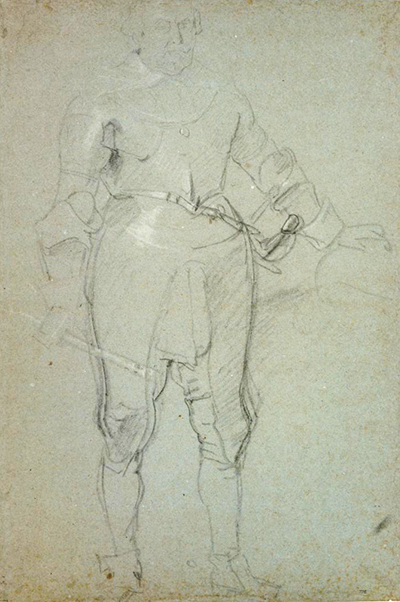
In Anthony van Dyck’s study of Johann of Nassau-Siegen, a few white chalk marks make the armour catch the light. The face is barely described, yet the standing figure already has a commanding presence. Broad shoulders, bent elbows and long, planted legs carry much of the portrait’s effect.
At a Glance
- Artist Anthony van Dyck
- Subject Johann VIII, Count of Nassau-Siegen
- Date About 1634
- Medium Black chalk heightened with white chalk on blue paper
- Dimensions 50.9 × 33.8 cm
- Collection British Museum, London
- Museum number 1845,1208.3, recto [1]
This work across Anthony van Dyck’s career
Entry of Christ into Jerusalem
about 1617Frans Snyders
about 1620Rinaldo and Armida
1629–1632; Louvre commentary proposes late1631–spring1632Charles I in Three Positions
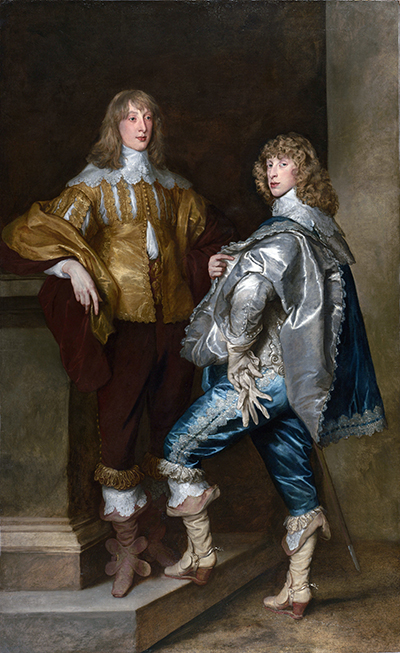
1635–before June 1636Lord John Stuart and his Brother
about 1638Cupid and Psyche
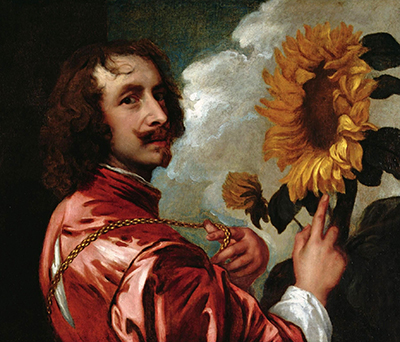
1639–40Self Portrait
c. 1640Contents
- How chalk makes the armour shine
- A commander’s stance
- The related painting and the difference in dates
- One sheet, two portrait subjects
- The commander in print
How chalk makes the armour shine
The most striking passages lie around the chest and waist. Pale strokes sit against the quieter surface of the paper, while darker curves describe the breastplate and the overlapping forms below it. The brightness is sparing. It takes only a small change of tone to suggest light sliding across metal.
Look at the difference between the upper body and the head. The face consists of a handful of faint indications, without the modelling that would establish a fully developed likeness. Around the torso, the marks become more purposeful: a curved edge, a dark joint, a bright patch. The Frick Collection’s account identifies the armour and its white highlights as the study’s principal concern. [2]
Van Dyck also varies the strength of the outline. Some edges fade almost into the paper; others are reinforced enough to hold an elbow or knee in place. The viewer completes the figure across these gaps. That economy gives the drawing a lively, searching quality, with enough structure to make the body convincing and enough openness to let us follow its construction.
The blue paper gives the dark and pale chalk a middle ground between them. In a reproduction, the sheet may appear muted or warm in colour, so its present appearance should not be used alone to identify the paper’s original hue.
A commander’s stance
Johann carries a baton in his right hand and a helmet beneath his left arm. [1] These objects help explain the spread of the arms: each side of the figure has a different task, creating an uneven rhythm around the body. The upper silhouette widens at the elbows, narrows sharply towards the waist and opens again through the legs. Even before we study the face, this arrangement gives the sitter weight and room.
The contrast between the broad torso and the lightly indicated head is particularly useful to notice. A finished portrait might draw us first to a recognisable expression. Here we can see how much of a public image can be established through the placement of a body, its clothing and its accessories.
The Frick places the drawing within Van Dyck’s return to the Southern Netherlands in 1634, when he portrayed Brussels courtiers. Johann was a Catholic convert and a general serving the Habsburgs there. His allegiance placed him in conflict with members of his Protestant family. [2] That history gives the military presentation a specific setting. The drawing itself supplies no account of a battle or victory: its interest lies in the controlled presentation of the commander.
The related painting and the difference in dates
The British Museum connects this study with the full-length portrait in the Liechtenstein Princely Collections. It dates the drawing to about 1634, partly through the Scaglia studies on the reverse. [1] The painting’s owner currently dates its canvas to about 1627. Its argument considers Johann’s award of the Order of the Golden Fleece in 1627 and his older appearance in Van Dyck’s dated family portrait of 1634. [3]
Those dates do not establish a simple sequence from preparatory drawing to finished canvas. The connection is the British Museum’s curatorial identification, with the precise chronology still unsettled. [1] [3] The evidence concerns different things: the Golden Fleece helps date the painted costume, while the drawings on the reverse connect this piece of paper with another portrait project. Neither kind of evidence, by itself, tells us when Van Dyck worked on each side of the sheet.
The painting measures 204 × 122 cm, a substantial enlargement of the human figure into a formal portrait. The Liechtenstein account describes a rich hanging and cloudy sky behind the armoured sitter, and records an original companion portrait of Ernestine Yolande, now known through a copy. [3] Such a setting gives the commander a surrounding world. On paper, the almost empty space keeps our attention close to the figure’s stance and the small decisions that make it legible.
Watch: Van Dyck’s art and working methods
Choose a museum introduction, a specialist lecture or a conservation film to continue exploring Van Dyck’s work.
Stijn Alsteens: Drawing for Portraits
Stijn Alsteens explores how portrait drawings prepare and develop a likeness.
Watch on YouTubeOne sheet, two portrait subjects
Two studies of Cesare Alessandro Scaglia occupy the reverse, linked to a devotional portrait of about 1634–35. [1] Turning the sheet therefore takes us from a military figure to another sitter and another kind of image.
In the National Gallery’s The Abbot Scaglia adoring the Virgin and Child , the kneeling diplomat receives the infant Christ’s blessing. He commissioned the picture for the Recollect church in Antwerp. [4] This is the painted work behind the British Museum’s comparison when it considers the date of the Nassau sheet. [1]
The two sides also offer a striking comparison in the handling of likeness. On the reverse, Scaglia’s head appears twice, one study above the other. The lower figure has a clearly articulated eye, nose and mouth, with a hand brought towards the chest. Johann’s face on the front remains a pale suggestion above a much more emphatic body. Looking from one side to the other, we can see a change in where the defining information lies: in the commander’s armour and stance, then in the diplomat’s turned head and gesture. The shared paper preserves both approaches without explaining which drawing came first.
Johann’s separate seated study relates to the Firle Place family portrait. [1] Looking between the two poses makes the standing figure’s outward breadth more apparent. Here the body has space to extend from shoulder to foot; the bent arms interrupt the long vertical movement and make the upper half feel firmly organised.
Further examples in Van Dyck’s drawings show how differently he could distribute attention within a study.
The commander in print
Johann’s armoured image also took a form that could be reproduced. In his 1931 catalogue, Gustav Glück records that Paulus Pontius engraved the upper part of the painted portrait, with changes, for Van Dyck’s Iconography . The same note identifies a white-heightened chalk study of the count’s figure in the British Museum, citing Hind’s catalogue number 41. [5] The drawing and canvas therefore belong to a wider history of the portrait’s adaptation across different materials and formats.
The Museum of the University of Tübingen holds an impression catalogued as Johann VIII of Nassau-Siegen, engraved by Pontius after Van Dyck and dated before 1658. [6] In that image, the commander’s curly hair, moustache and beard are sharply defined. The bright collar spreads over the armour, and the chain with its hanging insignia crosses the chest. Lines accumulate densely in the background and across the metal, leaving narrow areas of light to describe its shine.
Comparing the print with the drawing makes the chalk sheet’s omissions more revealing. The engraving brings the face close and closes much of the space around the sitter. The drawing gives the whole body room, including the long legs that disappear from the engraved portrait. Its few pale accents on the breastplate accomplish with very little marking an effect that the print develops through a closely worked network of lines. The study already contains the broad military silhouette, even where the details of an individual likeness have scarcely begun.
Artworks directory
A selected directory of paintings, drawings and prints, including works discussed in the articles and the Frick’s 2016 portraiture exhibition. It is not a complete catalogue of Van Dyck’s work. Print titles identify collaborators or later printmakers; disputed and workshop attributions are retained. The exhibition checklist supplies additional object records; current collection information governs the updated article entries. [7]
Frequently Asked Questions
It is a chalk study. The lightly indicated face and selective work on the body allow us to see the artist concentrating his attention on particular problems. The Frick identifies it as preparation for a portrait presenting Johann as a commander. [2]
Start with the bright marks around the armour, then follow the darker contours down towards the knees. Finally return to the faint face. That movement reveals how unevenly the attention is distributed across the figure, and how effectively a few chosen passages hold the whole body together.
Discussion
Look again at the images and ideas explored in Johann of Nassau-Siegen, Standing, Wearing Armour. These editorial prompts invite your observations.
Reader Insights
Which single chalk mark contributes most to your sense that the armour is reflecting light?
How does the figure’s presence change when you look at the face first, then at the stance?
What changes in Johann’s public image when you compare this standing figure with the seated family-portrait study?
Join the Conversation
Share a detail, comparison or question about Johann of Nassau-Siegen, Standing, Wearing Armour below.
References
- British Museum , Drawing: Johann of Nassau-Siegen; studies of Cesare Alessandro Scaglia, 1845,1208.3. View source .
- The Frick Collection , Johann of Nassau-Siegen, Standing, Wearing Armor, Van Dyck: The Anatomy of Portraiture , 2016 exhibition. View source .
- Liechtenstein. The Princely Collections , Vaduz–Vienna, Portrait of Johann VIII, Count of Nassau-Siegen (1583–1638), GE 94. View source .
- National Gallery , London, The Abbot Scaglia adoring the Virgin and Child, NG4889, online collection record. View source .
- Gustav Glück (ed.) , Van Dyck: des Meisters Gemälde , p. 567, note to p. 428, 1931; digitised by Heidelberg University Library (in German). View source .
- Museum of the University of Tübingen , Johann VIII. von Nassau-Siegen, Paulus Pontius after Anthony van Dyck, KHI-Gs-5171, online collection record (in German). View source .
- The Frick Collection, Van Dyck: The Anatomy of Portraiture, online exhibition checklist (2016). View source.