


 by
Tom Gurney
Tom Gurney BSc (Hons) is an art history expert with over 20 years experience
Email:
tomgurney1@gmail.com
/ Phone:
+44 7429 011000
Samson and Delilah by Anthony van Dyck: Introduction
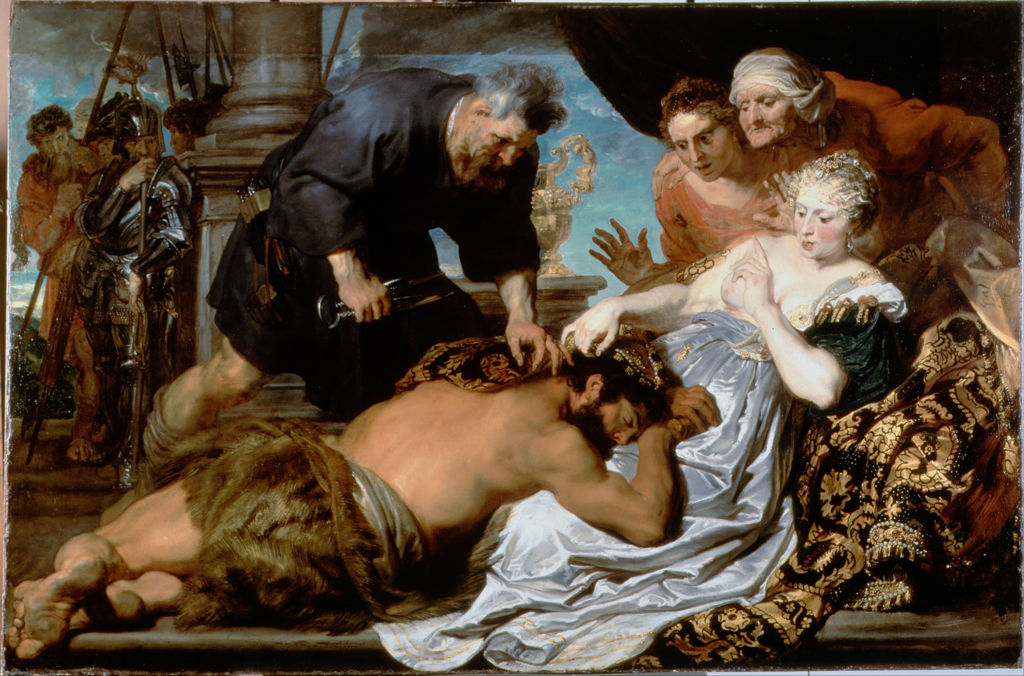
Samson is still asleep, and the shears have yet to touch his hair. Anthony van Dyck makes that small interval the centre of Samson and Delilah : a powerful man lies across a woman's lap while everyone around him prepares for his capture. Painted about 1618–20, the large canvas at Dulwich Picture Gallery turns a familiar biblical betrayal into an intricate arrangement of hands, glances and waiting bodies. [1]
At a Glance
- Artist Anthony van Dyck
- Title Samson and Delilah
- Date About 1618–20
- Medium Oil on canvas
- Dimensions 152.3 × 232 cm
- Collection Dulwich Picture Gallery, London
- Inventory number DPG127
- Acquisition Bourgeois Bequest, 1811
- Subject The preparation to cut the sleeping Samson's hair, from Judges 16. [1] [2]
This work across Anthony van Dyck’s career
Entry of Christ into Jerusalem
about 1617Frans Snyders
about 1620Rinaldo and Armida
1629–1632; Louvre commentary proposes late1631–spring1632Charles I in Three Positions
1635–before June 1636Lord John Stuart and his Brother
about 1638Cupid and Psyche
1639–40Self Portrait
c. 1640Contents
- The pause before the cut
- The story in Judges 16
- How hands organise the betrayal
- Flesh, satin and brocade
- A particular answer to Rubens
- What the canvas reveals, and what remains unknown
The pause before the cut
The sleeping body stretches almost the full width of the lower picture. Samson's feet press close to the left edge; his bent arm carries our eye towards Delilah on the right. His broad back is fully exposed. Above it, a dark-clothed man bends forward with open shears, while Delilah handles the hair he is preparing to cut. Soldiers wait beyond the column at the left. The threatened violence has already gathered around the sleeper, although his body gives no sign that he knows it. [1]
Van Dyck makes the danger easy to find and slow to unfold. The shears have large loops and long blades, outlined against the cutter's dark clothing. We can see the tool before it reaches Samson's head. The cutter's other hand extends towards the hair. These two separated actions create an interval that a picture can hold indefinitely: the man is ready, but the decisive movement remains ahead.
Delilah occupies the other end of this narrow working space. Her head inclines towards Samson, yet her raised finger addresses the people who can hear and obey her. The gesture asks for quiet. The lifted finger and the exposed blades become competing signals above the untroubled face. They tell us how much depends upon the sleeper remaining still.
The setting opens behind the figures into blue sky, with a substantial column dividing the soldiers from the central group. Dark drapery gathers overhead. This combination gives the scene the feel of an elaborately furnished platform with access from outside. The column does more than establish grandeur: it partly conceals the men who will take Samson, making their waiting presence a separate episode within the same view.
At the front, the stone edge runs beneath flesh and fabric. Samson's feet approach this boundary, and the pale folds spread across it near the centre. The bodies feel close enough to occupy the space immediately above us. Van Dyck allows little comfortable distance between the spectator and the preparations.
The story in Judges 16
The biblical account gives the silence its particular meaning. Samson loves Delilah, a woman living in the valley of Sorek. The Philistine leaders approach her with a proposal: discover the source of his strength so that they can overpower and bind him. Each leader promises her 1,100 pieces of silver. [2]
Several attempts follow. Samson first says that fresh, undried bindings will hold him, then unused ropes. Delilah tries both, with men waiting nearby, and he breaks free. His next answer brings the deception closer to the truth: he tells her to weave the seven locks of his hair into a loom. Again he escapes. These repetitions matter when looking at the painting. The soldiers' concealed position belongs to an established pattern of entrapment, but this time Delilah has obtained the answer she needs. [2]
Under continued pressure, Samson tells her that his hair has never been cut because he has been consecrated to God as a Nazirite from birth. If it is shaved, his strength will leave him. The hair therefore belongs to his religious identity and relationship with God. The story's explanation is more specific than the familiar shorthand that Samson has magical hair. When he wakes after the cutting, he expects to escape as before and does not realise that the Lord has left him. [2]
Delilah calls the Philistine leaders back. They arrive with money; she puts Samson to sleep on her knees and summons a man to shave his head. Van Dyck follows this division of labour. Delilah directs and enables the betrayal, while another person holds the cutting instrument. In the painting, her richly dressed, conspicuous presence may first draw attention away from the man who is about to perform the decisive task. [1] [2]
Judges then describes Samson's capture, blinding and imprisonment at Gaza. Later, after his hair begins to grow again, he prays for strength and brings down the building where the Philistines have assembled, dying with them. None of that subsequent action appears on this canvas. [2] Knowledge of it makes the sleeper's unguarded eyes particularly affecting. Van Dyck gives us a face temporarily closed to its surroundings, before the permanent injury that the story will describe.
The chapter also requires care over Delilah's identity. Its opening tells of Samson visiting a prostitute in Gaza; Delilah enters afterwards as a separately named woman whom he loves. The Bible does not identify Delilah as that prostitute. [2] Her costume and company in the painting invite questions about Van Dyck's staging, but they cannot supply a biblical occupation that the text leaves unstated.
How hands organise the betrayal
The most active part of Delilah's role is concentrated into her two hands. One reaches towards Samson's head, making his hair available to the cutter; the other lifts its warning finger. Together they connect practical assistance with control of the surrounding group. She does not need to rise from her seat to organise what is happening.
The arrangement makes ordinary gestures difficult to separate from their consequences. A head resting on a lap and a hand touching hair can belong to affection or care. Here those same positions give someone access to Samson at his most vulnerable. Van Dyck keeps the intimacy visible at the moment it is being used against him. The painting's force comes partly from the fact that nothing in Samson's posture registers the change.
His own hands offer another rhythm. His bent arm ends near Delilah's lap, with the fingers loosely gathered. The cutter's hand reaches down from above, its fingers separated and directed towards the task. Samson's strength is abundantly visible in the shoulder and forearm, but his hand performs no useful action. Those around him possess less imposing bodies and exercise all the immediate control.
Behind Delilah, a younger woman bends towards the scene with her mouth slightly open and a hand spread against the sky. An older woman in a white head covering leans over her shoulder. Their crowded heads and overlapping arms give the central operation an audience. Their movements seem to press forward, while Delilah's finger insists on restraint. The tension exists between the urgency of watching and the need to keep quiet.
The waiting soldier beside the column carries a related ambiguity of readiness and restraint. His armour, helmet and upright weapon make force visible at the left, yet he remains apart from Samson. He has not begun to seize him. The work is still being done by the people around the hair.
Sightlines gather towards this small area of the picture. The cutter bows his head; Delilah looks down; the younger attendant follows the action from behind. Samson alone cannot participate in that exchange of looking. The viewer shares the alertness of the surrounding figures, with a wider view that also includes the waiting men. It is an uncomfortable position: we can see how the trap fits together, but the picture offers no way to interrupt it.
Watch: Van Dyck’s art and working methods
Choose a museum introduction, a specialist lecture or a conservation film to continue exploring Van Dyck’s work.
Alejandro Vergara: Van Dyck and the Problems of Youth
Alejandro Vergara examines the ambitions and problems of Van Dyck’s early career.
Watch on YouTubeFlesh, satin and brocade
Samson's warm back forms the largest uninterrupted area of flesh. Its broad curve meets the pale fabric cascading from Delilah's lap. The folds break into narrow ridges, troughs and sharp changes of direction, each catching a different amount of light. Beside them, the body reads as heavy, continuous and still. Van Dyck gives the resting man physical weight through these differences in surface.
Delilah's clothing builds several further contrasts. The pale satin spreads widely across her lap and down towards the foreground. A dark green sleeve, white fabric around the shoulder and small accents of gold and red make her upper body more intricate. Her light skin and ornamented hair stand out against the women behind her and the dark canopy overhead. Her prominence is carefully constructed even though Samson occupies more of the canvas.
The gold and dark pattern of the brocade curls around her at the right and reappears behind Samson's head. Its curling motifs and heavy tassels have a density quite different from the satin's long folds.
Helen Hillyard identifies this brocade as a studio prop, connecting the apparent luxury of the scene with the painter's working materials. [3]
Seen together, these surfaces make the encounter both sumptuous and precarious. Samson lies on the most delicate-looking material in the picture, with his hair close to the richly patterned cloth. The folds seem to receive his weight, while the people seated and standing above him prepare to remove his protection. The beauty of the setting does not soften the action; it helps make his ease within it convincing.
At the left, the soldier's armour answers the bright dress with smaller, harder reflections. Metal belongs to the capture waiting to happen; satin belongs to the place where Samson has fallen asleep. Van Dyck joins them within a single sweep across the canvas. The passage from the soldier to Delilah is also a passage between two forms of power, both already coordinated around the inert man.
A particular answer to Rubens
Van Dyck painted this work during his early Antwerp years, when he was working in Peter Paul Rubens's studio. [1]
Rubens's own Samson and Delilah , about 1609–10, now belongs to the National Gallery in London. It is a separate painting, NG6461, on an oak panel. Rubens places the cutting inside a dim room, with soldiers beyond a doorway and the central group illuminated by artificial light. [4]
The reversal of the principal grouping is immediately useful for comparison. Rubens places Delilah towards the left and the cutter towards the right; Van Dyck puts them on opposite sides.
Dulwich proposes that a reversed print after Rubens could have contributed to Van Dyck's arrangement; this remains a possibility. [1] [3]
Rubens shows the cutting underway, with hands and shears gathered at a lock of hair. [4] Van Dyck separates the tool from the head. His conspicuous open blades let anticipation occupy a larger part of the story, giving us time to inspect how each person contributes.
Rubens's Delilah rests a hand on Samson's shoulder, within a close gathering of faces and hands. [4] Van Dyck extends the scene sideways, placing armed men at the far end. Samson's bare back becomes an expansive foreground that the cutter must lean across. We feel the scale of the body that a small, precise action will render helpless.
The connection to Rubens helps locate Van Dyck's early ambition. He takes on the same difficult combination of muscular anatomy, luxurious surfaces and a story dependent upon restrained movement. His own choices of interval, daylight and distribution of figures give the familiar subject a different pace. More of his early narrative work belongs within the story of Van Dyck in Antwerp , before his reputation became so closely associated with portraits.
What the canvas reveals, and what remains unknown
X-ray examination reveals a change to the spread fingers of the younger woman behind Delilah. Van Dyck moved them farther apart, clarifying their silhouette against the sky. [3]
The adjustment concerns a small area, but it affects the legibility of a crowded group. In the finished picture, the gaps between the fingers admit the blue of the sky. The hand is readable from a distance and distinct from the surrounding bodies. That clarity matters in a composition whose several gestures must remain intelligible without competing equally for attention.
The original patron and location are unknown. The viewpoint from below and foreground ledge have prompted a suggestion that the canvas hung high, perhaps above a fireplace. That is a proposed reconstruction, not a documented setting. [3]
The physical scale makes the question worth considering. At more than two metres wide, the picture gives the recumbent figure a substantial presence. The ledge and low viewpoint can be experienced directly even without knowing an original room. They encourage us to look upwards into the action, where Delilah and the cutter control the space above Samson.
The painting is recorded in Amsterdam in the early eighteenth century. Noël Desenfans bought it in London in 1783; it entered Dulwich through the Bourgeois Bequest in 1811. It was attributed to Rubens until 1880 and is now catalogued as Van Dyck. [1] [3]
That earlier attribution makes the comparison with Rubens part of the canvas's reception as well as its making. The Dulwich canvas DPG127 has its own history and visible revisions; Rubens's National Gallery panel and Van Dyck's related treatment in Vienna are separate objects. The small adjustment to an attendant's hand brings us back to the work of arranging this particular group, making each participant legible around the sleeping man.
Artworks directory
A selected directory of paintings, drawings and prints, including works discussed in the articles and the Frick’s 2016 portraiture exhibition. It is not a complete catalogue of Van Dyck’s work. Print titles identify collaborators or later printmakers; disputed and workshop attributions are retained. The exhibition checklist supplies additional object records; current collection information governs the updated article entries. [5]
Frequently Asked Questions
It is at Dulwich Picture Gallery in London, inventory number DPG127. [1]
In Judges, Samson explains that his uncut hair belongs to his consecration to God as a Nazirite. After the shaving, the text says that the Lord has departed from him. The hair is bound up with that religious relationship, rather than explained as a physical source of muscular power. [2]
Discussion
Look again at the images and ideas explored in Samson and Delilah by Anthony van Dyck. These editorial prompts invite your observations.
Reader Insights
How does seeing the shears before they touch Samson's hair affect your experience of the story?
Follow the hands and eyes around the group. Which gesture most clearly establishes who controls the scene?
What changes when you compare Samson's bare back with the satin, brocade and armour around him?
Join the Conversation
Share a detail, comparison or question about Samson and Delilah by Anthony van Dyck below.
References
- Dulwich Picture Gallery , Samson and Delilah, Anthony van Dyck, DPG127. View source .
- BibleGateway , Judges 16, King James Version, especially verses 4–21. English translation of the Hebrew biblical text. View source .
- Helen Hillyard , Dulwich Picture Gallery, Van Dyck's Samson and Delilah uncovered, 2016. View source .
- The National Gallery , London, Peter Paul Rubens, Samson and Delilah, NG6461. View source .
- The Frick Collection, Van Dyck: The Anatomy of Portraiture, online exhibition checklist (2016). View source.


