 by
Tom Gurney
Tom Gurney BSc (Hons) is an art history expert with over 20 years experience
Email:
tomgurney1@gmail.com
/ Phone:
+44 7429 011000
Study of Anna van Thielen and her Daughter Anna Maria Rombouts: Introduction
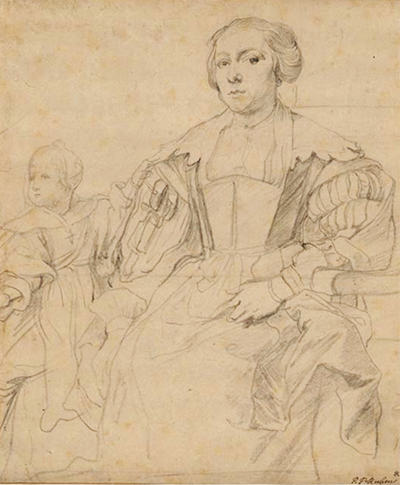
Anna’s expansive sleeves and folded skirt fill much of this drawing, while her small daughter stands close beside her. Anthony van Dyck gives the two figures markedly different degrees of definition. Looking between them reveals how much a portrait study can establish through a few lines, and where the artist chooses to linger.
At a Glance
- Artist Anthony van Dyck
- Date About 1631–32
- Medium Black chalk with pen and brown ink on laid paper
- Dimensions 317 × 262 mm
- Collection The Morgan Library & Museum, New York
- Inventory number I,244 [1]
This work across Anthony van Dyck’s career
Entry of Christ into Jerusalem
about 1617Frans Snyders
about 1620Rinaldo and Armida
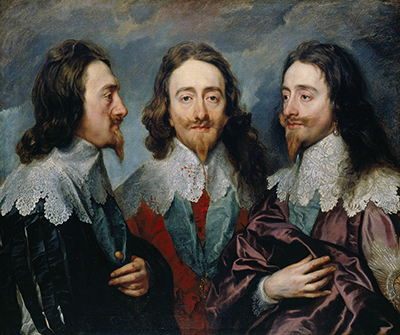
1629–1632; Louvre commentary proposes late1631–spring1632Charles I in Three Positions
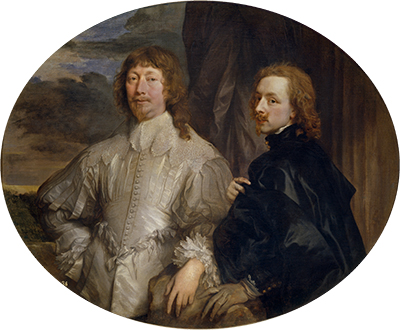
1635–before June 1636Lord John Stuart and his Brother
about 1638Cupid and Psyche
1639–40Self Portrait
c. 1640Contents
- A mother and daughter sharing the sheet
- Sleeves that give the figure breadth
- A hand resting above the folds
- What the lighter passages leave open
- From the study to the painted portrait
- One half of a family pair
- The name at the lower right
A mother and daughter sharing the sheet
Anna van Thielen was the wife of the painter Theodoor Rombouts. The Morgan identifies the child as their daughter Anna Maria, probably three or four years old, and connects the study with a painted portrait in Munich’s Alte Pinakothek. [1]
These sitters belonged to Van Dyck’s circle of artist colleagues and friends in Antwerp. The Frick’s exhibition account connects the knee-length arrangement with a sixteenth-century portrait format that remained popular in the city. [2] The space given to Anna’s lap and sleeves belongs to that larger conception of the portrait: her likeness includes the way she occupies a chair and carries her clothing, as well as the features of her face.
The mother occupies the centre and right of the sheet. Her head rises above a wide spread of costume, giving her seated figure a broad, stable base. The child stands at the left, smaller and close to the paper’s edge. Their unequal sizes create the basic structure of the double portrait before the details of either face are considered.
The daughter’s face sits near the height of her mother’s shoulder, and the open paper between them makes that difference especially clear. Anna’s clothing extends towards the child, bringing the figures together through overlapping contours. Their closeness is expressed through the arrangement itself.
The two faces also offer different kinds of presence. Anna’s eyes, nose and mouth are defined with small, concentrated marks; the contour of her cheek leads into the neck and collar. The daughter’s features are much fainter. We can locate her head and the direction of her face readily, but the image asks us to spend longer with the mother’s features.
The contrast between their gazes also draws the figures apart. Anna looks towards us; Anna Maria turns her attention beyond the sheet’s left edge. In a close reading for the Morgan, curator Austėja Mackelaitė also draws attention to the child’s left hand resting on her mother’s shoulder. [3] That small contact joins two figures whose faces address different directions. The mother’s substantial sleeve almost conceals the gesture, making it easy to overlook beside the much more prominent hand on her lap.
Sleeves that give the figure breadth
Anna’s costume has a strongly architectural effect. The fitted bodice forms a relatively narrow centre between enormous sleeves. Its upright seams direct the eye towards her face, while the sleeves spread out on either side. Across this structure, the collar makes a broad, irregular border between head and clothing.
The slashed sleeves contain some of the busiest drawing. Repeated openings and curved divisions describe their swollen forms. At the viewer’s right, the sleeve projects towards the edge of the sheet; at the left, darker, more tangled marks follow the arm as it descends beside the child. These passages give the shoulders breadth without making the whole figure rigidly symmetrical.
Look at the changes of line within a single sleeve. Some contours continue smoothly around a rounded form. Others break into short curves or gather into clusters at an edge. The eye can follow the large volume first and then return to the smaller divisions inside it. Van Dyck makes a complicated garment readable at both scales.
The sleeve pattern also sharpens the contrast with the bodice. The centre is comparatively spare, its shape legible through a few long boundaries. Around it, the abundance of small marks creates a more restless surface. The drawing finds variety within one costume through the direction and density of its lines.
A hand resting above the folds
The clearest hand lies across Anna’s lap near the centre of the composition. Its fingers extend over the skirt, with individual contours visible against the broader fabric beneath. The wrist emerges from the cuff at the viewer’s right, linking the hand to the forearm resting along the chair arm.
That horizontal support helps explain the seated pose. Much of the chair remains unobtrusive, but its arm gives the elbow a place to rest and introduces a firm line beneath the rounded sleeve. The hand then carries the movement inward, towards the lap. Furniture, arm and hand work together to make the body’s position understandable.
Below them, the skirt changes character across the page. Large areas remain lightly indicated, while the folds at the lower right gather into deep, angular turns. Long diagonals suggest fabric drawn across the knees. Smaller strokes collect at the sharp changes of direction, producing a sense of depth without an evenly shaded surface.
The folds matter to the pose as well as to the dress. Their layered edges make room for the seated body beneath, and their downward sweep extends the figure towards the bottom of the paper. The contrast between the broad, open lap and the crowded folds at its side keeps the lower half from becoming a uniform mass.
Watch: Van Dyck’s art and working methods
Choose a museum introduction, a specialist lecture or a conservation film to continue exploring Van Dyck’s work.
Stijn Alsteens: Drawing for Portraits
Stijn Alsteens explores how portrait drawings prepare and develop a likeness.
Watch on YouTubeWhat the lighter passages leave open
The child is drawn economically, yet her place in the portrait is clear. A head, a spreading collar, the outline of a small body and a few indications of clothing are enough to establish a second figure. Her lighter treatment gives the left side a different visual weight from the mother’s densely worked sleeve and skirt.
The lighter passages suggest room for further decisions. A slight change to the child’s contour would have fewer marks to accommodate than a change to Anna’s elaborately divided sleeve. This difference makes the relationship with a painted portrait especially interesting: the drawing gives us an arrangement whose parts remain open to development in different ways.
Softer and darker lines coexist throughout the image. They allow some edges to remain tentative while others become emphatic. From the reproduction alone, it is difficult to assign every mark to chalk or ink, or to reconstruct the order in which they were made. What remains visible is the effect of their combination: a figure can be both firmly placed and open at its edges.
For a wider view of the purposes served by such sheets, see Van Dyck’s drawings . Here, the differences of finish let us examine the separate decisions that contribute to a double portrait.
From the study to the painted portrait
The finished mother-and-daughter portrait is an oak-panel painting, inventory 599 in the Alte Pinakothek. Dated about 1631–32, it measures 122.8 × 90.7 cm: a considerably larger object than this sheet, whose height is just under 32 cm. [4] Comparing the two makes the drawing’s selective attention easier to understand.
In the painting, Anna’s broadly seated pose, the projecting sleeves and the hand across her lap remain recognisable. Colour establishes distinctions that the drawing leaves largely undescribed. Her dark dress surrounds an intricately ornamented bodice; a pale, lace-edged collar spreads across her shoulders. Anna Maria’s lighter sleeve and reddish drapery separate her small figure from her mother’s clothing. The paper study gives little indication of that distribution of colour. [1] [4]
The child’s connection to her mother also becomes more immediately legible. In the painting she presses close to Anna’s side, with her arm beside her mother’s arm. The Pinakothek interprets this proximity as a young child seeking protection. [4] The drawing lets us examine how the large shapes were established before colour and the surrounding interior made their relationship more explicit.
One half of a family pair
This double portrait belonged to a pair: Van Dyck painted Theodoor Rombouts separately. [2] His portrait, Munich inventory 603, is also dated about 1631–32 and painted on oak. At 122.9 × 90.8 cm, it almost exactly matches the dimensions of the mother-and-daughter picture. The museum describes Rombouts leaning over the back of his chair, giving his portrait a different bearing from Anna’s seated arrangement. [5]
Within the matching format, the mother-and-daughter portrait has two people to accommodate. Anna’s broad dress anchors the larger figure, while the daughter occupies a narrow strip beside her. Read with the pairing in mind, the crowded left edge becomes particularly interesting: the small figure joins her mother’s likeness without requiring a wider format.
The shared wooden support has a place in the history of these portraits too. In his study of Van Dyck’s panel paintings, Justin Davies groups the Rombouts pair with portraits of fellow painters including Marten Pepijn and Marten Ryckaert. Fully coloured paintings on panel formed a small part of Van Dyck’s output during this second Antwerp period; many of his other panels were monochrome oil sketches. [6] The family pair thus belongs to a specific group of finished portraits of his artistic circle, while the Morgan sheet preserves the drawn preparation for one of them.
The name at the lower right
The brown-ink inscription “P.P. Rubens” at the lower right is an old inscription. The Morgan attributes the sheet to Van Dyck; the name is not evidence of an autograph Rubens signature. Its writer and date are unspecified. [1]
Pierpont Morgan purchased the drawing in 1909. [1]
Artworks directory
A selected directory of paintings, drawings and prints, including works discussed in the articles and the Frick’s 2016 portraiture exhibition. It is not a complete catalogue of Van Dyck’s work. Print titles identify collaborators or later printmakers; disputed and workshop attributions are retained. The exhibition checklist supplies additional object records; current collection information governs the updated article entries. [7]
Frequently Asked Questions
It belongs to the Morgan Library & Museum in New York, under inventory number I,244. [1]
It is a preparatory drawing. The Morgan links it to the painted portrait of mother and daughter in the Alte Pinakothek, Munich. [1]
Her lighter outlines establish her position and size with relatively few details. The contrast lets us see how a study can resolve some parts closely while leaving others more flexible; it does not tell us how long either sitter posed.
Discussion
Look again at the images and ideas explored in Study of Anna van Thielen and her Daughter Anna Maria Rombouts. These editorial prompts invite your observations.
Reader Insights
Follow the contours from Anna’s face through her collar and sleeves. Where does your eye slow down, and which marks cause that change?
How would the relationship between the two figures feel different if the daughter were drawn as darkly as the mother’s dress?
Compare the hand on the lap with the folds beneath it. How does each help you understand Anna’s seated position?
Join the Conversation
Share a detail, comparison or question about Study of Anna van Thielen and her Daughter Anna Maria Rombouts below.
References
- The Morgan Library & Museum , Study of Anna van Thielen and her Daughter Anna Maria Rombouts. View source .
- The Frick Collection , Portrait Study of Anna van Thielen and Her Daughter, Anna Maria Rombouts, Van Dyck: The Anatomy of Portraiture , 2016. View source .
- Austėja Mackelaitė , in The Morgan Library & Museum, The Morgan’s Drawing Department Portrait Selects, 9 April 2020. View source .
- Bayerische Staatsgemäldesammlungen , Anna van Thielen mit ihrer Tochter Anna Maria Rombouts, inventory 599 (in German). View source .
- Bayerische Staatsgemäldesammlungen , Der Maler Theodoor Rombouts, inventory 603 (in German). View source .
- Justin Davies , Anthony Van Dyck and his use of panels: an introduction, Jordaens Van Dyck Journal , issue 1, July 2021, pp. 48–63, especially pp. 56–59. View source .
- The Frick Collection, Van Dyck: The Anatomy of Portraiture, online exhibition checklist (2016). View source.