by Tom Gurney
Tom Gurney BSc (Hons) is an art history expert with over 20 years experience
Published on June 19, 2020 / Updated on October 17, 2026
Email: tomgurney1@gmail.com / Phone: +44 7429 011000
Looking at Genesis II
Yellow, black and green shapes sweep through Franz Marc’s Genesis II. The image on this page shows an impression in the National Gallery of Art’s Rosenwald Collection, accession 1946.21.134. The gallery identifies the work as a 1914 woodcut printed in those three colours. The sheet belongs to a print design that is also called Schöpfungsgeschichte II, or Tale of Creation. These titles describe a single design that survives in more than one impression. [1]
Watch: Franz Marc
Explore Marc’s blue horses, the Blue Rider circle and the move towards abstraction in English-language videos.
Franz Marc, Blue Horses and Der Blaue Reiter
An English-language introduction to Marc’s blue horses, animals, spirituality and the Blue Rider.
Watch on YouTubeLooking at the National Gallery’s sheet
The broad pale margin makes the restless image feel contained. A curved yellow band opens at the upper left; green lines cut across darker forms near the centre; black arcs and pointed shapes carry the eye downward. A horse and a fish can be suggested by parts of the pattern, but their outlines merge with the surrounding movement. Marc did not arrange animals against a quiet landscape here. He made the act of finding a body within the image part of looking at it. [1]
Colour woodcut builds an image from printed colour areas, so this design depends on broad shapes rather than fine painted transitions. The gallery catalogues this sheet as state V in Klaus Lankheit’s catalogue of Marc’s work. That is an identification of this impression and its print state, not a date for every surviving sheet. [1]
One design, several impressions
Marc intended the Genesis II design for an illustrated Bible, according to the Cleveland Museum of Art. MoMA records another impression that was printed and published after Marc’s death in 1921. That later publication date belongs to MoMA’s sheet; it does not establish when the National Gallery impression was printed. [2] [3]
The related Tale of Creation page shows Cleveland’s accession 1959.228. It offers a second museum image of this same design. Changes in the two digital images’ colour or crop should not, by themselves, be treated as evidence of differences between the physical impressions. For another example of how Marc used a carved surface to fuse animal and setting, see Animal Legend. [1] [2]
Artwork Directory
This source-checked selection contains 192 identified works and print designs from the current Franz Marc research set. It is a curated selection, not a complete catalogue raisonné. Some works link to their article here; others link to a collection record. Unresolved identifications are omitted.
Discussion
The National Gallery impression invites viewers to find animals inside a field of printed colour.
Reader Insights
Observation
Where do the green and black shapes first suggest an animal to you?
Comparison
What can you compare with the Cleveland impression on the Tale of Creation page?
Interpretation
How does the broad sheet margin affect the sense of movement inside the design?
Join the Conversation
Which detail changed the way you saw this work? Share a close observation or a comparison with another Marc picture.
References
- National Gallery of Art, Genesis II. View source.
- Cleveland Museum of Art, Genesis II. View source.
- MoMA, Genesis II. View source.
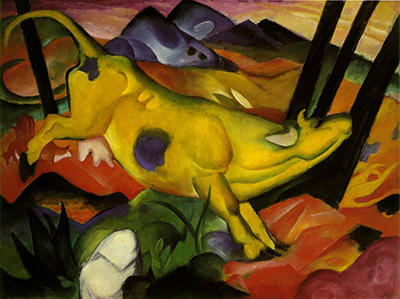
- Related artwork image, Yellow Cow: Photograph by Dr. Alexey Yakovlev; resized without crop or colour change, CC BY-SA 2.0.
- Splash image: Franz Marc, Genesis II (Schöpfungsgeschichte II), 1914, woodcut in yellow, black and green. Rosenwald Collection, National Gallery of Art, Washington, 1946.21.134. Public-domain image from the NGA. Object record.