by Tom Gurney
Tom Gurney BSc (Hons) is an art history expert with over 20 years experience
Published on June 19, 2020 / Updated on October 17, 2026
Email: tomgurney1@gmail.com / Phone: +44 7429 011000
Looking at Horse in a Landscape
Franz Marc’s horse stands close to us, its reddish body cut off by the lower and right edges of Horse in a Landscape. Its neck rises from that near position, and its head turns into a broad field of yellow and green. The animal does not face the viewer as a portrait subject. We seem to arrive beside it, looking outward across the land it inhabits. Marc painted this work in 1910, before the blue horses for which he later became famous. It already shows how he could make a horse’s place in nature the organising idea of an entire picture. [1]
The canvas is oil on canvas, 85 × 112 cm, in Museum Folkwang, Essen. The German title, Pferd in Landschaft, translates directly as Horse in a Landscape. Its width gives the banded fields plenty of room, while the horse claims the foreground by touching the frame. The museum notes that this view is unusually close to the animal and that the landscape has no conventional horizon. Those two choices make it difficult to separate a passive “view” from the creature through which we enter it. [1]
Watch: Franz Marc
Explore Marc’s blue horses, the Blue Rider circle and the move towards abstraction in English-language videos.
Franz Marc, Blue Horses and Der Blaue Reiter
An English-language introduction to Marc’s blue horses, animals, spirituality and the Blue Rider.
Watch on YouTubeLooking with the horse
Begin at the lower right, where the red-brown body enters the picture only in part. A dark blue-black mane runs along the neck toward the small turned head. We cannot see its legs or the ground directly beneath it. That crop moves our attention away from a complete horse silhouette and into the direction the animal faces. The landscape opens from its head to the left in wide, soft-edged zones of yellow, green and red. [1]
The yellow field is unusually broad. It is crossed by darker green patches that might be land, shadow or vegetation, but the exact geography remains open. A red strip runs below it, near the horse’s body. Above, more green and yellow reach the top of the canvas without the distant skyline that would usually tell us where to stop looking. Marc gives a sense of spreading terrain through colour bands and their curved edges. The field feels immense even though the horse is pressed tightly against the front of the painting. [1]
The museum proposes that we experience the view from the animal’s perspective. That is a useful way to look, as long as it is not turned into a claim about literal equine vision. We do not know what this horse sees. We do know that Marc has placed its head between us and the land, so that our own route into the distance passes through its posture. The painting makes the animal a partner in looking rather than a thing observed from afar. [1]
The Folkwang text also raises a possible echo of Caspar David Friedrich’s Wanderer above the Sea of Fog, in which a figure faces a landscape from the foreground. It presents this as an association Marc may have wanted, not as established intention. The comparison sharpens a difference: Marc places a horse where an earlier painter placed a human wanderer. The animal’s large cropped body makes the scene feel immediate and embodied, with no high lookout separating the observer from the land. [1]
A turning point in the horse pictures
The museum describes Marc’s work among animals in the meadows around Kochel, Lenggries and Sindelsdorf. He made paintings, studies and drawings near them, while seeking something more than academic animal likeness. In this canvas, anatomy is still legible: we recognise head, mane and powerful neck. Yet the figure’s colour and cropping make it part of a larger visual question about creature and place. It belongs to the sequence that leads toward the more intensely coloured, more simplified horse paintings of 1911. [1]
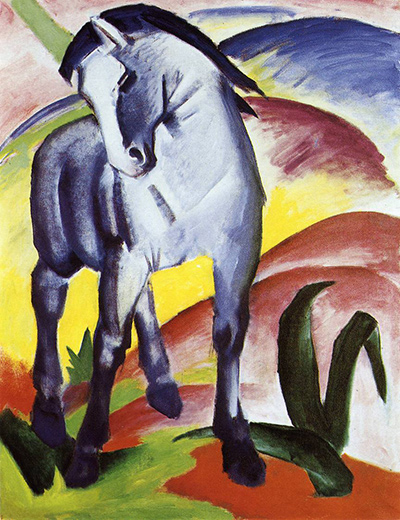
Compare the solitary animal with Blue Horse I, painted the following year. There the blue foal faces us more directly, its curved body echoing a landscape of strong colour bands. Horse in a Landscape creates closeness differently: the horse is turned away, and we share its outward gaze. The two paintings give the animal a central role without repeating the same pose or emotional encounter. [2] [1]
Colour in the earlier painting is already doing structural work. The mane’s dark blue sets a vertical accent against the glowing yellow ground, while the red-brown body connects to the lower red strip. The broad bands of land need no precisely drawn horizon to carry us outward. These relationships make Marc’s developing use of independent colour visible before the fully blue horse becomes his most recognisable image. They also show why calling every vivid Marc horse “a blue horse” would erase important distinctions. [1]
Ownership and an unresolved gap
The painting’s later history deserves the same precision as its visual story. Museum Folkwang traces it from Marc to Franz Kluxen, then to Hugo and Gertrud Simon by 1921. The Jewish couple held it at least into 1937; from 1935 it was with their son-in-law Wolf Demeter in France, either in his custody or ownership, according to the museum’s qualified wording. The museum then marks its whereabouts from 1937 to 1953 as unknown. It acquired the work in 1953 through dealers Werner Rusche and the Abels galleries in Cologne, with support from the Folkwang-Museumsverein. [1]
Museum Folkwang explicitly says that the provenance remains under clarification. Germany’s Lost Art database likewise records the Simon ownership and the 1953 purchase and describes the circumstances of loss as unresolved. The Hugo Simon Stiftung identifies the work among pictures formerly held by the Simons. These records establish that the gap is important; they do not establish how title passed during those missing years. The painting’s account should therefore leave the question open, acknowledging both the family’s history and the limits of the current record. [1] [3] [4]
Look back at the horse after that history. Its turned head still gives us the painting’s starting point, but the object has also travelled through different hands and an unresolved interval. The physical canvas is carefully identified as Folkwang G 239. Its bright, horizonless field can be explored in detail without pretending that every part of the work’s twentieth-century path is equally clear. [1]
Artwork Directory
This source-checked selection contains 192 identified works and print designs from the current Franz Marc research set. It is a curated selection, not a complete catalogue raisonné. Some works link to their article here; others link to a collection record. Unresolved identifications are omitted.
Discussion
The horse’s position makes the viewer look into the landscape with it.
Reader Insights
Observation
How do the horse’s back and head direct you into the field?
Comparison
What changes between this horse and the more enclosed Blue Horse I?
Interpretation
Where does the animal end and the surrounding landscape begin?
Join the Conversation
Which detail changed the way you saw this work? Share a close observation or a comparison with another Marc picture.
References
- Museum Folkwang, Pferd in Landschaft, G 239. View source.
- Lenbachhaus, Blaues Pferd I. View source.
- Lost Art, fund record 581609. View source.
- Hugo Simon Stiftung, collection research. View source.
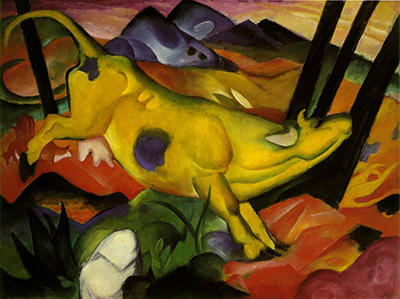
- Related artwork image, Yellow Cow: Photograph by Dr. Alexey Yakovlev; resized without crop or colour change, CC BY-SA 2.0.
- Splash image: Franz Marc, Horse in a Landscape, 1910, oil on canvas. Museum Folkwang, Essen, G 239. Museum object record. Image: art-book reproduction via Wikimedia Commons, Public Domain Mark; resized without crop or colour adjustment.