


 by Tom Gurney
Tom Gurney BSc (Hons) is an art history expert with over 20 years experience
Page created on March 2, 2018 / Page updated on October 6, 2026
Email: tomgurney1@gmail.com / Phone: +44 7429 011000
Introduction
Frida Kahlo's The Broken Column (La columna rota, 1944) presents a figure whose torso opens around a fractured architectural column while a rigid brace holds the surrounding body. Tears, nails and cracked ground make bodily pain impossible to ignore, yet the painting is not a transparent medical record. Its direct gaze, severe organisation and deliberate substitutions turn an experience of constraint into a constructed image that has supported different, sometimes conflicting readings. [1] [2]
The strongest contemporary document is Kahlo's letter to the New York dealer Julien Levy of 20 April 1944. She reported that spinal trouble and an iron corset were making it hard to paint and described an operation as something she feared might become necessary; the documented New York spinal fusion belongs to 1946. That difference in dates matters because a frequently repeated post-surgery account names no earlier operation that can be shown to have triggered the picture. [1] [4] [5]
At a Glance
- Artist and titles: Frida Kahlo, The Broken Column / La columna rota
- Date: 1944. [22]
- Medium: Oil on canvas mounted on Masonite. [22]
- Dimensions: 39.8 × 30.5 cm in the official 2022 exhibition catalogue. [22]
- Collection: Museo Dolores Olmedo, La Noria, Xochimilco, Mexico City
- Subject: self-portrait with a fractured column, orthopaedic brace and nails. [1] [22]
Contents
- Introduction
- Scale and Materials
- Looking Closely at the Painting
- What the 1944 Letters Establish
- Questioning Treatment
- Corsets and Painted Supports
- Tears, Nails and the Temptation of a Symbolic Key
- Martyr Images, Anatomy and the Baroque
- Disability, Visibility and the Viewer's Response
Scale and Materials
The official catalogue for the 2022 Madrid exhibition Frida Kahlo: alas para volar records the painting as oil on canvas mounted on Masonite, measuring 39.8 × 30.5 centimetres. Its checklist identifies the Museo Dolores Olmedo as the lender unless another owner is specified, and none is listed for The Broken Column. This places the painted body on a small, rigidly supported surface, rather than on metal or a large free-standing canvas. [22]
Published measurements have not always agreed. Andrea Kettenmann's older object caption gives 40 × 30.7 centimetres, while Rebeca Sánchez's scholarly article gives 43 × 33 centimetres; both describe canvas attached to a hard support. The more directly exhibition-linked 2022 record provides the measurement used here, although it does not explain the differences or establish that they result from rounding, a frame or a new examination. [2] [3] [22]
The small format contrasts with the architectural weight of the central figure. Kahlo fills much of the vertical surface with the body, while the low horizon gives the head and exposed column a broad space against the sky. This arrangement lets a private bodily predicament acquire the visual gravity of a damaged monument without turning the image into a literal building or a life-size medical display. [1] [2] [22]
Watch: Frida Kahlo
Five perspectives to view here alongside the article.
Frida Kahlo’s The Two Fridas: Great Art Explained
A focused visual introduction to the painting and its context.
Looking Closely at the Painting
The image is vertical, with a single nearly frontal figure occupying most of its height. A low horizon leaves a broad field of clouded sky around her head and shoulders; below it, green-brown ground recedes through dark fissures. No other person, furniture or conventional building diverts the eye from the standing body and the architectural form inside it. [1]
Kahlo's loose dark hair falls behind her shoulders, and thin pale tears descend from both eyes. Her mouth is closed and her gaze meets the viewer's space. Those details are visible, but words such as “stoic,” “defiant” or “emotionless” would already interpret how the tears and controlled pose work together; none is a neutral description supplied by the image. [1]
A dark-edged vertical opening runs through the torso. Within it, a grey classical column takes the position of a spine, its shaft interrupted by fractures and its capital-like top placed just below the chin. The Museo Dolores Olmedo-supplied description and Sánchez identify an Ionic column, but neither the painting nor the surviving evidence makes it a literal map of vertebrae or a clinical image of a particular diagnosis. [1] [2]
Pale straps cross and encircle the shoulders, chest, waist and hips. They cover the figure's sides while leaving the central opening exposed, so the support appears both to hold and to frame what is broken. The museum text calls the bands metal lined with fabric, while the inspected digital image cannot determine their precise material; Kahlo's letter documents a real iron corset but does not identify this painted apparatus with a particular surviving one. [1] [5]
Nails of different sizes appear over the face, torso, arms and exposed lower body. Both hands gather a pale cloth around the hips, and the fissured landscape spreads behind her. The broken ground and opened torso form a visual echo, but the image alone cannot tell us that each nail stands for a specific injury, that the cloth was added later, or that the landscape is a direct diagram of Kahlo's mind. [1] [2]
The column and brace offer two different answers to the problem of support. The inner structure appears fractured, whereas the outer bands remain continuous across the body; neither makes the rupture disappear. Their relation gives the painting a tension between uprightness and threatened collapse, rather than presenting the standing figure as simply restored or wholly defeated. [1] [2]
The Broken Column in Kahlo’s career
The Two Fridas
1939Documented New York spinal fusion
1946Viva la Vida
c. 1950–54Selected context, not a complete chronology. Dates and the 1946 fusion are documented in reference 4 [4].
What the 1944 Letters Establish
Getty Research Institute identifies Kahlo's two-sided letter to Julien Levy, dated 20 April 1944, as accession 2022.M.20. Kahlo told the dealer that trouble with her spine had sharply restricted her painting and that an iron corset was difficult to work in. She said the device was meant to avert an operation, which she feared, while also mentioning four paintings ready to send when wartime transport allowed. [5]
This letter is powerful because it is contemporary, not because it supplies a secret key to the picture. It does not name The Broken Column, describe its nails or column, give an execution date, or identify the depicted support as a portrait of her own corset. Getty's suggestion that the picture followed shortly afterwards is a curatorial reconstruction; the secure statement is that severe spinal difficulty, an iron brace and continuing artistic work were part of Kahlo's life in spring 1944. [5]
By 24 June 1944, Kahlo was writing to physician Leo Eloesser from bed about continuing spinal trouble. In the published transcript she names Dr Alejandro Velazco Zimbrón, who had prescribed a corset that she had already worn for five months, and describes some early improvement followed by renewed pain. The five months therefore refer to elapsed use, not the length of a treatment course ordered in June. [6]
Kahlo also asks why immobilising her spine has failed to stop the symptoms and requests an explanation she can understand. Some doctors are again recommending an operation, but she tells Eloesser she would consent only if he performed it and it proved necessary. Her report of what doctors told her is not an independently established diagnosis; the letter documents uncertainty about treatment as well as fear of surgery. [6]
The same letter turns from symptoms to work. Kahlo asks Eloesser to send an easel by train, explaining that she sometimes lends her own two easels to her students and needs another. This practical request preserves the teacher and working painter within a document about physical restriction, without specifying which easel, room or bodily position she used to make The Broken Column. [6]
Museo Frida Kahlo places Kahlo's trip to New York for spinal fusion in 1946, two years after the painting. An owner-supplied interpretation used by Fundación Casa de México in Spain, and repeated by the Walker Art Center, nevertheless calls The Broken Column a work made shortly after spinal surgery, without identifying the operation or its date. The April and June letters describe an operation as prospective, so they do not establish that origin story; they also do not prove that Kahlo underwent no procedure of any kind in 1944. The painting can be connected securely to that year's spinal pain and corset treatment without falsely relocating the documented 1946 fusion. [1] [4] [5] [6] [21]
Questioning Treatment
Lorena Garrido Donoso's Spanish-language study of Kahlo's correspondence reads the June letter as an exercise of agency. In her account, asking why a treatment is failing, weighing its burdens and making surgical consent conditional are ways of taking part in decisions about an uncertain bodily condition. That interpretation challenges the image of Kahlo as a passive martyr without denying the severity of her pain. [23]
Garrido Donoso also stresses that the addressee matters: a letter to a trusted doctor and one to a lover need not describe the same body in the same way. This makes the correspondence valuable alongside the painting, but not as a verbal caption for it. The figure's exposed torso, repeated punctures and outward gaze are a separate pictorial construction, rather than a complete account of everything the artist could feel, ask or do. [1] [2] [23]
Corsets and Painted Supports
Kahlo's letter names an iron corset, but the surviving material history is more varied than a simple progression from plaster to steel. Labels for the Fine Arts Museums of San Francisco's Appearances Can Be Deceiving exhibition record painted plaster corsets dated around 1941, 1944 and 1950, and also a cotton-and-steel orthopaedic corset dated 1944. Other listed supports combined leather, cardboard, felt, cotton and metal; some plaster fronts were retained after the hardened supports were cut away. [7]
These objects matter because the brace was not only a metaphor invented in paint. Supports were worn, altered, sometimes decorated and saved, while the painted one crosses Kahlo's chest and hips without hiding the open centre. Nevertheless, a shared year and comparable shape do not prove that a specific surviving 1944 corset was the model for The Broken Column. The real apparatus, the letter's wording and the painted structure are related kinds of evidence, not interchangeable objects. [1] [5] [7]
Helga Prignitz-Poda identifies a different object in Hidden Frida Kahlo: a plaster jacket titled Corset the Broken Column, provisionally dated around 1944 and kept at the Museo Frida Kahlo. Its caption records oil paint and ribbons, while her discussion describes a broken column surrounded by organic, plant-like lines. The object shares an architectural motif with the painting, but its material and provisional date do not identify it as the iron brace mentioned in April or the particular support represented on canvas. [24]
Prignitz-Poda interprets painted corsets as readymades: existing objects brought into the artist's work through appropriation and alteration. This comparison extends the column motif beyond a picture of a constrained body to an object made to fit around one. It also preserves an important difference between a medical support that could be worn and a self-portrait that represents support as part of its visual structure. [24]
The San Francisco labels interpret decorated supports through resilience, self-presentation and joy. Those are meaningful curatorial terms, but the object facts are narrower: material, date, construction and survival. Kahlo's 1944 letter also says wearing a support could obstruct work; neither the decorated corsets nor the painting requires readers to transform that difficulty into an uncomplicated triumph. [5] [7]
Tears, Nails and the Temptation of a Symbolic Key
The nails cover several regions of the painted skin and differ in size. In the Museo Dolores Olmedo-supplied account, the largest central nails refer to damage from the accident, while ones near the breast are read as emotional hurt and loneliness. Fernando Antelo, writing in the AMA Journal of Ethics, instead takes the varied nails as a way of communicating sharp and diffuse pain; both are readings rather than a key Kahlo left to decode each nail. [1] [9]
The difference is useful. The museum reading ties particular locations to kinds of experience, while Antelo's medical-humanities response stresses the difficulty of making pain perceptible to someone else. Neither permits an exact count, a pain-scale diagnosis or the legacy claim that a Spanish idiom or one alleged relationship event caused the motif. The visual evidence is a field of punctures across a body whose interior has already been opened. [1] [9]
Valmantas Budrys, in a retrospective neurology article, offers a further caution: the image of a broken spinal column can exaggerate the spine as the sole explanation for Kahlo's complex pain history. His own diagnostic proposals are also retrospective and do not become facts about this painting. The point for looking is more modest: Kahlo chose a powerful architectural metaphor, and a metaphor need not reproduce a complete clinical account. [10]
The surrounding land is likewise fissured, making rupture visible outside the figure as well as inside her. This is a formal relation between shapes, not proof that the ground “is” loneliness, a nation, or a precisely named emotional state. Keeping the two forms in view allows the painting's scale of estrangement to be discussed without pretending that a landscape is an unmediated confession. [1] [2]
Martyr Images, Anatomy and the Baroque
Rebeca Sánchez reads the tears in relation to images of the sorrowing Virgin, the Mater Dolorosa, and considers the Mexican La Llorona tradition through earlier scholarship. The pale cloth, exposed body and numerous punctures also lead her to Saint Sebastian, ordinarily pierced by arrows. Such comparisons identify a visual tradition to which a viewer can bring the painting, but nails are not arrows, and no inspected document establishes one specific devotional image that Kahlo copied. [2]
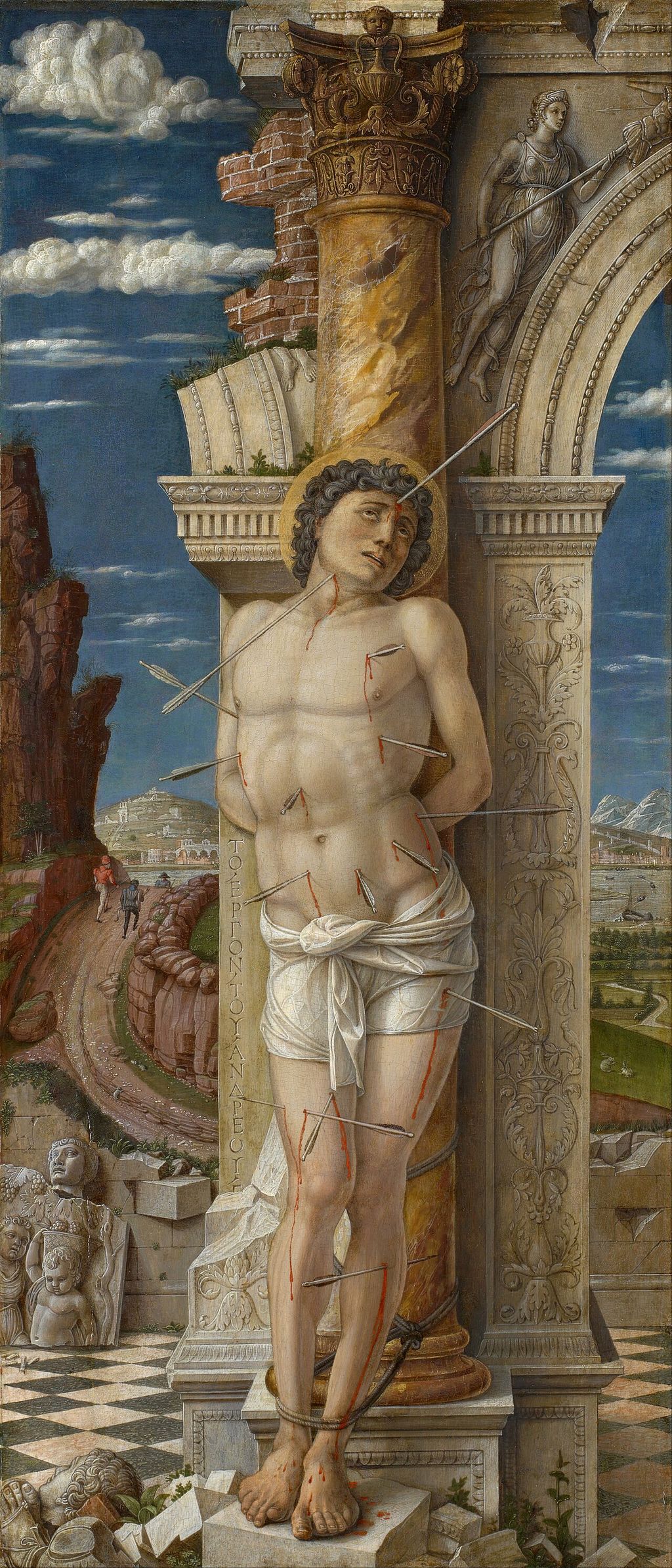
Gabriela Miranda's Spanish-language theological study also compares the nails, cloth, column and exposed body with Christian images of martyrdom. Her crucial qualification is that use or transformation of Christian forms does not prove the artist's personal religious belief. Frances Borzello likewise values the Saint Sebastian transformation while warning that art made from lived experience is not identical with a life laid bare; her separate claim that the painting followed surgery is not adopted. [8] [17]
For Sánchez, the comparison becomes most revealing where Kahlo departs from the saint's conventional pose. Rather than raising her eyes towards heaven, the crying figure looks horizontally towards the spectator; instead of having her hands bound, she uses them to hold the cloth. The transformation gives the exposed woman an active relation to what is concealed and what is shown, and directs the appeal towards another human viewer rather than a visible divine response. [2]
The cloth consequently does more than preserve modesty. In Sánchez's reading it acts as a veil that conceals the lower body while leaving the opened torso and damaged support exposed. Bringing the female self-portrait together with the wounded male saint and the sorrowing mother also joins traditions that were ordinarily distributed among different religious figures, without making the result an orthodox devotional image. [2] [8]
Sánchez presses the comparison beyond recognisable religious figures. She describes the open body in relation to anatomical display and a damaged column that should support a building but cannot support itself; the external brace then becomes another, imperfect architecture of support. This reading attends to how Kahlo reorganises body and structure, rather than treating the column as an illustrated X-ray or each fracture as a vertebral finding. [2]
Her specific anatomical comparison is Rembrandt's The Anatomy Lesson of Dr Deyman, in which an opened body is presented towards the spectator. The comparison concerns the exposure of an interior normally hidden from sight, not evidence that Kahlo copied or even consulted that painting. Kahlo's self-portrait changes the relation again: the represented person remains upright, looks out and holds her own cloth, rather than becoming an anonymous body available for dissection. [1] [2]
Her later argument moves from European baroque and colonial forms toward Latin American neobaroque thought, especially the work of Severo Sarduy and José Lezama Lima. For Sánchez, the painting can appropriate an inherited visual language of suffering and architectural order to make an unstable American identity visible. That is a substantive critical proposal, not a statement of Kahlo's programme or an interpretation that cancels the painting's bodily and personal circumstances. [2]
These approaches overlap without being equivalent. The sorrowing figure, punctured martyr, displayed anatomy and ruined column direct attention to different features and historical contexts. Their value is to make a reader ask what Kahlo changed in each tradition: arrows become nails, architecture enters the body, a brace both supports and exposes, and the landscape repeats damage on another scale. [1] [2] [8]
Disability, Visibility and the Viewer's Response
A Dutch-language discussion made with the Drents Museum during its 2022 Viva la Frida! exhibition puts disabled viewers' perspectives close to the painting. Historians and advocates Eline Pollaert and Xandra Koster spoke with disabled queer activist Agnes van Wijnen among Kahlo's displayed corsets and near The Broken Column. They were discussing an object present in the galleries, not offering evidence of Kahlo's private intention in 1944. [11]
Van Wijnen reads the painted tears, punctures and direct gaze as a refusal to hide pain, but she is equally wary of reducing the artist to a body made to suffer. Her account holds strength and vulnerability together while refusing both pity and the demand that a disabled person provide an uplifting lesson. Pollaert raises the related concern that women and disabled artists are too often interpreted through their health and private lives rather than their work's historical and social decisions. [11]
Their discussion of Kahlo's decorated supports adds a material dimension to that critique. A corset can be necessary, restrictive, altered by its wearer and deliberately shown; its visibility need not mean defeat or inspirational conquest. In The Broken Column, the pictured brace is plainly there, but it does not erase the figure's address to the viewer or the painting's religious and architectural transformations. This is a later reception of the work, not one universal response for disabled audiences. [7] [11]
A Mexican governmental feature from CONADIS offers a contrasting public-language record. It tentatively reads the empty landscape as solitude and ends by making Kahlo a model of achievement despite disability. That history of admiration is worth knowing, but its moral cannot govern the painting: the Drents speakers show how a compulsory inspiration story can become another way of not seeing constraint, politics, pleasure or artistic choice. [11] [12]
Collection, Provenance and Selected Exhibitions
The Broken Column belongs to the Museo Dolores Olmedo in La Noria, Xochimilco. The museum's public history identifies the collection and place, while the 2022 Madrid exhibition catalogue supplies the more specific title, support, measurements and lending collection. Neither record provides an object-level accession, exact acquisition date, frame description or complete provenance. [13] [22]
At the museum's May 2026 reopening, La Jornada reported information supplied by the institution: its group of twenty-seven Kahlo works, including The Broken Column, had been bought together from engineer Eduardo Morillo Safa's collection. That gives a bounded Morillo–Olmedo route, not an artist-to-collector transaction history. Neither the date on which Morillo acquired the painting nor the precise terms and date of Olmedo's purchase are established by the public sources checked. [13] [14]
Institutional exhibitions document part of the painting's later circulation. The Walker Art Center named The Broken Column in its 27 October 2007–20 January 2008 exhibition; the show then travelled to the Philadelphia Museum of Art from 20 February to 18 May 2008 and to SFMOMA through September 2008. Philadelphia also identifies the work among its highlights, while the Drents transcript confirms its presence in Viva la Frida! in 2022. [11] [15] [21]
The official Alas para volar catalogue also records the painting in the 2022 exhibition at Fundación Casa de México in Madrid. It places the work among a selection of Kahlo paintings and photographs, with an accompanying essay and object checklist rather than an isolated image detached from its collection. These records document selected later appearances; they do not amount to a complete exhibition history or establish inclusion in Kahlo's 1953 Mexican solo show. [22]
SFMOMA counted 412,244 visitors to the 2008 exhibition. That number speaks to the scale of the whole show's reception, not the drawing power of this one painting. The 2026 reopening report named a Kahlo section at La Noria, but collection ownership does not guarantee continued display: the dated report describes a particular moment rather than a permanent place in the galleries. [14] [16]
Exhibiting Pain
The setting in which a painting is displayed can shape what viewers notice. Describing a July 2017 visit to Frida Kahlo: Me pinto a mí misma at the Museo Dolores Olmedo, Odailso Berté recalls The Broken Column standing out against dark walls with a ticking-clock soundscape. He interprets the sound as an evocation of the hours spent in pain and convalescence; it was part of the later exhibition encounter, not a sound embedded in Kahlo's painting. [25]
That account makes an important distinction between the picture and the atmosphere constructed around it. The clock can draw attention towards waiting and physical distress, whereas Berté's wider argument connects the creating body with its social and political environment and resists purely psychological biography. The museum setting can intensify one reading of the painting, but it need not exhaust the column's architectural associations, the transformed martyr imagery or the figure's deliberate address to a spectator. [2] [25]
Books and Further Reading
The exhibition catalogue Frida Kahlo: alas para volar is especially useful for placing this self-portrait among works lent from the Museo Dolores Olmedo. Its essay discusses the fractured body and column, and its checklist supplies the dimensions and support used above. Helga Prignitz-Poda's Hidden Frida Kahlo takes a different route, extending attention beyond familiar paintings to less widely known objects, including the painted plaster jacket carrying the broken-column motif. [22] [24]
The large TASCHEN volume Frida Kahlo: The Complete Paintings, by Luis-Martín Lozano, Andrea Kettenmann and Marina Vázquez Ramos, offers an oeuvre-wide catalogue route. Hayden Herrera's Frida: The Biography of Frida Kahlo is a major life-history study, while Gannit Ankori's Frida Kahlo provides a shorter critical introduction. These books serve different purposes: locating an object in the painted oeuvre, following a life through time, and considering the relationship between experience and artistic construction. [18] [19] [20]
Lorena Garrido Donoso's study of Kahlo's letters is a valuable companion to these visual and biographical approaches. It restores the person who asks questions, evaluates treatment and addresses different people in different ways. Read beside the painting, that correspondence complicates any account in which the exposed body is only a suffering body and the artist has no role except to endure. [6] [23]
Related Reading
The accident and recovery study and the health and disability pages take up the medical and testimonial questions that cannot be answered from this painting alone. The style and Surrealism study considers the wider dispute over uncanny imagery and artistic labels, while the paintings guide places this object among other securely identified works.
Frequently Asked Questions
Not after the documented New York fusion of 1946. Kahlo's 20 April 1944 letter describes an iron corset and an operation she feared might be necessary, and a June transcript still treats surgery as prospective. The museum-supplied post-surgery account names no dated operation; the evidence does not establish one as the painting's trigger, although it cannot exclude every other 1944 procedure. [1] [4] [5] [6]
Their varied size and distribution are visible, but no verified artist statement assigns each nail one meaning. The Museo Dolores Olmedo-supplied account links particular nails to physical or emotional hurt, while Fernando Antelo reads the pattern as sharp and diffuse pain and scholars compare punctures with martyr images. These are named interpretations, not a universal symbolic code. [1] [2] [8] [9]
It is a broken classical column placed where a spine would be; the museum-supplied description and Rebeca Sánchez call it Ionic. Its structural failure works as an architectural metaphor, but the picture is not an X-ray or proof of a particular diagnosis. The April letter is the separate contemporary evidence for spinal difficulty. [1] [2] [5]
It belongs to the Museo Dolores Olmedo in Xochimilco, Mexico City. A May 2026 reopening report described a Kahlo display that included it, but display locations can change and should be checked with the museum before a visit. The publicly accessible records used here do not supply a complete accession or conservation file. [13] [14]
Discussion
Use the cited evidence and your own close looking to explain your view. The prompts below are starting points, not fixed interpretations.
Reader Insights
How do the column, brace and fissured landscape organise your attention before you interpret their meanings?
What can Kahlo's April 1944 letter establish about the painting, and what does it leave open?
How do the museum's symbolism, Sánchez's baroque reading and disabled viewers' later responses differ?
Join the Conversation
Which reading best fits the evidence, and where does uncertainty remain?
References
- Fundación Casa de México en España, “La columna rota”, bilingual description supplied from Museo Dolores Olmedo material and museum-supplied front image, especially Spanish and English object-description passages. Its unnamed post-surgery origin is not established by the dated letters, and cannot refer to the documented 1946 fusion. View source text.
- Rebeca Sánchez, “Lectura de «La columna rota» de Frida Kahlo: tradición barroca y configuración de la imagen del americano”, Revista de Teoría del Arte 21, printed pp. 161–174, complete Spanish article; object identity p. 162, iconography pp. 163–169, anatomy/architecture pp. 169–170 and neobaroque argument pp. 170–173. Interpretations remain attributed. View source text.
- Andrea Kettenmann, Frida Kahlo, 1907–1954: Pain and Passion, consulted object caption at printed p. 69: 40 × 30.7 cm and oil on canvas mounted on hard fibreboard. The complete book was not read; Indiana University's 1993 edition record identifies the book but does not reproduce or authenticate the cited caption. View source text.
- Museo Frida Kahlo, “Frida” interactive chronology, 1944 La columna rota entry and 1946 New York spinal-fusion entry. Event dates are used; the chronology's iconography and operation total are not treated as clinical documentation. View source text.
- Getty Research Institute, “Intimate Addresses: Frida Kahlo”, Kahlo's original letter to Julien Levy of 20 April 1944, accession 2022.M.20, and transcript passage on painting, iron corset and feared prospective surgery. The page's isolated “oil on metal” image caption is rejected against object records. View source text.
- Frida Kahlo to Leo Eloesser, 24 June 1944, published transcript in El Viejo Topo, paragraphs on bed rest, corset treatment and possible operation. The archival original and exact printed source page have not been consulted; this transcript is corroborative, not controlling. View source text.
- Fine Arts Museums of San Francisco, Frida Kahlo: Appearances Can Be Deceiving exhibition labels, corset and support labels including painted plaster and cotton/steel objects dated 1944. The labels do not identify one surviving device as the painting's model. View source text.
- Gabriela Miranda, “La columna rota: cuando los cuerpos duelen; el arte y lo sagrado en la obra de Frida Kahlo”, Vida y Pensamiento 28, no. 2 (2008), pp. 229–252, complete Spanish article, especially pp. 229–231 and 242–246. Theological comparisons are attributed; its weaker medical background is not imported. View source text.
- Fernando Antelo, “Pain and the Paintbrush: The Life and Art of Frida Kahlo”, AMA Journal of Ethics 15, no. 5 (2013), pp. 460–465, Broken Column paragraph. Sharp and diffuse pain is the author's reading, not a clinical finding or Kahlo statement. View source text.
- Valmantas Budrys, “Neurological Deficits in the Life and Works of Frida Kahlo”, European Neurology 55, no. 1 (2006), pp. 4–10, painting passage. The retrospective diagnostic claims are not adopted; Budrys's caution about the spinal metaphor is used narrowly. View source text.
- Eline Pollaert, Xandra Koster and Agnes van Wijnen, “Transcript aflevering 2: Agnes van Wijnen,” Op Frida's vleugels, Drents Museum, 2022, especially the speakers' identifications, corset discussion and De gebroken zuil exchange. Dutch-language later reception, not artist intention. View source text.
- Consejo Nacional para el Desarrollo y la Inclusión de las Personas con Discapacidad, “Frida Kahlo, su vida a través de la discapacidad”, 6 July 2018, Spanish paragraphs on La columna rota and concluding inspiration frame. A dated public reading, not a moral dictated by the painting. View source text.
- Museo Dolores Olmedo, “El Museo”, institutional collection and La Noria history. The public site does not give a complete object entry, accession, technical file or current-display confirmation for The Broken Column. View source text.
- Merry MacMasters and Ángel Bolaños, “Con fiesta comunitaria, mañana reabrirá el Museo Dolores Olmedo tras 6 años”, La Jornada, 29 May 2026, museum-supplied Morillo Safa group-purchase account and dated reopening/display report. Not a full accession or provenance record. View source text.
- Philadelphia Museum of Art, Frida Kahlo exhibition archive, object highlights and Walker–Philadelphia–SFMOMA itinerary, especially 20 February–18 May 2008 Philadelphia dates. Its interpretation of illness is institutional reception, not a complete medical account. View source text.
- SFMOMA, “SFMOMA Boasts Record Numbers for Frida Kahlo”, 7 October 2008, reporting 412,244 visits to the exhibition as a whole. The number is not attributed to this painting individually. View source text.
- Frances Borzello, “Why We Need To See Frida Kahlo Beyond Her Biography”, Google Arts & Culture interview, Saint Sebastian and art-versus-biography passages. Her post-operation premise is rejected. View source text.
- Luis-Martín Lozano, Andrea Kettenmann and Marina Vázquez Ramos, Frida Kahlo: The Complete Paintings, TASCHEN, 624-page English edition, publisher record only. The complete book has not been consulted for object claims about this painting. View source text.
- Hayden Herrera, Frida: The Biography of Frida Kahlo, Bloomsbury edition record only. Full book unread; detailed biographical claims in this article do not rest on it. View source text.
- Gannit Ankori, Frida Kahlo, Critical Lives, Reaktion Books, publisher description only. The complete book has not been consulted and no object-specific argument is attributed to it. View source text.
- Walker Art Center, Frida Kahlo exhibition archive, 27 October 2007–20 January 2008, naming The Broken Column. Its post-surgery explanation does not identify a dated operation and is not adopted as a verified making sequence. View source text.
- Susana Pliego Quijano, Frida Kahlo: alas para volar, Fundación Casa de México en España, 2022, selected passages directly read: painting plate at PDF p. 48, essay at printed p. 45 / PDF p. 49, and exhibition checklist at printed p. 60 / PDF p. 64. The checklist records 1944, oil on canvas mounted on Masonite, 39.8 × 30.5 centimetres and the Museo Dolores Olmedo lending collection; no registrar remeasurement or complete provenance is inferred. View source text.
- Lorena Garrido Donoso, “Discapacidad y autosomatografía en las cartas de Frida Kahlo”, Nueva Revista del Pacífico 80 (2024), pp. 173–199, complete Spanish article directly read; method and addressee distinctions pp. 176–180 and 195–196, and treatment, agency and the June 1944 letter pp. 184–187. Her citation of Raquel Tibol's Escrituras de Frida Kahlo (2004), p. 326, is an acquisition lead, not a directly read page of that book. View source text.
- Helga Prignitz-Poda, Hidden Frida Kahlo: Lost, Destroyed or Little-Known Works, Prestel, 2017, printed pp. 146–149 read in the ordinary borrowed reader, including the complete Corset the Broken Column discussion and its caption on p. 146. Only these selected pages, contents and index were read, not the complete book. The circa-1944 date is provisional and does not identify the plaster object with the April letter's iron corset or the painted brace. View source text.
- Odailso Berté, “Pintarse a sí misma – pintar la revolución: el cuerpo en los procesos creativos de Frida Kahlo”, Nierika 14 (July–December 2018), pp. 142–158, complete Spanish essay directly read. The 2017 exhibition encounter and clock sound are at p. 149; the interpretive method and relation between bodily creation and social context are at pp. 142–143, 148 and 153–155. This is later reception, not direct access to Kahlo's mental states or a clinical account. View source text.
Image Credits
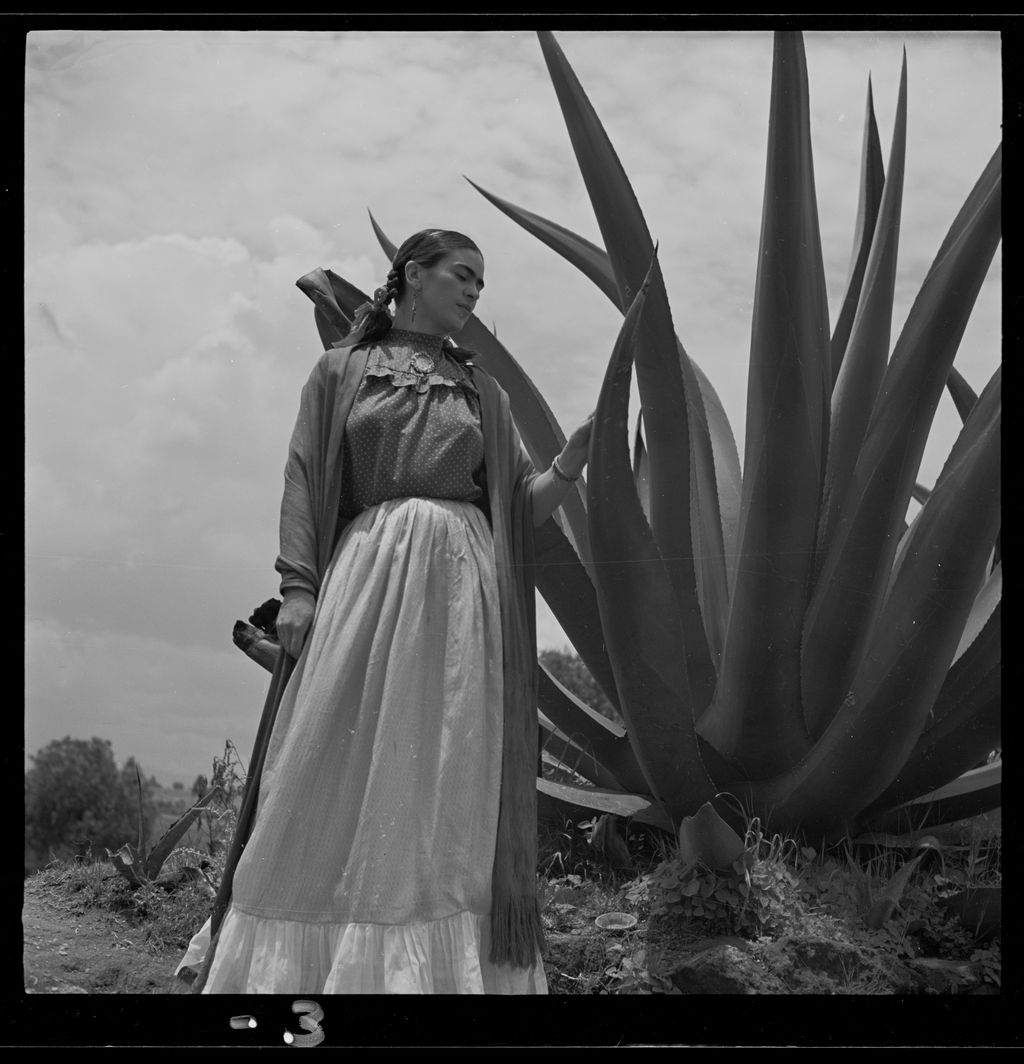
- Toni Frissell, 1937. Library of Congress, Prints & Photographs Division, Toni Frissell Photograph Collection, LC-F9-01-3707-25, no. 3; digital ID ds.05049. Source record.
- Andrea Mantegna. Public domain. Source: Wikimedia Commons (File:Andrea Mantegna - St. Sebastian - Google Art Project.jpg). 1024px proportional sRGB JPG derivative; no crop. Licence. Source record.
