


 by Tom Gurney
Tom Gurney BSc (Hons) is an art history expert with over 20 years experience
Page created on March 2, 2018 / Page updated on October 6, 2026
Email: tomgurney1@gmail.com / Phone: +44 7429 011000
Introduction
Frida Kahlo's 1940 Self-Portrait with Thorn Necklace and Hummingbird holds a face steady amid thorns, blood, insects, a suspended bird and two animals. The clustered imagery invites symbolic explanations, but the painting does not come with an artist-authored key: its forms, its documented history and the meanings later viewers have proposed are different kinds of evidence. Looking at how the portrait is constructed gives those interpretations something more precise to address. [1] [3]
The Harry Ransom Center, which owns it, catalogues the work formally as Untitled [Self-portrait with thorn necklace and hummingbird]. Kahlo transferred it directly to photographer Nickolas Muray soon after its completion, although the Center's publications disagree over whether that transfer was a gift or a sale. The work remained in Muray's New York apartment for much of the following quarter-century before his collection reached Austin. [1] [2] [4] [5]
At a Glance
Contents
- Introduction
- Looking Closely
- A Face Deliberately Made
- The 1939–40 Moment
- Muray's Painting, and the Gift-or-Sale Problem
- Thorns and the Limits of Martyrdom
- Bird, Animals and Leaves: Several Possible Readings
- Photographs and Objects in the Painted Garden
- A Portrait Given a Voice
Looking Closely
The vertical format closes around Kahlo's head, shoulders and upper chest. Her face is almost frontal, with eyes directed outward, closed reddish lips, joined dark eyebrows and visible hair above the upper lip. Those features can be described from the Harry Ransom Center's image; calling the gaze sad, impassive or defiant would already be a viewer's interpretation. [1]
Her dark hair is drawn upward into a purple-burgundy wrapping with two pale butterfly-like ornaments. Their fine openwork differs from the two forms hovering above: those have flower-like centres attached to veined wings, joining plant and insect shapes rather than simply repeating the ornaments. The small upper-right mark appears in the owner image to read “Frida Kahlo 40,” although that reading is not an owner-certified transcription. [1]
A plain white garment opens at the neckline beneath brown thorn branches. The branches loop around the neck, cross the shoulders and chest, and place several pointed ends against or into the skin, where small red drops descend. This is not a conventional string of jewellery: its irregular extensions and blood marks make the boundary between ornament and injury unstable. [1]
From the thorn structure hangs a dark hummingbird with its wings extended sideways. Its small horizontal shape repeats, on another scale, the spread of the eyebrows and the balance of the portrait; its stillness is visible, while whether it is dead, an amulet or a named deity is not established by sight alone. The bird lies at the compositional centre but does not erase the many other directions in which the thorns lead the eye. [1] [3] [7]
At the viewer's left, a dark monkey reaches toward or handles part of a branch. A black cat appears behind the opposite shoulder and looks outward; it does not perform the monkey's action. Their positions balance the picture, but their different gestures resist the tempting rule that one animal must be the exact opposite of the other. [1]
Large, overlapping leaves in green, yellow-green and pale tones fill nearly all the remaining space. Veins and folded surfaces produce detail without much open depth, pressing figure, animals and plants into a staged foreground. The visible differences among the leaves do not license exact botanical identifications from this image, nor do density and shallowness prove a single feeling such as confinement. [1]
Seen at close range, the portrait also has a material presence that a small reproduction cannot convey. Harry Ransom Center registrar Ester Harrison describes visible brush direction, colour layers and even a brush fibre, although her interview does not map those details or provide a technical examination of the support. The tightly controlled image was made through physical brushwork, not merely assembled as a set of symbolic signs. [8]
Watch: Frida Kahlo
Five perspectives to view here alongside the article.
Frida Kahlo’s The Two Fridas: Great Art Explained
A focused visual introduction to the painting and its context.
A Face Deliberately Made
The joined brows and upper-lip hair matter formally because Kahlo gives them definition at the centre of a densely detailed image. Aguilar-Castañeda and Singh's 2026 historical perspective identifies this portrait among works in which she accentuated those features, and cites Olga Campos's recollection of Kahlo's awareness of their masculine social coding. Their art-historical significance lies in deliberate pictorial emphasis: the face is presented through choices about what to sharpen rather than soften. [1] [9]
The portrait is nearly symmetrical without becoming mechanically mirrored. Brow, outspread bird and encircling thorn line organise the centre, while the monkey handles a branch, the cat watches, and the insects and leaves differ on either side. Kahlo's visible facial hair is one decision in that construction, not a raw confession that lets a viewer bypass the decisions around it. [1] [9]
The relatively simple white garment contrasts with the more elaborate forms surrounding it. Its broad neckline exposes the area crossed by the thorns, while the pale cloth makes the dark suspended bird especially legible; no securely identified regional costume is needed to explain that pictorial contrast. The fashion and Tehuana-dress study considers her wider use of clothing, but here the visual emphasis falls on the transformation of a collar into something wounding. [1]
Self-Portrait with Thorn Necklace and Hummingbird in Kahlo’s career
The Two Fridas
1939Timeline source: Museo Frida Kahlo chronology [31].
The 1939–40 Moment
Kahlo and Diego Rivera divorced in November 1939 and remarried in San Francisco on 8 December 1940. Her affair with Muray had ended, but the Harry Ransom Center says their friendship continued until her death. Because the portrait was made in 1940 and transferred to Muray soon afterwards, both relationships belong to its historical setting; neither dated fact tells us exactly what the hummingbird or cat was meant to say. [3] [4] [5]
Museo Frida Kahlo reads the work as reflecting Kahlo's emotional state after the divorce. That is a named institutional interpretation, not a statement by Kahlo explaining each depicted form or the circumstances of transfer. The familiar claim that the picture was a farewell message, a purchase to rescue her finances or a response to one man's behaviour is not secured by the sources examined here. [1] [3] [5]
The year also places it beside the very different Self-Portrait with Cropped Hair, where an oversized suit and severed strands reorganise Kahlo's appearance. In the thorn-necklace portrait, raised hair, pale ornaments, a white garment and abundant foliage produce another construction of the self. Neither the owner record nor the small painted date establishes an execution month, so their shared 1940 setting is firmer than a sequence tied to the December remarriage. [1] [2] [3] [27]
Muray's Painting, and the Gift-or-Sale Problem
The Ransom Center's current object page says Kahlo gave the portrait to Muray. A 2020 article by its curator Tracy Bonfitto says he purchased it; a 2021 article more cautiously says that he received it directly from the artist soon after completion. None presents a transaction document that resolves the difference, so the secure wording is “transferred directly,” not a claim about payment or an invented commission. [1] [4] [5]
From the 1940s until Muray's death in 1965, the painting hung in his apartment at 230 East 50th Street in New York. The Center's account describes it alongside Kahlo's later Still Life with Parrot and Fruit and within a collection that Muray lived with among friends and visitors, including Rosa Rolanda, Miguel Covarrubias and Anna May Wong. That domestic history is evidence of how the work was encountered before its present museum fame, not proof of its original intended audience or private message. [4]
The Ransom Center's finding aid records its 1965 purchase of Muray's 103-work Mexican art collection; Kahlo's painting appears there as accession 66.6. A 2020 curatorial account says the collection was sold through a New York bookseller whose catalogue emphasised Covarrubias illustrations, while referring to Kahlo primarily through her marriage to Rivera. That detail rests on the curator's account rather than direct inspection of the complete seller's catalogue, but it shows the distance between the portrait's earlier reception and its later prominence. [2] [5]
The collection also includes Kahlo's Still Life with Parrot and Fruit and the drawing Diego y Yo. Their presence gives the portrait a small group of Kahlo works within Muray's larger collection, not a complete archive of her letters to him. The accession number's “66” and an older Ransom Center release's 1966 date sit beside the finding aid's more specific “Purchase, 1965 (R2738)” entry; the acquisition file would be needed to explain the dating difference. The institution's gift wording likewise does not erase its own curator's purchase wording. [1] [2] [5] [12]
Thorns and the Limits of Martyrdom
The thorns visibly puncture the painted skin, making the comparison with Christ's crown of thorns understandable. A Spanish academic study from the Universidad de La Laguna sets the collar in a martyr-image tradition, while the Ransom Center lists Christian martyrdom and resurrection among several ways viewers have read the work. Those are readings of resemblance and transformation: there is no inspected artist statement saying Kahlo copied a particular devotional image or meant the necklace as a declaration of personal faith. [5] [11]
The comparison is also incomplete in an instructive way. Here the thorns encircle a living, upright self-portrait; they are attached to a bird and handled by a monkey against a screen of leaves rather than placed on the head in a conventional Passion scene. The blood marks matter, but the painting's own arrangement does more than illustrate martyrdom, and a Christian analogy cannot by itself explain the animals or plant life. [1] [11]
Bird, Animals and Leaves: Several Possible Readings
The hummingbird's form is unambiguous in the owner image, while its condition and role are not. A Ransom Center account of the New York Botanical Garden exhibition calls it a dead-bird amulet; other discussions gathered by the Center set animals and other details among readings of love, hope, death and Mexican cultural identity. Naming these as interpretations is more informative than choosing a single answer from an unsourced dictionary of symbols. [5] [7]
The monkey's visible action makes it especially tempting to say that it causes Kahlo's wounds. The branch it handles is part of the thorn network, yet the image does not label the animal “Diego” or declare its moral character. The cat is equally resistant to a one-word translation into bad luck or death: its gaze, position and black colouring are visible; its supposed omen is a later viewer's claim. [1] [3] [5]
Perla Labarthe, director of Museo Frida Kahlo, has described the monkey as one that might be Fulang Chang. Her conditional identification is more precise than an assertion that every painted monkey depicts the same pet, and it directs attention toward the animals Kahlo lived with without making their appearance a documentary photograph. The figure's handling of the branch remains important whatever its individual identity. [19]
The leaves have likewise produced opposing readings. In a 2015 interview about Frida Kahlo: Art, Garden, Life, curator Adriana Zavala described the usual oppressive-background interpretation, then suggested that the figure might instead be seen emerging like a bud from a network of plants and animals. Her argument about interdependence and hybridity is a named curatorial response to the very spatial density that a darker reading calls confinement; neither is a neutral fact contained in the foliage. [1] [7]
That disagreement sharpens rather than dissolves the painting. The plants screen off a distant setting, but they also make the animal and human presences meet at the same depth; the thorn branches run across that field rather than floating in front of a blank portrait backdrop. A viewer can account for how the space is made before deciding whether its effect is enclosing, generative, both or something else. [1] [7]
Photographs and Objects in the Painted Garden
Museo Frida Kahlo proposes a more specific source for the black cat: a Martin Munkácsi photograph preserved at the Casa Azul. Christine Camara's French review of the museum-coedited Frida Kahlo: sus fotos describes an arch-backed cat print, while Labarthe repeats the connection in her Spanish interview. This trail changes the question from what a black cat universally symbolises to how a particular collected image may have entered the painting. [3] [19] [20] [21]
The photographic relation can now be considered visually through Dávid Bíró's published view of the 2024 Mai Manó Ház exhibition. Its caption identifies Munkácsi's Black Cat Before an Attack, dated 1930: a complete animal stands on rough ground, its back raised, head facing the camera and ears spread sideways. Kahlo's cat shares the outward-facing head and splayed ears, but the painted shoulder and leaves conceal the legs and ground; the portrait transforms the setting rather than importing the photograph whole. [1] [23]
Adriána Lantos discusses that connection in her Hungarian photography essay, but her suggestion that Kahlo received the print from Munkácsi during his 1934 visit remains speculative. The inspected view is also a photograph of a modern exhibition display: Mai Manó Ház describes its show as 241 giclée prints. It supplies a meaningful formal comparison without establishing the vintage print's reverse, its precise arrival at the Casa Azul or Kahlo's method of working from it. [23] [26]
Wearable objects offer another material connection. Bendigo Art Gallery's programme for Lauren Ellis's 2025 close reading announced the portrait's pairing with a delicate silver filigree butterfly brooch and a Munkácsi print from Kahlo's home and studio. The brooch provides an object-based context for the pale butterfly-like ornaments in the raised hair, rather than requiring those shapes to be read only as emblems of resurrection. [24]
The distinction between ornament and organism remains visible. Two forms rest in the hair wrapping, while the hovering forms above combine flower-like centres and wings; the picture moves between things worn, things collected and invented organic combinations. Bendigo's pairing does not identify both painted ornaments as two surviving brooches, but it makes the portrait's artifice more tangible: this is a carefully assembled environment, not simply a likeness recorded in a garden. [1] [24]
A Portrait Given a Voice
The thorns have also entered a later literary conversation about gender and suffering. In her Spanish study of Elena Poniatowska's Las siete cabritas, Jimena Zambrano reads the portrait's appropriation of Christ-like thorn imagery as crossing boundaries between religious and gendered roles. She places that interpretation against the ideal of a compliant, self-denying domestic woman, the “angel of the home,” rather than treating female suffering as naturally virtuous. [25]
Zambrano also examines Poniatowska's device of making Kahlo's self-portrait speak in the first person. That imagined voice gives a silent painted figure a later literary presence, but it is not a diary passage, interview or explanation supplied by Kahlo in 1940. The distinction matters because the painting can challenge conventional roles in a critic's reading without its thorn collar becoming proof of the artist's religious belief or every animal becoming a literal statement about her private life. [25]
The portrait also prompted Pascale Petit's poetry collection What the Water Gave Me (2010). Petit identifies it as the first painting she turned into a poem for the book, and describes a connection between Kahlo's accident and her own childhood trauma. That is a documented account of the later poet's encounter with the work, not a claim that the picture contains a single recoverable autobiography. [29]
Edwin Stockdale's 2025 study compares three poems in that collection bearing the portrait's title. They use the image differently: one shifts its setting into night and memory, another makes the cat and monkey guards of an intimate interior, and a third transforms the hummingbird through mythic and erotic imagery. These changes exemplify writing in response to art—often called ekphrasis—rather than factual decoding; a bird that becomes a war god in Petit's poem does not thereby establish what Kahlo meant by her painted pendant. [28]
A Painting Reframed by Exhibitions
The portrait's exhibition life is much broader than the available object-level checklist. A 2009 Ransom Center publication counted appearances at 28 museums since 1990, and a 2013 owner release described it as one of the Center's most frequently borrowed works. These are dated cumulative statements, not an exhaustive sequence or an argument that the painting was permanently accessible in Austin. [12] [13]
Several verified displays explain why its meanings have shifted with curatorial setting. The New York Botanical Garden placed it beside another Muray-collection Kahlo painting and a garden reconstruction in 2015; the Ransom Center showed all three of its Kahlo works in Mexico Modern in 2017. MUDEC's Beyond the Myth in 2018 situated it amid letters, photographs and personal objects, while the Museum of Fine Arts, Boston's 2019 Frida Kahlo and Arte Popular placed Mexican handmade objects in the interpretive foreground. [5] [7]
The Smithsonian's study of the 2005–06 Washington Retratos exhibition records another kind of encounter. One visitor imagined the cat and monkey as opposing companions while admiring the portrait's symmetry and vivid colour; a student of Mexican heritage described feeling more confident in her appearance without cosmetics. These individual responses show the picture generating stories and self-recognition, not a universal reaction: the researchers explicitly describe their interviews as non-random and unsuitable for representing all visitors. [30]
Earlier, the Ransom Center recorded the work in the three-venue In Wonderland: The Surrealist Activities of Women Artists in Mexico and the United States exhibition, moving from Los Angeles to Quebec City and Mexico City before a 2013 Danish Kahlo–Rivera presentation. This object-linked record precedes the later botanical, popular-art and global-modernist frames. It adds evidence of shifting exhibition questions, not a final classification of Kahlo's intentions or style. [12]
The 2020 Fantastic Women presentation at Frankfurt's Schirn, later shown at Louisiana in Denmark, located the work among women associated with Surrealist worlds. That display is a fact of reception, not proof that Kahlo accepted “Surrealist” as a sufficient description of her own work. The style and reality study examines that wider debate; this object illustrates why an exhibition category and the painting's formal decisions must be kept distinct. [5] [8]
In 2022–23 the Johannesburg Contemporary Art Foundation made this portrait one of three principal works in Kahlo, Sher-Gil, Stern: Modernist Identities in the Global South. Its object text reads the thorns through Catholic imagery and the animals and leaves through identity, hybridity and indigenismo; those are the exhibition's arguments, not undisputed evidence of Kahlo's ancestry or intention. The pairing with works by Amrita Sher-Gil and Irma Stern also shows how a painting often framed as a private Mexican confession can enter a comparative account of modern portraiture across regions. [10]
Bendigo's Frida Kahlo: In Her Own Image, held from 15 March to 13 July 2025, brought the HRC loan into a presentation centred on Kahlo's personal possessions. Its object-pairing approach complements the botanical and global-modernist readings rather than replacing them. [24]
Tate's 2026 exhibition materials identify the painting with Frida: The Making of an Icon, scheduled to run until 3 January 2027. The Ransom Center's Tokens of Friendship, planned for 21 September 2027 to 9 January 2028, instead emphasises Muray's collecting relationships. Both notices belong to the portrait's dated exhibition history; neither establishes permanent display or removes the possibility of changes to a loan schedule. [1] [14] [15]
Frequent loans create a preservation question as well as an access one. Registrar Ester Harrison explains that the painting moves through condition checks, specialist transport and sometimes courier oversight, while periods away from light help limit exposure. Her 2021 account does not publish a condition report or establish a present conservation problem; it explains why a famous work may be in storage between displays. [8]
Measurements and Further Reading
The owner finding aid gives 62.5 × 48 centimetres for oil on canvas mounted to board. The Smithsonian National Portrait Gallery's secondary catalogue instead gives 61.3 × 47 centimetres for the board and a separate 64.8 × 51.1 centimetres for the frame. Those differently labelled measurements cannot be treated as interchangeable; the owner figure is used here, without pretending that the published records agree. [1] [2] [6]
Luis-Martín Lozano, Andrea Kettenmann and Marina Vázquez Ramos's Frida Kahlo: The Complete Paintings is the broad catalogue route for placing this portrait within Kahlo's painted work. Gannit Ankori's Frida Kahlo and Imaging Her Selves: Frida Kahlo's Poetics of Identity and Fragmentation offer further reading on identity and self-representation. These recommendations are based on the books' publisher records, not on a claim that their complete contents supplied the object evidence above. [16] [17] [18]
Two more specialised books follow the portrait's photographic and collecting histories. Pablo Ortiz Monasterio's museum-coedited Frida Kahlo: sus fotos addresses the Casa Azul archive in which the Munkácsi image was preserved, while Peter Mears's The Covarrubias Circle: Nickolas Muray's Collection of Twentieth-Century Mexican Art concerns the collection that carried this painting to Austin. Their publisher and library records establish relevance; neither complete volume has been used as an unseen authority for the gift-or-sale question or the photograph's precise provenance. [21] [22]
Related Reading
Frida's fashion and Tehuana dress explores the clothing used to construct her image. Fulang-Chang and I and Self-Portrait with Monkey and Parrot offer two other animal-filled self-portraits with distinct object histories. The photography study considers her use and collection of photographs beyond this painting.
Frequently Asked Questions
Its formal caption begins Untitled and places the familiar descriptive name in brackets. The conventional English and Spanish titles remain useful for finding the work, but they should not be treated as proof that Kahlo supplied an explanatory title. Another 1940 self-portrait dedicated to Dr Leo Eloesser also includes a thorn necklace and is a different object. [1] [3]
She transferred it directly to him soon after making it, according to the owner. The current Ransom Center object page says “gifted,” while its 2020 curator article says “purchased”; neither presents a primary transaction record that settles the contradiction. “Transferred directly” is the evidence-led description. [1] [4] [5]
It is a dark, wing-spread bird suspended at the centre of the thorn collar. A Ransom Center exhibition account calls it a dead-bird amulet, and other readings associate the painting's imagery with hope, love or death, but no consulted statement by Kahlo fixes the bird's meaning. Its placement and multiple later interpretations are firmer than a single symbolic equation. [1] [5] [7]
It belongs to the Nickolas Muray Collection of Mexican Art at the Harry Ransom Center in Austin, not to a permanently guaranteed gallery display. The owner's dated notices place it on international exhibition in 2026–27 and plan an Austin presentation beginning September 2027; loans, schedules and conservation rest can change. Check the Center's current object and exhibition pages before travelling. [1] [8] [14] [15]
Discussion
Use the cited evidence and your own close looking to explain your view. The prompts below are starting points, not fixed interpretations.
Reader Insights
How do the thorn necklace, bird and animals frame Kahlo's direct gaze without fixing one symbolic meaning?
What do the conflicting owner records establish about the painting's transfer to Muray?
How have later exhibitions altered the balance between the portrait's visual form and biography?
Join the Conversation
Which reading best fits the evidence, and where does uncertainty remain?
References
- Harry Ransom Center, “Self-Portrait with Thorn Necklace and Hummingbird by Frida Kahlo”, current owner page, formal Untitled caption, accession 66.6, material, direct-transfer gift wording and owner image. The owner image supports visible description, not a technical examination of the painting. View source text.
- Harry Ransom Center, Nickolas Muray Art Collection finding aid, AR-00190, collection administrative section and accession 66.6 item entry: 1965 purchase, 103 works, 62.5 × 48 cm and canvas mounted to board. View source text.
- Museo Frida Kahlo, “Frida” interactive chronology, 1939–40 entries including Autorretrato con collar de espinas y colibrí, divorce and remarriage, separate Dr Eloesser portrait, and the Martin Munkácsi cat-photograph proposal. The emotional reading and proposed visual source remain attributed. View source text.
- Tracy Bonfitto, “Living with Frida Kahlo's Self-Portrait with Thorn Necklace and Hummingbird”, Harry Ransom Center Magazine, 3 October 2021, apartment, direct-transfer and continuing-friendship passages. View source text.
- Tracy Bonfitto, “Looking at Frida Kahlo”, Harry Ransom Center Magazine, 6 July 2020, sale wording, 1965 bookseller account and 2017–20 exhibition/interpretation passages. The sale claim conflicts with reference 1. View source text.
- Smithsonian National Portrait Gallery, Autoretrato con Collar de Espinas y Colibrí catalogue record, secondary board and frame dimensions. The owner finding-aid measurement controls over this variance. View source text.
- Harry Ransom Center Magazine, “Frida Kahlo's ‘Self Portrait with Thorn Necklace and Hummingbird’ is star of New York Botanical Garden exhibition”, 21 July 2015, especially curator Adriana Zavala's interview on foliage, interdependence, emergence and the exhibition's garden frame. Her reading is attributed, not Kahlo's documented intention. View source text.
- Harry Ransom Center Magazine, “Q & A: Registrar Ester Harrison”, 12 October 2021, loan procedures, light rest and close-looking comments. Not an object-specific technical publication. View source text.
- Raúl Daniel Aguilar-Castañeda and Parmpreet Singh, “Frida Kahlo's facial hair: Hirsutism, identity and dermatology in self-portraiture”, Journal of the European Academy of Dermatology and Venereology, published 14 August 2026, passages on this portrait and Olga Campos. Deliberate pictorial emphasis is used; retrospective diagnosis and inaccurate ancestry claims are not. View source text.
- Johannesburg Contemporary Art Foundation, Kahlo, Sher-Gil, Stern: Modernist Identities in the Global South, Section III, 25 October 2022–22 February 2023, portrait object caption and comparative exhibition interpretation. Cultural and religious readings are attributed to the exhibition. View source text.
- Universidad de La Laguna, La identidad cultural mexicana en la obra de Frida Kahlo, 2015–16 thesis, selected printed pp. 36–38 only, especially p. 37 crown-of-thorns discussion and notes 57–58. Wider second-hand symbolism is not adopted. View source text.
- Harry Ransom Center, 2013 homecoming release, 1 February 2013, frequent-borrowing statement and In Wonderland / ARKEN itinerary. Its 1966 acquisition and purchase-for-financial-help claims conflict with stronger owner administrative and current-object records. View source text.
- Harry Ransom Center, Ransom Edition, Spring 2009, printed p. 7, dated 28-museum count since 1990; not a complete checklist. View source text.
- Tate Modern, Frida: The Making of an Icon, 25 June 2026–3 January 2027. The exhibition page was not accessible in the latest research pass; Tate's exhibition poster supplies the printed dates and its product record for this portrait confirms the object as a featured work. The product's larger size is not adopted over owner documentation. View source text 1; View source text 2; View source text 3.
- Harry Ransom Center, Tokens of Friendship: The Nickolas Muray Collection of Mexican Art, planned 21 September 2027–9 January 2028, naming this painting. View source text.
- Luis-Martín Lozano, Andrea Kettenmann and Marina Vázquez Ramos, Frida Kahlo: The Complete Paintings, TASCHEN publisher record only; complete volume unread and not used for specific object claims. View source text.
- Gannit Ankori, Frida Kahlo, Reaktion Books publisher description only; complete book unread. View source text.
- Gannit Ankori, Imaging Her Selves: Frida Kahlo's Poetics of Identity and Fragmentation, publisher record only; complete book unread. View source text.
- “Frida en África: Entrevista con Bárbara Rousseaux, Perla Labarthe y María Teresa Moya”, UNAM Internacional, Spanish interview, especially Perla Labarthe's responses on this portrait, a possible monkey and Munkácsi's cat photograph. Her “could be” wording is preserved. View source text.
- Christine Camara, “Pablo Ortiz Monasterio, Frida Kahlo: sus fotos, 2010”, Institut national d'histoire de l'art, updated 29 August 2024, French review, especially the paragraph describing Munkácsi's black-cat print. This is a review of the book, not direct inspection of its photographic plate here. View source text.
- Editorial RM, Frida Kahlo: sus fotos, Spanish publisher record, museum coedition, 552 pages, 2010. Complete book and original Munkácsi print not read or inspected; an exact-source route for later direct consultation. View source text.
- Library of Congress, The Covarrubias Circle: Nickolas Muray's Collection of Twentieth-Century Mexican Art, 2004 bibliographic and Handbook of Latin American Studies annotation for the Peter Mears/Kurt Heinzelman collection volume. The complete book was not read and is not a direct source for transaction facts. View source text.
- Adriána Lantos, “Frida Kahlo és a magyar fotográfusok: Munkácsi, Muray és Sternberger”, PUNKT, 19 January 2025, especially Dávid Bíró's published photograph of the 2024 Mai Manó Ház display and its caption identifying Munkácsi's Black Cat Before an Attack (1930). The exhibited image was visually inspected; the vintage original and its reverse were not. Speculative gift, erroneous relationship dates and fixed motif codes are not adopted. View source text.
- Bendigo Art Gallery, Lauren Ellis close-reading programme, 18 June 2025, brooch-and-Munkácsi-print pairing and HRC loan, and Frida Kahlo: In Her Own Image, 15 March–13 July 2025. The programme was read, not the spoken talk; its incorrect divorce-year statement is not adopted. View source text 1; View source text 2.
- Jimena Zambrano, “Transformando al ángel: la mujer-artista en Las siete cabritas de Elena Poniatowska”, Revista Laboratorio, issue 12 (2015), DOI 10.32995/rl12201548, complete 20-page article, especially PDF pp. 4–9. Poniatowska's literary voice is distinguished from Kahlo's testimony; fixed animal codes and inferred personal belief are not adopted. The migrated website's automated citation lists 2019, unlike the issue date. View source text.
- Mai Manó Ház, Frida Kahlo fotógyűjteménye exhibition record, 18 October 2024–9 February 2025, curator Pablo Ortiz Monasterio and technical description of 241 giclée prints on Matte Litho-Realistic paper. This identifies a modern exhibition presentation rather than direct access to vintage originals. View source text.
- Museum of Modern Art, Self-Portrait with Cropped Hair, current owner entry and excerpt from MoMA Highlights (2019), confirming 1940, the loose suit and cut hair. Used for a bounded same-year comparison, not an execution sequence between the portraits. View source text.
- Edwin Stockdale, “Linking ekphrasis and psychogeography as similar research methods”, New Writing 22(4) (2025), pp. 581–603, DOI 10.1080/14790726.2025.2579617, complete open-access HTML article read, especially “Ekphrasis in practice” after figure 3 and its three Petit excerpts, citing her pp. 17, 34 and 49. Later poetry is distinguished from Kahlo's testimony; unsupported biographical and medical reconstruction is not adopted. View source text.
- Pascale Petit, “Review of What the Water Gave Me and an essay”, author's blog, 16 December 2010, complete dated post, especially its final painting paragraph and preceding personal-trauma connection. A primary account of the poet's practice; the complete poetry collection was not read. View source text.
- Smithsonian Institution, Office of Policy and Analysis, Do Portraits Speak and Tell Stories? A Visitor Study of Retratos: 2,000 Years of Latin American Art, February 2006, printed pp.1–4,7–8,11 and27. Selected original report pages, not the complete exhibition catalogue; qualitative individual responses do not represent every visitor. View source text.
- Museo Frida Kahlo, Frida interactive chronology, selected work dates used for the comparison timeline. The current work's date follows its cited object record. View source text.
Image Credits
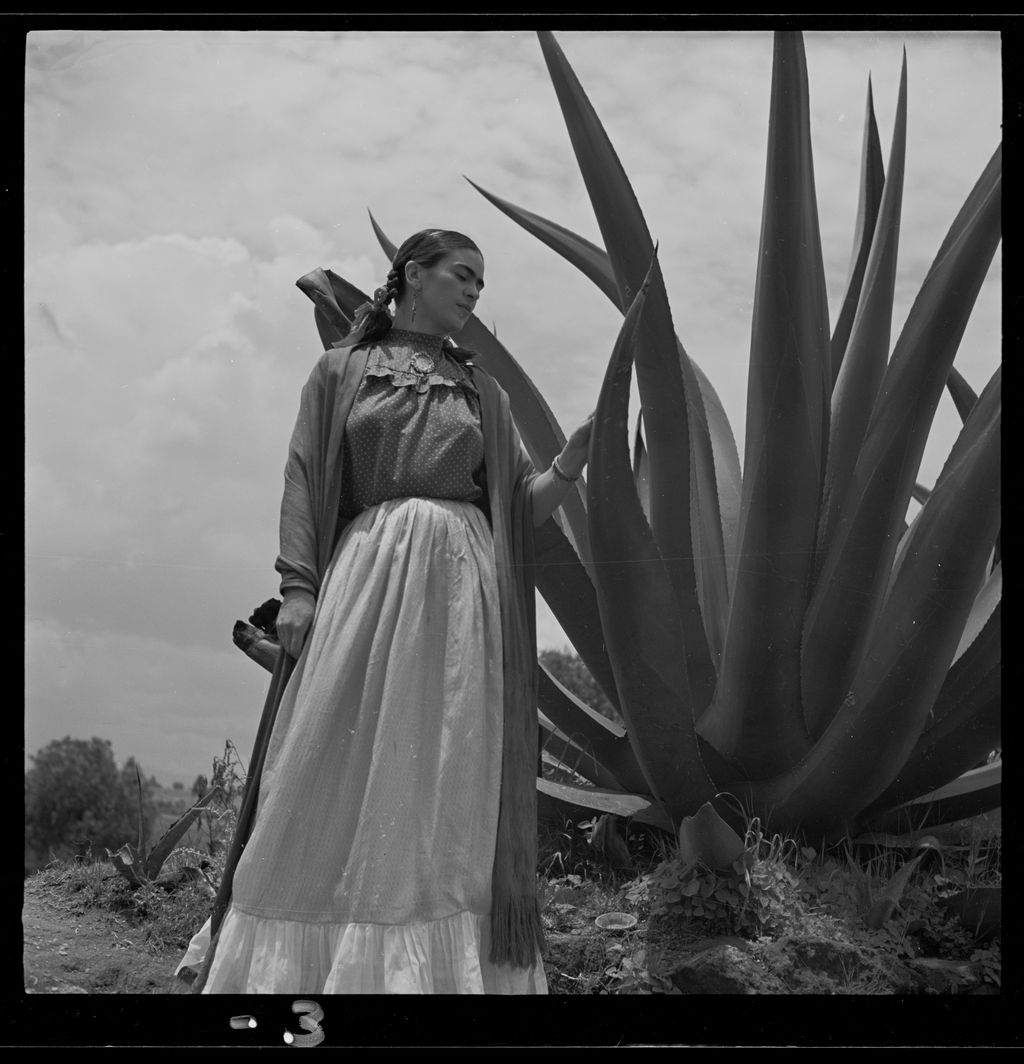
- Toni Frissell, 1937. Library of Congress, Prints & Photographs Division, Toni Frissell Photograph Collection, LC-F9-01-3707-25, no. 3; digital ID ds.05049. Source record.
