


 by Tom Gurney
Tom Gurney BSc (Hons) is an art history expert with over 20 years experience
Page created on March 2, 2018 / Page updated on October 6, 2026
Email: tomgurney1@gmail.com / Phone: +44 7429 011000
Introduction
Frida Kahlo's paintings encompass self-portraits, portraits of other people, fruit and flowers, city streets, family histories and political images. Her familiar face is one point of entry, but it should not obscure the differences between a small painted panel, an ambitious double portrait, a watercolour and an unfinished composition. Looking across these forms reveals an artist repeatedly finding different ways to organise personal experience and the world around her. [1] [2] [3]
This guide brings together all 117 individual work articles featured in this cluster, with text links to their detailed studies. Watercolours and works on paper have their own group, while records with questioned or incompletely established attribution are clearly separated. The directory describes the articles available here, not a definitive count of everything Kahlo painted. [1] [4]
At a Glance
- Coverage: 117 individual work articles, including explicitly qualified attribution records.
- Subjects: Self-portraits, other portraits, still lifes, landscapes, narrative scenes and political compositions.
- Formats: Oil and mixed-media works, with watercolours and works on paper distinguished. [2] [3]
- Catalogue total: TASCHEN's publisher describes 152 paintings; that is a different scope from this site's directory. [1]
- Sources: Individual studies distinguish owner records, historical catalogues, observation and attributed interpretation. [3] [4]
Contents
- Introduction
- Explore the Paintings and Other Works
- How Many Paintings Did Frida Kahlo Make
- From Early Portraits to Late Compositions
- Popular Painting and Carefully Made Images
- Titles That Look Similar but Identify Different Works
- Supports Frames and More Than One Component
- Collections Private Works and Pictures That Cannot Be Located
- Attribution and Why a Signature Is Not Enough
- Books for Further Study
Explore the Paintings and Other Works
The links below cover the full range of individual works discussed here. Short English titles provide a convenient way into articles that retain documented Spanish names, alternative dates, different component histories and other qualifications. A familiar label such as Still Life or Self-Portrait with Monkey should not be mistaken for a unique identity shared by every work with a similar name. [3] [5]
The final group leads to articles about published or questioned attributions. Including those records makes their documentary history accessible without presenting their authorship as settled. The three groups contain no duplicate article links, and the paper works remain visible rather than disappearing from a guide centred on oil painting. [4]
Oil Paintings and Mixed-Media Works
- A Few Small Nips
- Alicia and Eduardo Safa
- Brick Ovens
- Cactus Fruits
- Coconuts
- Congress of the Peoples for Peace
- Diego and Frida 1929–1944
- Diego and I
- Flower of Life
- Four Inhabitants of Mexico City
- Frida and the Cesarean
- Frieda and Diego Rivera
- Fruit of Life
- Fruits of the Earth
- Fulang-Chang and I
- Girl with Death Mask
- Girl with Necklace
- Henry Ford Hospital
- Landscape
- Living Nature
- Lupita Morillo Safa
- Magnolias
- Mariana Morillo Safa
- Marxism Will Give Health to the Sick
- Me and My Parrots
- Memory (The Heart)
- Moses (Nucleus of Creation)
- My Birth
- My Dress Hangs There
- My Grandparents, My Parents, and I
- My Nurse and I
- Pancho Villa and Adelita
- Pitahayas
- Portrait of a Girl
- Portrait of Agustín M. Olmedo
- Portrait of Alejandro Gómez Arias
- Portrait of Arija Muray
- Portrait of Cristina, My Sister
- Portrait of Diego Rivera
- Portrait of Doña Rosita Morillo
- Portrait of Dr. Leo Eloesser
- Portrait of Eva Frederick
- Portrait of Frida's Family
- Portrait of Isolda Pinedo Kahlo
- Portrait of Luther Burbank
- Portrait of Marta Patricia Procel
- Portrait of My Father
- Portrait of Natasha Gelman
- Portrait of Tina Modotti
- Portrait of Virginia
- Roots (Raíces)
- Self-Portrait (January 1930)
- Self-Portrait (Time Flies)
- Self-Portrait as a Tehuana
- Self-Portrait Dedicated to Dr. Eloesser
- Self-Portrait Dedicated to Jacqueline Lamba
- Self-Portrait Dedicated to Leon Trotsky
- Self-Portrait Dedicated to Sigmund Firestone
- Self-Portrait in a Velvet Dress
- Self-Portrait in Miniature
- Self-Portrait on the Borderline
- Self-Portrait with Bonito
- Self-Portrait with Braid
- Self-Portrait with Cropped Hair
- Self-Portrait with Curly Hair
- Self-Portrait with Dr Farill
- Self-Portrait with Loose Hair
- Self-Portrait with Monkey (1938)
- Self-Portrait with Monkey (1940)
- Self-Portrait with Monkey and Parrot
- Self-Portrait with Small Monkey
- Self-Portrait with Stalin
- Self-Portrait with Thorn Necklace and Hummingbird
- Shop Window in Detroit
- Stalin
- Still Life (1942)
- Still Life (I Belong to Samuel Fastlicht)
- Still Life Dedicated to Samuel Fastlicht (1952)
- Still Life with Flag
- Still Life with Parrot and Flag
- Still Life with Parrot and Fruit
- Still Life with Watermelons
- Sun and Life
- The Bride Frightened at Seeing Life Opened
- The Broken Column
- The Bus
- The Chick
- The Dream (The Bed)
- The Flower Basket
- The Frame
- The Love Embrace
- The Suicide of Dorothy Hale
- The Two Fridas
- The Wounded Deer
- The Wounded Table
- Thinking About Death
- Tray with Poppies
- Tree of Hope, Remain Firm
- Two Nudes in a Forest
- Viva la Vida
- Viva la Vida and Dr Juan Farill
- Weeping Coconuts
- What the Water Gave Me
- Without Hope
- Xochitl (Flower of Life)
Watercolours and Works on Paper
- Cantina Tu Suegra
- Échate l’Otra
- El Salón de Belleza
- Landscape I (1951)
- Landscape II (1951)
- Small Life (I)
- Small Life (II)
Questioned and Qualified Attributions
- Piggy Bank and Black Horse — Published attribution; provenance and attribution information incomplete; watercolour.
- Seated Girl with Duck — Attribution questioned.
- Self-Portrait Published as 1923 — Attribution and date questioned.
- Still Life with Fruit — Attribution questioned.
- Still Life with Roses — Published attribution; provenance and attribution questioned.
Watch: Frida Kahlo
Five perspectives to view here alongside the article.
Frida Kahlo’s The Two Fridas: Great Art Explained
A focused visual introduction to the painting and its context.
How Many Paintings Did Frida Kahlo Make
The publisher of Luis-Martín Lozano's Frida Kahlo: The Complete Paintings, written with Andrea Kettenmann and Marina Vázquez Ramos, describes a corpus of 152 paintings. Its large-format volume also includes photographs, letters and diary material, alongside private works and works previously considered lost or long unexhibited. That declared catalogue scope is more informative than a number assembled from whatever pictures happen to appear in an image search. [1]
The 117 links in this guide answer a different question: which individual work studies are available on this site. They include watercolours, unfinished pictures, historically untraced works and articles on attribution disputes, so the directory must not be presented as 117 securely authenticated oil paintings. Nor can the difference between the two numbers be treated as a list of missing works without comparing the catalogue's actual entries and inclusion rules. [1] [4]
Self-portrait totals are similarly dependent on definitions. A double portrait, a disguised self-image, a miniature and an unfinished picture may be included or excluded differently, while a drawing does not become a painted self-portrait simply because its subject is Kahlo. This guide therefore offers a route into the self-portrait study without promising a definitive numerical subdivision of the oeuvre. [1]
From Early Portraits to Late Compositions
Several paths through the directory begin in the 1920s: the elongated figure of Self-Portrait in a Velvet Dress, portraits of relatives and friends, and the watercolour street scenes. These works invite comparison of pose, space, dress and public setting before the more familiar double portraits and densely populated still lifes. They also show why an account of Kahlo beginning and ending with the same iconic face is too narrow. [2]
The 1931 Frieda and Diego Rivera offers another kind of self-image: Kahlo stands beside Rivera rather than alone. SFMOMA's record fixes the title's spelling, the year and the oil-on-canvas medium, while its interpretive audio brings more than one later artist's response to the pair's unequal scale and presentation. Documentary facts and those responses belong together without being mistaken for the same kind of statement. [5]
The United States pictures open further comparisons. Self-Portrait on the Borderline, My Dress Hangs There and the Detroit street display lead to articles about different arrangements of place, objects and identity. Their specialist studies distinguish what is visible from interpretations about nationality, industrial life and Kahlo's position abroad.
By the later 1930s, portraits, animals, invented settings and bodily experience were being combined in markedly different ways. The intimate ensemble of Fulang-Chang and I is unlike the expanded confrontation of The Two Fridas, and neither can stand for every work in the period. MoMA dates the former's painted panel to 1937 but places assembly with its mirror after 1939, illustrating how a work's history can extend beyond a single date. [3]
The 1940s and final years offer portraits of patrons, friends and doctors alongside fruit compositions and overtly political subjects. The directory makes it possible to move from Portrait of Doña Rosita Morillo to Magnolias, or from The Broken Column to Marxism Will Give Health to the Sick. Those comparisons need not turn a changing practice into a single narrative of either decline or triumph.
Popular Painting and Carefully Made Images
Teresa del Conde's Spanish study connects Kahlo's practice with Mexican popular painting, small metal supports and ex-voto conventions. Her argument provides a historical alternative to describing every flat or simplified form as merely naïve. Scale, painted words, framing and a concentrated narrative can be deliberate means of organising an image rather than evidence that an artist lacked pictorial control. [2]
The relationship with devotional pictures is not an identity between genres. A traditional thanksgiving image and a Kahlo composition can use comparable formats while addressing different experiences, audiences and purposes. The folk traditions study develops those connections more fully, including the limits of calling every bodily scene a retablo. [2]
This also helps resist a universal symbol dictionary. A ribbon can carry a dedication, an animal can have a particular place in a portrait, and a fruit arrangement can combine observation with a critic's proposed meanings. The individual articles keep visual description distinct from documented fact and attributed interpretation, while the guide to reading Kahlo explains how those forms of evidence work together.
Titles That Look Similar but Identify Different Works
An English title is often a useful translation or descriptive label, not necessarily the words Kahlo chose. SFMOMA retains Frieda and Diego Rivera; Centre Pompidou records The Frame and Le cadre, together with a separate attributed self-portrait title. The latter's bibliography also distinguishes the English title in the 1938 New York catalogue from the French form used in Paris in 1939. [5] [6]
The problem is especially visible among still lifes. Flower of Life and Xochitl are separate compositions, as are the two studies connected with Samuel Fastlicht. Coconuts retains an inherited web address that mentions melons, but the address is not an authoritative catalogue title.
Portraits also need individual identities. The oval self-portrait dedicated to Jacqueline Lamba is distinct from the self-portrait in miniature, and the monkey portraits differ in date, composition and collection history. Similar wording should make comparison easier, not collapse separate objects into a supposedly single picture with inconsistent dates. [3]
The drawings and original printmaking page supplies another important boundary. A drawing and an oil painting may share a phrase such as Diego y Yo without becoming the same object, while an original lithograph is different from a modern poster reproducing a painting. The prints guide treats those commercial and medium distinctions separately.
Supports Frames and More Than One Component
The support beneath a painting can be part of its scale, texture and relationship with other forms of picture-making. Kahlo's works include canvas, metal and rigid fibreboards, while the paper group encompasses watercolour and, in some cases, additional drawing media. These terms are not freely interchangeable: an owner record describing zinc, aluminium or Masonite conveys more information than a generic label such as board. [2] [6]
The Frame offers a particularly clear example. Centre Pompidou identifies a portrait painted on aluminium and an artisan reverse-painted glass element that frames it; the small portrait panel and the framed ensemble have different dimensions. Treating the entire object as a plain canvas would erase the construction that gives the work its familiar title. [6]
Fulang-Chang and I poses a different component question. MoMA records the painting and the later mirror separately, each with its own framing and measurements, while explaining how the reflective element brings the viewer into proximity with the portrait. A date or size copied without its component would describe only part of the ensemble. [3]
The technique and materials study considers these choices alongside paint handling and technical evidence. What a reproduction shows is not the same as a pigment identification, a condition report or examination of the reverse. A visible colour can be described without claiming that its material composition has been scientifically established.
Collections Private Works and Pictures That Cannot Be Located
Collection ownership and public display answer different questions. An institution can own a picture without showing it, and a private work can become publicly visible through a temporary loan. SFMOMA, MoMA and Centre Pompidou records identify particular holdings and component histories; they are not permanent guarantees that a visitor will encounter a given picture on a chosen day. [3] [5] [6]
TASCHEN's description includes private and formerly lost or long-unexhibited material, which helps explain why a museum-only selection cannot represent the full catalogue. Conversely, a historical private-collection credit does not identify the owner today. The distinction is particularly important for works known through publications or old photographs rather than a current accessible object record. [1] [4]
The word lost also needs a history. A work may be untraced, destroyed, temporarily unseen, known from a photograph, or rediscovered after an earlier publication called it missing. The article on The Wounded Table examines its own documentary problem; that status should not be borrowed for every privately held work that is difficult to find online.
The collections and provenance page follows those distinctions in more detail. The exhibitions guide separately treats documented appearances, since exhibition history does not automatically establish a continuous chain of ownership. The French state's 1939 purchase recorded for The Frame, for example, is more precise than a loose claim that the Louvre bought it. [6]
Attribution and Why a Signature Is Not Enough
The directory's qualified group includes records worth studying precisely because their published history is not the same as settled authorship. The ribbon-bearing Still Life with Fruit was attributed to Kahlo in earlier publications and an exhibition record, while a 2016 catalogue explicitly reports authenticity doubts. The article preserves both the earlier attribution and the later warning rather than turning either into an unqualified verdict. [4]
Jason Edward Kaufman's report on the separate Noyola controversy records competing ownership claims and strong expert objections to a large group of purported Kahlo works and papers. His account of the 2010 Dallas discussion explains an important distinction: materials compatible with an artist's lifetime do not prove who used them, or when. That historical dispute is relevant as a method of asking questions, not a ruling on every picture in this directory. [7]
A signature, a familiar motif and repeated publication can all belong to an attribution history without supplying a complete provenance or technical examination. Mexican patrimonial registration is another separate matter: INBAL's guidance expressly states that registration determines neither authenticity nor ownership rights. Protected artistic-monument status must not be turned into an authorship certificate. [8]
These distinctions do not make looking at the pictures pointless. They make it possible to appreciate a composition, reconstruct its reception and understand its uncertainty without claiming more than the evidence establishes. The linked disputed-work articles carry their own specific questions rather than a shared blanket assertion of authenticity.
Books for Further Study
For an extensive painted corpus, Lozano's TASCHEN volume offers a different scale of reference from an introductory biography. The publisher describes 624 pages and 152 paintings, with documentary and biographical material alongside them. Those are edition and scope facts; the complete book has not been consulted for this guide, so no unseen catalogue entry is used to settle a date or attribution. [1]
Andrea Kettenmann's shorter TASCHEN introduction has a different purpose: an accessible selection of works and an account of the artist's life rather than an independently complete corpus. The 1988 catalogue by Helga Prignitz-Poda, Salomón Grimberg and Kettenmann is also important for understanding how catalogue decisions have changed. The complete earlier volume remains unconsulted here, and its method should be compared with the later study rather than assumed identical. [7] [9]
Specialist reading can then follow the reader's question. Celia Stahr's Frida in America concerns the United States years, whereas dress and appearance catalogues develop material different from a paintings index. The books page distinguishes these purposes and the editions available, without pretending that attractive reproductions alone supply an object's provenance.
Frequently Asked Questions
It lists every individual work article featured in this cluster. Its 117 links should not be equated with TASCHEN's publisher-declared corpus of 152 paintings, because the directory also distinguishes paper works and qualified attribution studies. [1]
The Two Fridas, Frieda and Diego Rivera, Self-Portrait with Cropped Hair and Viva la Vida offer contrasting formats and subjects. From them, the thematic studies lead into portraits, still lifes, materials, travel and the relationship between imagery and lived experience.
No blanket authentication claim is made. The separate qualified group identifies published or questioned attributions, and the individual studies explain the evidence and its limits. [4] [7]
An original painting, an original lithograph and a modern printed reproduction are different kinds of object. The drawings and printmaking article and the commercial prints guide explain those distinctions without converting reproductions into additional original paintings.
Discussion
Use the cited evidence and your own close looking to explain your view. The prompts below are starting points, not fixed interpretations.
Reader Insights
Which less familiar work changes your understanding of Kahlo beyond self-portraiture?
What differences become visible when you compare paintings with the separate watercolours?
How does an attribution qualification change the questions you ask of an object?
Join the Conversation
Which reading best fits the evidence, and where does uncertainty remain?
References
- TASCHEN, Frida Kahlo: The Complete Paintings, Luis-Martín Lozano with Andrea Kettenmann and Marina Vázquez Ramos, English XXL edition ISBN 9783836574204, publisher's 624-page and 152-painting scope, directly checked 6 October 2026. Complete book unconsulted. View source text.
- Teresa del Conde, “Lo popular en la pintura de Frida Kahlo,” Anales del Instituto de Investigaciones Estéticas 13.45 (1976), pp. 195–203; in Spanish. Complete article consulted for popular/ex-voto formats and supports, not as authority for its erroneous biographical details. View source text.
- Museum of Modern Art, Fulang-Chang and I, 277.1987.a–b: 1937 painting, assembly after 1939, component materials, measurements and interpretation. View source text.
- Ivanna Margarucci, Frida Kahlo: Una vida a través del arte, Museo Roca, Historia Visual Argentina 45 (2016), physical p. 78, entry 112, attribution warning and acknowledgement of earlier exhibition/bibliographic attribution; in Spanish. Other directory qualifications follow the sources in the individual linked studies, not a universal judgement from this entry. View source text.
- SFMOMA, Frieda and Diego Rivera, 36.6061: owner title, 1931 date, oil on canvas, collection credit and attributed interpretive audio responses. View source text.
- Centre Pompidou, The Frame / Le cadre, JP 929 P (1): bracketed 1938, aluminium panel, reverse-painted glass framing element, separate dimensions, 1939 French state purchase and lifetime catalogue-title references; in French. Variable loan/display fields are not adopted as an enduring viewing promise. View source text.
- Jason Edward Kaufman, “Finding Frida Kahlo,” IFAR Journal 11.3–4 (2010), pp. 18–25, complete article: Noyola controversy, expert/owner positions, material-authenticity distinction and 1988 catalogue reference. Not a current judgement on every attributed work. View source text.
- INBAL, Registro Público de Monumentos y Zonas Artísticos, institutional registration guide, one-page PDF, “Información adicional relevante”: registration determines neither authenticity nor ownership; in Spanish, directly rechecked 6 October 2026. View source text.
- TASCHEN, Andrea Kettenmann, Frida Kahlo, Basic Art Series, English edition ISBN 9783836500852, 96-page selected introduction; German publisher record. Complete edition unconsulted. View source text.
Image Credits
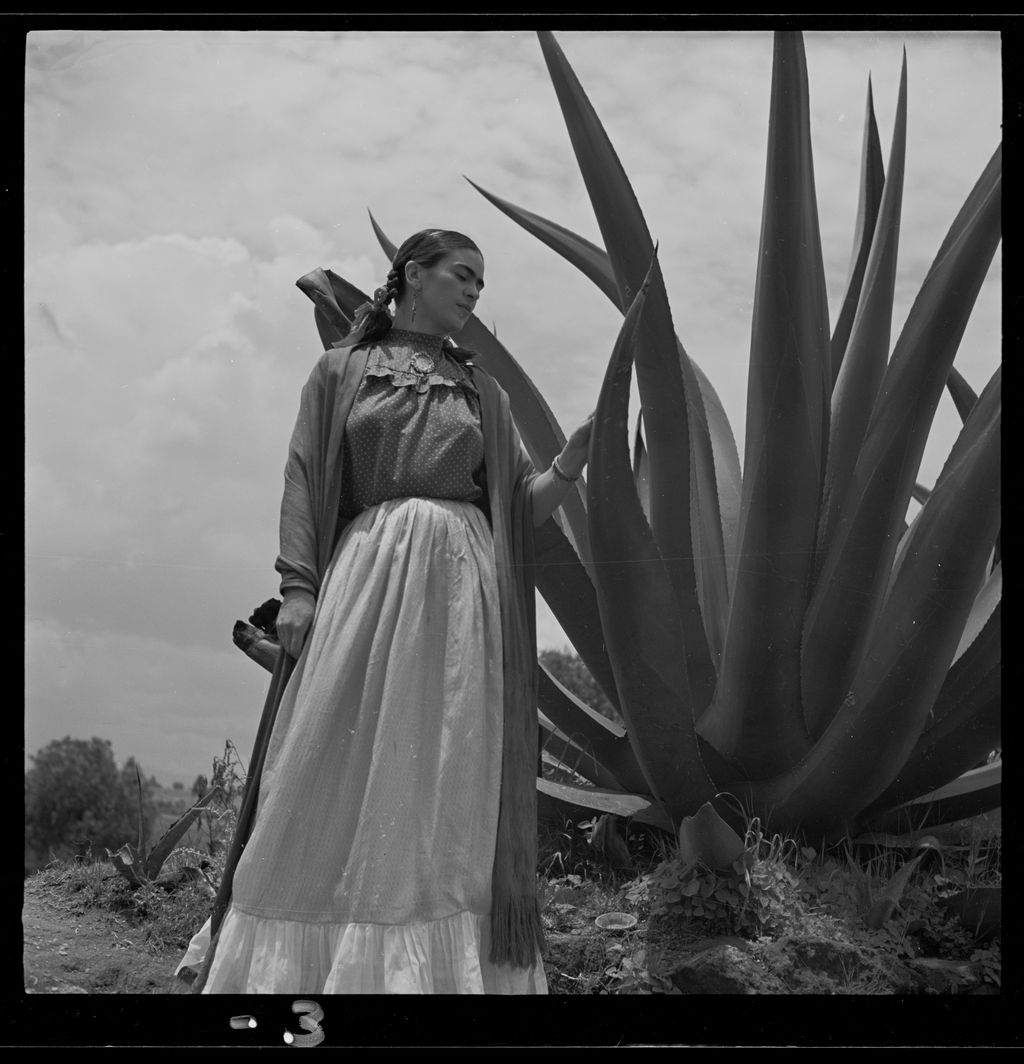
- Toni Frissell, 1937. Library of Congress, Prints & Photographs Division, Toni Frissell Photograph Collection, LC-F9-01-3707-25, no. 3; digital ID ds.05049. Source record.
