


 by Tom Gurney
Tom Gurney BSc (Hons) is an art history expert with over 20 years experience
Page created on March 2, 2018 / Page updated on October 6, 2026
Email: tomgurney1@gmail.com / Phone: +44 7429 011000
Introduction
Frida Kahlo's Self-Portrait Dedicated to Leon Trotsky is a portrait of herself, not of the man named in its title. She stands between drawn-back curtains, holding flowers and a painted note that addresses Trotsky by name and dates the work 7 November 1937. The picture makes an intimate dedication visible to anyone who looks at it, yet its careful staging also gives Kahlo control over how that relationship appears. [1] [2]
The date was Trotsky's fifty-eighth birthday and, in the Gregorian calendar, the twentieth anniversary of the October Revolution. Their brief affair belongs to the painting's history, but it had ended by the summer according to historian Bertrand Patenaude's account; the November portrait is not simply a scene painted during an active romance. Its personal address sits alongside Mexican dress, revolutionary exile and the later claims others made about Kahlo's allegiance and intentions. [2] [5] [8] [9]
At a Glance
- Artist, title and date: Frida Kahlo, Self-Portrait Dedicated to Leon Trotsky, 1937; its painted note is dated 7 November. [1] [2]
- Medium and size: Oil on Masonite, 76.2 × 60.96 cm, according to the owner museum. [1]
- Collection: National Museum of Women in the Arts, Washington, DC; gift of Clare Boothe Luce. [1]
- Other title: Between the Curtains is a later museum title, not an established first title. [2]
Contents
- Introduction
- A Self-Portrait Addressed to Someone Else
- What the Dedication Says
- San Ángel and the Setting of Its Making
- Trotsky in Mexico and the November Portrait
- Dress, Fashion and Mexican Identity
- Curtains, Retablos and the Act of Display
- From Trotsky's Study to the Museum
- Titles, Support and Measurements
A Self-Portrait Addressed to Someone Else
The painting is vertical and shows Kahlo nearly full length, alone in a shallow setting. Pale curtains tied back at both sides open onto a greenish rear field; horizontal brown boards mark the floor. The central body and balanced curtains produce a stage-like presentation, but no raised platform is visible, so a literal stage is more than the image establishes. [1]
Kahlo's head is slightly turned, though her unsmiling face meets the viewer. Dark brows, a braided crown with red material and flowers, pendant earrings and a small ornament near the neckline make the face a precise centre of attention. None of these details, considered alone, verifies that she felt confident, seductive or mournful; those are later responses to a deliberately composed likeness. [1] [10]
Her clothing broadens the figure toward the floor. A fringed, honey-coloured shawl lies across red and green areas of the bodice; a pink skirt carries pale ornament, a white flounced-looking hem and a long geometric front panel. These are visible painted forms and colours, not a fibre analysis or proof of every garment's place of manufacture. [1] [12] [13]
At the centre, one hand holds a compact bouquet while the other presents a sheet covered with writing. The flowers, paper and overlapping hands make giving an action within the painted image, rather than a story supplied only by its modern title. Trotsky is absent as a figure; he enters through the words on the sheet and through the viewer's knowledge of their addressee. [1] [2]
The paper also changes the viewer's role. It faces out, so a private dedication becomes publicly legible in a painting that can move between homes, galleries and museums. Kahlo depicts herself not merely as an object to be looked at, but as the person who displays the message and decides the terms of its presentation. [1] [12]
Watch: Frida Kahlo
Five perspectives to view here alongside the article.
Frida Kahlo’s The Two Fridas: Great Art Explained
A focused visual introduction to the painting and its context.
The Trotsky self-portrait in Kahlo’s career
Selected works; not a complete chronology. The portrait’s date follows the NMWA collection record [1].
What the Dedication Says
The museum's curator transcribes the Spanish note as a dedication to Leon Trotsky made “con todo cariño,” followed by the date, Kahlo's name and “En San Ángel, Mexico.” “With all affection” preserves the phrase's warmth without automatically intensifying it into the museum object's English gloss, “with all my love.” The inscription itself names neither an affair nor a political programme. [1] [2]
Its date is nevertheless specific. Trotsky was born on 7 November 1879, so 7 November 1937 was his fifty-eighth birthday, as the curator's transcript correctly says. An older overview on the same museum exhibition page calls it his sixtieth; the birth date and arithmetic rule that wording out. [2] [8]
The same Gregorian date marked twenty years since the events conventionally called the October Revolution: the Russian State Archive gives 25 October in the old calendar and 7 November 1917 in the new. For Trotsky, a leading figure in that revolution, birthday and political anniversary coincided. The painting's note does not mention 1917, however, and no inspected letter or diary proves Kahlo chose the date to celebrate both occasions. [2] [9]
The distinction between dedication and handover matters. The date and museum interpretation support describing the portrait as a birthday gift, and André Breton later reported seeing a Kahlo self-portrait in Trotsky's study. Neither source supplies a receipt, witness account or inventory showing that Trotsky accepted it on 7 November itself. [2] [10]
San Ángel and the Setting of Its Making
“En San Ángel” is part of the painted note, not an address for Casa Azul. Two later reports from Mexico's National Institute of Fine Arts and Literature identify the San Ángel house studio as a place where Kahlo painted this self-portrait. They strengthen the studio-house connection beyond the inscription, although neither identifies a precise room, working sequence or contemporaneous making diary. [2] [3] [4]
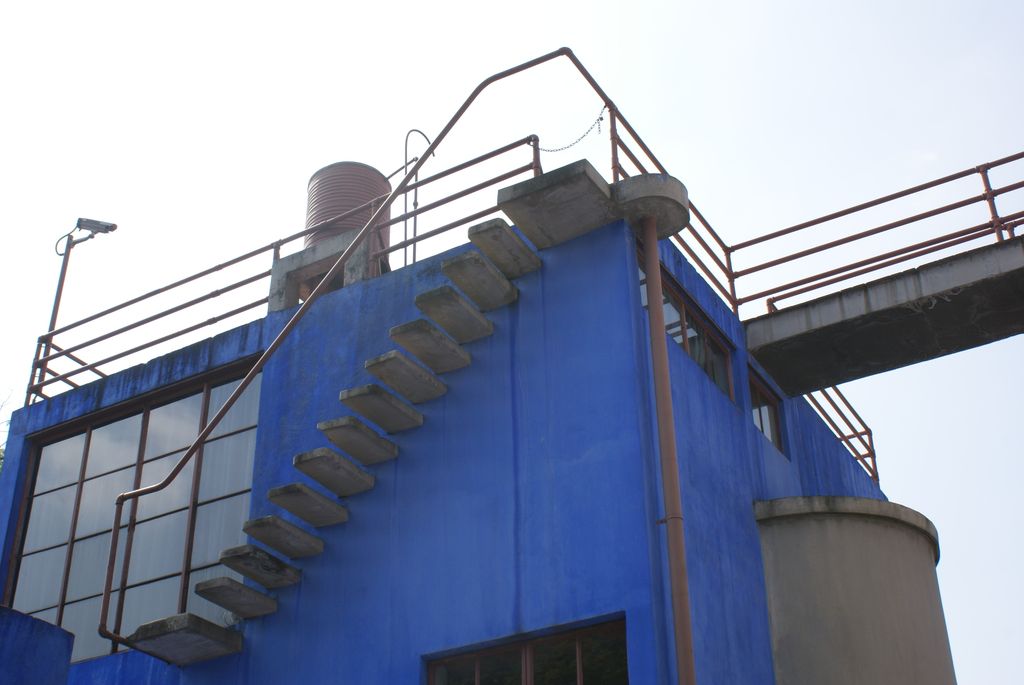
That distinction is easy to lose because Trotsky and Natalia Sedova lived at Casa Azul, Kahlo's family home in Coyoacán. The recipients' residence is not necessarily the artist's place of work on this particular panel. The painting can be connected to both places: San Ángel through its written location and later studio-museum history, Casa Azul through the exiles' stay and the personal and political relationships that made the dedication possible. [3] [4] [6] [7]
Trotsky in Mexico and the November Portrait
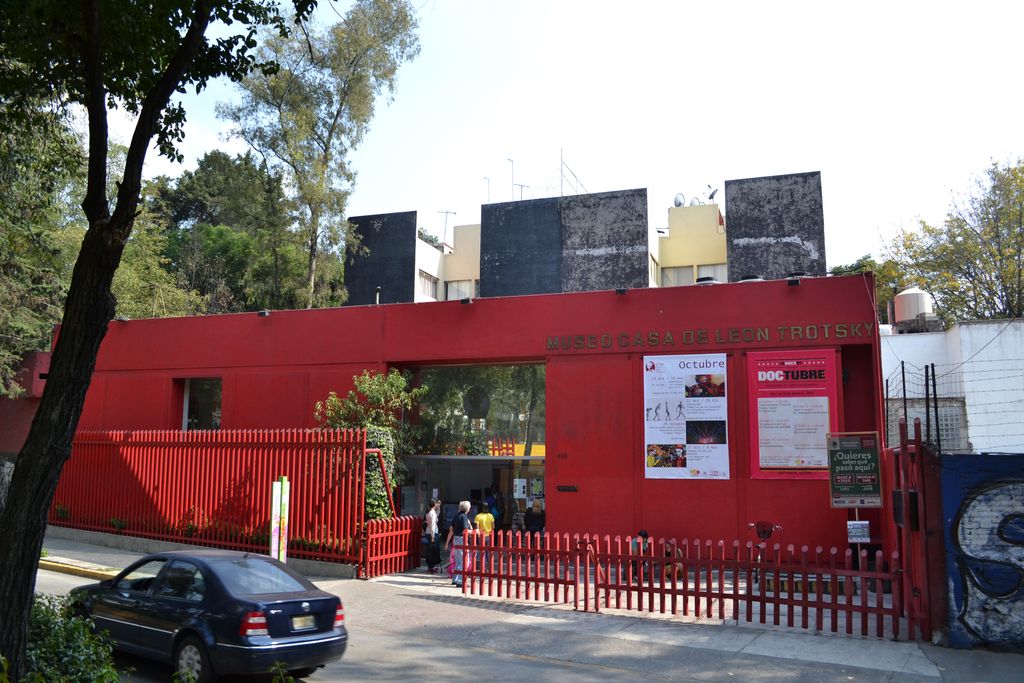
Trotsky and Sedova arrived at Tampico on 9 January 1937 after Mexico granted the revolutionary exile asylum. Kahlo and Diego Rivera had helped secure and receive them, and Casa Azul became their home for roughly two years. This was a consequential political arrangement under President Lázaro Cárdenas, not simply the setting for a later love story. [5] [6] [7]
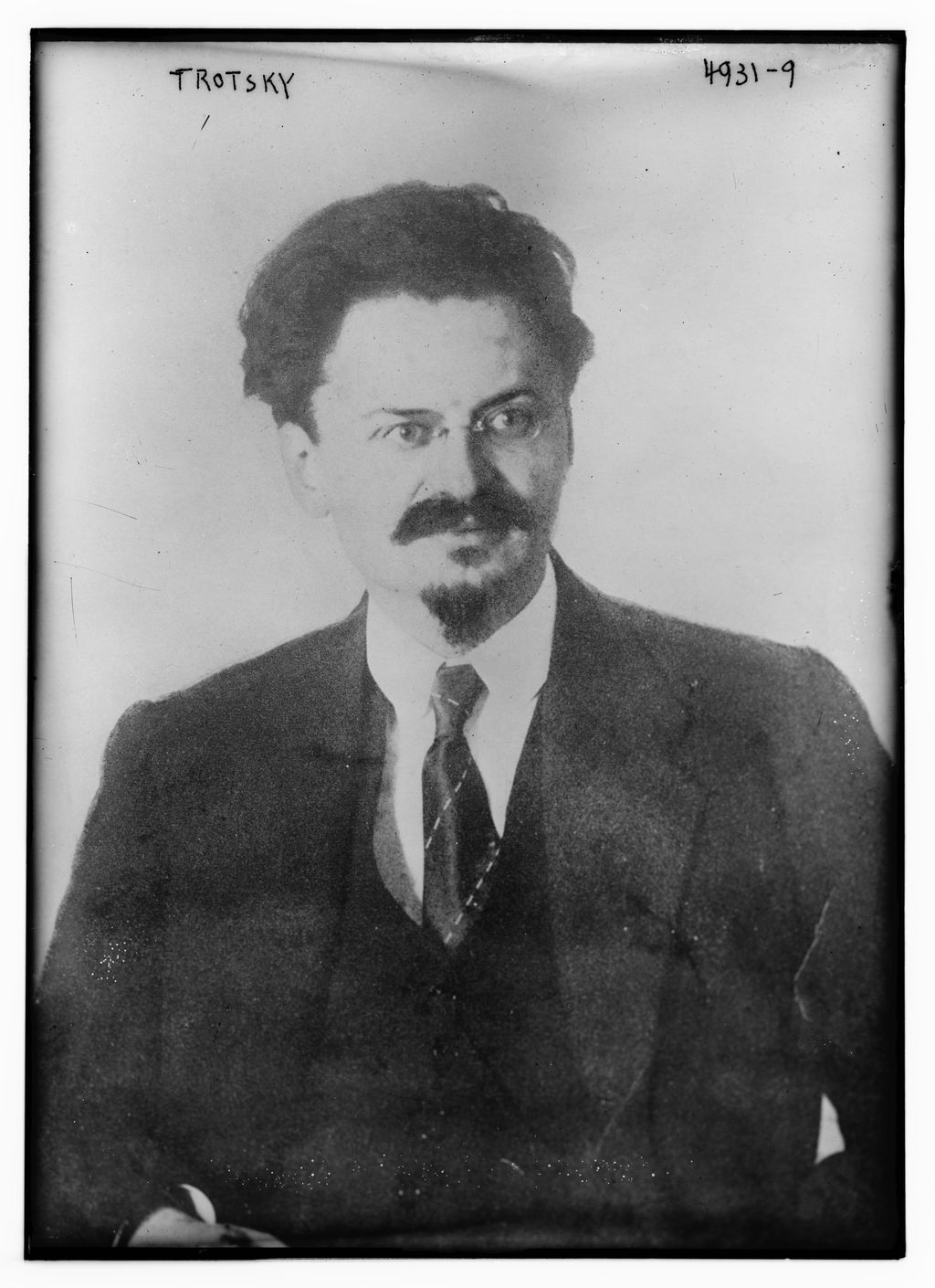
Trotsky was an opponent of Stalin's leadership and a participant in a wider struggle over the future of revolutionary socialism. That context made a named dedication to him publicly meaningful, even though the painted note uses the language of affection rather than political doctrine. The portrait can record solidarity, friendship, personal attachment or a combination; its inscription alone cannot choose among those motives. [2] [5] [18]
The timing is especially important. Patenaude places Kahlo and Trotsky's affair after the April 1937 hearings of the Dewey Commission, which investigated accusations made against Trotsky, and says it ended during that summer. The 7 November inscription therefore follows the relationship's end on the best accessible historian chronology, even as it preserves a direct and warm address to him. [2] [5]
Patenaude also says Natalia Sedova knew of the affair but that there is no evidence Rivera knew of it at the time. The later Rivera–Trotsky break developed in late 1938 and early 1939 amid political and personal tensions; it cannot responsibly be explained as Rivera discovering the affair. The November painting belongs to a moment before that rupture, not to a simple chain of romance, exposure and revenge. [5]
It is tempting to call the work a love token and stop there. The bouquet and affectionate phrase make the interpersonal register undeniable, but the self-portrait also presents Kahlo in a carefully arranged public identity and names a political exile on an unusually charged date. Reading it only as a keepsake for a former lover neglects those formal and historical choices; claiming it as a declaration of doctrinal Trotskyism goes beyond the note and the available correspondence. [1] [2] [5] [9] [11]
Dress, Fashion and Mexican Identity
The National Museum of Women in the Arts connects Kahlo's clothing with the dress of Zapotec women from the Isthmus of Tehuantepec and with post-revolutionary Mexicanidad. Art historian Gail Levin likewise includes this portrait among Kahlo's images in Tehuana-associated dress and argues that clothing and painting helped her create identities that travelled beyond the original setting. These are interpretive and historical accounts of her self-presentation, not tests of the painted garments' fibres or a statement of the single motive behind choosing them. [11] [12] [18]
Josefina De La Torre's object-specific fashion essay makes the outfit less uniform. She observes that the red blouse is not the embroidered huipil often treated as emblematic of Tehuana dress, and reads the shawl, pink skirt, flounced hem, jewellery and late-1930s beauty styling as a mixture of regional and contemporary choices. Her proposed exact weave and skirt subtype cannot be authenticated from this digital image, but her larger point is useful: the painting does not have to show one complete, unchanged “traditional costume” for dress to carry regional associations. [1] [13]
The Victoria and Albert Museum's account of Mexican dress adds a material reason to resist that timeless label. Regional garments changed through trade and manufacture, and a rebozo could be a practical as well as a presentational object. In the painting the fringed shawl is visible; assigning it a precise place of weaving, fibre or date would require evidence beyond the painted surface. [1] [13] [22]
Museum language has also changed. An earlier Places of Their Own brochure called Kahlo's clothing “aristocratic” and speculated about Trotsky's response, while current NMWA material stresses Tehuana association and Mexican national culture. The first label documents a dated interpretation, not Trotsky's opinion; the contrast shows how the same staged figure can be read through class, region, nationalism and fashion without any one viewer possessing Kahlo's private explanation. [11] [14]
Red, white and green do appear in the painting, but a resemblance to the Mexican flag is not proof that Kahlo designed a fixed patriotic code. Nor do flowers automatically stand for romance or a shawl for submission. The image supplies colours, objects and relationships among them; their cultural and emotional meanings require argued, attributed interpretation. [1] [12] [13]
Curtains, Retablos and the Act of Display
NMWA compares the frontal format and inscribed message with Mexican retablos, devotional paintings that Kahlo knew and collected. The analogy draws attention to the shallow space, direct address and combination of image and words. It does not technically classify this oil-on-Masonite self-portrait as an ex-voto or make Trotsky a sacred recipient. [1] [11] [18]
The curtains offer another way to think about that address. Their drawn-back folds disclose the figure but also frame her as someone who has chosen how to appear. “Stage-like” describes this formal effect; there is no visible elevated platform or record that Kahlo meant the curtains to reveal a secret affair. [1] [2]
Breton's response in 1938 demonstrates how quickly that presentation could be recast by another viewer. Writing for Kahlo's New York exhibition, he described a portrait of her hanging in Trotsky's study through a language of adornment, veiling and seduction. His prose is valuable as a contemporary report of the picture's early location and a record of Surrealist reception, but it is his gendered reading, not a neutral transcript of Kahlo's intentions. [10]
From Trotsky's Study to the Museum
Breton's account gives the painting an unusually firm early location: he said he had admired a Kahlo self-portrait on the wall of Trotsky's study. Because he wrote within months of his April 1938 visit, this is stronger evidence than a later retelling that the portrait reached Trotsky's space. It is still one witness's report, not a receipt or a continuous record of ownership from November 1937 onward. [7] [10]
The National Museum of Women in the Arts says the picture appeared in Kahlo's 1938 New York exhibition at the Julien Levy Gallery. The Hoover Institution identifies the catalogue cover in Bertram D. Wolfe's papers, but the original object-by-object checklist has not been inspected; the work's exact exhibition title, catalogue number, lender, price and sale status remain open. The alternate name Between the Curtains is a useful later museum heading, but should not be backdated as the original Levy title without that checklist. [2] [15] [31]
The work's path after the Trotskys' time at Casa Azul is less secure. A 2009 essay by then-museum director Susan Fisher Sterling tells a dramatic story: after news of Trotsky's 1940 assassination, Kahlo tried to destroy the portrait, and visiting Clare Boothe Luce persuaded her to sell it instead. The museum's account is part of its institutional history, but the inspected page gives no underlying letter, diary, invoice or eyewitness transcript for the scene; it cannot be narrated as independently established dialogue. [15]
A surviving letter shows a different kind of evidence about the assassination's aftermath. Writing to Kahlo on 7 October in a year the archive leaves unspecified, her friend Mary Sklar reflected on Trotsky's death and guessed that it must have shaken Kahlo's political faith. The death reference places the letter after August 1940, but its words record Sklar's concern and interpretation, not Kahlo's reply or proof that she attempted to destroy this painting. [30]
The same account says Luce later offered the painting to museum founder Wilhelmina Holladay. The current owner credit firmly identifies Luce as donor, and NMWA dates the museum gift to 1988, but these endpoints do not document every intervening transaction. A Library of Congress finding aid identifies Luce's art and provenance files and two Kahlo folders in Box 41; the folder descriptions are promising acquisition routes, not proof of what any letter inside says. [1] [15] [16]
The portrait subsequently acquired a public history unlike the private dedication with which it began. NMWA's collection metadata associates it with exhibitions from 1990 to 2012, including Places of Their Own in 2002, and the museum places it at Washington's National Gallery of Art through June 2023 during NMWA's renovation. Those are selected documented appearances, not a complete exhibition itinerary or proof that it was continuously on view. [17] [19] [20] [32]
Titles, Support and Measurements
The owner's English title, Self-Portrait Dedicated to Leon Trotsky, accurately identifies both subject and addressee. Between the Curtains names a conspicuous feature and is used in NMWA's online exhibition, but its status as a lifetime title has not been demonstrated here. The Spanish Autorretrato dedicado a León Trotsky is a documented translation or catalogue form; none of these variants should be treated as a second painting. [1] [2] [23]
NMWA's current object record describes oil on Masonite and measures 30 × 24 inches. An Inter-American Development Bank catalogue caption instead says oil on canvas, 70.2 × 61 centimetres, while an indexed older Kettenmann entry gives canvas and 87 × 70 centimetres. These differences are too large to “correct” by rounding, and no owner technical file or authorised full catalogue entry has been read to explain them. The owner's record remains the controlling public description, while the competing publications are noted without an invented explanation for their differences. [1] [21] [23]
The same caution applies to display. The NMWA page marked the work “On Display: Yes” on 3 October 2026, but a collection page is not a promise of permanent access in a particular room. The stable fact is that the work belongs to NMWA; anyone planning a visit should check the museum's live record. [1]
Related Reading
Frida's fashion and Tehuana dress explores the clothing Kahlo used to shape her public image. Self-Portrait Dedicated to Dr. Eloesser offers another addressed portrait, while Self-Portrait with Monkey shows a different construction of her likeness.
Further Reading and Open Questions
For the painting itself, the priority source is Luis-Martín Lozano, Andrea Kettenmann and Marina Vázquez Ramos's Frida Kahlo: The Complete Paintings. Its publisher identifies a 624-page catalogue, but its object entry, plate, notes and technical record have not been consulted here. The owner's account remains the strongest available basis for the painting's support and size. [1] [24]
Hayden Herrera's Frida is a necessary route into the widely repeated stories of the affair, gift, Trotsky's reaction and Luce's purchase, provided that a specified edition and its notes are checked rather than merely invoked. Gannit Ankori's Frida Kahlo and Margaret Lindauer's Devouring Frida are relevant to identity, politics and the risk of consuming a self-portrait as biography alone. Their complete texts have not been consulted for the claims made here; the cited records establish their relevance as further reading. [25] [26] [27]
For the Mexican asylum and the later Rivera–Trotsky conflict, Olivia Gall's Trotsky en México y la vida política en el periodo de Cárdenas promises a much fuller Spanish political history than a single artwork page can contain. The cited UNAM record gives its contents and 448-page extent, but its complete text has not been consulted. Luce's archival folders, the NMWA technical file, the 1938 Levy catalogue interior and a catalogue lead for a November 1938 Vogue clipping likewise remain questions for further documentary study, not evidence for the events described above. [16] [24] [28] [29] [31]
Frequently Asked Questions
No. The visible figure is Kahlo, who holds a painted message addressed to Leon Trotsky; he is present as named recipient rather than as a likeness. This distinction explains why the work is a self-portrait dedicated to him, not a portrait of him. [1] [2]
No. The dedication is dated 7 November 1937, and Trotsky, born on 7 November 1879, turned fifty-eight that day. An older NMWA overview contains a sixtieth-birthday error that its curator transcript corrects. [2] [8]
It proves that she made a warm, dated dedication to Trotsky in 1937. NMWA interprets the letter as political allegiance as well as affection, but the painting does not spell out a party doctrine, and the available archive overview cannot settle all of Kahlo's changing political commitments. The wider trajectory belongs to documentary political history, not a single image. [2] [18]
The affair is well supported, but Patenaude says there is no evidence Rivera knew of it at the time. He places their later break in a separate late-1938 and early-1939 political and personal sequence. Treating the affair as its established cause is therefore misleading. [5]
What the Portrait Makes Public
The painting's strongest evidence is its own act of address: Kahlo portrays herself presenting a bouquet and a legible dedication to an absent recipient. The curtains, clothing and frontal pose make that address deliberately visible, while the 1937 asylum and birthday context explain why it mattered beyond a private affair. Later museum, fashion and Surrealist readings illuminate different parts of the work only when kept distinct from the words Kahlo actually painted and the history the sources can establish. [1] [2] [5] [10] [12] [13]
Discussion
Use the cited evidence and your own close looking to explain your view. The prompts below are starting points, not fixed interpretations.
Reader Insights
What does Kahlo make public by turning a private dedication toward the viewer?
How do the dated inscription, Breton’s report and the museum’s later accounts differ as historical evidence?
Where does the carefully staged dress complicate a reading based only on the affair?
Join the Conversation
Which reading best fits the evidence, and where does uncertainty remain?
References
- National Museum of Women in the Arts, Self-Portrait Dedicated to Leon Trotsky object record, checked 3 October 2026: owner title, 1937, oil on Masonite, 30 × 24 inches, Luce gift, visual reference and time-bound display field. The owner image supports description of the visible composition; it is not a physical examination of the panel. View source text.
- National Museum of Women in the Arts, Between the Curtains: Frida Kahlo's Self-Portrait, complete online exhibition and Hannah Shambroom curator transcript, especially transcript on the Spanish note and correct fifty-eighth birthday. Its older overview's “sixtieth” wording is erroneous. View source text.
- INBAL, bulletin 678 on Frida Kahlo and Juan O'Gorman, 6 July 2020, lines 39–41 on the San Ángel studio and the portrait; a later institutional making-place account. View source text.
- INBAL / Museo Casa Estudio Diego Rivera y Frida Kahlo, bulletin 27, 21 October 2024, lines 24–35, identifying this portrait among works painted in the studio house. View source text.
- Bertrand M. Patenaude, “Exile and Murder in Mexico,” Berkeley Review of Latin American Studies, spring–summer 2010, printed pp.44–49, especially pp.44–45 and 47–48 on the affair and later Rivera–Trotsky rupture. Complete relevant article was read from the saved Berkeley PDF. View source text.
- Archivo General de la Nación, “La llegada de León Trotsky a México”, Spanish institutional account of the 9 January 1937 Tampico arrival and asylum context. View source text.
- Museo Frida Kahlo, “Frida” chronology, 1937–38 entries on Trotsky and Sedova at Casa Azul and Breton's Mexican visit; not a diary or object technical record. View source text.
- Internet Encyclopedia of Ukraine, “Trotsky, Leon”, birth date 7 November 1879, checked against the NMWA transcript and older erroneous overview. View source text.
- Russian State Archive, “First Decrees of Soviet Power”, Russian digital exhibition giving the 25 October / 7 November 1917 dual-calendar date. It establishes a calendar coincidence, not Kahlo's intention. View source text.
- André Breton, page four of the 1938 Julien Levy Gallery exhibition invitation, Museo Dolores Olmedo via Google Arts & Culture, complete institutional transcription. It reports a Kahlo self-portrait in Trotsky's study and records Breton's gendered reception. View source text.
- National Museum of Women in the Arts, gallery labels for the Rotunda, Great Hall and mezzanine, section on this portrait's retablo analogy, Tehuana-associated dress and Mexicanidad; curatorial interpretation. View source text.
- Gail Levin, “Frida Kahlo's Circulating Crafts: Her Painting and Her Identities”, in Rhapsodic Objects (De Gruyter, 2022), pp.211–232, especially pp.211–214. Complete open chapter read; its dress and crafted-identity argument about this portrait is attributed. View source text.
- Josefina De La Torre, “1937—Frida Kahlo, Self-Portrait Dedicated to Leon Trotsky”, Fashion Institute of Technology Fashion History Timeline, 2021, especially lines 123–152 on blouse, shawl, skirt and mixed fashion. Specific weave, subtype and symbolic claims remain her readings. View source text.
- Sharyn Rohlfsen Udall, Places of Their Own museum brochure, Museum of New Mexico, 2001–02, pp.3–4; a dated “aristocratic” dress reading and speculative Trotsky-response question. View source text.
- Susan Fisher Sterling, “Welcome!”, National Museum of Women in the Arts, 6 July 2009, especially its later institutional account of New York exhibition, attempted destruction, Luce purchase and Holladay transfer. Underlying primary records were not inspected. View source text.
- Library of Congress, Clare Boothe Luce Papers finding aid, collection scope p.5 and art/provenance and Kahlo folders in boxes 38–41, especially box 41. Folder contents, transactions and letters remain unread. View source text.
- National Museum of Women in the Arts via Google Arts & Culture, object and exhibition metadata, six owner-associated exhibitions from 1990 to 2012; same institution as [1], not independent provenance corroboration. View source text.
- National Museum of Women in the Arts, large-print collection labels, label for this portrait, printed p.48, on owner data and attributed political and clothing interpretations; read with the Hoover Institution archive overview on the limits of its Kahlo–Trotsky holdings. View source text 1; View source text 2.
- National Museum of Women in the Arts, “NMWA at the National Gallery: Modern Visions”, time-bounded loan during museum renovation. View source text.
- National Museum of Women in the Arts, Places of Their Own exhibition record, Washington presentation, 8 February–12 May 2002. View source text.
- Inter-American Development Bank, Art of Latin America, 1900–1980, caption for this portrait giving oil on canvas and 70.2 × 61 centimetres; a conflict with current owner data, not the controlling record. View source text.
- Chloë Sayer, “Traditional Mexican Dress”, Victoria and Albert Museum, sections on Tehuana textiles, shawls and the changing material culture of regional dress; context, not technical examination of this painting. View source text.
- Andrea Kettenmann, Frida Kahlo, 1907–1954: Pain and Passion (TASCHEN, 2000), indexed p.40 caption reportedly giving Between the Curtains, oil on canvas and 87 × 70 centimetres. The linked edition record does not establish that the page or its notes have been directly inspected; the current owner record controls the object facts. View source text.
- Luis-Martín Lozano, Andrea Kettenmann and Marina Vázquez Ramos, Frida Kahlo: The Complete Paintings (TASCHEN, 2021), publisher record, 624 pages; complete catalogue and exact portrait entry unread. View source text.
- Hayden Herrera, Frida: The Biography of Frida Kahlo (Bloomsbury edition), publisher record only; exact portrait pages and notes not read. View source text.
- Gannit Ankori, Frida Kahlo (Reaktion Books, Critical Lives, 2013), publisher/distributor record only; full book unread. View source text.
- Margaret A. Lindauer, Devouring Frida (Wesleyan University Press), distributor record only; relevant pages on this portrait unread. View source text.
- Olivia Gall, Trotsky en México y la vida política en tiempos de Lázaro Cárdenas (1937–1940) (CEIICH-UNAM/ITACA, 2012), publisher record and contents, 448 pages; complete book unread. View source text.
- Universidad de las Américas Puebla, Miguel Covarrubias Archive, item 13840, search-indexed catalogue lead for a November 1938 Vogue printed clipping of the portrait. Neither item page nor original leaf was opened. View source text.
- Mary Sklar, letter to Frida Kahlo, 7 October, year uncatalogued, NMWA Archives of Women Artists, Nelleke Nix and Marianne Huber Frida Kahlo Papers, Folder 184, ten-page transcription, especially p.8 on Trotsky's death. It records Sklar's conjecture, not Kahlo's own response. View source text.
- Hoover Institution, Frida Kahlo and Diego Rivera materials in the archives, slideshow caption identifying the cover of the 1938 first-U.S.-exhibition catalogue in Bertram D. Wolfe papers, box 117; the interior checklist has not been read. View source text.
- National Museum of Women in the Arts, Collection on the Move, object-specific loan listing at the National Gallery of Art, Washington, through June 2023. View source text.
Image Credits
- Photo: Enriquesrz / Wikimedia Commons, CC BY-SA 4.0. Resized to 1024 px wide; no crop. Source record.
- Bain News Service, Library of Congress, LC-DIG-ggbain-28899; no known restrictions on publication. Resized to 1024 px wide; no crop. Source record.
- Museo Casa de León Trotsky desde Río Churubusco — Omar Ulises Ruiz Casas. CC BY-SA 4.0. Resized and converted to JPEG/sRGB; no crop.
