


 by Tom Gurney
Tom Gurney BSc (Hons) is an art history expert with over 20 years experience
Page created on March 2, 2018 / Page updated on October 6, 2026
Email: tomgurney1@gmail.com / Phone: +44 7429 011000
Introduction
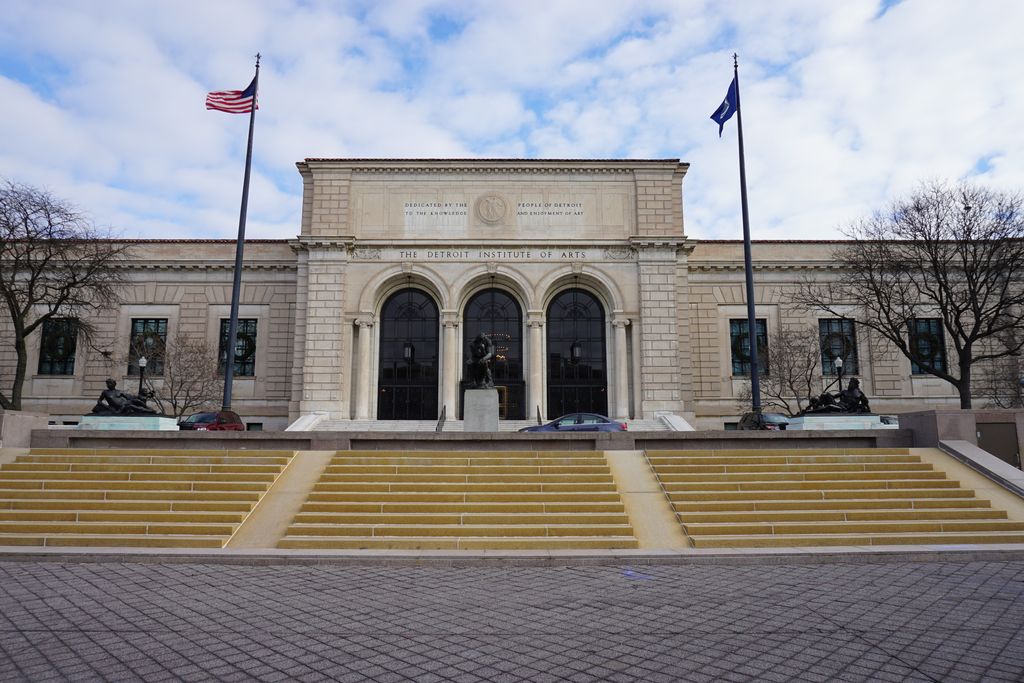
Frida Kahlo came to Detroit with Diego Rivera in April 1932 because the Detroit Institute of Arts had commissioned his Detroit Industry murals. The commission placed her beside a monumental public project, but her own year cannot be told solely through Rivera's work: she painted, experimented with materials, maintained friendships and family ties across borders, endured a pregnancy loss, and travelled to Mexico before returning to Detroit. [1] [2] The surviving evidence offers a more complicated account than either a city she simply rejected or a city that suddenly made her an artist.
Detroit mattered to Kahlo as a working setting and as a network. A dated Ford archive photograph shows her at work on a self-portrait in August 1932; letters received that summer connect her to friends in New York and Mexico, and later correspondence with museum and Ford figures shows that some relationships continued after she left. [3] [4] [5] These records are not a complete diary. They let us follow her independent activity while keeping unanswered questions—especially exact travel dates and contested medical details—where the sources leave them.
At a Glance
- Detroit stay: Kahlo arrived with Diego Rivera in April 1932 while he worked on the Detroit Institute of Arts murals. [1] [2]
- Dated painting record: A Ford archive photograph shows her working on the border self-portrait on 2 August 1932; it does not establish the completion date. [3]
- Family journey: She travelled to Mexico in September after news of her mother's illness; earlier letters show that a possible visit was already under discussion. [1] [16] [17]
- Later correspondence: A 1933 telegram and a 1939 letter document continuing contacts with Detroit figures. [5] [20]
Contents
- Introduction
- A Move Planned, Then Changed
- Working Beside the Murals
- Illness, Bloch and the Family at a Distance
- A September Journey That Was Not the End
- Relationships Beyond the Commission
- What Detroit Changed—and What It Did Not
- Further Reading
- Related Reading
A Move Planned, Then Changed
In a letter to her mother Matilde Calderón on 14 January 1932, Kahlo expected that she and Rivera would leave New York for Detroit around 5 February. She thought the coming mural work might take several months, speculated about further American moves and hoped for a return to Mexico. [6] This was a daughter's account of plans still in motion, not a record that the move happened in February. Museo Frida Kahlo places their arrival in April, and a later annotation in the Museum of Fine Arts, Houston's ICAA archive gives 20 April; other published accounts differ by a day, so April is the securely useful precision. [1] [7]
The change from her January expectation is visible in correspondence from the New York friends they left behind. In a letter dated circa 28 April, Suzanne wrote that she missed Kahlo and Rivera, wondered how they found Detroit and hoped their accommodation was better than the Barbizon Plaza in New York. [4] Those doubts about the new city were Suzanne's, not a statement by Kahlo. The letter shows that the couple's social world did not end at the city boundary, while leaving their Detroit address and Kahlo's first impressions unproved.
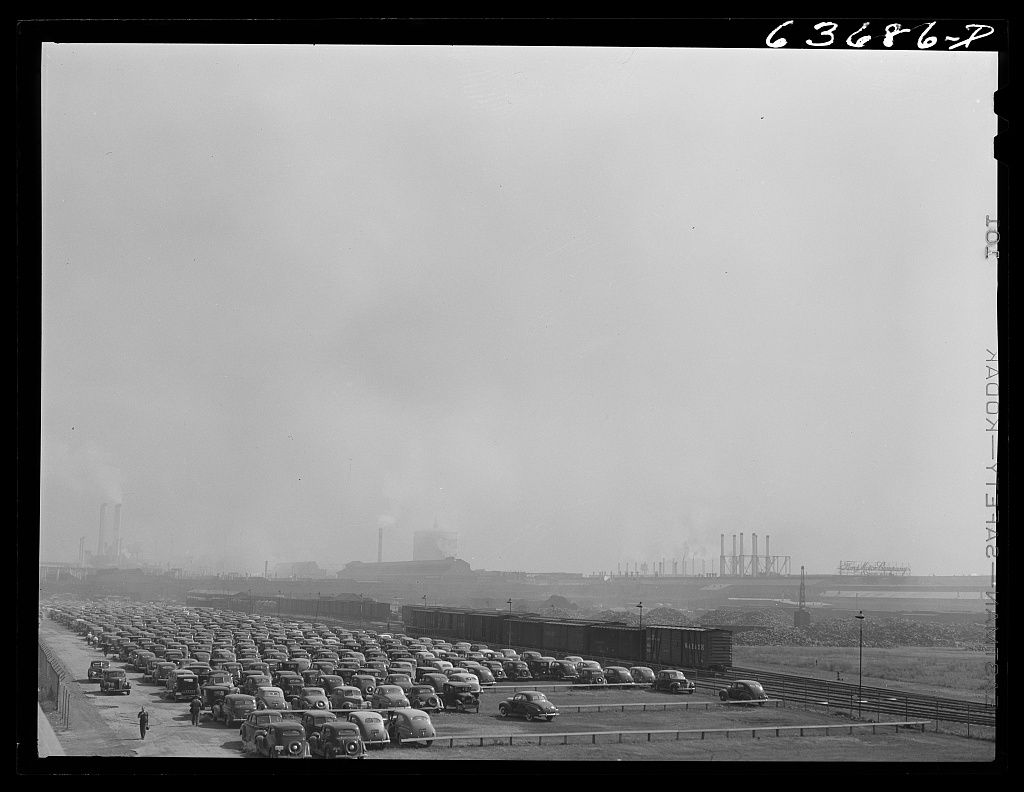
Rivera's commission explains why they were there. Edsel Ford financed the DIA project, whose twenty-seven panels presented Detroit's industrial activity within the museum; Rivera's main mural campaign extended into March 1933. [2] [7] The industrial landscape was part of Kahlo's setting, but Rivera's documented commission offers no basis for treating her paintings as Ford commissions. Nor should his public explanation of the murals be substituted for her view of the city.
Watch: Frida Kahlo
Five perspectives to view here alongside the article.
Frida Kahlo’s The Two Fridas: Great Art Explained
A focused visual introduction to the painting and its context.
Working Beside the Murals
The clearest dated trace of Kahlo making art in Detroit is a Ford Motor Company Photographic Department record. It catalogues a photograph of her working on Self-Portrait on the Border Line between Mexico and the United States on 2 August 1932. [3] The image establishes that the small painting was underway by then, before her September journey to Mexico. It does not say when the picture was completed, whether its design changed afterwards or who first received it.
The portrait's division between Mexican and American settings has often made it a shorthand for Kahlo's response to industrial Detroit. That is one possible reading of the painted objects, but it should not replace the specific evidence of her working on the panel or become a claim that every machine expresses a fixed personal hatred of the United States. [3] [8] Its scale and documented August production show a different artistic undertaking beside the institute's vast murals.
Other works broaden that picture without yielding a complete Detroit catalogue. Museo Frida Kahlo dates Henry Ford Hospital to July 1932 and lists the unfinished Frida and the Cesarean in the same year; The Henry Ford also names My Birth among paintings made during the stay. [1] [2] The works address body and family experiences, but they do not all have the same documentary route or an equally exact making date. Their distinct images and medical interpretations need their own pages rather than a single explanation imposed by this city's name.
Kahlo also tested an artistic method associated with Rivera's work. A Christie's catalogue, drawing on Lucienne Bloch's later recollection, describes Bloch and Stephen Dimitroff helping her prepare a fresco support for Self-Portrait (Very Ugly). [9] The account supports a practical experiment in materials; it is not evidence that Kahlo joined Rivera's mural crew or that Ford commissioned the portrait. The Philadelphia Museum of Art identifies Bloch as Rivera's assistant and confirms that she accompanied the couple to Detroit. [10]
Window Display on a Detroit Street offers another caution about chronology. Its 1931 inscription and a catalogue execution range extending into 1932 are not the same thing, while the familiar account of a shop-window encounter reaches us through later recollection in an auction essay. [11] It is part of the Detroit-related body of work worth considering, but an exact painting day or a complete story of its first encounter cannot be deduced from its title. The city gave Kahlo subjects and working circumstances; it did not make every work equally easy to date.
Illness, Bloch and the Family at a Distance
Kahlo's medical experience in Detroit is inseparable from the art she made there, but an artwork is not a clinical file. Her 1932 pregnancy and its loss are documented through letters, later medical accounts and the paintings; those sources differ on important terminology and causal questions. [1] [12] A contemporary letter comes from a friend, not Kahlo: on 9 July, a friend named Mariana wrote that Bloch had told her Kahlo was in hospital, suffering and in pain, and hoped she would recover. [13] It confirms concern and Bloch's presence. It does not state a diagnosis, the date of admission or a medical outcome.
The painting now called Henry Ford Hospital makes the experience visible through Kahlo's composition, with the hospital name tying it to the city. Museo Frida Kahlo places its making in July and notes an earlier title, The Lost Desire; forms of that title also appeared in lifetime exhibition catalogues. [1] [12] Its imagery should not be used to settle whether the loss was spontaneous or induced. A May letter to physician Leo Eloesser, available in a scholarly reproduction rather than its original manuscript, describes an attempted intervention that did not then end the pregnancy; later accounts of the July outcome do not all agree. [12] The medically cautious description is a pregnancy loss, with the distinctions left to the painting and health histories.
Bloch's friendship reached beyond a single emergency. She was a fellow artist assisting Rivera, and Mariana's letter identifies her as the person informing friends about Kahlo in hospital. [10] [13] The later account of preparing a fresco support with Kahlo suggests a working friendship as well, although its timing is less secure than the dated hospital letter and Ford photograph. [9] Calling Bloch a helper alone would flatten her own artistic role; the relationship joined personal support to the shared practice of making images.
Other letters register how friends worried about the ordinary terms of Kahlo's stay. Ernestine, writing circa 1932, asked whether a Detroit hotel was expensive, whether Kahlo would remain there, whether the city stimulated her painting and whether she had found new friends. [14] These questions show the matters a contemporary wanted to know. They do not tell us Kahlo's rent, where she eventually lived or what she replied. Read beside Suzanne's April letter, they reveal concern and curiosity travelling between cities rather than an established verdict on Detroit.
Family contact was equally immediate despite the distance. In an August letter, Matilde described how strongly she felt hearing Kahlo's voice over a long-distance telephone call and receiving photographs of Kahlo and Rivera. [15] She also wrote about household matters and thanked her daughter for a gift, ending with affection. The letter is poignant because Matilde died the following month, but its own pages do not announce a fatal illness. The relationship should be visible in its ordinary exchange, not only as a prelude to bereavement.
Guillermo Kahlo's letters add the father's side of that distance. In August 1932 he wrote with affection but also disappointment on learning that his daughter would remain in the United States until Rivera finished his work. By December, after Matilde's death, he described the sorrow of being unable to share Frida's latest letter with his wife and of having his daughter so far away. [17] These are his expressions, preserved in selected letters published by scholars and the National Museum of Women in the Arts; Frida's replies are not part of that published exchange.
The letters also show Frida's attention to a future home in Mexico while she was away. Guillermo reported on the red and blue sections of the San Ángel house that she and Rivera were building, and he photographed its façades for her with a wide-angle lens. [17] The house was a project beyond Detroit, yet its progress was part of the news crossing the border during her stay. His affectionate and sometimes worried correspondence makes the family's presence in her American life more concrete than a simple account of homesickness would.
A September Journey That Was Not the End
The September 1932 departure is often explained as a sudden response to Matilde's worsening health. Museo Frida Kahlo says that Kahlo travelled to Mexico with Bloch after learning her mother was seriously ill; Matilde died on 15 September. [1] Yet Guillermo's 30 June letter already worries about a proposed journey from Detroit during Matilde's illness, and a friend writing from Mexico on 19 July had heard from Kahlo's sister Kitty that Kahlo might come in September. [16] [17] These references show that a visit was being considered before the eventual departure, but they do not prove that its date, escort or purpose was settled in June or July.
The trip breaks up a neat story of eleven uninterrupted months in Detroit. The museum chronology does not give a precise date for Kahlo's return to the city. [1] The evidence does place Kahlo back in Detroit by early March 1933. In a letter to Georgia O'Keeffe dated there on 1 March, she reported that she had been painting a little and that it had helped her; the passage is available through a university publication that points to the original in Yale's Beinecke Library. [18] That is a rare indication of how she herself described painting during the late Detroit stay, though it does not identify a canvas or establish her eventual departure day.
The same letter suggests a more layered emotional account than a simple rejection of the city: she was glad Rivera was happy working on the frescoes and could acknowledge her own difficult experiences while saying she had also been happy in some ways. [18] Those are Kahlo's reported thoughts at a particular moment, mediated by a later excerpt, not an all-purpose summary of her whole stay. Her next New York period began in 1933, opening another setting for the relationships formed in Detroit. [1]
Relationships Beyond the Commission
Kahlo's presence at the DIA was often read through Rivera's fame, but the record also contains direct exchanges with her. Mark Rosenthal, curator of the 2015 exhibition about the couple's Detroit years, later said that Rivera had sought accommodation with space for Kahlo to paint and that the artists responded to one another's work. [19] His account is a curator's retrospective interpretation, not a transcript of Kahlo's daily practice. The dated Ford photograph and the individual works give firmer evidence that the space to work was used.
The professional contacts persisted after the murals were completed. On 6 May 1933, DIA director William Valentiner sent a telegram to Kahlo at the Barbizon Plaza in New York, thanking her for a picture. [20] He addressed her in the married form “Frieda Rivera,” but the telegram was directed to her, not to Rivera; it shows an individual exchange without naming the picture or proving a sale. The item belongs to the Detroit network's continuation, though the New York visit has its own separate history.
An even later letter shows Kahlo using that network actively. Writing to Edsel Ford on 19 November 1939, she recommended Ricardo Arias Viñas for possible employment in Mexico and greeted Detroit acquaintances including Valentiner and collector Robert Tannahill. [5] The Ford record preserves the text of this 1939 request. Other Kahlo–Ford letters are catalogued for 1941, but their wording cannot be inferred from those entries; the records also do not establish whether Arias Viñas obtained the position. [5] [21] It would be wrong to turn this later warmth into proof that Kahlo liked every aspect of Detroit in 1932, but equally wrong to erase her initiative in maintaining the connection.
What Detroit Changed—and What It Did Not
A later DIA exhibition described the couple's Detroit responses in sharp contrast, with Rivera embracing the city and Kahlo turning away from it. [22] That frame is useful as evidence of how the 1932–33 period was presented in 2015, but Kahlo's letters, work and relationships resist a single verdict. The border self-portrait can invite interpretation of Mexican and American difference; a hospital painting conveys loss; a letter to O'Keeffe says painting helped. None, by itself, supplies a complete psychological history of her stay. [3] [12] [18]
Art historian Delia Cosentino has also challenged the tempting idea that Detroit was the moment Kahlo was “reborn” as an artist. [23] Kahlo had painted before arriving, and the Ford photograph does not turn the city's industry into the origin of her vocation. Detroit was nevertheless a period of consequential making, experiment, grief and transnational contact. Those are substantial changes in the circumstances of an existing artist, not a sudden creation of one.
The strongest account keeps Kahlo's own work in view while refusing false precision. Her January plans differed from the April move; a possible September visit was discussed before illness compelled a journey; the return date remains uncertain; and a 1933 letter reports painting again without identifying everything she produced. [6] [16] [18] Detroit did not contain a single, uninterrupted story. Its importance lies partly in the way painting, family loss, friendship and professional relationships crossed its borders.
Further Reading
Celia Stahr's Frida in America follows Kahlo through her American years, while the Detroit Institute of Arts' Diego Rivera and Frida Kahlo in Detroit places the artists beside the city's mural commission. [22] [24] The letters, photographs and works discussed above leave room for both artists' very different projects without making either life an illustration of the other's.
Related Reading
Self-Portrait on the Borderline between Mexico and the United States examines the work photographed in progress in August 1932. Henry Ford Hospital treats the pregnancy-loss painting and its disputed medical context; Frida Kahlo in New York follows her later exhibitions and relationships in that city.
Discussion
Use the cited evidence and your own close looking to explain your view. The prompts below are starting points, not fixed interpretations.
Reader Insights
What does the 2 August 1932 photograph establish about Kahlo's painting, and what does it leave open?
How do the June and July letters complicate a single-cause account of the September journey?
Which Detroit relationships continued after the mural commission ended?
Join the Conversation
Which reading best fits the evidence, and where does uncertainty remain?
References
- Museo Frida Kahlo, “Frida: Vida y obra,” English chronology, entries for April–September 1932 and the 1933 New York move. View source text.
- The Henry Ford, “Detroit Industry Frescoes: The Backstory”, curated collection entries for the commission and Kahlo's Detroit work. View source text.
- The Henry Ford, “Frida Kahlo at Work on ‘Self-Portrait on the Border Line between Mexico and the United States,’ 1932”, Ford Motor Company Photographic Department, 2 August 1932, object 2002.0.34.7. View source text.
- National Museum of Women in the Arts, Suzanne to Frida Kahlo and Diego Rivera, circa 28 April 1932, folder 186, pp. 1–4. View source text.
- The Henry Ford, Frida Kahlo to Edsel Ford, 19 November 1939, object 64.167.6.58, exposed typed inscription. View source text.
- National Museum of Women in the Arts, Frida Kahlo to Matilde Calderón, 14 January 1932, folder 140, especially pp. 7–8. View source text.
- Museum of Fine Arts, Houston, ICAA Documents Project, Diego Rivera, “Dynamic Detroit: an interpretation”, Creative Art 12 (April 1933), pp. 289–295, repository annotation. View source text.
- Museo Frida Kahlo, 1932 border self-portrait chronology entry, entry following the April Detroit move. View source text.
- Christie’s, “Self-Portrait (Very Ugly)” lot record, essay and object details. View source text.
- Philadelphia Museum of Art, Lucienne Bloch, Muralist at Work (Diego Rivera), 1933, collection record and description. View source text.
- Christie’s, “Window Display on a Detroit Street” lot record, inscription, execution range and essay. View source text.
- Eva Zetterman, “Frida Kahlo's Abortions: With Reflections from a Gender Perspective on Sexual Education in Mexico”, Konsthistorisk tidskrift 75.4 (2006), pp. 230–243, for the mediated 26 May 1932 Eloesser letter, clinical-history dispute and lifetime exhibition titles; original documents not read. View source text.
- National Museum of Women in the Arts, Mariana to Frida Kahlo, 9 July 1932, folder 246, p. 1. View source text.
- National Museum of Women in the Arts, Ernestine to Frida Kahlo, circa 1932, folder 236, p. 1. View source text.
- National Museum of Women in the Arts, Matilde Calderón to Frida Kahlo, 15 August 1932, folder 141, pp. 1–2. View source text.
- National Museum of Women in the Arts, Ady to Frida Kahlo and Diego Rivera, 19 July 1932, folder 221, p. 1. View source text.
- Annette B. Ramírez de Arellano and Servando Ortoll, “¡Queridísima Frieducha!… Cartas de Guillermo Kahlo a su hija Frida”, La Ventana 32 (2010), pp. 244–269, especially pp. 253–261; and their NMWA account in English. Both draw on the same NMWA letters; Frida's replies are not available in this group. View source text 1; View source text 2.
- Western Sydney University, “Frida Kahlo,” Circles of Emotion, excerpt and citation of the 1 March 1933 Kahlo-to-Georgia O’Keeffe letter, Beinecke Rare Book and Manuscript Library record 3666035; original scan not read. View source text.
- Yale University Press, David Ebony interview with Mark Rosenthal, Rosenthal's replies on Detroit. View source text.
- National Museum of Women in the Arts, William Valentiner to Frida Kahlo, 6 May 1933, folder 191, p. 1. View source text.
- The Henry Ford, Frida Kahlo to Edsel Ford, 5 December 1941, catalogue metadata only; full letter text not read. View source text.
- Detroit Institute of Arts, Diego Rivera and Frida Kahlo in Detroit, 2015 exhibition page; full catalogue not read. View source text.
- Delia Cosentino, review of Diego Rivera and Frida Kahlo in Detroit, CAA Reviews, 4 February 2016, especially discussion of artistic “rebirth.” View source text.
- Celia Stahr, Frida in America: The Creative Awakening of a Great Artist, publisher record and opening San Francisco excerpt only; full Detroit chapters unread. View source text.
Image Credits
- John Vachon, 1941. Library of Congress, FSA/OWI Collection, LC-USF34-063686-D; public domain. Resized to 1024 px wide; no crop. Source record.
- Detroit Institute of Arts January 2015 01 — Michael Barera. CC BY-SA 4.0. Resized and converted to JPEG/sRGB; no crop.
