


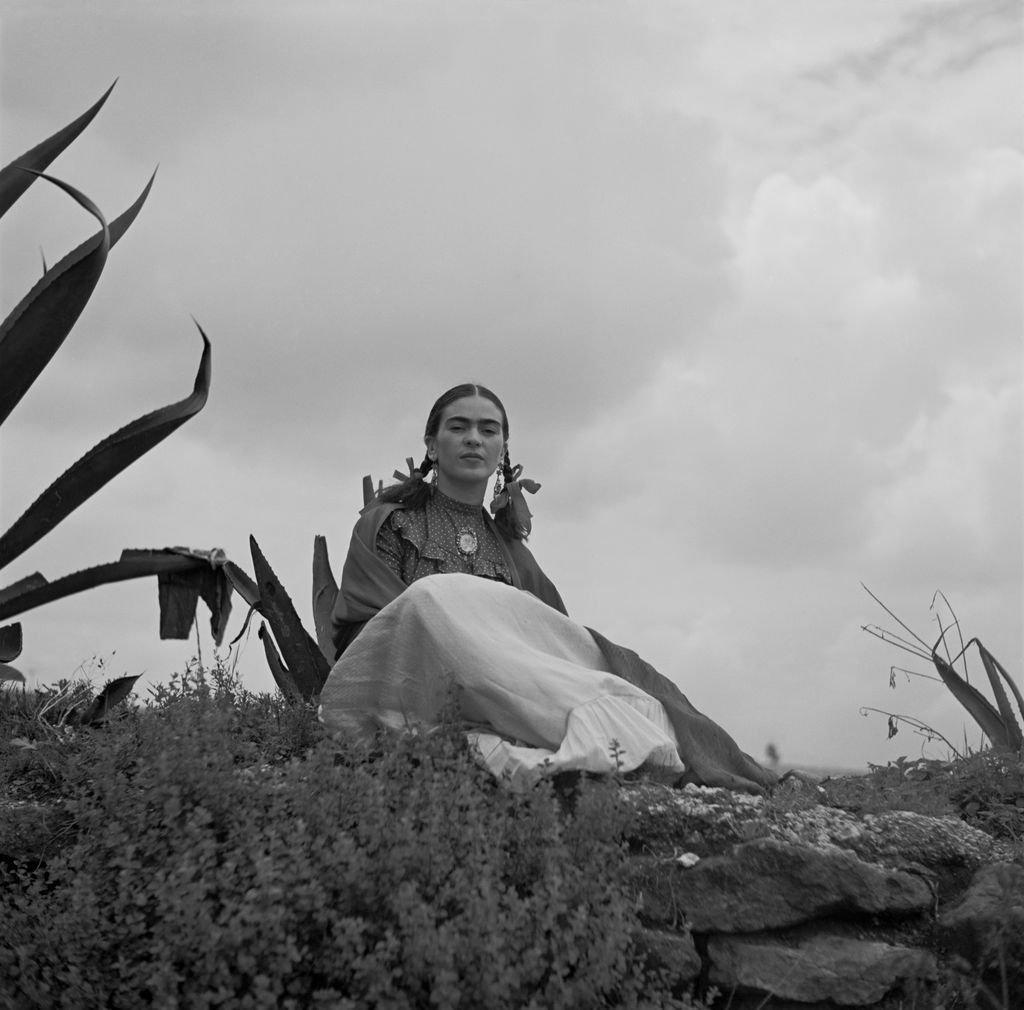
 by Tom Gurney
Tom Gurney BSc (Hons) is an art history expert with over 20 years experience
Page created on March 2, 2018 / Page updated on October 6, 2026
Email: tomgurney1@gmail.com / Phone: +44 7429 011000
Introduction
Frida Kahlo returned to her own face throughout her career, but repetition did not make each self-portrait the same kind of picture. A youthful painting given to a lover, a figure standing between Mexico and the United States, an image accompanied by a mirror, and a late portrait of the artist with her doctor address different people and ask different questions of the viewer. Looking across selected works is more revealing than treating every likeness as a direct report of Kahlo’s private feelings. [1] [3] [5] [18]
“Self-portrait” is also a useful label with limits. In some works Kahlo faces us alone; elsewhere she appears twice, inserts herself into a family tree or gives a deer her face. Published totals do not share an agreed rule for counting drawings, composite images or disputed works. This guide therefore follows clearly identified examples without announcing a definitive number. [3] [8] [11] [19]
At a Glance
- Scope: Selected self-images from 1926 to 1951, not a complete catalogue or a fixed portrait count. [1] [18]
- Different forms: Gifts, paired selves, animal companions and a painting with a later mirror show several kinds of self-image. [5] [8] [14]
- Looking closely: Clothing, framing and materials change the work each image does; they do not supply one psychological key. [9] [12] [20]
- Evidence: Museum records establish object facts, while letters and later recollections have different limits. [21] [24]
Contents
- Introduction
- The Early Self: Gift, Dress and Place
- Portraits Addressed to Someone Else
- Mirrors, Frames and Public Selves
- Two Figures, One Painter
- Animals, Plants and Other Company
- Dress, Relationships and Work over Time
- The Body and the Limits of a Label
- Related Reading
The Early Self: Gift, Dress and Place
Kahlo painted Self-Portrait in a Velvet Dress in 1926 and gave the canvas to Alejandro Gómez Arias. Its long neck, dark dress and sea-like setting make the young painter appear carefully composed rather than casually caught in a moment; the form of that presentation belongs to the work, not to a diagnosis of her mood. An inscription on the reverse says she was seventeen in September 1926, although her documented birth year makes her nineteen: the words she placed on a painting and the biographical calendar are different kinds of evidence. [1]
About three years later, Self-Portrait (Time Flies) presents another frontal figure, this time with a clock and an aircraft. The picture is catalogued around 1929 as oil on Masonite, unlike the earlier oil canvas, and its current public credit identifies a private collection in California without naming a present legal owner. The objects invite a comparison of pose, dress and pictorial setting; the familiar reading of clock plus aircraft as a visual pun is an interpretation, not a surviving explanation by Kahlo of every detail. [2]
In Self-Portrait on the Borderline between Mexico and the United States (1932), Kahlo puts a standing version of herself on a pedestal amid two differently organised environments. Plants, earth and Mexican forms confront industry and machinery, but the lower exchanges between roots, cables and devices resist a simple division into wholly pure and wholly corrupt worlds. A Ford photographic record shows the painting already underway on 2 August 1932, so it cannot have been conceived only after Kahlo’s later September return from Mexico; the picture's setting must not be made into an exact diary of one trip. [4]
A deliberately awkward 1933 exception is Self-Portrait (Very Ugly), a small fresco on Celotex board whose surviving writing includes the abbreviated words “VERY U.” Kahlo gave it to the artist Lucienne Bloch that year, according to the work's recorded provenance; Bloch's much fuller account of the panel, its making and Kahlo's self-critical writing reaches us through a later catalogue quoted by Christie's. The combination of visible inscription, gift and unusual support is more specific than a generic claim that every self-portrait was a polished public image, while the sale essay's account of Kahlo's private distress remains an interpretation. [23]
The small 1936 My Grandparents, My Parents, and I shows why a self-image need not be primarily an adult portrait. MoMA identifies Kahlo as a child within an extended family-tree composition, painted in oil and tempera on zinc, and its later labels also describe prenatal forms. The museum's proposed connection with Nazi racial legislation is a curatorial reading; the painted ancestry is not by itself documentary proof of every genealogical claim about her relatives. [3]
These early works give Kahlo's likeness different jobs: a personal gift, a constructed adult presence, a figure locating herself between countries and a child within a lineage. Clothing, support and scale change with those tasks. Their formal differences matter before a biography is used to explain them. [1] [2] [3] [4]
Watch: Frida Kahlo
Five perspectives to view here alongside the article.
Frida Kahlo’s The Two Fridas: Great Art Explained
A focused visual introduction to the painting and its context.
Portraits Addressed to Someone Else
The title Self-Portrait Dedicated to Leon Trotsky makes its recipient unusually explicit. Kahlo placed a bouquet in the full-length figure’s hand and painted an inscription naming San Ángel and 7 November 1937, Trotsky’s birthday. The date also coincides with an anniversary in the revolutionary calendar, but that coincidence alone does not prove she selected it for a political commemoration; the painted words securely establish a dedication, not every intention behind it. [6]
The dedication changes how the reader sees the poised figure. Curtain, dress, flowers and inscribed sheet turn the image outward, toward a named person who could receive and display it. Breton later reported a portrait in Trotsky’s study, but that report and the visible staging should not be inflated into a complete, certain account of the work’s subsequent movement or Kahlo’s emotional state. [6]
Other dedicated self-portraits belong to separate exchanges, not to one repeated “portrait with a recipient” template. The 1940 portrait for Dr Leo Eloesser addressed a physician and friend, while the February 1940 painting dedicated to Sigmund Firestone arose within a proposed pair of self-portraits by Kahlo and Diego Rivera. Their recipients, pictorial inscriptions and documented contexts differ from the 1937 Trotsky gift; a similar title or thorn motif is not evidence that one work's story belongs to another. [7]
In the 1951 Self-Portrait with the Portrait of Dr Farill, the painter appears with her brushes in a wheelchair before an image of the physician. The picture makes both artistic work and a relationship of care visible, while a 1950–51 diary passage preserved through later transcription and printed mediation records an intended gift to Farill. The exact transfer date and a complete original-diary reading remain unsettled; the picture can still be compared with earlier addressed portraits without calling it a transparent record of treatment. [18]
Mirrors, Frames and Public Selves
Fulang-Chang and I began as a 1937 painting of Kahlo with a monkey, but the MoMA object now includes a framed mirror added after 1939. A ribbon joins sitter and animal inside the painting; the separate mirror can bring an actual viewer into the encounter. Those two material dates matter: the mirror is not evidence that every feature of the assembled work was present in 1937, nor is the viewer’s reflection a second painted Kahlo. [5]
MoMA's account of its painting-and-mirror files gives the added element a more personal history. The museum says Kahlo joined the mirror to the portrait when she gave the ensemble to her friend Mary Sklar, after Sklar bought a different painting at the 1938 Julien Levy exhibition; the accompanying explanation was that the two friends could remain together. That documented gift account makes the reflected viewer more than a formal device, though it does not erase the difference between a specific recipient and anyone later standing before the museum object. [24]
Another self-image depends on its surround. The Centre Pompidou records The Frame as a small oil portrait on aluminium, bracket-dated 1938, combined with a Mexican reverse-glass element and painted wooden frame. The French state purchased the work in 1939 after its New York and Paris exhibition appearances; the shorthand that “the Louvre bought it” obscures the actual acquisition and later collection history. [9]
Jennifer Josten argues that exhibited pictures such as The Frame, The Two Fridas and Self-Portrait with Cropped Hair should be read as public artistic acts, not only private confessions. Her comparison with Claude Cahun attends to doubled images and changing presentations of gender and sexuality within the period’s Surrealist networks. It is a productive scholarly interpretation, but it does not show that Kahlo adopted one fixed movement identity or intended every picture to carry the same message. [20]
Josten’s broad argument also needs factual checking at the object level. She describes The Frame as tin and gives a slightly different width, whereas its current owner calls the support aluminium and measures the painted portrait at 28.5 by 20.7 centimetres. Her suggestion that a later exhibition brought Kahlo her first sales is unsafe: in a letter of 20 November 1931, Kahlo already told her mother that New York society women bought her paintings, although she named no particular transaction in that passage. [9] [21]
Two Figures, One Painter
The large 1939 The Two Fridas makes repetition structural: two seated figures share a line of hands and exposed vessels while their clothes and hearts differ. The Museo de Arte Moderno connects the painting with Kahlo's separation from Rivera, a real biographical context, but the pair is more than a diagram of “loved” and “unloved” selves. The scale, parallel pose and circulating connection make difference and relation present at once, and the details of each dress deserve attention rather than an instant psychological key. [8]
Its doubling is unlike the mirror in Fulang-Chang and I. In the latter, a later assembled object offers the viewer’s actual face beside a painted Kahlo; in The Two Fridas, both seated bodies are Kahlo’s painted inventions. The distinction makes a wider point about self-portraiture: repeated likeness can compare versions of a self without settling which one is the “real” person behind the work. [5] [8]
Changes in hair and clothes can be equally striking without being interchangeable across objects. The 1935 Self-Portrait with Curly Hair is a very small oil on tin with a close view of short curls, jewellery and red clothing; its documented passage through Bertram and Ella Wolfe differs from the later MoMA picture's history. It has no painted scissors, severed locks, man's suit or song text, all conspicuous elements of Self-Portrait with Cropped Hair (1940). [10] [12]
In the 1940 painting, Kahlo sits in an oversized-looking suit among cut strands, still wearing an earring and heeled shoes, with scissors in hand and a borrowed-song inscription above. The work followed her 1939 divorce, and writers have connected the cropped hair with that moment, but neither chronology nor painted proportions prove that the actual suit belonged to Rivera or that a single revenge, gender or sexuality statement exhausts the image. What is securely available is the painter’s unusually explicit alteration of appearance within the picture and its contrast with the carefully dressed selves elsewhere. [12] [20]
Animals, Plants and Other Company
The 1940 painting in the Harry Ransom Center is formally untitled, though widely known as Self-Portrait with Thorn Necklace and Hummingbird. Its close face is set among foliage and animals, with a thorn necklace making the body’s surface hard to ignore. The institution's public “55 self-portraits” statement has no stated inclusion rule there; its object title, medium and collection are stronger evidence than its unspecific oeuvre count. [11]
Kahlo returned to monkeys, but “self-portrait with monkey” is not the identity of one recurring canvas. Buffalo AKG owns a distinct 1938 work; MALBA catalogues a 1942 Autorretrato con chango y loro with both monkey and parrot. Museo Robert Brady's 1945 painting places a monkey behind Kahlo against a dark stump, whereas Museo Dolores Olmedo's different 1945 Autorretrato con changuito includes a dog, ceramic figure, gold ribbon, nail and oval signature. Dates, owners and visible arrangements must be checked before a symbolic argument moves from one picture to another. [13] [14] [15]
MALBA's James Oles describes the compressed coexistence of sitter, animal companions, dress and dry plants in the 1942 picture without reducing each creature to a single episode in Kahlo's life. Laura E. Pérez goes further, proposing that Kahlo's animals and vegetation can articulate a relational self rather than merely a self-absorbed one. Pérez’s argument helps explain why the painted companions are more than decorative inventory; it remains a scholar’s reading, not Kahlo’s universal key to monkeys, birds and leaves. [14] [19]
The museum-authored Brady essay offers more particular meanings for a stump, a green ribbon and the monkey, including mourning and comfort. Those claims tell us how one institution has interpreted its own 1945 picture, not what the separate Olmedo work means or what Kahlo documented as her intention. Keeping visual observation apart from attributed interpretation is especially important when several paintings share animals, frontal poses and near-identical English names. [15]
Dress, Relationships and Work over Time
In Diego en mi pensamiento, often called Self-Portrait as a Tehuana, Rivera's face appears within Kahlo's elaborate head arrangement. The painting was underway around 1940 in a documented photographic state and completed in 1943, so its final forms cannot be treated as a snapshot of the divorce alone. Its Tehuana dress and miniature face invite questions about identity and attachment, but the Gelmans bought an existing painting rather than commissioning every symbol it contains. [16]
The costume contrasts with the cut hair and suit of the 1940 MoMA picture and with the black velvet of the 1926 gift. Those differences are intentional visible choices within particular paintings, not a reliable timetable of what Kahlo wore every day. A full account of Tehuana garment history belongs with the fashion page; in this comparison, dress matters for the way it changes each painted self’s relation to recipient, viewer or pictured partner. [1] [12] [16]
Kahlo’s own correspondence also warns against turning a professional self-image into a single career-conversion story. In November 1931 she described society women who bought her paintings, while also complaining to her mother about the clothes and social work those encounters demanded. Servando Ortoll and Annette B. Ramírez de Arellano later analysed her 1932–33 letters to Abby Aldrich Rockefeller, finding that she promoted Rivera's commissions and sometimes belittled her own painting and lithographs in the same period. Their article quotes letters whose originals are not consulted here; the tension between self-deprecating language and actual artistic labour is more informative than claiming she became a professional only after 1938. [21] [22]
The Body and the Limits of a Label
In The Broken Column (1944), Kahlo presents an opened torso, brace and damaged architectural form, changing the conventions of the dressed, close-framed face. The picture belongs to a history of pain and treatment, yet a contemporary April 1944 letter treats an operation as something still feared, while the documented New York spinal fusion belongs to 1946. Its painted column cannot be read as a clinical chart or called a straightforward aftermath of that later procedure. [17]
The 1951 Dr Farill portrait gives the working artist another late form: wheelchair, brushes and the doctor’s image share one space. The medical context is real, but the picture also stages making a portrait for another person, much as earlier works used a recipient or dedication to turn the self-image outward. Neither work reduces Kahlo’s painted body to a case history; each constructs a different relation among subject, material, viewer and addressee. [18]
A family tree, a deer with Kahlo’s face, a double figure and a painting-plus-mirror ensemble all show why the boundary of “self-portrait” is porous. Published totals differ or leave their inclusion rules unstated, so a selected, clearly sourced comparison is more useful than an unsupported claim to completeness. Kahlo’s recurring likeness matters because she made it do new work from one picture to the next. [3] [5] [8] [19]
Related Reading
Self-Portrait in a Velvet Dress examines the early gift painting; Fulang-Chang and I traces the later mirror ensemble. The Two Fridas studies doubling, while Self-Portrait with Cropped Hair considers altered dress and hair. Frida’s fashion and photography pursue adjacent forms of self-presentation.
Discussion
Use the cited evidence and your own close looking to explain your view. The prompts below are starting points, not fixed interpretations.
Reader Insights
How do a named recipient and a later added mirror change the address of a self-portrait?
Which differences between painted observation, a dated letter and a scholar's reading matter most here?
What changes when a family tree, a double figure or an animal-bodied self-image is called a portrait?
Join the Conversation
Which reading best fits the evidence, and where does uncertainty remain?
References
- Tate, Self-Portrait in a Velvet Dress, object entry X102252 in the Frida: The Making of an Icon immunity-from-seizure list; Museo Frida Kahlo 1926 chronology and the separately documented reverse inscription. The present loan listing is time-sensitive. View source text.
- TASCHEN publicity caption reproduced by It’s Nice That, Self-Portrait (Time Flies), circa 1929, oil on Masonite, 77.5 × 61 cm, California private collection; earlier published measurements vary. This citation is a publisher caption, not the complete TASCHEN catalogue. View source text.
- Museum of Modern Art, My Grandparents, My Parents, and I (1936), object 102.1976, metadata, 2024 and 2023 labels, and object provenance. Later curatorial readings are attributed rather than treated as Kahlo's statement. View source text.
- Museo Frida Kahlo, artist chronology, 1932 entry for Self-Portrait on the Borderline between Mexico and the United States; The Henry Ford, Ford Motor Company Photographic Department print 2002.0.34.7, subject date 2 August 1932, showing the work underway. View museum chronology; view photograph record. View source text 1; View source text 2.
- Museum of Modern Art, Fulang-Chang and I, object 277.1987.a–b, owner metadata and label distinguishing the 1937 painting from the framed mirror added after 1939. View source text.
- National Museum of Women in the Arts, Self-Portrait Dedicated to Leon Trotsky (1937), object record and painted inscription; the date alone does not establish a political-anniversary intention, while Breton's reported study display is separate later testimony. View source text.
- Museo Frida Kahlo’s 1940 chronology for the distinct Eloesser dedication, and Christie’s catalogue essay for Rivera’s Firestone companion portrait and its mediated January–February 1940 correspondence. The original Firestone letters were not inspected. View museum chronology; view Firestone source text. View source text 1; View source text 2.
- Museo de Arte Moderno, “Obras destacadas,” Las dos Fridas (1939), object description and museum interpretation. The divorce explanation is attributed to the museum, not presented as Kahlo’s only meaning. View source text.
- Centre Pompidou, Autoportrait (Le cadre), object JP 929 P (1), French component, material, measurement and acquisition record. View source text.
- Christie’s, Self-Portrait with Curly Hair (1935), 2003 object, provenance and signed essays; interpretive claims remain attributed. View source text.
- Harry Ransom Center, untitled 1940 Kahlo self-portrait conventionally known as Self-Portrait with Thorn Necklace and Hummingbird, object 66.6. Its “55” count does not publish an inclusion rule on the checked page. View source text.
- Museum of Modern Art, Self-Portrait with Cropped Hair (1940), object 3.1943; historical object details and visual account are supported by a previously checked official excerpt; the current museum page did not open when this account was prepared, and no present display is claimed. View source text.
- Buffalo AKG Art Museum, Self-Portrait with Monkey (1938), owner object and provenance record. View source text.
- MALBA, Autorretrato con chango y loro (1942), owner collection record with James Oles’s Spanish essay. View source text.
- Museo Robert Brady, María Celia Fontana Calvo, “Self-Portrait with Monkey, 1945,” complete museum-authored story hosted by Google Arts & Culture; this is distinct from Museo Dolores Olmedo's different 1945 painting. The story's symbolism is interpretation, not artist testimony. View source text.
- Fundación Banco Santander, 2026 Gelman-Santander object sheet for Diego en mi pensamiento; Fundación Proa's separately read Spanish collection-history account with a circa-1940 photographic making state discussed in the object study. View Proa object text; view collection history. View source text 1; View source text 2.
- Frida Kahlo’s 20 April 1944 letter to Julien Levy, Getty Research Institute item 2022.M.20, in Getty’s Intimate Addresses complete transcription; Museo Frida Kahlo chronology distinguishes the 1944 Broken Column from the documented 1946 spinal fusion. The letter and painting supply different kinds of evidence. View letter transcription; view chronology. View source text 1; View source text 2.
- INBAL / Museo Casa Estudio Diego Rivera y Frida Kahlo, Kahlo Without Borders guide, p. 6 on Dr Farill and portrait gifts; the intended gift is known through later diary transcriptions rather than an original diary reading. View source text.
- Laura E. Pérez, “Decolonizing Self-Portraits of Frida Kahlo, Ana Mendieta, and Yreina D. Cervántez,” Monograma 11 (2022), printed pp. 71–85, especially pp. 71–74 and 80–82. Her relational nature reading is an attributed interpretation. View source text.
- Jennifer Josten, “Reconsidering Self-Portraits by Women Surrealists,” Atlantis 30, no. 2 (2006), pp. 22–35, especially pp. 26–30. Owner records and the 1931 Kahlo letter correct several factual claims in the essay. View source text.
- Frida Kahlo to Matilde Calderón de Kahlo, 20 November 1931, National Museum of Women in the Arts, Frida Kahlo Papers, folder 129, Spanish transcription pp. 1–2. The letter mentions women buying paintings but does not document named transactions. View source text.
- Servando Ortoll and Annette B. Ramírez de Arellano, “Frida Kahlo: Retrato de la artista como esposa empresaria,” Desacatos 11 (2003), pp. 120–30, especially pp. 123–25 and 129–30, notes 33–35. Their Rockefeller-letter excerpts are scholarly mediation; the original leaves have not been read here. View source text.
- Christie’s, Self-Portrait (Very Ugly) (1933), lot details and provenance, lines 5–20; essay's quotations from Lucienne Bloch through the unread 1988 Das Gesamtwerk, lines 75–80. The sale essay's psychology is not artist testimony. View source text.
- Museum of Modern Art, “A Close Look: Frida Kahlo’s Fulang-Chang and I,” museum file-based account of Mary Sklar, the 1938 exhibition and the later gift-plus-mirror ensemble, lines 17–23. View source text.
Image Credits
- Toni Frissell, 1937. Library of Congress, Prints & Photographs Division, Toni Frissell Photograph Collection, LC-F9-01-3707-25, no. 4; digital ID ds.05050. Restoration: Adam Cuerden. Source record.
