


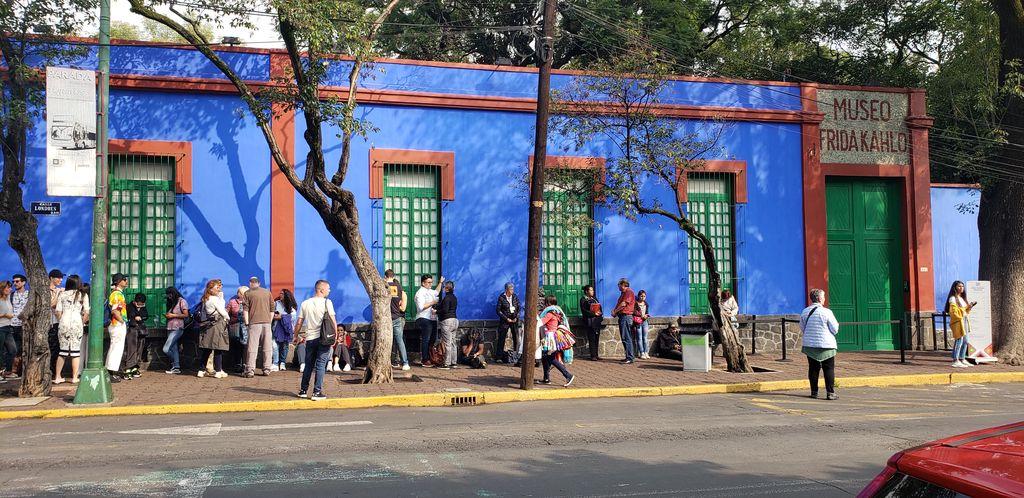
 by Tom Gurney
Tom Gurney BSc (Hons) is an art history expert with over 20 years experience
Page created on March 2, 2018 / Page updated on October 6, 2026
Email: tomgurney1@gmail.com / Phone: +44 7429 011000
Introduction
Frida Kahlo’s artistic world was built through more than introductions to famous people. Fellow artists shared techniques and work, friends exchanged letters and practical help, photographers made portraits with her, students worked alongside her, and collectors and dealers moved her paintings into new settings. These relationships overlapped, but a dinner invitation, a long correspondence and a purchase did not mean the same thing. [1] [4] [8]
The surviving record is uneven. Some connections can be followed in dated letters; others appear in undated correspondence, museum chronologies, object provenance or recollections made decades later. Keeping those forms of evidence distinct makes Kahlo visible as an artist and correspondent acting within networks, rather than as either a solitary genius or an ornament of Diego Rivera’s circle. [4] [7] [15]
At a Glance
- Early circles: Kahlo moved among Los Cachuchas at school and later became friends with photographer Tina Modotti. [1] [2] [3]
- Artist friends: Lucienne Bloch shared mural practice and correspondence with Kahlo across the 1930s. [1] [4] [5] [6]
- Teaching: Four pupils known as Los Fridos worked with Kahlo on public murals in Coyoacán. [1] [21]
- Exhibition: Lola Álvarez Bravo organised Kahlo’s 1953 solo show at her Mexico City gallery. [1] [19]
Contents
- Introduction
- From School Companions to Political Artists
- Lucienne Bloch: Artistic Work and Lasting Contact
- Friendship in Letters: Ella Wolfe and Mary Sklar
- Photographers, Portraits and an Image Archive
- Kahlo as Teacher and Collaborator
- Patrons, Dealers and the Work of Staying in Touch
- A Network of Different Kinds of Care and Work
- Related Reading
From School Companions to Political Artists
Kahlo’s preparatory-school circle, Los Cachuchas, formed one early network of discussion and friendship before her marriage to Rivera. The Museo Frida Kahlo chronology places her with the group in 1923, naming Alejandro Gómez Arias and Carmen Jaime among its members. A circa-1927 drawing associated with Pancho Villa and Adelita later passed from Kahlo to another school contemporary, Miguel N. Lira, according to its recorded provenance. [1] [2]
That gift records an artwork moving between peers, while the identification of figures in the related composition has a different evidentiary history. A Christie’s essay attributes the Cachuchas identification to Gómez Arias roughly sixty years after the drawing was made. The names therefore come from a later participant’s recollection, not a contemporary record of who sat at the table. [2]
By 1928, the museum chronology places Kahlo in the Young Communist League and describes a close friendship with the Italian photographer Tina Modotti. An INBAL account independently includes Kahlo in Modotti’s Mexican artistic-political circle and describes Modotti’s work in photography, Mexican Folkways and El Machete. These sources establish a shared social and political setting; neither supplies a sufficiently precise witness account for a dramatic scene in which Modotti introduces Kahlo to Rivera. [1] [3]
Watch: Frida Kahlo
Five perspectives to view here alongside the article.
Frida Kahlo’s The Two Fridas: Great Art Explained
A focused visual introduction to the painting and its context.
Lucienne Bloch: Artistic Work and Lasting Contact
The Museo chronology says Kahlo became friends with Lucienne Bloch during the couple’s New York period and that Bloch accompanied her to Mexico when Matilde Calderón became gravely ill in September 1932. Bloch was a muralist and photographer who also worked professionally with Rivera, but her own letters to Kahlo show a relationship that cannot be described solely through his commission. They preserve her experiences as a working artist in her own voice. [1] [4]
Writing in September 1934, Bloch discussed the Madison House fresco she made with Stephen Dimitroff, including the demands of the technique and the politics of artists’ labour. She had heard Kahlo was in hospital and recalled shared experiences in Detroit and New York. The letter documents Bloch’s concern and professional confidence in her correspondent; the reported hospital news and her joking rumours about Rivera’s arm are not independent medical records. [4]
Bloch’s April 1936 letter had a different energy, moving among languages, drawings and a comic account of a lost-and-recovered Leica camera. In February 1939, she sought Kahlo’s Paris address through their mutual contact Mary Sklar, hoped the exhibition would succeed and referred to Kahlo as godmother to her child Geddo. She also mentioned a home movie and a possible Swiss Pavilion commission, neither of which has been examined or established as completed work here. [5] [6]
The collaboration left an object trail as well as letters. Christie’s records Bloch as the direct recipient of Kahlo’s 1933 fresco Self-Portrait (Very Ugly) and relays Bloch’s later account that she and Dimitroff provided plaster panels before Kahlo painted and gave them the work. That technical sequence comes through retrospective testimony rather than a surviving letter written during its making, but it gives a concrete example of assistance and gift exchange between artists. [7]
Friendship in Letters: Ella Wolfe and Mary Sklar
The letters of Ella Wolfe show how a connection could persist without leaving a continuous record. In February 1932 she tried to arrange a visit or dinner with Kahlo and Rivera; in March she acknowledged receiving a humorous letter from Kahlo and proposed meeting again. The second letter confirms some exchange in both directions, but neither invitation proves that a dinner took place. [8] [9]
Wolfe wrote warmly again in February 1944. Yet an undated letter says earlier messages had gone unanswered, and another asks Cristina Kahlo for news of her sister. Taken together, they show contact, distance and family mediation across years, not a friendship that can be reconstructed day by day or explained by a guessed reason for the silences. [10] [11]
Mary Sklar’s surviving letters reveal another kind of practical intimacy. In a long note dated 11 June without a year, she confided grief, asked after Kahlo and offered help, while passing along news of artists and political acquaintances. These names came through Sklar’s reporting; their presence in her letter does not establish that Kahlo was personally close to everyone mentioned. [12]
Another Sklar letter, dated 7 October but again without a year, recalled time in a New York hotel and offered Kahlo a room bright enough for painting and care after hospital discharge. Sklar also wrote about Rivera and Trotsky’s death, which places the letter after August 1940 without identifying its year. Her offer is direct evidence of care, not evidence that Kahlo accepted it or moved into the room. [13]
Sklar also connected friendship to the art market. A Museum of Modern Art curator reports from departmental files that Sklar bought one work at Kahlo’s 1938 Julien Levy exhibition and then received Fulang-Chang and I with its mirror as a gift from the artist. This is a file-based curatorial reconstruction of two distinct acts—purchase and gift—rather than a surviving sales receipt reproduced with the account. [14]
The French artist Jacqueline Lamba sent Kahlo an undated letter proposing a summer journey to Mexico with her daughter Aube and asking for help with immigration papers. She discussed an approaching solo exhibition, said she had begun painting seriously since they last met and reported that Kahlo had not written to her. The letter brings two women’s artistic and practical lives together, but does not show that the journey happened or that Kahlo caused Lamba to take up painting more seriously. [15]
Photographers, Portraits and an Image Archive
Photography linked Kahlo to other artists as a sitter, collaborator, collector and maker. The Victoria and Albert Museum describes the photographs kept at Casa Azul as an archive she exchanged, annotated and preserved, not just a record made of her. It also identifies photographs placing her at a Nicholas Haz seminar in June 1945; attendance shows an active interest in photographic practice, not necessarily a personal friendship with Haz. [16]
The V&A characterises Kahlo and Nickolas Muray’s colour portraits as collaborations in which sitter and photographer both shaped the result. Muray was also a collector: the Harry Ransom Center’s inventory of his Mexican-art collection includes three Kahlo works within a much larger group dominated by Miguel Covarrubias. That art inventory supports a collecting relationship but should not be mistaken for an archive of private Muray–Kahlo letters. [16] [17]
Women photographers made important images of Kahlo, although being a sitter did not mean every photographer had the same place in her life. INBAL’s later Delante de Frida exhibition brought eight women’s portraits together, showing the breadth of photographic attention without making them eight equally close friends. The V&A places Gisèle Freund among late Casa Azul photographers, while Lola Álvarez Bravo’s work extended beyond portraiture into exhibition organisation. [18] [16] [19]
The Museo Frida Kahlo chronology and INBAL both identify Lola as the organiser of Kahlo’s 1953 solo exhibition at her Galería de Arte Contemporáneo. That was a specific act of artistic promotion, not merely a famous name in a visitor list. A later museum account also describes her Kahlo portraits and an unfinished film, extending this relationship into photographic and cinematic work while leaving the film a reported, incomplete project. [1] [19] [20]
Kahlo as Teacher and Collaborator
Kahlo’s networks were not only sources of support for her. The Museo chronology says she taught at La Esmeralda from 1942, later holding classes at home, and names Fanny Rabel, Guillermo Monroy, Arturo García Bustos and Arturo Estrada as the four pupils known as Los Fridos. An INBAL account of Rabel independently names the group and describes her as a painter, muralist, printmaker and the only woman among the four. [1] [21]
The group’s work took teaching into public space. The Museo describes Kahlo and students painting murals at the La Rosita pulquería in 1943 and returning to renew them in 1952; INBAL also connects Los Fridos to murals near Casa Azul and to local Coyoacán lavaderos. These accounts support a working relationship around social art, but do not prove that each of the four students painted every wall or that all later choices in their careers were Kahlo’s influence. [1] [21]
Rabel in particular deserves a place here as an artist with her own long practice, not simply as a pupil. In an INBAL account of Los Fridos, curator Javier Roque Vázquez Juárez describes the four as sharing a social world while developing different artistic views; researcher Guillermina Guadarrama also notes differences that emerged in their later work. Their common training and public projects did not make their careers interchangeable. [21] [29]
Patrons, Dealers and the Work of Staying in Touch
Kahlo also helped sustain relationships with patrons and institutions. The inscription on her 1931 portrait Frieda and Diego Rivera names Albert Bender as a friend, and the San Francisco Museum of Modern Art records the painting as his gift. This is an unusually tangible patronage path, but it is separate from another Bender transaction that concerned Rivera’s work. [22]
In August 1935, Bender thanked Kahlo for her letters and said that he had shared them with mutual friends. He described her help with the placement and framing of a Rivera picture, while a September telegram specified a $500 museum draft for Diego’s picture. The correspondence shows Kahlo participating in practical communication among artist, collector and museum; it is not a record of a $500 sale of her own painting. [23]
Art historians Servando Ortoll and Annette B. Ramírez de Arellano analyse Kahlo’s 1932–33 letters to Abby Aldrich Rockefeller as another instance of social mediation. Their Spanish-language study reports Kahlo writing in English about Rivera’s mural work, health, gifts and contact with the patron, while also noting that she continued to paint. Its “corporate wife” interpretation reveals a real aspect of the correspondence but should not be mistaken for the total of Kahlo’s artistic or social identity. [24]
Other correspondents dealt with Kahlo’s own paintings. In November 1941, the critic Walter Pach wrote that he owned a small work by her and asked for a photograph of her more recent art; he was unsure whether another Julien Levy exhibition would take place. The letter supports a collector’s interest and an image request, not the identification of the painting, a confirmed reply or a later show. [25]
Kahlo’s April 1944 letter to Levy joins work and affection in a single message. She discusses delayed pictures and the iron corset she was wearing, then asks after Mary Sklar, Ella Paresce and others across her American circle. The letter is a reminder that a dealer relationship could carry personal news as well as exhibition business, though a named person in its closing lines is not automatically an intimate friend. [26]
Two further object records illustrate how widely these pathways could reach. The reverse of Diego y yo names Florence Arquin and Sam Williams, whom Sotheby’s lists as direct acquirers from Kahlo; an auction description of 1941 export papers says the actress Paulette Goddard bought a still life for $300. A dedication and a transaction document circulation of art, but neither by itself settles the private feelings of those involved. [27] [28]
A Network of Different Kinds of Care and Work
The network around Kahlo changed with place and time. Early school peers and Modotti helped form a political and artistic setting; Bloch exchanged working knowledge and care across borders; Sklar offered painting space; Lola arranged a Mexican exhibition; and Los Fridos carried teaching into public murals. Patrons and dealers moved paintings and news, but none of these roles can stand in for all the others. [1] [3] [4] [13] [19] [21] [23]
The letters also preserve absences: an invitation does not confirm a visit, a planned journey may never have taken place, and a surviving note does not reveal every reply. Kahlo’s friends and artistic contacts are most intelligible through what people demonstrably did with and for one another—write, work, teach, buy, give, exhibit and offer help—rather than through an unchanging list of celebrated names. [8] [11] [15] [24]
Related Reading
Family and Childhood follows Kahlo’s early school circle. Frida Kahlo in New York develops the American contacts and 1938 exhibition, while Frida Kahlo in Paris examines Bloch’s 1939 address-book context. Frieda and Diego Rivera and Fulang-Chang and I follow two paintings that moved through the networks described here.
Discussion
Use the cited evidence and your own close looking to explain your view. The prompts below are starting points, not fixed interpretations.
Reader Insights
What changes when a surviving invitation is distinguished from a documented meeting?
How did Kahlo take part in artistic exchange as a colleague, teacher and correspondent?
What can an artwork gift or purchase establish about a relationship, and what remains unknown?
Join the Conversation
Which reading best fits the evidence, and where does uncertainty remain?
References
- Museo Frida Kahlo, Spanish artist chronology, especially Los Cachuchas (1923), Modotti (1928), Bloch (1931–32), Los Fridos (1943/1952) and Lola Álvarez Bravo (1953), HTML lines 239–270, 320–325, 456–460, 519–525, 1157–1163, 1434–1452. Institutional chronology. View source text.
- Christie’s, Sketch for Pancho Villa and Adelita, provenance and lot essay, lines 9–22 and 34–40. Gift to Miguel N. Lira; Gómez Arias identification is later recollection. View source text.
- INBAL, Tina Modotti memorial notice, lines 31–39. Professional and political context and Kahlo friendship roster, not an exact introduction scene. View source text.
- National Museum of Women in the Arts, Lucienne Bloch to Kahlo, 15 September 1934, complete six-page transcription, lines 152–513. View source text.
- National Museum of Women in the Arts, Bloch to Kahlo, 25 April 1936, complete two-page transcription, lines 139–197. View source text.
- National Museum of Women in the Arts, Bloch to Kahlo, 20 February 1939, complete two-page transcription, lines 139–227. View source text.
- Christie’s, Self-Portrait (Very Ugly), provenance lines 16–20 and retrospective Bloch account in essay lines 75–81. View source text.
- National Museum of Women in the Arts, Ella Wolfe to Kahlo, 25 February 1932, one-page transcription, lines 134–167. View source text.
- National Museum of Women in the Arts, Wolfe to Kahlo, 16 March 1932, one-page Spanish/English transcription, lines 134–167. View source text.
- National Museum of Women in the Arts, Wolfe to Kahlo, 21 February 1944, one-page transcription, lines 137–173. View source text.
- National Museum of Women in the Arts, Wolfe to Kahlo, 15 March, year unknown, lines 139–200; Wolfe to Cristina Kahlo, no date, lines 136–176. View source text 1; View source text 2.
- National Museum of Women in the Arts, Mary Sklar to Kahlo, 11 June, year unknown, complete six-page transcription, lines 150–305. View source text.
- National Museum of Women in the Arts, Sklar to Kahlo, 7 October, year unknown, complete ten-page transcription, lines 165–405. View source text.
- Museum of Modern Art, Veronica Roberts, “A Close Look: Frida Kahlo’s Fulang-Chang and I”, lines 13–22, reporting from departmental files; underlying sale record unread. View source text.
- National Museum of Women in the Arts, Jacqueline Lamba to Kahlo, no date, complete one-page English/French transcription, lines 137–190. View source text.
- Victoria and Albert Museum, “Photographing Frida Kahlo”, lines 33–37 and 64–90, curatorial interpretation and dated photographs. View source text.
- Harry Ransom Center, Nickolas Muray Collection of Mexican Art finding aid, lines 48–60 and 86–107. Art inventory, not a correspondence archive. View source text.
- INBAL, Delante de Frida, opening and roster; later curatorial grouping. View source text.
- INBAL, Lola Álvarez Bravo career notice, lines 34–39, gallery organisation and photographs. View source text.
- National Museum of Women in the Arts, “Artist Friendships: Lola Álvarez Bravo and Frida Kahlo”, lines 120–126; media details remain secondary assertions. View source text.
- INBAL, Fanny Rabel remembrance, bulletin 1656 (2023), PDF pp. 1–2, especially p. 2 lines 38–67. The 1941 exhibition-text date needs catalogue confirmation. View source text.
- San Francisco Museum of Modern Art, Frieda and Diego Rivera object record, lines 39–43 and 144–166, inscription and Bender gift. View source text.
- National Museum of Women in the Arts, Albert Bender to Kahlo, 30 August 1935, lines 139–223; 3 September letter, lines 137–197; 3 September telegram, lines 139–178. View source text 1; View source text 2; View source text 3.
- Servando Ortoll and Annette B. Ramírez de Arellano, “Frida Kahlo: Retrato de la artista como esposa empresaria,” Desacatos 11 (2003), PDF pp. 1–12, especially pp. 4–10. Rockefeller originals cited there were not read independently. View source text.
- National Museum of Women in the Arts, Walter Pach to Kahlo, 5 November 1941, complete two-page Spanish transcription, lines 139–203. View source text.
- Getty, Kahlo to Julien Levy, 20 April 1944, published letter transcription, lines 171–199. View source text.
- Sotheby’s, Diego y yo object record, dedication and provenance lines 71–105. View source text.
- Heritage Auctions, Kahlo–Paulette Goddard export-declaration lot, description lines 34–38. Original forms were not independently transcribed; surrounding intimacy claims are not used. View source text.
- INBAL, “Presentaron el catálogo de Los Fridos. Una génesis permanente”, lines 32–47, reporting the curatorial presentation. The complete catalogue essays were not read. View source text.
Image Credits
- Photo: Alex1210O / Wikimedia Commons, CC BY-SA 4.0. Resized to 1024 px wide; no crop. Source record.
