


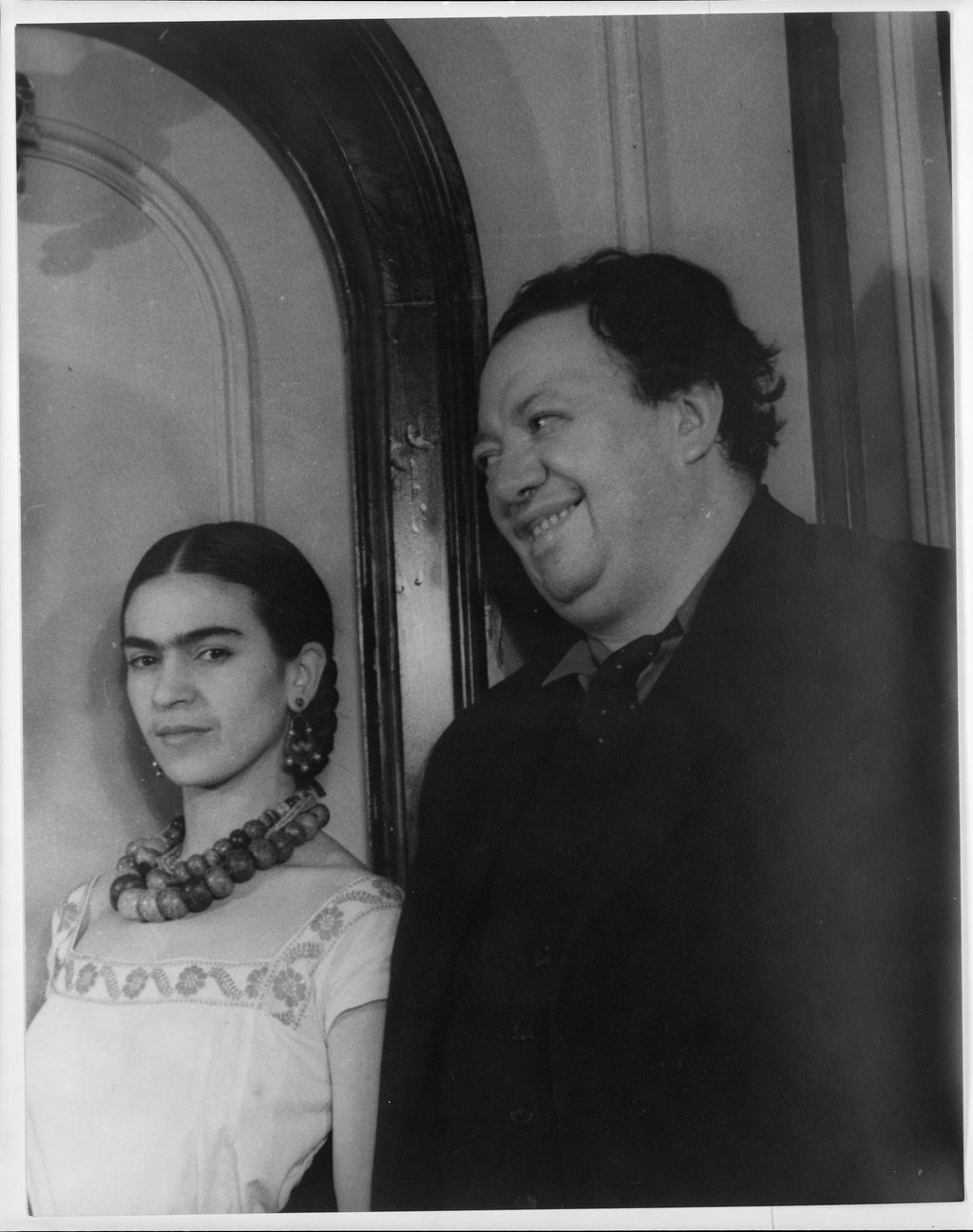
 by Tom Gurney
Tom Gurney BSc (Hons) is an art history expert with over 20 years experience
Page created on March 2, 2018 / Page updated on October 6, 2026
Email: tomgurney1@gmail.com / Phone: +44 7429 011000
Introduction
In April 1931, Frida Kahlo painted herself beside Diego Rivera in San Francisco and wrote their names, her own authorship and the intended recipient into the picture. Rivera is much larger and holds the palette and brushes; Kahlo stands at his side, but the banner says that she painted “these portraits.” The painting’s tension lies between the artist’s-wife role shown within the image and the artist’s voice that made and dedicated it. [1] [2]
The work is also unusually well anchored in public records. Kahlo made it for the San Francisco patron Albert M. Bender; it became her first documented public exhibition in 1931, appeared under Bender’s name as a loan at a San Diego fair in early 1936, and entered the San Francisco Museum of Modern Art as his gift in 1936. Those records offer a more precise history than stories that turn the portrait into a prediction of the couple’s later marriage. [1] [3] [4]
At a Glance
- Artist and title: Frida Kahlo, Frieda and Diego Rivera (Frieda y Diego Rivera);
Friedais the spelling in SFMOMA’s institutional title and the painted inscription - Date and place: April 1931 according to the picture’s banner; made in San Francisco during the couple’s first United States stay
- Medium and dimensions: oil on canvas, 100.1 × 78.7 centimetres (39 3/8 × 31 inches)
- Recipient and collection: painted for Albert M. Bender; his gift to SFMOMA in 1936, accession 36.6061
- First documented public showing: Sixth Annual Exhibition of the San Francisco Society of Women Artists, 4 November–3 December 1931
- Present display: SFMOMA listed the painting on Floor 2 on 2 October 2026; gallery placement can change. [1] [3] [5]
Contents
- Introduction
- A Marriage Portrait That Names Its Painter
- San Francisco, Stackpole and Bender
- Scale, Hands and the Limits of Interpretation
- Dress, Self-Presentation and the Painted Wife
- The Bird, Banderole and Wedding-Portrait Form
- A Spanish Argument About the Artist’s Wife
- First Public Showing, and What the Records Actually Say
- A Newly Verified 1936 Loan and the Museum Gift
A Marriage Portrait That Names Its Painter
The vertical canvas presents two nearly full-length figures against a quiet grey-green wall and a narrow strip of brown floor. Rivera stands on the viewer’s left in dark clothing and a blue shirt; he rises close to the top and bottom of the picture. Kahlo stands on the right in a green dress and red-orange fringed shawl, substantially smaller and surrounded by more empty wall. [1] [6]
Rivera holds an oval palette and four brushes. His other hand meets Kahlo’s near the picture’s centre, where her hand rests lightly over his without a tight interlock. Kahlo tilts her head toward him but looks out at the viewer; the different directions of head and gaze complicate any claim that she is absorbed entirely in the man beside her. [1] [6]
Above them, a bird holds a pale pink banderole carrying Kahlo’s Spanish words. SFMOMA translates the central declaration as “I painted these portraits” and gives San Francisco, their friend Mr. Albert Bender and April 1931 as its place, destination and date. The first-person inscription makes Kahlo both a sitter in the marriage portrait and the person controlling its account of who made it. [1] [2]
The plural “portraits” is worth retaining. The painting joins two recognisable people in one composition, but Kahlo’s text describes her work as the making of their paired likenesses, not as a passive appearance beside an already established painter. Rivera alone carries the tools within the depicted scene; the upper register supplies the other, equally concrete, evidence of an artist at work. [2] [6]
Watch: Frida Kahlo
Five perspectives to view here alongside the article.
Frida Kahlo’s The Two Fridas: Great Art Explained
A focused visual introduction to the painting and its context.
Frieda and Diego Rivera in Kahlo’s career
The Two Fridas
1939Timeline source: Museo Frida Kahlo chronology [21].
San Francisco, Stackpole and Bender
Kahlo and Rivera arrived in San Francisco on 9 November 1930, according to the publisher-hosted opening chapter of Celia Stahr’s Frida in America. Rivera’s commissions had met objections from some local artists, and his former Communist affiliation initially led the United States State Department to deny him a visa. Stahr’s excerpt identifies sculptor Ralph Stackpole as the advocate who approached Albert Bender, whose connections helped reverse that decision; the rest of Stahr’s book and its notes remain unread here. [7]
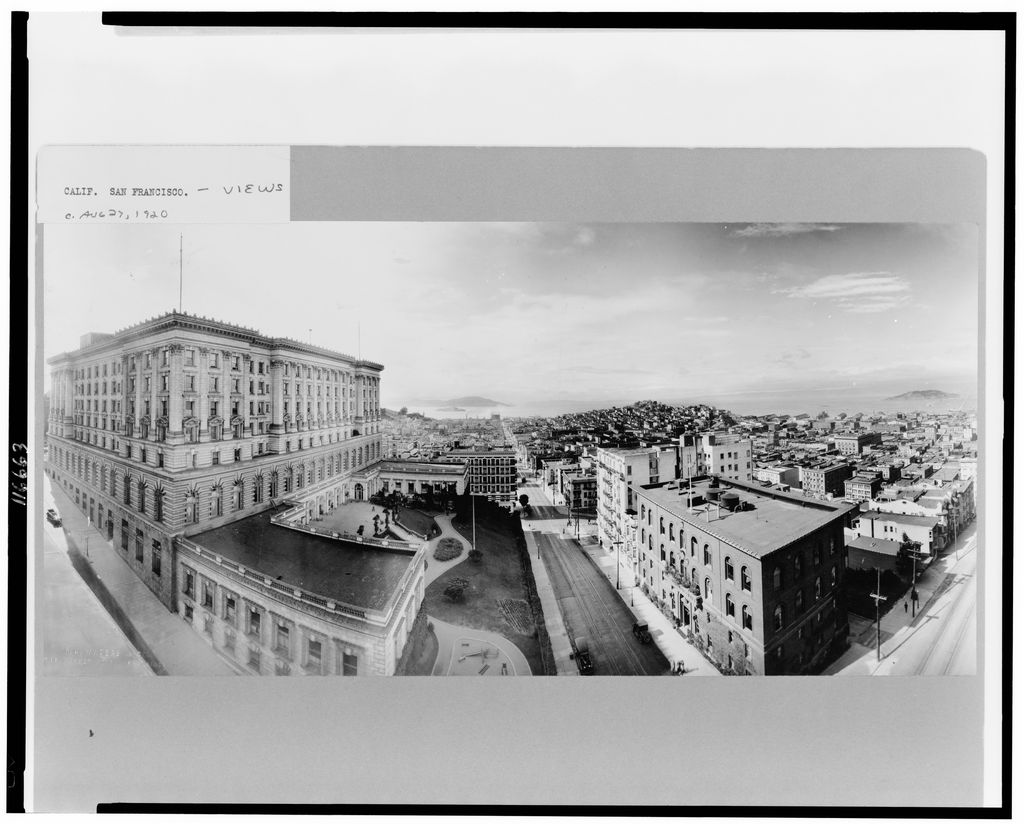
The Fine Arts Museums of San Francisco place the couple at 716 Montgomery Street, Stackpole’s house and studio, from November 1930 through May 1931. Their account describes an active circle of artists rather than an isolated stop in Rivera’s itinerary. Kahlo painted Portrait of Mrs Jean Wight in this setting; Jean’s husband Clifford assisted Rivera, and the portrait’s San Francisco outlook made the local environment part of another work from the same period. [8]
The marriage portrait’s inscription calls Bender “our friend” and says the picture was made for him. Stahr’s documented visa episode makes gratitude a plausible context, but the painted sentence does not say that the painting was payment or an explicit thank-you for the visa. Bender was also a collector and later founding trustee whose gifts helped shape SFMOMA’s holdings in Mexican modernism, photography and Bay Area art. [2] [7] [9]
The visit should not be stretched into an eighteen-month San Francisco stay. Museo Frida Kahlo records Kahlo’s trip to Mexico City in May 1931 and the couple’s return to Mexico on 8 June; the Fine Arts Museums’ November–May residence label fits that shorter sequence. An older SFMOMA essay’s eighteen-month description is inconsistent with those dated institutional records and is not used here. [8] [10] [11]
Scale, Hands and the Limits of Interpretation
Rivera’s height and mass dominate the canvas, while Kahlo’s small blue shoes emerge beneath her long skirt. SFMOMA artist Rupert Garcia has read the disparity between her shoes and his heavy footwear in relation to their unequal artistic standing in Mexico. Artist Amalia Mesa-Bains reads Kahlo’s light hold on Rivera as a possible search for an anchor during her first journey outside Mexico, when she spoke little English. [1] [6]
These are later named interpretations, not reports of Kahlo’s private thoughts in April 1931. The image supports the scale difference, the professional tools, the touching hands and Kahlo’s outward gaze; it does not by itself establish dependence, fear, marital submission or foreknowledge of infidelity. A contemporary viewer can see tenderness, hierarchy and self-assertion together without making one of them the picture’s single hidden message. [1] [6] [11]
SFMOMA’s earlier collection essay asks whether the apparent imbalance is sincere self-representation or a veiled critique of a subordinate role. Its question is more useful than an answer imposed on the artist without evidence. Garcia also finds love in Kahlo’s careful handling of the blue tones of Rivera’s shirt: an attentive response to paint, but still Garcia’s response rather than a documented statement of her intention. [1] [11]
Dress, Self-Presentation and the Painted Wife
Kahlo’s skirt, shawl, jewellery, braided hair and small shoes are carefully staged in a sparse setting that offers no furniture or landscape to distract from the couple. A de Young exhibition label calls this her first painted “Tehuana self” and reads her as the Mexican wife beside a man identified as the great artist. That is a useful account of how clothing and pictorial attributes work, but the label’s claim that she defines herself “not as a painter” needs to be set against the plainly legible banner. [6] [8]
The label’s regional identification is a curatorial reading, not something that can be proven from a green dress and red shawl alone. Berit Potter’s review of the San Francisco exhibition relates Kahlo’s early American period to the formation of a deliberate public appearance, with Gannit Ankori’s catalogue essay pointing to her experience as a photographer’s daughter and her presence in photographs by Edward Weston and Imogen Cunningham. Those photographs help define a research route, not an image licence for this page. [12]
Museo Frida Kahlo likewise places professional California portraits and Kahlo’s display of Mexican dress within the 1930–31 phase. The painted clothing belongs to that history of self-presentation, but an editor cannot use it alone to assign her ancestry, identify every garment’s place of manufacture or say that Rivera chose the outfit. The fuller textile and Tehuana history belongs in the separate dress study. [10] [12]
The Bird, Banderole and Wedding-Portrait Form
The golden-brown bird carries the text across the upper field, giving the otherwise still portrait an address to its viewer and recipient. Museo Frida Kahlo calls the work a representation of the couple’s wedding and compares the bird-held dedication with legends on the ex-votos Kahlo collected. Their civil marriage occurred on 21 August 1929, nearly twenty months before the dated April 1931 painting; “wedding portrait” describes its commemorative form, not a canvas painted on the wedding day. [10]
The analogy to devotional pictures is illuminating but limited. The banner names a friend and describes a gift; it does not record a miracle, saint or prayer answered. SFMOMA’s earlier essay also compares the composition to a colonial marriage portrait, an art-historical frame that helps explain its formal pairing and lettering without requiring it to be classified simply as an ex-voto. [10] [11]
Some accounts say the double portrait was copied from a particular wedding photograph. No inspected owner or primary record establishes a direct photographic model, so resemblance is not enough to specify one. The picture itself provides more secure evidence: the held tools, light hand contact, outward look and named dedication can be studied without assuming an unseen source image. [2] [6]
A Spanish Argument About the Artist’s Wife
Servando Ortoll and Annette B. Ramírez de Arellano, writing in Spanish in Desacatos, take seriously the large muralist with brushes and palette and the smaller, admiring wife at his side. Their section on the self-effacing wife and amateur artist places that presentation beside Kahlo’s later correspondence with Abby Aldrich Rockefeller, where she acted as interpreter, intermediary, carer and social organiser while sometimes diminishing her own work. This is a historical argument about roles Kahlo performed within a prominent artistic partnership, not proof that her art or agency disappeared. [13]
The authors describe a symbiotic but asymmetric working relationship. Read beside their analysis, the 1931 painting can present the public-facing “artist’s wife” and still be an accomplished object of Kahlo’s own making, social exchange and patronage. The words above the figures do not erase the scale difference, but neither does the scale difference silence the words. [2] [13]
In a Portuguese-language University of Brasília dissertation, Brígida Duarte de Oliveira Medeiros studies the portrait as a verbal–visual construction. She treats the joined hands as a compositional centre and shows how the text above the figures alters the apparent narrative of dress, tools and gazes below. Her detailed observations are productive here; psychological conclusions about what Kahlo inwardly felt remain Medeiros’s interpretation, not a statement secured by the canvas. [14]
The two non-English readings help resist opposite simplifications. It would be as misleading to deny the hierarchy shown by Rivera’s scale and attributes as to declare Kahlo an uncreative appendage. The painting puts marriage, artistic reputation, female social labour and explicit authorship into one deliberately public gift. [2] [6] [13] [14]
First Public Showing, and What the Records Actually Say
The Archives of American Art dates the Sixth Annual Exhibition of the San Francisco Society of Women Artists to 4 November–3 December 1931 at the California Palace of the Legion of Honor. Its catalogue item record calls this the first public viewing of Kahlo’s work. The Online Archive of California’s finding aid identifies the painting and says Kahlo appeared under the listing “Senora Frieda Rivera,” a name that made her marriage visible even as her work entered an artists’ exhibition. [3] [5]
There is a conflict in the archive’s own online descriptions: a broader Smithsonian historical note says 1932, while the item-level 1931 catalogue and the California finding aid agree on 1931. The dated catalogue is the stronger evidence. Only its cover and two representative pages were digitised in the pass documented here, so the exact printed object entry and the complete participant list were not independently read. [3] [5]
A repeated story says a newspaper judged the work valuable only because Rivera’s wife had made it. No original clipping with that precise line was found, and it should not be presented as a verified review. A different contemporary caption, dated 22 January 1931, did describe Kahlo as “Mrs. Diego Rivera” while discussing her portrait of Jean Wight; it shows marital framing in the press, but it is neither a response to this canvas nor evidence about the November show. [15]
A Newly Verified 1936 Loan and the Museum Gift
An illustrated catalogue of the 1936 California Pacific International Exposition supplies another public appearance in the year of the museum gift. In Gallery I at the Palace of Fine Arts, San Diego, item 62 names the artist “Frieda Rivera,” lists Frieda and Diego Rivera as an oil painting, and credits “Mr. Albert M. Bender, San Francisco” as lender. The entry adds “On view until April first”; the fair’s art-exhibition catalogue gives the wider run as 12 February–9 September 1936, not a promise that this painting stayed for the entire season. [4]
This contemporary entry tightens the picture’s early history. It identifies Bender as the lender for an early-1936 exhibition, while SFMOMA records his gift in the same year. It does not supply a delivery date from Kahlo, a sale or gift instrument, or the exact day and order of the exhibition loan and museum transfer. [1] [2] [4]
SFMOMA’s owner record credits the painting to the Albert M. Bender Collection and says “gift of Albert M. Bender.” The museum’s accounts of its early collecting history identify his interest in Mexican modernism and his connection to Rivera’s San Francisco commissions. The secure points are an April 1931 work made for Bender, a catalogue naming him as lender in early 1936, and his gift to the museum dated 1936; the older date of 1937 is incorrect. [1] [4] [9] [16]
The work remained useful to later curators as a portrait of two artists and as part of the museum’s own history. SFMOMA included it in its 2017 Side by Side exhibition about artist pairs, and the 2020–21 de Young presentation put it alongside evidence of Kahlo’s developing appearance in San Francisco. These are selected object-specific appearances, not a claim to have reconstructed a complete exhibition history. [12] [17]
Books, Open Questions and Artwork Access
Three books are especially relevant for taking this page further. Luis-Martín Lozano, Andrea Kettenmann and Marina Vázquez Ramos’s Frida Kahlo: The Complete Paintings is the priority for a full object entry, historical titles, provenance, exhibitions and bibliography. Celia Stahr’s Frida in America promises a detailed account of the San Francisco period, while Gannit Ankori’s Frida Kahlo offers a critical route through identity and the myths surrounding the marriage; only Stahr’s publisher-hosted opening excerpt has been consulted for the claims made here; the complete volumes remain routes for deeper reading. [7] [18] [19]
The complete 1931 women artists’ catalogue, Bender’s surviving correspondence and customs papers, and SFMOMA’s fuller curatorial or conservation file remain necessary for a fuller reconstruction. The Archives of American Art finding aid locates Bender papers that include correspondence with Diego and “Frieda Kahlo Rivera,” but the relevant microfilm was not inspected. No catalogue raisonné number, original frame history, condition report, technical image or evidence of a specific wedding-photograph model is claimed here. [3] [20]
The painting is held by SFMOMA, whose official object page provides an independent view and currently lists it on Floor 2 in 1900 to Now: SFMOMA’s Collection. That status was rechecked on 2 October 2026; the museum warns that locations change, so it should be checked again before a visit or publication update. The museum's account identifies the painting; the contextual photographs here are separate historical evidence, not reproductions of it. [1] [6]
Related Reading
The San Francisco study places this 1931 portrait in the couple's first United States stay. Portrait of Diego Rivera is a distinct later Kahlo painting of him, while The Love Embrace of the Universe offers a very different image of their relationship.
Frequently Asked Questions
SFMOMA’s institutional title is Frieda and Diego Rivera, and the name appears in the painted Spanish banderole. Kahlo’s first-person inscription identifies her as the maker and gives the work’s recipient, city and month. The spelling is preserved as an object title, not silently modernised to the artist’s more familiar name. [1] [2]
The Archives of American Art calls its 1931 showing the first public viewing of Kahlo’s work, and the California finding aid identifies this painting under “Senora Frieda Rivera.” That is the first documented public showing in the inspected records, rather than proof that no earlier informal display occurred. The relevant exhibition ran from 4 November to 3 December 1931, not 1932. [3] [5]
The banner says Kahlo made it for their friend Bender, and Stahr’s published excerpt documents his part in reversing Rivera’s visa refusal. Those facts make a gesture of gratitude a reasonable interpretation, but the banner does not specify the visa as its reason. The newly examined 1936 catalogue names Bender as lender that year; SFMOMA independently records his 1936 gift, without an exact transfer day. [1] [2] [4] [7]
Rivera’s larger size and his palette and brushes make unequal public roles visible, and several museum and scholarly commentators read them that way. Yet Kahlo looks outward and says in the banner that she painted the paired portraits. The work can stage a wife’s social position while asserting the painter’s authorship; its forms do not prove a fixed psychological submission. [1] [2] [8] [13]
Discussion
Use the cited evidence and your own close looking to explain your view. The prompts below are starting points, not fixed interpretations.
Reader Insights
How do the tools in Rivera's hand and Kahlo's signed banner distribute artistic roles?
What do San Francisco exhibition and Bender records establish beyond the painted image?
How much of a marriage can a single commissioned portrait responsibly be made to represent?
Join the Conversation
Which reading best fits the evidence, and where does uncertainty remain?
References
- San Francisco Museum of Modern Art, Frieda and Diego Rivera, accession 36.6061, current object metadata, audio-story transcript and audio-description transcript; owner title, medium, dimensions, 1936 gift and display checked 2 October 2026. The “news announcer” in the audio is explicitly dramatised, not a 1931 recording. View source text.
- SFMOMA, “Frieda and Diego” discussion questions, April 2016, question 4 and owner translation of the painted inscription. The owner audio [1] uses a slightly different English rendering of the same Spanish text. View source text.
- Archives of American Art, 1931 Sixth Annual Exhibition catalogue item record, Digital ID 17928, catalogue metadata and 4 November–3 December dates; only cover and two representative pages digitised. View source text.
- Illustrated Catalogue: Official Art Exhibition, California Pacific International Exposition 1936, cover and Gallery I, printed p. 13, item 62, PDF pp. 1 and 8. The scanned original was visually inspected: it calls Bender the lender and says the painting was “On view until April first.” The URL filename says
1935, but the scanned cover explicitly dates this catalogue to 1936. View source text. - Online Archive of California, San Francisco Society of Women Artists finding aid, historical note on Kahlo’s 1931 appearance under “Senora Frieda Rivera” and first public showing. A separate Smithsonian historical note gives 1932; the dated catalogue [3] controls. View source text.
- San Francisco Museum of Modern Art, Frieda and Diego Rivera object record and image, 1,619 × 2,048-pixel front view used for visual description; it cannot establish the reverse, physical condition or image-reproduction rights. View source text.
- Celia Stahr, Frida in America publisher-hosted opening excerpt, chapter 1, arrival on 9 November 1930 and paragraphs on Stackpole, Bender and the visa decision. The complete 384-page book and notes were not read. View source text.
- Fine Arts Museums of San Francisco, bilingual Frida Kahlo: Appearances Can Be Deceiving labels, label 108 and adjacent Montgomery Street / Jean Wight label; the “not a painter” and first Tehuana-self descriptions are attributed exhibition interpretations. View source text.
- SFMOMA, 75 Years of Looking Forward anniversary exhibition release, 22 September 2009, Albert Bender section and Mexican modernist gifts. View source text.
- Museo Frida Kahlo, “Frida” chronology, 1929 marriage, 1930–31 San Francisco, May journey and 8 June return entries; Frieda and Diego Rivera entry on wedding representation and ex-voto-like inscription. View source text.
- SFMOMA, Frieda and Diego Rivera text from Painting and Sculpture Highlights, originally published 2002; colonial wedding-portrait comparison and question of self-representation or critique. Its eighteen-month stay claim is rejected against dated chronology [8][10]. View source text.
- Berit Potter, review of Frida Kahlo: Appearances Can Be Deceiving, Panorama 7.1 (2021), San Francisco section and notes 5–8; complete review consulted. Its image caption’s 1930 date does not displace the owner’s 1931 record. View source text.
- Servando Ortoll and Annette B. Ramírez de Arellano, “Frida Kahlo: Retrato de la artista como esposa empresaria”, Desacatos 11 (2003), pp. 120–31, especially “Esposa desprendida, artista aficionada,” pp. 128–30; complete Spanish article consulted. View source text.
- Brígida Duarte de Oliveira Medeiros, Frida Kahlo: uma autoficção verbo-visual, University of Brasília MA dissertation (2019), printed pp. 73–77; Portuguese object passage consulted. View source text.
- Bettmann/Getty Images, 22 January 1931 caption to Kahlo painting Portrait of Mrs Jean Wight, editorial image 517443422; caption only, no image licence. It concerns a different portrait, not this painting or the November exhibition. View source text.
- SFMOMA, “Discover Latin American Art at SFMOMA”, 24 August 2011, Bender’s Rivera connection, museum opening and following-year donation of Frieda and Diego Rivera. View source text.
- SFMOMA, Side by Side, 17 June–3 December 2017, exhibition description explicitly including Frieda and Diego Rivera. View source text.
- Luis-Martín Lozano, Andrea Kettenmann and Marina Vázquez Ramos, Frida Kahlo: The Complete Paintings, TASCHEN publisher metadata, 624 pages; complete volume unread. View source text.
- Gannit Ankori, Frida Kahlo, Reaktion Books publisher metadata; complete Critical Lives book unread. View source text.
- Archives of American Art, Albert M. Bender papers, 1909–1941, collection-level finding aid and microfilm reels 2293–2294; correspondence and other primary documents not inspected. View source text.
- Museo Frida Kahlo, Frida interactive chronology, selected work dates used for the comparison timeline. The current work's date follows its cited object record. View source text.
Image Credits
- Carl Van Vechten, 19 March 1932. Library of Congress, LC-USZ62-42516. Public domain / no known restrictions. Resized to 1024 px wide; no crop. Source record.
- R. J. Waters & Co., about 1920. Library of Congress, item 96514400; public domain. Resized to 1024 px wide; no crop. Source record.
