


 by Tom Gurney
Tom Gurney BSc (Hons) is an art history expert with over 20 years experience
Page created on March 2, 2018 / Page updated on October 6, 2026
Email: tomgurney1@gmail.com / Phone: +44 7429 011000
Introduction
Frida Kahlo's Marxism Will Give Health to the Sick places her corseted body at the centre of a divided world. Enormous hands hold her upright while crutches angle away; a pale bird, globe and blue watercourse occupy one side, and a violent encounter beneath Karl Marx's head occupies the other. The painting joins a personal wish for relief to a public political vision, but it does not tell us that Kahlo expected ideology to cure her in any literal medical sense. [1] [2] [3]
Museo Frida Kahlo identifies the work as an unfinished self-portrait of about 1954. Its museum-supplied object record gives oil on Masonite, 76 × 60 centimetres without frame, and the Museo Frida Kahlo collection. The picture is therefore both a late painting and an unfinished one; neither description supplies the month in which Kahlo began or stopped working on it. [1] [4]
At a Glance
- Spanish title: El marxismo dará salud a los enfermos; the museum's English label uses Marxism Will Give Health to the Sick. [1] [2]
- Date and status: About 1954; unfinished according to Museo Frida Kahlo. No precise working date is documented. [4]
- Medium and size: Oil on Masonite, 76 × 60 cm unframed in the museum record; two books give a roughly 61-cm width. [1] [5] [6]
- Collection: Museo Frida Kahlo, Casa Azul, Mexico City; current gallery display is unconfirmed. [1] [7]
Contents
- Introduction
- A Body Held Up
- Two Sides of the World
- Political Art Before 1954
- Health, Disability and the Last Year
- Miraculous Cure or Political Propaganda?
- Title, Material and Unfinished State
- Collection, Display and Conservation
- Books and Open Questions
A Body Held Up
The composition is vertical, with Kahlo standing almost frontally. Her dark hair rises above connected brows and an unsmiling face. A tan orthopaedic corset encloses the middle of her exposed torso, while a dark green skirt broadens below it and ends in a wide pale band. The available small image, compared with published plates, cannot identify the brace's material, a particular surviving corset or the regional construction of the skirt. [3] [5]
Two hands far larger than Kahlo's own enter from either side and sustain her torso. An eye appears in the palm at image left. Her smaller hand, at image right, holds a red book whose cover cannot be read, while crutches or similar supports pass diagonally beside her instead of forming ordinary support beneath her arms. [2] [3]
These objects establish the painting's central tension without settling every symbol. The brace and crutches are visible medical aids, and the enlarged hands offer an impossible second source of support. Museo Frida Kahlo identifies the hands with Marx and says that, held by them, Kahlo can release her crutches; the museum-partner text calls this a utopian vision of political belief freeing her from pain. [1] [2] That is the institution's interpretation of the image, not evidence of an actual cure or of Kahlo's precise medical expectation.
The upper body is bare around the corset, a frank way of placing the injured and supported body before the viewer. Kahlo has not hidden the apparatus beneath an intact costume; nor is the brace simply a medical illustration. Its dark fasteners and central line give it visual weight, while the greatly enlarged hands shift the question from how a device works to what, or who, might sustain a person. [3]
The skirt's green and broad light band are visible, but the low-resolution image cannot establish a Tehuana garment. A 2016 museographic thesis uses that name, whereas textile identification would require stronger object or clothing evidence. Kahlo's dress remains relevant here because it keeps her self-representation within the political allegory; the full history of her clothing belongs to a separate study. [3] [8]
Watch: Frida Kahlo
Five perspectives to view here alongside the article.
Frida Kahlo’s The Two Fridas: Great Art Explained
A focused visual introduction to the painting and its context.
Marxism Will Give Health to the Sick in Kahlo’s career
The Two Fridas
1939Marxism Will Give Health to the Sick
c. 1954; unfinishedTimeline source: Museo Frida Kahlo chronology [20].
Two Sides of the World
At image left, a large pale bird crosses a light blue-green sky above a globe. Red-orange areas mark parts of the globe; below it, green-yellow terrain is crossed by a blue river-like channel. A small golden disc lies near the globe, although the image does not establish whether it is meant as a sun, planet or other sign. [3]
The museum's visitor label calls the bird a pigeon and asks readers what it might represent. Kettenmann reads it as a peace dove and identifies the red regions of the globe as the Soviet Union and China. Those identifications are plausible within the painting's politics and later scholarship, but the small available image cannot verify the bird's species or every mapped border. [2] [3] [5]
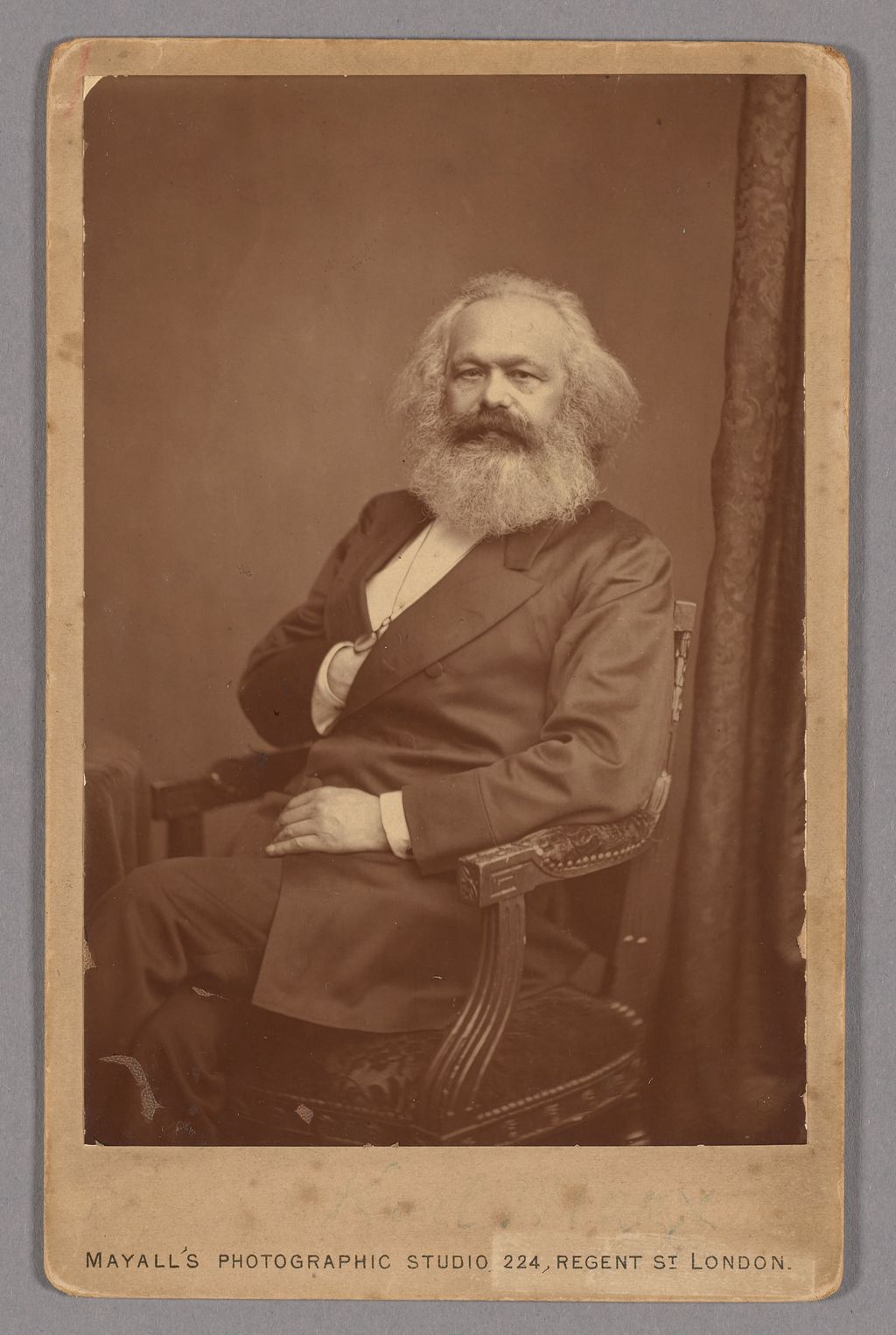
The darker right side brings a white-haired, white-bearded head into a pale field. Museo Frida Kahlo identifies this figure as Karl Marx. An arm reaches from his vicinity to grip a smaller man's neck or collar; the man's tall hat has red, white and blue stripes. Nearby are a black bird-like form, a pale mass resembling a mushroom cloud, red-brown ground and a dark red channel. [2] [3]
Kettenmann identifies the top-hatted figure as Uncle Sam, the black bird as an American eagle, and the pale mass as an atomic mushroom cloud. Andrea Calvo Díaz instead calls the black bird a crow. The striped hat supplies strong conventional United States coding, while the competing bird names show why an iconographic reading should not be mistaken for zoological observation. No specific bomb test, city, politician or military event is labelled in the painting. [3] [5] [9]
The blue channel on one side and the red one on the other make a forceful colour opposition. Kettenmann interprets them as water in a peaceful world and blood in a damaged one; Portuguese scholar Diego de Oliveira Souza also builds an argument around that contrast. Visually, the channels are blue and dark red, and the surrounding terrain differs in colour and mood. Calling one literal blood is a sourced interpretation, not a material finding from the image. [3] [5] [10]
Kahlo, Marx, the hands, the tiny top-hatted figure and the globe occupy incompatible scales. Their overlaps connect a single supported body with a global conflict rather than constructing one natural room or landscape. This assembled space can be described as allegorical without assigning the painting to Surrealism or any other movement on the strength of an online genre tag. [3]
Political Art Before 1954
The painting's peace imagery has a documented setting beyond symbolic guesswork. Historian Jorge Octavio Fernández Montes places Kahlo, Rivera and David Alfaro Siqueiros on the organising committee of the Continental American Congress for Peace in Mexico City, held from 5 to 11 September 1949. He also records their participation in gathering signatures during the March–April 1950 Stockholm Appeal campaign against atomic weapons. [11]
Rivera's 1952 mural Nightmare of War and Dream of Peace showed Kahlo collecting those signatures, set against atomic-war imagery. Fernández Montes relates Kahlo's later divided globe, dove, mushroom-cloud form and confrontation with Uncle Sam to that pro-Soviet peace culture. His historical account explains why peace and nuclear danger could be present together in this painting; it does not establish that the movement commissioned it or dictated each detail. [11]
Art historian Dina Comisarenco Mirkin independently traces the World Peace Council milieu through the work and recollections of artists Rina Lazo and Arturo García Bustos. She connects Kahlo's 1952 Congress of the Peoples for Peace and this later self-portrait to the movement's outlook. That comparison places this self-portrait within a developing body of political art rather than an isolated slogan, while the other painting's object history remains separate. [12]
A 1953 diary passage reproduced in Mariano Ramírez Avendaño's UNAM thesis gives closer evidence of Kahlo's late artistic programme. In the thesis transcription she hopes to help the Communist Party and speaks of aligning painting with what she calls “Revolutionary Realism.” The original diary leaf and an authorised translation have not been independently checked, so the passage is treated as mediated evidence of a stated ambition, not as a direct quotation proving that party officials ordered this particular painting. [13]
The exact intensity and continuity of Kahlo's party involvement are more contested than this one image can settle. Ramírez preserves differing later recollections by Guillermo Monroy and Raquel Tibol, and no membership file has been read here. The congress, appeal, related works and mediated diary passage are sufficient to explain the painting's immediate political vocabulary without reducing the whole of Kahlo's career to a single, uninterrupted party history. [11] [13]
Health, Disability and the Last Year
Museo Frida Kahlo records that gangrene led to amputation of Kahlo's right leg below the knee in August 1953. Her long skirt hides the lower legs in this painting, so the amputation is historical context, not something directly depicted. The visible brace and crutches nevertheless make bodily support impossible to set aside when reading a self-portrait dated about 1954. [3] [4]
The museum says Kahlo was seriously ill while working on this painting and attributes increasingly imprecise strokes to illness and strong medication. Areas of the lower landscape do look looser than the face, brace and large hands in the available reproduction, and the museum explicitly calls the work unfinished. Yet neither a small image nor this institutional explanation can identify a drug, dose or motor impairment, or tell which passages Kahlo meant to revise. [3] [4]
The same museum chronology records hospitalisation with pneumonia in June 1954, attendance in a wheelchair at a 2 July protest against United States intervention in Guatemala, and Kahlo's death on 13 July. Comisarenco reports that Bustos later discussed the Guatemalan coup with Kahlo during her final days. These events show sustained political attention despite illness, but the painting has no documented month: it cannot be dated after the protest or explained as a direct response to that conversation. [4] [12]
The word “health” in the title therefore works on several levels. It is addressed to an artist whose support devices are conspicuous, yet the surrounding image also imagines a world divided by violence and peace. The composition does not show a clinical recovery; it stages a wish or promise, in which relief for one person and transformation of society are made visually dependent on the same political power. [1] [3] [10]
Miraculous Cure or Political Propaganda?
Kettenmann reads the picture as a modern ex-voto: a suffering person is rescued by a power in which she has faith. In this argument Marx assumes the role of a saving saint, the giant hands embody communism, the eye in one palm signifies wisdom, and the abandoned crutches make healing visible. The comparison explains the unequal scale and glowing apparition, but Kahlo has not been found calling the work an ex-voto, and it lacks the customary inscription panel of many votive paintings. [3] [5]
Calvo develops a related Christian-triad analogy and proposes that the red book may be Marx's Capital. She also suggests the Communist Manifesto as an intellectual source. These are different propositions: one attempts to identify a painted object, while the other names a text that might have informed the idea. Neither book's title can be read on the cover, and no checked artist statement, preparatory study or library record fixes it. [3] [9]
Prignitz-Poda offers a much less sympathetic judgement of Kahlo's late explicitly political pictures, describing their imagery and handling as propagandistic and artistically narrowed. This view documents a critical strand of reception; its evaluative language is not a neutral description of the painted forms. Museo Frida Kahlo instead emphasises a utopian effort to overcome physical distress through political militancy. [1] [4] [6]
Souza's Portuguese-language analysis asks a different question. He places Kahlo's individual body against the larger social world and interprets the opposed water and blood channels as a way of thinking about both biological suffering and the social conditions of health. Importantly, he explicitly disclaims direct historical influence between Kahlo and the later field of Latin American Social Medicine. His comparison is a modern analogy grounded in related Marxist concerns, not a claim that the artist founded or anticipated that discipline. [10]
These readings need not be forced into one verdict. The image can be examined as secular ex-voto, political declaration, Cold War peace allegory, object of hostile critical reception, and later stimulus for a theory of social health. Each view highlights a different part of the painting. The safest account states whose interpretation is being offered and keeps the visible corset, hands, book, crutches and divided terrain as the common evidence under discussion. [1] [3] [5] [6] [9] [10]
Title, Material and Unfinished State
The museum's Spanish title is the short El marxismo dará salud a los enfermos. A longer Spanish wording promising peace on earth and salvation for the sick and oppressed circulates in later writing. A UAEMex thesis calls it the original title, and a Google Arts & Culture editorial story says Kahlo revised the work and changed its title; neither checked account supplies an early inventory, inscription, diary entry or owner object-file citation proving the wording or a revision sequence. The short museum title remains the responsible form here. [1] [4] [8] [14]
Oil on Masonite is the museum-partner medium. Kettenmann's “hard fibreboard” is a broader rigid-support description, while one later scholarly article uses canvas; neither overturns the holding museum's object card. The published image does not show an exposed edge, reverse or panel mark, and no technical file is cited to establish support construction or condition. [1] [3] [5] [10]
The museum gives unframed dimensions of 600 millimetres wide by 760 millimetres high. Kettenmann gives 76 × 61 centimetres, and Prignitz-Poda's 30 × 24 inches is approximately 76 × 61 centimetres. The one-centimetre width disagreement might reflect measurement convention or catalogue transmission, but no current technical sheet explains it. Reporting both is more accurate than silently averaging them. [1] [5] [6]
“Unfinished” is an institutional classification, not a diagnosis made from rough-looking passages. The lower zones appear less bounded than the face and hands, but open brushwork can be a deliberate finish, and a small digital file can exaggerate irregularity. No checked source identifies the exact moment work ceased, which portions were left for revision, or whether the painting was on an easel when Kahlo died. [3] [4]
Collection, Display and Conservation
The museum-supplied object card places the painting in the Museo Frida Kahlo collection. An official museum statement dates Diego Rivera's creation of the private, non-profit trust at Banco de México to August 1955, and the Casa Azul opened as a museum in 1958. Those collection-level facts do not supply an inheritance schedule for this painting or prove that the painting has been continuously displayed since the opening. [1] [7]
A bilingual museum teaching label places it in Room One, while a 2016 museographic thesis also records it in that gallery. These sources document presentation at the times of the materials, not a live 2026 hanging. The present physical location should be checked with Casa Azul before a visit; “in the collection” is the current supported statement. [2] [8]
An official 2012 Secretaría de Cultura release specifically names this painting in the corset section of Las apariencias engañan: los vestidos de Frida Kahlo, presented at Casa Azul with a run announced through November 2013. The museum's digital exhibition story likewise puts the painting beside corset displays and later fashion responses. This is a documented selected appearance, not a complete exhibition or loan history. [15] [16]
The conservation record has two stages in public reporting. A May 2009 announcement listed this painting among oils proposed for treatment and said authorisation would be sought; an EFE report from a May 2010 museum press presentation named it among Kahlo paintings already “intervened.” The latter supports a reported intervention by that date, but no individual treatment report has been read, so its timing, procedures and effect on the work remain unknown. [17] [18]
Books and Open Questions
The priority object-specific book is Luis-Martín Lozano, Andrea Kettenmann and Marina Vázquez Ramos's Frida Kahlo: The Complete Paintings. Its complete 624-page volume and exact entry have not been consulted; a circulating catalogue number is only a locator to verify, not an accepted identification. The exact relevant pages of Kettenmann's earlier Frida Kahlo: Pain and Passion and Prignitz-Poda's Frida Kahlo: The Painter and Her Work have been read, and their distinct interpretations and measurements are attributed above. [5] [6] [19]
Gannit Ankori's Frida Kahlo and Margaret Lindauer's Devouring Frida are further book routes for political, bodily and biographical interpretation, but their pages relevant to this painting have not been consulted. The full diary facsimile, the reported 1966 nurse documentary segment, the museum's current registrar and conservation files, and an early inventory for the longer title are also outstanding. Those sources could clarify the history and interpretation, but their unseen contents do not support the claims made here. [13] [19]
The museum's object record confirms that the painting belongs to its collection, while the older Room One label documents a historical display. Neither establishes its present gallery position. [1] [2]
Related Reading
The Broken Column offers an earlier, very different image of bodily support. Frida’s Fashion and Tehuana Dress gives the wider clothing history that cannot be inferred from this small reproduction. The 1937 Self-Portrait Dedicated to Leon Trotsky belongs to a distinct moment in Kahlo’s political and artistic life, not to the making of this late painting.
Frequently Asked Questions
Museo Frida Kahlo dates the unfinished painting to about 1954, the last year of her life. The checked records do not identify a month or establish whether it preceded or followed the 2 July Guatemala protest. [4]
It is a small red book, but its title is illegible in the available image. Calvo suggests Capital and a connection to the Communist Manifesto; neither identification is established by a checked primary record. [3] [9]
No such medical claim is established. The museum interprets the scene as a utopian image in which Marx's hands support Kahlo and she can release her crutches. Her visible corset and the work's unfinished state make the promise of relief poignant rather than a record of recovery. [1] [2] [4]
Discussion
Use the cited evidence and your own close looking to explain your view. The prompts below are starting points, not fixed interpretations.
Reader Insights
How do the supporting hands and divided world shape the painting's promise of health?
What does the museum's unfinished designation limit us from claiming?
How should political iconography be weighed against Kahlo's disability experience?
Join the Conversation
Which reading best fits the evidence, and where does uncertainty remain?
References
- Museo Frida Kahlo, museum-supplied Google Arts & Culture object record, details for El marxismo dará salud a los enfermos: 1954, self-portrait, oil on Masonite, 600 × 760 mm unframed, museum collection and utopian interpretation. The English web route says “the Ill.” View source text.
- Museo Frida Kahlo, bilingual Cédulas infantiles teaching labels, PDF physical p.3, “Sala uno / Room One”: controlled English “the Sick,” Marx identification, supporting hands, crutches and question about the pale bird. The label is not a live display register. View source text.
- Editorial close-looking of the available 400 × 507-pixel image supplied through the Museo Frida Kahlo object record (reference 1), checked against the museum's teaching label (reference 2) and published plates. It supports visible arrangement, not physical condition or image-publication rights.
- Museo Frida Kahlo, official artist chronology, 1953–54 entries: August 1953 amputation; c.1954 unfinished painting and museum interpretation; June pneumonia, 2 July protest and 13 July death. Spanish chronology also checked. View source text.
- Andrea Kettenmann, Frida Kahlo: 1907–1954: Dolor y pasión, Spanish edition, PDF p.84 / printed p.81 for interpretation and context; PDF p.88 / printed p.85 plate; PDF p.99 / printed p.96 object list and notes 38–40. The linked university library identifies the edition; only the stated pages, not the whole book, were consulted. View source text.
- Helga Prignitz-Poda, Frida Kahlo: The Painter and Her Work, English excerpt, PDF pp.2–3 / printed pp.69–70: circa-1954 object card, 30 × 24 in and an attributed critical late-style judgement. The linked 2004 edition record does not display the consulted excerpt; only those pages were read. View source text.
- Museo Frida Kahlo, 2025 institutional communiqué, on the August 1955 trust; Banco de México's cultural-trust history, chapter 7; and the museum's account of its 1958 opening. These establish institutional history, not an individual deed for this painting. View source text.
- Karen Tania Luna Benítez, Propuesta de folleto interpretativo auto guiado para el público nacional que visita el Museo Frida Kahlo “Casa Azul”, Universidad Autónoma del Estado de México thesis (2016), PDF p.86 / printed p.72, table 7: Room One inventory, 60 × 76 cm, skirt description and expanded-title claim marked as author compilation. View source text.
- Andrea Calvo Díaz, “La influencia del Manifiesto del Partido Comunista de Karl Marx y Friedrich Engels en la pintura de Frida Kahlo,” Versiones, second epoch no.13 (May 2018), pp.94–110, especially pp.96–100: Christian-triad analogy, crow designation, Capital and Communist Manifesto proposals. The latter are hypotheses. View source text.
- Diego de Oliveira Souza, “El marxismo dará salud a los enfermos: ideia-chave da medicina social latino-americana”, Cadernos PROLAM/USP 22, no.45 (2023), pp.155–178, especially pp.167–173 and conclusion; DOI 10.11606/issn.1676-6288.prolam.2023.206201. The author expressly rejects a direct historical influence claim. View source text.
- Jorge Octavio Fernández Montes, “Voces y llamamientos de la cultura por la paz”, Política y Cultura 41 (2014), pp.7–29: pp.16–17 on the 1949 committee and 1950 appeal, p.24 on Rivera's 1952 mural, and pp.26–27 on Marxism Will Give Health to the Sick. View source text.
- Dina Comisarenco Mirkin, “La formación de Rina Lazo y Arturo García Bustos”, Discurso Visual 50 (July–December 2022), especially peace-network paragraphs and final Guatemala testimony. Oral recollections are attributed. View source text.
- Mariano Ramírez Avendaño, Arturo Estrada, un Frido contemporáneo, UNAM master's thesis (2013), PDF physical pp.51–52 / printed pp.58–59: mediated 1953 diary passage and differing Monroy/Tibol recollections. The diary facsimile and interviews were not directly read. View source text.
- Google Arts & Culture, “Los significados ocultos de las pinturas de Frida Kahlo”, editorial feature, painting discussion and third-party disclaimer. Its expanded-title and reworking statements are not authenticated by the museum's object file. View source text.
- Secretaría de Cultura, 22 November 2012 release on Las apariencias engañan, item-specific El Corsé: arte avant garde section and announced run through November 2013. View source text.
- Museo Frida Kahlo, Las Apariencias Engañan digital exhibition, “Corsés / El corsé: arte avant-garde” section placing Marxism Will Give Health to the Sick within a historical corset display. The digital presentation does not grant image-publication rights. View source text.
- El Informador/Notimex, “Participa Gobierno Alemán en restauración de la obra de Frida Kahlo”, 28 May 2009, paragraphs naming this painting among oils proposed for treatment and saying INBA approval would be requested; this announcement does not prove treatment occurred. View source text.
- EFE, “Frida Kahlo y Diego Rivera, vistos como nunca antes”, 19 May 2010, museum press-presentation report naming this painting among seven Kahlo easel works described as already treated. The report gives no painting-specific treatment method or condition record. View source text.
- Luis-Martín Lozano, Andrea Kettenmann and Marina Vázquez Ramos, Frida Kahlo: The Complete Paintings (TASCHEN, 2021), publisher record for the 624-page edition. Its exact entry for Marxism Will Give Health to the Sick has not been consulted; neither have the relevant Gannit Ankori and Margaret A. Lindauer book pages, original diary leaf, early inventory, nurse's account or current technical file. Their unseen contents do not establish any object fact here. View source text.
- Museo Frida Kahlo, Frida interactive chronology, selected work dates used for the comparison timeline. The current work's date follows its cited object record. View source text.
Image Credits
- Portrait Karl Marx (SM stf131) — John Jabez Edwin Mayall; Städel Museum, St.F.131; Städel Museum-Verein e.V. Public domain. Resized and converted to JPEG/sRGB; no crop.
