


 by Tom Gurney
Tom Gurney BSc (Hons) is an art history expert with over 20 years experience
Page created on March 2, 2018 / Page updated on October 6, 2026
Email: tomgurney1@gmail.com / Phone: +44 7429 011000
Introduction
Frida Kahlo's politics were expressed in more than the names and emblems that appear in her paintings. She joined a communist youth organisation according to the Museo Frida Kahlo, took part in public marches, helped Spanish Republicans and refugees, shared her home with political exiles, and used a personal connection to seek work for a man displaced by war. The records for those acts differ in kind, but together they show an artist with commitments and initiative of her own. [1] [2] [3]
Her political history is not a simple progression from one party label to another. The surviving institutional accounts and directly accessible letters document certain decisions much better than they document the dates of formal membership or an inner change of belief. Understanding that difference makes her late political pictures and her appearance at a Guatemala protest in 1954 more, rather than less, meaningful. [1] [4] [5]
At a Glance
- Early commitment: The Museo Frida Kahlo dates Kahlo's entry into the Young Communists League to 1928. [1]
- Public activity: The museum identifies her among participants in a Labour Day march on 1 May 1929. [1]
- Spanish Civil War: Its chronology records Kahlo and Diego Rivera joining a Republican-aid committee after the war began in 1936. [1]
- Refugees: In a letter dated 19 November 1939, Kahlo asked Edsel Ford to help a Catalan exile find work in Mexico. [3]
- Last years: The museum records an unfinished political painting around 1954 and Kahlo's participation in a 2 July demonstration against US intervention in Guatemala. [5]
Contents
- Introduction
- How Did Kahlo Enter Political Life?
- Support for the Spanish Republic
- A Letter That Shows Her Own Intervention
- Trotsky at the Casa Azul
- Political Images and the Question of Allegiance
- The Guatemala Protest of July 1954
- Related Reading
How Did Kahlo Enter Political Life?
Kahlo's student years placed her among young people who read and argued about politics. The Museo Frida Kahlo describes her school friendship group, Los Cachuchas, as sharing left-wing values, and dates her entry into the Liga de Jóvenes Comunistas to 1928. It also records her friendship with photographer Tina Modotti and her growing closeness to Rivera that year. [1]
Those connections help locate Kahlo within a political milieu, but they should not dissolve her into Rivera's much better documented party career. The museum's wording names a youth league; it is not an inspected adult Communist Party membership card. A later UNAM essay gives a conflicting age for Kahlo's entry, so the precise museum date is best presented as that institution's chronology rather than as an incontrovertible date recovered from her own application. [1] [6]
The next public record is visual. The Casa Azul chronology captions a photograph of Kahlo, Rivera and other intellectuals marching on Labour Day, 1 May 1929. The museum's caption identifies her participation in a collective event that preceded the more prominent international episodes of the following decade. [1]
Political culture and artistic culture often overlapped in postrevolutionary Mexico, but overlap is not proof that every meeting or work of art was a party assignment. Luz de María Muñoz Corona reads Kahlo's national imagery within that wider climate and connects it to questions of social class and anti-imperialism. That is an attributed interpretation of her art, not a substitute for the records of what she joined or did. [6]
Kahlo's own words offer a more direct view of her concerns before the Spanish Civil War. In a published English translation of her 14 November 1931 letter to her mother, she admires New York's scale but is troubled by the contrast between wealthy Fifth Avenue and people who lack food. The published extract captures a response to social inequality; it does not by itself record an American party activity or settle what she thought about every aspect of the United States. [15]
Watch: Frida Kahlo
Five perspectives to view here alongside the article.
Frida Kahlo’s The Two Fridas: Great Art Explained
A focused visual introduction to the painting and its context.
Support for the Spanish Republic
The Spanish Civil War widened the scope of Kahlo's activity beyond Mexico. The Museo Frida Kahlo says that she and Rivera, with other intellectuals, formed or joined a committee to raise economic assistance for the Republican side after war began in July 1936. The museum establishes a shared act of solidarity, but its short entry does not give the committee's full records, Kahlo's exact role or a sum that can be credited to her individually. [1]
It is tempting to tell the Spanish story as if one committee ran without interruption from 1936 through the great refugee exodus of 1939. The evidence instead describes several episodes. In early 1939 Kahlo was in Paris while defeat of the Republic drove Spanish civilians and combatants into France; her concern then centred on making departure and Mexican refuge possible for people who faced particular political obstacles. [1] [7] [8]
Jaime Moreno Villarreal, in an accessible preview of his archival study Frida en París, 1939, says she attempted to obtain Mexican asylum for Trotskyists and anarchists among the refugees. The complete book chapter behind that finding has not been read for this article, so his statement is evidence of a historian's reported reconstruction, not an invitation to supply further unseen details or a number of people admitted. [7]
The Spanish historian Alma Rodríguez Domínguez reproduces a telegram dated 23 March 1939, citing Marc Petitjean's earlier book. As she transcribes it, Kahlo told Rivera that she had spoken to the French deputy Gaston Bergery about financing transport for Spaniards if Mexico would receive a substantial group, and she pressed for an urgent response before leaving France. The original telegram and Petitjean's book page have not been examined here; the account therefore rests on Rodríguez Domínguez's published transcription, not a direct reading of a document in Kahlo's hand. [8]
Her research also follows the exiled Durán-Leal family, whose remembered contact with Kahlo aboard the Orizaba becomes part of a larger study of flight and settlement. Family recollection and photographs add human detail to the story, while the dated telegram focuses it on a practical question: who could pay for passage, and whom would Mexico admit? The article's additional assertion that Kahlo belonged to a particular international aid commission depends on pages of Moreno Villarreal's complete book that have not yet been read here; formal membership in that body cannot be treated as established by this evidence alone. [8] [7]
A Letter That Shows Her Own Intervention
A second 1939 document makes Kahlo's agency unusually clear. The Henry Ford museum holds and transcribes her letter of 19 November to Edsel Ford, written after the Catalan Ricardo Arias Viñas had reached Mexico. She explains his long experience with Ford's business in Spain and asks whether Edsel could send a note to the company's Mexico City manager to help him seek a position. [3]
The request is specific and personal. Kahlo drew on people she knew from her and Rivera's Detroit years, but the letter is hers: she describes Arias's situation, makes the case for his experience and asks for the recommendation herself. Rivera appears in the closing greetings, not as the author of the petition. [3]
The letter does not tell us whether Ford replied, whether Arias was hired or whether Kahlo could help other refugees in the same way. Its value lies in what it does establish: she tried to turn a relationship across borders into employment help for one displaced Spaniard. That practical act sits alongside, rather than merely illustrates, the more public committee and asylum efforts. [3] [8]
Trotsky at the Casa Azul
In 1937 the Casa Azul became a place of political refuge. The Museo Frida Kahlo credits Rivera's intervention with President Lázaro Cárdenas for Leon Trotsky's asylum, then says Kahlo and Rivera invited Trotsky and Natalia Sedova to live in the house. The distinction matters: the state's decision, Rivera's appeal and the couple's hospitality were related but not identical actions. [1]
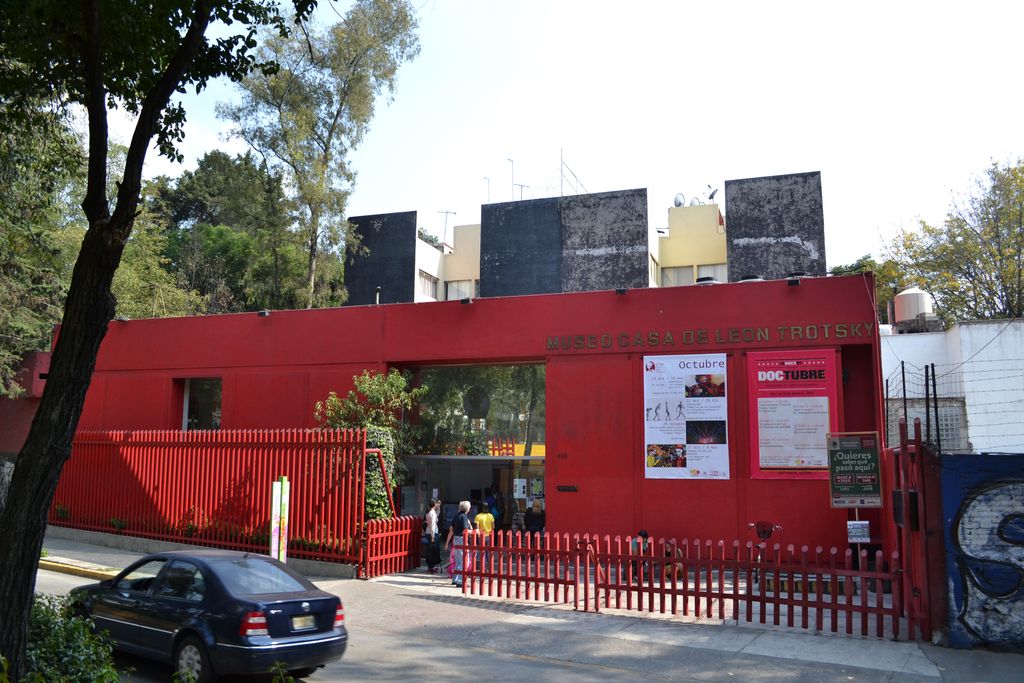
Mexico's historical institute dates Trotsky's arrival to January 1937, and the museum says the visitors remained at Casa Azul for about two years. Kahlo's 1937 Self-Portrait Dedicated to Leon Trotsky documents a personal dedication to their guest, but a portrait is not an organisational membership record. The dedicated study of the painting follows its image and history more closely; this page is concerned with what hosting an exile meant as an action within Kahlo's political life. [1] [9] [10]
The association also cannot be projected unchanged across the rest of her life. The Hoover Institution notes that its archives include a 1939 letter from Trotsky to Kahlo about Rivera's break with the Fourth International; the original has not been read for this article. Even the archive's brief description shows why Rivera's formal factional decisions cannot be assigned to Kahlo without evidence of her own position. [11]
After Trotsky's assassination in 1940, Kahlo's friend Mary Sklar wrote that the event must have shaken her political faith. That is Sklar's speculation in a letter whose exact year is not supplied by the archive, not Kahlo's reply or a dated declaration of changed allegiance. A tidy account in which Kahlo moves from “Trotskyist” to “Stalinist” in one precisely known year would conceal this gap. [12]
Political Images and the Question of Allegiance
Later images make Kahlo's continuing engagement with communist ideas visible, though pictures and diary pages are not always dated or explained as precisely as readers might wish. A Museo Dolores Olmedo account of her diary describes a page that invokes Marx, Lenin and Stalin; a Hoover archive essay describes an image including Mao and a hammer and sickle. The museum story does not give a secure date for that individual page, and Hoover's judgement about her later orthodoxy is a retrospective interpretation rather than a party record. [4] [11]
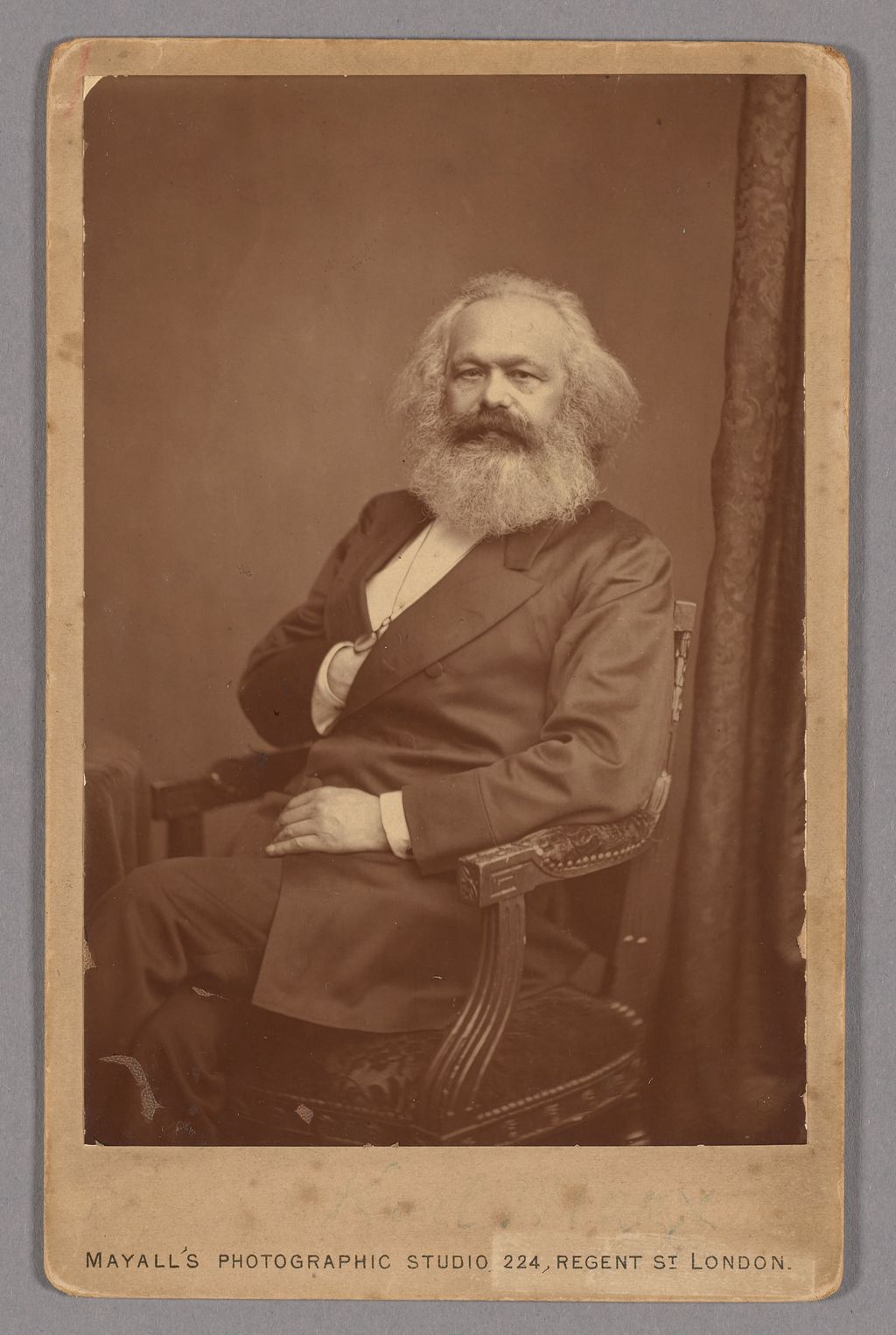
The Museo Frida Kahlo dates her unfinished Marxism Will Give Health to the Sick to around 1954 and calls it a declaration of political principles. The title and unfinished status are grounded in the museum's work chronology; the idea of a “declaration” is its curatorial reading. It would go further than the available evidence to treat the picture as a complete explanation of her private beliefs, medical circumstances or exact relationship to every named political leader. [5]
These distinctions do not empty the art of political content. They leave room to recognise that Kahlo chose to paint and record revolutionary figures and concepts, while letting each source speak at its proper level. Muñoz Corona's interpretation of Mexican nationalism and the Cobra Museum's later exhibition framing of social engagement can enrich the discussion when attributed, but neither supplies missing first-person testimony about a precise shift of party allegiance. [6] [13]
The Guatemala Protest of July 1954
Kahlo's political commitments remained public close to the end of her life. The Museo Frida Kahlo dates her appearance at a demonstration against US intervention in Guatemala to 2 July 1954. Its caption, referring to a photograph held by the Museo Casa Estudio Diego Rivera y Frida Kahlo, identifies her in a wheelchair alongside Rivera and Juan O'Gorman. [5] [14]
That photograph supports presence at a particular protest despite severe illness; it does not reveal the full content of her thoughts on Guatemala or prove that the demonstration caused her death eleven days later. Nor is the image's catalogue title, which calls it her last photograph in life, proof that this was literally her final public action. The documented act is strong enough without either claim. [5] [14]
The route from a youth league and a May Day march to a protest over an international intervention was not a straight line with every affiliation settled along the way. What can be traced is Kahlo's repeated willingness to associate herself with collective political causes: organising aid, hosting an exile, seeking passage and work for refugees, making explicitly political art, and appearing in public at considerable personal difficulty. Her decisions should be understood alongside Rivera's, but not hidden behind them. [1] [3] [5] [7] [8]
Frequently Asked Questions
The Museo Frida Kahlo dates her entry into the Young Communists League to 1928, and her later art and diary include explicitly communist imagery. The exact dates and records of adult party membership or re-entry have not been independently established in the sources used here, so a single unqualified membership timeline would overstate them. [1] [4] [5]
The museum records her participation in Republican relief with other intellectuals. Moreno Villarreal describes her Paris asylum efforts, Rodríguez Domínguez transcribes a 1939 telegram about transport and admission, and Kahlo's own letter to Edsel Ford requests employment help for one newly arrived Spanish exile; the outcome of those requests is not documented by the sources read here. [1] [3] [7] [8]
The museum credits Rivera's intervention with President Cárdenas for asylum and credits both Kahlo and Rivera with inviting Trotsky and Sedova into Casa Azul. Kahlo's role as host is documented in that chronology; the presidential petition should not be attributed to her personally without another source. [1]
Related Reading
The Kahlo timeline places these events within the wider life, while Frida Kahlo and Diego Rivera follows their shared and separate careers. For close examination of the 1937 dedication, read Self-Portrait Dedicated to Leon Trotsky; Frida Kahlo and feminism considers later interpretations of her public identity.
Discussion
Use the cited evidence and your own close looking to explain your view. The prompts below are starting points, not fixed interpretations.
Reader Insights
Which actions can be documented as Kahlo's own political interventions rather than Rivera's?
What do the 1931 mother letter and 1939 Ford letter reveal about her social concerns and practical refugee help?
How can her later political images be discussed without inventing a precise party-conversion date?
Join the Conversation
Which reading best fits the evidence, and where does uncertainty remain?
References
- Museo Frida Kahlo, Spanish life chronology, entries for Los Cachuchas, the 1928 Young Communists League, the 1929 Labour Day photograph, 1936 Republican relief and 1937 Casa Azul asylum. The youth-league entry is not an adult party card. View source text.
- Museo Frida Kahlo, English life chronology, overview of Kahlo's political and artistic episodes. This is a companion translation of the institutional chronology, not an independent primary record. View source text.
- The Henry Ford, “Letter from Frida Kahlo to Edsel Ford regarding Ricardo Arias Vinas, November 19, 1939,” Edsel B. Ford Office Papers, object 64.167.6.58, full museum transcription. A request for a recommendation does not establish that a job followed. View source text.
- Museo Dolores Olmedo, “A Peek at Frida Kahlo's Diary,” account of the undated political diary page. The specific page date and complete published diary are not established by this short curatorial story. View source text.
- Museo Frida Kahlo, English chronology, entries for unfinished Marxism Will Give Health to the Sick and the 2 July 1954 Guatemala demonstration, lines 1480–1503. Medical causation and “last public act” are not inferred. View source text.
- Luz de María Muñoz Corona, “Frida Kahlo y el nacionalismo mexicano,” UNAM Punto de Partida, interpretive passages on nationalism and anti-imperialism. Its age-at-youth-entry claim conflicts with the museum chronology and is not adopted. View source text.
- Jaime Moreno Villarreal, Frida en París, 1939, accessible authorized book preview, PDF p. 22 / printed p. 28 on Kahlo's efforts for Spanish Trotskyist and anarchist exiles. This is not the complete monograph. View source text.
- Alma Rodríguez Domínguez, “La reconstrucción familiar como método de investigación histórica,” Arte y Ciudad 25 (2024), printed pp. 32–37, especially p. 34 for the 23 March 1939 telegram as reproduced from Petitjean (2019), p. 103. The original telegram and Petitjean book were not read here. View source text.
- Instituto Nacional de Estudios Históricos de las Revoluciones de México, “León Trotsky: México, refugio y tumba,” historical note on his January 1937 arrival and asylum. View source text.
- National Museum of Women in the Arts, Self-Portrait Dedicated to Leon Trotsky, collection record. A dedication is documented; formal political membership does not follow from it. View source text.
- Hoover Institution, “Frida Kahlo and Diego Rivera Materials in the Hoover Institution Archives,” collection overview, lines 188–191. Its Trotsky-letter description and later political judgement are identified as such; the original letter has not been inspected. View source text.
- National Museum of Women in the Arts, complete transcription of Mary Sklar's letter to Kahlo, 7 October, year unknown, p. 8. Sklar's conjecture is not a statement by Kahlo. View source text.
- Cobra Museum of Modern Art, “Frida Kahlo & Diego Rivera: A Love Revolution,” 2021 exhibition text, Dutch. Its framing of political and social engagement is retrospective curatorial interpretation. View source text.
- Museo Casa Estudio Diego Rivera y Frida Kahlo, catalogued photograph of Kahlo, Juan O'Gorman and Rivera at the Guatemala demonstration. Its catalogue title is not a separate proof of her final public act; the image is not reproduced. View source text.
- Frida Kahlo, 14 November 1931 letter to her mother, published in an authorized English extract from You Are Always With Me, edited and translated by Héctor Jaimes (Virago, 2018). The original manuscript and complete book have not been read here. View source text.
Image Credits
- Museo Casa de León Trotsky desde Río Churubusco — Omar Ulises Ruiz Casas. CC BY-SA 4.0. Resized and converted to JPEG/sRGB; no crop.
- Portrait Karl Marx (SM stf131) — John Jabez Edwin Mayall; Städel Museum, St.F.131; Städel Museum-Verein e.V. Public domain. Resized and converted to JPEG/sRGB; no crop.
