


 by Tom Gurney
Tom Gurney BSc (Hons) is an art history expert with over 20 years experience
Page created on March 2, 2018 / Page updated on October 6, 2026
Email: tomgurney1@gmail.com / Phone: +44 7429 011000
Introduction
Fulang-Chang and I is often reproduced as a portrait of Frida Kahlo with a monkey. At the Museum of Modern Art, New York, it is a two-part work: the 1937 oil painting, subsequently surrounded by a painted mirror frame, stands beside a larger framed mirror made after 1939. Looking only at the painted image misses the work's later transformation into a gift that placed Kahlo, her friend Mary Sklar and eventually other viewers in changing relation to one another. [1] [2] [3]
The portrait joins two outward-looking faces with a pink ribbon amid dense leaves and pale, hair-covered plants. Those visible features have supported several readings, from a Madonna-and-Child analogy to a recent account of companionship across human and animal lives. Neither an image of the panel nor a single symbol key settles what the ensemble meant to Kahlo. [2] [3] [15]
At a Glance
- Title and artist: Fulang-Chang and I, Frida Kahlo; Spanish institutional accounts use Fulang-Chang y yo and minor punctuation variants.
- Dates and parts: Oil on board, painted in 1937. MoMA dates the separate mirror and painted mirror frame after 1939, when the ensemble was assembled. [1] [4]
- Sizes: Framed painting: 56.5 × 44.1 × 4.4 cm; framed mirror: 64.1 × 48.3 × 4.4 cm. MoMA records the components separately. [1]
- Owner: Museum of Modern Art, New York; Mary Sklar Bequest 277.1987.a–b. Its online record said “Not on view” on 3 October 2026. [1] [13]
Contents
- Introduction
- A Portrait Made Before the Mirror
- Two Related Frames and an Unequal Pair
- Mary Sklar and the Gift of a Mirror
- The Madonna and Surrogate Child Reading
- Fulang-Chang as a Subject in the Picture
- Nahualli and the Limits of Cultural Analogy
- Monkey Images Are Not a Single Symbol Key
- What the Mirror Can and Cannot Say
A Portrait Made Before the Mirror
The painting occupies the left side of MoMA's image of the complete ensemble. Kahlo is shown from the upper torso, her head slightly turned but her eyes directed outward; centre-parted dark hair falls over her shoulders. A continuous brow, faint upper-lip hair, flushed cheeks and red lips are visible, but neither the gaze nor the small reproduction proves an emotion such as calm, defiance or sadness. [2]
A dark primate sits in front of her at the lower centre and right. Its round eyes face outward too, while paler fur spreads across the lower body. MoMA identifies this individual as Fulang-Chang, a pet spider monkey; the image alone cannot establish its individual identity, sex or exact zoological species. [1] [2] [14]
A ribbon of pink to lilac passes through the human figure's hair, across the neck and around the monkey's space. Its repeated colour and route visibly bring the two figures together, but the ribbon does not by itself establish maternity, affection or a culturally specific bond. Behind them, overlapping green leaves and pale, densely hairy columnar forms fill nearly all the space; calling the setting a forest or naming each plant would outrun the inspected image. [2] [15]
There is a small, multi-line mark near the painted panel's lower-left edge. It appears consistent with a name, title or date inscription, but its exact letters, accents, punctuation and line division cannot be securely transcribed from the available reproduction. The mark's lettering remains uncertain without MoMA's object file or a reliable catalogue transcription. [2]
Watch: Frida Kahlo
Five perspectives to view here alongside the article.
Frida Kahlo’s The Two Fridas: Great Art Explained
A focused visual introduction to the painting and its context.
Fulang-Chang and I in Kahlo’s career
Timeline source: Museo Frida Kahlo chronology [31].
Two Related Frames and an Unequal Pair
The portrait is surrounded by a frame that projects in small rectangular tabs beyond its main outline. Pale mirrored strips alternate with white scrolling forms on red panels, and the larger mirror at right has a closely related but not identical border. Their resemblance visually pairs the components without making them one painted surface or establishing that both frames were built at the same moment. [1] [2]
The larger right-hand field is an actual mirror, not a second painted likeness or a permanently blank panel. MoMA's photograph records a pale reflection in controlled conditions; in a gallery the reflected image changes with a visitor's position, other people, light and the room. Because the mirror is taller and wider than the framed portrait, a viewer's changing image does not merely fill a second equal-sized portrait slot. [1] [2] [14]
MoMA's current metadata calls both borders painted mirror frames. A frame specialist at Lowy, writing after close study of the original for a reproduction project, describes pieces of mirror and reverse-painted glass joined by lead or solder and associates the decoration with verre églomisé, painting on the reverse of glass. This is useful specialist evidence for construction, but the methods used to make a modern reproduction cannot themselves establish every material or hand at work in the historic frames. [1] [5]
The specialist's article also says the painting's frame was present at the 1938 New York exhibition, in conflict with MoMA's present dating of that frame to after 1939. MoMA's component record is the strongest available dating authority; an original 1938 installation photograph or gallery checklist would be needed to settle the discrepancy. The same specialist says the frames' exact origin is unknown, while the Museo de Arte Latinoamericano de Buenos Aires later described the mirror as artisanal and Oaxacan. That label is a curatorial attribution, not an identified maker or workshop. [1] [5] [7] [11]
Mary Sklar and the Gift of a Mirror
Mary Sklar met Kahlo in Mexico in 1935, according to both MoMA and the National Museum of Women in the Arts. The latter identifies her as art historian Meyer Schapiro's sister and preserves a letter illustrating their friendship. Its digitised October 7 letter does not mention this painting, its mirror or a gift, so it cannot serve as the missing transaction document. [3] [6]
Another undated Sklar letter, headed March 14, makes the friendship less abstract. Sklar responds warmly to Kahlo's letters, asks for a catalogue or photograph of her paintings for herself and Meyer, hopes to see her in New York and closes with an expression of love and concern. The four-page transcription does not name Fulang-Chang and I or document the mirror's transfer, and its missing year prevents it from fixing the gift date. [29]
In a separate June 11 letter, also without a year, Sklar writes of missing Kahlo, hoping for a visit in New York or Mexico, and wanting more than pictures or messages could offer. Read beside MoMA's reported explanation for the companion mirror, the letter makes the friendship's distance tangible; it does not say that this object was made in response to those words. It too is evidence of their relationship rather than a deed of gift. [3] [30]
MoMA curator Veronica Roberts reports that Sklar bought a different painting from Kahlo's 1938 Julien Levy exhibition in New York. Roberts, who consulted the museum's Painting and Sculpture files, says Kahlo gave Fulang-Chang and I to Sklar in thanks, combining the painting with a mirror so that the friends could always be together. The account is strong institutional evidence for the gift and its reported explanation, though the underlying letter or object-file note has not been inspected here and the different purchased picture is not identified. [3] [6]
The sequence remains less precise than a dated deed of gift. MoMA dates the painted frame, mirror and its frame after 1939, whereas a later Cleveland Museum of Art article says Kahlo gave the work in 1939; a Spanish UNAM thesis, relaying Hayden Herrera, describes a different intended-gift sequence. The owner record and Roberts's file-based account support a later gift, but the exact date, place, legal form and first paired installation are not settled by these public texts. [1] [3] [10] [19]
Sklar's bequest eventually brought the two-part work to MoMA, where the current credit is “Mary Sklar Bequest” and the number is 277.1987.a–b. The year embedded in that number should not be substituted for an inspected accession document. The securely stated path is Kahlo to Sklar to MoMA; precise transfer and transport details remain undocumented in the cited public records. [1] [3] [6]
The Madonna and Surrogate Child Reading
Roberts compares the compact portrait with Renaissance Madonna-and-Child paintings: the adult figure occupies the established portrait position, but a spider monkey rather than an infant comes forward. She also notes a widespread interpretation of Kahlo's monkeys as surrogates for children Kahlo and Diego Rivera did not have. MoMA's audio carefully presents that second idea as something scholars have proposed, not a fact that can be seen in Fulang-Chang's face. [3] [14]
The analogy can help a reader notice the animal's placement against the human body, yet no inspected source identifies a specific Renaissance painting that Kahlo copied. Nor does the work document a particular pregnancy event, a clinical diagnosis or Kahlo's intention to substitute this monkey for a child. Her reproductive history is relevant where properly evidenced, but the named animal cannot be reduced to a medical symptom. [3] [14] [15]
Roberts offers a different inflection within the same portrait: humour in the resemblance among Kahlo's facial hair, the monkey's coat and the pale hairy plants. That is her close reading of visible repetitions, not a claim that every likeness is accidental or that the painting has one comic meaning. It leaves room for the monkey to be a co-present figure rather than an emblem with only one biographical job. [2] [3]
Fulang-Chang as a Subject in the Picture
Yaxkin Melchy begins from the title's order: the monkey is named before the “I.” In his object-specific study, Fulang-Chang occupies the foreground and meets an outward field of view, while Kahlo's figure appears behind; the dark hair or fur of both figures and the pale hair of plants create a network across the composition. Those are persuasive formal observations, but the claim that the arrangement redistributes subjecthood is Melchy's interpretation. [2] [15]
Melchy criticises an account in which Kahlo's animals merely fill a human absence. He prefers to describe animalitos living with the artist and argues for a relation of cohabitation, drawing on the portrait's foreground, ribbon, shared textures and paired gazes. His argument does not erase Kahlo's reproductive losses or prove that she called herself an animalist; it tests what the surrogate-child story fails to notice about the pictured animal. [15]
The botanical details remain less secure than this formal relation. Roberts calls the pale growths white-haired cacti, while Melchy suggests an old-man cactus and proposes other possible leaf and succulent names. The image supports pale hairy columns and overlapping leaves, not a verified species list or proof of a particular garden location. [2] [3] [15]
Nahualli and the Limits of Cultural Analogy
Melchy extends his animalist interpretation through nahualli, but the term requires more care than an English “spirit animal” label. In a Spanish synthesis of nahualismo, UNAM scholar Roberto Martínez González describes traditions in which a nonhuman co-essence can be linked to a person, sharing an animic dimension and sometimes protecting, assisting or advising them. His account also stresses variation: such beings can take many forms, several may be linked to one person, and the linked lives remain distinct. [15] [16]
The UNAM study does not name Kahlo or this painting. Melchy's move from that cultural model to the portrait is a contemporary scholarly proposal, not an inspected statement by the artist naming Fulang-Chang as her nahualli. Nor should a concept drawn from particular Indigenous histories be applied as a universal Mexican belief or a synonym for any loved pet. [15] [16]
Part of Melchy's fuller argument compares a different Kahlo painting, Self-Portrait with Small Monkey of 1945. That later work's ribbon arrangement and any figure he identifies in it cannot be silently transferred into the 1937 panel. The visible ribbon, named animal and companion mirror support a discussion of relation without making the two paintings identical statements. [2] [15]
Monkey Images Are Not a Single Symbol Key
Roberts mentions possible monkey associations with promiscuity and sin in early Christian and Maya art. Two Spanish studies of specific Mesoamerican images show why even that useful comparison should not become the formula “monkey means lust in Mexican mythology.” Tomás Villa Cordova connects a particular Nahua ozomatli sculpture with song, dance, sin, death, named deities and hair, while Araceli Rojas Martínez Gracida discusses artistic skill, writing, joy, entertainment, excess, sexuality and Maya scribes in another historical corpus. [3] [17] [18]
These are not interchangeable source traditions or an inventory of meanings deliberately packed into Kahlo's monkey. They establish that historical monkey imagery can be plural and context-dependent, so no single gloss should displace the painting's more immediate evidence: a named spider monkey gazes outward beside Kahlo, with the ribbon visibly passing through both figures' space. [1] [2] [17] [18]
What the Mirror Can and Cannot Say
The mirror's most specific documented personal explanation is the one MoMA reports from its files: Kahlo added it so that she and Sklar could always be together. This is a reported gift account, not a surviving artist letter consulted directly. It concerns the relationship between two friends at the time the components were paired, rather than every possible meaning a later visitor may find in the reflective surface. [3] [6]
Roberts also interprets the mirror as an invitation for viewers to enter the work; MoMA's audio describes an interactive relation. Those readings rest on a physical property: unlike the painted portrait, the mirror's content changes with the person, room and angle before it. But a new viewer does not automatically become Sklar, and the object photograph's pale reflection is not what every installed visitor would see. [2] [3] [14]
In a later creative response commissioned by MoMA, poet Ada Limón used the mirror and ribbon to explore connection, otherness and separateness. Her poem belongs to the ensemble's reception, not to documentary evidence of Kahlo's 1930s purpose. The work can sustain that later encounter while the reported Sklar explanation retains its distinct historical footing. [3] [21]
The Portrait in New York in 1938
MoMA curator Roberts and the Museo Frida Kahlo both place the painting in Kahlo's Julien Levy Gallery exhibition, held in New York from 1 to 15 November 1938. André Breton wrote an accompanying text, and the Philadelphia Museum of Art's archive lists a surviving exhibition work list alongside correspondence and his handwritten French preface. The list itself has not been inspected, so the precise title, number, price, sale status and frame state at the show remain open. [3] [7] [8]
This was the painted portrait's appearance, not a documented display of the later paired ensemble. MoMA says the mirror came afterwards and currently dates the portrait frame to after 1939; the specialist Lowy account offers a conflicting earlier frame chronology without the primary installation record needed to overturn the owner metadata. A historical exhibition narrative should not project the present mirror back onto a 1938 gallery wall. [1] [3] [5]
The contemporary magazine TIME reviewed the exhibition on 14 November 1938. It did not name Fulang-Chang and I, but its account described Kahlo through Rivera, her appearance and diminutive language; Roberts later called the praise patronising and sexist. The review's claim that the pictures were mostly oil on copper concerns the show in general and must not replace MoMA's oil-on-board record for this portrait. [1] [3] [9]
MoMA reports that about half the works sold, though the uninspected Levy list and ledgers are needed for object-level reconstruction. Interest in this particular portrait contributed to A. Conger Goodyear's request for another monkey self-portrait, but the making, sale and Buffalo ownership of that 1938 Self-Portrait with Monkey belong to its own study. Neither Goodyear's response nor a show-wide sales estimate identifies Mary Sklar's different purchase. [3] [7] [26]
Selected Displays After the Gift
Roberts describes the paired work in MoMA's Mexican Modernism gallery, opened in May 2009, and reports watching visitors step into the mirror's field. Cleveland Museum of Art borrowed the complete ensemble for a 21 June–25 September 2016 display in gallery 224A. These are documented moments in the object's exhibition life, not a complete account of all intervening installations or loans. [3] [10]
Buenos Aires museum MALBA showed it in México moderno. Vanguardia y revolución from 3 November 2017 to 19 February 2018. MALBA called this the first MoMA loan of the work to a Latin American institution and described the mirror as Oaxacan, while its exhibition framing placed Kahlo among modernist and Surrealist propositions. The loan and dates are object history; the mirror's proposed origin and stylistic placement are the borrowing museum's interpretations. [5] [11]
MoMA's 2019 fifth-floor checklist put the work in gallery 517, “Surrealist Objects,” while its installation history also identifies it in “A Surrealist Art History” views between 2019 and 2021. Images of 1991 and 1995 displays on the object page are useful leads, but appearance in an installation photograph does not by itself prove formal checklist inclusion in those exhibitions. MoMA's 2025 label continued the Surrealist lens, which records a curatorial frame rather than a movement membership Kahlo necessarily accepted. [1] [12] [27]
The ensemble appeared in MoMA's Frida and Diego: The Last Dream, 21 March–12 September 2026; the exhibition checklist names both components and the Mary Sklar credit. That display has ended, and MoMA's owner record said “Not on view” when checked on 3 October 2026. A reader planning to visit should consult the live museum record rather than treating ownership or a past checklist as a guarantee of display. [1] [13]
Surrealist Object, Personal Gift
The combination of a painted self-portrait and a functioning mirror has given curators a reason to place the work among Surrealist objects. MoMA's gallery 517 and MALBA's modernist exhibition are evidence of that later curatorial treatment, while the 1938 Levy exhibition also brought Kahlo into a New York milieu shaped by Breton's advocacy. None of these labels proves that Kahlo conceived the mirror as a Surrealist experiment when she painted the portrait in 1937: MoMA's own component dates put the mirror after 1939. [1] [7] [11] [12]
The distinction matters because the two-part object's history is also unusually personal. If Roberts's file-based account is followed, the mirror was attached to a gift for Mary Sklar, allowing a friend to appear beside Kahlo and Fulang-Chang. The ensemble can later invite an unknown museum visitor into the same space, but that public invitation should not overwrite the particular relationship described in the gift record. [3] [14]
The portrait itself resists a single stylistic label. Its close, outward-facing figures and densely filled botanical backdrop permit formal comparisons across portraiture, devotional composition and Mexican modernism; its named monkey is more particular than a generic emblem. The resulting ambiguity is a feature of the picture and its later reception, not a licence to claim that any one exhibition category records Kahlo's own settled theory of it. [2] [3] [15]
Later Interpretations Across Languages
The work has generated several distinct lines of inquiry in English and Spanish. Roberts emphasises the gift, a Madonna-like arrangement, formal humour and a mirror that admits a visitor; Melchy's object-specific study instead presses the monkey's named presence and the possibility of cohabitation beyond the surrogate-child reading. The two approaches illuminate different evidence and need not be collapsed into one intention attributed to Kahlo. [3] [15]
Spanish-language scholarship on nahualismo and on historical monkey images supplies a vocabulary for testing cultural analogies, but it does not identify this animal as Kahlo's supernatural counterpart. A Turkish-language study of Kahlo's animal motifs offers another example of later cross-cultural interpretation; its wider account is not an object file for the Sklar ensemble, and comparison with other monkey pictures cannot resolve this one by repetition. These texts are valuable where their scope is kept visible. [16] [17] [18] [20]
MoMA's audio and later poetry commission show the work continuing to elicit institutional explanation and new creative encounters. A poem or audio guide can bring a modern viewer closer to the object's reflective experience, yet neither is a primary record of its 1937 making or the precise moment of Sklar's gift. Their contribution belongs to reception history alongside, rather than in place of, the painting, component record and surviving archive leads. [1] [14] [21]
MoMA's accessible image description and bilingual family activity also describe the paired forms, monkey, ribbon and opportunity for reflection. These materials describe the paired forms for a wider audience, but educational prompts are not technical findings or independent testimony about Kahlo's intention. [24] [25]
Books, Archives and the Limits of This Account
A major object-level book for further study is Luis-Martín Lozano, Andrea Kettenmann and Marina Vázquez Ramos's Frida Kahlo: The Complete Paintings. The publisher identifies a 624-page volume, but its Fulang-Chang and I entry has not been consulted; no catalogue number, unpublished document, frame conclusion or revised dating is drawn from its title. Gannit Ankori's Frida Kahlo is a relevant critical study available here only through the publisher description, not a read monograph. [22] [23]
Hayden Herrera's biography, the Kettenmann discussion and Sharyn Rohlfsen Udall's study remain unconsulted at the cited pages. The most consequential archival request is MoMA's Painting and Sculpture object file behind Roberts's account: it might establish the gift document, its date, a possible inscription transcription, frame and mirror histories, and how the museum separated the two components in its record. The Julien Levy work list and correspondence in Philadelphia could independently test the portrait's 1938 title, frame and sale context; finding-aid descriptions are not substitutes for the documents. [1] [3] [7] [28]
The available owner image permits careful description, not conservation analysis. No reverse view, technical report, material sampling, condition record or original frame-maker documentation has been inspected; even the tiny lower-left mark remains untranscribed. MoMA's medium and dimensions should therefore control the factual record, with Lowy's construction account explicitly identified as a specialist's reading and MALBA's Oaxacan description as a later attribution. [1] [2] [5] [11]
MoMA's object record makes the two-component construction clear, but it does not establish that the ensemble is currently on view. A conservation or registrar file would be needed to resolve the remaining questions about the two frames. [1] [24]
The work's unusual afterlife lies in the time between its parts. A painted meeting between Kahlo and Fulang-Chang was made in 1937; a later mirror made room for Sklar, and subsequent displays have made room for other viewers. Those facts support a powerful account of companionship and change, while the precise design, making and first use of the ensemble still require documents the public sources do not supply. [1] [2] [3]
Questions About Fulang-Chang and I
MoMA identifies Fulang-Chang as Kahlo's pet spider monkey and gives his name in the work's title. The inspected image shows a dark primate in the foreground, but it cannot independently verify the individual's identity or a more exact biological classification. He is a named participant in the composition, not an interchangeable monkey motif. [1] [2] [14] [15]
No. MoMA dates the painting to 1937 and the separate mirror and both painted mirror frames to after 1939. Lowy's specialist account differs on when the portrait frame was present, but no inspected 1938 installation record settles that conflict; the owner record is the responsible basis for the present description. [1] [5] [7]
Roberts reports from MoMA's files that Kahlo gave the portrait to Mary Sklar, along with a mirror, so the two friends could always be together. The underlying gift document has not been inspected, and the exact date and maker of the frame are unresolved. Later visitor-participation readings are compatible with the mirror's physical effect, but they do not replace that attributed personal explanation. [1] [3] [6]
The first is an established scholarly interpretation discussed by Roberts and MoMA's audio; the second is Melchy's more recent cultural analogy. Neither has been verified as Kahlo's own explanation of this portrait, and the independent UNAM study of nahualismo is not about the painting. The named animal, his position and the ribbon are visible; the symbolic conclusions remain attributed readings. [2] [3] [14] [15] [16]
MoMA owns the two-part work as the Mary Sklar Bequest, 277.1987.a–b. On 3 October 2026, after the Frida and Diego display closed, its online record marked the work “Not on view.” Check the live museum page before a visit; past loans and gallery checklists do not promise a current installation. [1] [13]
Related Reading
The Frida Kahlo overview provides the wider 1930s chronology without turning this portrait into a record of one medical episode. Style: Surrealism and Reality examines the stylistic question raised by later gallery labels, while Self-Portrait with Monkey is a separate 1938 work with a different commission and owner. [1] [3] [12] [26]
Discussion
Use the cited evidence and your own close looking to explain your view. The prompts below are starting points, not fixed interpretations.
Reader Insights
What changes when the portrait is viewed beside a mirror rather than as a single painting?
How do MoMA's component dates and the specialist frame account disagree?
What can the Sklar gift account establish without dictating every viewer's experience?
Join the Conversation
Which reading best fits the evidence, and where does uncertainty remain?
References
- Museum of Modern Art, Fulang-Chang and I collection record, object identity, component dates and media, separate framed dimensions, Mary Sklar Bequest, 277.1987.a–b, interpretive labels and display status; “Not on view” checked 3 October 2026. View source text.
- Museum of Modern Art, Fulang-Chang and I ensemble image, showing the framed painted board beside its separate framed mirror. The view supports visible-form description, not technical findings about glass, paint layers or the frames' original assembly. View source text.
- Veronica Roberts, “A Close Look: Frida Kahlo’s Fulang-Chang and I”, Museum of Modern Art, 3 December 2009, especially the 1938 exhibition, Sklar gift and mirror account. Interpretations are attributed to Roberts; underlying object-file documents were not inspected. View source text.
- Museum of Modern Art, Destination: Modern Art historical object block, giving an unframed painted-board measurement and historical framed-dimension variants; current record in reference 1 controls current component measurements. View source text.
- Lowy, “Reproducing an Iconic Frida Kahlo Frame”, 1 April 2025, original-frame observation, mirrored and reverse-painted glass construction, uncertain origin and a disputed 1938 frame claim; its modern reproduction procedure is not evidence of every historic process. View source text.
- National Museum of Women in the Arts, Frida Kahlo Papers and Mary Sklar letter overview, including the undated October 7 letter transcription, Folder 184. The letter does not mention this painting or gift. View source text.
- Philadelphia Museum of Art Archives, Julien Levy Gallery Records, box 16, folder 1, finding-aid entry identifying the 1938 exhibition work list, correspondence and Breton preface; the underlying folder was not inspected. View source text.
- Museo Frida Kahlo, Frida chronology, relevant 1937 painting and November 1938 New York exhibition entries. View source text.
- TIME, “Art: Bomb Beribboned”, 14 November 1938, contemporary group-level exhibition review. It does not name Fulang-Chang and I or control its medium. View source text.
- Cleveland Museum of Art, “Centennial Loan: Kahlo” and loan announcement, 2016, documenting the MoMA loan, gallery and dates; its 1939 gift phrasing conflicts with MoMA's present component chronology. View source text 1; View source text 2.
- MALBA, México moderno. Vanguardia y revolución press information and event record, Spanish, 2017–18, loan, dates and curatorial description of the mirror as Oaxacan. View source text 1; View source text 2.
- Museum of Modern Art, 2019 fifth-floor checklist, PDF pp. 19–21, listing the ensemble in gallery 517, “Surrealist Objects”. View source text.
- Museum of Modern Art, Frida and Diego: The Last Dream press release and exhibition checklist, 2026, dates, Fulang-Chang and I inclusion and component metadata; the exhibition ended 12 September 2026. View source text 1; View source text 2.
- Caitlin Ryan, MoMA collection audio for Fulang-Chang and I, complete transcript, on Fulang-Chang, scholarly interpretation and mirror interaction. View source text.
- Yaxkin Melchy, “Fulang-Chang and Frida Kahlo: An Animalist Vision on Self-identity”, The Annual Review of Cultural Studies 9 (2021), pp. 97–113, especially pp. 105–112; complete English article and Japanese abstract read. View source text.
- Roberto Martínez González, El nahualismo, UNAM, 2011/2016 digital edition, “Síntesis y conclusiones finales,” printed pp. 499–530, especially pp. 502–503. This 32-page section was read, not the complete 650-page book; it does not discuss Fulang-Chang and I. View source text.
- Tomás Villa Cordova, “Apuntes sobre Huitzilopochco”, Arqueología 47 (2014), pp. 296–327, especially printed p. 317 / PDF p. 22, on a particular ozomatli sculpture. View source text.
- Araceli Rojas Martínez Gracida, “Los entretenedores en los policromos del tipo Albina de Cholula”, Arqueología 39 (2008), pp. 77–91, especially printed pp. 82–83 / PDF pp. 6–7. View source text.
- Carlos Omar Segoviano Rodríguez, La Fridomanía: Difusión y comunicación de la imagen de Frida Kahlo, UNAM bachelor's thesis (2011), printed pp. 102–103 / PDF pp. 117–118. Its account cites Herrera p. 143 and conflicts with MoMA on the gift sequence. View source text.
- Zeynep Özkazanç, “Hayvanlar ile Birlikte Bakmak: Sürrealist Kadın Sanatçıların Otoportreleri”, Feminist Tahayyül (August 2023), pp. 225–257, especially printed p. 248 / PDF p. 24; the article's principal close reading concerns another monkey portrait. View source text.
- Ada Limón, “The Mirror & the Ribbon”, Museum of Modern Art, 31 December 2019, commissioned-poem context and interview; the poem is treated as later reception and is not reproduced. View source text.
- TASCHEN, Luis-Martín Lozano, Andrea Kettenmann and Marina Vázquez Ramos, Frida Kahlo: The Complete Paintings, publisher record for the 624-page volume. The portrait's exact entry and the complete book have not been consulted. View source text.
- Reaktion Books, Gannit Ankori, Frida Kahlo, publisher description only; the complete critical biography and any pages specifically discussing this portrait have not been consulted. View source text.
- Museum of Modern Art, Fulang-Chang and I object record and images, documenting the paired painting and mirror and the online display-status label. The record does not grant reproduction permission or establish a present gallery location. View source text.
- Museum of Modern Art, “Create Ability: Familiar Faces” image description and “Connecting with Friends” family activity, with a Spanish version; visual and educational framing, not independent intention evidence. View source text 1; View source text 2; View source text 3.
- Buffalo AKG Art Museum, Self-Portrait with Monkey owner record, 1938, and the museum's contextual accounts; a different painting commissioned after Goodyear's interest in Fulang-Chang and I. View source text.
- Museum of Modern Art, Fulang-Chang and I object-page installation views, gallery 517 and 518 identifications and historical 1991/1995 photographs. An identified photograph is not a formal exhibition checklist. View source text.
- Unconsulted source leads: Hayden Herrera, Frida: A Biography of Frida Kahlo, p. 143 (cited by reference 19); Andrea Kettenmann, Frida Kahlo 1907–1954: Pain and Passion, exact portrait passage and edition still to locate; Sharyn Rohlfsen Udall, “Frida Kahlo's Mexican Body: History, Identity, and Artistic Aspiration,” Woman's Art Journal 24, no. 2 (2003), p. 13, DOI 10.2307/1358781. These exact pages were not directly read and supply no independent claims here.
- National Museum of Women in the Arts, Mary Sklar to Frida Kahlo, March 14, no year, Nelleke Nix and Marianne Huber Collection: The Frida Kahlo Papers, Folder 182b, complete four-page transcription, especially pp. 1–3. The letter illustrates friendship and interest in Kahlo's paintings, not the gift transaction. View source text.
- National Museum of Women in the Arts, Mary Sklar to Frida Kahlo, June 11, no year, same collection, Folder 182a, complete six-page transcription, especially pp. 1–3. The letter documents affection, separation and hopes of meeting but does not name Fulang-Chang and I or its mirror; it is paraphrased, not reproduced. View source text.
- Museo Frida Kahlo, Frida interactive chronology, selected work dates used for the comparison timeline. The current work's date follows its cited object record. View source text.
Image Credits
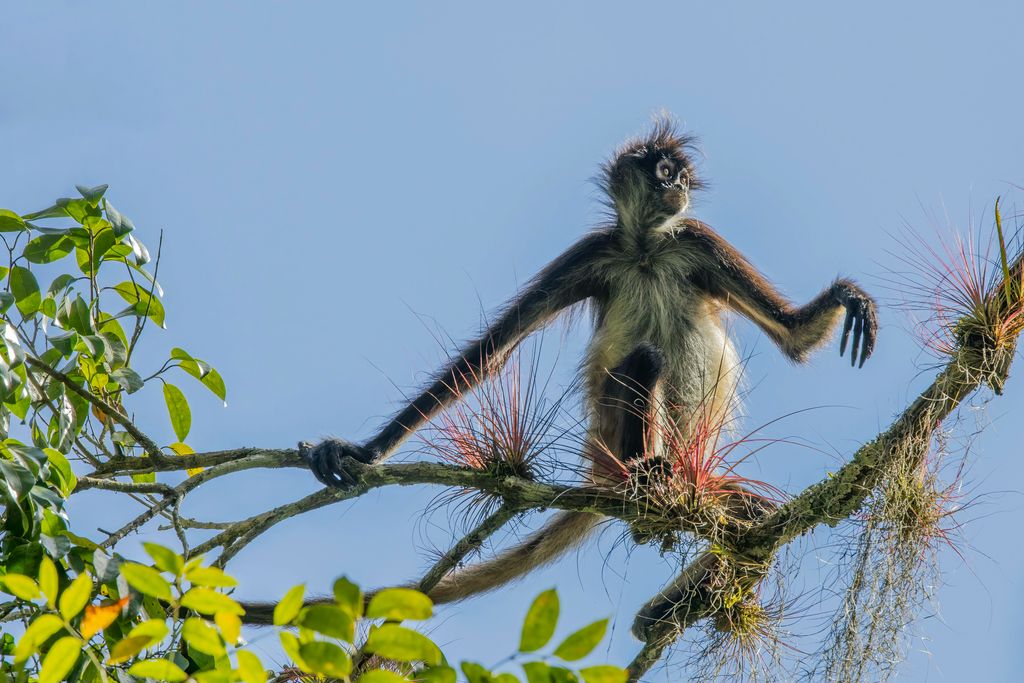
- Geoffroy's spider monkey (Ateles geoffroyi yucatanensis) Peten 2 — Charles J. Sharp / Sharp Photography. CC BY-SA 4.0. Resized and converted to JPEG/sRGB; no crop.
