


 by Tom Gurney
Tom Gurney BSc (Hons) is an art history expert with over 20 years experience
Page created on March 2, 2018 / Page updated on October 6, 2026
Email: tomgurney1@gmail.com / Phone: +44 7429 011000
Introduction
Frida Kahlo's connection with San Francisco belongs to two visits, not one continuous American sojourn. She lived in the city from November 1930 into the spring of 1931, painting portraits, meeting patrons and artists, writing home and entering her first documented public exhibition. She returned in 1940 amid illness and separation from Diego Rivera, visited the Treasure Island mural studio, and remarried him in the city on 8 December. [1] [2] [3]
Rivera's mural commissions brought the couple to San Francisco on both occasions, but they do not account for everything Kahlo did there. Her inscribed paintings, a family letter, post-return correspondence, an exhibition record and enduring relationships with Albert Bender, Leo Eloesser and others show an artist navigating a network in which she was often introduced as Rivera's wife. [4] [5] [6] The dates, settings and sources for the two stays differ, and the distinction matters whenever a later memory turns them into a single story of transformation.
At a Glance
- Two stays: Kahlo lived in San Francisco from November 1930 into spring 1931 and returned in 1940; these were not one continuous American residence. [1] [2] [3]
- First stay: She painted portraits, wrote home, entered her first documented public exhibition and met local artists and patrons. [4] [5] [6]
- Second stay: She visited Rivera's Treasure Island mural studio and remarried him in San Francisco on 8 December 1940. [2] [3]
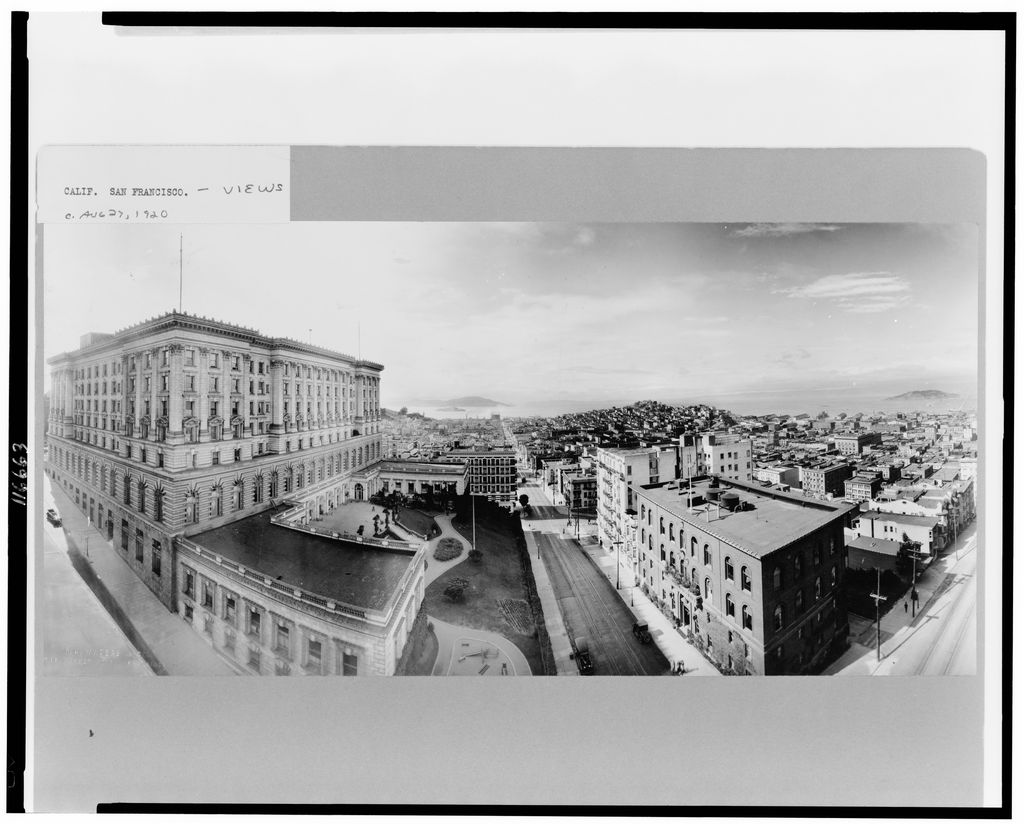
- Place: 716 Montgomery Street was a home and artistic workplace during the first stay; the circa-1920 city photograph here shows a different San Francisco viewpoint. [9]
- Key document: Kahlo's letter to her mother dated 21 November 1930 records experiences from the first weeks in the city. [5]
Contents
- Introduction
- The First Arrival and Its Limits
- Montgomery Street: Home, Studio and Introductions
- The Portraits and the People Around Them
- A Letter Home from the First Weeks
- The First Public Exhibition
- What Changed in the First Stay?
- A Different San Francisco in 1940
- Eloesser, the Second Marriage and Their Boundaries
The First Arrival and Its Limits
The opening excerpt of Celia Stahr's Frida in America dates the couple's arrival by train at Third and Townsend to 9 November 1930. [7] It describes a visa difficulty connected with Rivera's former Communist affiliation and credits sculptor Ralph Stackpole and collector Albert Bender with helping to secure entry.
Stahr also records resentment among some local artists who questioned why the mural commission had not gone to them, complicating any picture of an entirely frictionless welcome. [7] This is a valuable, specific account from a publisher-hosted excerpt, but the complete 384-page book and its notes have not been read here; the excerpt does not establish every step of the journey.
Rivera had been invited to make murals for the San Francisco Stock Exchange and the California School of Fine Arts. SFMOMA calls this the first United States city in which he painted murals and places the 1930–31 commissions within a wider Bay Area relationship. [8] Kahlo's arrival was therefore enabled by his work, while the paintings and relationships that followed were her own professional activity. Neither the marital connection nor her agency needs to be erased to tell the story accurately.
The first stay was substantial but not eighteen months long. The Fine Arts Museums of San Francisco date residence at 716 Montgomery Street from November 1930 through May 1931; the Museo Frida Kahlo chronology records Kahlo travelling to Mexico City in May and the couple returning to Mexico by 8 June. [2] [9] These sources do not provide a continuous count of nights or every intermediate journey. An older SFMOMA reference to eighteen months should not override the more precise sequence.
Watch: Frida Kahlo
Five perspectives to view here alongside the article.
Frida Kahlo’s The Two Fridas: Great Art Explained
A focused visual introduction to the painting and its context.
Montgomery Street: Home, Studio and Introductions
At 716 Montgomery Street, Kahlo and Rivera lived in sculptor Ralph Stackpole's house and studio. A Fine Arts Museums exhibition label describes the building as a close artistic community rather than an isolated apartment. [9] That combination of residence, work space, visitors and introductions helps explain why a newly arrived painter could encounter sitters and patrons even while Rivera's commissions dominated local publicity.
Clifford Wight, a British sculptor assisting Rivera, and his wife Jean were part of this circle. Kahlo painted Portrait of Mrs Jean Wight in 1931, placing the sitter before a San Francisco skyline visible from the building. [9] The portrait is evidence of a named relationship and local setting; it does not prove that every person around Stackpole sat for her or that the household was socially equal. Kahlo's limited early English and Rivera's established fame shaped her position within the network. [4] [9]
John Weatherwax's papers provide a promising but bounded glimpse of that milieu. The Archives of American Art identifies an unpublished, nineteen-page typescript, The Queen of Montgomery Street, in which he wrote about Kahlo; the digitised collection contains hundreds of images. [10] The typescript has not been critically transcribed here, so its evocative title cannot stand in for its contents. What is already demonstrable is that Kahlo and the Weatherwax circle maintained contact after she left California.
On 2 September 1931, writing from Coyoacán, Kahlo addressed an illustrated letter to Clara Strang Weatherwax and Gerry Strang in Berkeley. [11] Smithsonian's item description says it discusses Rivera's work on a rendering of the Popol Vuh. A Smithsonian-associated online exhibition describes a playful royal persona in the letter and a possible January return to San Francisco; that was an expressed prospect, not proof that the trip occurred. [12] This post-return correspondence is more useful as evidence of a continuing Bay Area relationship than as a warrant for a new travel date.
The city also appears in the photographic record. Edward Weston and Imogen Cunningham made early professional images of Kahlo, and museum research connects her clothing and presentation with how she was noticed. [2] [13] Those photographs should be read as made images with photographers, settings and later circulation, not as unmediated evidence of an essential identity. None is cleared for reproduction on this page; the full history of dress and self-fashioning belongs in the separate fashion study. [13]
The Portraits and the People Around Them
A controlled group of works links the first visit to San Francisco and the nearby Bay Area: Portrait of Mrs Jean Wight, Frieda and Diego Rivera, Portrait of Dr. Leo Eloesser, Portrait of Eva Frederick and Portrait of Luther Burbank. [9] [14] [15] [16] [17] This is a set of documented examples, not a complete catalogue of every painting made during the stay. Their differing sitters—studio neighbour, patron, physician, less-documented woman and posthumous horticulturist—show that “San Francisco painting” is more than one picture of marriage.
Kahlo's Frieda and Diego Rivera has the clearest contemporary place and patron statement. Its painted ribbon identifies San Francisco, April 1931, and says she made the portraits for their friend Albert Bender. [4] SFMOMA records Bender's 1936 gift of the painting, the year after the museum opened. The object thus links a named friendship, Kahlo's own inscription and a later public collection history without needing a speculative account of the exact transaction.
Bender had helped Rivera's visa route, according to Stahr's excerpt, and the Archives of American Art finding aid records correspondence with Diego and “Frieda Kahlo Rivera,” customs declarations and photographs among his papers. [7] [18] Those records make an exact archival route available, but the microfilm letters and declarations have not been read. The painting's “for our friend” does not by itself say that it was payment for the visa intervention or identify terms of a commission. Gratitude may be plausible; a contract is not documented. [4] [18]
Kahlo painted Portrait of Dr. Leo Eloesser in 1931 at his Leavenworth Street home, according to the present San Francisco General/UCSF account. [15] Eloesser became both a physician and a lasting friend. A more precise street number, 2152 Leavenworth, comes through his 1968 recollection as later transmitted by Herrera and should be read at that retrospective level, not mistaken for a contemporaneous address card. [15] The portrait's ship and its later medical-institution history have their own object account; here the important connection is between the city, a sitting and a relationship that continued.
Portrait of Eva Frederick provides a useful counterweight to the heavily documented Bender and Eloesser stories. Its ribbon names the sitter and San Francisco as her birthplace, but the checked records do not establish her occupation, exact age, address or the terms on which she posed. [16] A city history can include her without inventing a biography. The absence of a recovered personal record does not show that the sitter was unimportant to Kahlo; it leaves her relationship and life incompletely known.
The Burbank portrait belongs to an excursion rather than a meeting. Luther Burbank died in 1926, four years before Kahlo visited Santa Rosa; a Fine Arts Museums label says she obtained a photograph there and used it for the posthumous portrait. [17] Kahlo's letter of 21 November 1930 reports the Santa Rosa visit, trees, a lake and photographs of Burbank's small house. [5] It does not say she painted from life, and a reader should not imagine a conversation between artist and sitter.
A Letter Home from the First Weeks
The National Museum of Women in the Arts provides a complete Spanish transcription of Kahlo's two-page letter to her mother Matilde dated 21 November 1930. [5] She reports feeling well in her spine and finger, describes the Santa Rosa outing, says she is sending photographs and asks for pictures of family members. Health, travel, landscape and affection occupy the same letter, resisting a simple claim that she felt either wholly delighted or wholly alienated in the United States.
The letter also carries ordinary family business. Kahlo asks for news of her father, mentions relatives' notes, asks about a house railing and property papers, and says she is happier as the day of departure approaches. [5] That last remark is her own contemporary anticipation of leaving, not a verdict on every San Francisco experience. It stands beside, rather than cancels, the documented artistic opportunities of the stay.
Her statement about her body is testimony about that day, not a clinical finding or proof that San Francisco cured an injury. The affectionate closing also complicates a flat narrative of family estrangement. [5] The institutional transcription provides the quoted letter; the complete Tu hija Frida collection and its editorial notes have not been consulted. [19] A single letter can illuminate an early week without speaking for the entire stay.
The First Public Exhibition
The Archives of American Art dates the Sixth Annual Exhibition of the San Francisco Society of Women Artists at the California Palace of the Legion of Honor to 4 November–3 December 1931. [20] Its item record calls the event the first public viewing of Kahlo's work. The Online Archive of California finding aid identifies Frieda and Diego Rivera and records her catalogue listing as “Señora Frieda Rivera.” [21] That contemporary name is historical evidence, not the name this article adopts for the artist.
The Society was an organised platform for women artists, not simply an event invented to display a famous muralist's wife; its finding aid traces the group from its 1925 formation. [21] Only the 1931 catalogue cover and two representative pages were exposed in the Smithsonian item record; the complete checklist, hanging place and contemporary reception have not been read. [20]
The exhibition occurred after the documented return to Mexico by June, so it should not be narrated as Kahlo standing before the picture in San Francisco that November without new travel evidence. [2] [20] Her work entered a local public exhibition even though the record still framed her through her marriage.
Another piece of period language makes that asymmetry visible. A 22 January 1931 Bettmann caption described “Mrs. Diego Rivera” as making “very passable portraits,” a patronising assessment attached to an image with her portrait of Jean Wight. [14] Kahlo's named sitters, painted inscription and exhibition entry provide a firmer record of practice than that judgement. Quoting historical condescension helps show the conditions of reception; repeating it as our own assessment would obscure the work.
What Changed in the First Stay?
The Fine Arts Museums' exhibition and Berit Potter's review argue that San Francisco was personally and professionally important to Kahlo, with Frieda and Diego Rivera marking an early painted Tehuana self-presentation. [9] [22] This is a curatorial and scholarly interpretation, not a measurable instant at which her identity became complete. The portraits, new sitters, Bender connection and first public listing document real developments, but earlier paintings and later changes keep the first stay within a longer artistic life.
Spanish scholarship by Servando Ortoll and Annette B. Ramírez de Arellano offers another way to understand the marriage's social labour. Their “esposa empresaria” analysis examines Kahlo's later 1932–33 correspondence with Abby Aldrich Rockefeller and shows how writing, arranging, interpreting and sometimes performing self-effacement could coexist with agency. [23] Those later letters do not prove that every San Francisco introduction happened in the same way. They do, however, warn against treating the role of “wife” as either a complete account of Kahlo or a role she never strategically occupied.
The evidence therefore resists two retrospective caricatures. Kahlo was not merely a decorative companion of an already famous muralist, as the pictures and correspondence demonstrate; nor was she in 1931 the independent international celebrity she later became. [4] [5] [21] San Francisco supplied a network, new subjects, a public audience and a chance to test her presentation amid genuine asymmetries of fame, language and gender. Its effects are visible in records, while their ultimate significance remains open to interpretation.
A Different San Francisco in 1940
Rivera returned in 1940 to paint the vast portable fresco now known as Pan American Unity at the Golden Gate International Exposition on Treasure Island. [3] [24] City College of San Francisco describes its ten-panel construction and notes Kahlo's portrait within the mural. The fresco's making and imagery belong to Rivera's history; for Kahlo's city story it identifies the workplace that drew her back and the setting of an important letter. [24]
The 1940 visit also had a public art dimension of Kahlo's own. A Fine Arts Museums exhibition label reports that she now described her profession as “painter” and exhibited four works at the Exposition. [9] The accessible label does not supply a complete checklist or proof of which four objects appeared, so this should be treated as an institutional account rather than a reconstructed installation. It complicates any narrative in which the second visit consisted only of treatment and remarriage.
Kahlo's return was also bound to health and the couple's separation. Fine Arts Museums labels identify a 29 August 1940 visa application and a 13 September clinical summary among displayed documents, though those originals were not inspected for this page. [9] [27] A published medical-humanities account reports that she consulted Eloesser about back pain and a fungal infection of her right hand, but it relies on secondary books rather than a recovered clinical chart. [27] These pieces establish a documentary route without yielding a complete hospital itinerary or diagnosis.
The Archives of American Art preserves a one-page 1940 letter from Kahlo to Rivera. In the repository's translation, she asks him to remember that they will be together when he finishes the fresco, urges him to follow Emmy Lou Packard's instructions and expresses her affection. [25] Those are Kahlo's words in translation. The item record separately reproduces Packard's later identification: Kahlo left the note at the Treasure Island studio before travelling to New York, and its envelope held jewellery while she was briefly under Eloesser's observation at St Luke's Hospital. [25] The latter details are a witness's identifying note, not text written by Kahlo in the letter.
Packard, Rivera's mural assistant, later recounted the New York episode and the couple's emotional strain in a 1964 oral-history interview. [26] Retrospective testimony can illuminate a relationship, but it must be checked against event records: Packard located the second marriage at the San Francisco Museum of Art, while Fine Arts Museums labels place the ceremony at City Hall and the Museo Frida Kahlo chronology confirms the date, 8 December 1940. [2] [9] [26] The date and City Hall venue are the stronger present institutional account. Her mistake about the venue does not make every remembered interaction useless; it marks the appropriate level of caution.
Eloesser, the Second Marriage and Their Boundaries
Kahlo and Rivera had divorced officially on 6 November 1939; their second marriage took place in San Francisco on 8 December 1940. [2] The city is thus the site of both an artistic return and a civil remarriage, but no single mural, physician, letter or local atmosphere can be proved to have “repaired” the relationship. The 1940 letter documents a wish for reunion before the wedding; it does not supply all the negotiations that led to it. [25]
Kahlo's Self-Portrait Dedicated to Dr. Leo Eloesser belongs to 1940 and identifies him in its inscription as her doctor and close friend. [27] The year alone does not place completion before or after 8 December. A Fine Arts Museums interpretation relates him to the terms of the second marriage, but the relevant original agreement or correspondence remains unread. [27] Here the 1931 portrait and the 1940 dedication show a relationship sustained across visits, not a simple story in which medical care caused remarriage.
SFMOMA's institutional account likewise sees San Francisco as a place where Kahlo and Rivera deepened ties with local cultural figures. [3] That city-level conclusion is better supported than colourful but unverified reconstructions of every night, address or encounter in 1940. The surviving letter, mural context, medical references and civic marriage date form a sequence with gaps, not a day-by-day diary.
Where the History Happened
Several sites can be named with evidence, but they played different roles. 716 Montgomery Street was the 1930–31 residence and studio circle; the Stock Exchange and California School of Fine Arts were Rivera's mural sites; Eloesser's Leavenworth Street home was the setting of his 1931 portrait; and the California Palace of the Legion of Honor hosted the later exhibition. [8] [9] [15] [20] Santa Rosa and Burbank's home belong to an excursion beyond the city. Treasure Island was the 1940 mural workplace, St Luke's Hospital appears through Packard's identifying note, and City Hall is the documented remarriage site. [2] [17] [24] [25]
These are historical places, not a ready-made present-day walking route. Current addresses, access and building identities would require a separate implementation check. Frida Kahlo Way is a later municipal commemoration, not proof that she lived or painted on that road. [28] Residence, work, exhibition, medical context, excursion and memorial should remain distinct when locating the two visits.
Related Reading
Frieda and Diego Rivera follows the 1931 painting made for Albert Bender. Portrait of Eva Frederick treats a less-documented Bay Area sitter, while Self-Portrait Dedicated to Dr. Eloesser explores the distinct 1940 portrait and medical friendship.
Books and Archives Still Needed
The most directly relevant book for further study is Celia Stahr's Frida in America: only the publisher's opening excerpt, not the complete San Francisco chapters and notes, has been read. [7] The complete edition of Kahlo's fifty-four letters to her mother, Tu hija Frida, is likewise unread despite the complete NMWA transcription of the November 1930 letter. [5] [19] The Fine Arts Museums exhibition catalogue Frida Kahlo and San Francisco: Constructing Her Identity and its Ankori essay are further priorities; Potter's review describes them but does not substitute for direct consultation of their full text. [22] [29] Herrera's full biography should also be compared with its underlying archive rather than taken as an unexamined authority. [30]
Further primary evidence may lie in Bender's correspondence and customs records, Weatherwax's complete typescript, the full 1931 exhibition catalogue, Packard-related papers, the original 1940 medical and visa documents, and the civil marriage record. [10] [18] [20] [25] [30] Their absence does not cancel the documented visits, portraits, letter and exhibition. It does set limits on private motives, exact transactions, clinical detail, daily movements and how the marriage was negotiated.
The contextual San Francisco photograph shown here is not a Kahlo artwork or a facsimile of her letters. [6] Museum and archive records cited below provide the documentary basis for the account. The city story is strongest when the sources remain recognisable as what they are: a painter's own words, an object inscription, an institutional catalogue line, an archive description, a later memory or a scholar's interpretation.
Discussion
Use the cited evidence and your own close looking to explain your view. The prompts below are starting points, not fixed interpretations.
Reader Insights
What distinguishes Kahlo's two San Francisco stays?
Which portraits and letters establish her own work there?
How did local networks shape—and limit—her opportunities?
Join the Conversation
Which reading best fits the evidence, and where does uncertainty remain?
References
- The Museo Frida Kahlo chronology supplies the broad sequence of the two San Francisco stays; dated museum, artwork and archive records in the references below establish narrower events. View source text.
- Museo Frida Kahlo, bilingual chronology, 1930–31 travel and 1939–40 divorce and remarriage entries; institutional chronology checked against narrower records. View source text.
- SFMOMA, “Diego Rivera's America” press release, 8 March 2022, San Francisco murals, Treasure Island return and city ties. View source text.
- SFMOMA, Frieda and Diego Rivera, current owner medium, Bender gift and inscription in audio-description transcript. View source text.
- National Museum of Women in the Arts, Kahlo to Matilde Calderón, 21 November 1930, complete two-page Spanish transcription and rights note. View source text.
- The Fine Arts Museums of San Francisco exhibition labels identify documentary, photographic and painted objects discussed here. Their publication does not grant reproduction rights for the images or facsimiles. View source text.
- Celia Stahr, Frida in America, Macmillan Academic publisher excerpt, opening section only; complete book unread. View source text.
- SFMOMA, “How San Francisco Became the Site of Diego Rivera's First U.S. Mural”, official historical context for the 1930 arrival and commission. View source text.
- Fine Arts Museums of San Francisco, exhibition labels, 716 Montgomery Street, Jean Wight, 1940 Exposition works and City Hall remarriage. View source text.
- Archives of American Art, The Queen of Montgomery Street item, nineteen-page unpublished typescript metadata; text not critically read. View source text.
- Archives of American Art, Kahlo to Clara Strang Weatherwax, 2 September 1931, item identity and description; handwritten two-page letter not transcribed here. View source text.
- Archives of American Art exhibition on Google Arts & Culture, curatorial description of the Weatherwax letter's playful persona and proposed January return; not a complete transcription. View source text.
- The Fine Arts Museums of San Francisco exhibition labels, especially the 1931 Weston and Cunningham photograph captions and dress sections, document how photographs and clothing entered Kahlo's San Francisco reception. Their interpretations remain attributed. View source text.
- SFMOMA's Frieda and Diego Rivera object record establishes the painting's inscription and Bender gift. The separate Bettmann/Getty caption of 22 January 1931 concerns Kahlo with her Jean Wight portrait, not a review of the later Society of Women Artists exhibition. View source text 1; View source text 2.
- Zuckerberg San Francisco General/UCSF, Portrait of Dr. Leo Eloesser, institutional history of the 1931 sitting and later friendship. View source text.
- Fundación Casa de México en España's bilingual Portrait of Eva Frederick account preserves the sitter's name, Kahlo's painted ribbon and the limited biographical record. It does not establish her age, occupation or sitting address. View source text.
- The Fine Arts Museums of San Francisco exhibition labels describe the Burbank portrait as posthumous and made from a photograph obtained during Kahlo's Santa Rosa visit. Kahlo's 21 November 1930 letter is separately linked in reference 5. View source text.
- Archives of American Art, Albert M. Bender papers, finding aid for correspondence, declarations and photographs; reels 2293–2294 unread. View source text.
- Siglo XXI Editores, Tu hija Frida, publisher description of the 54-letter edition; complete volume unread. View source text.
- Archives of American Art, Sixth Annual Exhibition catalogue item, event dates and limited scan notice. View source text.
- Online Archive of California, San Francisco Society of Women Artists finding aid, “Señora Frieda Rivera,” painting and first-public-showing identification. View source text.
- Berit Potter, review of Frida Kahlo: Appearances Can Be Deceiving, Panorama 7, no. 1 (2021), complete review and attributed curatorial claims. View source text.
- Servando Ortoll and Annette B. Ramírez de Arellano, “Frida Kahlo: Retrato de la artista como esposa empresaria,” Desacatos 11 (2003), complete Spanish article; 1932–33 material not silently transferred to 1931. View source text.
- City College of San Francisco, Pan American Unity, 1940 Treasure Island making and Kahlo's represented presence. View source text.
- Archives of American Art, Kahlo to Diego Rivera, 1940, repository translation and separately labelled Packard identification. View source text.
- Archives of American Art, Emmy Lou Packard oral-history transcript, 11–12 May 1964, retrospective testimony, including mistaken marriage venue; current transcript route. View source text.
- The Fine Arts Museums of San Francisco exhibition labels identify the 1940 visa, clinical-summary and Eloesser portrait records, while Park and Park's published medical-history discussion reports treatment through earlier books rather than an original clinical chart. Neither source fixes the portrait's completion day or supplies a marriage agreement. View source text 1; View source text 2.
- City and County of San Francisco, Frida Kahlo Way legislative research, commemorative record distinguished from historical residence. View source text.
- Hirmer Verlag, Frida Kahlo and San Francisco: Constructing Her Identity, publisher record; complete 2020 book unread. View source text.
- Archives of American Art, Hayden Herrera papers, Series 3, finding-aid route only; underlying research files unread. View source text.
Image Credits
- R. J. Waters & Co., about 1920. Library of Congress, item 96514400; public domain. Resized to 1024 px wide; no crop. Source record.
