


 by Tom Gurney
Tom Gurney BSc (Hons) is an art history expert with over 20 years experience
Page created on March 2, 2018 / Page updated on October 6, 2026
Email: tomgurney1@gmail.com / Phone: +44 7429 011000
Introduction
Frida Kahlo’s art cannot be contained by a single movement label. Surrealism is historically unavoidable: she used at least one of its collaborative methods, knew artists in its international network and exhibited in Surrealist settings. Yet the label is insufficient for paintings also shaped by Mexican portraiture, popular and devotional forms, political commitments, bodily experience and an exacting kind of figurative invention. [1] [4] [5]
The most useful description is therefore a qualified one. Kahlo was a Mexican modernist figurative painter whose autobiographical and symbolic art drew on several visual traditions and developed in documented contact with international Surrealism. That formulation identifies relationships rather than pretending that every work was made by one method or carried one stable meaning.
At a Glance
- Best short description: Mexican modernist, figurative, autobiographical and symbolic, with documented Surrealist connections.
- Surrealist practice: Kahlo and Lucienne Bloch made two collaborative exquisite-corpse drawings around 1932. [2] [3]
- Surrealist network: André Breton promoted her work in 1938; she exhibited in New York that year, Paris in 1939 and the International Exhibition of Surrealism in Mexico City in 1940. [7] [8] [9] [10] [12]
- Kahlo’s own position: in 1953, TIME reported her rejection of the Surrealist label and her insistence that she painted her own reality. [13]
- Other foundations: nineteenth-century Mexican portraiture, popular and devotional art, Mexicanidad, deliberate drawing and tightly controlled composition. [4] [5] [6]
- How to classify her work: exhibition history, artistic practice, other people’s classifications and an artist’s self-description are related forms of evidence, but they are not interchangeable.
Contents
- Introduction
- Why a Yes-or-No Answer Fails
- A Working Vocabulary
- Style Before Breton
- Surrealist Practice Before the Label
- Breton and New York, 1938
- Paris in 1939 and Mexico City in 1940
- Mexican Criticism Before the 1953 Statement
- “I Painted My Own Reality”
- Books for Further Study
Why a Yes-or-No Answer Fails
“Was Frida Kahlo a Surrealist?” can mean several different things. It may ask whether she belonged formally to a group, whether she used techniques associated with the movement, whether she moved through its social and exhibition networks, whether critics classified her work that way, or whether she accepted the name herself. The available evidence gives different answers to those questions.
The Metropolitan Museum of Art and Tate describe Surrealism as a shifting international network rather than an exclusively Parisian membership roll. In this account, artists adapted dreams, chance, collective making, political revolt and poetic association to local struggles in cities including Mexico City. [1] This broader model makes Kahlo’s participation visible without turning every fantastic-looking image into proof of allegiance.
Dawn Adès adds an important conceptual correction: reality is not simply the opposite of Surrealism. Surrealist thought repeatedly moved between waking and dream, exterior and interior, imagination and the real, so Kahlo’s insistence on “reality” does not by itself settle the art-historical question. [12] Her statement still matters greatly, but it must be placed beside the chronology rather than used to erase it.
A Portuguese counterargument by Laura Rodrigues Noehles reaches the problem from the other direction. She argues that Kahlo’s Surrealist classification arose from a particular historical constellation and can obscure the singularities of the work if it is allowed to become comprehensive. [35] That warning usefully limits the label, although the documented collaborations and exhibitions mean that a complete separation would also simplify the record.
Watch: Frida Kahlo
Five perspectives to view here alongside the article.
Frida Kahlo’s The Two Fridas: Great Art Explained
A focused visual introduction to the painting and its context.
A Working Vocabulary
| Term | What it can usefully describe here | What it does not prove |
|---|---|---|
| Mexican modernism | Kahlo’s historical field and dialogue with modern Mexican art | One uniform national style |
| Figurative | Recognisable bodies, plants, objects and places | Literal transcription of visible life |
| Autobiographical | Art constructed in relation to experience and self-representation | That every detail records one event |
| Symbolic | Forms whose arrangement can carry meanings beyond appearance | A universal dictionary of Kahlo symbols |
| Surrealist | A practice, network, exhibition context or critical interpretation | Continuous membership or one method for the entire career |
| Popular / ex-voto | Specific materials, formats and devotional histories that Kahlo transformed | Instinctive or culturally anonymous “naïveté” |
| Feminist, queer, socialist | Critical and political approaches to works and their reception | A description of paint handling or formal technique |
“Magical realism” is not a neutral replacement for Surrealism. Adès traces a separate and contested history for the term in Latin American art, which makes it useful only when a writer defines the comparison being made. [12] Substituting one loose category for another would leave the underlying evidence problem unchanged.
Style Before Breton
Kahlo’s early and mature work needs to be studied before André Breton’s arrival in Mexico in 1938. SFMOMA places her art in relation to nineteenth-century Mexican portraiture, popular art and Mexicanidad, while Teresa del Conde’s Spanish-language study argues that Kahlo deliberately adapted popular forms instead of producing an unreflective folk art. [4] [5] These are different historical strands, not a recipe from which every picture can be mechanically derived.
The ex-voto is a particularly useful example. Small devotional paintings on metal commonly record danger, divine aid and thanksgiving; Kahlo adopted aspects of their scale, support and pictorial directness while changing their purposes. [5] A painted injury, body or inscription in her work is therefore not automatically an act of devotional thanks, and this distinction is developed in the guide to religion, ex-votos and popular traditions.
Deliberation is visible in other kinds of evidence. A surviving drawing connected with Pancho Villa and Adelita, dedicated to Kahlo’s friend Miguel N. Lira, appears to be a preparatory study for a planned group composition. [6] One drawing cannot establish the procedure for an entire career, but it does contradict the blanket idea of a purely instinctive or childlike painter.
Recognisable objects in Kahlo’s pictures are likewise not guarantees of literalism. Carefully bounded bodies, plants, furniture and landscape can enter impossible spatial relationships or become components of a symbolic construction. The method for reading Kahlo and the separate guide to technique and materials pursue those distinctions at work level.
Surrealist Practice Before the Label
The strongest correction to a simple 1938 “discovery” story comes from two small works on paper. The Met records companion drawings titled Frida and Diego, made in pencil by Kahlo and the American artist Lucienne Bloch around 1932; LACMA’s checklist groups them in the plural as Exquisite Corpses. [2] [3] In the collaborative game, participants extend a figure or phrase without fully seeing what the others have contributed, allowing discontinuity and chance to enter the result. [2]
These drawings document Kahlo’s participation in a Surrealist practice years before Breton saw her paintings. They do not establish formal membership, nor do they show that her finished paintings were normally automatic. The distinction matters because collaborative play, private experiment and sustained studio procedure are different claims.
The episode also changes the geography of the story. Bloch and Kahlo worked together in the United States during Kahlo and Diego Rivera’s years there, before the more celebrated New York and Paris exhibitions. [2] [3] Surrealist contact was not a single idea imported from Paris by one authoritative man; it could occur through friendships, travel and shared making.
Breton and New York, 1938
Breton encountered Kahlo’s paintings in Mexico in 1938 and presented them as having reached Surrealism independently of his group’s programme. His invitation text linked aesthetic and political freedom, but its imagery also framed Kahlo through femininity, seduction and an exoticised Mexico. [7] [8] It is valuable primary evidence of Breton’s advocacy, not a neutral certificate of what Kahlo was.
Her first New York solo exhibition ran at the Julien Levy Gallery from 1 to 15 November 1938. Levy’s gallery was closely connected with Surrealism, and Breton’s introductory text placed the paintings inside that context even though Kahlo had not simply adopted his identity for them. [8] [9] What the Water Gave Me became especially important to Breton’s reading; the painting’s crowded bathtub space is considered in the dedicated artwork study.
The reception reveals the cost of promotion through this framework. Alyce Mahon and MoMA’s account of the exhibition show critics admiring Kahlo through patronising ideas of childishness, instinct and exotic difference. [8] [9] Such language made the work legible to a New York audience while diminishing its planning, intellectual contexts and political intelligence.
Mahon instead interprets the exhibition as part of a global modernism in which Mexican, New York and Parisian concerns meet. This does not make Kahlo representative of an undifferentiated world outside Europe; it relocates agency within exchanges that were artistic, political and commercial at once. [8]
Paris in 1939 and Mexico City in 1940
Kahlo travelled to France expecting a more concentrated presentation of her work, but the 1939 event became the broader exhibition Mexique. Her letters record anger at Breton’s delays and at seeing her paintings mixed with popular and pre-Columbian objects. [10] [11] Those complaints are evidence about organisation, framing and personal relations; they should not be inflated into a timeless rejection of every Surrealist person or practice.
The same correspondence makes the situation more complicated. Kahlo praised Marcel Duchamp’s practical help and reported favourable responses from artists including Joan Miró, Wassily Kandinsky, Pablo Picasso, Yves Tanguy and Wolfgang Paalen. [10] [11] Her Paris experience could contain institutional frustration, selective friendships and artistic recognition at the same time.
In 1940, Kahlo’s work appeared in the International Exhibition of Surrealism in Mexico City, a setting shaped by debates about nationalism, internationalism and artists living in exile. [1] [12] The Two Fridas was included there and also in MoMA’s Twenty Centuries of Mexican Art that year. [12] Those appearances establish two institutional contexts for the painting, not a final verdict on its style; its scale, doubled bodies and competing historical interpretations belong in the full study of The Two Fridas.
The Mexico City exhibition catalogue makes the internationalising argument unusually explicit. In his introduction, the Peruvian poet and artist César Moro connected early European avant-gardes with what he saw as affinities between Surrealism and the Indigenous cultures of Mexico and Peru; the catalogue placed works by Kahlo, Rivera and Manuel Álvarez Bravo beside Dalí, Miró, Ernst and Tanguy. [31] This was a curatorial and poetic construction of connection, not proof that all the artists shared one method or accepted Moro’s cultural comparison.
MoMA’s bilingual catalogue supplied a different contemporary frame for The Two Fridas. Its entry described Kahlo’s paintings as autobiographical episodes expressed in a Surrealist dream language and motivated by psychological states. [32] The wording is valuable evidence of how a major institution classified the art in 1940, but it remains an institutional judgement—not Kahlo’s self-description and not a substitute for analysing the painting.
Mexican Criticism Before the 1953 Statement
The argument over Kahlo and Surrealism did not begin with later scholarship. In 1951, the Spanish exile and Mexico City critic Ceferino Palencia classified her within an oneiric or Surrealist genre, but only with restrictions. He considered Breton’s celebrated formulation inadequate to the work’s complexity and stressed Kahlo’s solid drawing and analytical method alongside dreamlike imagery and harsh realism. [33]
Two years later, José Moreno Villa reviewed Kahlo’s first solo exhibition in Mexico City. Writing on 26 April 1953, he argued that her art could not be separated from her life and identified physical and emotional pain, popular or primitivist feeling, and recurring forms such as suns, moons and vein-like roots. [34] These categories belong to Moreno Villa’s criticism and include language a present-day account should not adopt unexamined, but they show a Mexican critic seeking a vocabulary broader than simple movement membership.
The timing is revealing. Moreno Villa’s review appeared one day before the dated TIME report that preserved Kahlo’s best-known refusal of the Surrealist name. [13] [34] By then, “Surrealism,” “reality,” autobiography, popular art and controlled technique were already competing terms within contemporary reception; the later statement entered an existing debate rather than closing a question no one had yet asked.
“I Painted My Own Reality”
Kahlo’s clearest late statement appeared in a report on her 1953 exhibition in Mexico City. TIME wrote: “They thought I was a surrealist, but I wasn’t. I never painted dreams. I painted my own reality.” [13] The article and date provide a direct publication route for words that are often circulated without one; later sources disagree about the page number in the printed issue, so no print page is claimed here.
This is decisive evidence of how Kahlo rejected the label near the end of her life. It does not retroactively remove the collaborative drawings, Breton’s advocacy or the New York, Paris and Mexico City exhibitions. A historically adequate account has to retain both the self-description and the encounters that preceded it.
“Reality” should not be mistaken for ordinary optical realism. Kahlo’s pictures can relate to operations, relationships, politics, dress or remembered places while visibly rearranging scale, anatomy, space and chronology. Joëlle Guyot’s French study is valuable here because it resists reducing a composition to an illustrated medical or marital episode and asks readers to attend to pictorial structure. [14]
The distinction is between experience and transcription. An autobiographical painting is made from experience, but it remains made: selecting, combining and transforming material for a viewer. Tamira Fernandes Pimenta’s Portuguese study similarly approaches Kahlo’s selves as plural constructions in which memory and fiction, word and image, coexist rather than as an unedited record. [18]
Reading Works Without a Symbol Dictionary
No single key can decode the beds, roots, blood vessels, doubled bodies, animals or broken architectures that recur in Kahlo’s art. Composition, support, scale, pose, inscription, date and exhibition history must be considered before a biographical or symbolic proposal is made. [5] [14] Even a recurring form can work differently when its neighbours and visual structure change.
The scholarship around What the Water Gave Me demonstrates this plurality. Jeffrey Belnap reads the bathtub painting through gender, national identity, transnational display and the position created for its viewer. [15] Joanna Piechura instead concentrates on Kahlo’s encounter with Surrealist ideas of the Woman-Child and Gradiva, arguing that she reworked a passive feminine role and that Jacqueline Lamba is important to this history. [16] These are attributed arguments, not recovered explanations by Kahlo.
Other works generate different formal problems. Itsuka Komatsu’s Japanese study follows plant–body metamorphosis and cyclical regeneration through Portrait of Luther Burbank, later paintings and the diary; a second study reads the nested figures of The Love Embrace of the Universe as successive, mutually dependent layers rather than simple opposites. [19] [20] These interpretations direct attention to relations within the images without proving a single ancient source or fixed meaning. They can be tested more fully in the studies of Portrait of Luther Burbank and The Love Embrace of the Universe.
Scale and public context can alter interpretation too. In a Japanese conference abstract, Makoto Sugimae proposes that the unusual size, mestizaje theme and a possible comparison with José Clemente Orozco complicate a narrowly marital reading of The Two Fridas. [25] This is a research proposal rather than evidence that Kahlo used Orozco as a source, but it usefully marks questions for the dedicated object dossier.
The practical rule is simple: begin with what can be seen, add documented facts, and label interpretation as interpretation. It prevents a wound from becoming an automatic diagnosis, an animal from receiving one universal meaning, or an impossible scene from being called a dream merely because it is strange.
The Diary as a Word–Image Laboratory
Kahlo’s diary extends the classification problem beyond finished paintings. Gaëlle Hourdin and Modesta Suárez describe an irregular, non-linear object in which poems, lists, letters, drawings, stains, collage, colour and calligraphic experiment overlap. [17] Its pages support discussion of poetic association and Surrealist affinities, but they are not a transparent daily chronology or a clinical chart.
The same French study finds that few completed paintings can be identified there in embryonic form. The authors treat the diary more convincingly as an experimental artist’s book and reservoir of images than as a conventional preparatory sketchbook. [17] Mahon likewise connects its associative word–image practice with a Surrealist imaginary while retaining Kahlo’s rejection of the movement’s name. [8]
Other multilingual studies demonstrate why “automatic” needs equal care. Mª del Carmen Fernández Díaz reads the diary’s writing and images through Breton’s psychic automatism, while still concluding that Kahlo’s creative impulse arose from concrete reality and did not obey a Surrealist theoretical programme. [36] Natalia Vanessa Ramírez Peña also examines lists and verbal play as Surrealist procedures, but acknowledges that colour, scale, typography and later rational elaboration mediate what may begin as freer association. [37]
This disagreement expands rather than settles the question of method. Association, fragmentation and accidental-looking marks are present, but editing, graphic design and deliberate elaboration are present too; no source establishes automatic procedure as the normal way Kahlo constructed her finished paintings. [17] [36] [37] A complete commercial edition of the diary has not been consulted for this study, so detailed page-level claims remain with the later diary and letters guide.
Why Classifications Differ
Institutions classify artists for different purposes. Nagoya City Art Museum places Kahlo within a “Mexican Renaissance” collection alongside Rivera, Orozco, Siqueiros, Rufino Tamayo, María Izquierdo and Tina Modotti. [21] The National Gallery Prague has placed her in an exhibition dialogue with Henri Rousseau around archaism, classicism and distinctive realism. [22] Neither frame proves an exclusive style or a direct line of influence.
LACMA’s In Wonderland instead positioned Kahlo within a history of women artists connected with Surrealism in Mexico and the United States. [26] That framework corrects a story centred entirely on Paris and on women as companions of celebrated men, although its broad curatorial claims still require testing artist by artist.
Scholarly labels also answer different questions. Tamara Kubečková’s Czech thesis maps gender, national identity, Surrealism, socialism and reception as distinct approaches to Kahlo rather than one consolidated technique. [23] A feminist, queer or socialist interpretation may clarify bodies, power or reception without telling us how a particular layer of paint was applied.
Sabina Stent identifies a final complication: excluding women from Surrealist critical language can preserve the masculine authority that defined the movement in the first place. [24] Her warning needs to be balanced against Kahlo’s own stated refusal of the name. The responsible conclusion is neither to enrol Kahlo against her will nor to let one late sentence make her documented participation disappear.
Kahlo’s style is best understood as controlled figurative transformation within Mexican modernism, responsive to popular and devotional forms, autobiography, politics and the body. Surrealism belongs to that history as practice, network, exhibition context and contested interpretation—not as the master key to every picture.
Books for Further Study
Gannit Ankori’s Imaging Her Selves: Frida Kahlo’s Poetics of Identity and Fragmentation is the specialist starting point most closely aligned with this page. Its stated focus on identity, fragmentation and visual sources promises a sustained alternative to a single-label account. [27]
Margaret A. Lindauer’s Devouring Frida is especially relevant to the way biography, criticism and celebrity can consume the art they set out to explain. [28] Patricia Mayayo’s Spanish-language Frida Kahlo: Contra el mito offers another deliberately critical route into the construction of the artist’s myth and reception. [29]
Christina Burrus’s Frida Kahlo: I Paint My Reality is a shorter illustrated introduction for readers who want a more compact orientation before the specialist studies. [30] Its title does not serve as the documentary source for Kahlo’s statement; that role belongs to the 1953 TIME report. [13]
These recommendations are based on verified publisher descriptions, contents or catalogue records. No complete commercial Kahlo monograph has yet been read, so they are presented for subject relevance rather than as first-hand reviews. Exact arguments should be checked against the books themselves before being quoted or relied upon in a later manuscript.
Frequently Asked Questions
She participated in a Surrealist collaborative practice, moved through the movement’s international network and exhibited in Surrealist contexts. [1] [2] [7] [12] She also rejected the identity in a published 1953 statement, so “connected with Surrealism” is more accurate than an unqualified label. [13]
Breton became an important advocate after seeing her paintings in Mexico in 1938, but “discovered” gives him too much authority. [7] [8] Kahlo was already making art and had produced exquisite-corpse drawings with Lucienne Bloch around 1932. [2] [3]
Kahlo explicitly said that she did not paint dreams and instead painted her own reality. [13] Her reality could nevertheless be pictorially transformed through doubling, metamorphosis, dislocated scale and impossible space, so the statement does not mean that every image records visible life literally.
The phrase can be used only with a clear definition and source. “Magical realism” has its own disputed history in Latin American art and is not a convenient neutral substitute for Surrealism. [12]
Those descriptions can conceal deliberate choices and repeat the patronising language of early reception. [5] [8] [9] Preparatory drawing, transformed pictorial traditions and controlled construction make it more accurate to describe what a particular work does than to treat supposed naïveté as a career-wide method. [6]
Discussion
Use the cited evidence and your own close looking to explain your view. The prompts below are starting points, not fixed interpretations.
Reader Insights
What changes when Surrealism is treated as a network and practice rather than an all-purpose label?
Compare Kahlo’s documented collaborative drawings with the controlled construction of a finished painting.
How much weight should a late artist statement carry against earlier exhibitions and encounters?
Join the Conversation
Which reading best fits the evidence, and where does uncertainty remain?
References
- The Metropolitan Museum of Art and Tate, Surrealism Beyond Borders visiting guide. View source text.
- LACMA, In Wonderland exhibition didactics. View source text.
- The Metropolitan Museum of Art, Surrealism Beyond Borders exhibition and object overview. View source text.
- San Francisco Museum of Modern Art, “Frida Kahlo”. View source text.
- Teresa del Conde, “Lo popular en la pintura de Frida Kahlo,” Anales del Instituto de Investigaciones Estéticas 13, no. 45 (in Spanish). View source text.
- Christie’s, “Sketch for Pancho Villa and Adelita,” lot essay and object record. View source text.
- André Breton, text for Kahlo’s 1938 Julien Levy exhibition invitation, museum-held transcription. View source text.
- Alyce Mahon, “The Lost Secret: Frida Kahlo and the Surrealist Imaginary,” Journal of Surrealism and the Americas 5, nos. 1–2 (2011), pp. 33–54. View source text.
- Jodi Roberts, “A Close Look: Frida Kahlo’s Fulang-Chang and I,” Museum of Modern Art. View source text.
- Didier Schulmann, “Frida Kahlo à Paris,” Google Arts & Culture. View source text.
- Caitlin Haskell, excerpt from Frida Kahlo’s Month in Paris, Yale University Press / Art Institute of Chicago. View source text.
- Dawn Adès, “Surrealism and its Legacies in Latin America,” Proceedings of the British Academy 167 (2010), pp. 393–422. View source text.
- “Art: Mexican Autobiography,” TIME, 27 April 1953. View source text.
- Joëlle Guyot, “Mythes identitaires et histoire dans l’œuvre de Frida Kahlo,” América 3 (1988), pp. 81–99 (in French). View source text.
- Jeffrey Belnap, “Disentangling the Strangled Tehuana,” Genders (2001). View source text.
- Joanna Piechura, “Wading into Battle: Challenging the ‘Woman-Child’ in Frida Kahlo’s What the Water Gave Me,” RIHA Journal 0258 (2021). View source text.
- Gaëlle Hourdin and Modesta Suárez, “Le Journal de Frida Kahlo: des pleins et des liés,” Mélusine XXXIII (2013) (in French). View source text.
- Tamira Fernandes Pimenta, Entre as palavras, o corpo e as imagens, Universidade Federal de Uberlândia dissertation (2020). View source text.
- Itsuka Komatsu, “Frida Kahlo’s Circle of Life,” Rikkyo Review of New Humanities 3 (2015) (in Japanese). View source text.
- Itsuka Komatsu, “The Chain of Embracing Bodies,” Rikkyo Review of New Humanities 4 (2016) (in Japanese). View source text.
- Nagoya City Art Museum, “Collection characteristics”. View source text.
- National Gallery Prague, Henri Rousseau: The Painter’s Lost Paradise. View source text.
- Tamara Kubečková, Frida Kahlo: život, dílo a jeho reflexe, Charles University repository (in Czech). View source text.
- Sabina Daniela Stent, Women Surrealists: Sexuality, Fetish, Femininity and Female Surrealism, University of Birmingham PhD thesis. View source text.
- Makoto Sugimae, “Frida Kahlo and Contemporary Art: Focusing on The Two Fridas,” Japan Art History Society conference abstract. View source text.
- LACMA, In Wonderland: The Surrealist Adventures of Women Artists in Mexico and the United States. View source text.
- Gannit Ankori, Imaging Her Selves: Frida Kahlo’s Poetics of Identity and Fragmentation, Bloomsbury / Praeger. View source text.
- Margaret A. Lindauer, Devouring Frida, Wesleyan University Press. View source text.
- Patricia Mayayo, Frida Kahlo: Contra el mito, Cátedra. View source text.
- Christina Burrus, Frida Kahlo: I Paint My Reality, Thames & Hudson. View source text.
- César Moro, introduction to Exposición Internacional del Surrealismo, Galería de Arte Mexicano (1940), ICAA/MFAH record (in Spanish). View source text.
- Museum of Modern Art, Twenty Centuries of Mexican Art / Veinte siglos de arte mexicano (1940), p. 160. View source text.
- Ceferino Palencia, “La realidad ensoñada en la pintura de Frida Cahlo [sic],” Novedades: México en la Cultura, 10 June 1951, ICAA/MFAH record. View source text.
- José Moreno Villa, “La realidad y el deseo en Frida Kahlo,” Novedades: México en la Cultura, 26 April 1953, ICAA/MFAH record (in Spanish). View source text.
- Laura Rodrigues Noehles, “O não-surrealismo de Frida Kahlo,” Conhecimento & Diversidade 5, no. 9 (2013), pp. 28–36 (in Portuguese). View source text.
- Mª del Carmen Fernández Díaz, “La ‘escritura’ surrealista de Frida Kahlo,” Estudios Románicos 16–17 (2007–08), pp. 417–424 (in Spanish). View source text.
- Natalia Vanessa Ramírez Peña, “El deseo Surrealista en el diario de Frida Kahlo,” Papéis 21, no. 42 (2017), pp. 33–44 (in Portuguese). View source text.
Image Credits
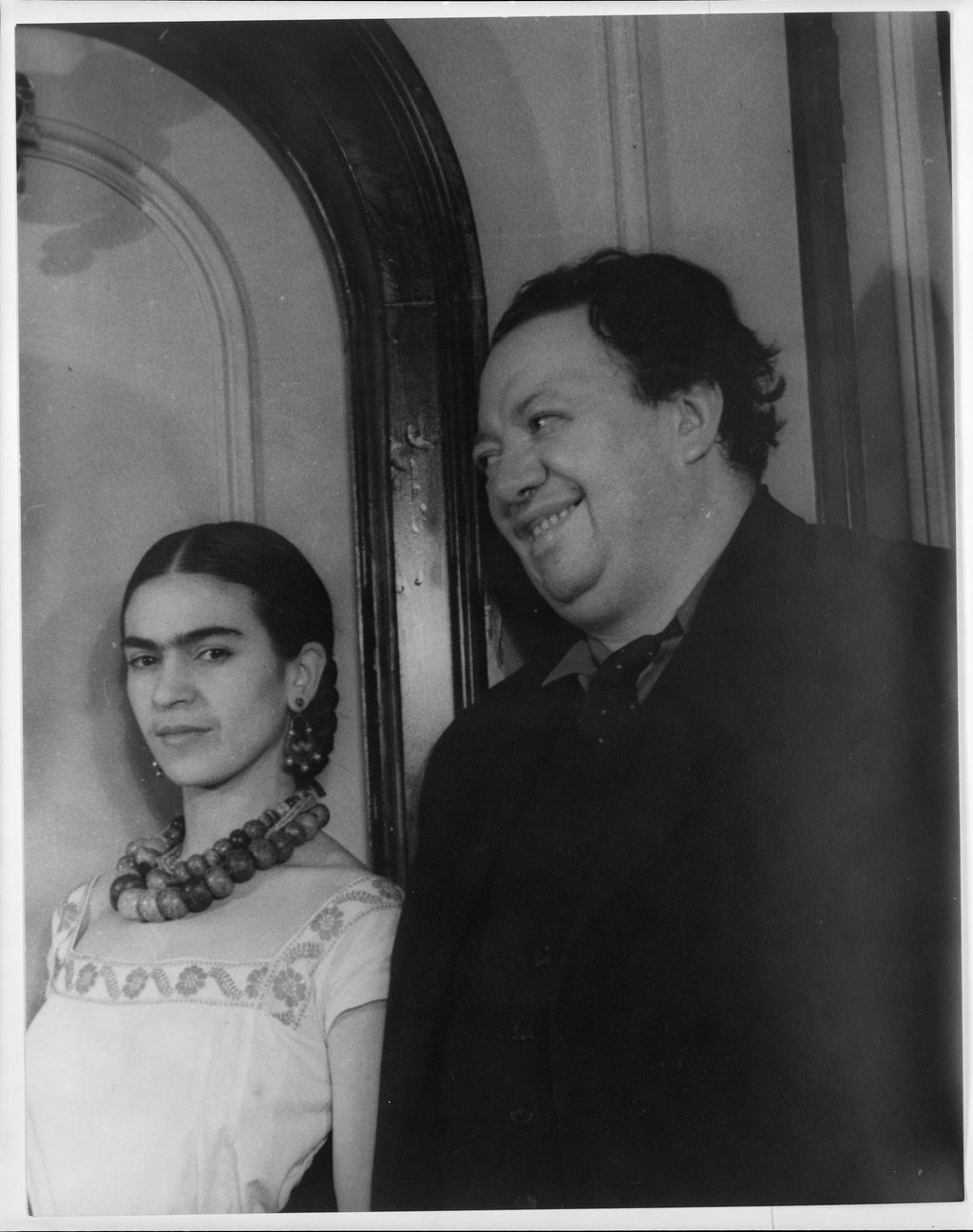
- Carl Van Vechten, 19 March 1932. Library of Congress, LC-USZ62-42516. Public domain / no known restrictions. Resized to 1024 px wide; no crop. Source record.
