


 by Tom Gurney
Tom Gurney BSc (Hons) is an art history expert with over 20 years experience
Page created on March 2, 2018 / Page updated on October 6, 2026
Email: tomgurney1@gmail.com / Phone: +44 7429 011000
Introduction
Frida Kahlo's Self-Portrait as a Tehuana (Diego on My Mind) was completed in 1943, but a photograph shows her at work on an earlier state around 1940. Between those dates Kahlo and Diego Rivera remarried, making it difficult to read the finished image as the record of one moment of separation. The small portrait of Rivera on her forehead matters, but so do the precisely arranged Isthmus headdress, flowers and lines that fill the space around her. [1] [2] [4]
The painting has often been explained as a declaration of obsessive love or a net intended to catch Rivera. Those are identifiable critical readings, not statements the painting itself can verify or intentions established by a surviving studio note. Looking first at what is visible, then at the documented changes and the dress's cultural history, yields a richer account of an image that Kahlo worked on across changing circumstances. [4] [5] [6] [7]
At a Glance
- Artist and titles: Frida Kahlo, Diego en mi pensamiento / Diego on My Mind; also Self-Portrait as a Tehuana. [1] [2]
- Date and medium: completed 1943; oil on Masonite. A photograph dated about 1940 records an unfinished state, not an exact starting day or uninterrupted three-year campaign. [1] [4]
- Dimensions: 76 × 61 cm without the frame; 97 × 81 × 8 cm framed, according to the current technical sheet. [1]
- Collection: Gelman Santander Collection. The Zambrano family owns the collection; Fundación Banco Santander manages it under a 2026 agreement. [3] [21]
- Display: Listed for Faro Santander's Modern Mexico exhibition, 8 September 2026–10 January 2027; individual display may change. [13]
Contents
- Introduction
- Looking at the Finished Portrait
- A Painting with Two Documented States
- Divorce, Remarriage and an Over-Simple Story
- The Resplandor Is More Specific Than a “Mexican Veil”
- Rivera's Forehead Portrait and the Question of a “Third Eye”
- Flowers, Branching Lines and Devotional Analogies
- Popular Forms, Identity and Critical Reception
- What the Material Record Does—and Does Not—Tell Us
Looking at the Finished Portrait
Kahlo appears approximately from the chest upward, nearly frontal, with her face close to the painting's central axis. Her eyes meet the outward field of view; the continuous brow, faint upper-lip hair and red lips are visible. An expression such as melancholy, defiance or devotion would already be an interpretation of those marks rather than an observable fact. [1]
A small bust-length male portrait sits just above the brow line. Institutional records identify him as Rivera; that identity does not have to be guessed from the miniature's facial features alone. The position makes the current title's idea of Diego being “on my mind” unusually literal, though a title does not tell us whether the image records affection, memory, dependence, artistic partnership or several feelings at once. [1] [2]
A pale lace resplandor frames Kahlo's face in an uneven ruffled oval and covers her shoulders. Pink edging and ornament animate the lower part of the garment, while flowers and green leaves rise over her hair. Against a warm ochre-brown ground, fine pale and dark lines spread and branch through the headdress, shoulder area and surrounding space; they look variously like stems, roots or drawn connections without becoming visually identifiable as literal hair, thread or spider silk. [1] [4] [5]
The picture has no described room or landscape horizon. This compressed setting directs attention to the relation among face, garment, miniature and branching lines, but it cannot establish a precise studio, outdoor site or psychological state. An apparent name and date near the upper left should not be transcribed from a digital reproduction: the 1943 date is secure from the current collection record, while the inscription's exact lettering awaits authoritative examination. [1]
Watch: Frida Kahlo
Five perspectives to view here alongside the article.
Frida Kahlo’s The Two Fridas: Great Art Explained
A focused visual introduction to the painting and its context.
Self-Portrait as a Tehuana (Diego on My Mind) in Kahlo’s career
The Two Fridas
1939Timeline source: Museo Frida Kahlo chronology [22].
A Painting with Two Documented States
Bernard G. Silberstein photographed Kahlo at an easel with Rivera standing behind her. The Detroit Institute of Arts dates its print's subject to about 1940, and the Cincinnati Art Museum catalogues a second print of the same encounter. The institutions' print sizes and later printing histories differ, but both preserve evidence for a photographed working state rather than a precise daily studio diary. [4] [8]
Claire Wilcox and Circe Henestrosa identify the unfinished painting in this photograph as Diego on My Mind. In the introduction to Frida Kahlo: Making Her Self Up, they distinguish the later, finished image by its added tendrils, bougainvillea flowers and leaves, and miniature portrait of Rivera. Their account does more than compare two apparently similar pictures: it connects a named, dated photographic scene with the specific work and its later visible elements. [5]
The photograph does not prove that Kahlo worked continuously from 1940 to 1943, nor can it date each new line or flower. One partnered museum presentation warns that a version of the photograph is horizontally reversed, so the apparent working hand and exact studio orientation cannot safely be inferred. What survives is a strong but bounded sequence: the painting was under way by about 1940 and reached the 1943 state recorded by the collection. [1] [4] [5] [8]
Gail Levin later proposed August 1940 as a start month, but the underlying dated source for that precision has not been cited here. Her adjacent description of the couple as “just” divorced is also chronologically misleading: the divorce was final in November 1939. August may remain a research lead, not the page's unqualified creation date. [2] [18]
Divorce, Remarriage and an Over-Simple Story
Museo Frida Kahlo gives 6 November 1939 for Kahlo and Rivera's divorce and 8 December 1940 for their remarriage in San Francisco. The earlier photographed state falls within or near the year of their separation, while the completed painting belongs to a later, renewed marriage. This order allows relationship history to inform the picture without making its final form a straightforward bid to “get Diego back.” [2] [4] [5]
Rivera's miniature appears in the finished state identified by Wilcox and Henestrosa. Its presence may recall a separation, signal continuing attachment, or turn the painter's thoughts into a visible motif, but no inspected 1940–43 letter or diary entry states the purpose of each addition. Even an emotionally persuasive reading should be presented as a reading, especially when the final work postdates the second wedding by more than two years. [2] [5]
Andrea Kettenmann's influential Spanish-language account calls the image a sign of obsessive love, associates Kahlo's Tehuana dress with Rivera's preference and likens the spreading lines to a web for trapping him. Her exact page is valuable evidence for how the picture has been interpreted; it is not a recorded confession by Kahlo. The old popular story that the couple divorced in 1940 and never resumed their relationship is contradicted by the museum chronology and should not carry these interpretations as historical fact. [2] [6]
The Resplandor Is More Specific Than a “Mexican Veil”
Chloë Sayer's Victoria and Albert Museum account identifies the garment as a resplandor, also called a huipil grande, associated with Tehuana dress from the Isthmus of Tehuantepec. She distinguishes a full-dress arrangement opening around the face from a church mode in which the ruffled collar frames the face while the fabric covers the shoulders. Kahlo paints the latter arrangement; calling it simply a wedding veil misses both its form and its range of ceremonial uses. [7]
Tehuana dress belongs to particular regional histories, especially those of Zapotec communities in Oaxaca, but it was never a single timeless national costume. The V&A records changing materials and methods, including imported fabrics and machine stitching, as well as combinations of garments from different regions. Kahlo's self-presentation could draw on that modern, hybrid vocabulary without providing proof of a specific maker, date, textile fibre or surviving wardrobe match for the painted resplandor. [7]
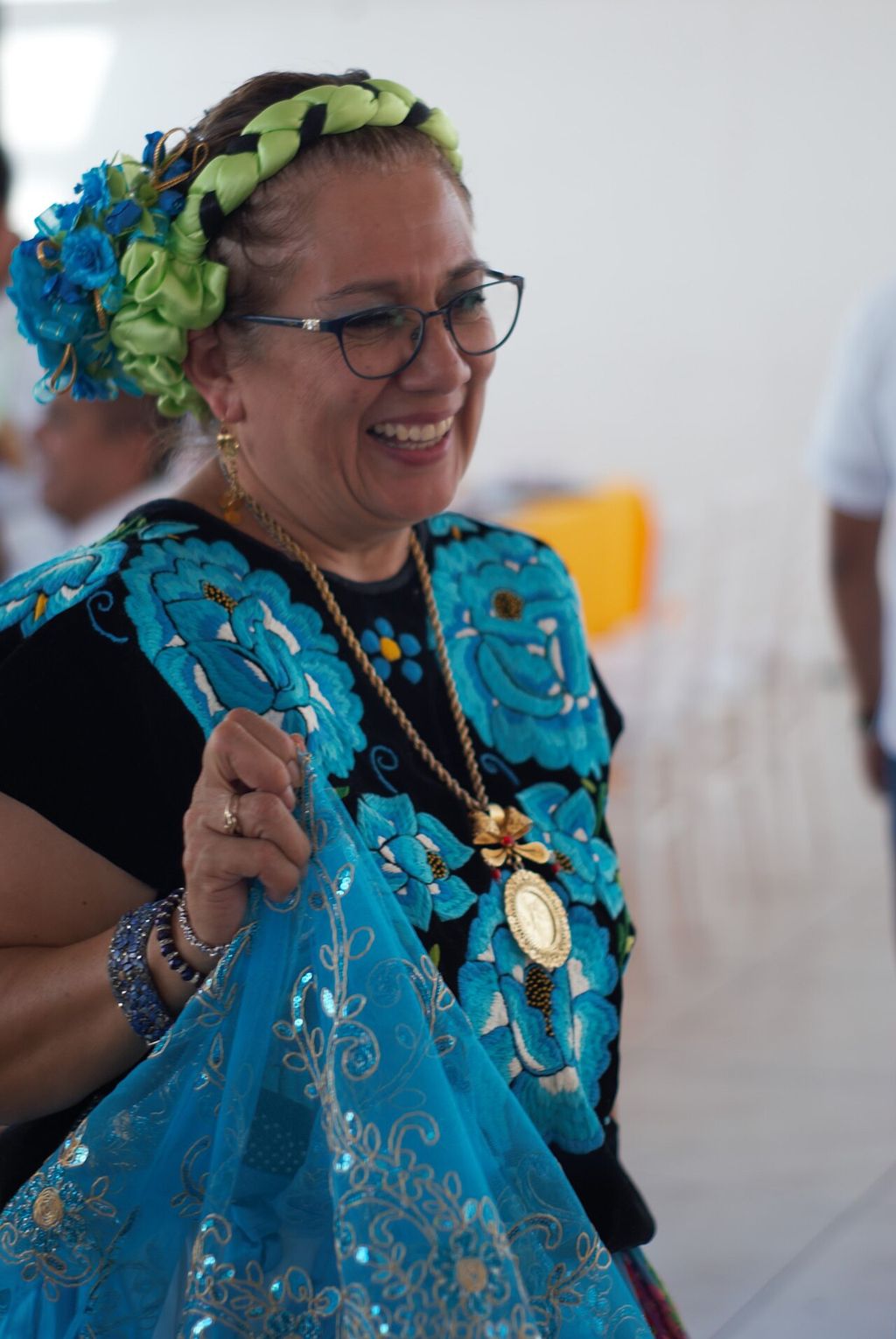
Museo Frida Kahlo notes that women in her maternal family wore traditional dress. That statement does not establish a Tehuana or Zapotec lineage for Kahlo, and wearing or depicting a regional garment does not make ancestry visually verifiable. The painting can be discussed in the history of Mexicanidad and post-Revolutionary regional imagery without turning self-fashioning into a genealogical certificate. [2] [7] [17]
The familiar description of Tehuantepec as a straightforward “matriarchy” also needs qualification. Women exercised important economic and social roles, yet scholarly accounts of the powerful Tehuana image show how outsiders and nationalist projects idealised or exoticised that figure. Kettenmann's unqualified formulation records one influential interpretive tradition; it should not be repeated as a settled description of all Isthmus communities. [6] [7] [16] [17]
Rivera's Forehead Portrait and the Question of a “Third Eye”
The placement of Rivera's likeness near Kahlo's forehead invites the thought that he occupies her mental vision. Some writers call it a “third eye,” an analogy that adds a spiritual or visionary register to the current title's plainer language. Tamara Kubečková's Czech-language study surveys this and other readings, while keeping their status as interpretations visible; neither the placement nor the title proves a fixed iconographic programme. [1] [9]
The comparison with the later Diego and I of 1949 is useful only if the works remain distinct. Kahlo returned to the device of Rivera on her forehead, but the later painting has another date, expression, compositional setting and ownership history. Recurrence can show that this was not merely a pictorial trick confined to one crisis in 1940; it cannot tell us that each use meant exactly the same thing. [2] [9]
Wilcox and Henestrosa describe the effect of the miniature and surrounding lines in language of longing and identity. Kettenmann's obsession reading is sharper and more possessive. A reader can see why both readings arose without having to accept either as the artist's private diagnosis or the painting's sole subject. [5] [6]
Flowers, Branching Lines and Devotional Analogies
Flowers and leaves are plainly visible in the completed image; Wilcox and Henestrosa identify bougainvillea among the additions. The branching network appears to cross from the crown over garment and background, so it joins rather than neatly separates the portrait's pictorial zones. Its visual continuity is more secure than any claim that each strand is a literal botanical root, textile thread or nerve. [1] [5]
Kettenmann likens those lines to a spider's web that could entangle Rivera. Wilcox and Henestrosa use the different metaphor of a force field of tendrils, while later accounts have compared the face-framing lace with an aura or halo. These analogies illuminate formal effects, but the inspected technical sheet identifies no spider, physical web or specific saintly figure; the painting should not be converted into a diagram whose symbols have a single prescribed translation. [1] [5] [6] [9]
Kubečková's discussion is especially useful as a caution. Her pages bring together third-eye, halo, web, introjection and colonial or indigenista interpretations; her examiner criticised the speed with which several possibilities were accumulated. Each reading should be tested against its source and the visible work rather than accumulated as though five possible labels made one certain. [9]
Popular Forms, Identity and Critical Reception
The frontal figure, ornamental surround and shallow space have encouraged devotional or votive comparisons. Teresa del Conde's Spanish-language account of popular forms in Kahlo's painting supplies a wider Mexican critical history for those comparisons, but it is not an object file and does not prove that this portrait depicts a particular saint. A resemblance in pictorial address can be worth noting without assigning Kahlo a religious intention that no inspected source documents. [15]
The garment also participates in a history of how Indigenous women and regional dress were represented within Mexican modernity. Elisabeth Erin Pankl's geography dissertation treats the picture as a prominent vehicle for Kahlo's Tehuana public identity; Jeffrey Belnap's separate study of What the Water Has Given Me interrogates nationalist contradictions in the Tehuana figure. Belnap's object is not this painting, so his argument provides a critical comparison, not direct evidence for what Kahlo intended in Self-Portrait as a Tehuana. [16] [17]
The publisher's description of Adriana Zavala's Becoming Modern, Becoming Tradition identifies Diego on My Mind as relevant to modernity and Indigenous womanhood. The book's detailed argument remains unconsulted, as do the relevant passages in The Complete Paintings and Gannit Ankori's specialist studies; their titles alone cannot establish what Kahlo intended. [20]
Accounts that place the work under a broad label such as Surrealism, magical realism or autobiographical confession may help explain its later reception. They should not erase the documented making sequence, the exact garment or the social meanings of its representation. Self-Portrait as a Tehuana offers a case study in how formal invention, self-presentation and biography intersect without one label settling the relation among them. [5] [7] [9] [15] [17]
What the Material Record Does—and Does Not—Tell Us
The current Gelman Santander technical sheet specifies oil on Masonite and gives both unframed and framed dimensions. Masonite is a manufactured hardboard, but the support alone cannot explain why Kahlo selected it or establish a political intention to use an inexpensive material. A published suggestion that the panel proves identification with “the people” therefore remains an author's interpretation rather than a conclusion from the material record. [1]
No conservation study, technical imaging or treatment history has been inspected for this work. The early photograph documents a different visible state, but it cannot establish every underlayer, pigment, binder, ground, frame alteration or sequence of strokes. Nor can a digital image reliably settle the painting's physical colour, reflectance or condition; a 1943 date and apparent inscription are not substitutes for a full technical report. [1] [4] [5]
The framed dimensions—97 × 81 × 8 cm—belong to the present collection sheet, not to a verified description of the frame's maker or construction history. Some derivative records give rounded 75 × 60 cm dimensions for the painting; the current technical sheet and earlier Proa and Frist records agree on 76 × 61 cm. The 76 × 61 cm figure is therefore the best documented measurement, while the frame's construction and inscriptions remain unverified. [1] [10] [11]
How the Gelmans Acquired the Painting
The Gelman history distinguishes two Kahlo portraits that are sometimes confused. Kahlo painted a commissioned portrait of Natasha Gelman in 1943, and Sylvia Navarrete's published collection account says it was the first Kahlo painting in the Gelmans' home. Soon afterward, in Natasha's recollection, Kahlo invited the couple to a cocktail and a small display at the home of fashion designer Henri de Châtillon. [10]
This “first Kahlo in the home” is not the same as the first work in the wider Mexican collection. Santander's current summary dates the collection's beginning to a different 1943 commission: Diego Rivera's portrait of Natasha. Keeping the artist and collection scope attached to each statement prevents two portraits of the same sitter from being collapsed into one. [3] [10]
Natasha remembered seeing Diego en mi pensamiento there, asking Jacques to buy it and acquiring it for 12,500 pesos. The story makes Self-Portrait as a Tehuana an existing painting selected by the collectors, not the commissioned portrait of Natasha or a work demonstrably made for her. It is a later published recollection; the invoice, exact purchase day, first title on the sale papers and legal transferee have not been inspected. [10]
Fundación Proa's 1999 object page retains the historic Jacques and Natasha Gelman credit and corroborates the title, medium, date and size. After later changes in collection administration, the Zambrano family acquired the collection in 2023, according to Fundación Banco Santander's 2026 announcement. In a further March 2026 clarification, the foundation explicitly said that the family owns the collection and Santander manages its preservation, study and temporary exhibitions; that still does not supply an inspected deed for this particular object. [3] [10] [11] [21]
The present official release describes a 160-work collection including eighteen Kahlo works—ten paintings, seven drawings and one print. Older accounts count a smaller collection at Natasha's death or a different number of Kahlo paintings. These are dated snapshots of a changing collection, not necessarily contradictions about the object in front of us. [3] [13]
Early Publication and Selected Exhibitions
The image had a Mexican print life soon after completion: Dayna Díaz Uribe's scholarly index records a reproduction in issue 38 of El Hijo Pródigo, dated 15 May 1946. The original issue page has not been inspected, so the exact caption, placement and surrounding discussion cannot yet be described. Even with that limitation, the indexed record provides a more precise lead than a vague assertion that the work circulated in magazines. [19]
Fundación Proa's archive documents the painting in its 1999 Arte Mexicano exhibition. Later selected institutional records name it in a 2011 Kahlo and Rivera exhibition at Göteborgs konstmuseum, the Frist Art Museum's 2019 Gelman-collection display, and the Portland Art Museum's 19 February–5 June 2022 presentation. This is a selected history, not a claim that every loan, tour stop or interval of storage has been traced. [11] [12]
One tempting 1990 claim remains unresolved. Pankl reports that this painting appeared in publicity for the Metropolitan Museum of Art's Mexico: Splendors of Thirty Centuries, but Navarrete's Proa text identifies a different Gelman painting, Self-Portrait with Monkeys, as the widely posted image. Without the original advertisement and checklist, neither Self-Portrait as a Tehuana poster use nor its physical inclusion in that exhibition should enter the verified display history. [10] [17]
In 2026, Mexico's Instituto Nacional de Bellas Artes y Literatura named Diego en mi pensamiento among ten Kahlo oil paintings in Relatos modernos. Obras emblemáticas de la Colección Gelman Santander at the Museo de Arte Moderno in Mexico City. The 68-work show opened in February; its initial announcement gave 17 May as the end, while the museum's later archive records a run through 19 July 2026. The revised museum endpoint is the appropriate historical date, and the February–July show should not be confused with the later Santander exhibition. [14]
Modern Mexico in the Gelman Santander Collection opened at Faro Santander on 8 September 2026 with Self-Portrait as a Tehuana named on the exhibition page. As checked on 3 October, the scheduled end is 10 January 2027 and the exhibition is curated by Marisol Argüelles. Collection membership does not guarantee that an object will always be on display; anyone planning a visit should consult the venue's current listing. [13]
The changing presentation contexts matter. A Mexican literary magazine, a Gelman survey in Buenos Aires, international exhibitions and recent shows in Mexico City and Santander each place the same portrait before different audiences. They document reception and movement, not fresh evidence that Kahlo meant the flowers or forehead miniature to carry one fixed message in 1943. [11] [12] [13] [14] [19]
Books and the Limits of This Account
Several books offer routes to a fuller object history. Luis-Martín Lozano, Andrea Kettenmann and Marina Vázquez Ramos's Frida Kahlo: The Complete Paintings is the priority for an exact catalogue entry, inscription, provenance, bibliography and technical history; its 624-page publisher record has been identified, but that entry and the complete book have not been read. Andrea Kettenmann's separate Dolor y pasión has been checked at its exact printed page 67, where its obsession and web account can be attributed accurately, though its complete 96-page text has not been treated as read. [6] [20]
Wilcox and Henestrosa's Frida Kahlo: Making Her Self Up is particularly important for this painting because its complete nine-page introduction extract identifies the photographic working state and later additions. The full 240-page catalogue remains unread. Gannit Ankori's Imaging Her Selves and Critical Lives, and Adriana Zavala's Becoming Modern, Becoming Tradition, remain relevant specialist books, but their unseen arguments are not evidence for the claims made here. [5] [20]
The 1999 Proa/Gelman, 2026 Faro Santander and 2026 Museo de Arte Moderno catalogues may refine the object history. Mexico's ISBN agency confirms the last publication, but its entry for this portrait remains unconsulted; the sale document, conservation report, authoritative inscription and complete exhibition checklist are likewise unavailable. [10] [20]
Why the Picture Remains Open
The secure sequence is already substantial: an oil-on-Masonite self-portrait was under way by about 1940, reached its 1943 state after Kahlo and Rivera's remarriage, and was bought by the Gelmans according to Natasha's recollection. Its resplandor is a specific regional garment shown in a church-mode arrangement, while the miniature and branching lines are visible formal decisions to which later critics have given different meanings. [1] [2] [4] [5] [7] [10]
That evidence lets the page reject a reductive story without claiming to recover Kahlo's unrecorded thoughts. Rivera can be a compelling part of the image while dress, pictorial construction, regional representation, collector history and later reception remain equally worthy of attention. The strongest interpretation is one that says which of its parts can be seen, which can be documented and which remain open to argument. [1] [5] [6] [7] [9]
Frequently Asked Questions
The current collection uses Diego en mi pensamiento and Diego on My Mind. Museo Frida Kahlo gives the paired Spanish form Autorretrato como tehuana o Diego en mi pensamiento, while Self-Portrait as a Tehuana is a common English variant. Diego and I names a different, later painting. [1] [2]
The current record dates completion to 1943. A Silberstein photograph, dated about 1940, shows an unfinished state identified by Wilcox and Henestrosa, but it does not establish an exact start month or continuous work throughout the interval. [1] [4] [5]
His portrait sits above Kahlo's brow, and a third-eye interpretation has been proposed. Its placement and the title support discussion of thought and vision, but no inspected artist statement confirms that a specific religious or psychological symbol was intended. [1] [9]
No commission for this work has been established. Navarrete records Natasha's recollection of purchasing the existing self-portrait for 12,500 pesos after Kahlo's separate commissioned 1943 portrait of Natasha had entered the Gelman home. [10]
It is in the Gelman Santander Collection, managed by Fundación Banco Santander under an agreement with the Zambrano family. The Faro Santander exhibition currently lists it through 10 January 2027, subject to live display updates; the management record does not establish Santander's legal ownership of this individual object. [3] [13]
Related Reading
For wider wardrobe and regional dress history, see Fashion and Tehuana Dress. Diego and I treats Kahlo's later, distinct use of Rivera's forehead image; Style: Surrealism and Reality and the Frida Kahlo overview supply broader context without replacing this painting's object record.
Discussion
Use the cited evidence and your own close looking to explain your view. The prompts below are starting points, not fixed interpretations.
Reader Insights
What changed between the photographed unfinished state and the completed portrait?
How does the resplandor's specific textile history complicate an abstract symbol reading?
Which interpretations of Rivera's forehead portrait remain interpretations rather than documented intention?
Join the Conversation
Which reading best fits the evidence, and where does uncertainty remain?
References
- Fundación Banco Santander, Gelman Santander Collection technical sheet, 21 January 2026, Diego en mi pensamiento / Diego on My Mind row; the one-page official sheet supplies date, support and framed/unframed dimensions. Its image permits visual description, while the sheet is not an individual ownership deed or conservation report.
- Museo Frida Kahlo, biography and archive, 1939 divorce, 1940 remarriage, 1943 painting and Florence Arquin sections. View source text.
- Fundación Banco Santander, Gelman Collection management announcement, 21 January 2026, pp. 1–2 in the saved release. View source text.
- Detroit Institute of Arts, Bernard G. Silberstein photograph, object F81.484, about-1940 subject and print record. View source text.
- Claire Wilcox and Circe Henestrosa, “Fashioning Frida,” introduction to Frida Kahlo: Making Her Self Up (2018), printed pp. 12–14, especially p. 13 and photograph caption p. 14; exact nine-page extract read, not the full catalogue.
- Andrea Kettenmann, Frida Kahlo 1907–1954: Dolor y pasión (1999 Spanish edition), printed p. 67; exact page read, complete volume unread.
- Chloë Sayer, “Traditional Mexican dress,” Victoria and Albert Museum, resplandor modes and regional textile sections. View source text.
- Cincinnati Art Museum, Silberstein photograph, object 1986.570; partnered presentation notes a reversed print. View source text.
- Tamara Kubečková, Frida Kahlo: Approaches and Perspectives of Interpretation, 2022, printed pp. 26–27 and examiner report p. 1. View source text.
- Sylvia Navarrete, Gelman Collection essay, Fundación Proa, Kahlo/Gelman collection-history paragraphs and Natasha's purchase recollection. View source text.
- Fundación Proa, Diego en mi Pensamiento object record, 1999 exhibition archive; Frist Art Museum, Spanish family guide, p. 6 and 2019 show record. View source text 1; View source text 2.
- Göteborgs konstmuseum, 2011 Kahlo and Rivera archive; Portland Art Museum, 2022 exhibition archive. View source text 1; View source text 2.
- Faro Santander, Modern Mexico in the Gelman Santander Collection, exhibition dates and Diego on My Mind caption, checked 3 October 2026. View source text.
- INBAL, Relatos modernos announcement and opening release, February 2026; Museo de Arte Moderno 2026 archive, later 19 July endpoint. View source text 1; View source text 2; View source text 3.
- Teresa del Conde, “Lo popular en la pintura de Frida Kahlo”, Anales del Instituto de Investigaciones Estéticas 45 (1976), pp. 195–203. View source text.
- Jeffrey Belnap, “Disentangling the Strangled Tehuana”, Genders 33 (2001); its object is What the Water Has Given Me, not Self-Portrait as a Tehuana. View source text.
- Elisabeth Erin Pankl, The Critical Geographies of Frida Kahlo (Kansas State University dissertation, 2015), printed pp. 13–15, 59; original dissertation read, 1990 advertisement unverified.
- Gail Levin, “Frida Kahlo's Circulating Crafts”, in Rhapsodic Objects (2022), pp. 217–219; month-level start held pending its underlying source. View source text.
- Dayna Díaz Uribe, El Hijo Pródigo en la historia de la literatura mexicana, illustration index p. 256; original 1946 issue not inspected. View source text.
- TASCHEN, Frida Kahlo: The Complete Paintings, publisher metadata only; Penn State University Press, Zavala's Becoming Modern, Becoming Tradition, publisher introduction only; Mexico ISBN agency, 2026 MAM exhibition catalogue, bibliographic record only. The Proa and Faro full catalogues, Ankori books and exact entries for this portrait have not been consulted. View source text 1; View source text 2; View source text 3.
- Fundación Banco Santander, “Clarifications on the Gelman Santander Collection”, 23 March 2026, especially ownership and management clarifications; no deed for this individual painting supplied. View source text.
- Museo Frida Kahlo, Frida interactive chronology, selected work dates used for the comparison timeline. The current work's date follows its cited object record. View source text.
Image Credits
- Monsrulo. CC BY-SA 4.0. Source: Wikimedia Commons (File:Tehuana en vela.jpg). 1024px proportional sRGB JPG derivative; no crop. Licence. Source record.
