


 by Tom Gurney
Tom Gurney BSc (Hons) is an art history expert with over 20 years experience
Page created on March 2, 2018 / Page updated on October 6, 2026
Email: tomgurney1@gmail.com / Phone: +44 7429 011000
Introduction
Frida Kahlo's words survive in letters, interviews, diary pages and writing on paintings, but the sayings circulated under her name do not all come from those sources. Some have a dated documentary setting; others are later translations, remembered conversations or unresolved attributions. Several popular examples belong to modern writers or a fictional screen portrayal rather than Kahlo herself. [1] [2] [3]
These differences do not make the words less interesting. They reveal an artist whose private jokes, professional correspondence, intimate addresses and public statements have often been compressed into a single inspirational voice. The sections below keep documented passages, source-qualified material, unverified sayings and known misattributions separate, then distinguish Kahlo's words from what other people said about her. [1] [2] [3]
At a Glance
- Documented publication: TIME printed Kahlo's reality and sick/broken remarks on 27 April 1953. [1]
- Letters: Family, intimate and professional correspondence, including documents from 1925, 1930 and 1944. [2] [8] [39]
- Diary: An illustrated journal from 1944–1954, with institutionally presented extracts and differing translations. [4]
- Unverified sayings: Eight familiar sayings appear in their own clearly labelled section. [5]
- Misattributions: Identified modern authors and fictional dialogue are not genuine Kahlo quotations. [3] [6]
- Other voices: Contemporary criticism, family and friends, later scholars and artists are separately attributed. [27] [40] [41] [42] [43]
Contents
- Introduction
- What the Source Labels Mean
- Documented Quotes on Painting and Reality
- Family Friendship and Love Letters
- Diary Passages and Their Context
- Reported Statements Whose Sources Need Qualification
- Unverified Sayings Attributed to Frida Kahlo
- Misattributed Quotes and Modern Authors
- Contemporary Voices About Kahlo
- Family Friends and Later Remembrance
- Historians and Critics on Kahlo
- Artists and Popular Culture After Kahlo
- Books for Further Study
What the Source Labels Mean
Documented wording identifies text in an accessible dated publication or an institutional transcription of a specific letter. This establishes what the source prints, not necessarily a verbatim record of an unrecorded spoken conversation. TIME's English report, for example, does not disclose the language in which Kahlo originally made its remarks. [1] [2]
Institutionally quoted or reported means a museum, critic or witness supplies a passage, but the original document, exact edition or translation history remains incomplete. The date of a recollection is distinguished from the earlier events recalled, and an institutional English rendering is not silently presented as Kahlo's original English. [4] [7]
Unverified attribution marks a saying for which no adequate original Kahlo source has been identified. It may resemble something she wrote, but resemblance and repeated attribution are not documentary proof. Misattributed is stronger: positive evidence points to another writer, a modern text or a fictional scene. [3] [5] [6]
These labels apply to particular passages rather than to an entire museum, author or book. A source can reproduce one properly identified letter and present another saying without a locator. The useful question is therefore not simply whether a quotation appears on a respected website, but what evidence that website supplies for those exact words. [5] [7]
Watch: Frida Kahlo
Five perspectives to view here alongside the article.
Frida Kahlo’s The Two Fridas: Great Art Explained
A focused visual introduction to the painting and its context.
Documented Quotes on Painting and Reality
I never painted dreams
“I never painted dreams. I painted my own reality.” [1]
Status: documented contemporary English publication. TIME printed these sentences in “Mexican Autobiography” on 27 April 1953, in a report on Kahlo's Mexico City exhibition. They follow her rejection of the Surrealist label and describe how she understood the relationship between experience and painting. [1]
The familiar present-tense versions and additions about nightmares should not replace the published past tense. Nor is the remark a rule that every painted object can be decoded as a literal biographical event. The Surrealism and reality study examines the difference between Kahlo's self-description, Breton's classification and the paintings' imaginative constructions. [1]
I am not sick
“I am not sick … I am broken.” [1]
Status: documented contemporary English publication; the ellipsis joins two consecutive quoted sentences. The same TIME article prints the contrast and follows it with Kahlo's affirmation that remaining able to paint made her glad to be alive. Its setting is continued work during serious physical difficulty, not a general claim that illness or disability can be overcome by attitude. [1]
The article is also a journalistic portrait rather than a medical record. Its framing and biographical details require independent checking before being repeated elsewhere. The short statement preserves Kahlo's reported distinction without converting her metaphor into a diagnosis or a complete account of her health. [1]
A letter that combines work and affection
“Do you think of me some time?” [8]
Status: documented original-English letter, 20 April 1944, to Julien Levy. Getty's transcript places this intimate question near the end of a letter that also discusses shipping paintings, works ready to send, an iron corset and friends in New York. The sequence brings professional obligations and personal attachment into the same address. [8]
It is valuable precisely because it is not an isolated maxim. Kahlo speaks to a particular correspondent, asks for news and negotiates the difficulty of fulfilling artistic requests. The question's spelling and spacing follow the institutional transcript, while the full letter's reproduced grammar should not be polished into an invented literary English. [8]
Family Friendship and Love Letters
An early letter about drawing
“…even more talent for drawing than before…” [39]
Status: institutional English rendering of a letter to Alejandro Gómez Arias, 13 October 1925, page 3 of 7; translator not identified. Writing during hospital recovery, Kahlo reports Fernández's encouragement and a proposed payment when she becomes better. Her parenthetical scepticism and references to visitors make the passage an exchange with a particular person, not a retrospective slogan about an accident creating an artist. [39]
The document shows artistic aptitude already being discussed, while its English rendering remains distinct from the Spanish letter. It brings work, affectionate address and comic qualification together at an early date. The accident and recovery study considers the rest of the seven-page transcription without treating patient testimony as a complete clinical record. [39]
Friducha to her mother
“Friducha que te adora” — “Friducha who adores you.” [2]
Status: institutional Spanish transcription; English translation here. The National Museum of Women in the Arts places this affectionate closing in the two-page letter to Matilde Calderón catalogued 21 November 1930. Shortly before it, Kahlo values the day she receives her mother's letter above days of celebration, linking affection with the practical need for news while abroad. [2]
The diminutive signature belongs to a family relationship, not a public persona of independence. Keeping the addressee also prevents the letter from being mistaken for a message to Rivera or Muray. The catalogue date is retained as a catalogue attribution rather than resolving the weekday discrepancy in the surviving text. [2]
Inside the magenta rebozo
“You will always be inside the magenta rebozo.” [7]
Status: a dated letter extract quoted by the V&A original language and translator not supplied there. The museum identifies a letter to Nickolas Muray of 13 June 1939 and connects the sentence with his photographic portrait of Kahlo. Its shawl is an intimate material reference, not simply a metaphor selected from a general collection of love sayings. [7]
The same English wording cannot automatically be assigned to an original Spanish letter or to every photograph showing a similar garment. The dress study discusses the rebozo's place in Kahlo's visual presentation, while the extract preserves its particular correspondent and photographic association. The source-qualified label is retained because the full original and translation history are not exposed by the V&A article. [7]
Love me a little
“Quiéreme tantito.” — “Love me a little.” [9]
Status: Spanish letter wording transmitted through scholarly quotation; complete edition not consulted. The dated route is Kahlo's 23 July 1935 letter to Rivera, through Raquel Tibol's edited writings. The short request differs in register from the grand declarations commonly extracted from the surrounding letter: tantito makes affection a small, pleaded-for amount. [9]
The longer English version beginning with love greater than her own skin circulates with alterations and without consistent translation credits. Its emotional meaning depends on an address to Rivera at a particular moment, not on a universal model of romantic devotion. The Kahlo and Rivera page supplies the wider documented relationship without treating a private letter as the complete marriage. [9]
A portrait for two recipients
The verse associated with the 1946 gift of The Wounded Deer addresses Lina and Arcady Boytler together. A scholarly Spanish transcription uses plural forms; the familiar English wording about leaving a portrait with “you” can obscure that dual address. It should be understood as a gift verse for particular friends rather than an anonymous love letter. [10]
The full verse and its edition have not been directly compared here, so only its documented recipient context is described. That restraint preserves a useful correction without presenting a freely circulating English sentence as a verified translation. The painting's own page develops the gift history and visual interpretation separately. [10]
The Paris letters are individual documents
Kahlo's criticism of Paris intellectual circles belongs to identifiable correspondence, not an undated statement about all European art. The Archives of American Art catalogue identifies a seven-page letter to Muray dated 16 February 1939, while Didier Schulmann's French curatorial account routes other remarks through letters and translated editions. A different hospital letter of 27 February and a 17 March message to Ella and Bertram Wolfe must not be merged with it. [11] [12]
The archive record establishes the first letter's existence and date, but its full text was not accessible through the consulted item record. The French retellings likewise do not establish an original French composition by Kahlo. Their profanity, humour, practical grievances and particular addressees belong to the correspondence study rather than a composite quotation manufactured from several documents. [11] [12]
Diary Passages and Their Context
Feet and wings
“Pies, ¿para qué los quiero si tengo alas pa' volar?” [4]
Status: institutionally presented diary wording, associated with 1953; the full facsimile edition has not been consulted here. A literal English rendering is “Feet, why do I want them if I have wings to fly?” The colloquial contraction pa' belongs to the Spanish register and is often lost in polished English versions. [4]
The late-life context matters. The museum associates the page with the period of Kahlo's amputation, so it should not be detached into a claim that imagination made disability inconsequential. The words can express a wish for freedom while remaining part of an experience of bodily loss, distress and adaptation. [4]
Nothing is worth more than laughter
“Nada vale más que la risa.” — “Nothing is worth more than laughter.” [13]
Status: diary wording examined through Spanish scholarship; its revised written surface matters. María de la Luz Hurtado's study shows crossed-out wording beneath and around the passage usually circulated as a clean maxim. The familiar opening survives, but an expanded quotation that silently removes revision would conceal how the thought was worked on. [13]
Laughter here is not simply a cheerful brand message. This account's rewriting and juxtaposed reflections invite attention to shifts in tone and to the relationship between humour and suffering. Hurtado's analysis supplies that material distinction, while the exact facsimile and a named published English translation remain separate sources to consult. [13]
The joyful exit
“I hope the exit is joyful…” [14]
Status: a common English rendering of a diary passage discussed in a Spanish museum label; published translator not verified here. The complete saying goes on to express a wish not to return, and the exhibition label places it after thanks to people involved in her care. That surrounding gratitude matters as much as the phrase's frequent isolation as a meditation on death. [14]
Neither the wording nor its position establishes a cause of death or proves suicidal intent. Calling it Kahlo's literal last spoken words would also change a written diary passage into an event that the source does not document. The diary study treats the journal as an illustrated and revised object rather than a sequence of disembodied aphorisms. [14]
Colour politics and the wish for freedom
Kahlo's diary associates colours with particular feelings, ideas and figures, including affection for Rivera. Those associations belong to specific written pages and cannot be converted into a universal dictionary that explains every green, yellow or blue in her paintings. The institutional selections are useful guides to passages, but they do not replace the diary's sequence, crossings-out and changing contexts. [4] [13]
The long passage beginning with a wish to do as she pleases behind a curtain of madness is likewise materially more complex than its circulating English paragraph suggests. The Spanish discussion involves revision and masking, while the common translation does not consistently identify a page or translator. Its opening may be identified as a diary route, but the whole translated passage is not reproduced as an authenticated English quotation. [13]
Political language should also retain its historical subject. Revolutionary commitments in the journal are not interchangeable with later slogans of individual self-empowerment, and love, political hope and despair may occupy neighbouring pages without having the same addressee. The political activism study supplies the relevant organisations and chronology. [4]
Reported Statements Whose Sources Need Qualification
Why she painted herself
“…because I am so often alone…” [15]
Status: widely reported self-portrait explanation; original interview or letter not established here. The familiar longer statement joins solitude with knowing herself better than other subjects, and a precise secondary route is Hayden Herrera's 1983 biography, p. 71. That is not the same text as the modern own-muse poem discussed below, and the two should not be spliced together. [3] [15]
The idea can help introduce Kahlo's working circumstances without becoming the only explanation of her self-portraits. Those works also construct identities, engage other people and address cultural and political settings. The self-portrait study considers that range rather than letting one reported sentence define the entire genre. [15]
Painting as a source of fulfilment
“Painting completed my life.” [16]
Status: institutionally reproduced English wording; interview and translation need to be distinguished. Getty reproduces this phrase in its programme's closing discussion, while the Spanish documentary route identified in the cited bibliography is Raquel Tibol's conversations of May 1953, published in Novedades on 7 March 1954. The frequently repeated “1953 autobiography” label should not obscure the later publication or the interview's mediation. [16] [17]
The associated remarks concern pain, losses and the importance of work, not a claim that every picture is an unmediated confession. Another short phrase in the same translated passage is “I think work is best.” These extracts preserve the theme without reproducing the whole protected translation or confusing it with the 1944 Levy letter. [16]
An account of work and suffering
“My painting contains a message of pain.” [16]
Status: Getty's English rendering of the interview-derived passage, not an original-English diary entry. The remark belongs with the assessment of patient painting and with the statement about work. It should not become a retrospective diagnosis of the artist or proof that pain is the sole subject of her work. [16] [17]
The source distinction is especially useful beside The Broken Column and Henry Ford Hospital. Their visible bodily subjects and documentary contexts support detailed discussion, but a general saying cannot identify every painted object or settle each interpretation. The paintings remain constructed works as well as representations of experience. [16]
Writing about Diego as a husband
Kahlo's opening refusal to describe Rivera simply as a husband has a specific essay route: “Retrato de Diego,” prepared for the 1949 national homage catalogue. INBAL identifies that text, whereas the commonly circulated English passage does not consistently name its translator or page. It is an authored portrait of Rivera, not necessarily a spontaneous answer to an interview question. [18]
The argument belongs to the essay's larger account of Rivera's character and role. A short English fragment severed from that setting can turn a complicated written assessment into a universal pronouncement about marriage. The essay identity is established here, while its complete edition and controlled English translation remain unconsulted. [18]
Sorrows that learn to swim
“…the damned things learned how to swim.” [19]
Status: a reported letter joke with a specific secondary route; exact original letter not inspected. Scholarship routes the drinking-and-sorrows passage to a 1938 letter to Ella Wolfe, identified as “Wednesday 13,” and to Tibol's edited writings. The secondary commentary also credits a borrowing from José Frías rather than presenting Kahlo as the joke's inventor. [19]
The shorter meme removes the correspondent, Spanish comic phrasing and borrowing. Recognising the letter route allows discussion of Kahlo's humour without claiming originality for every sentence she used. It also distinguishes reported correspondence from a modern motivational saying with no documentary trail. [19]
A song painted onto a canvas
The inscription in Self-Portrait with Cropped Hair is a different category again. MoMA identifies its Spanish words as a Mexican popular or folk song about a lover's attraction to hair. Kahlo selected and painted the lyric, but selecting a text is not the same as composing it. [20]
The inscription is consequently discussed as borrowed song language within an artwork, not listed as an original Kahlo aphorism. Its relation to the suit, scissors and cut hair belongs to the painting's full composition. No song author is supplied where the controlling source leaves authorship unidentified. [20]
Unverified Sayings Attributed to Frida Kahlo
The following sayings are included because they are commonly encountered under Kahlo's name, not because their authorship has been established. An unresolved attribution is not automatically a proven falsehood, but none of these items should be quoted as authenticated Kahlo wording without a specific original source. Their labels remain part of each entry, even when the sentiment appears compatible with her life. [5] [6]
Flowers that will not die
“I paint flowers so they will not die.” [21]
Status: unverified original source. The saying circulates widely and appears in the title of Grimberg's scholarly article on the still lifes. That publication identity does not, by itself, identify the interview, letter or diary page in which Kahlo supposedly said it. [21]
Its neat explanation of flower painting is appealing, but the paintings do not all have the same subject or purpose. The still-life study explores fruit, flowers, gifts, inscriptions and changing compositions without using this unresolved saying as a master key. A precise document could strengthen its attribution; repetition alone cannot. [21]
Self-love and desire
“Fall in love with yourself, with life and then with whoever you want.” [5]
Status: unverified Kahlo attribution. The fuller saying moves from loving oneself to loving life and then another person. Denver Art Museum includes it in a Kahlo quotation list, but the item does not carry an original document, date or individual source locator. [5]
The institution's publication establishes circulation, not authorship. The saying is therefore retained in this explicitly unverified section rather than placed beside a dated letter as if the two had equivalent support. No alternative author is asserted without positive evidence. [5]
A saying about change
“Nothing is absolute.” [5]
Status: institutionally circulated English wording; exact original diary or edition location unresolved here. Denver's version continues through a sequence of changing, moving and departing things, but does not supply the particular written page or translation credit. The opening identifies the familiar saying without presenting the expanded English sequence as a controlled diary transcription. [5]
Its account of change is different from a promise that suffering inevitably leads to happiness. The movement of the sentence deserves attention as language, while any claim about when Kahlo wrote it still needs a dated documentary source. Neither the apparent suitability of the thought nor its museum circulation resolves that question. [5]
Beauty and horror
“Everything can have beauty, even the worst horror.” [5]
Status: attributed by an institution; original document and translator not identified there. The saying appears in Denver's life quotations, but its exact source is not individually located. It remains an unverified attribution rather than an authenticated statement about the purpose of every Kahlo painting. [5]
The tension between attraction and distress can be a productive question for looking at art. That possibility does not license romanticising the artist's pain or declaring that she welcomed injury. The paintings' specific forms and documents are more informative than treating this unresolved sentence as a general doctrine. [5]
Two great accidents
“There have been two great accidents in my life…”
“…Diego was by far the worst.” [22]
Status: unresolved original speaker record, date and witness. Variants compare Kahlo's transport accident with her relationship with Rivera, changing the vehicle and wording as they circulate. The comparison is frequently repeated, including in later accounts, but no original interview or dated contemporary document has been identified in the sources cited here. [22]
Its force comes from a compressed, bitter joke. It cannot be used as evidence that Kahlo literally regarded the marriage as a worse injury, nor can the saying determine the physical details of the 1925 collision. The accident study and partnership account distinguish their respective documents from this unresolved aphorism. [22]
Born a painter
“I was born a bitch. I was born a painter.” [23]
Status: unverified modern circulation. The fragment appears as part of a supposed undelivered letter circulated online by 2014, without an identified manuscript, date or edited source. Its boldness is not evidence that Kahlo wrote it. [23]
The coarse language should not itself decide authenticity: genuine correspondence can also be irreverent. The problem is the absence of a documentary connection, not a judgement about what an artist ought to have sounded like. The fragment remains attributed and unresolved rather than being promoted as her declaration of identity. [23]
I simply am
“I am. I simply am.” [23]
Status: unverified composite letter passage. The same modern circulation includes a sequence of self-definitions about love, pleasure, tenacity and alcohol, followed by an insult to the addressee. The supposed letter's emotional plausibility supplies neither its date nor its author. [23]
The short extract identifies the familiar wording without reprinting the whole composite. It is kept separate from the documented correspondence, whose recipient, physical or edited source and language can be identified. No evidence is offered that the composite is a translation of an otherwise unknown Spanish original. [23]
A balanced family resemblance
“I have my father's eyes and my mother's body.” [7]
Status: institutionally attributed, original source unresolved. The V&A uses the line in its discussion of Guillermo Kahlo and photography but does not identify a letter, diary page, interview date or translation for it. It is therefore not treated here as a documented genealogical or physical self-assessment. [7]
The phrase's balanced form makes it memorable. That balance also makes it easy to reuse without asking when or to whom it was said. Its source-qualified inclusion acknowledges the museum's attribution while retaining the unresolved documentary question. [7]
Misattributed Quotes and Modern Authors
I am my own muse belongs to Oroma Elewa
“I am my own muse.” [3]
Status: modern poem by Oroma Elewa, not Kahlo. Elewa identifies the three-line poem as part of her Pen and Jotter series, published online in 2011. Her first-person account explicitly rejects the persistent attribution to Kahlo and asks publishers to restore her authorship. [3]
The full poem should not be merged with the separately reported Kahlo self-portrait explanation. Similar vocabulary about being one's own subject does not make the texts identical or their authors interchangeable. Restoring Elewa's name also recognises the contemporary artist whose work has been stripped of its credit. [3]
You deserve a lover belongs to Estefanía Mitre
“Mereces un amor” — “You deserve a love.” [24]
Status: modern poem associated with Estefanía Mitre, not an authenticated Kahlo letter. The Spanish poem's author-credit route includes Mitre's own 2015 performance, and the provenance investigation distinguishes it from other modern texts circulated under Kahlo's name. The popular English “You deserve a lover” is a translation label, not evidence that Kahlo composed an English original. [24]
Its extended catalogue of what love should offer has a different literary form from a short private letter. Repeating the complete poem under Kahlo's name would erase the living writer and obscure the translation's own history. The identifying title is sufficient here; the poem is not reproduced in full. [24]
The strangest person in the world
“I used to think I was the strangest person…” [6]
Status: documented modern circulation, with a credible authorship claim by Rebecca Katherine Martin. Quote Investigator traces the passage to an anonymous PostSecret appearance in March 2008, before its attribution to Kahlo on later quotation platforms. The investigation also records communication supporting Martin's authorship claim. [6]
Because its earliest appearance was anonymous, that conclusion should retain the investigation's evidential qualification. It is nevertheless positive evidence against treating the paragraph as a Kahlo diary entry. Its message of recognition between strangers is modern writing whose circulation acquired a famous historical name. [6]
Enduring more than we think
“…we can endure much more than we think…” [25]
Status: dialogue spoken by the Kahlo character in the film Frida (2002). The line has a screen-text origin and belongs to a dramatised encounter, not to an identified historical letter or interview. A sentence spoken in character can seem biographically plausible while remaining the work of the film's writers. [25]
The distinction is not a criticism of fiction. Drama can imagine a voice and interpret a life, but a subsequent quotation card must not discard that fictional frame. It is properly discussed as film dialogue, rather than used to authenticate a statement about Kahlo's own beliefs. [25]
A lover who thinks you are magic
“…like maybe you are magic.” [26]
Status: Marty McConnell's modern poem, not a historical Kahlo quotation. McConnell publishes Frida Kahlo to Marty McConnell on her own website and explicitly says Kahlo did not write it. She identifies its publication in issue 23 of Salt Hill Journal. [26]
Its title deliberately creates an imagined address from Kahlo to the poet. When an extract loses the author's name and the literary frame, that invented speaker is mistaken for the author. McConnell's correction supplies a particularly clear example of how persona poetry can become misattributed quotation. [26]
Contemporary Voices About Kahlo
André Breton and the ribbon around a bomb
“…a ribbon around a bomb.” [27]
Speaker: André Breton; source: the 1938 Julien Levy exhibition invitation. The museum-held document describes Kahlo's art, not simply her personality, and names her as Frida Kahlo de Rivera. Its explosive metaphor belongs to Breton's critical presentation of the paintings and to his engagement with their Surrealist possibilities. [27]
The ribbon suggests an enticing or decorative exterior around disruptive force. That is Breton's formulation, not Kahlo's self-description, and it should be read alongside her later rejection of the Surrealist label rather than made to overrule it. The style study develops the historical disagreement. [1] [27]
Kandinsky's contemporary response
“…avec une forte connotation surréaliste.” [12]
Speaker: Wassily Kandinsky, in a letter to Anna and Josef Albers of 17 March 1939, transmitted in a French curatorial account. Didier Schulmann supplies the phrase and an edition route; it conveys a strong Surrealist association in the paintings Kandinsky encountered. The French wording is a published rendering, not proof that the original letter was written in French. [12]
Kandinsky's response is useful evidence of reception in that particular moment. It does not settle how Kahlo categorised her own practice or how every painting should now be classified. The original correspondence edition would be necessary for a longer quotation and a controlled translation from its original language. [12]
Rivera on tenderness and force
“…acid and tender, hard as steel…” [44]
Speaker attributed: Diego Rivera; reported English wording in a later reading guide. Elizabeth R. Baer and Hester D. Baer's 1991 American Library Association guide quotes this contrast in its discussion of Kahlo's work. It preserves an assessment combining softness and force, rather than reducing her painting to delicate decoration. [44]
The guide does not identify the original Rivera passage or its translator, so this fragment remains a reported quotation. It concerns artistic qualities, not proof of a harmonious marriage. Rivera's own artist cluster explores his separate work and career. [44]
Diego Rivera's “Frida Kahlo y el arte mexicano” appeared in the Boletín del Seminario de Cultura Mexicana in October 1943, pp. 89–101. The ICAA public catalogue identifies the article and summarises its treatment of her art, but the full scan was not accessible without account access. Rivera's published critical voice therefore has a precise documentary route without the article's entire argument being available here. [28]
The 1943 essay and the guide's reported fragment are separate source routes; the fragment has not been verified against those original pages. Rivera's contemporary criticism belongs to Mexican art discussion, while the catalogue's synopsis is the later institution's account of his argument. Neither voice should be confused with Kahlo's own. [28] [44]
The reported Picasso compliment
The familiar report has Picasso praising Kahlo's ability to paint heads and comparing her achievement with his own and André Derain's. The most precise edition route identified here is Tibol's Frida Kahlo: Una vida abierta, pp. 95–96, but the supposed original letter, its date and language have not been established. This remains a reported compliment rather than an authenticated transcription of Picasso's correspondence. [29]
Its circulation says something about Kahlo's later reputation as an artist admired by prominent peers. The particular words cannot responsibly be used to reconstruct an undocumented meeting or to claim that Picasso supplied a formal judgement of her complete work. An institution repeating the story does not remove the need for the original source. [29]
Weston and the public attention to her dress
“People stop in their tracks…” [7]
Speaker: Edward Weston, as quoted by the V&A exact daybook or original document not identified there. The museum places the remark in its account of Kahlo's Mexican clothing and the attention she received in San Francisco. It records a photographer's response to her public appearance, not Kahlo's own assessment of her paintings. [7]
The observation is useful for the reception of her dress, but it also reminds us how frequently others made her appearance their subject. The fashion page keeps that gaze distinct from the garments' history and Kahlo's choices. A full Weston quotation would require its precise source and context. [7]
Family Friends and Later Remembrance
Matilde Kahlo on her sister's suffering
“…as if she were lying on broken glass.” [41]
Speaker: Matilde Kahlo Calderón, Frida's older sister, as quoted in the Museo Frida Kahlo's English chronology. The museum places the comparison in an account of Matilde's correspondence with Leo Eloesser during her sister's final years. It is a family member's description of suffering, not something Frida wrote about herself. [41]
The distinction matters because Frida's mother was also named Matilde. INBAL separately identifies an April 1950 letter from the sister to Eloesser, but its exhibition text does not reproduce this phrase, so that month cannot automatically date the quotation. The museum's English rendering has no identified translator, and the comparison is testimony of concern rather than a clinical diagnosis. [33] [41]
Mary Sklar offers practical help
“…what I can do to make it easier for you.” [40]
Speaker: Mary Sklar; original-English letter to Kahlo, 2 August, year unknown, page 3. NMWA's four-page transcription preserves the request just before Sklar's signature. Its surrounding discussion concerns possible travel to New York, news through friends, money and arrangements for medical advice, giving the offer a practical as well as affectionate meaning. [40]
This is a correspondent's willingness to help, not a motivational saying detached from its recipient. The unknown year remains unknown, and Sklar's account does not independently establish what treatment occurred. Other letters from Sklar and Ella Wolfe reveal additional support within the friendship network, but their words likewise belong to their senders. [32] [40]
Lucienne Bloch remembers a working artist
Lucienne Bloch's oral-history interview of 11 August 1964 recalls friendship, working habits and the importance of painting during illness. It was recorded ten years after Kahlo's death, so its date belongs to the recollection rather than the remembered event. The Archives of American Art transcript permits the witness's own voice to be considered without pretending that every remembered exchange is a contemporary verbatim record. [30]
Guillermo Monroy recalls the classroom
Guillermo Monroy's classroom recollection was published still later, in Excélsior on 17 July 1976. The scholarly transcription combines enthusiasm for painting with difficulty, discipline, friendship and love of the work. Its category is retrospective pupil testimony, not a stenographic record of a lesson. [31]
“To paint is the most terrific thing…” [31]
Speaker attributed: Kahlo, remembered by Monroy; English rendering of the short reported opening. The larger recollection qualifies excitement with the difficulty of painting well. That balance is lost when the opening becomes a motivational card without the pupil, publication date and retrospective status. [31]
Muray's correspondence and its limits
Nickolas Muray's farewell correspondence belongs to Muray's voice, not Kahlo's, but its complete original and precise date remain unverified in the identified routes. A reference to that correspondence is therefore not sufficient to supply an authenticated farewell sentence. [33]
Historians and Critics on Kahlo
Hayden Herrera on artistic permission
“…permission to be personal and to be autobiographical…” [43]
Speaker: Hayden Herrera, in the published excerpts of Amy Stechler's interview for PBS's Kahlo documentary. Asked about the painter's legacy, the biographer discusses the possibilities Kahlo opened for other artists, including frank treatment of the body and imaginative exploration of the self. The phrase describes a later creative influence rather than a rule Kahlo announced. [43]
Herrera's emphasis moves beyond a catalogue of hardships to the artistic freedoms others found in the paintings. Her account is a scholar's interpretation, and the transcript does not supply the interview's exact recording day. Consulting these excerpts is distinct from consulting her complete biography. [43]
Laura Mulvey and Peter Wollen on women's experience
“…an ironic, bitter comment on women's experience.” [44]
Speaker attributed: Laura Mulvey; passage quoted in the Baers' 1991 reading guide. The guide identifies Visual and Other Pleasures and places the remark within an argument about Kahlo's art, clothing and domestic life. It offers a feminist critical reading rather than a recollection of knowing Kahlo. [44]
The publisher identifies the underlying essay, “Frida Kahlo and Tina Modotti,” as co-written with Peter Wollen. [45] Its complete text has not been consulted here, so the extract remains a reported quotation rather than a newly verified edition transcription. This critical emphasis resists treating the paintings as uncomplicated inspirational messages. [44] [45]
Mari Carmen Ramírez challenges the stereotype
“Frida is the exception, and not the rule!” [42]
Speaker: Mari Carmen Ramírez, interviewed by Derek C. Blasberg in Gagosian Quarterly, 9 February 2026. The curator recalls visitors who dismissed a collection of South American art because it did not resemble Kahlo. Her response challenges the use of one exceptional artist as the measure of an entire continent's production. [42]
In the surrounding answers, Ramírez distinguishes admiration for Kahlo's achievement from dissatisfaction with commercial stereotypes. This is criticism of how her image has been used, not a dismissal of the paintings. It also shows why a substantial collection of voices about Kahlo should include disagreement and historical perspective, not only admiration. [42]
Artists and Popular Culture After Kahlo
Julie Taymor's cinematic interpretation
Julie Taymor's 2002 interview about Frida describes a painter working out of passion rather than merely market demand. This is the filmmaker's interpretation, recorded decades after Kahlo's death, not a statement by Kahlo or contemporary testimony about every sale. It belongs to the reception of a life through film. [34]
Julio Salgado on telling his own story
“…we get to own our queer narratives.” [35]
Speaker: Julio Salgado, in Google Arts & Culture's published artist responses. He recalls encountering The Two Fridas as a young immigrant and connects Kahlo with his own creative freedom. His emphasis is on artists describing their experiences rather than accepting identities defined by others. [35]
Camila Fontenele de Miranda on an intimate connection
“…in a very intimate way.” [35]
Speaker: Camila Fontenele de Miranda, in the same published feature. She identifies The Broken Column as especially meaningful to her and discusses her participatory portrait project Everyone Can Be Frida. This is a Brazilian artist's personal response, not an explanation attributed to Kahlo. [35]
Raychelle Duazo on pictorial structure
“…balance created through good structure.” [35]
Speaker: Raychelle Duazo, in the feature's third artist response. Duazo describes Kahlo's influence on her own portrait compositions, attending to focal points and surrounding forms. Her interest brings formal construction into the discussion alongside emotional identification; the feature supplies neither a publication date nor translation credits. [35]
Madonna's song and interview
Madonna's “Super Pop” invokes Kahlo as an imagined painterly identity. This is a song reference, not an interview aphorism; the recording is available in the 2025 twentieth-anniversary edition of Confessions on a Dance Floor. Its use is evidence of popular-cultural reception rather than of ownership of particular paintings today. Older collection claims must not be turned into an unverified present inventory. [36]
A separate 2023 Vanity Fair interview records Madonna recalling her teenage discovery of Kahlo at the Detroit Institute of Arts and identifying the painter as a source of strength and inspiration. This is Madonna's account of a formative encounter and affinity, not independent evidence for the medical biography she retells. It also differs from the song's imagined identity and supplies no present inventory of privately owned paintings. [38]
This later material is valuable because it introduces distinct speakers and historical moments. A filmmaker, a contemporary visual artist and a songwriter may each find something different in Kahlo. Their responses broaden her reception while remaining separate from the documents in which she speaks for herself. [34] [35] [36]
Books for Further Study
For documentary reading, Raquel Tibol's Escrituras, Héctor Jaimes's Tu hija Frida: Cartas a mamá, The Diary of Frida Kahlo and The Last Interview and Other Conversations serve different purposes. Letters need recipients and dates; a diary needs its material sequence; an interview collection needs journalists, source publications and translators. Publisher descriptions and selected excerpts do not amount to reading complete editions. [37]
The complete editions have not been consulted for this article, and their exact source notes remain important further reading. Gift books of wisdom may offer attractive selections, but a familiar saying without an original locator cannot close an attribution question. The strongest distinction is between a source-bearing edition and a design-led compilation, not simply between a long book and a short one. [37]
Frequently Asked Questions
No. Dated publications and letters coexist with unresolved attributions, later translations, remembered speech and positively identified modern texts. The individual source labels above distinguish those categories. [1] [3] [5] [6]
A museum may supply a strong original document or only repeat a familiar saying. The document's date, identity and exact passage matter more than the reputation of the host alone. [2] [5] [7]
Their separate inclusion helps readers recognise wording they encounter elsewhere and understand what remains unresolved. The unverified label is part of the entry, not an optional disclaimer or a claim that a missing source must prove the saying false. [5] [23]
An English translation should identify its source and translator where known. When the translator is unknown, that limitation remains visible; the original Spanish is not reconstructed by translating a later English or French rendering backwards. [4] [7] [12]
Their distinct voices show how family, friends, fellow artists and later scholars understood her life and work. A sister's letter, a contemporary assessment and a modern interview illuminate different relationships; none becomes Kahlo's own statement simply by appearing in a collection associated with her. [27] [40] [41] [42] [43] [44]
Discussion
Use the cited evidence and your own close looking to explain your view. The prompts below are starting points, not fixed interpretations.
Reader Insights
Which source distinction most changes your understanding of a familiar saying?
Have you encountered a modern poem circulated under Kahlo's name?
What does knowing a letter's recipient add to its meaning?
Join the Conversation
Which reading best fits the evidence, and where does uncertainty remain?
References
- TIME, “Art: Mexican Autobiography,” 27 April 1953, paragraphs quoting reality and sick/broken remarks. This authenticates the contemporary published English, not an original-language interview transcript. View source text.
- National Museum of Women in the Arts, Letter 2 from Frida Kahlo to Matilde Calderón de Kahlo, catalogued 21 November 1930, two-page Spanish transcription, closing paragraph. The catalogue date and weekday conflict remain distinguished; collection rights statement acknowledged. View source text.
- Oroma Elewa, “I Am My Own Muse,” author's complete statement: Pen and Jotter, online 2011, and correction of Kahlo misattribution. View source text.
- Museo Dolores Olmedo, “A Peek at Frida Kahlo's Diary,” institutional Spanish/English selection, especially 1953 feet-and-wings page and colour associations. Full facsimile and translation edition unconsulted. View source text.
- Denver Art Museum, “Quotes from Frida Kahlo,” self-love item. Evidence of institutional circulation, not an original source for the saying. View source text.
- Quote Investigator, “It's True I'm Here, and I'm Just as Strange as You,” 28 January 2016: PostSecret March 2008 history, later Kahlo attribution and qualified Rebecca Katherine Martin authorship evidence. View source text.
- V&A, “Photographing Frida Kahlo,” updated 17 April 2024: 13 June 1939 Muray letter extract; family-body and Weston passages. Original language/translator or daybook locator is not supplied for the passages discussed. View source text.
- Getty Research Institute, Intimate Addresses: Frida Kahlo, 26 September 2023, transcript of Kahlo to Julien Levy, 20 April 1944, accession 2022.M.20, especially closing question. The letter's original English is separate from podcast commentary. View source text.
- Universitat Politècnica de València, Spanish thesis passage transmitting Kahlo's 23 July 1935 Rivera letter and Tibol edition route, pp. 165–166/alternate-edition p. 328. Original letter and complete edited volume unconsulted. View source text.
- Spanish scholarly discussion of the 1946 Boytler gift verse, plural recipients and edited-writings route p. 357; full underlying edition unconsulted. View source text.
- Smithsonian Archives of American Art, Frida Kahlo, Paris, France, letter to Nickolas Muray, New York, N.Y., 16 February 1939, Digital ID 491, seven-page manuscript metadata only. View source text.
- Didier Schulmann, “Frida Kahlo à Paris,” Centre Pompidou institutional story, French renderings and correspondence references, including Kandinsky to the Alberses, 17 March 1939, Cahiers November 1998 p. 129. Original editions not directly consulted. View source text.
- María de la Luz Hurtado, “Frida Kahlo. Del imaginario al lenguaje: un circuito de doble vía,” Revista Chilena de Literatura 61 (2002), especially printed p. 116/PDF p. 6, revised laughter passage; in Spanish. View source text.
- Fine Arts Museums of San Francisco, diary exhibition label 49: feet/wings date and final exit passage with care-team context; in Spanish. Full English edition and translator unverified. View source text.
- Hayden Herrera, Frida: A Biography of Frida Kahlo (1983), p. 71, identified secondary route for the self-portrait explanation; relevant complete edition and original witness unconsulted. Linked record identifies the edition, not the quoted page. View source text.
- Getty, Intimate Addresses: Frida Kahlo, current transcript PDF p. 10, translated painting/life/work passage, directly inspected. Its “1953 autobiography” description is distinguished from the Tibol interview/publication route. View source text.
- Museo Soumaya, July 2017 periodical, reproduced masthead and bibliography for Raquel Tibol, “Fragmentos para una vida de Frida Khalo,” Novedades, México en la Cultura 259, 7 March 1954. Full original interview article unconsulted; in Spanish. View source text.
- INBAL, “Desde el arte hasta el ropero de Diego Rivera,” identification of Kahlo's 1949 “Retrato de Diego”; in Spanish. Complete homage catalogue and controlled translation unconsulted. View source text.
- Universidade Federal da Bahia thesis, Spanish letter quotation and Tibol 2007 p. 237 route for Kahlo to Ella Wolfe, “Wednesday 13”; in Portuguese/Spanish. Borrowing note is transmitted through the Herrera p. 197 route, not an inspected original letter. View source text.
- MoMA, Self-Portrait with Cropped Hair, 1940, object/audio interpretation identifying borrowed Mexican song wording. View source text.
- Salomón Grimberg, “Frida Kahlo's Still Lifes: I Paint Flowers So They Will Not Die,” Woman's Art Journal 25.2 (Autumn 2004–Winter 2005), pp. 25–30. Article title and publication identity only; no original source for the saying established from metadata. View source text.
- PBS, The Life and Times of Frida Kahlo, later biographical presentation of the accident/Rivera comparison. Not a dated original speaker record or independent authentication of its wording. View source text.
- “Yo soy, simplemente soy,” 2 May 2014 Spanish blog circulation of a supposed undelivered letter. No archival or edition source; cited only to identify modern circulation, not as Kahlo authority. View source text.
- Truth or Fiction, “Frida Kahlo: You Deserve a Lover,” provenance discussion identifying Estefanía Mitre's author-credit route and distinguishing the separate McConnell poem. Modern text, not a Kahlo document. View source text.
- Frida (2002), film dialogue transcription, scene corresponding to endurance remark, lines 1716–1738 in the inspected transcript. Screen dialogue is not a historical Kahlo interview. View source text.
- Marty McConnell, Frida Kahlo to Marty McConnell, author's publication and explicit correction; Salt Hill Journal 23 identified. Only a short analytical extract reproduced. View source text.
- André Breton, Julien Levy Gallery invitation, 1938, page 4, institutional transcription of concluding art description; displayed English, translation provenance undisclosed. View source text.
- ICAA, Diego Rivera, “Frida Kahlo y el arte mexicano,” October 1943, bulletin 1.2, pp. 89–101, record 735544; Spanish catalogue synopsis only, full scan account-gated. View source text.
- Raquel Tibol, Frida Kahlo: Una vida abierta, 1985, pp. 95–96, identified secondary route for Picasso report. Full edition and original Picasso letter unconsulted; link identifies the museum's general reception claim, not those book pages. View source text.
- Smithsonian Archives of American Art, Lucienne Bloch oral-history interview, 11 August 1964, relevant transcript at 00:29:59 and 01:00:46; retrospective witness testimony. View source text.
- Portuguese scholarly transcription and bibliography citing Guillermo Monroy, Excélsior, 17 July 1976, p. 8; classroom recollection, not contemporary stenography. Original newspaper unconsulted. View source text.
- NMWA, Frida Kahlo Papers, Mary Sklar letter of 7 October, unknown year, and Ella Wolfe items of 15 March, unknown year, undated, and 21 February 1944; institutional transcriptions. These are correspondents' words, not Kahlo's. View source text.
- INBAL, Kahlo sin fronteras, April 1950 Matilde-to-Eloesser route and medical-correspondence context; museum/edition routes for Muray farewell remain incomplete and no exact farewell text is reproduced. View source text.
- Directors Guild of America, Frida, November 2002, Taymor's discussion; corroborates the filmmaker's 25 October 2002 PBS interview route, not Kahlo's own testimony. View source text.
- Google Arts & Culture, “Frida Kahlo's Lasting Impact on LGBTQ+ Artists,” Salgado's narrative paragraph, Miranda's first answer and Duazo's composition discussion. Publication date and translation credits undisclosed. View source text.
- Madonna, Super Pop, recording in Confessions on a Dance Floor (Twenty Years Edition), 7 November 2025, authorised Apple Music release record. This date identifies the reissue, not the song's first circulation; earlier academic lyric indexing is a separate source route. No lyrics reproduced here. View source text.
- Melville House/Penguin Random House, Frida Kahlo: The Last Interview and Other Conversations (2020), ISBN 9781612198750, source-bearing interview edition metadata. Tibol's writings, Jaimes's mother-letter edition and the diary remain separate unconsulted complete editions. View source text.
- Simone Marchetti, “Being Madonna,” Vanity Fair Italia, 18 January 2023, published English interview, question and answer about the Kahlo-styled photograph, Detroit encounter and inspiration. First-person reception, not a source for Kahlo's medical facts or current ownership. View source text.
- Frida Kahlo to Alejandro Gómez Arias, 13 October 1925, page 3 of 7, Museo Dolores Olmedo institutional English transcription: Fernández's encouragement, proposed payment and Kahlo's sceptical aside. Original Spanish manuscript and translator not inspected here; no document image reproduced. View source text.
- NMWA, Mary Sklar to Frida Kahlo, 2 August, year unknown, Folder 183, four-page original-English transcription; page 3, request before the signature. Original-material rights restrictions acknowledged; no letter image reproduced. View source text.
- Museo Frida Kahlo, English chronology, 1899 entry on Matilde Kahlo Calderón, paragraph quoting her later correspondence with Eloesser. Exact quotation date and translator undisclosed; the speaker is the older sister. View source text.
- Derek C. Blasberg, “Fridaphenomenon,” Gagosian Quarterly, 9 February 2026, interview with Mari Carmen Ramírez; answer recalling visitors at the Blanton collection and adjacent discussion of stereotypes. View source text.
- PBS, The Life and Times of Frida Kahlo, published excerpts of Amy Stechler's interview with Hayden Herrera, first answer to the legacy question. Exact recording day not given. View source text.
- Elizabeth R. Baer and Hester D. Baer, Isabella's Sisters: Women Creating Worlds, ALA, 1991, PDF pp. 2 and 6: reported Mulvey and Rivera extracts respectively. Underlying original texts uninspected. View source text.
- Laura Mulvey, “Frida Kahlo and Tina Modotti,” Visual and Other Pleasures (1989), pp. 81–107, publisher abstract and chapter metadata identifying co-writing with Peter Wollen. Complete chapter not accessed. View source text.
Image Credits
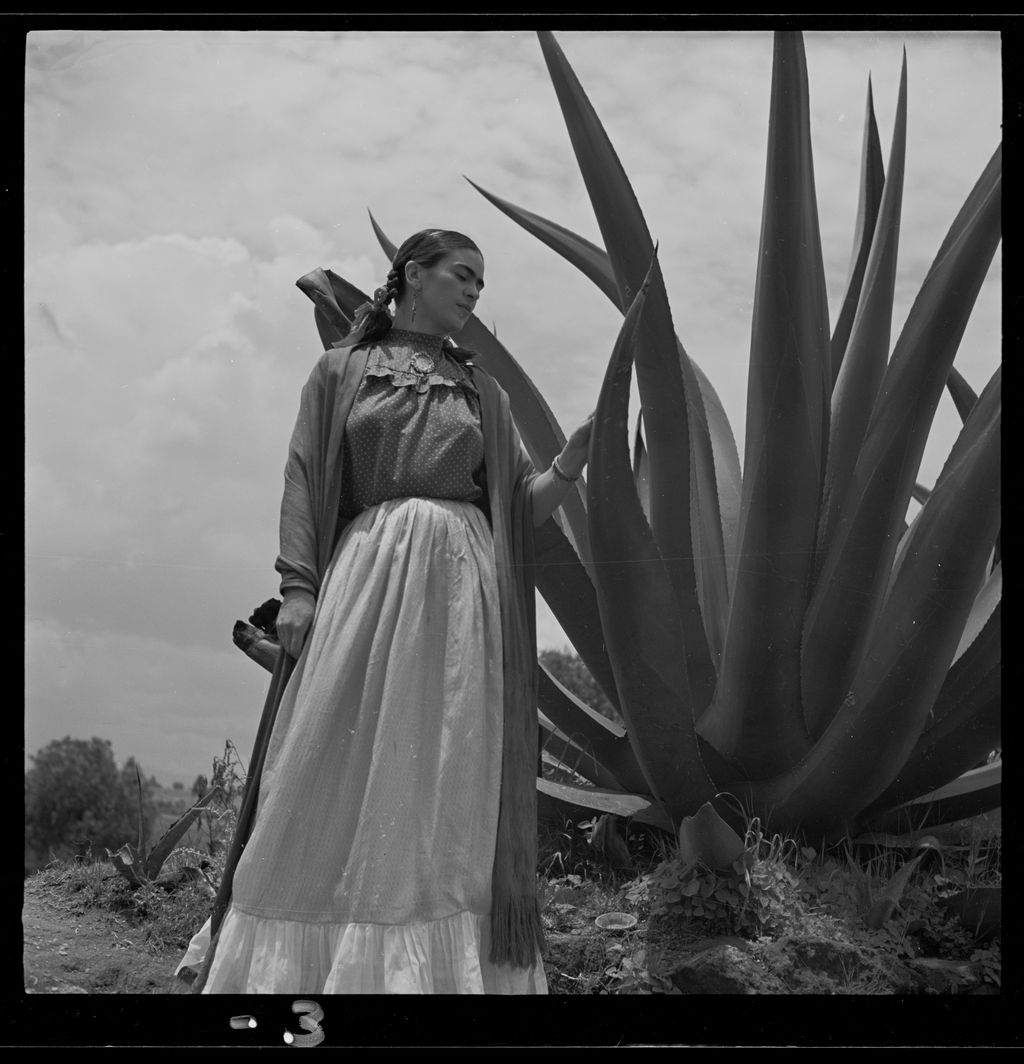
- Toni Frissell, 1937. Library of Congress, Prints & Photographs Division, Toni Frissell Photograph Collection, LC-F9-01-3707-25, no. 3; digital ID ds.05049. Source record.
