


 by Tom Gurney
Tom Gurney BSc (Hons) is an art history expert with over 20 years experience
Page created on March 2, 2018 / Page updated on October 6, 2026
Email: tomgurney1@gmail.com / Phone: +44 7429 011000
Introduction
Frida Kahlo's time in the United States was not one uninterrupted adventure or one decisive encounter with modernity. Between 1930 and 1933 she lived and worked in San Francisco, visited New York, moved to Detroit, returned to Mexico for a period, and came back to New York. Later journeys brought a solo exhibition in 1938, an exhibition and remarriage in San Francisco in 1940, and a reported treatment stay in New York in 1946. [1] [2] [3]
Diego Rivera's commissions helped determine the first route, but they do not explain everything Kahlo did there. Her letters record museum visits, encounters with patrons, concern for her family and observations of poverty; surviving works and exhibition records trace a painter whose public position changed over time. The more revealing question is not whether “America made Frida Kahlo,” but how particular American cities, people and institutions entered a career that remained deeply connected to Mexico. [2] [4] [5]
At a Glance
- First American stay: San Francisco, beginning in November 1930. [1] [2]
- Early exhibition: A San Francisco archive lists her in a 1931 group showing under the name “Señora Frieda Rivera.” [6] [25]
- New York, 1931: Museum study, social observation and contacts with patrons; on 27 November she reported that she had not yet painted there. [5] [24]
- Detroit: The Museo Frida Kahlo places her move in April 1932; a Ford archive photograph dates work on her border self-portrait to 2 August. [3] [7]
- Independent return: Her first New York solo exhibition opened at Julien Levy's gallery in November 1938. [8]
- Later ties: She exhibited in San Francisco in 1940 and used a Detroit contact in a documented 1939 request to assist a Spanish exile. [9] [10]
Contents
- Introduction
- San Francisco: The Painter Beside the Muralist
- New York in 1931: Looking Before Painting
- Museums, Learning and Mexican Cultural Judgment
- Patrons, Clothes and Family Responsibilities
- Detroit: Rivera's Commission, Kahlo's Work
- Family Correspondence Across the Border
- New York Again: Work, Marriage and Patronage in 1933
- The 1938 Solo Exhibition and Later American Visits
San Francisco: The Painter Beside the Muralist
The couple's arrival in San Francisco in November 1930 followed Rivera's opportunities to paint murals in the city. Stahr's published opening excerpt describes assistance from the art patron Albert Bender and sculptor Ralph Stackpole in arranging the journey. Patrons and artists thus helped provide access before the paintings and encounters that would make the visit significant. [1]
Kahlo lived at 716 Montgomery Street and made portraits in a city where Rivera's public reputation preceded her. Fine Arts Museums of San Francisco's exhibition labels identify the address and several works and contacts from this period. Frieda and Diego Rivera, now at SFMOMA, records her early treatment of their shared public identity, while her portraits of friends and acquaintances show that the visit was also a time of independent painting. [2] [11]
A San Francisco Society of Women Artists archive lists “Señora Frieda Rivera” in a 1931 exhibition. The Smithsonian dates the show to 4 November–3 December at the California Palace of the Legion of Honor and describes it as the first public viewing of her work, although it does not expose the full Kahlo checklist page. The married-name listing reminds us how she could be introduced through Rivera even while exhibiting as an artist herself. [6] [25]
The city also gave Kahlo material unlike the Mexican settings in which she had begun painting, though SFMOMA's later account sees the city's portraits drawing on nineteenth-century Mexican folk portraiture. Her visit to the horticultural world associated with Luther Burbank informed an imaginative portrait, although Burbank had died years earlier and she did not meet him. Those works are better evidence of experimentation and continuity than a claim that an entire mature style appeared on arrival. The San Francisco study follows the local sitters, exhibitions and 1940 return in greater detail. [2] [12] [22]
Watch: Frida Kahlo
Five perspectives to view here alongside the article.
Frida Kahlo’s The Two Fridas: Great Art Explained
A focused visual introduction to the painting and its context.
New York in 1931: Looking Before Painting
Kahlo travelled to New York later in 1931 while the Museum of Modern Art prepared a Rivera retrospective. Her letters home offer something the institutional exhibition record cannot: a dated account of what she noticed for herself. In a letter of 14 November she described her arrival and the contrast between New York wealth and people without enough to eat; subsequent letters returned to family money, rich patrons and the practicalities of life in the city. [4] [5]
Her first impressions were not uniformly hostile. She admired the city's astonishing scale and described comfortable accommodation at the Barbizon-Plaza Hotel beside Central Park, comparing it favourably with San Francisco. That pleasure coexisted with anger at the gulf between wealthy residents and people struggling to obtain food; privileged access did not prevent her from noticing the conditions beyond it. [4]
She also looked closely at art. Letters of 16 and 20 November describe Metropolitan Museum looking, with attention to artists such as Goya and El Greco, while the earlier letter locates Rivera's work at nearby MoMA. Her 20 November report that wealthy women were buying paintings is a first-person account of patronage as she understood it then, not a checked list of transactions, buyers and prices. [23] [24]
These letters were written in Spanish. A later reviewer of Stahr's book disputes the tone of one English rendering of viejas, a reminder that a translation can sharpen or soften the social register of a familiar word. Their social judgments belong to a familiar exchange with her mother, not a neutral survey of American society. [13]
Museums, Learning and Mexican Cultural Judgment
Kahlo treated the museum visit as an opportunity to learn, not simply a social excursion. On 16 November she reported seeing originals by early Italian, German and modern French painters that she had not encountered before. Access to those works enlarged her field of comparison while Rivera painted nearby at MoMA, making their activities related without making them identical. [23]
The 20 November letter also reveals a selective response rather than uncomplicated European admiration. After describing the collections and praising particular painters, she judged ancient Mexican sculpture especially highly. Her American museum experience therefore joined new encounters to an existing cultural allegiance; Mexican art did not become something she left at the border. [24]
On 27 November, her explanation for not yet painting was that she wanted first to look at things. It gives this period of observation an active purpose, even as she complained of boredom and hoped to begin work. Later paintings should not all be assigned to particular museum encounters, but the letter resists the assumption that every artistically significant week must produce a finished object. [5]
Patrons, Clothes and Family Responsibilities
Public access came with social demands. In the 20 November letter, Kahlo described dinners and other obligations among wealthy women whose purchases made their company professionally consequential; suitable clothes and shoes were part of that expectation. She also reported going around New York alone, a small but telling contrast with the accompanied social rounds. [24]
The prospect of winter introduced other practical adjustments. On 16 November she anticipated buying a bonnet and wool dresses for outdoor use, setting that need against the excessive heat inside buildings. These everyday choices complicate the idea that Kahlo's American self-presentation consisted of one unchanging regional costume. [23]
Distance did not detach her from household life in Mexico. She asked about the dollar's value against the silver peso and explained that she was keeping money available for family emergencies; later enquiries returned to relatives' welfare and the progress of the San Ángel houses. The letters connect international travel with continuing financial and domestic care, although they do not establish exact remittance totals or completed building stages. [5] [23]
These strands belong to the American story alongside exhibitions and new pictures. Learning, professional sociability and family responsibility occupied the same days, and the surviving letters move between them without treating any one as the whole experience. Kahlo could value access, criticise the people and inequalities around it, and maintain obligations elsewhere without resolving those positions into a single attitude towards the United States.
Detroit: Rivera's Commission, Kahlo's Work
The Detroit Institute of Arts commissioned Rivera's Detroit Industry frescoes with financial support from Edsel Ford. The Museo Frida Kahlo places the couple's move to Detroit in April 1932. A letter Kahlo wrote in January had anticipated travel in February, but a plan is not evidence that they had already arrived; a later review of Stahr's book also gives March, which conflicts with the museum's chronology. [3] [13] [14]
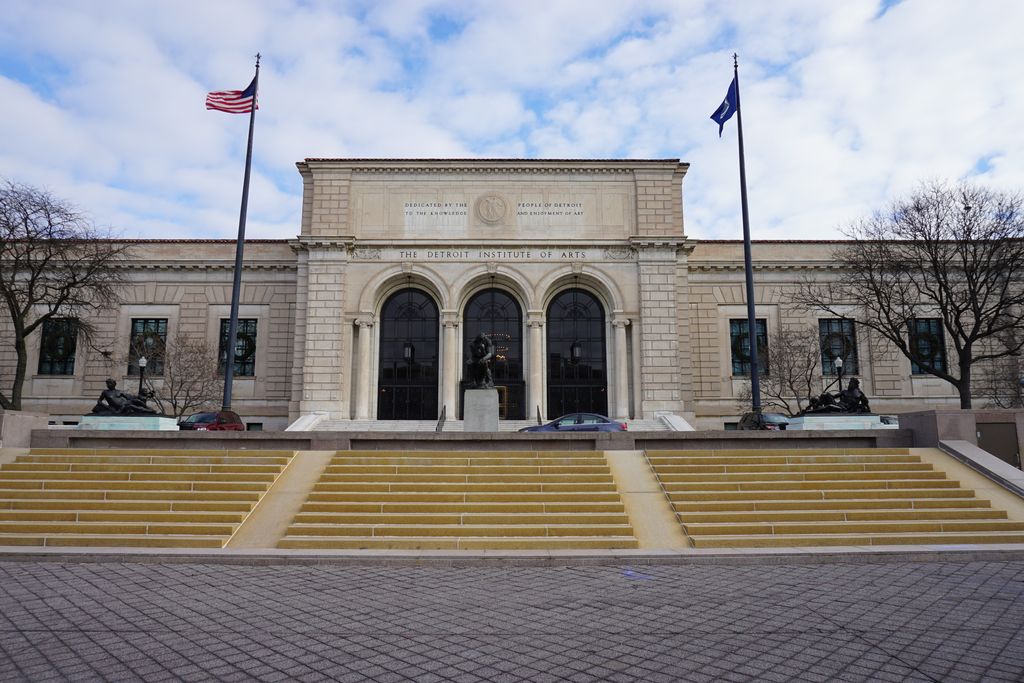
Kahlo's Detroit record cannot be reduced to standing beside the frescoes. The Henry Ford holds a photograph dated 2 August 1932 in which she is working on Self-Portrait on the Border Line between Mexico and the United States. It establishes work in progress on that date, not the exact day of completion. The individual painting study considers the object's particular imagery. [7]
Her work during the larger American period ranged beyond a single contrast of machines and Mexican roots. The painting commonly called Window Display on a Detroit Street carries a 1931 inscription, while Christie's catalogues its execution as 1931–32. That difference cautions against forcing every work into a precise Detroit month. Lucienne Bloch's later account of a shop-window encounter, as reported in the lot essay, is valuable testimony with a different status from a dated making diary. [15]
Detroit was also marked by grief and disrupted travel. Kahlo's medical experience has often become the entire explanation for the art she made there, yet such a single-cause story fails to account for her earlier experiments, her continuing work and the larger network of friends and influences. Curator Mark Rosenthal describes the Detroit period as significant to her development; it is a considered later interpretation, not Kahlo's declaration that one event made her an artist. [3] [16]
Her mother's death drew Kahlo back to Mexico in September 1932, interrupting what is sometimes described as an eleven-month Detroit residence. The documents available here do not establish every travel day around that interruption. The Detroit study examines the work, friendship with Bloch and personal events at city level without treating Rivera's mural as Kahlo's own commission. [3]
Family Correspondence Across the Border
The American period also appears differently when read from Mexico. In letters published by Annette B. Ramírez de Arellano and Servando Ortoll, Guillermo Kahlo writes of missing his daughter and grieving after Matilde's death. His December 1932 response places her geographical absence beside his wife's irreversible absence, giving the prolonged journey a family cost beyond Kahlo's own homesickness. [26]
Their exchange also sustained practical collaboration. The published correspondence records photographs of the San Ángel houses sent by Guillermo and Kahlo's proposal that he preserve his photographic knowledge in a book. His refusal, expressed with self-deprecating humour, shows that the relationship involved requests, resistance and attempts to give work a continuing purpose. [26]
Affection did not mean uncritical approval. August 1933 letters allude to Guillermo's criticism of one of Kahlo's paintings, but the preceding letter is missing and the work cannot be identified securely. These published extracts add a demanding family voice to the American years without turning an uncertain picture identification into fact. [26]
Her older sisters, Matilde and Adriana, offered another kind of involvement. Their published 1932 letters repeatedly urged her to return to Mexico, where family members could attend to her, while the exchange shows information about illness being selectively shared or withheld. The sisters' own husbands and children limited their ability to travel, making the problem of care more complicated than a simple preference for home over the United States. [28]
The Rockefeller controversy reached that family through newspapers as well as private correspondence. Adriana's May and June 1933 letters expressed fear for the couple and urged their return, but those fears are not proof that the threatened harm occurred. American events were being interpreted at a distance by relatives whose affection, limited information and anxieties shaped what they wrote. [28]
New York Again: Work, Marriage and Patronage in 1933
By the time the couple were in New York again in 1933, Rivera's Rockefeller Center project brought a different network of patrons and publicity. Kahlo took part in that world without simply becoming an appendix to the mural. A telegram sent to her by the Detroit Institute of Arts director William Valentiner on 6 May 1933 gives a New York hotel address and thanks her for a picture. The message does not identify the work or document a sale, but it does show a direct professional exchange addressed to Kahlo. [17]
The commission's collapse did not end all work in New York. Rivera was dismissed and the mural covered in May 1933, but he went on to complete the Portrait of America panels at the New Workers' School that December. MoMA's chronology dates the couple's return to Mexico to 26 December and the Rockefeller mural's destruction to February 1934: dismissal, continued work, departure and destruction were separate events. [29]
The Mexican scholars Servando Ortoll and Annette B. Ramírez de Arellano interpret her correspondence with Abby Aldrich Rockefeller as evidence of an “entrepreneurial wife”: a woman who translated, organised and tended to the practical and social conditions of Rivera's work. Their argument usefully makes that often-invisible labour legible. It remains an interpretation based on letters not independently read in full for this article, and it does not cancel Kahlo's own painting, purchases, gifts or contacts. [18]
The two roles could coexist. Rivera's American commissions created access to cultural institutions, while Kahlo wrote to her family, met artists and collectors, and developed art that did not look like his murals. This is a better way to understand the period than either denying her participation in Rivera's career or assuming that assistance meant a lack of ambition of her own. [4] [5] [18]
Painting offered another way to negotiate that setting. Helga Prignitz-Poda reads My Dress Hangs There through the Rockefeller rupture and the prospect of returning to Mexico, treating its collage and absent wearer as more than a collection of American curiosities. That is an interpretation of the work, not a dated explanation supplied by Kahlo. [27]
The earlier letters make a sudden conversion from admiration to hostility difficult to sustain. Kahlo had already criticised inequality and the demands of wealthy society in November 1931, while continuing to enjoy aspects of New York and study its collections. The 1933 painting can belong to a changed situation without becoming the first evidence that she found American life contradictory. [4] [24] [27]
The 1938 Solo Exhibition and Later American Visits
Kahlo's return to New York in 1938 had a more clearly independent public purpose. An invitation located in the Philadelphia Museum of Art's Julien Levy Gallery records dates her solo exhibition to 1–15 November. MoMA's account of Fulang-Chang and I and contemporary press response confirm how New York audiences met her work, even though the complete Levy checklist and sales ledger have not been inspected here. [8] [19]
That distinction matters for the whole American story. The 1931 New York visit put her in the orbit of Rivera's retrospective and its patrons; the 1938 show presented a body of her own paintings under her name. Neither date alone proves that she first became an artist in America, but the contrast does show a change in public visibility and exhibition opportunity. The New York study follows the Levy exhibition and its reception more closely. [8] [19]
In 1940 Kahlo returned to San Francisco, where four works appeared at the Golden Gate International Exposition according to Fine Arts Museums of San Francisco labels. Her remarriage to Rivera at City Hall that December is part of the visit, not the whole reason it matters to her professional history. A later 1946 letter to Alejandro Gómez Arias reports a New York stay for treatment, another journey with a different purpose; the letter is her own report, not a substitute for a medical chart. [9] [20]
American ties also remained active when Kahlo was in Mexico. In a letter of 19 November 1939, held and fully transcribed by The Henry Ford, she asked Edsel Ford for help obtaining a recommendation for the Catalan exile Ricardo Arias Viñas to the company's Mexico City manager. The document proves her request and the durability of a Detroit connection; it does not prove that Arias received a job. Separate 1941 Ford catalogue entries show later correspondence but expose no letter text from which an outcome can be inferred. [10] [21]
What Changed Across These Visits?
The evidence does not support an instant transformation on a station platform, nor a single trauma that supplied artistic originality. A more defensible pattern is gradual and uneven: portraits and a group exhibition in San Francisco, intense museum looking and social observation in New York, dated work in Detroit, direct professional correspondence in 1933, and an independent New York exhibition in 1938. Mexican family life, dress, visual traditions and political concerns accompanied Kahlo across those borders rather than disappearing in an American setting. [2] [5] [7] [8] [18]
The phrase “creative awakening,” associated with Stahr's study of 1930–33, remains a worthwhile interpretive proposition. Her complete book and Bloch diary sources have not been read for this article, so it should not be presented as a proven diagnosis of Kahlo's interior life. The surviving letters and institutions tell a more interesting, less tidy story: an artist learning, working, sometimes not working, navigating another country's wealth and poverty, and returning to American contacts when they could serve her own purposes. [1] [5] [10] [13]
Frequently Asked Questions
Her principal early American period ran from the San Francisco arrival in November 1930 through visits to New York and Detroit in 1931–33. It was not continuous residence in one city: a September 1932 journey to Mexico interrupts the Detroit sequence, and she made separate returns in 1938, 1940 and 1946. [1] [3] [8] [9] [20]
Yes. A San Francisco archive lists her in a 1931 group exhibition. The 1938 Julien Levy Gallery show was her first New York solo exhibition, not the first time she had ever shown work publicly. [6] [8] [25]
Detroit was significant, and a dated 1932 archive photograph documents her at work on a painting there. The claim that one place or painful event created her originality is an interpretation, not a contemporary fact; her earlier portraits, exhibitions, letters and later work belong in the explanation as well. [2] [6] [7] [16]
Related Reading
Explore Kahlo in San Francisco, Kahlo in Detroit and Kahlo in New York for the fuller local histories. The Kahlo timeline places the journeys alongside work in Mexico, while Frida Kahlo's fashion examines the dress and self-presentation she carried across borders.
Discussion
Use the cited evidence and your own close looking to explain your view. The prompts below are starting points, not fixed interpretations.
Reader Insights
How did Kahlo's role differ across the 1930–33 San Francisco, New York and Detroit visits?
What do her November 1931 letters establish about museum looking and painting at that date?
How did the 1938 solo exhibition and later US contacts change her public position?
Join the Conversation
Which reading best fits the evidence, and where does uncertainty remain?
References
- Celia Stahr, Frida in America: The Creative Awakening of a Great Artist (St Martin's Press, 2020), publisher's opening excerpt and edition record only. The full book and notes were not read. View source text.
- Fine Arts Museums of San Francisco, bilingual labels for Frida Kahlo: Appearances Can Be Deceiving, sections on Montgomery Street, San Francisco portraits and later return. View source text.
- Museo Frida Kahlo, English life chronology, 1932 Detroit and Mexico entries and later US visits. The April move is an institutional month, not a verified arrival day. View source text.
- National Museum of Women in the Arts, Kahlo to Matilde Calderón, 14 November 1931, folder 127 pp. 1–5, original Spanish institutional transcription. View source text.
- National Museum of Women in the Arts, Kahlo to Matilde Calderón, 27 November 1931, folder 131 pp. 1–6, original Spanish institutional transcription; p. 4 reports that she had not yet painted in New York. View source text.
- Smithsonian Archives of American Art, sixth annual exhibition catalogue metadata, 4 November–3 December 1931, California Palace of the Legion of Honor; full Kahlo checklist entry not scanned. View source text.
- The Henry Ford, “Frida Kahlo at Work on Self-Portrait on the Border Line between Mexico and the United States, 1932,” object 2002.0.34.7, dated 2 August 1932. Research-only record; image not reproduced. View source text.
- Philadelphia Museum of Art, Julien Levy Gallery Records, Box 35 folder 7, invitation for Kahlo exhibition, 1–15 November 1938. Finding aid, not complete checklist. View source text.
- Fine Arts Museums of San Francisco, 1940 Golden Gate International Exposition labels, four Kahlo works and San Francisco return. View source text.
- The Henry Ford, Kahlo to Edsel Ford, 19 November 1939, object 64.167.6.58, complete museum transcription of her request on behalf of Ricardo Arias Viñas. View source text.
- San Francisco Museum of Modern Art, Frieda and Diego Rivera, owner object record and accompanying descriptions. View source text.
- National Museum of Women in the Arts, Kahlo's 21 November 1930 letter to her mother, institutional transcription; San Francisco/Burbank context. View source text.
- Walker Simon, review of Celia Stahr's Frida in America, CUNY Graduate Center-hosted Vol. 15.1 (2020), PDF pp. 2–5. This review maps primary sources and discusses translation, but cannot stand in for the book and gives a conflicting Detroit arrival month. View source text.
- The Henry Ford, “Detroit Industry Frescoes: The Backstory,” curated archival set and introduction to the Edsel Ford-funded Rivera commission. Individual documents have separate evidentiary status. View source text.
- Christie's, Window Display on a Detroit Street, object record, essay and literature, recording execution as 1931–32 despite its 1931 inscription. View source text.
- Yale University Press, “Diego and Frida in the Motor City,” interview with curator Mark Rosenthal (8 May 2015). His assessment of artistic change is an interpretation; the full Detroit catalogue was not read. View source text.
- National Museum of Women in the Arts, William Valentiner telegram to Frida Kahlo, 6 May 1933, folder 191 p. 1. The thanked picture is unidentified. View source text.
- Servando Ortoll and Annette B. Ramírez de Arellano, “Frida Kahlo: Retrato de la artista como esposa empresaria,” Desacatos 11 (2003), pp. 120–131, especially 128–130. The original Rockefeller letters were not independently read. View source text.
- Museum of Modern Art, “Kahlo's New York Debut” and Fulang-Chang and I context; contemporary 1938 press and a single Levy catalogue entry are documented in the New York page research. View source text.
- Museo Dolores Olmedo, Kahlo's 30 June 1946 letter to Alejandro Gómez Arias, four displayed transcription pages, artist's report of her New York stay. This is not a clinical record. View source text.
- The Henry Ford, Kahlo to Edsel Ford, 5 December 1941, object 64.167.6.67, metadata only. Its text and any employment outcome have not been read. View source text.
- SFMOMA, “Frida Kahlo,” institutional artist page, interpretation of 1930–31 California portraits in relation to Mexican folk portraiture. View source text.
- National Museum of Women in the Arts, Kahlo to Matilde Calderón, 16 November 1931, folder 128 pp. 1–8, original Spanish institutional transcription; museum visits and family finances. View source text.
- National Museum of Women in the Arts, Kahlo to Matilde Calderón, 20 November 1931, folder 129 pp. 1–6, original Spanish institutional transcription; museum looking and reported patrons. View source text.
- Online Archive of California, San Francisco Society of Women Artists collection finding aid, 1931 listing for “Señora Frieda Rivera.” View source text.
- Annette B. Ramírez de Arellano and Servando Ortoll, “¡Queridísima Frieducha!… Cartas de Guillermo Kahlo a su hija Frida,” La Ventana 4, no. 32 (2010), pp. 244–269, especially pp. 247, 253, 260–261 and 265–266. Complete article read; letter extracts regularised by the editors, not original manuscript inspection. View source text.
- Helga Prignitz-Poda, Hidden Frida Kahlo: Lost, Destroyed or Little-Known Works, translated by Cynthia Hall (Prestel, 2017), selected American-period chapter, printed pp. 54–67, especially pp. 64–67. Complete book not read. View source text.
- Annette B. Ramírez de Arellano and Servando Ortoll, “Fridi Linda: El legado epistolar de las hermanas Kahlo,” Estudios sobre las Culturas Contemporáneas XIX, no. 38 (2013), pp. 121–139, especially pp. 127–130 and 135–136; editorial regularisation explained at p. 124 n. 7. Complete article read, not complete original letters. View source text.
- Museum of Modern Art, Diego Rivera: Murals for The Museum of Modern Art, online chronology, 1933 entry: May dismissal, continued New York work, December return and February 1934 destruction. View source text.
Image Credits
- Detroit Institute of Arts January 2015 01 — Michael Barera. CC BY-SA 4.0. Resized and converted to JPEG/sRGB; no crop.
