


 by Tom Gurney
Tom Gurney BSc (Hons) is an art history expert with over 20 years experience
Page created on March 2, 2018 / Page updated on October 6, 2026
Email: tomgurney1@gmail.com / Phone: +44 7429 011000
Introduction
Casa Azul in Coyoacán was a family dwelling, one of Frida Kahlo’s working places and, after her death, a deliberately arranged museum. Its courtyard, studio, garden, domestic objects and archive offer unusually close evidence of a life and an artistic environment, but the house was altered while Kahlo lived there and repeatedly reinterpreted after 1954. To understand it, a visitor needs the history of those changes as well as the atmosphere that the museum seeks to preserve. [1] [2] [3] [4]
The house stands at Londres 247, at the corner of Allende in Colonia del Carmen, Mexico City. Museum sources identify it as Kahlo’s birthplace and the place where she died; a 2025 museum statement estimates that she lived there for thirty-six of her forty-seven years. That summary must not imply continuous residence: travel, stays in the United States and years associated with the separate San Ángel studios punctuated her attachment to Casa Azul. [2] [3] [5]
At a Glance
- Place: Londres 247, Coyoacán. Institutional histories date the original family house to 1904; its first plan and colour are less certain. [1] [2]
- Changing building: A courtyard house received security changes during Leon Trotsky and Natalia Sedova’s stay and a substantial studio and bedroom addition associated with Juan O’Gorman in 1946. [1] [2]
- Museum: Diego Rivera established a trust in 1955, followed by a complementary deed in 1957. The museum opened on 12 July 1958, according to Mexico’s National Institute of Anthropology and History, or INAH. [2] [6] [7]
- Archive: Spaces kept closed for decades were opened after 2004; cataloguing, exhibitions and conservation have altered what can be studied and how it is shown. [8] [9]
- Visiting: For current tickets, hours and access, see the museum's visit page. [10]
Contents
- Introduction
- A Courtyard House That Became the Blue House
- Kahlo’s Intermittent Home
- The 1946 Studio and Garden Changes
- Rooms, Work and Collecting
- A Trust and a Designed Museum
- Closed Spaces and the Archive Opened After 2004
- Conservation as Part of the Story
- What the Museum Shows Now and What Can Change
A Courtyard House That Became the Blue House
Museo Frida Kahlo’s Spanish booklet associates the original family house with Guillermo Kahlo and dates it to 1904. INAH describes its first plan as C-shaped around an open courtyard, a domestic arrangement later expanded and altered. No original permit, architect’s drawing or complete construction file confirms every detail of that early reconstruction. [1] [2]
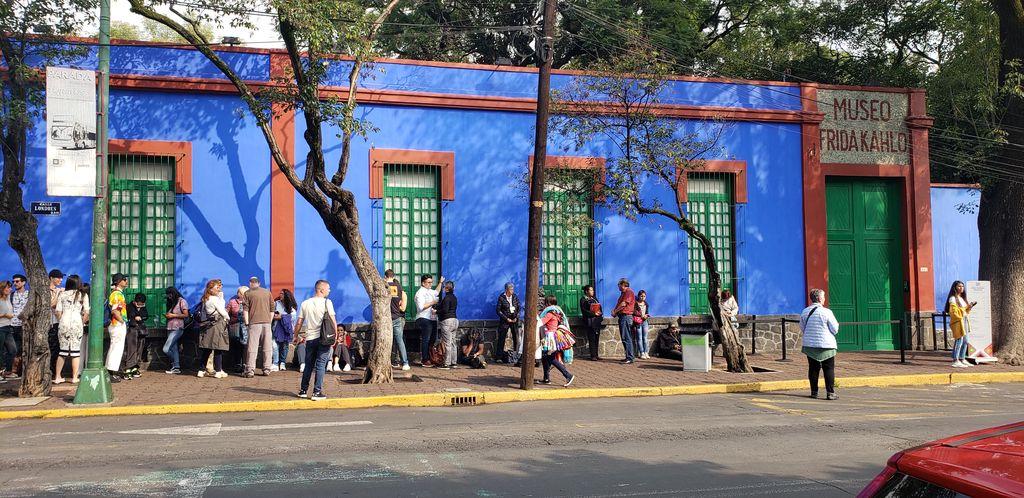
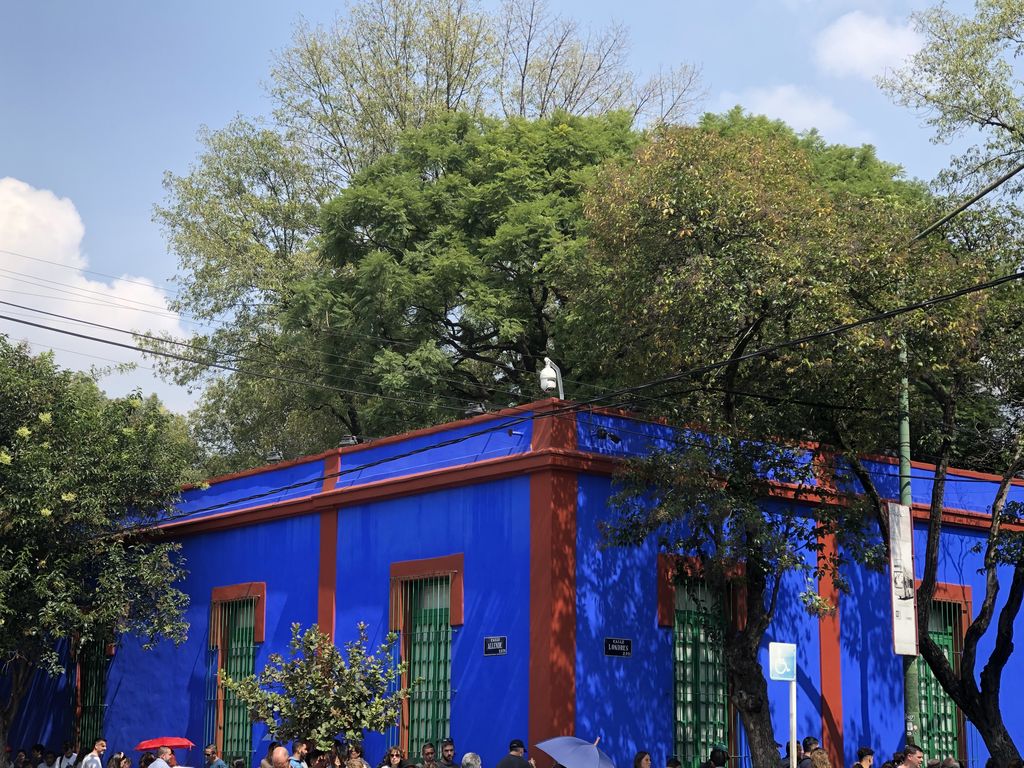
The familiar blue exterior should not be projected unchanged back to the date of construction. INAH retrospectively links the house’s name to blue walls in its 1904 history, but that account cites later writing rather than a contemporary paint analysis; the exact date and extent of early blue have not been established from controlled colour evidence. The same record describes a changing palette, including blue, green, brick and gold surfaces in 1939. [1] [2]
INAH classifies the property as a civil building of cultural value, originally a residence and now a museum. Its record does not list the house as an individually declared historic monument or as a UNESCO World Heritage site. That administrative description is distinct from its evident cultural importance and should not be inflated into a legal designation it does not hold. [2]
The present house combines different architectural moments. A courtyard dwelling, secured and enlarged grounds, an upper studio and later museum changes cannot accurately be reduced to one “colonial,” “French” or “functionalist” style. INAH also records reforms to exterior and interior façades in 1988, although the full project file and its exact scope have not been acquired. [1] [2]
Watch: Frida Kahlo
Five perspectives to view here alongside the article.
Frida Kahlo’s The Two Fridas: Great Art Explained
A focused visual introduction to the painting and its context.
Kahlo’s Intermittent Home
Kahlo grew up in the family house, but marriage did not begin a single uninterrupted residence there. She and Rivera married in August 1929, lived at other Mexican addresses and spent substantial time in the United States from 1930 to 1933. After their return they used Juan O’Gorman’s separate San Ángel house-and-studio complex; calling its smaller blue building “Casa Azul” would confuse two places with different construction and occupancy histories. [2] [5] [11]
INAH’s property history says Rivera helped pay the family mortgage or debts and records a short Casa Azul stay during Kahlo’s mother’s final illness in 1932. The deed and amount are not documented in the cited account, so it establishes only the broad institutional history, not the terms of a transaction. The residence history is clearer at the level this page needs: Casa Azul remained an anchor while Kahlo also lived and worked elsewhere. [1] [2]
Leon Trotsky and Natalia Sedova stayed in the house beginning in 1937. The museum booklet and INAH describe street-facing windows or walls being closed for security, another room being added and an adjoining parcel acquired; the booklet gives the parcel as 1,040 square metres. Those physical changes explain how a family dwelling adapted to a particular political circumstance without requiring this page to retell the entire asylum history or treat the addition as the house’s original plan. [1] [2]
By summer 1939 Kahlo was living at Casa Azul again, before her divorce from Rivera was completed. They remarried in December 1940, and the house became a principal shared base from early 1941, while Rivera continued to use his San Ángel studio. This chronology matters because the often repeated phrase “she returned after the divorce” reverses the sequence and obscures a dual-site working life. [2] [5] [11]
Casa Azul also served recovery and work, but the furniture cannot be turned into a simple story that an accident created Kahlo’s artistic ability. The museum identifies a bed with an overhead mirror in the day bedroom and describes its adaptation after the 1925 collision. Kahlo had drawn before that event; the mirror and bed show changed conditions under which she worked, not a documented moment when talent appeared from nothing. [1] [4]
The 1946 Studio and Garden Changes
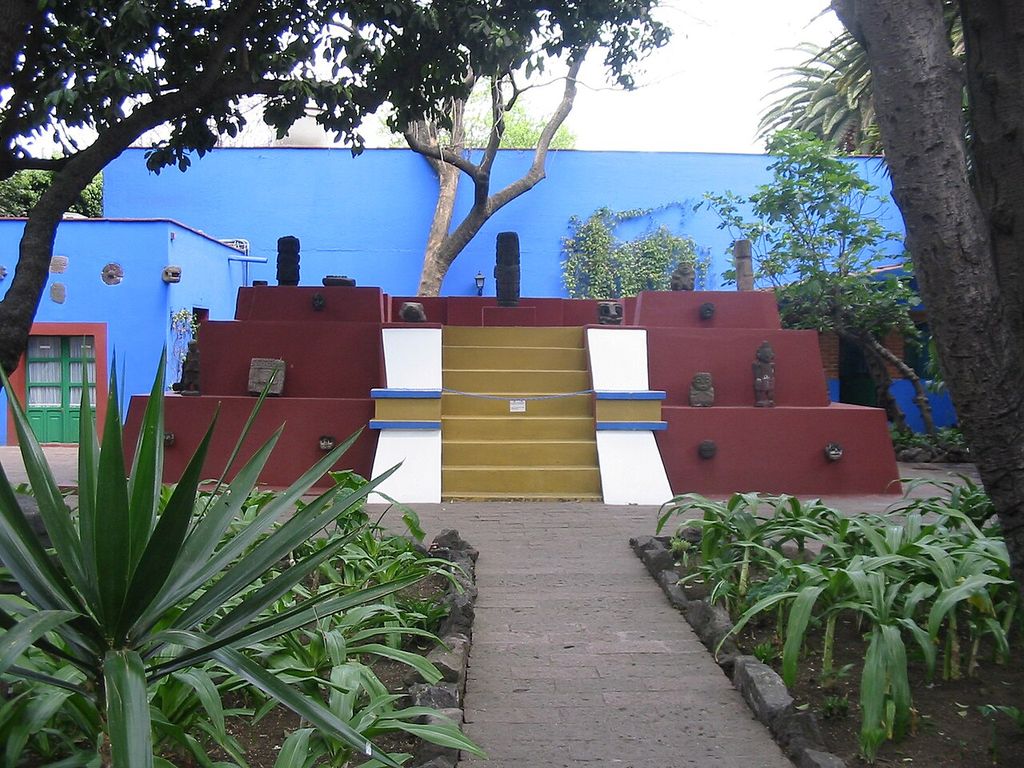
In 1946 Rivera asked O’Gorman to help create a new studio at Casa Azul. The museum booklet describes a functional working space using local volcanic basalt alongside pre-Columbian sculpture, mosaics, shells and jars built into the walls. INAH identifies an upper studio and bedroom wing and attributes one natural-stone mosaic to Mardonio Magaña, a reminder that not every decorative element should automatically be credited to O’Gorman. [1] [2]
The addition brought practical working needs together with materials and forms that the museum associates with Mexican cultural traditions. Its date and designer must be kept separate from the original 1904 house, whose architect or contractor is not established by the cited records. The upstairs rooms, easel, brushes and books belong to a history of work rather than a generic image of the artist lying permanently in bed. [1] [2] [4]
The garden changed with the property. INAH describes a wall, fountain, stepped pyramid, water feature and a small room for archaeological display among the later works. The booklet’s adjoining-parcel figure cannot simply be added to its present estimates of roughly 800 square metres of construction and 1,200 square metres of land, because the intervening cadastral history has not been established. [1] [2]
Daniel Glass has argued that Kahlo’s garden and art can be read in relation to one another, according to a published summary of his Garden History article. The complete article has not been consulted, so Glass's claim remains an attributed argument rather than a fully tested account of every plant or motif. Portuguese scholars Wesley Oliveira Kettle and Victória Emi Murakami Vidigal make a different, useful point: a historic garden presented to visitors becomes a curated heritage environment, not an untouched view of its owner’s lifetime choices. [12] [13]
That distinction protects the living garden from becoming a false inventory of Kahlo’s intentions. The current arrangement may preserve older elements, incorporate later planting and reflect museum maintenance; no controlled census proves that every specimen or displayed sculpture was selected by Kahlo. The building chronology rests on the museum and INAH, while the garden’s artistic and heritage meanings remain attributed interpretations. [1] [2] [13]
Research for the New York Botanical Garden’s 2015 Frida Kahlo: Art, Garden, Life exhibition illustrates the problem. NYBG curator Joanna L. Groarke reported little detailed contemporary documentation of Casa Azul’s plantings, although the team studied photographs, visited the property and consulted a hand-drawn 1939 home-and-garden map attributed to Kahlo. The map's plant labels have not been verified against the original and cannot be repeated as a secure lifetime inventory. [25]
The Botanical Garden built an evocation in the Bronx from several kinds of evidence, including plants seen in lifetime and later photographs, plants depicted in Kahlo’s art and species selected for their Mexican cultural associations. That creative reconstruction was neither Casa Azul’s present garden nor a literal replica of a particular year in Kahlo’s life. It helps explain why the garden’s history is best told through identifiable changes and documented research choices, with the living display’s broader symbolism clearly attributed. [25]
Rooms, Work and Collecting
The museum’s presentation identifies a day bedroom with bed and overhead mirror, an upstairs studio with work tools, and bedrooms associated with Kahlo’s later years. Its booklet describes an easel said to have been a gift from Nelson Rockefeller, along with brushes and books; no original transaction record confirms that gift attribution. These details are most useful as evidence of how living, care and work occupied different parts of the house, not as props in an unchanging biographical scene. [1] [4]
Crutches, corsets, medicines and a wheelchair also appear in the institution’s account of the house. They document possessions and museum choices, but no displayed object on its own establishes a diagnosis, a precise period of use or the meaning Kahlo assigned to it. Likewise, a memorial arrangement involving her ashes should be described as a museum presentation, not as proof that the present bedroom has remained exactly as it was in July 1954. [1] [2] [4]
The kitchen and dining room speak to a different kind of domestic history. The museum booklet’s contribution by Romandía describes a tiled charcoal stove, clay vessels, wooden utensils, regional ceramics, textiles and painted furnishings; jars on the kitchen wall form the names Diego and Frida. Some tableware sets are incomplete, a modest material reminder that a curated domestic room is not a perfectly preserved day in the couple’s life. [1]
These objects can show what was kept and how the museum has chosen to arrange it. They cannot, without a dated menu, letter or witness, prove that a particular guest ate a particular meal or that Kahlo personally placed every vessel where it stands. The house’s role in hospitality is well established at a general level, but a roll call of famous visitors would substitute celebrity recognition for the spatial history this page can actually document. [1] [8]
Frida and Diego collected Mexican popular art, and Rivera’s archaeological interests shaped parts of the house and garden. The museum describes ceramics from several Mexican regions, exvotos, sculptures, photographs, books and other objects, but a collection category is not item-by-item provenance. Its statement that the couple assembled nearly 500 exvotos, for example, is a dated institutional estimate; the separate history and religious forms of those objects deserve their own study. [1] [4]
A Trust and a Designed Museum
Casa Azul did not become a public museum through a simple outright gift of the building “to Mexico.” Banco de México’s trust history, a 2025 museum communiqué and UNAM legal commentary identify a trust created in August 1955 to open and maintain Casa Azul and the Anahuacalli as public museums. UNAM gives 16 August and deed number 19066, while Banco records a complementary deed on 10 September 1957; the complete signed deed and asset schedules are not available in the cited records. [3] [6] [7]
Banco de México is the fiduciary, but the museum describes the trust as private and nonprofit. A Banco transparency decision characterises its patrimony as private resources rather than Banco’s own public funds, while the bank’s broader history also records federal participation in museum-adaptation work. Those distinct facts prevent two easy but inaccurate summaries: that Casa Azul is simply a government museum, or that its history has been funded solely by tickets and donations. [3] [6] [14]
The museum opened on 12 July 1958 according to INAH. Poet and curator Carlos Pellicer planned its initial presentation, and former museum director Hilda Trujillo Soto describes rooms devoted to Kahlo, Rivera and their circles alongside furnished domestic spaces intended to retain a sense of the house. That intention is a curatorial act: the first museum already selected, grouped and interpreted material rather than opening an untouched private residence. [2] [4] [8]
The museum dates a later permanent exhibition to the late 1960s, while INAH records building changes in 1988. The archive project and exhibition of the 2000s and a new thematic installation opened in 2023 added still more phases. A visitor may experience continuity across them, but it is continuity made by preservation, editing and renewal—not by the absence of intervention. [2] [4] [8] [15]
Closed Spaces and the Archive Opened After 2004
Rivera asked that his bathroom remain closed for fifteen years after his death, according to the museum booklet and Trujillo Soto. Dolores Olmedo kept that bathroom and several other spaces or containers closed for almost fifty years. The later discoveries therefore did not emerge from one neat “secret bathroom”: another bathroom, storage areas, wardrobes, trunks, drawers and other places formed a dispersed archive. [1] [8]
After Olmedo’s death, a museum committee authorised opening and recovery work in 2004. Trujillo Soto describes nearly three years of classification with ADABI and specialist help; the material included garments, orthopaedic devices, correspondence, photographs, books, drawings, periodicals and artworks. Opening a space was only the beginning: identifying, documenting, conserving and deciding how to display each item created a new research collection. [8] [9]
The scale is considerable, but its totals are not stable across publications. Trujillo Soto’s 2008 account reports 22,105 documents, 5,387 photographs, 2,170 books, 3,874 periodicals, 1,124 graphic items, more than 300 garments and 270 works on paper or canvas. A later conservation study gives rounded totals of about 27,000 documents, 6,500 photographs, 300 garments and 400 artworks, while the museum’s 2022 booklet lists 2,776 books rather than 2,170. [1] [8] [9]
Different stages or definitions may explain some discrepancies, but the published sources do not establish a reconciliation. It is safer to say that the opened material comprised tens of thousands of documents and thousands of photographs than to advertise one undated “final” count. The figures above are dated reports of particular cataloguing moments, not quantities that can be averaged into a supposedly exact present inventory. [1] [8] [9]
The 2007 Tesoros de la Casa Azul exhibition made that archive work visible. Trujillo Soto says five rooms, the stairwell and studio were intervened and that the original museography changed substantially; selected documents, books, photographs, drawings and other material entered the display. The exhibition is evidence of an active museum making new stories from the house, not proof that every discovered item was simultaneously displayed or that the old rooms survived untouched. [8]
Conservation as Part of the Story
The photographic archive is particularly revealing because photographs carry histories on their surfaces. Conservators Elisa Carmona Vaillard and Karla Castillo Leyva describe inscriptions, paint, lipstick, crop marks, folds and older adhesive repairs. Some alterations were retained as evidence of handling and artistic use, while unstable materials could be removed or treated; “restoring” a photograph did not mean erasing every trace of its life in the house. [9]
Their account of a 2014 campaign gives treatment figures for 305 photographs in two condition groups and five especially unstable works. Those are project-stage numbers, not a count of the archive as a whole. Their broader argument is that preservation and historical evidence can pull in different directions, and that treatment must balance both rather than turn every mark into damage or every old repair into a sacred relic. [9]
This is why Casa Azul is an archive as well as a museum of rooms. Its documents, photographs and objects can complicate familiar stories, but custody does not make the collection complete: related material survives in other institutions and private hands. The photographic archive and full correspondence networks deserve their own accounts; here they demonstrate how new evidence and conservation decisions continue to change the house’s public meaning. [9]
What the Museum Shows Now and What Can Change
Museo Frida Kahlo describes the house and garden as holding personal objects, furniture, working tools, photographs, books, Mexican popular art, pre-Columbian sculpture, documents, clothing and paintings by Kahlo and Rivera. These are collection categories, not a promise that every named object occupies the same room on every visit. Conservation, loans and changing exhibitions can alter access even when the building itself is open. [1] [4]
The museum says its exhibition Un lugar lleno de lugares: la Casa Azul opened on 28 July 2023 with more than 200 works and personal objects. A contemporary account describes curatorial themes including the house as refuge and workshop, a window on the world and an ideological statement. Those themes are the museum’s interpretation of its holdings; the exhibition’s present status and exact object list should be checked on its official page before a visit. [4] [15]
The wardrobe and personal-object displays have also travelled and been reframed. The V&A’s 2018 Making Her Self Up and Brooklyn Museum’s later Appearances Can Be Deceiving belong to a linked exhibition history, not two independent inventories proving every Casa Azul claim. A 2018 INBAL announcement described more than 200 objects from the house in that project; detailed histories of garments, corsets and Tehuana dress belong to the separate clothing account. [20] [21] [22]
Three Museums That Should Not Be Confused
Casa Azul is the Frida Kahlo Museum at Londres 247. The Museo Casa Estudio Diego Rivera y Frida Kahlo in San Ángel is a separate complex of functionalist houses and studios associated with O’Gorman’s earlier work; the blue building there is not the Coyoacán family house. Rivera’s continuing use of San Ángel while Casa Azul served as a principal home makes the distinction historical as well as practical. [2] [3] [11]
The newer Museo Casa Kahlo at Aguayo 54 is also a separate institution. Museo Frida Kahlo’s 2025 communiqué identifies it, the San Ángel museum and Museo Dolores Olmedo as independent of the Banco de México museums trust. A visitor planning to see the courtyard, 1946 studio or Casa Azul archive should therefore verify the institution and address before booking rather than relying on “Frida’s house” as an unambiguous destination. [3] [16]
Planning a Visit
The enduring location is Londres 247, but opening hours, timed-ticket rules, prices, access provisions, photography restrictions and the status of individual displays are service information. The museum’s home and visit pages have published conflicting hours, so a fixed schedule would be unreliable. Use the official visit page and confirm conditions immediately before going. [2] [10]
The official page describes accessibility measures as well as limitations imposed by a historic house; requirements should be checked for a particular visitor rather than assumed from a general description. Personal-photography rules are separate from permission to republish collection works or images of visitors. The museum’s archive was still described as closed for restructuring when rechecked on 3 October 2026, a changeable access state that should be verified directly before a research visit. [10] [23]
Books for the House and Its Archive
Three relevant books open different routes beyond the museum’s public rooms. Claire Wilcox and Circe Henestrosa’s Frida Kahlo: Making Her Self Up is a candidate for possessions and their exhibition history; Frida Kahlo: Her Photos, edited with texts including Pablo Ortiz Monasterio’s, is especially relevant to the photographic archive; Guadalupe Rivera and Marie-Pierre Colle’s Frida’s Fiestas offers a route into household food and family reminiscence. These recommendations rest on publisher and museum descriptions, not on complete first-hand readings, and their unread passages are not cited as evidence for historical details. [17] [18] [19]
The 2007 Banco de México volume La Casa Azul de Frida would be an especially valuable source for further study for the building itself. Only an official nine-page press and sample PDF has been examined, not Beatriz Scharrer Tamm’s complete architectural essay or the full book. Daniel Glass’s complete garden article and the 2015 NYBG catalogue Frida Kahlo’s Garden likewise remain unread; the garden interpretation here is limited to Glass’s published summary, the complete Portuguese heritage study and Groarke’s participant account. [12] [24] [25]
Casa Azul remains compelling because its house, workspaces, collection and archive meet in one place. Its value does not depend on imagining that time stopped there in 1954. The more exact history—of family residence, architectural change, a two-stage museum trust, closed storage, cataloguing and careful conservation—shows how much work has gone into making the house legible at all. [1] [2] [6] [8] [9]
Related Reading
The fashion and Tehuana dress study examines objects and clothing preserved at Casa Azul. The San Francisco account follows one of Kahlo’s periods away from the house, while the technique and materials guide considers how surviving objects support claims about her artistic practice. These subjects clarify different aspects of the house without treating its present display as an unchanged record of her lifetime.
Frequently Asked Questions
The date when its exterior became predominantly cobalt blue has not been established from the sources cited here. Institutional records describe an early courtyard house and later changes of colour, building and display. The present name should not be used as evidence for a 1904 paint scheme. [1] [2]
No. It was her family home and a recurrent place of work and residence, but she also lived or stayed elsewhere in Mexico and the United States and used the separate San Ángel complex. The museum’s thirty-six-of-forty-seven-years figure is a summary of association, not a continuous-residence chronology. [2] [3] [5] [11]
No. Pellicer arranged its first display, a later permanent exhibition was mounted, the building underwent recorded changes, and the archive opening, 2007 intervention, conservation work and 2023 exhibition all changed how the house is presented. A preserved atmosphere is a curatorial aim, not proof that every room and object remains in its lifetime position. [2] [4] [8] [9] [15]
Check the museum’s current access and visitor rules directly. A reported archive closure for restructuring and rules allowing some personal photography were current-service statements when checked, not permanent guarantees or rights to republish images. Permission for a personal photograph is separate from permission to publish an image of a collection object. [10] [23]
Discussion
Use the cited evidence and your own close looking to explain your view. The prompts below are starting points, not fixed interpretations.
Reader Insights
Which parts of Casa Azul belong to Kahlo's lifetime, and which reflect later museum decisions?
How do the 1946 studio and the altered garden complicate the idea of an unchanged childhood home?
What does the archive opening after 2004 make possible to study?
Join the Conversation
Which reading best fits the evidence, and where does uncertainty remain?
References
- Museo Frida Kahlo, La Casa Azul: el universo íntimo de Frida Kahlo, complete nineteen-page institutional booklet; architecture and studio at printed pp. 1–4, household and collections at pp. 7–14. View source text.
- Instituto Nacional de Antropología e Historia, National Catalogue record for Museo Casa de Frida Kahlo / Casa Azul, I-09-03866, identification, history, legal and architectural sections; official indexed text, updated 4 February 2025. The direct record was unavailable when consulted. View source text.
- Museo Frida Kahlo, communiqué MFK-MDRA/003-25, June 2025. View source text.
- Museo Frida Kahlo, museum and collection pages, including the permanent and Un lugar lleno de lugares exhibition descriptions. View source text.
- Museo Frida Kahlo, Frida chronology, relevant residence and work entries. View source text.
- Banco de México, history of the Diego Rivera and Frida Kahlo museums trust, chapter IV.7 and notes on the original and complementary deeds. View source text.
- Antonio Fernández Fernández, “La disputa por los derechos de la imagen de Frida Kahlo”, UNAM legal commentary, introductory trust history, 2021; original deed not inspected. View source text.
- Hilda Trujillo Soto, “Tesoros de la Casa Azul, una experiencia museográfica en el Museo Frida Kahlo”, Museos.es 4 (2008), pp. 222–229; opening and archive totals at pp. 222–223, exhibition changes at pp. 224–225 and 228. View source text.
- Elisa Carmona Vaillard and Karla Castillo Leyva, “La historicidad como principio de conservación en la intervención de la colección fotográfica de Frida Kahlo”, Estudios sobre conservación, restauración y museología III (2016), pp. 19–28; discovery and material state at pp. 19–21, treatment and historicity at pp. 22–23, conclusions at pp. 27–28. View source text.
- Museo Frida Kahlo, official visit page; current visitor hours, tickets, rules and accessibility details; service information may change. View source text.
- INBAL, “Se cumplen 90 años de la primera casa funcionalista en México”, official account of the separate San Ángel complex, 2019. View source text.
- Erin Blakemore, “Inside Frida Kahlo’s Garden”, JSTOR Daily, summarising Daniel Glass, “Once Upon a Time in Mexico,” Garden History 39, no. 2 (2011), 239–248. Glass’s complete article was not read. View source text.
- Wesley Oliveira Kettle and Victória Emi Murakami Vidigal, “O lado verde da Casa Azul: o jardim de Frida Kahlo como espaço para o Ensino de História”, Revista Espacialidades 18, no. 1 (2022), 17–37; used for heritage interpretation, not its erroneous biographical details. View source text.
- Banco de México Transparency Committee, resolution on the museums trust, findings on private resources and fiduciary role. View source text.
- La Jornada report on Un lugar lleno de lugares, 28 July 2023; launch framing, not proof of a current installation. View source text.
- Museo Casa Kahlo’s official site; its independence from the Banco de México museums trust is stated in the Museo Frida Kahlo's June 2025 communiqué (reference 3). View source text.
- V&A, Frida Kahlo: Making Her Self Up exhibition-book record; complete book unread. View source text.
- Editorial RM, Frida Kahlo: Her Photos publisher record; complete book unread. Its promotional claim that the house remains “just as” arranged is not adopted as historical proof. View source text.
- Penguin Random House, Frida’s Fiestas publisher record; complete book unread. View source text.
- V&A, Frida Kahlo: Making Her Self Up exhibition overview, 2018. View source text.
- Brooklyn Museum, Frida Kahlo: Appearances Can Be Deceiving exhibition record. View source text.
- INBAL, 2018 account of the Casa Azul objects in Making Her Self Up. View source text.
- Museo Frida Kahlo, archive and collection access page; service status requires rechecking. View source text.
- Banco de México, 2007 La Casa Azul de Frida press and sample PDF; nine-page sample examined; the complete book and Scharrer architectural essay were not consulted. View source text.
- Joanna L. Groarke, “Art, Garden, Life: A Multidisciplinary Approach to Frida Kahlo”, Museum, Fall 2016, pp. 60–70, especially pp. 63–66 on the 1939 map, photographs and Bronx reconstruction; complete participant article consulted. The reported 1939 map and 2015 catalogue were not read directly. View source text.
Image Credits
- Photo: Alex1210O / Wikimedia Commons, CC BY-SA 4.0. Resized to 1024 px wide; no crop. Source record.
- Photo: A01655306 / Wikimedia Commons, CC BY-SA 4.0. Resized to 1024 px wide; no crop. Source record.
- Thelmadatter. Public domain. Source: Wikimedia Commons (File:PyramidCasaAzul.JPG). 1024px proportional sRGB JPG derivative; no crop. Licence. Source record.
