


 by Tom Gurney
Tom Gurney BSc (Hons) is an art history expert with over 20 years experience
Page created on March 2, 2018 / Page updated on October 6, 2026
Email: tomgurney1@gmail.com / Phone: +44 7429 011000
Introduction
Frida Kahlo gave El venado herido (The Wounded Deer) to Lina and Arcady Boytler in May 1946 with a poem calling the painted animal her portrait. Her face joins a deer pierced by arrows, but the accompanying words do not stop at injury: they imagine shelter, relief, return and a clearing sky. That double movement is essential to an object often reduced to a picture of despair. [1] [2]
The small painting also has a firmly documented sequence. An official presentation of Kahlo's corrido says she made it in April and delivered it on 3 May; a letter she wrote on 30 June places a major New York operation only about three weeks before that later date. The Wounded Deer therefore cannot have been painted in disappointment after the June surgery, however relevant Kahlo's existing health difficulties may be to its imagery. [1] [3]
At a Glance
Contents
- Introduction
- A Human Face in an Arrow-Struck Body
- Forest, Broken Branch and Distant Water
- April Painting, May Gift, June Surgery
- The Corrido's Wound and Its Shelter
- What Is Written Beside the Signature?
- Arrows, Martyrdom and the Hunted Deer
- Love, Emblems and the Underworld
- A Body That Crosses Human and Animal
A Human Face in an Arrow-Struck Body
The horizontal support is only about thirty centimetres wide. Within it, tall trunks close around a deer whose head is Kahlo's: her joined brows, dark hair and outward gaze meet an animal neck and torso without a visible dividing line. Antlers rise above the hair, making the joined body more than a straightforward portrait with an animal beside it. [2] [5]
Nine arrows cross or enter the neck and body, a count supported by object-specific scholarship as well as the available image. Several wounds release narrow red streams. Yet the face has a closed mouth and no clearly visible tears; the painting does not tell us whether that controlled expression is calm, defiance, resignation or something else. [5] [6] [7]
The legs extend in different directions as if the deer were running, leaping or suspended between movements. No hunter is visible, and the painted moment does not disclose whether the figure is escaping, falling or landing. The arrows establish injury within the image, but neither the assailant nor the precise event they might stand for can be recovered by inspection alone. [5]
Kahlo's face remains the most direct encounter with the viewer while the deer's body fills the forest. This division is not simply face equals mind and body equals pain: the head is physically joined to the animal, and the antlers and dark hair participate in the same silhouette. The work asks the viewer to hold portrait likeness and an invented, vulnerable creature together. [5] [8]
Colour reinforces that encounter without requiring a symbolic dictionary. The warmer, lighter face emerges from a field dominated by muted greens, greys, browns and ochres, while red gathers at wounds and blood trails rather than covering the whole scene. At this intimate scale, small concentrations of colour make the injury immediately legible beside a face that does not mirror the body's visible bleeding. [5]
Watch: Frida Kahlo
Five perspectives to view here alongside the article.
Frida Kahlo’s The Two Fridas: Great Art Explained
A focused visual introduction to the painting and its context.
Forest, Broken Branch and Distant Water
Olive, grey, ochre and brown tree trunks repeat across nearly the whole picture, screening the distance and making a dense vertical setting for the moving body. Some limbs appear bare, cut or splintered. A long broken branch with green leaves lies diagonally in the foreground, between the viewer and the deer's legs; calling it dead would ignore the foliage Kahlo painted. [5]
Through a narrow gap beyond the trunks appears a turquoise strip of water under a paler blue-grey sky. Thin branching lightning interrupts that opening toward the right. The water is neither a securely identifiable coast nor a guaranteed route of escape, and the lightning prevents a simple claim that the scene moves from darkness to uncomplicated safety. [5]
Branching shapes recur in antlers, severed limbs, the leafy foreground branch and lightning. Estrella de Diego, writing in Spanish for El aura de los ciervos, finds a formal echo between antlers and broken wood and a contrast between the vulnerable moving animal and Kahlo's more hieratic face. These are illuminating relationships in the painting's construction, although they do not make every branch a fixed symbol of fear or every fork a biological equivalence. [5] [8]
The clearing sky in Kahlo's accompanying poem offers a meaningful comparison with the small distant opening. It does not eliminate the visible storm or turn the landscape into a literal illustration of one verse. The painting allows enclosure and distance, injury and movement, to remain present at once. [1] [5]
The opening is also a change in the picture's rhythm. Against the trunks' strong vertical repetitions, the water supplies a narrow horizontal band, and its turquoise colour differs sharply from the darker forest floor. The animal stretches across those uprights, while the foreground branch cuts diagonally across its legs; these conflicting directions create a moving figure within a setting that repeatedly interrupts movement. [5]
The Wounded Deer in Kahlo’s career
Timeline source: Museo Frida Kahlo chronology [26].
April Painting, May Gift, June Surgery
The Instituto Nacional de Bellas Artes y Literatura publishes Corrido para A y L with an editorial note stating that Kahlo painted the small oil on Masonite in April 1946 and handed it to the Boytlers on 3 May. The corrido itself is dated that Friday in Coyoacán. These specific dates are stronger than the order of undated entries on a year-by-year museum chronology or an inherited account that starts with a supposed failed operation. [1] [4]
In a letter of 30 June 1946 to Alejandro Gómez Arias, Kahlo writes from New York that an operation had taken place three weeks before and recalls the severe pain of the first two weeks afterwards. The interval points to early June, without establishing an exact surgical day. By then the painting had already been made and given away; the pain in that letter is later evidence, not the origin event for an April work. [3]
Museo Frida Kahlo places the painting amid continuing back and walking difficulties and separately records the New York spinal fusion later in 1946. These institutional facts allow a bounded medical context, not a retrospective diagnosis from the arrows or proof of what Kahlo expected from a future procedure. The related Tree of Hope study takes up the postoperative image rather than transferring its chronology to this one. [4] [9]
The Corrido's Wound and Its Shelter
Kahlo's Spanish corrido begins with the deer alone, sad and wounded, then finding warmth and a nest with Arcady and Lina. It imagines the animal returning strong and relieved, its wounds erased, and thanks the couple for consolation as the forest sky begins to clear. The movement from wound to shelter belongs to Kahlo's own accompanying language, not to a later critic's attempt to soften the painting. [1]
The second part makes the gift's self-portrait status explicit. Kahlo tells the Boytlers she is leaving them her portrait to remember during her absence. She says sadness appears throughout her painting, but follows that thought with joy in her heart because they love her as she is; the little picture is offered with tenderness in return for their affection. [1]
The word corrido describes the published accompanying verses; the official record does not identify their physical sheet as a napkin. Nor should a short quotation of the sadness lines stand in for the entire text, since it would remove the immediate turn to consolation and anticipated return. The poem is close evidence for the picture's gift relationship and Kahlo's self-description, but it still does not provide a key assigning one meaning to every arrow, tree or flash of lightning. [1]
Another published title, Soy un pobre venadito (I Am a Poor Little Deer), appears in Kettenmann's Spanish volume and Prignitz-Poda's later book. Guadalupe Loaeza's 2007 literary essay associates the picture with the popular song El venadito. That musical connection belongs to the work's reception; Kahlo's dated Boytler verses remain the direct evidence for this particular gift. [22] [23] [24]
What Is Written Beside the Signature?
The lower-left edge carries Kahlo's name, the date “46” and a short additional mark. Museo Frida Kahlo reads that mark as carma, rendered Karma in its English chronology, and accordingly lists the word among the painting's alternative titles. The 800-pixel research view shows the mark's placement but is not a sound basis for deciding its script letter by letter. [4] [5]
Helga Prignitz-Poda has made a substantial objection to the familiar reading. In a Spanish article devoted to this picture, she argues that the characters should be read as Cyrillic Sadja, comparing their shapes with Kahlo's use of Cyrillic in other materials. She explicitly revises her own earlier approach, making the dispute part of the work's critical history rather than a minor spelling variation. [6]
Prignitz-Poda further proposes an affectionate name associated with the Boytlers and a chain of literary and verbal associations. Those steps are hypotheses whose biographical basis was not independently established in the sources inspected here. The responsible formulation is that Carma/Karma is the museum's current reading and Sadja a reasoned scholarly counter-reading; neither a low-resolution image nor a translation of “karma” proves a settled message of fate or destiny. [4] [5] [6]
There is relevant evidence that Carma was used around other Kahlo works in the same year. The Blanton Museum of Art catalogues a separate 1946 graphite drawing as Carma II [Karma II], and a contemporary 2000 report on the José Bartoli collection names both Carma I and Carma II among 1946 drawings. Those records make the term part of a real neighbouring work group, but a later catalogue title or auction description cannot settle the strokes on The Wounded Deer; the drawings were also reported as made after the June operation, whereas the painting was given away in May. [1] [20] [21]
Prignitz-Poda returned to the Cyrillic argument in Hidden Frida Kahlo, linking the name with other coded drawings and affectionate identities. The later book develops the same scholar's case rather than supplying an independent second verdict. Its interpretive richness does not remove the need to distinguish a proposed personal name, a museum's established title and the actual painted marks. [4] [6] [20] [22]
Arrows, Martyrdom and the Hunted Deer
The arrows invite bodily associations, but an arrow in a painting is not a clinical record. Prignitz-Poda surveys readings that connect the work to wounded-deer lore, Saint Sebastian, numerology and other traditions. Their variety shows why the presence of a familiar motif is not enough to establish a single programme: similar arrows can acquire different meanings in devotional, hunting, literary or autobiographical images. [6]
De Diego likewise brings hunted-deer and Saint Sebastian comparisons to the object. In 2025, Art Institute of Chicago curator Caitlin Haskell discussed La venadita and The Frame as works with devotional or martyr-like visual tropes, in which Kahlo's vulnerability also accompanies a claim to artistic standing. Those readings explain why the arrows may be more than a private pain scale, but they remain critical comparisons, not a documented statement from Kahlo about a patron saint. [8] [10]
The picture itself keeps several tensions visible before any iconography is attached. Blood runs down the body while the deer remains in an extended stride; the face meets the viewer even as the trunks interrupt the route ahead. A martyrdom reading can draw on the arrows, while Kahlo's poem also insists on the wounded creature's hoped-for return. Neither reading should erase the other or settle the painting as a single allegory. [1] [5] [10]
Love, Emblems and the Underworld
Prignitz-Poda's literary reading gives the running deer a different history. In Hidden Frida Kahlo, she compares it with wounded-deer emblems in books by Heinsius and Junius, attached to Petrarch's Sonnet CCIX. The shared image is of a creature unable to escape a wound that travels with it: faster flight can increase the hurt rather than bring relief. She takes that paradox towards frustrated love, not a literal medical procedure. [6] [22]
This offers a productive question about the painting's suspended movement. If the arrows are already in the body, motion does not mean that injury has been left behind; the seemingly light stride and the visible blood are simultaneous. That formal tension is present whether or not Kahlo consulted the specific emblem books. No documented reading or ownership of those volumes was found to turn Prignitz-Poda's comparison into a proved source for the composition. [5] [22]
Her reconstruction then connects the work to Dido and Aeneas in Virgil's epic. She brings the storm, a wounded lover and an underworld encounter into relation with Kahlo's lightning, hybrid body and forest, reading the conspicuous leafy branch as the golden bough. The visible water becomes an underworld river within this argument, not an independently identified place in the painting. These correspondences explain the scholar's proposed narrative; they do not make the branch or water cease to be ambiguous. [5] [22]
The difference from a straightforward despair reading is substantial. Prignitz-Poda sees an image operating through older stories and emblems, in which bodily transformation can carry attachment, distance and grief. However, her more specific numerical, religious and biographical conclusions are not documented statements by Kahlo. The antlers cannot by themselves establish a Buddhist programme, and the wounded creature cannot establish a private wish to die. [22]
Kahlo's corrido provides a useful counterweight to any interpretation that ends permanently in the underworld. Its deer is hurt and absent, but is also loved, sheltered and expected to return strong. The gift's personal language and the literary comparison need not be mutually exclusive, yet the dated words should remain audible beside a critic's reconstructed plot. The picture's emotional range is diminished if either bodily difficulty or affectionate hope is removed to make one explanation complete. [1] [4] [22]
A Body That Crosses Human and Animal
Eliana Laurino Cadenasso, Fabiana González Alzamendi and Giuliana Mardero Gastelumendi use the work in a Spanish-language study informed by Donna Haraway's cyborg. For them, the fused human and animal body troubles a strict division between human and nonhuman rather than offering a simple disguise for one person. Their framework makes the antlers, joined neck and torso, human gaze and animal motion active parts of the painting's construction. [7]
This is a different question from whether each arrow refers to a specific operation or intimate betrayal. The scholar's hybrid reading asks how Kahlo makes one body from categories usually held apart; the image itself supplies a visible basis for that question. Their wider claims about ontologies and coloniality should be heard as the authors' interpretation, not silently converted into Kahlo's documented 1946 programme. [5] [7]
The same article's caption gives dimensions and a named owner that conflict with MoMA's later object checklist. Its theoretical argument can be considered without accepting those metadata fields. Source criticism matters here because a compelling account of the composite body does not automatically make a source authoritative about the current private collection. [2] [7]
Prignitz-Poda also compares the deer's arrows with those borne by an animal in a later drawing she calls Winged Xibalba Xólotl. The recurrence broadens the question from one deer to Kahlo's repeated invention of vulnerable animal bodies. It does not prove that both works share a single mythological code, and the author herself describes the dog drawing as difficult to interpret unambiguously. [22]
Granizo and a Separate Deer Drawing
Museo Frida Kahlo records that a little deer called Granizo lived among the animals at Casa Azul in 1941. Kettenmann's Spanish book goes further: its caption to a photograph of Kahlo with Granizo calls the animal the model for The Wounded Deer. That is an explicit published identification, but the caption supplies no preparatory drawing or contemporary account establishing direct modelling. Granizo's presence is documented; his precise role in constructing this hybrid remains less certain. [4] [23]
MoMA's 2026 checklist lists a separate pencil drawing titled Venado (Deer) from 1946, measuring 7.9 × 13.7 centimetres. That is a related work by title, subject and year, but the checklist does not call it a preparatory study for this oil. A comparison could become productive if a full catalogue or technical study establishes their sequence; the current record supports only the narrower relationship. [2]
Neither the pet nor the drawing turns the hybrid into a generic assertion that Kahlo's animals were substitutes for children. Such a formula would bypass the named Boytler gift, the self-portrait language and the extraordinary assembly of a human–animal body. The animals study can pursue the wider history, while this page keeps the two contextual facts at their demonstrated level. [1] [4] [7]
Gift, Ownership and Exhibitions
The earliest secure provenance point is unusually personal: Kahlo delivered the picture to Lina and Arcady Boytler with the corrido on 3 May 1946. Museo Frida Kahlo describes it as a wedding gift, while the accompanying poem confirms affection and the wish that the couple remember her absence. The sources available here do not trace every later transfer; a 1992 Los Angeles Times report identified Houston collector Carolyn Farb as its owner but also assigned the wrong year, 1948, to the painting, so its ownership notice is useful only as a dated historical report. [1] [4] [11]
Di Donna Galleries listed the work as a private-collection loan in its 2019 Surrealism in Mexico exhibition. MoMA's 2026 checklist again says only “Private collection,” without naming the present owner. A 2023 article's different named-collection caption has no documented transfer chain and cannot displace that current institutional wording; no direct Boytler-to-Farb or Farb-to-present-owner transaction is claimed. [2] [7] [12]
Exhibition evidence is selective but informative. The 1992 report says the painting had travelled with Mexico: Splendors of Thirty Centuries in the United States but was absent from that show's Mexican presentation amid broader cultural-property concerns. The National Museum of Mexican Art placed La venadita centrally in its 2007 Women Artists of Modern Mexico gallery documentation, and Di Donna explicitly included it in 2019. [11] [12] [13]
In 2025 the Art Institute of Chicago showed the painting in Frida Kahlo's Month in Paris: A Friendship with Mary Reynolds, as object-specific contemporary reporting and the curator's comments confirm. MoMA's official checklist then placed it in Frida and Diego: The Last Dream from 21 March to 12 September 2026. Since that listed exhibition has ended, neither record justifies calling the work currently on view; a visitor should use a fresh museum listing rather than this history as a location promise. [2] [10] [14] [15]
MoMA's 2026 presentation also changed the setting in which viewers met the work. Its bilingual exhibition texts explain that Jon Bausor designed an elaborate installation in conjunction with the Metropolitan Opera's fictional account of Kahlo and Diego Rivera. The opera moves between living, dead and artistic worlds, giving the exhibition a theatrical framework beyond a conventional painting display. That later frame is part of the deer's reception, not evidence that the 1946 image originally illustrated the opera's story. [2] [25]
Catalogues and Further Reading
The selected deer pages of Prignitz-Poda's Hidden Frida Kahlo develop the emblem and underworld reading at length, while Kettenmann's Spanish Dolor y pasión supplies titles, object metadata and the Granizo caption. They do not agree on the picture's explanation: Kettenmann's caption ties frustrated hope to the New York operation, whereas the dated April painting and May gift exclude a postoperative origin. A useful book comparison therefore requires attention to documentary chronology as well as interpretive insight. [1] [3] [22] [23]
Luis-Martín Lozano, Andrea Kettenmann and Marina Vázquez Ramos's Frida Kahlo: The Complete Paintings is a substantial catalogue to consult for inscription, historical titles, provenance and exhibition bibliography. Hayden Herrera's Frida: The Biography of Frida Kahlo offers a biographical route, and Gannit Ankori's Frida Kahlo a critical approach to bodily representation. Their publisher records were checked, but these complete volumes were not read for the present article; the selected-page readings above do not imply a complete monograph review. [16] [17] [18]
Some questions depend on evidence different from a published interpretation. A close image of the inscription could test the competing readings; the corrido's physical sheet could establish its material form; ownership documents could bridge the gaps after the Boytler gift. The original Bartoli auction entry and fuller exhibition catalogues could clarify neighbouring drawings and loans. Until such records are available, those questions remain distinct from what the front image, dated poem and letter already establish. [1] [2] [6] [21]
Later hospital photographs belong to other dated episodes, not the making of a picture already given to the Boytlers in May 1946. The affectionate portrait and corrido locate the deer in a relationship as well as a history of bodily difficulty. This is what makes the small work more complicated than a medical illustration: visible injury is joined to movement, personal likeness and the possibility of return. [1] [4] [19]
Related Reading
The Broken Column and Without Hope make different images of bodily vulnerability before this 1946 deer. Tree of Hope concerns the postoperative phase, while the animals study follows Kahlo's wider human–animal relationships.
Frequently Asked Questions
No. INBAL's accompanying-document note says she painted it in April and gave it away on 3 May; her 30 June letter places the operation about three weeks before that later date. Existing health difficulties remain relevant context, but a failed June operation cannot have caused an already delivered painting. [1] [3] [4]
Kahlo called the picture her portrait and wrote of a wounded, sad deer finding shelter with Lina and Arcady Boytler. The verses also anticipate a strong return, consolation, affection, joy and a clearing forest sky. They complicate, rather than cancel, the visible wounds. [1]
Museo Frida Kahlo reads the lower-left mark as carma and gives Karma in English. Helga Prignitz-Poda instead argues for Cyrillic Sadja, and no definitive high-resolution owner study was found in the cited sources. It is therefore a real inscription dispute, not a secure one-word explanation of the whole picture. [4] [5] [6]
MoMA's 2026 checklist identifies a private collection but does not name the current owner. The painting appeared in MoMA's exhibition through 12 September 2026; that dated showing is not evidence that it remains there now. Use the MoMA exhibition and checklist for the documented appearance, and seek a new listing before travelling. [2] [15]
Discussion
Use the cited evidence and your own close looking to explain your view. The prompts below are starting points, not fixed interpretations.
Reader Insights
How do Kahlo's human face, the deer's body and the surrounding arrows hold different kinds of pain together?
Which dated gift and surgery records prevent a mistaken postoperative origin story?
How should the contested signature-side word affect an interpretation of the title?
Join the Conversation
Which reading best fits the evidence, and where does uncertainty remain?
References
- Instituto Nacional de Bellas Artes y Literatura, Corrido para A y L, PDF p. 1, lines 2–34: Kahlo's 3 May 1946 verses and editorial note on April painting, Masonite and gift to Lina and Arcady Boytler. The poem's physical support is not identified. View source text.
- Museum of Modern Art, Frida and Diego: The Last Dream exhibition checklist, PDF p. 10, The Wounded Deer entry, and p. 11, the separate 1946 Venado drawing. Both locations use physical PDF page numbers. View source text.
- Frida Kahlo, letter to Alejandro Gómez Arias, 30 June 1946, Museo Dolores Olmedo / Google Arts & Culture transcription, page 1 of 4; letter's rights record does not authorise reproduction here. View source text.
- Museo Frida Kahlo, “Frida” chronology, Spanish 1941 Granizo and 1946 painting/operation entries, with associated rights-marked research image; chronology is not a day-by-day event log. View source text.
- Museo Frida Kahlo, “Frida” chronology and image of El venado herido, 1946 entry, 800 × 596-pixel front view. Supports broad composition, not a definitive examination of the inscription, reverse or condition. View source text.
- Helga Prignitz-Poda, “Frida Kahlo: Sadja, Carma y El venado herido, 1946”, Crónicas 13 (2010), pp. 195–208, especially pp. 195–97 and 204–07; complete article read at research stage. Literary reconstruction and nickname etymology remain attributed hypotheses. View source text.
- Eliana Laurino Cadenasso, Fabiana González Alzamendi and Giuliana Mardero Gastelumendi, “Frida Kahlo Cyborg: una mirada de su vida-obra”, Encuentros Latinoamericanos 7.2 (2023), pp. 187–207, The Wounded Deer at printed pp. 194–95; article's caption does not control present ownership or measurements. View source text.
- Estrella de Diego, “Ciervos,” in El aura de los ciervos, Museo Nacional del Romanticismo, 2014, printed pp. 27–29, PDF pp. 14–15; complete deer passage at the cited pages. View source text.
- Valmantas Budrys, “Neurological Deficits in the Life and Works of Frida Kahlo”, European Neurology 55.1 (2006), pp. 4–10, June 1946 operation at PDF p. 4; retrospective diagnostic method not adopted. View source text.
- Caitlin Haskell interviewed on La venadita and The Frame, Chicago Sun-Times, 3 November 2025; dated curatorial reading of devotional and martyr tropes, not Kahlo's artist statement. View source text.
- Dick Reavis, “Same Show, Different Splendors”, Los Angeles Times, 19 July 1992, ownership and exhibition passage; its 1948 painting date is erroneous. View source text.
- Di Donna Galleries, Surrealism in Mexico, 2019 exhibition record naming La venadita and private-collection loan, with a minor size variant. View source text.
- National Museum of Mexican Art, Women Artists of Modern Mexico: Frida's Contemporaries, 22 June–2 September 2007, gallery image and The Wounded Deer caption; a later travelling-show itinerary does not itself prove the individual painting travelled. View source text.
- Art Institute of Chicago, Frida Kahlo's Month in Paris: A Friendship with Mary Reynolds, 29 March–13 July 2025, institutional exhibition dates; object inclusion also corroborated by Haskell's interview [10] and Rachel Cohen's exhibition review. View source text 1; View source text 2.
- Museum of Modern Art, Frida and Diego: The Last Dream, exhibition and press page, 21 March–12 September 2026; the associated checklist [2] establishes this object's inclusion. The display period has ended. View source text.
- Luis-Martín Lozano, Andrea Kettenmann and Marina Vázquez Ramos, Frida Kahlo: The Complete Paintings, TASCHEN publisher metadata; complete volume unread. View source text.
- Hayden Herrera, Frida: The Biography of Frida Kahlo, Bloomsbury publisher metadata; complete biography unread. View source text.
- Gannit Ankori, Frida Kahlo, Reaktion Books publisher metadata; complete critical biography unread. View source text.
- Instituto Nacional de Bellas Artes y Literatura, Kahlo Without Borders guide, pp. 4–7 on later hospital photography and medical correspondence; those photographs do not document this painting's April making or May gift. View source text.
- Blanton Museum of Art, 2016–17 acquisitions bulletin, printed p. 33, PDF p. 34, Carma II (Karma II), 1946 graphite drawing; a distinct work with an institutional title, not a visual examination of this painting's mark. The current object record lists accession 2016.107. View source text 1; View source text 2.
- Merry Mac Masters, “Sandías, de Tamayo, la pieza más cara en la subasta de Sotheby's”, La Jornada, 6 November 2000, lines 15–24, reporting the Bartoli drawings and catalogued titles; the underlying Sotheby's lot entry remains uninspected. View source text.
- Helga Prignitz-Poda, Hidden Frida Kahlo: Lost, Destroyed or Little-Known Works, Prestel, 2017, selected printed pp. 150–156 and 198, locating index pp. 213–214 and relevant notes pp. 210–211, read through the ordinary borrowed-book reader. Whole volume and underlying emblem/letter sources not read. View source text.
- Andrea Kettenmann, Frida Kahlo 1907–1954: Dolor y pasión, TASCHEN, Spanish edition 2003, original 1992, translation María Ordóñez-Rey, ISBN 3-8228-6548-6; selected printed pp. 72–73 and 95, title and colophon. Complete monograph not read; the postoperative explanation does not control chronology. View source text.
- Guadalupe Loaeza, “El venado… (¡herido!)”, Revista de la Universidad de México 43, September 2007, pp. 46–49, complete essay; cited for its musical/literary association, not its conflicting surgical chronology. View source text.
- Museum of Modern Art, Frida and Diego: The Last Dream, Exhibition Texts, complete bilingual four-page PDF, pp. 1–2 on the installation and 3–4 on the fictional opera. The exhibition ended 12 September 2026; these texts contain no individual deer label. View source text.
- Museo Frida Kahlo, Frida interactive chronology, selected work dates used for the comparison timeline. The current work's date follows its cited object record. View source text.
Image Credits
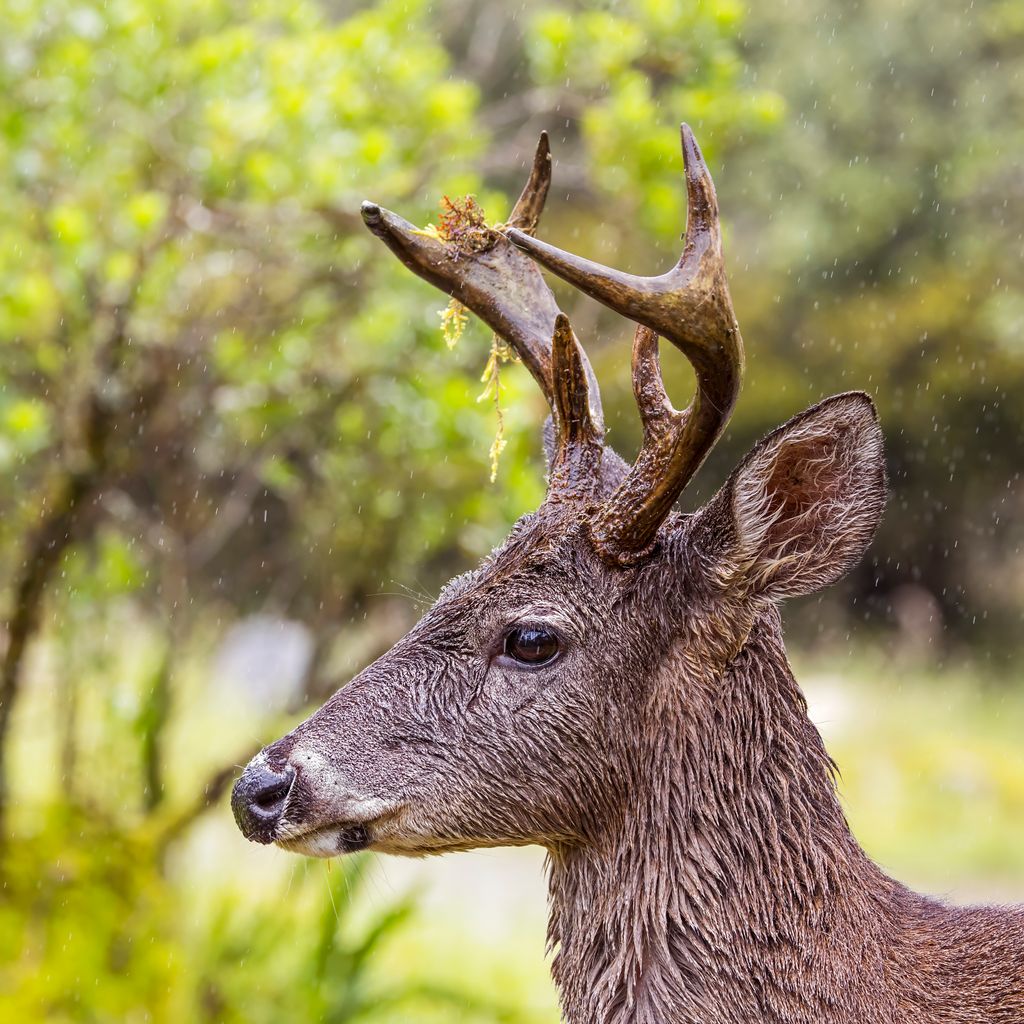
- White-tailed deer (Odocoileus virginianus goudotii) male head Chingaza — Charles J. Sharp / Sharp Photography. CC BY-SA 4.0. Resized and converted to JPEG/sRGB; no crop.
