



 by Tom Gurney
Tom Gurney BSc (Hons) is an art history expert with over 20 years experience
Page created on March 2, 2018 / Page updated on October 6, 2026
Email: tomgurney1@gmail.com / Phone: +44 7429 011000
Introduction
A small child holds a red ribbon beneath her parents and four grandparents. Around her, Frida Kahlo paints a house, two different landscapes, a fetus and the beginning of conception, bringing generations and stages of her own life into a single view. My Grandparents, My Parents, and I is a family picture in which the person at the end of the lineage also appears to organise it. [1] [2] [3]
The painting invites questions that its figures cannot answer by themselves. Photographs and documents help identify the relatives, but the picture transforms those sources, and later accounts of Kahlo’s paternal ancestry conflict with archival research. Its possible relationship to the racial genealogies of Nazi Germany is likewise a consequential museum interpretation, not an intention established by a surviving statement from Kahlo. [1] [4] [5] [6]
At a Glance
- Artist and title: Frida Kahlo, My Grandparents, My Parents, and I; also listed as Family Tree.
- Date, medium and size: 1936; oil and tempera on zinc, 30.7 × 34.5 cm.
- Collection: MoMA, New York, no. 102.1976; gift of Allan and B. Mathieu Roos in 1976.
- Historic exhibition title: My Family, no. 7 at Julien Levy Gallery in 1938; distinct from Kahlo’s unfinished 1949 family picture.
- Present access: MoMA listed it on Floor 5, Gallery 517 on 2 October 2026; displays can change. [1] [4]
Contents
- Introduction
- Seven Figures and Three Moments of Life
- The Parents’ Wedding Portrait as a Source
- Maternal Mexico and Paternal Migration
- A Ribbon, an Inverted Triangle and a Relational Self
- Mexican Popular Painting and the Limits of the Ex-Voto Comparison
- The Nuremberg-Laws Interpretation
- How the Painting’s Interpretation Changed
- Books, Unread Sources and Viewing the Work
Seven Figures and Three Moments of Life
The almost-square panel is organised in three broad levels. Four older faces occupy the sky, a wedding couple stands and sits across the middle, and a naked child holds the branching red ribbon near the lower centre. The portraits do not share a naturalistic space: the grandparents appear as small busts, the parents are much larger, and the child is enormous beside the blue-walled house below her. [2] [3]
Kahlo makes her origins visible without arranging them as a simple before-and-after sequence. At lower left, sperm-like forms approach an ovum-like form beside a flower and cactus; a fetus appears against the mother’s white dress; the standing child is already holding the family line. Conception, prenatal life and childhood occupy the same pictorial present, so none of these details alone establishes a dated pregnancy or a literal scene that could have been witnessed. [2] [3]
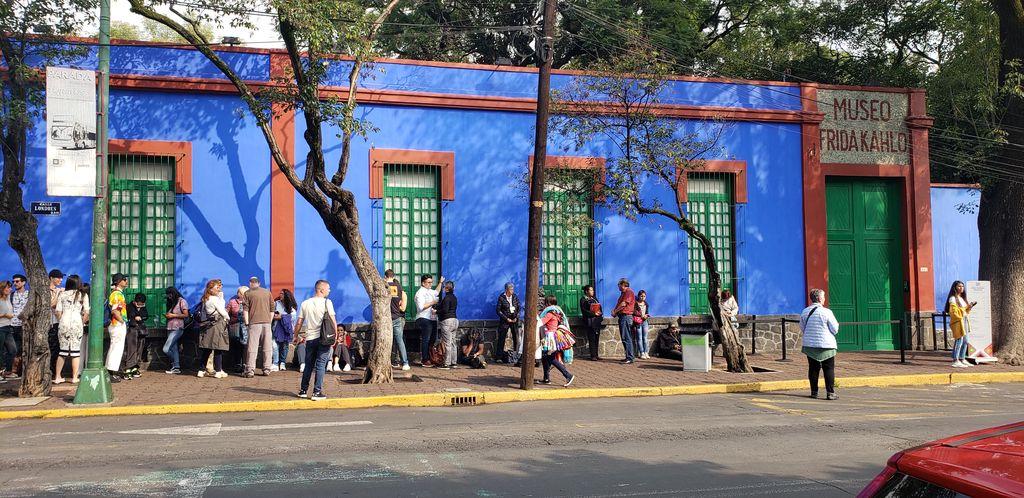
MoMA identifies the house as Kahlo’s childhood home, Casa Azul, in Coyoacán. The courtyard and building are seen from an elevated or oblique angle while the family faces outward, and the child is too large for the architecture. Museo Frida Kahlo dates the house’s construction by Guillermo Kahlo to 1904; the painting’s spatial discrepancy makes it a remembered and constructed family place rather than an architectural survey. [1] [3] [4]
The red ribbon begins at the child’s hand and spreads upward toward the other six figures. It makes a family tree without showing an actual trunk, leaves or roots, and the painted landscape above the grandparents is not a map of Mexico. Bloodline or umbilical connection may be suggested by its colour and course, but those are readings of the form rather than labels supplied by the image. [2] [3] [7]
Watch: Frida Kahlo
Five perspectives to view here alongside the article.
Frida Kahlo’s The Two Fridas: Great Art Explained
A focused visual introduction to the painting and its context.
The family picture in Kahlo’s career
Selected works; not a complete chronology. See the Museo Frida Kahlo chronology [4].
The Parents’ Wedding Portrait as a Source
The couple at the centre are Kahlo’s mother, Matilde Calderón, standing in white on the viewer’s left, and her father, Guillermo Kahlo, seated in a dark suit on the right. MoMA’s audio description says the painted figures are based on their wedding photograph. A Spanish exhibition page from Centro Cultural Tijuana places that 1898 photograph beside the painting, making the relationship more concrete than a merely guessed resemblance. [2] [8]
The marriage took place on 21 February 1898, according to Museo Frida Kahlo. Yet a photographic source does not turn the painting into a transparent family document: Kahlo combines the couple with relatives from other portrait sources, changes scale, locates them between two landscapes and brings her own childhood and conception into the scene. The parents closely follow the wedding image, although that does not establish that every contour was traced. [4] [8]
CECUT quotes Masayo Nonaka’s comparison of the upper portraits: she says maternal grandfather Antonio Calderón was rendered more faithfully from a photograph, while Kahlo changed grandmother Isabel González’s appearance. Nonaka interprets that change as making Isabel look more visually compatible with her husband, whom the museum identifies as having Indigenous ancestry. This is an attributed interpretation reported through CECUT; Nonaka’s underlying book page has not been independently read, and the painted face cannot verify a person’s ancestry or Kahlo’s motive. [4] [8]
These selections matter because they make family tree an active pictorial operation. Photographic likeness, altered appearance, bodily diagrams and mismatched scales are held together by the child who grips the ribbon. The painting can be read as a record of named relatives and as Kahlo’s decision about how those relations should be made visible. [2] [3] [8]
Maternal Mexico and Paternal Migration
MoMA places the maternal grandparents above the arid Mexican terrain on the viewer’s left and the paternal grandparents above water on the right. Its children’s label reads the water as the Atlantic crossed by Guillermo on his journey from Germany to Mexico. Those identities and geographical meanings come from the museum’s interpretation; the panel does not inscribe the grandparents’ names, draw national borders or identify their religions. [1] [3]
The Museo Frida Kahlo chronology identifies Matilde’s father, Antonio Calderón, as a photographer of Indigenous ancestry and her mother, Isabel González, as a descendant of a Spanish general. MoMA’s current label condenses their background into mixed Indigenous and Spanish descent. These sources support the description at that level, but they do not name an Indigenous people or establish that the maternal family came from Tehuantepec; such specifics should not be inferred from the landscape or painted clothing. [1] [4]
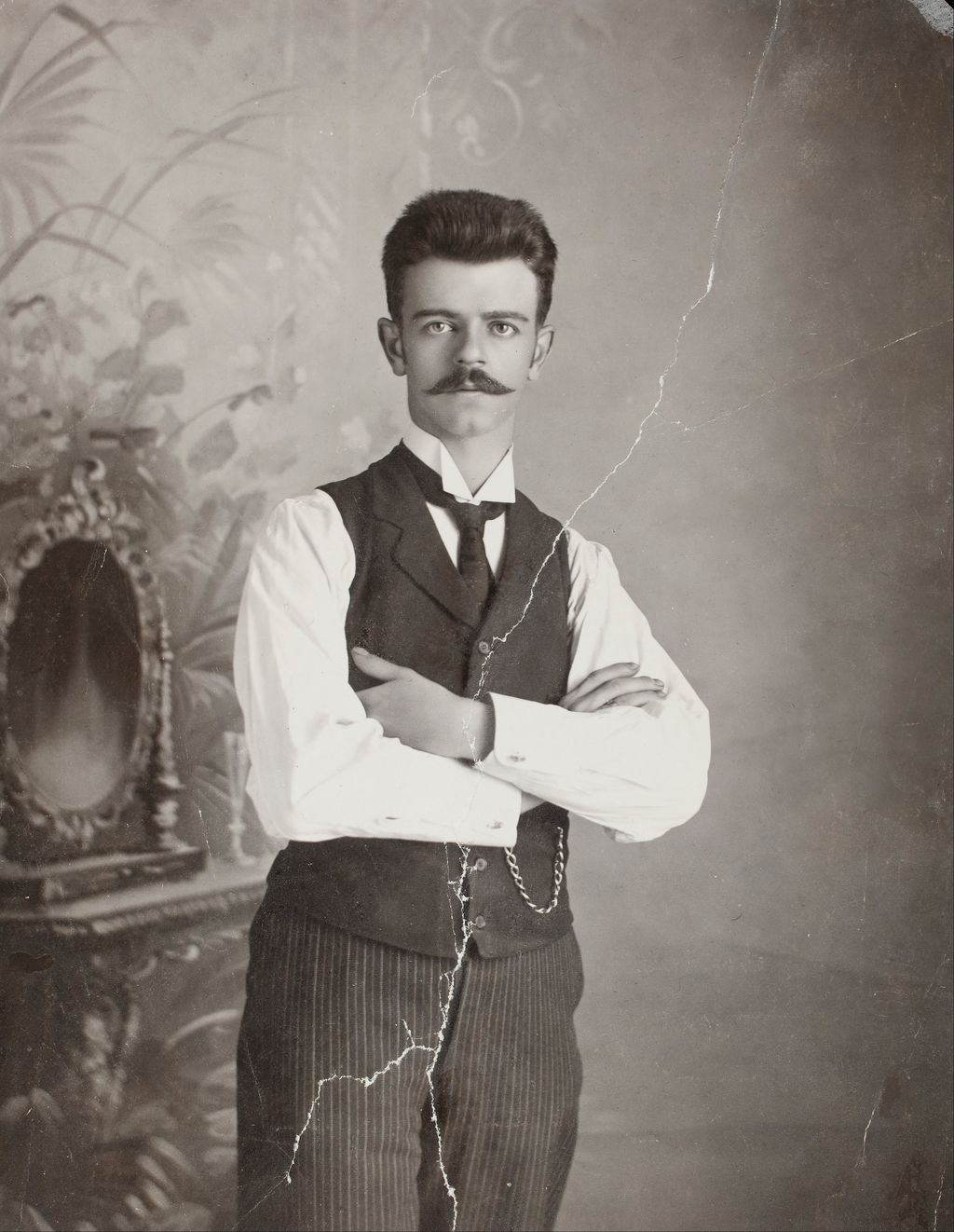
Guillermo’s documented history is more precise and also more contested in popular accounts. Museo Frida Kahlo names him Carl Wilhelm Kahlo, born in Pforzheim, Baden, on 26 October 1871, to Henriette and Jakob Kahlo, whom it identifies as Lutheran. He migrated to Mexico as a young man, adopted the name Guillermo and married Matilde in a Catholic ceremony although he was not Catholic. [4]
In a Spanish scholarly review of Gaby Franger and Rainer Huhle’s archive-based 2005 study, Peter Krieger reports municipal and church records for a German, Protestant family line rather than the often-repeated Hungarian or Jewish paternal origin. Huhle’s later German essay independently restates the Pforzheim birth and Protestant household. The complete 2005 book and its underlying archive documents have not been read for this page, so the conclusion is identified as the strongest accessible source-based account, not as a claim of direct archival inspection. [5] [9]
This evidence does not make Kahlo’s own contrary family story disappear. Gail Levin records an annotation Kahlo wrote on a photograph identifying her paternal grandmother as a German Jew and discusses an 18 May 1949 letter in which Kahlo gave family names while expressing uncertainty about what she had heard from her father. The annotation and letter document Kahlo’s testimony and self-understanding; they do not by themselves overturn the Protestant record reconstructed by later researchers. [6]
The distinction matters especially in a painting about ancestry. To say that Kahlo claimed a German-Jewish grandmother preserves her voice; to say that the painting proves that descent mistakes an authored image for a civil register. Nor should archive-based correction be used to claim certainty about why she repeated a family account: personal inheritance, political solidarity and public identity are possible subjects of interpretation, not securely documented motives in the sources read here. [5] [6]
A Ribbon, an Inverted Triangle and a Relational Self
Portuguese scholar Simone Rocha de Abreu describes the seven people as an inverted triangle, with Kahlo and Casa Azul at the lower point. The format narrows toward the child while the ribbon broadens outward across generations; Abreu reads that tension as a way of making the self through family and place. The geometric observation is helpful, but its account of identity remains Abreu’s interpretation rather than a sentence written by Kahlo beside the picture. [3] [10]
Joanna Latimer, writing in The Sociological Review, attends to the child, fetus, reproductive vignette and connected figures as parts of an “in/dividual” body. Her point is not that the seven people are literally one organism; it is that the picture unsettles a self imagined as wholly separate from relations and bodily origins. Latimer’s formal analysis can be used without importing her erroneous grandparent-side identification or treating her assumed Jewish genealogy as established fact. [7]
The painting’s temporal compression gives those readings their force. The child both emerges from the represented family and draws its branching line, although no child could have seen her own conception or all four grandparents posed in this arrangement. In that sense the image is not a recovered memory: it is an act of placing a self among ancestors, stages of life and remembered home. [2] [3] [7] [10]
Mexican Popular Painting and the Limits of the Ex-Voto Comparison
The Museum of Fine Arts, Boston compares Kahlo’s metal support, shifting perspectives and floating family members with Mexican ex-voto or popular-painting forms. In that curatorial account, the ancestors occupy a visual position often given to sacred figures. The comparison draws attention to how a modest metal panel can present a consequential personal history without requiring the work to be classified as a commissioned devotional painting. [11]
Nothing in the owner’s medium line identifies which passages are oil and which are tempera, and no object-specific conservation analysis was located. “On zinc” is a material fact; an ex-voto relationship is an attributed formal interpretation. Neither allows an editor to invent a miraculous event, a saint, a prayer or technical methods that have not been documented. [1] [11]
The Nuremberg-Laws Interpretation
Germany promulgated the Nuremberg Laws on 15 September 1935, the year before Kahlo painted this picture. As the United States Holocaust Memorial Museum explains, Nazi rules classified people through the religious affiliation of their grandparents, and a surviving 1935 chart shows how such categories were diagrammed. That history makes the act of picturing four grandparents in 1936 politically resonant; it does not prove that Kahlo saw a particular chart or made this painting in direct answer to one. [12] [13]
MoMA’s Vital Signs label now interprets Kahlo’s family image as a counter to the racial genealogies imposed by those laws. Curator Adriana Zavala, in MoMA audio, more carefully calls the connection one interpretation and reads the painting’s mixed family history as an affirmation of mixture. Both readings deserve space because they show how an institution and a named scholar understand the picture, but they cannot be rewritten as Kahlo’s documented statement of intent. [1] [2]
The comparison also has a limit in the genealogy itself. The Nazi regime’s categories were coercive administrative inventions, not a scientifically valid account of ancestry; the painting, by contrast, is a personal construction of relatedness, place and living continuity. No inspected letter, diary entry, annotated drawing or contemporary review identifies the Nuremberg Laws as Kahlo’s subject or a specific Nazi diagram as her model. [1] [6] [12] [13]
How the Painting’s Interpretation Changed
The Jewish Museum devoted a focused New York exhibition, Frida Kahlo’s Intimate Family Portrait, to this painting from 5 September 2003 to 4 January 2004. Its surviving overview explicitly framed the work through hybrid identity and supposed German-Jewish roots; Gannit Ankori directed the project. That premise is part of the exhibition’s history, not genealogical proof, and the later Franger–Huhle archival findings oblige a present account to qualify it. [5] [14]
Levin traces how Jewish-family and Nuremberg readings circulated through exhibitions and an earlier MoMA label, later removed. Her historiography shows why a visitor may have encountered a more categorical account than MoMA’s current title and ancestry wording support. The painting has not changed, but the documentary basis for interpreting its family line has been questioned, while its possible political opposition to racist classification remains a curatorial argument. [1] [6] [14]
Its public history began earlier. Museo Frida Kahlo records the work in a 1936 exhibition at the Autonomous University of Mexico, although an original checklist was not recovered. MoMA’s provenance footnote then identifies number 7 in the Julien Levy Gallery’s November 1938 Kahlo exhibition under the title My Family; the owner record says it passed through Levy to Allan and Beatrice Roos that year, before their 1976 gift to MoMA. [1] [4]
The title My Family should not draw this object into a different unfinished work of 1949. Later displays and loans belong to its reception history, but a complete exhibition catalogue has not been reconstructed here. The direct provenance, early showings and later Jewish Museum interpretation are the events needed to understand this object’s identity and the changing arguments made around it. [1] [4] [14]
Books, Unread Sources and Viewing the Work
The 624-page Frida Kahlo: The Complete Paintings by Luis-Martín Lozano, Andrea Kettenmann and Marina Vázquez Ramos is the priority book for a full object entry, bibliography, related studies and any catalogue number. Gannit Ankori’s Frida Kahlo is relevant to the identity arguments, while Gaby Franger and Rainer Huhle’s Fridas Vater is essential for checking the paternal archive case in full. None of these complete books has been read for this page; the genealogy above uses Krieger’s full review and Huhle’s accessible essay, and no unseen book entry has been cited as evidence. [5] [9] [15] [16]
Other exact-source upgrades remain: the original 1936 exhibition checklist, Julien Levy Gallery invoice or correspondence, Nonaka’s cited printed page, the complete 2003 exhibition checklist and any MoMA conservation record. Their absence prevents a claim to exhaustive provenance, technical or exhibition history, but it need not suppress the owner-controlled facts and precisely attributed scholarship already available. It would be especially misleading to infer pigment analysis, a frame date or a direct Nazi chart source from the public record. [1] [8] [14]
The MoMA collection record is the independent place to view the painting. On 2 October 2026 it listed the work in Floor 5, Gallery 517, but location should be checked before visiting. The contextual photographs on this page show Kahlo’s family and home, not the painting or the wedding photograph that informed its central figures. [1] [3]
Related Reading
Portrait of Frida's Family is a later, unfinished family composition, not a second version of this 1936 panel. Portrait of My Father and Portrait of Isolda Pinedo Kahlo follow two relatives separately; the Casa Azul study examines the family house without turning its present rooms into a frozen childhood scene.
Frequently Asked Questions
No. MoMA records oil and tempera on zinc, a small metal support measuring 30.7 × 34.5 centimetres. The older description of a canvas is incorrect, and no public technical report examined here identifies the individual painted layers. [1]
MoMA identifies the maternal pair on the viewer’s left above Mexican terrain and the paternal pair on the right above water associated with migration from Germany. Their names and religious identities are not inscribed on the panel. Sources that reverse the sides should not control the description. [1] [3]
The strongest source-based account available here places Guillermo’s birth in Pforzheim, Germany, and traces a Protestant family line, not a documented Hungarian or Jewish branch. Kahlo herself later identified a paternal grandmother as a German Jew; that is genuine testimony but a different kind of evidence from the municipal and church records reported by Krieger and Huhle. The underlying 2005 book and archive files have not been read in full for this page. [4] [5] [6] [9]
MoMA interprets the 1936 painting as a counter to Nazi racial genealogies, and Adriana Zavala calls that one possible interpretation. The laws and contemporary ancestry charts provide documented historical context. No inspected artist statement or specific-source evidence proves that Kahlo made the panel for that purpose or copied a particular chart. [1] [2] [12] [13]
Discussion
Use the cited evidence and your own close looking to explain your view. The prompts below are starting points, not fixed interpretations.
Reader Insights
How does the child’s red ribbon connect family members who occupy different spaces and times?
What does the wedding photograph establish, and where does Kahlo’s painted construction depart from it?
How should an ancestry record, Kahlo’s own account and MoMA’s later political reading be weighed differently?
Join the Conversation
Which reading best fits the evidence, and where does uncertainty remain?
References
- Museum of Modern Art, My Grandparents, My Parents, and I, object 102.1976, current heading, metadata, Vital Signs and children’s labels, provenance footnote and display field; checked 2 October 2026. The current heading omits the older parenthetical Family Tree and lists Floor 5, Gallery 517. View source text.
- MoMA, audio description and Adriana Zavala commentary, transcript lines 9–20 and 32–46; visual identifications, wedding-photo basis and attributed Nuremberg interpretation. The transcript’s claim that Kahlo had just returned from four years in the United States in 1936 is chronologically erroneous and is not used. View source text.
- Museum of Modern Art, My Grandparents, My Parents, and I, object 102.1976, official recto image viewed at 2,000 × 1,758 pixels for visual description. The image does not establish physical condition, reverse details or permission to reproduce the painting. View source text.
- Museo Frida Kahlo, “Frida” chronology, entries on Wilhelm and his parents, Matilde and her parents, the 1898 marriage, Casa Azul, the 1936 exhibition and the separate unfinished 1949 family work. Its later Hungarian-German wording conflicts with the earlier documented entry and archival research. View source text.
- Peter Krieger, “Corrección e inspiración: Reflexiones en torno a una monografía sobre el fotógrafo Guillermo Kahlo”, Anales del Instituto de Investigaciones Estéticas 29:90 (2007), “Hechos y ficciones” and notes 8–15; Spanish review of Franger and Huhle’s 2005 archive-based book, read in full. View source text.
- Gail Levin, “Frida Kahlo’s Circulating Crafts: Her Painting and Her Identities”, in Rhapsodic Objects (2022), printed pp. 218–29, especially 224–28; accessible chapter passage on family annotation, 1949 letter, 2003 exhibition and former MoMA label. Motive arguments are Levin’s interpretations. View source text.
- Joanna Latimer, “Unsettling Bodies: Frida Kahlo’s Portraits and In/Dividuality”, The Sociological Review 56(s2) (2009), pp. 48–50; formal account used selectively, without its genealogy or side-identification errors. View source text.
- Centro Cultural Tijuana, “De la foto a la pintura”, photograph pairing and lines 10–19 citing Pablo Ortiz Monasterio p. 16 and Masayo Nonaka p. 27. The printed pages were not independently read. View source text.
- Rainer Huhle, “Mehr als Fridas Vater: Guillermo Kahlo als Pionier der mexikanischen Architekturfotografie”, Ibero-Amerikanisches Institut volume, printed pp. 85 and 91; German essay confirming Pforzheim and the Protestant household. View source text.
- Simone Rocha de Abreu, “Frida Kahlo: à procura de si mesma”, Revista USP 109 (2016), pp. 102–04; Portuguese object-specific analysis of the inverted triangle, ribbon and constructed self. View source text.
- Museum of Fine Arts, Boston, “Frida Kahlo and Arte Popular”, object paragraph comparing metal support, altered perspective and ancestors with ex-voto forms; institutional interpretation, not a technical report. View source text.
- United States Holocaust Memorial Museum, “The Nuremberg Race Laws”, historical article on the September 1935 legislation and grandparent-based classifications. View source text.
- United States Holocaust Memorial Museum, 1935 Die Nürnberger Gesetze chart, collection record documenting contemporary diagrammatic classification, not a known source for Kahlo. View source text.
- The Jewish Museum, Frida Kahlo’s Intimate Family Portrait, 5 September 2003–4 January 2004, exhibition overview and historic caption; the German-Jewish premise is reception history, not independently established genealogy. View source text.
- Luis-Martín Lozano, Andrea Kettenmann and Marina Vázquez Ramos, Frida Kahlo: The Complete Paintings, TASCHEN publisher metadata, 624 pages; complete volume unread. View source text.
- Gannit Ankori, Frida Kahlo, Reaktion Books catalogue description; complete Critical Lives volume unread. View source text.
Image Credits
- Guillermo Kahlo, 1916; Museo Frida Kahlo / Google Art Project. Public domain. Source: Wikimedia Commons. Resized to 1024 px wide; no crop. Source record.
- Photo: Alex1210O / Wikimedia Commons, CC BY-SA 4.0. Resized to 1024 px wide; no crop. Source record.
- Guillermo Kahlo, c.1920; Museo Frida Kahlo / Google Art Project. Public domain. Source: Wikimedia Commons. Resized to 1024 px wide; no crop. Source record.
