


 by Tom Gurney
Tom Gurney BSc (Hons) is an art history expert with over 20 years experience
Page created on March 2, 2018 / Page updated on October 6, 2026
Email: tomgurney1@gmail.com / Phone: +44 7429 011000
Introduction
Frida Kahlo's Self-Portrait with Monkey of 1938 places her face, a monkey, a bone necklace and a wall of leaves within a picture only 16 inches high. The animal reaches across her shoulders, so that it participates in the portrait's structure rather than sitting beside her as a detachable symbol. The work is also unusually well documented: Buffalo AKG Art Museum records its sale to A. Conger Goodyear and its later bequest, while more recent scholarship traces the image's transformation into an advertising emblem. [1] [2] [3]
This is the Buffalo portrait dated 1938, not every Kahlo painting bearing a similar English title. That distinction matters when asking who commissioned it, which monkey appears in it, or what a later exhibition did with its image. It also keeps close observation separate from the claims that have accumulated around Kahlo's life. [1] [4] [5]
At a Glance
- Artist and titles: Frida Kahlo, Self-Portrait with Monkey; Spanish title Autorretrato con mono
- Date and inscription: 1938; signed and dated at lower right,
F. KAHLO. 38 - Medium and support: oil on Masonite
- Size: 40.64 × 30.48 cm for the support; 49.53 × 39.69 × 3.81 cm framed. [1]
- Collection: Buffalo AKG Art Museum, accession 1966:9.10, bequest of A. Conger Goodyear
- Provenance anchors: Kahlo sold the painting to A. Conger Goodyear on 3 January 1939; it entered Buffalo AKG through his 1966 bequest. [1]
- Current display: The museum calls the work a Collection Highlight, but gives no confirmed present gallery location. [1]
Contents
- Introduction
- Which Monkey Portrait?
- Looking Closely
- A Commission in New York
- Fulang-Chang and the Problem of a Single Symbol
- Ribbon, Bone and Leaves
- A Self-Portrait That Stages a Self
- From Goodyear's Collection to Public Exhibition
- The Portrait Cropped into “Passion”
Which Monkey Portrait?
Kahlo returned to the combination of her face and a monkey more than once. The 1937 Fulang-Chang and I is an earlier, different painting; a 1940 self-portrait uses a red ribbon around the monkey's neck, while works of 1942, 1943 and 1945 rearrange the animals and other elements again. A title without date, collection or visual description can silently merge those objects and transfer an interpretation from one to another. [4] [5]
The Buffalo painting is identified by its broad green ribbon in Kahlo's hair, narrow green collar on a single monkey, pale segmented necklace, white blouse and densely patterned leaves. Its accession number and owner-recorded support size remove the remaining catalogue ambiguity. The museum identifies this particular animal as her spider monkey Fulang-Chang; that is a curatorial identification, not something its painted face could independently prove. [1] [4]
This distinction bears directly on the story of the commission. Buffalo's educational account says Goodyear admired the earlier Fulang-Chang and I and commissioned a similar portrait because that work was unavailable. It does not make the 1937 work a preparatory study for this one, or make the later monkey portraits replicas. [6]
Watch: Frida Kahlo
Five perspectives to view here alongside the article.
Frida Kahlo’s The Two Fridas: Great Art Explained
A focused visual introduction to the painting and its context.
Looking Closely
Kahlo fills the vertical support with her head, long neck and shoulders. The face is nearly frontal but turns slightly towards the viewer's left, and the dark eyes look outward rather than towards the monkey. Joined brows, visible upper-lip and facial hair, a small nose and closed reddish lips are deliberately articulated; none of these visible features settles whether the expression is stern, sad or assured. [1] [4]
Dark braids form a substantial arrangement across the crown of her head. A wide, deep-green ribbon threads through the hair, and a related green encircles the monkey's neck. That repeated colour makes a connection across the two figures before the animal's arm is even followed; whether Kahlo meant it as a bond of affection, control or kinship is a further question. [1] [4]
The monkey emerges from behind the shoulder at the viewer's left. Most of its body is obscured, but a long dark arm travels behind Kahlo and a paw comes to the necklace near the opposite shoulder. The gesture crosses the painting's centre and makes the relationship physically visible without specifying whether the contact is protective, playful or possessive. [1] [4]
A pale necklace circles the base of Kahlo's neck. Its curved, separated pieces are joined by a fine red cord; Buffalo identifies the material as bone, an identification the front image alone cannot securely establish. The top of a white blouse appears at the lower edge, but too little of the garment is visible to label it Tehuana dress or assign a particular regional textile history. [1] [4]
Large overlapping leaves occupy nearly all the space behind the figures. Their greens vary, veins are sharply patterned, and fine pale marks travel across several surfaces like threads or webs; the image does not settle what those marks represent. Small interruptions of blue do little to open a distant landscape, leaving face, animal, jewellery and vegetation pressed into a shallow, active field. [1] [4]
These observations derive from the owner's available image, not from a technical examination of the panel. They support placement, colour and form, not a claim about pigments, underdrawing, the painting's condition or the order in which Kahlo worked. The available visual account remains distinct from a technical examination of the object. [1]
Self-Portrait with Monkey in Kahlo’s career
The Two Fridas
1939Timeline source: Museo Frida Kahlo chronology [21].
A Commission in New York
Kahlo's first New York solo exhibition at Julien Levy's gallery took place in late 1938, during a period of growing international attention to her work. Museo Frida Kahlo's chronology places her in New York across the end of that year and into early 1939. The chronology supplies a setting; it does not establish that the newly commissioned Buffalo portrait was among the works displayed at Levy's exhibition. [5]
Buffalo's lesson plan says Goodyear wanted a painting like Fulang-Chang and I and commissioned the new portrait. Art Institute of Chicago curator Caitlin Haskell, writing in a published excerpt from Frida Kahlo's Month in Paris, also calls the Buffalo work a commission and says Kahlo finished it in her New York hotel. Her note directs readers to a Hayden Herrera letter dated 20 April 1977 in the Buffalo object file, making the documentary route visible without turning that later letter into a contemporary contract. [6] [7]
The current owner record supplies a firm next step: Kahlo sold Self-Portrait with Monkey to Goodyear on 3 January 1939. It does not give a price, name the hotel, identify a precise completion day or explain every circumstance of the order. A secondary account's appealing story that Kahlo produced the painting in about a week remains unverified by a primary document. [1] [7]
The small support should not be mistaken for a casual or unplanned work. The compact picture brings an elaborately handled face, braided hair, animal, necklace and foliage into one tightly coordinated composition. Whether Goodyear specified any of those details is unknown; the commission tells us something about the work's first destination, not the origin of each formal choice. [1] [6]
Fulang-Chang and the Problem of a Single Symbol
Buffalo identifies the companion as Fulang-Chang and describes Kahlo's pets as a source of comfort in the context of her desire for children. That curatorial reading has a human basis in the artist's biography, but it is still an interpretation of this image rather than an artist-authored explanation. The painting contains no statement that the monkey stands for a child, and the paw's contact with the necklace can be read without fixing a substitute-family role. [1] [4]
The Spanish-language account researched by Buffalo curator Holly E. Hughes and editor Emily Mangione looks carefully at the monkey's collar, lead and position behind Kahlo. It describes the animal as slightly embracing her, an apt report of one viewer's response to the encircling arm. Its closer attention to where the paw and ribbon actually lie is more useful here than treating tenderness as a fact that resolves the work's meaning. [4]
Another scholarly route points away from a universal key. Yaxkin Melchy studies animality and Nahua ideas in Fulang-Chang and I of 1937 and a separate 1945 monkey portrait, asking how human and non-human identities might be made together. His argument cannot simply be pasted onto the 1938 Buffalo object; it demonstrates why “monkey equals surrogate child” is not the only serious question a monkey self-portrait can raise. [8]
Nor does an unsourced phrase such as “Mexican mythology” provide a reliable dictionary in which monkeys always signify one thing. The animal's visible action is more specific: it crosses the sitter's shoulders, shares a green accent with her hair and interrupts the necklace's circuit. A claim about a particular cultural tradition would require a particular source and a convincing connection to this work. [1] [4] [8]
Ribbon, Bone and Leaves
The broad hair ribbon and the narrow monkey collar echo the leaves in colour. The necklace's pale pieces contrast with all three green areas, and its fine red binding offers a second, much smaller line to trace around the neck. These are formal relations that a reader can test against the picture; they do not predetermine whether its overall effect is intimacy, enclosure or display. [1]
Hughes and Mangione connect costume, jewellery, colour and vegetation with Kahlo's engagement with Mexican culture and folk art. That is a named curatorial reading, not proof that every leaf is an emblem of the nation or that the cropped blouse belongs to a specified region. The fuller history of Kahlo's self-fashioned clothing belongs in the fashion and Tehuana-dress study. [4]
The dense foliage is especially easy to reduce to a slogan about “nature.” Its veins, sizes and directions differ, while the narrow interval between leaves and figure leaves little visual escape into a landscape. It gives the portrait a constructed setting with a strong surface rhythm, not a botanical inventory or a secure geographical location. [1] [4]
The Spanish feature's characterisation of the vegetation as a warm Mexican environment is therefore best understood as the contributors' cultural interpretation. The painting itself does not say where the leaves grow, and describing Mexico through an automatically “exotic” green background would repeat a stereotype that the work's later publicity exploited. The visible arrangement can be analysed without asking it to prove a timeless national essence. [3] [4]
A Self-Portrait That Stages a Self
Alfonso de Toro's Spanish-language study places several Kahlo monkey portraits alongside photographs of her, examining how face, hair, dress, animal and gaze recur in altered arrangements. He argues that such repeated elements are a form of staging or performance across media. The point useful to the Buffalo work is not that every portrait has the same message, but that Kahlo visibly selects and recombines parts of a public self. [9]
The 1938 painting makes that process unusually concentrated. The face faces outward while the monkey touches the necklace; the hair ribbon, collar and leaves carry related greens; the white blouse and pale bones pull the eye back towards the sitter. Each choice directs attention, so the painting offers more than an unmediated glimpse of Kahlo's mood during a difficult or successful year. [1] [9]
De Toro's broader claims about Kahlo anticipating later performance and body art remain his theoretical position. A narrower observation follows from the painting: a portrait can be a deliberate construction even when it draws on a recognisable body, animal and personal history. Treating the painted face as a transparent confession would obscure the careful visual decisions that make the work. [9]
From Goodyear's Collection to Public Exhibition
Goodyear retained the painting, and Buffalo records his bequest to the then Albright-Knox Art Gallery on 15 January 1966. The museum's history of his gifts identifies Self-Portrait with Monkey among the significant works that entered through his collection; a separate 1996 exhibition record describes the wider scale of Goodyear's donations without supplying a new transaction document for this painting. This unusually direct artist-to-collector-to-museum chain is firmer than many of the stories about Kahlo's intentions, although a commission contract or original transaction file has not been inspected here. [1] [2] [10]
MoMA's master checklist places the painting in its 1993 Latin American Artists of the Twentieth Century exhibition and independently records the 1938 date, Masonite support, small size and Goodyear bequest. The museum describes that larger survey as more than 300 works by approximately 90 artists. The checklist documents this object's presence; the exhibition's broad interpretive frame should not be mistaken for a statement by Kahlo about the portrait. [11]
The painting later appeared in exhibitions with very different questions: a collection-history presentation at Albright-Knox in 2011–12, Sincerely Yours in Denver in 2014, Buffalo's animal-centred Menagerie in 2017, the Detroit Institute of Arts' pairing of Kahlo and Dalí in 2020, and the Art Institute of Chicago's 2025 presentation about Kahlo's month in Paris. The Chicago museum shop explicitly identifies the 1938 painting as part of that exhibition, a useful object-specific confirmation beyond its general exhibition page. These are selected verified occurrences, not a complete loan record and not evidence that it is on display at any of those venues now. [12] [13] [14] [15] [16]
The Detroit pairing illustrates how exhibition context can supply an additional reading. Its organisers described a poised, self-assured Kahlo and read the necklace as an expression of Mexican heritage, positioning her portrait beside Dalí's unsettling imagery and near Rivera's Detroit murals. That was the museum's interpretive proposal for a temporary display, not an objective emotional label or a key to the necklace supplied by the artist. [15]
The Portrait Cropped into “Passion”
The most detailed object-specific account of the painting's public afterlife comes from Sarah E. K. Smith's open-access Trading on Art. She studies Mexican Modern Art: 1900–1950, which opened in Montreal in 1999 and went to Ottawa in 2000, in the setting of North American cultural diplomacy and free trade. Buffalo's painting was part of the exhibition, but its role went well beyond a label in the gallery: it became a basis for the Montreal campaign's visual identity. [3]
Smith traces a sequence of changes. In one design, the complete painting sat within a vivid red frame, with the word pasión laid over the top of Kahlo's hair; the composition appeared on a visitor guide and print advertisements. Other invitations cut away almost everything but her mouth and part of a cheek, and yoghurt-container lids repeated that small facial fragment alongside the same promotional word. [3]
The reductions matter because they changed what the public was invited to see. The monkey's spanning arm, shared green, bone necklace and articulated foliage vanished from the most cropped formats. A viewer encountering the lips and the word “passion” could be given a simplified story about Kahlo's body and temperament before seeing the original painting's more complicated relations. [1] [3]
Smith argues that the campaign helped market Mexico as exotic cultural consumption and amplified an already mythologised, sexualised image of Kahlo. Her analysis concerns the design and its historical setting; it does not prove that every visitor received the same message. It does, however, document precisely how a particular painting was made to carry a promotional claim that its complete image does not itself state. [3]
The Ottawa venue used a different Kahlo painting, the 1940 Self-Portrait with Thorn Necklace and Hummingbird, in its own campaign. That distinction is important: the two Canadian publicity programmes should not be blended into a single history of the Buffalo object. The Montreal use of Self-Portrait with Monkey can be described in detail because Smith identifies its formats and reproduces the relevant campaign materials in her scholarly book; none is reproduced here. [3]
A later advertisement for Carr, O'Keeffe, Kahlo: Places of Their Own returned to the Buffalo portrait and placed it under a headline made of drama, passion and “estrogen.” Smith calls this an essentialising, exoticising reduction of Kahlo's work to biography and gender. Its force is clearer after looking closely at what the portrait contains: a constructed relationship of sitter, animal, adornment and setting, not a three-word account of a woman's personality. [3]
Books, Open Sources and Remaining Limits
Smith's Trading on Art is a complete, open-access scholarly source for the advertising history rather than a publisher blurb. For a broader object catalogue, Luis-Martín Lozano, Andrea Kettenmann and Marina Vázquez Ramos's Frida Kahlo: The Complete Paintings remains a priority source. Gannit Ankori's Frida Kahlo and Imaging Her Selves are relevant to self-representation, while Caitlin Haskell's Frida Kahlo's Month in Paris is especially relevant to the New York commission and 1939 transition. [3] [7] [17] [18] [19]
Only Haskell's complete published excerpt, not her full exhibition book, has been read here; the three commercial monographs likewise remain unread. Their descriptions identify relevant further reading but do not support detailed claims about the painting without the full texts. Buffalo also lists a 1966 Goodyear-collection exhibition catalogue containing a checklist; its publisher record has been checked, but not the catalogue itself, so it remains an exact-source lead rather than proof that Self-Portrait with Monkey hung in that show. [1] [7] [17] [18] [19] [20]
The exact sources still to pursue are the Herrera letter in Buffalo's object file, any original Goodyear commission or sale documents, the 1966 catalogue's Self-Portrait with Monkey entry if there is one, a technical record for the Masonite panel and a comprehensive exhibition checklist. Those absences constrain the transaction story, a possible earliest museum display and material analysis; they do not undermine the owner-documented provenance or the close reading of the front image. [1] [7] [20]
The owner calls the painting a “Collection Highlight,” but that does not establish its physical location as of October 2026. The independent Buffalo AKG object page is the appropriate place to view the work and seek current visitor information. No Kahlo artwork image, held contextual photograph or unapproved external video is used here. [1]
Related Reading
Compare the separately dated Fulang-Chang and I, Self-Portrait with Small Monkey and Self-Portrait with Monkey and Parrot for different animals, compositions and ownership histories. The style and Surrealism study considers why a striking portrait detail does not settle a movement label.
Frequently Asked Questions
No. Fulang-Chang and I dates from 1937 and is the earlier monkey portrait that Buffalo says Goodyear admired; the 1938 painting he acquired is the distinct Buffalo AKG work with accession 1966:9.10. Their subject matter and the museum's commission account connect them, but their identity and later ownership histories must remain separate. [1] [5] [6]
Buffalo's educational material and Haskell's recent curatorial research describe a commission. The museum's object record establishes that Kahlo sold the finished painting to Goodyear on 3 January 1939; an original commission agreement has not been inspected here. The precise completion date and a claimed one-week turnaround remain unverified. [1] [6] [7]
Buffalo offers a reading of her pets as comfort in relation to her wish for children. That interpretation should be attributed to the museum, not converted into Kahlo's documented intention or a fixed meaning for the animal. The monkey's arm, collar and place within the composition can be described without deciding that question. [1] [4]
It belongs to Buffalo AKG Art Museum, but the consulted owner page does not confirm that it is presently hanging in a particular gallery. Its object record provides an independent artwork view and is the right starting point for checking current access before a visit. [1]
Discussion
Use the cited evidence and your own close looking to explain your view. The prompts below are starting points, not fixed interpretations.
Reader Insights
Which details distinguish this 1938 monkey portrait from Kahlo's other paintings with monkeys?
What do the owner record and Goodyear provenance establish more firmly than symbolic interpretations?
How does a later advertising crop change the work's original composition and address?
Join the Conversation
Which reading best fits the evidence, and where does uncertainty remain?
References
- Buffalo AKG Art Museum, Self-Portrait with Monkey, 1938, current owner record: artwork details, inscription, exact provenance and rights notice. The owner image supports description of the visible painting but does not confer a reproduction licence. View source text.
- Buffalo AKG Art Museum, Gifts from A. Conger Goodyear, collector and bequest context. View source text.
- Sarah E. K. Smith, Trading on Art: Cultural Diplomacy and Free Trade in North America, UBC Press, 2025, especially printed pp. 35–39 and 86–87 (PDF pp. 47–51, 98–99); complete relevant chapters and notes read. The Montreal pasión materials and later Places of Their Own campaign are distinct episodes. View source text.
- Holly E. Hughes and Emily Mangione, “Autorretrato con mono, 1938”, Albright-Knox contribution to Google Arts & Culture, Spanish, visual description and attributed cultural reading. View source text.
- Museo Frida Kahlo, “Frida” chronology, selected 1937–45 entries, New York setting and distinct monkey self-portraits. View source text.
- Buffalo AKG Art Museum, Symbolic Self-Portrait lesson plan, pp. 1–2, Goodyear commission account. Its simplified symbolism and incorrect birth year do not control the object facts stated here. View source text.
- Caitlin Haskell, excerpt from Frida Kahlo's Month in Paris: A Friendship with Mary Reynolds, Yale University Press, 13 June 2025, commission/New York-hotel passage and note 10 to Herrera's 20 April 1977 Buffalo object-file letter. Full book unread. View source text.
- Yaxkin Melchy, “Fulang-Chang and Frida Kahlo: An Animalist Vision on Self-identity”, The Annual Review of Cultural Studies 9 (2021), pp. 97–113, especially 105–12; DOI 10.32237/arcs.9.0_97. The article analyses other monkey portraits, not this Buffalo work. View source text.
- Alfonso de Toro, “Las «nuevas meninas» o «bienvenido Foucault»”, Aisthesis 50 (2011), pp. 11–41, especially 15–20 and 25–27, Spanish study of staging and series. View source text.
- Buffalo AKG Art Museum, The A. Conger Goodyear Collection, 13 July–1 September 1996, summary of the scale of Goodyear's donations. The page does not individually name Self-Portrait with Monkey among its exhibited works. View source text.
- Museum of Modern Art, Latin American Artists of the Twentieth Century, 6 June–7 September 1993, exhibition overview; 31-page master checklist, PDF p. 12, lines 415–17, the exact Self-Portrait with Monkey entry. View source text 1; View source text 2.
- Buffalo AKG Art Museum, The Long Curve: 150 Years of Visionary Collecting, 4 November 2011–4 March 2012, with Self-Portrait with Monkey illustrated in the exhibition record. View source text.
- Buffalo AKG Art Museum, Sincerely Yours: Treasures of the Queen City, Denver 2014, with Self-Portrait with Monkey named in the exhibition record. View source text.
- Buffalo AKG Art Museum, Menagerie: Animals on View, 11 March–4 June 2017, object listing for Self-Portrait with Monkey. View source text.
- Detroit Institute of Arts, Guests of Honor: Frida Kahlo and Salvador Dalí, 7 February–27 September 2020, object loan and museum interpretation. View source text.
- Art Institute of Chicago, Frida Kahlo's Month in Paris: A Friendship with Mary Reynolds, 29 March–13 July 2025, exhibition context; museum-shop object-specific listing explicitly identifies Self-Portrait with Monkey as included in the exhibition. View source text 1; View source text 2.
- Luis-Martín Lozano, Andrea Kettenmann and Marina Vázquez Ramos, Frida Kahlo: The Complete Paintings, TASCHEN publisher page only; complete volume unread. View source text.
- Gannit Ankori, Frida Kahlo and Imaging Her Selves, publisher records only; complete volumes unread. View source text 1; View source text 2.
- Caitlin Haskell, Frida Kahlo's Month in Paris, Yale University Press / Art Institute of Chicago, 2025, publisher metadata and acquisition lead; complete book unread. View source text.
- Buffalo AKG Art Museum, Paintings, Sculpture, Drawings, Prints Collected by A. Conger Goodyear, 1966 exhibition-catalogue publisher record. The stated checklist and selected reproductions have not been read, and object inclusion is not claimed. View source text.
- Museo Frida Kahlo, Frida interactive chronology, selected work dates used for the comparison timeline. The current work's date follows its cited object record. View source text.
Image Credits
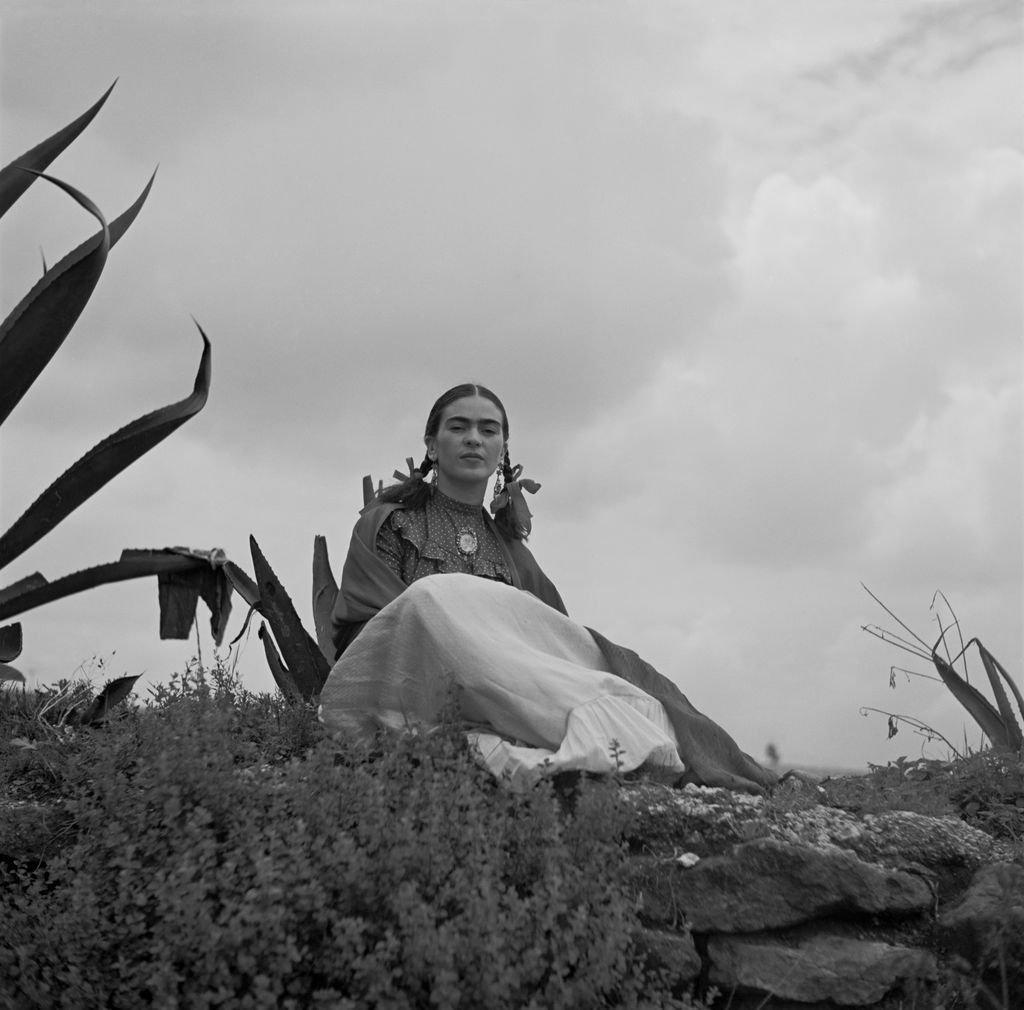
- Toni Frissell, 1937. Library of Congress, Prints & Photographs Division, Toni Frissell Photograph Collection, LC-F9-01-3707-25, no. 4; digital ID ds.05050. Restoration: Adam Cuerden. Source record.
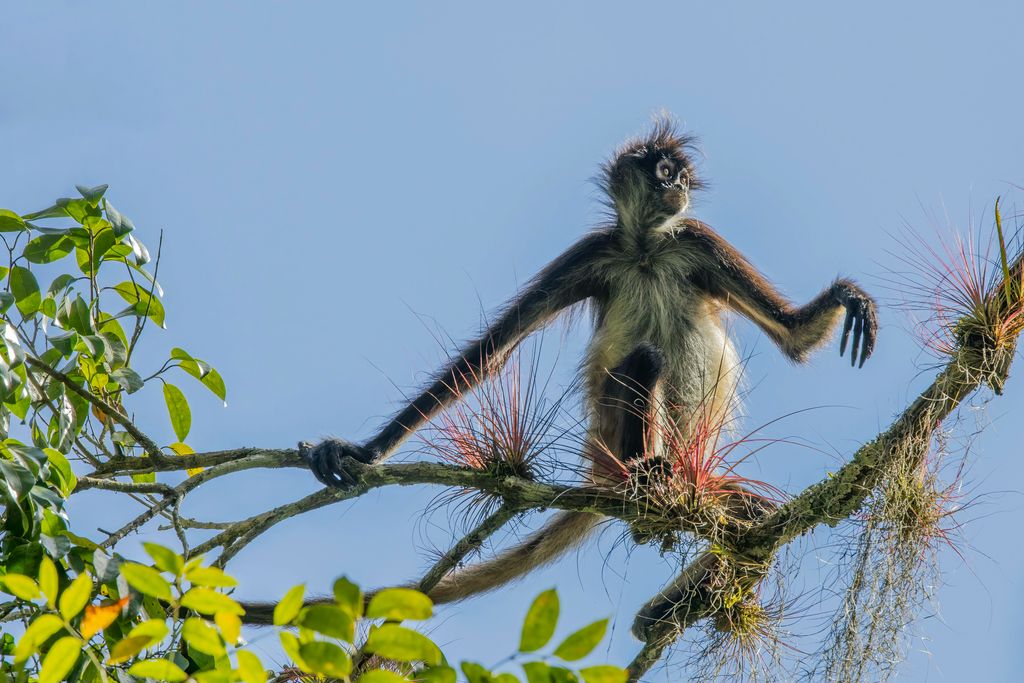
- Geoffroy's spider monkey (Ateles geoffroyi yucatanensis) Peten 2 — Charles J. Sharp / Sharp Photography. CC BY-SA 4.0. Resized and converted to JPEG/sRGB; no crop.
