


 by Tom Gurney
Tom Gurney BSc (Hons) is an art history expert with over 20 years experience
Page created on March 2, 2018 / Page updated on October 6, 2026
Email: tomgurney1@gmail.com / Phone: +44 7429 011000
Introduction
Frida Kahlo places herself between a monkey and a parrot, close enough that the three seem to share the narrow foreground of the painting. The animals invite stories, but Self-Portrait with Monkey and Parrot does not supply a written key to their meaning. Its carefully arranged dress, hair, gaze and companions make it a study in how Kahlo constructed her public image as well as a portrait of creatures familiar from her household. [1] [2]
Painted in 1942, the work passed through Thomas J. Watson’s and IBM’s collection, was sold at Sotheby’s in 1995, and entered the Museo de Arte Latinoamericano de Buenos Aires (MALBA) through Eduardo F. Costantini’s 2001 donation. Those transactions are unusually well documented for a Kahlo painting; the identity of any original commissioner, the exact working method and Kahlo’s intended symbolism are not. [1] [3] [4] [5]
At a Glance
- Artist and titles: Frida Kahlo, Autorretrato con chango y loro / Self-Portrait with Monkey and Parrot. [1] [6]
- Date and material: 1942, oil on Masonite, 54.6 × 43.2 cm in MALBA's owner record. [1] [6]
- Collection: MALBA, inventory 2003.34; Eduardo F. Costantini donated it in 2001, not 2003. [1] [5]
- Current exhibition: MALBA lists it in Viva Frida, open since September 2026. The museum gives conflicting March 2027 closing dates. [1] [7]
Contents
- Introduction
- Reading the Arrangement
- Dress, Hair and a Chosen Public Identity
- Monkey, Parrot and a Living Household
- What Might the Animals Mean?
- Portrait Traditions Beyond a Symbol Dictionary
- Making a Painting in 1942
- From Watson and IBM to MALBA
- On View, Then and Now
Reading the Arrangement
MALBA’s educational description identifies Kahlo’s joined brows, rosy cheeks, lightly suggested upper-lip hair and direct gaze. A monkey and parrot sit close to the shoulders, with the hair gathered high and spike-like plant forms behind the figures. These details come from the museum’s textual account, not from an independently inspected image of the painted object. [1] [2]
James Oles, writing in MALBA’s collection record, describes a bust- or waist-length figure pressed between the picture plane and a dense vegetal screen. He sees Kahlo’s body as slightly turned while her eyes look forward, the monkey as looking toward the bird, and the bird’s colouring and direction as echoing the painter. The narrow spacing gives the companions a formal role before it gives them any biographical or symbolic one. [1]
MALBA Education calls the ground yellow and the surrounding spikes golden; Oles describes interwoven, brownish plant forms resembling dried bromeliad flowers. He suggests Tillandsia cyanea as a possibility and speculates that the plants could have come from the Casa Azul garden or a market. The plant screen is described securely, but species, dried condition and point of origin have not been established by botanical or archival evidence. [1] [2]
Oles also characterises the painting’s handling as controlled, with more variation in the fur and feathers, and notes a signature near the upper-right corner. These are a scholar’s observations in the owner record, not findings from a conservation examination. The published sources cited here do not transcribe the signature or document the board’s reverse, paint layers, condition or frame. [1]
Watch: Frida Kahlo
Five perspectives to view here alongside the article.
Frida Kahlo’s The Two Fridas: Great Art Explained
A focused visual introduction to the painting and its context.
Self-Portrait with Monkey and Parrot in Kahlo’s career
The Two Fridas
1939Timeline source: Museo Frida Kahlo chronology [26].
Dress, Hair and a Chosen Public Identity
The garment is more specific than an undifferentiated “Mexican dress.” Oles identifies a short huipil with yellow machine embroidery of a kind associated with women of the Isthmus of Tehuantepec. He distinguishes it from the two high braids interwoven with thick green wool cords, a hairstyle he relates more broadly to Indigenous women in central and southern Mexico. [1]
Those distinctions matter because clothing can disclose a deliberate affiliation without proving ancestry. Oles reads Kahlo’s combination of regional forms as part of a cultivated public identity, but a painted garment cannot establish the wearer’s genealogy or the maker, fibre and exact community of the textile. His statement that Kahlo owned about twenty similar blouses rests on Marta Turok’s page 58, which has not been consulted directly. [1] [8]
In a later Spanish interview, Oles complicates the familiar claim that Diego Rivera simply transformed Kahlo into a Tehuana. He describes Indigenous-inflected dress as already circulating among artists and their associates, and Kahlo’s combining of elements from different regions as a creative, sometimes theatrical construction. MALBA’s earlier exhibition text invokes the Isthmus’s supposedly matriarchal society, but Oles notes that anthropologists dispute that shorthand; neither proposition should be made into a simple explanation of this single blouse. [8] [9]
The portrait thus presents dress and coiffure as chosen parts of its composition, alongside face, animals and plants. That does not make them a disguise or render their cultural references inauthentic. The Fashion and Tehuana Dress study examines the wider textile history and the difference between painted dress and surviving garments. [1] [8]
Monkey, Parrot and a Living Household
Kahlo and Rivera lived with numerous animals. Museo Frida Kahlo’s chronology names birds, dogs, cats, tortoises and monkeys at the Casa Azul, including Fulang-Chang and Caimito. It confirms that these were real companions, but its relevant entries do not identify which individual monkey or parrot appears in this 1942 panel. [10]
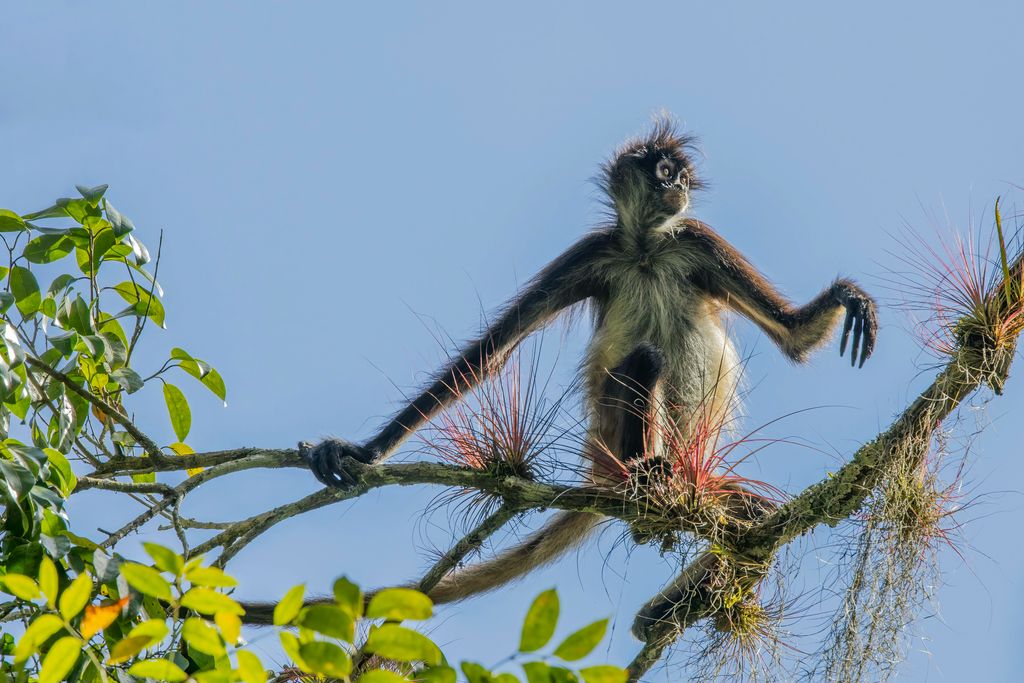
Oles proposes that the monkey is probably Caimito de Guayabal, said to have been given to Kahlo by Rivera after a journey to southern Mexico. His identification depends in part on Hayden Herrera’s account, whose cited page has not been checked directly here. “Probably Caimito” preserves the owner essay’s useful identification without turning a represented animal into a documented sitter. [1] [10]
The bird, described by Oles as green and yellow, may be a yellow-headed Amazona parrot. He compares it with Kahlo’s favoured Bonito but says that bird died in December 1941, before the painting’s stated year. Neither an art historian’s species suggestion nor that household comparison establishes the bird’s biological species or individual name, and the painting cannot be assumed to have been made directly from life. [1] [10]
Oles relays a 1942 report that Kahlo found lively animals difficult to paint because they would not keep still. The statement is known through his citation to Luis-Martín Lozano and Hayden Herrera; Betty Ross’s original Excélsior article of 23 October 1942 has not been acquired. It is valuable context for animal portraiture, not proof of the circumstances of this panel’s making. [1]
Oles also recounts Emmy Lou Packard’s memory of Kahlo arranging flowers, fruit and animals at dinner, again through Herrera rather than an inspected Packard transcript. Such recollections evoke a household in which animals and carefully arranged scenes mattered, but a dinner table is not a documented preparatory model for the painting. The more immediate fact is that Kahlo deliberately brought animal companions into a tightly planned self-portrait. [1] [10]
What Might the Animals Mean?
The monkey can be read as an affectionate pet, an unruly counterpart to Kahlo’s steadier gaze, an alter ego or a substitute child; Oles presents these as competing possibilities rather than a solved code. His essay reports that Griselda Pollock rejects the child-surrogate reading, but the cited Pollock chapter has not been inspected. The disagreement matters precisely because Kahlo’s reproductive history cannot by itself prove what the monkey means here. [1]
Oles treats the parrot as another possible companion or confidant and notes broader pre-Columbian associations of colourful birds. He also observes that Kahlo’s household parrots were largely imported from South America, complicating any claim that this particular bird is a straightforward emblem of indigenous Mexican nature. Nothing in the checked evidence makes the bird a fixed sign of lust, occult practice or childlessness. [1]
The most firmly grounded relation is formal: Kahlo looks outward while the animals create movement and attention around her. Oles sees the bird’s colours and pose as an echo of the artist and the monkey as turning toward it. These are attributable readings of an arrangement, not Kahlo’s own explanation, and they allow the painting to be intimate without forcing every creature into an autobiographical diagnosis. [1]
Portrait Traditions Beyond a Symbol Dictionary
Oles compares Kahlo’s direct, frontal presentation with nineteenth-century Mexican popular portraiture collected by Kahlo and Rivera. He also places animal companions alongside Rosalba Carriera’s Girl with a Monkey of 1721 and two 1866 paintings titled Woman with a Parrot by Gustave Courbet and Édouard Manet. The comparisons show how a sitter and animal can make a charged pictorial relationship without requiring a single universal meaning for the animal. [1]
No checked letter, diary entry or annotated catalogue proves that Kahlo saw the particular European works or borrowed their designs. They remain Oles’s art-historical parallels, not documented sources for this painting. His wider discussion resists calling the work naïve or provincial and considers Mannerism, Neue Sachlichkeit and Surrealism among several useful contexts, none a complete stylistic classification on its own. [1]
The repeated bust-length format is another formal context. Oles compares the slight turn of Kahlo’s body with a private 1940 Self-Portrait with Monkey and hypothesises that photographs, rather than mirrors, may have helped her make such portraits. The published essay cites a then-forthcoming discussion of photography, but no particular source photograph for this painting has been identified or examined here. [1]
Alfonso de Toro’s Spanish-language study places the painting within a series of monkey-and-parrot portraits and reads Kahlo’s repeated pose as a performance that changes from image to image. This is an interpretive account of serial self-presentation, not a catalogue proof that every similarly titled work shares the same animal or intended message. The 1938 Buffalo Self-Portrait with Monkey, 1941 Me and My Parrots, 1943 Self-Portrait with Monkeys and 1945 Self-Portrait with Small Monkey are distinct objects, not alternative dates for the MALBA panel. [11] [1]
Making a Painting in 1942
Oles situates the work after Kahlo’s New York and Paris exposure, when she was trying to increase production and live from painting. That context helps explain why the repeated, compact portrait format could be useful, but it does not identify the date she began this panel or show that a buyer ordered it. His observation that collectors wanted paintings with monkeys is a general market statement, not evidence of a commission for this portrait. [1]
He describes carefully controlled brushwork apart from the animals’ fur and feathers and associates it with the height of Kahlo’s practice. MALBA records oil on Masonite, but no technical report has been found to establish a preparatory drawing, transfer from a photograph, paint sequence, pigments or revisions. The published object’s material and the proposed working method must therefore be kept separate. [1]
Kahlo’s own explanation of this painting has not emerged from the checked letters, diary excerpts or interviews. Even the signature’s exact wording remains unpublished in the owner material consulted here. The composition and its historical context can be examined without inventing a studio account absent from the surviving public records. [1]
From Watson and IBM to MALBA
According to Oles, Thomas J. Watson, founder of IBM, acquired the painting through Mexico City’s Galería de Arte Mexicano not long after it was made. It was then known simply as Self-Portrait. Inés Amor sold several Kahlo works through the gallery, but was not the artist’s exclusive dealer; the checked record does not include this painting’s invoice or the date on which Watson took possession. [1]
The precise acquisition year is reported differently. A contemporary Washington Post article says Watson bought it in the late 1940s for less than $1,000, while a 1995 Vanity Fair account, citing Salomon Grimberg, gives 1947. Neither report is a stockbook, receipt or IBM accession record, so the broad gallery-to-Watson account is firmer than one asserted calendar year or purchase price. [4] [12]
IBM later included the painting in its International Foundation collection. When that collection was dispersed, the work appeared as lot 5 at Sotheby’s New York on 17 May 1995, with an estimate of $2.5 million to $3 million. Sotheby’s records a sale price of $3,192,500, and contemporary reporting identifies Eduardo F. Costantini as the buyer; the auction house conducted the sale, rather than becoming the owner through it. [3] [4] [13]
The result was described in 1995 as a record for Kahlo and for Latin American art, and as one of the highest prices then paid for a work by a woman. These are historical market claims, not present-day rankings. A Spanish El Tiempo report independently gave the exact amount, while a Portuguese study later treated the purchase as important to the growth of Costantini’s collection. [4] [13] [14]
Costantini donated Self-Portrait with Monkey and Parrot to MALBA in 2001, a fact stated by both the current owner record and MALBA’s foundation-era account. The collection number 2003.34 identifies the work now but does not revise that gift date. The painting is a MALBA collection work; Costantini’s later personal acquisition of Kahlo’s Diego y yo should not be merged into this provenance. [1] [5] [15]
The intervening chain has limits. No pre-Watson owner, gallery stockbook, IBM accession file, physical 1995 sale catalogue, export paper or full sequence of later loans has been checked. MALBA’s note and a catalogue listing give the sale number as 6703, while one thesis gives 6704; the secure identifiers are the auction house, date and lot 5. [1] [3] [16]
On View, Then and Now
MALBA’s object record lists an appearance in La Colección Costantini en el Museo Nacional de Bellas Artes in Buenos Aires in 1996. Eva Zetterman’s contemporary review also identifies it in Tate Modern’s 2005 Kahlo exhibition, recognising the yellow background and the MALBA/Costantini loan. These records document particular appearances, not an exhaustive exhibition chronology. [1] [17]
More recently, MALBA showed the painting within Frida y Diego: Transformar los afectos, alongside Kahlo’s lithograph Untitled (The Miscarriage) and Rivera’s Dance in Tehuantepec, through 25 August 2025. It also appeared in the broader Tercer ojo presentation, which closed in April 2026. Sotheby’s displayed it in New York in Icons: Back to Madison in December 2025, an exhibition rather than a second sale. [3] [9] [18]
As checked in October 2026, MALBA names Self-Portrait with Monkey and Parrot as a central work in its open Viva Frida exhibition with Diego y yo and Untitled (The Miscarriage). The event page states public dates from 20 September 2026 and describes the exhibition on level 2; elsewhere on that same page its end date varies between 14 and 15 March 2027. The present-tense listing is time-sensitive, and the conflicting closing dates do not justify a precise endpoint. [7]
Some apparently plausible exhibition claims need an object-identity check. MoMA’s catalogue for its 1942–43 Twentieth-Century Portraits includes a Kahlo Self-Portrait dated 1941, oil on canvas and of different dimensions. That entry cannot be turned into evidence that the 1942 Masonite MALBA painting appeared there. [19]
Later Readings and Public Life
The painting has become a prominent MALBA collection image, appearing in the museum’s digital storytelling and merchandise. That distribution documents an institutional afterlife, not proof that it is Kahlo’s single most important self-portrait. Image-agency listings show the portrait's modern circulation, not Kahlo's original intentions or the painting's artistic rank. [20] [21]
Later scholarship shows how easily the portrait becomes a screen for other concerns. Inmaculada Pertusa traces a modern ex-voto by Gonzalo Hernández that reworks this portrait by changing the animal pairing and adding a fictional reconciliation text. The new work’s reproductive-loss associations belong to that later act of reinterpretation, not to a recovered statement of Kahlo’s 1942 intention. [22]
A recent endocrine article cites the portrait in discussing facial hair and possible hirsutism but cautions that Kahlo’s depicted features may express cultural identity and aesthetic autonomy rather than a medical condition. A quantitative colour study assigns the work a numerical pain-or-anger score of zero; that is an output of the researchers’ coding scheme, not a measurement of Kahlo’s feelings. Both examples are useful reminders that a medical or statistical method can study reception and representation without diagnosing the artist from the picture. [23] [24]
Zetterman’s review of the 2005 retrospective likewise warns against prescriptive biographical interpretation. De Toro’s account of changing self-performance and Oles’s refusal of a single animal key offer more productive alternatives: this portrait can register lived attachments and public self-fashioning at once. Its meaning is richer when direct visual description, documented biography and later interpretations are allowed to remain different kinds of evidence. [1] [11] [17]
Books and Open Questions
The most important unread object-specific book is Luis-Martín Lozano, Andrea Kettenmann and Marina Vázquez Ramos’s Frida Kahlo: The Complete Paintings. An open-access study points to catalogue entry 96 on page 563, but the 624-page commercial volume itself has not been read, so its catalogue text, inscription, bibliography and technical information are not used here. Gannit Ankori’s Frida Kahlo and Imaging Her Selves are relevant monographs for identity and self-representation but likewise remain relevant further reading rather than consulted authorities. [24] [25]
The physical Sotheby’s catalogue for Mexican Paintings and Drawings from the IBM International Foundation, 17 May 1995, lot 5, is another priority. It may help resolve the sale-number conflict and record what provenance and exhibitions were known in 1995; bibliographic listings do not substitute for reading its lot entry. Gallery and IBM archives could refine the first-sale and ownership chronology, while the original Betty Ross article, Oles’s cited Herrera and Turok pages, and Pollock’s chapter would allow several mediated details to be checked directly. [1] [16] [25]
These are identified limits, not a reason to fill gaps with customary Kahlo myths. The owner’s detailed essay, institutional chronology, contemporary auction reporting and open scholarship support a full account of the painting as it stands. The original commission, first transfer and intended symbolism remain uncertain despite the strong later collection record. [1] [3] [10] [25]
Related Reading
Me and My Parrots is a distinct 1941 four-bird portrait. Self-Portrait with Bonito addresses a separate named bird, while Fashion and Tehuana Dress gives the fuller context for Kahlo's clothing and hair choices.
Discussion
Use the cited evidence and your own close looking to explain your view. The prompts below are starting points, not fixed interpretations.
Reader Insights
How do the monkey and parrot frame Kahlo without settling their symbolism?
Which records establish the Watson–IBM–MALBA chain, and where is the early link uncertain?
Why should a current exhibition listing be distinguished from the painting's collection status?
Join the Conversation
Which reading best fits the evidence, and where does uncertainty remain?
References
- MALBA, Autorretrato con chango y loro, with essay by James Oles, object text, technical record and essay notes; accessed October 2026. View source text.
- MALBA Education and Cultural Action, Propuestas para educadores: Frida Kahlo, PDF p. 1, description of face, animals, clothing and plant screen. View source text.
- Sotheby’s, Highlights on View in New York, Self-Portrait with Monkey and Parrot slide caption with 17 May 1995 lot 5 and December 2025 display details. View source text.
- Judd Tully, “Self-Portrait Sets Kahlo Record,” The Washington Post, 18 May 1995. View source text.
- MALBA, Apertura del calendario de exposiciones 2022, pp. 4–5. View source text.
- Smithsonian National Portrait Gallery, Autorretrato con Chango y Loro, object catalogue record. View source text.
- MALBA, Viva Frida, event text naming this portrait and conflicting March 2027 closing dates; checked 3 October 2026. View source text.
- Daniel Gigena, interview with James Oles, La Nación, 6 December 2017. View source text.
- MALBA, Frida y Diego: Transformar los afectos, exhibition text and labels. View source text.
- Museo Frida Kahlo, artist chronology, 1941–43 entries. View source text.
- Alfonso de Toro, “Las nuevas meninas o bienvenido Foucault”, PDF p. 13, discussion of this portrait within a series of animal self-portraits. View source text.
- Vanity Fair, Frida Kahlo feature, September 1995. View source text.
- El Tiempo, “Frida sigue siendo la primera”, May 1995. View source text.
- UNICAMP conference paper on collection formation and Latin American art market, paragraph on the 1995 sale of Self-Portrait with Monkey and Parrot. View source text.
- MALBA, Frida Kahlo: Diego y yo, collection distinction. View source text.
- University of San Martín master’s thesis, printed pp. 135–36 on the 1995 sale, compared with MALBA note 9; the sale number conflicts. View source text.
- Eva Zetterman, review of Frida Kahlo at Tate Modern, 2005. View source text.
- MALBA, Tercer ojo: Colección Costantini en Malba, historical exhibition record. View source text.
- MoMA, Twentieth-Century Portraits catalogue, 1942, p. 138. View source text.
- MALBA, Malba en Google Arts & Culture, digital collection announcement. View source text.
- DNP Art Communications, Japanese image archive record BAL2639880, metadata and rights listing. View source text.
- Inmaculada Pertusa, “De lo visual a lo minitextual en los exvotos pictóricos en México”, Microtextualidades 6 (2019), pp. 49–63. View source text.
- “Frida Kahlo (1907–1954): endocrine perspectives on art and identity,” PubMed abstract, 2026. View source text.
- Edoardo Boccardi et al., “The art of pain”, Frontiers in Human Neuroscience (2022), methods section and table entry for Self-Portrait with Monkey and Parrot. View source text.
- TASCHEN, Frida Kahlo: The Complete Paintings, publisher information; volume not read. View source text.
- Museo Frida Kahlo, Frida interactive chronology, selected work dates used for the comparison timeline. The current work's date follows its cited object record. View source text.
Image Credits
- Geoffroy's spider monkey (Ateles geoffroyi yucatanensis) Peten 2 — Charles J. Sharp / Sharp Photography. CC BY-SA 4.0. Resized and converted to JPEG/sRGB; no crop.
