


 by Tom Gurney
Tom Gurney BSc (Hons) is an art history expert with over 20 years experience
Page created on March 2, 2018 / Page updated on October 6, 2026
Email: tomgurney1@gmail.com / Phone: +44 7429 011000
Introduction
Frida Kahlo's 1949 painting builds an embrace inside an embrace. A divided cosmic figure surrounds an earth-coloured woman, who holds Kahlo as Kahlo cradles a miniature adult Diego Rivera; a curled dog rests beside them. The unusually long title names these beings in sequence, but neither the title nor the image turns every gesture and mark into a fixed symbol. [1] [2]
The painting is intimate without being only a statement about marriage. It joins Rivera to a female chain of support, a landscape identified as Mexico, a sky divided between dark and light, and the companion animal Señor Xólotl. Museums and scholars have read this structure through maternity, duality, national culture and several religious traditions; the most useful account begins with what is visible and then asks who proposed each meaning. [1] [2] [5] [6] [7]
At a Glance
- Artist, title and date: Frida Kahlo, 1949. The English title follows the sequence in Museo Frida Kahlo's Spanish chronology; it is not presented as Kahlo's own English wording. [1]
- Medium and dimensions: Published records disagree: oil on canvas, 69.8 × 60.3 cm (FAMSF), or oil on Masonite, 70 × 65 cm (Québec) and 70 × 60.5 cm (Portland). [2] [3] [25]
- Collection and display: Historically the Gelman Collection; the Zambrano family acquired the collection in 2023 and Santander manages it. Individual legal title and current display are unverified. [21] [22] [23]
- Related study: A 1949 graphite drawing in a Fine Arts Museums of San Francisco label is one of three studies identified by the museum. [2]
Contents
- Introduction
- How the Embraces Organise the Painting
- The Long Title and the Object Record
- Divided Sky, Joined Hands and Earth as Mexico
- Kahlo Holding Rivera and the 1949 Portrait in Words
- Rivera's Third Eye and the Form in His Hand
- Maternity, Injury and Creative Power
- Señor Xólotl, Companion and Mythic Name
- Different Cultural Readings Without a Single Code
How the Embraces Organise the Painting
The vertical picture can be read from outside inward. An enormous human-like figure fills the surrounding field, its left side dark and its right side pale; two vast differently coloured hands meet across the bottom. Inside it, a broad earth-coloured woman encloses Kahlo, whose arms support the small adult Rivera. The dog curls at lower left, within the encompassing field but outside the central human chain. [1] [2]
The outer face appears high among dark masses and a paler clouded sky. A pale orb on the dark side and a red-orange orb on the brighter side invite identification as moon and sun, while smaller circular forms occupy the upper field. The contrast is visible, but calling it a strict diagram of night and day is a further reading: plants, hands and bodies cross the central divide. [2]
The middle woman's lower body seems to become ground. Cactus-like pads, pointed leaves, stems and root-like lines press into and around her mottled torso, so body and landscape are not separate background and subject. The title names her as Earth (Mexico); the image alone does not name a particular goddess or certify each plant species. [1] [2]
At the centre Kahlo looks outward, with loose dark hair and a red-orange covering over a paler patterned area. A red form runs from her upper chest toward her lap, and light marks near her eyes appear tear-like in the available reproduction. The middle figure has a fissure across her chest and a pale droplet at one breast. These visible marks make an uncomplicated picture of comfort difficult, but their exact bodily substances and emotional meanings are not settled by the image. [2] [9]
Rivera's adult face belongs to a nude or nearly nude body reduced to infant scale, lying across Kahlo's arms. An oval above his ordinary eyes is widely called a third eye, and he holds an orange-red form that resembles a small flame, flower or plant. He is dependent in pose but not a literal baby, and the held object cannot be securely identified as a species or single emblem from this view. [2] [6] [16]
Japanese scholar Itsuka Komatsu calls attention to the chain of embracing bodies and relates its overall silhouette to mountain- or pyramid-like forms and successive layers. That approach helps explain why the repeated arms determine the image's structure rather than merely decorating it. His account of interdependent duality is an interpretation of how the contrasts work, not a translation of a written key left by Kahlo. [5]
Watch: Frida Kahlo
Five perspectives to view here alongside the article.
Frida Kahlo’s The Two Fridas: Great Art Explained
A focused visual introduction to the painting and its context.
The Long Title and the Object Record
The Museo Frida Kahlo's Spanish chronology calls the work El abrazo de amor de El universo, la tierra (México), yo, Diego y el señor Xólotl. Its “yo” places Kahlo before Diego, preserving the same movement inward that the image makes visible. English institutional titles vary—“Me” or “Myself,” “Mr.” or “Señor,” and even a reversed “Diego, Me” in one caption—but these are versions of the same 1949 work, not evidence for multiple paintings. [1] [2] [26]
The title is unusually helpful and unusually limited. It identifies Universe, Earth/Mexico, Kahlo, Diego and the dog, so the viewer need not guess which figure is which. It does not name the outer figure Ometéotl, the Earth Cihuacóatl, or the radiating object in Rivera's hand; those proposals belong to later iconographic arguments. [1] [6] [8]
All principal institutional records agree on 1949, but none consulted gives an exact completion day or month. A small mark near the painting's lower-right edge cannot be transcribed from the published comparative image, and no inspected owner technical record supplies its wording. Nor has a commission, first buyer, original intended recipient or exact place of making been documented in the accessible object sources. [1] [2] [3]
The physical record is less settled than the year. FAMSF's comparative caption says oil on canvas, 27½ × 23¾ inches, equivalent to 69.8 × 60.3 centimetres; a Québec government's 2019 legal loan list instead says oil on Masonite, 70 × 65 centimetres. A 2022 Portland Art Museum guide gives a third institutional description, oil on Masonite, 70 × 60.5 centimetres. Portland's width is close to FAMSF's, but that does not prove Québec's figure wrong or explain the canvas/Masonite conflict; a current technical file is still needed. [2] [3] [25]
Divided Sky, Joined Hands and Earth as Mexico
FAMSF describes the picture as based on a yin-yang diagram and says it harmonises night with day and earth with sky. Museo Frida Kahlo also reads a reconciliation of opposites. Those museum readings respond to a real formal pattern—the split field and interlocking hands—but the accessed record contains no sketch annotation or artist statement proving that Kahlo began with a particular diagram. [1] [2]
Komatsu's account puts weight on mutual dependence rather than a tidy two-column code. The differently coloured hands overlap, roots and stems cross the central axis, and the figures are held within one another rather than isolated on their respective sides. The image shows contrast in contact; whether that constitutes harmony, struggle or both is a question for interpretation. [2] [5]
Spanish scholar Luis Roberto Vera proposes a more specific iconography. He reads concentric and pyramidal forms through Mesoamerican paired principles and suggests divine identities for the outer and earth figures, while also comparing enthroned maternal groups from other traditions. These are argued comparisons, not names visible on the bodies or documented sources that Kahlo herself listed for this painting. [6]
“México” is the title's explicit national term. The earth-coloured figure's body merges with vegetation, making it reasonable to speak of a personified landscape, but neither a complete botanical inventory nor a named Indigenous goddess follows from the visible plants. The painting connects land, female bodies and a small male artist; how that connection represents a nation remains open to critical rather than merely celebratory reading. [1] [2] [7]
Art historian Camilla Sutherland reads the female chain as creative power and the meeting of dark and light hands through mestizaje, while also questioning the history of state-sponsored indigenismo. Her point is not that colour alone proves racial identity: nationalist art could make varied living Indigenous cultures into a single symbolic resource, sometimes excluding Indigenous voices. That warning matters whenever this painting is praised as a transparent image of “ancient Mexico,” for the title and imagery do not establish Kahlo's authority to speak for every culture invoked by later viewers. [7]
The Love Embrace of the Universe in Kahlo’s career
The Two Fridas
1939Timeline source: Museo Frida Kahlo chronology [32].
Kahlo Holding Rivera and the 1949 Portrait in Words
The central pair is visually intimate but not simply equal in scale or role. Kahlo sits clothed and upright while Rivera lies exposed across her arms, his mature face resisting the idea that he has become an ordinary infant. The arrangement can suggest care, dependence, artistic regard, humour or possession; it does not prove how either person behaved throughout their marriage. [2] [7]
A contemporary textual parallel makes the maternal comparison more than a modern guess. Kahlo wrote Retrato de Diego for a 1949 catalogue celebrating Rivera's fifty years of artistic work, according to Mexico's Fonoteca Nacional, and Vera quotes through Raquel Tibol a passage comparing the wish to hold Rivera with holding a newborn child. The original catalogue page has not been read here, so the wording is a mediated quotation route rather than a newly verified primary transcription; the probable sound recording discussed by the Fonoteca is not certainly Kahlo's voice. [6] [14]
Painting and text can therefore be read together without making one a literal illustration of the other. The verbal portrait's maternal metaphor helps explain why Kahlo could depict an adult Rivera at infant scale, while the painting's Earth/Mexico and Universe extend the relationship beyond a private couple. It does not justify the old story that she simply “mothered” or pampered him in life. [1] [6] [14]
Rivera's own 1947 mural Dream of a Sunday Afternoon in Alameda Central offers a nearby, distinct comparison. The Museo Mural Diego Rivera identifies him there as a child with Kahlo behind him in a gesture it calls maternal; institutional descriptions also record a yin-yang emblem in her hand. These parallels show that child/adult reversal and duality were available in the couple's imagery before 1949, but not that Rivera's mural directly supplied Kahlo's composition. [15]
Rivera's Third Eye and the Form in His Hand
The oval on Rivera's forehead is commonly described as a third eye, but it is not the picture's sole account of him. A 1947 drawing titled El Tercer Ojo provides an earlier Rivera-related instance of the motif, and Diego and I, made in 1949, places his image on Kahlo's forehead. These comparisons show recurrence without proving that the eye means exactly the same thing in every work. [16] [17]
Ellen Landau relates such images to cross-religious forms of vision and to the 1949 prose portrait, while Aparna Sharma reads Kahlo's Hindu and Buddhist references as critical reworkings rather than a simple turn toward transcendence. “Wisdom” is one possible gloss; it is too narrow as a translation of the visible eye, which can also speak to artistic attention, relationship and spiritual vision in different contexts. The painting offers no explanatory caption fixing the motif's meaning. [18] [19]
The orange-red form in Rivera's hands is similarly resistant to a label. It has radiating edges and can look vegetal or flame-like; Vera discusses petals, flame and a sexualised floral analogy. Calling it definitively a maguey, a penis or a “fire of genius” would turn interpretive possibilities into object identity. Its small concentrated brightness does, however, give the cradled man a visual attribute of his own rather than leaving him merely passive. [2] [6]
Maternity, Injury and Creative Power
FAMSF's phrase “Tehuana Madonna” and Museo Frida Kahlo's maternal account respond to the repeated holding gestures. Vera compares enthroned mother-and-child images from several traditions, while Portuguese scholars Ciro Inácio Marcondes and Vanessa Daniele de Moraes foreground maternal imagination and the movement from Universe through Earth and Kahlo to Rivera. Those perspectives illuminate the form; they do not establish that Kahlo copied a particular Virgin, Isis-and-Horus image or other named prototype. [1] [2] [6] [9]
The painting also resists a purely nurturing reading. The fissure and pale droplet on Earth/Mexico's breast, Kahlo's red chest-to-lap form and her tear-like marks join care to damage. Marcondes and Moraes discuss milk and blood, but the available digital image cannot identify both liquids or make the forms a clinical record. Reproductive loss is part of Kahlo's wider biography; the picture does not prove a diagnosis of permanent infertility or reduce every embrace to a substitute child. [2] [9]
Sutherland's reading moves maternity beyond individual loss. Universe, Earth/Mexico and Kahlo appear as female powers surrounding a male artist, so the structure can picture creation and dependence as well as vulnerability. That argument also prevents the smallest body from becoming the unquestioned source of all meaning: Rivera is prominent, but the women and landscape actively make the space in which he appears. [7]
Señor Xólotl, Companion and Mythic Name
The dog lies asleep or at rest on the dark lower side, set apart from the upright faces and repeated cradling arms. The Spanish title identifies him as Señor Xólotl, and the Museo Frida Kahlo separately records an animal companion of that name at Casa Azul. The figure therefore has a domestic as well as a possible mythic context; his exact breed cannot be established by the small research reproduction alone. [1] [2]
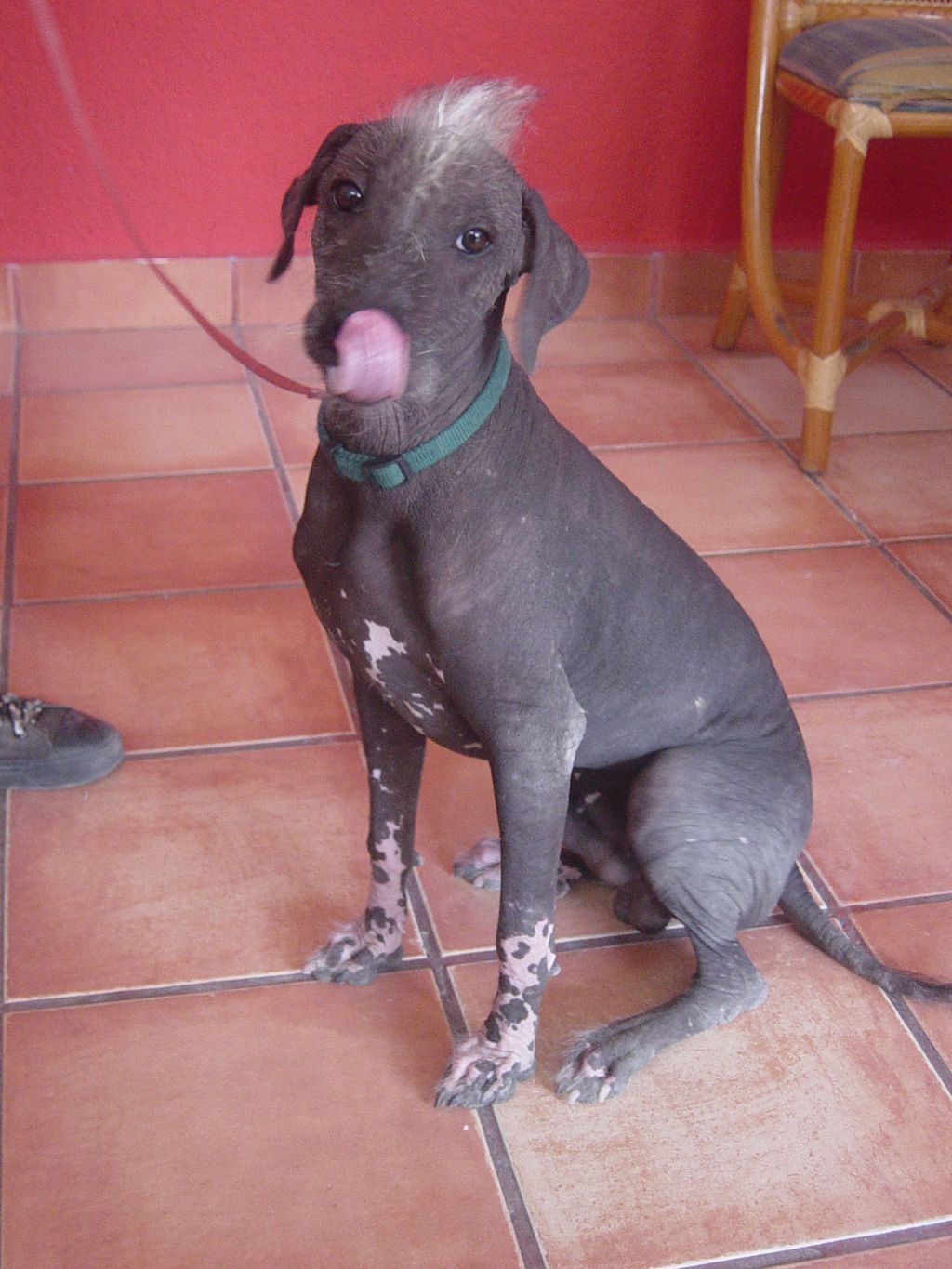
The Brooklyn Museum identifies the painted animal as a Mexican hairless dog and associates the breed's name with Xólotl, a deity linked to the underworld. Mexican archaeology and a UNAM pictographic database show a wider constellation of associations involving companionship, transformation, life and death, solar movement and guidance of souls. “Xólotl means death” erases that complexity, and the sources on the deity do not by themselves prove what Kahlo meant by including her resting dog. [10] [11] [12]
Melanie Otto reads the dog through Mictlán and protective nahual traditions, placing it within a broader feminist reinterpretation of myth. Her account makes the peripheral animal more consequential than a decorative pet, but it is a later scholarly interpretation, not an artist-authored explanation of every mythic episode. The dog's visible posture remains quiet and curled even as its name opens other histories. [8]
Different Cultural Readings Without a Single Code
The embrace has been compared with Mesoamerican duality, a Christian mother and child, Isis and Horus, Asian yin-yang and third-eye imagery, and European enthroned family groups. Vera argues across several of these genealogies; FAMSF's Madonna and yin-yang language selects two; Otto applies the later concept of nepantla, an in-between condition, to crossings among bodies, land, animal and spiritual worlds. These are ways of analysing a painting that juxtaposes many forms, not evidence that Kahlo consulted or intended every named tradition. [2] [6] [8]
Such comparisons are most helpful when their differences remain clear. A Tehuana association does not authenticate Kahlo's entire painted garment as one fixed regional costume; a Madonna analogy does not make Earth/Mexico a Christian figure; and Xólotl is not interchangeable with any god of death. The painting's formal relationships are strong enough to support cross-cultural discussion without a universal symbol dictionary. [2] [6] [7] [8] [10]
Otto's nepantla argument is particularly useful as a retrospective lens, because it describes a work in which categories touch and overlap rather than settle into a single origin. The word comes from later theoretical work, not from a statement by Kahlo about this painting. Its value lies in the question it poses about the spaces between human and animal, body and landscape, Mexican and transregional imagery. [8]
Drawings, Photograph and the First Exhibition
The painting's structure was worked through rather than merely discovered in one final image. FAMSF identifies a related 1949 graphite drawing at the Museo Frida Kahlo as one of three known sketches, a concrete record of preparatory work. Its label said the sheet had not previously been exhibited at the time of that show; that historical statement does not tell us where the other two studies are or their order. [2]
An archival photograph associated with the Florence Arquin papers shows Kahlo seated beside the painting. The Archives of American Art record dates the print only “194-?”, which cannot responsibly be tightened to 1949 or placed before or after the first exhibition. The photograph records Kahlo beside the painting, but its broad date cannot establish the exact sequence of making and exhibition. [20]
Museo Frida Kahlo says that Kahlo participated with this painting in the inaugural exhibition of the Salón de la Plástica Mexicana. This gives the work a lifetime public setting in 1949, beyond its potential use as a private relationship image. The original Salón checklist and contemporary reviews have not been inspected, so exact dates, catalogue number, lender, sale status and critical reception remain open. [1]
The drawing, photograph and museum chronology point to different aspects of the picture's early life: planning, physical presence with Kahlo, and public exhibition. None alone proves a precise studio, completion date or commission. Keeping those records separate also prevents the later Gelman history from being projected backwards into the act of making. [1] [2] [20]
From the Gelman Collection to Gelman Santander
Older museum records credit the painting to the Jacques and Natasha Gelman Collection of Mexican Art, sometimes with the Vergel Foundation. That is a useful historical collection identity, but the accessible records do not say when the Gelmans acquired this particular work, who sold it to them or how legal title moved afterwards. A 2019 Québec loan list, 2021 Cobra record and 2022 Portland guide are dated snapshots, not a complete provenance chain. [3] [24] [25]
Mexican cultural authorities reported that the Zambrano family acquired the collection in 2023. In January 2026 Santander announced an agreement to manage its conservation, research and exhibition under the Gelman Santander name. Management is not ownership: the corporate release does not say that the bank purchased this painting, and a collection-level acquisition report does not identify the individual legal entity on an object sheet. [21] [22]
The collection's public itinerary also needs dated language. The 2026 Relatos modernos exhibition at Mexico City's Museo de Arte Moderno contained ten Kahlo oils and closed on 19 July; critic Anna Dumont described this painting among the works she saw there in June. A subsequent Faro Santander exhibition opened on 8 September 2026 and is scheduled through 10 January 2027, but its official general page does not enumerate this picture, so current physical display cannot be asserted from that announcement alone. [22] [23] [31]
The announced Faro catalogue may provide an object entry, technical description, latest credit and exhibition record, but its contents are not yet available in the cited material. Until that and the manager's file are obtained, the defensible present statement is that the painting belongs to the Gelman collection history now managed under the Gelman Santander name, with individual-work credit and display still to verify. [21] [23]
A Painting on the 500-Peso Note
The painting later entered a quite different public setting. Banco de México used fragments of it on the reverse of the F-series 500-peso banknote, alongside a 1940 Kahlo self-portrait; that design entered circulation on 30 August 2010. The bank's Spanish and English records supply the date and image credits, making this a documented example of national reception rather than a speculative claim about popular influence. [26]
The note used selected fragments within a designed banknote, not the full painting as a stand-alone plate. Its two sides joined Kahlo and Rivera in public currency, a striking afterlife for a work already built around their relationship and a Mexican landscape. It does not follow that the central bank endorsed a particular account of the dog, the maternal figures or the divided cosmos. [26]
Banco de México now places the F-series note among earlier designs. The painting's appearance belongs specifically to that 2010 design, not to the current 500-peso note. [26]
Books and Original Records
Faro Santander has announced a 2026 México moderno en la Colección Gelman Santander catalogue. An entry for this painting, if included, may clarify the current title, support, dimensions, legal credit, inscription and exhibition history; only the announcement, not the complete book, has been read. The 1949 Salón inaugural catalogue and the original page of Kahlo's Retrato de Diego are equally important contemporaneous records, as are the manager's technical file and the two related studies not identified by the FAMSF label. [1] [2] [14] [23]
Luis-Martín Lozano, Andrea Kettenmann and Marina Vázquez Ramos's Frida Kahlo: The Complete Paintings is a relevant comprehensive painting catalogue. The publisher confirms its scope and length, but its The Love Embrace object entry and apparatus have not been consulted, so the canvas/Masonite conflict remains unresolved. Gannit Ankori's Frida Kahlo and the V&A volume Frida Kahlo: Making Her Self Up are further routes into relational identity, dress and self-presentation; their complete relevant chapters are also unread here. [27] [28] [29]
Adriana Zavala's Becoming Modern, Becoming Tradition would deepen the historical account of modernity, gender and national culture, while the Museo Frida Kahlo's bibliography maps further edition-specific routes. Neither a publisher's contents list nor a museum bibliography substitutes for the actual chapters. In contrast, this page's Spanish Vera article, Japanese Komatsu study, Portuguese maternal-interpretation paper and English Sutherland and Otto essays were read at their stated access levels and are cited for arguments they make, not presented as one consensus. [4] [5] [6] [7] [8] [9] [30]
Teresa del Conde's earlier Spanish discussion of the popular in Kahlo's painting and Jeffrey Belnap's critique of Tehuana representation help frame why national forms require historical care. They do not identify The Love Embrace's support, exact plants or intended deity and therefore are contextual reading rather than substitute object records. The original 1949 catalogues, newly issued collection book and individual technical file have not been consulted; they may answer questions these essays cannot. [13] [23]
Related Reading
Frieda and Diego Rivera examines an earlier painted pairing. Diego and I follows another 1949 image of Rivera, while the fashion and Tehuana dress study gives clothing context that this painting alone cannot establish.
Questions Readers Often Ask
He has an adult face and body but is painted at infant scale in Kahlo's arms. The pose supports a maternal comparison, especially beside the mediated 1949 Retrato de Diego text, but it does not prove that Kahlo literally treated Rivera as a child or that the work is only about their marriage. [2] [6] [14]
Wisdom is one common interpretation of the forehead oval, not a meaning supplied by a painted caption. Related Rivera-eye imagery appears in a 1947 drawing and in Diego and I of 1949, while scholars consider relational and cross-religious contexts. The symbol should be discussed as a recurring motif rather than reduced to one equation. [16] [17] [18] [19]
The title identifies him as Señor Xólotl, the name of a real companion animal recorded by Museo Frida Kahlo. Xólotl also has underworld associations, but INAH and UNAM document wider roles involving life, companionship and transformation. A sleeping dog can carry these contexts without becoming merely a one-word death sign. [1] [10] [11] [12]
The picture has a Gelman collection history, and a visiting critic specifically saw it at Mexico City's Museo de Arte Moderno in June 2026. That show has closed; although Santander now manages the collection, the official Faro exhibition page checked in October did not give an individual display entry for this painting. Its present display therefore remains unconfirmed. [21] [22] [23] [31]
The inspected sources disagree: FAMSF says oil on canvas and 69.8 × 60.3 centimetres, the Québec legal loan list says oil on Masonite and 70 × 65 centimetres, and Portland's 2022 guide says oil on Masonite and 70 × 60.5 centimetres. Neither the image nor an average resolves the conflict. A current collection technical sheet is needed. [2] [3] [25]
What the Nested Embrace Holds Together
The painting's title and structure make a sequence of dependencies visible: Universe, Earth/Mexico, Kahlo, Rivera and Señor Xólotl occupy different positions in one encompassing design. Its joined hands and cradling arms invite an account of care, but the damaged chests, tears, dark field and peripheral dog keep the scene from becoming an uncomplicated celebration. The strongest readings illuminate these tensions while acknowledging which names come from Kahlo's title, which facts come from institutional records and which meanings are later arguments. [1] [2] [5] [6] [7] [8]
Discussion
Use the cited evidence and your own close looking to explain your view. The prompts below are starting points, not fixed interpretations.
Reader Insights
How does the sequence of enclosing bodies organise the work before any symbol is assigned?
What can the long title establish, and what remains a later cultural interpretation?
Why should conflicting support and size records remain visible in an object account?
Join the Conversation
Which reading best fits the evidence, and where does uncertainty remain?
References
- Museo Frida Kahlo, bilingual Frida chronology, Spanish and English 1949 entries for the title, date, inaugural Salón de la Plástica Mexicana statement and curatorial interpretations; 1941 animal entry identifies Señor Xólotl as a companion. The museum's reading of maternal care is attributed rather than treated as Kahlo testimony. View source text.
- Fine Arts Museums of San Francisco, Frida Kahlo: Appearances Can Be Deceiving exhibition labels, drawing and comparative painting entries, current online lines 243–253. They identify the 1949 graphite study as one of three known sketches and give oil on canvas, 27½ × 23¾ inches; yin-yang and “Tehuana Madonna” are the museum's interpretations. The comparative image supports the described composition but does not settle the painting's material or measurements. View source text.
- Gouvernement du Québec, Gazette officielle du Québec, 26 December 2019, immunity decree 71659, PDF p. 8, schedule entry for this painting: oil on Masonite and 70 × 65 centimetres, with Gelman/Vergel loan credit. This is a dated legal-list record, not a current technical inspection or proof of physical display. View source text.
- Museo Frida Kahlo, institutional bibliography, two pages; lists further books but does not itself supply their arguments. View source text.
- Itsuka Komatsu, “The Chain of Embracing Bodies Depicted by Frida Kahlo”, Rikkyo Review of New Humanities 4 (2016), pp.17–34, DOI 10.14992/00012050, especially pp.17–22 and 29–34. Complete Japanese PDF inspected with conservative paraphrase of the nested-body and interdependent-duality argument. View source text.
- Luis Roberto Vera, “Maternidad: raigambre y clasicismo en El abrazo de amor de Frida Kahlo”, Tramas 40 (2013), pp.301–317, especially pp.303–305 and 309–314. Complete Spanish article read; deity and art-historical genealogies are attributed proposals, and its Retrato de Diego wording is mediated through Tibol. View source text.
- Camilla Sutherland, “Indigenismo and the Limits of Cultural Appropriation”, in After Modernism: Women, Gender, Race (2023), DOI 10.4324/9781003371700-5, especially printed pp.76–78. Complete open chapter read for its female-force, mestizaje and indigenismo arguments. View source text.
- Melanie Otto, “Tierra entre medio: Borderlands of Knowledge in the Art of Frida Kahlo”, Irish Journal of American Studies, especially discussion of this painting in the article's central paragraphs. Complete article read; nepantla and mythic readings are retrospective analysis. View source text.
- Ciro Inácio Marcondes and Vanessa Daniele de Moraes, “O imaginário da maternidade em Frida Kahlo”, Intexto 40 (2017), pp.114–132, DOI 10.19132/1807-8583201740.114-132, especially pp.118–122. Complete Portuguese article read; partly develops earlier iconography rather than independently verifying Kahlo's intentions. View source text.
- Brooklyn Museum, Dog Figure object and gallery text, gallery-label passage on the painting identifying the painted animal as a Mexican hairless dog and explaining Xólotl associations; contextual institutional interpretation. View source text.
- Instituto Nacional de Antropología e Historia, “El perro, guardián de la vida después de la muerte”, Spanish archaeology context for canine and Xólotl roles; not a statement about Kahlo's intention. View source text.
- UNAM Tlachia, Xólotl pictographic entry, Telleriano-Remensis database; source for the name's broader creator, twin, solar and transformative associations, not an identified prototype for this picture. View source text.
- Teresa del Conde, “Lo popular en la pintura de Frida Kahlo”, Anales del Instituto de Investigaciones Estéticas 13, no.45 (1976), pp.195–203, DOI 10.22201/iie.18703062e.1976.45.1020; and Jeffrey Belnap, “Disentangling the Strangled Tehuana”, Genders 33 (2001). Complete relevant contextual discussions read, neither as an object record for this painting. View source text 1; View source text 2.
- Secretaría de Cultura / Fonoteca Nacional, announcement on a probable Kahlo voice recording, 12 June 2019, describing Retrato de Diego in the 1949 Rivera jubilee catalogue through Raquel Tibol; original catalogue page unread and voice attribution explicitly tentative. View source text.
- Museo Mural Diego Rivera / INBAL, museum and mural record for Sueño de una tarde dominical en la Alameda Central (1947), including the museum's maternal-gesture interpretation; comparison does not establish direct influence. View source text.
- Sotheby's, 1947 El Tercer Ojo drawing on envelope, public lot record and catalogue note. The record supports a related Rivera-eye motif, while its proposed meanings remain auction-house interpretation. View source text.
- MALBA, Diego y yo (1949), institutional object entry; the same-year forehead-Rivera comparison is visual and chronological, not proof of identical symbolism. View source text.
- Ellen G. Landau, “Performing the Self and the Other”, Crónicas (2010), UNAM-hosted PDF p.31 and note 29; read as attributed cross-religious and relational third-eye analysis. View source text.
- Aparna Sharma, scholarly review of the Frida Kahlo exhibition, Leonardo Digital Reviews, 1 December 2005; 1940s Hindu/Buddhist imagery discussion used as attributed context, not proof of this painting's source imagery. View source text.
- Smithsonian Archives of American Art, Florence Arquin papers photograph of Kahlo with the painting, catalogued “194-?”; date, photographer and place remain unresolved. The photograph shows Kahlo with the canvas, but its broad date does not establish a precise making sequence. View source text.
- Banco Santander, management announcement for the Gelman collection, 21 January 2026; conservation, research and exhibition management under the new name are distinguished from legal ownership. View source text.
- INBAL, Relatos modernos inauguration bulletin 163, 16 February 2026, on the Zambrano family acquisition and ten Kahlo oils; and Museo de Arte Moderno 2026 exhibition listing, showing the exhibition ended by 19 July 2026. The releases do not provide a technical entry for this painting. View source text 1; View source text 2.
- Faro Santander, México moderno en la Colección Gelman Santander, exhibition 8 September 2026–10 January 2027 and catalogue announcement. The public page does not individually list this painting; full catalogue unread. View source text.
- Cobra Museum, Frida Kahlo & Diego Rivera: A Love Revolution, 28 May–3 October 2021, object-specific image credit for this painting to the Gelman Collection and Vergel Foundation; a historical loan/credit snapshot. View source text.
- Portland Art Museum, Mexican Modernism bilingual activity guide, PDF p.7 (printed pp.12–13) discussion of this painting and PDF p.8 lines 504–510 object credit: oil on Masonite, 70 × 60.5 centimetres, with Vergel/MondoMostre/INBAL credit. The exhibition organiser dates the Portland presentation to 19 February–5 June 2022 and lists this painting. The guide's “wisdom” gloss is educational interpretation, not conclusive iconography. View source text 1; View source text 2.
- Banco de México, F-series 500-peso banknote record, Spanish design and circulation date, with English design record; fragments of this painting appear on the reverse of the F-series note introduced 30 August 2010. View source text 1; View source text 2.
- Luis-Martín Lozano, Andrea Kettenmann and Marina Vázquez Ramos, Frida Kahlo: The Complete Paintings (TASCHEN, 2021), publisher record only; complete 624-page book and the entry for this painting has not been consulted. View source text.
- Gannit Ankori, Frida Kahlo (Reaktion Books, 2013), publisher/distributor metadata only; relevant chapters unread. View source text.
- Claire Wilcox and Circe Henestrosa, eds., Frida Kahlo: Making Her Self Up (V&A Publishing, 2018), publisher/store record only; complete book and essays on this painting have not been consulted. View source text.
- Adriana Zavala, Becoming Modern, Becoming Tradition: Women, Gender, and Representation in Mexican Art (Penn State University Press), publisher introduction and contents only; complete book unread. View source text.
- Anna Dumont, “The heated debate over Mexico’s finest private collection”, Apollo, 12 June 2026, especially lines 55–61: a critic's firsthand account of the MAM display that explicitly describes this painting. It does not establish later Faro placement or the article's disputed transaction narrative. View source text.
- Museo Frida Kahlo, Frida interactive chronology, selected work dates used for the comparison timeline. The current work's date follows its cited object record. View source text.
Image Credits
- Canek (Xoloitzcuintle sitting) — Micyaotl G.T. CC BY 2.0. Resized and converted to JPEG/sRGB; no crop.
