


 by Tom Gurney
Tom Gurney BSc (Hons) is an art history expert with over 20 years experience
Page created on March 2, 2018 / Page updated on October 6, 2026
Email: tomgurney1@gmail.com / Phone: +44 7429 011000
Introduction
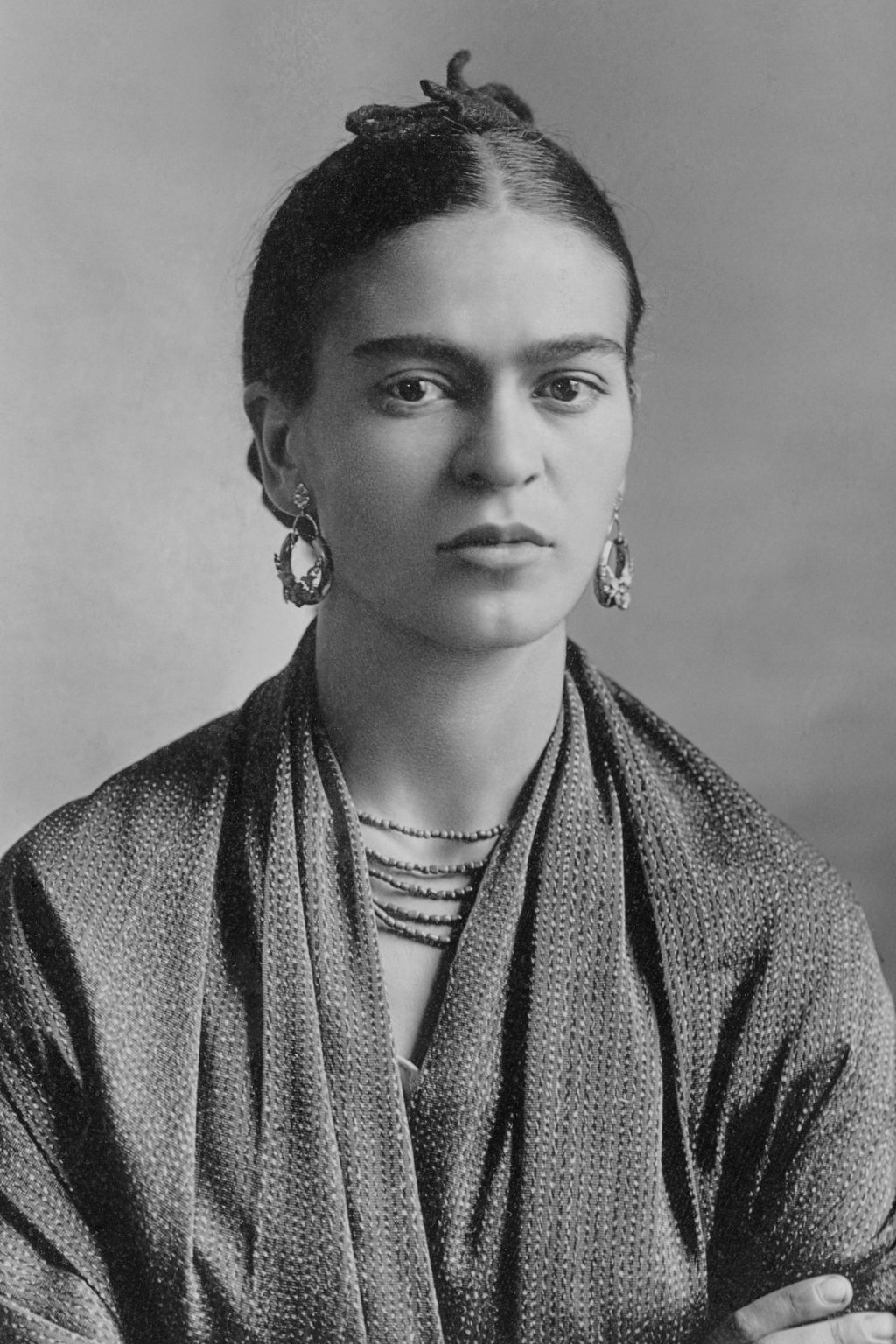
Frida Kahlo lived with photographs before she became a widely photographed artist. She posed for her father and for professional photographers, learned aspects of his craft, collected and exchanged prints, and made a small number of photographs herself. Those activities do not all confer the same authorship: a portrait can record Kahlo's considered appearance while still being the work of the person behind the camera. [1] [2] [3]
The distinction matters because later fame has encouraged viewers to treat every image of Kahlo as a revelation of her character. Her dress, gaze and chosen setting may be visible, but a photograph also has a photographer, a frame, a physical print, a caption and an audience. Following those layers shows how Kahlo participated in making an image without turning each portrait into either a passive document or a self-portrait she took herself. [1] [2]
At a Glance
- Family studio: Guillermo Kahlo photographed the family; the V&A says Frida helped retouch plates and worked in his darkroom. [1] [2]
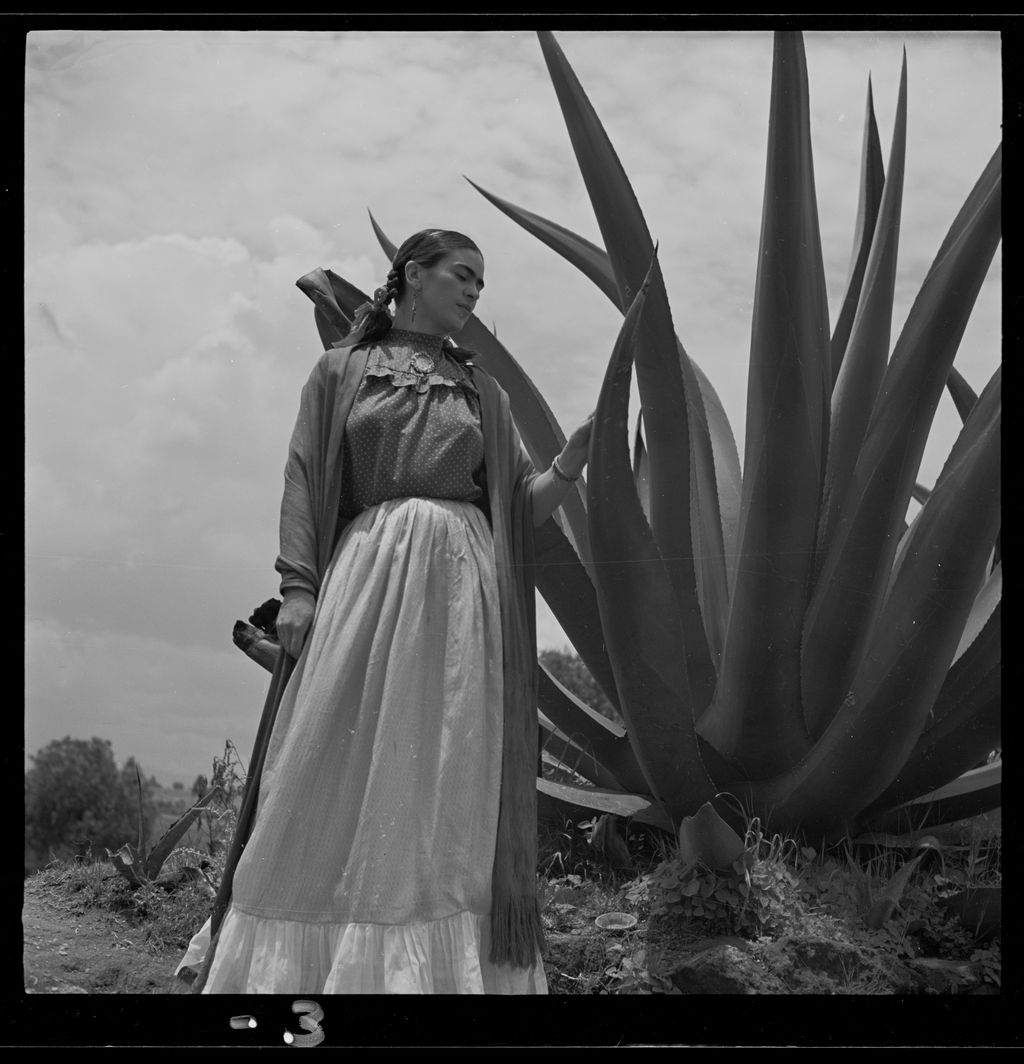
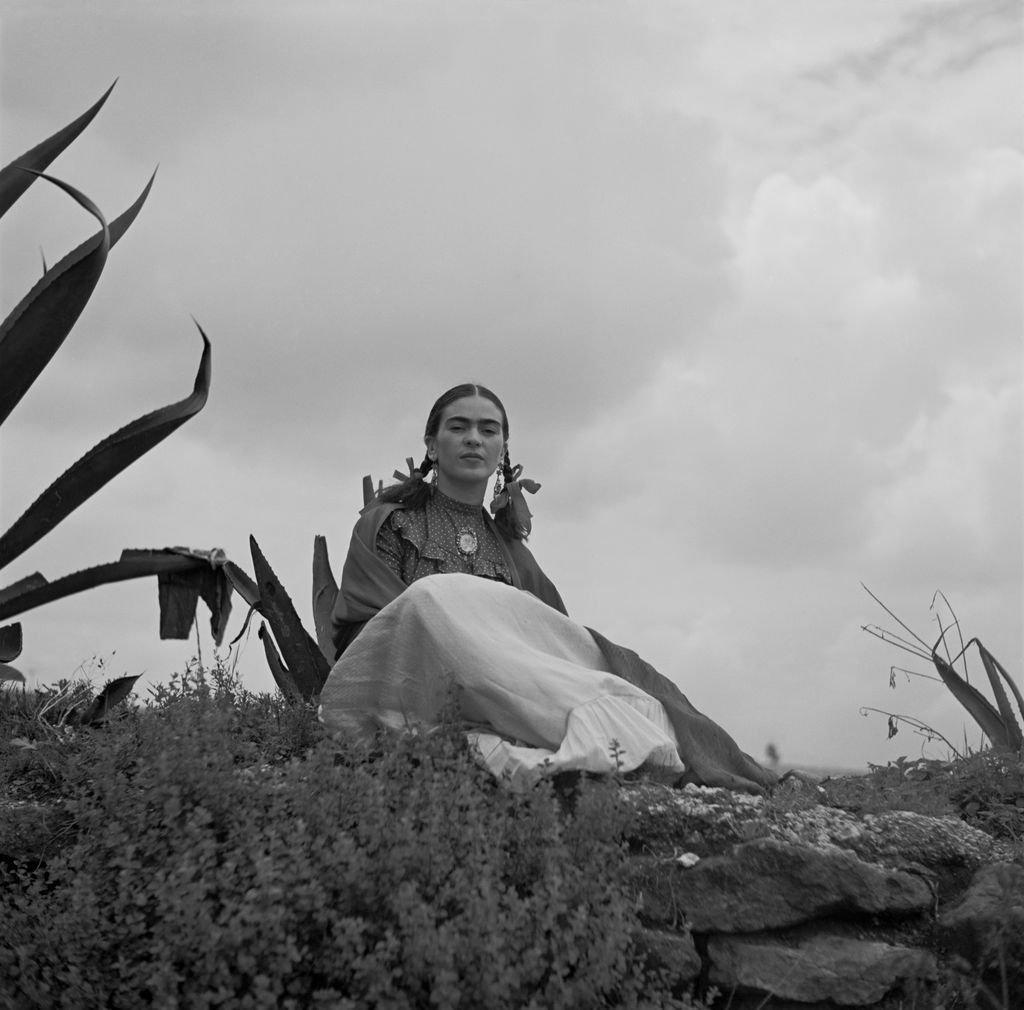
- 1937 portrait: Toni Frissell photographed Kahlo beside an agave for Vogue; the standing and seated views are distinct LOC negatives. [8] [9]
- Her own camera: A small signed group of 1929 photographs is documented, although consulted accounts differ on whether it comprises three or four. [2] [15]
- Collected photographs: The Casa Azul archive includes family, political, medical and artistic material; its exact total differs among institutional descriptions. [1] [17] [25]
Contents
- Introduction
- A Photographer in the Family
- Posing for Other Photographers
- The Small Group She Made Herself
- A Collected and Exchanged Archive
- When a Photograph Meets a Painting
- The Image After Kahlo
- Related Reading
A Photographer in the Family
Kahlo's father, Guillermo, ran a photographic studio and made architectural as well as family images. The Victoria and Albert Museum reports that she helped him retouch glass plates and worked in his darkroom, giving her familiarity with photographic processes while she was young. That museum account supports an early practical connection to the medium, although it does not establish the length or exact technical extent of any apprenticeship. [1] [3]
One family sitting, dated 7 February 1926 by the V&A, makes the difference between photographer and sitter particularly clear. Guillermo is credited with the image; Frida, standing among relatives in a three-piece suit and carrying a cane, provides its most conspicuous departure from conventional family dress. Scholar Nieves Limón Serrano examines two frames from the session and reads the repeated pose as an intervention in the ordinary family-portrait arrangement, not as evidence that Frida operated Guillermo's camera. [1] [2]
The reason for her choice cannot be settled from the photograph alone. Limón Serrano recounts a later description of the gesture as a joke through another scholar's interviews, while her own analysis attends to how the suit unsettles gendered expectations of a daughter in a family group. Both readings may illuminate the image; neither licenses a declaration that one hidden motive has finally been recovered. [2]
The family pictures also show why the back of a print and the date of its exposure should not be confused. Fine Arts Museums of San Francisco attributes a first-communion photograph to Guillermo rather than naming him as certain photographer, and notes an annotation by Kahlo that gives an erroneous year. Her later writing on a photograph is evidence of its subsequent handling, not automatic proof of when the camera shutter opened. [2] [4]
Watch: Frida Kahlo
Five perspectives to view here alongside the article.
Frida Kahlo’s The Two Fridas: Great Art Explained
A focused visual introduction to the painting and its context.
Posing for Other Photographers
Limón Serrano proposes that Kahlo could shape a photographic portrait by selecting dress, stance, expression and location, even when someone else exposed the negative. Her 2019 study calls this a degree of shared creative authorship in an analytical sense; it does not change an owning museum's photographer credit or settle copyright. It is most useful as a way to ask what Kahlo contributed to a sitting, rather than as a licence to claim that she designed every detail of a picture whose session record is unknown. [2] [3]
Imogen Cunningham's 1931 portraits illustrate the value of keeping particular photographs and prints distinct. Seattle Art Museum catalogues a gelatin-silver print titled Frida Kahlo, Painter 3; MoMA holds a smaller print titled Frida Rivera; Birmingham Museum of Art records a Cunningham image exposed in 1931 but printed later by Rondal Partridge. The institutions' titles, dimensions and print histories differ, and they should not be flattened into one material object or declared separate negatives without matching the images. [5] [6] [7]
Toni Frissell photographed Kahlo beside an agave for Vogue in 1937. The Museo Frida Kahlo chronology dates the sitting to September and the “Señoras de México” feature to the October issue; the Library of Congress preserves several distinct black-and-white negatives from the session. The standing view registered for this site's use is negative no. 3, not a crop of the separate seated view, no. 4. [8] [9]
Limón Serrano reads the magazine presentation as placing Kahlo among Mexican society women and introducing her through Diego Rivera's fame. That is an analysis of the publication's framing, not a statement made by Kahlo about herself. Without the original issue pages, it would be unsafe to describe their exact colour, layout or full copy; the surviving LOC negatives cannot by themselves tell us how Vogue printed them. [2] [8] [9]
Lucienne Bloch's portraits show a different kind of collaboration across repeated exposures. Limón Serrano groups five photographs made at New York's New Workers School in 1933, including changes of glance, gesture and playful use of a necklace or lamp, and interprets them as an associative series rather than a single fixed narrative. A photographic dealer independently lists a necklace and a wink portrait as 1933, but dates one lamp picture 1931; without matching the negatives, the five frames cannot all be assigned that dealer's titles or placed in a certain shooting order. [2] [10]
A separate museum record dates Bloch's photograph of Kahlo and Rivera beside a completed New Workers School mural to 3 December 1933. It confirms another camera encounter in that environment, not the identity of every frame in Limón Serrano's group. By placing both artists beside a commissioned work, it answers a different documentary question from the close portraits in which Kahlo changes her expression and pose. [11]
Bloch also photographed Kahlo with a Cinzano bottle in 1935, according to the gallery listing and the thesis. A later report interpreted the bottle as a lost child, but the chain reaches the thesis through a 2002 press account and does not preserve Kahlo's own explanation of the pose. The picture belongs to a discussion of photographic variation, not a proof of that symbolic claim. [2] [10]
Other photographers made quite different kinds of objects. The Metropolitan Museum of Art holds a Nickolas Muray portrait as a 1939 carbro print, while a V&A loan filing describes some Muray exposures of the late 1930s through prints made in 1991. The same broad photographic relationship can therefore be encountered through material objects separated by decades, and an exposure date should not silently become the date of every surviving print. [12] [13]
San Antonio Museum of Art's Fritz Henle records offer another example: a Kahlo photograph exposed in 1943 was printed in 1982, while a separate 1943 Henle portrait survives as a vintage print. The records do not establish whether both came from one negative, but they make the difference between the date of an image and that of its material print unmistakable. The portraits also extend the case set beyond photographers whose names are most often attached to Kahlo. [27]
Lola Álvarez Bravo's 1944 mirror portrait, Emmy Lou Packard's 1941 doorway image and a 1949 Héctor García print held by SFMOMA widen the account beyond the most reproduced Muray photographs. The V&A filing and museum labels establish these as named images or prints, not a single continuous session or a set of cleared illustrations. They show that Kahlo's image was made within more than one photographic practice and social relationship, each of which deserves its own camera credit. [4] [13] [14]
The Small Group She Made Herself
Kahlo was not only a sitter. The V&A says that a handful of photographs are attributed to her, and an exhibition account from Budapest identifies signed pictures alongside a separately attributed unsigned one. Limón Serrano's thesis describes three signed, dated and numbered photographs from 1929—a portrait of Carlos Veraza, a still life of tools and an arrangement of toys—whereas the Budapest exhibition describes four signed works. The difference has not been settled by an inspected catalogue of the individual objects, so a precise total would give false certainty. [1] [2] [15]
The shared point is more important than forcing those accounts into one number: a small signed group establishes that Kahlo sometimes worked behind a camera. Further proposed attributions must remain tentative, and possession of a photograph in her home does not make her its photographer. Limón Serrano reads the toy arrangement as recalling the 1925 accident, but this is a scholar's interpretation of the image rather than a statement surviving from Kahlo about why she arranged it. [2] [15] [16]
The distinction between making and looking also bears on a 1945 photographic-composition seminar. The V&A identifies two group pictures that place Kahlo and Rivera with the photographer and teacher Nicholas Haz; it credits the person who took those photographs as unknown. Her presence at the event supports continuing interest in photography, not an assumption that she operated the camera for either picture. [1]
A Collected and Exchanged Archive
Kahlo's photographs were also things to keep, send and revisit. In an original Spanish essay on the Casa Azul collection, curator Pablo Ortiz Monasterio describes an archive encompassing family and friends, politics, medicine, industry, science, works of art and period photographs by other makers. He characterises Kahlo as collecting and working with this material, a more expansive activity than posing for portraits. [17]
Institutions give different estimates of the archive's size: Ortiz Monasterio writes of more than 5,000 images, the V&A of around 6,000, and the Nevada Museum of Art of over 6,500 photographs and related objects. These figures come from different descriptions and should not be treated as a count to average. Nevada's 240-image exhibition selection and a later travelling account of 241 photographs measure chosen displays, not the contents of the entire archive. [1] [15] [17] [18]
The archive's later public opening likewise should not erase its earlier private circulation. In a letter transcribed by the National Museum of Women in the Arts, Mary Sklar told Kahlo that a photograph Kahlo had sent made a powerful impression on her, comparable to a painting. The letter is dated 7 October without a year, and it does not identify the photograph or its photographer; what it does document is one friend's response to an image Kahlo chose to share. [19]
Some prints were altered as physical objects. The V&A discusses inscriptions and exchanges, while Limón Serrano identifies marks, corrections and drawn additions on particular photographs and reads them as ways Kahlo reshaped her photographic appearance. The specific hand and sequence of every mark have not been independently cited here, so the most exact claims belong to the scholar's analysis rather than to an imagined universal habit of drawing over all the photographs she owned. [1] [2]
Conservators who worked on the Casa Azul photographic holdings found inscriptions, paint stains, lipstick, cuts and old tapes on many prints. They treated these traces as part of the objects' history: in some cases paper supports or historic tapes were retained or reattached because removing them would discard evidence of use. Their report concerns a collection associated with Kahlo and Rivera, however, so a mark on an unidentified print cannot automatically be assigned to Kahlo's hand. [25]
This material history makes selection central to the story. Alongside the 240- and 241-image touring selections, the Frick Pittsburgh showed 115 photographs drawn from private albums in the Vicente Wolf collection; none of those figures is the total Casa Azul archive. Each stage—acquisition, inscription, storage, rediscovery, later ownership and exhibition—changes which aspects of her photographic life can be seen. [15] [17] [18] [26]
When a Photograph Meets a Painting
Photographs could give Kahlo a face, a family arrangement or a view of a body to transform in another medium. A museum-related exhibition pairs an 1898 wedding photograph of her parents with the genealogy in My Grandparents, My Parents, and I (1936), and compares a Muray back view with Tree of Hope (1946). Such pairings make visual questions available, but resemblance by itself does not prove the order in which Kahlo looked at a print or that she copied it directly. [20]
A Fine Arts Museums of San Francisco label identifies a more specific photographic basis for Kahlo's unfinished 1931 Triple Self-Portrait: images of herself at ages four, twelve and twenty-two. That institutional account can be used as an attributed source relationship without treating the drawing as a mechanical transfer from camera to paper. The chosen ages and their rearrangement are artistic decisions, not merely the survival of three family photographs. [4]
The distinction cuts in the other direction as well. A photograph of Kahlo painting may document a working room, but the position of artist, canvas and camera can also present a public identity. Limón Serrano treats such images as part of the construction of Kahlo-as-artist; neither that reading nor a posed frame proves she never worked as pictured. [2] [13]
Preparation of her appearance could move between ordinary life, portrait sessions and painted self-images. V&A curator Claire Wilcox distinguishes Olga Campos's recollection of Kahlo's make-up habits from surviving objects such as an eyebrow pencil and lipstick; those materials make an unprepared, “natural” face an inadequate assumption. They do not reveal which product she wore in every photograph or make any photographer's colour choices hers. [21]
The Image After Kahlo
The photographers of Kahlo's later years left materially different portraits. The V&A captions Gisèle Freund's bed and garden photographs as 1952, while a Sotheby's record describes a particular vintage garden print as 1948; without matching the negatives, these cannot be declared contradictory dates for one image. Photographer, exposure, print and later catalogue label remain separate questions even when the subject's name is the same. [1] [24]
After Kahlo's death, other photographers turned her possessions and spaces into new work. In 2005, Graciela Iturbide photographed objects in the reopened Casa Azul bathroom and made a self-portrait in Kahlo's bathtub; the National Museum of Women in the Arts reads that picture as a dialogue with Kahlo's What the Water Gave Me. The photographs are Iturbide's interpretation of a place associated with Kahlo, not photographs taken by Kahlo or a direct visual record of her private experience. [22]
Ishiuchi Miyako's 2012 series takes another route through things Kahlo left behind. Yokohama Museum of Art groups Frida by Ishiuchi and Frida Love and Pain with Ishiuchi's photographs of her mother's possessions and objects left by Hiroshima survivors, interpreting all three as ways of encountering accumulated time. In that account the clothing and other belongings do not simply restore a familiar icon; another photographer's framing asks viewers to look again at what an object can remember. [23]
Those later projects make the need for clear credits more than a matter of archival tidiness. Guillermo, Cunningham, Frissell, Bloch, Muray, Álvarez Bravo, García, Freund, Iturbide and Ishiuchi did not make interchangeable “Frida photographs,” and Kahlo's own signed images form a different category again. Her relationship to photography lies across the acts of being pictured, preparing a pose, making a picture, keeping and sharing a print, and becoming the subject of work made after her life. [1] [2] [15] [22] [23]
Related Reading
Family and Childhood places Guillermo’s studio in the household. Nickolas Muray and Frida Kahlo follows one photographic relationship in greater depth, while Frida’s Fashion considers dress and self-presentation. My Grandparents, My Parents, and I and Triple Self-Portrait examine two distinct crossings between photographs and painting.
Discussion
Use the cited evidence and your own close looking to explain your view. The prompts below are starting points, not fixed interpretations.
Reader Insights
How does Kahlo’s choice of dress or pose affect a portrait without changing who operated the camera?
What can the physical marks on a collected print establish, and what cannot be assigned to Kahlo’s own hand?
Why does separating exposure dates from later print dates matter when comparing Kahlo photographs?
Join the Conversation
Which reading best fits the evidence, and where does uncertainty remain?
References
- Victoria and Albert Museum, “Photographing Frida Kahlo,” updated 17 April 2024, especially “Guillermo Kahlo,” “Photography and self-portraiture,” and “Gisèle Freund.” Institutional essay and captions, not permission to reproduce its images. View source text.
- Nieves Limón Serrano, Estrategias de autorrepresentación fotográfica: el caso de Frida Kahlo, doctoral thesis (2014), selected printed pp. 67–78, 108–13, 143–44, 160, 174–75, 213–17, 272–83 and 345–52. The cited sections, not the entire thesis, were read for this page. View source text.
- Nieves Limón Serrano, “Frida Kahlo’s Photographic Posing: A Theoretical Approach to Visual Autobiographies,” author-accepted manuscript of Journal of Latin American Cultural Studies 28, no. 2 (2019), PDF pp. 2–3, 6. The “shared creative authorship” argument is analytical, not a transfer of photographic credit. View source text.
- Fine Arts Museums of San Francisco, Frida Kahlo: Appearances Can Be Deceiving exhibition labels, especially first-communion and Triple Self-Portrait entries and Emmy Lou Packard label, web lines 81–112, 264–70 and 363–69. View source text.
- Seattle Art Museum, Imogen Cunningham, Frida Kahlo, Painter 3 (1931), gelatin-silver print, object 89.28, collection record. View source text.
- Museum of Modern Art, Imogen Cunningham, Frida Rivera (1931), gelatin-silver print, object 55.1940, collection and licensing record. View source text.
- Birmingham Museum of Art, Imogen Cunningham, Frida Kahlo Rivera, Painter and Wife of Diego Rivera (1931; printed later by Rondal Partridge), object AFI.21.2018, including Trust label and provenance. View source text.
- Library of Congress, Toni Frissell agave negatives, standing no. 3, ds.05049, and seated no. 4, ds.05050, from the 1937 Vogue sitting; checked against approved derivatives I07 and I06 in the current project register. View source text 1; View source text 2.
- Museo Frida Kahlo, Spanish artist chronology, September/October 1937 entry for Frissell's sitting and the “Señoras de México” feature, web lines 721–30. The original magazine issue remains uninspected. View source text.
- PDNB Gallery, Lucienne Bloch Kahlo photograph listings, web lines 60–63. The gallery dates a lamp image differently from Limón Serrano's proposed 1933 sequence; negative identity remains unverified. View source text.
- Museo Casa Estudio Diego Rivera y Frida Kahlo, museum-contributed object entry for Lucienne Bloch's New Workers School photograph, dated 3 December 1933. This is a distinct mural-containing frame, not identified as one of the thesis's five close portraits. View source text.
- Metropolitan Museum of Art, Nickolas Muray, Frida Kahlo (1939), carbro print, accession 1978.608, collection record. Its online display is not image permission. View source text.
- Victoria and Albert Museum, Frida Kahlo: Making Her Self Up 2018 seizure-immunity object list, PDF pp. 9–10, 12, 14, 16, 20–21 and 25–31. Proposed-loan descriptions distinguish exposure dates from later physical prints; a filing is not an installed-work list or image licence. View source text.
- San Francisco Museum of Modern Art, Héctor García, Frida Kahlo (1949), gelatin-silver print, object 2010.75; Packard identity is separately recorded in reference 4. View source text.
- Mai Manó House, “Overview of the Six Sections of the Frida Kahlo: Her Photos Exhibition,” especially the photography section and 241-image selection, web lines 8–10 and 53–55. Its signed-photo count differs from the thesis's described set. View source text.
- Editorial RM, publisher catalogue entry for Frida Kahlo: Her Photos, English edition, ISBN 978-84-92480-75-3. Only metadata and descriptive text were read; the complete 522-page book was not. View source text.
- Pablo Ortiz Monasterio, “Las fotos de Frida,” in La Casa Azul de Frida, Banco de México-hosted excerpt, PDF p. 7 / printed pp. 258–59. Original Spanish essay on the mixed photographic collection. View source text.
- Nevada Museum of Art, “Frida Kahlo: Her Photos,” exhibition account, web lines 44–50. Its 240 photographs are a selected show group, not the whole archive. View source text.
- Mary Sklar to Frida Kahlo, 7 October [year unknown], National Museum of Women in the Arts, Frida Kahlo Papers, folder 184, complete transcription, especially p. 9 and date/rights metadata. Original leaves were not independently transcribed; the sent photograph is unidentified. View source text.
- CECUT / Museo Frida Kahlo, “Relation between photo and painting,” exhibition microsite, web lines 10–35. The pairings are presented as museum comparisons, not independent proof of every act of direct copying. View source text.
- Claire Wilcox, “Making Her Self Up – Frida Kahlo's Cosmetics,” Victoria and Albert Museum, updated 17 April 2024, web lines 43–73. Surviving objects and Olga Campos's recollection are distinct kinds of evidence. View source text.
- Hannah Southern and Alicia Gregory, “Iturbide and Kahlo: A Conversation,” National Museum of Women in the Arts, 18 May 2020, web lines 103–22. Photographic and painting comparison is curatorial interpretation; images are not cleared for this site. View source text.
- Yokohama Museum of Art, Ishiuchi Miyako exhibition, “Belongings” section, original Japanese, web lines 62–74. Its account of material traces is a curatorial reading of Ishiuchi's later work. View source text.
- Sotheby's, Gisèle Freund, Frida Kahlo in Her Garden of Casa Azul, 2019 sale lot 35, catalogued as a vintage print of 1948. It has not been matched to the V&A's 1952-labelled garden image. View source text.
- Elisa Carmona Vaillard and Karla Castillo Leyva, “Conservation versus Historicity: A Necessary Reconciliation for the Intervention in the Photographic Collection of Frida Kahlo,” Topics in Photographic Preservation 16 (2015), printed pp. 279–84, especially pp. 279–82 and 284. Complete participant paper read; the publication expressly says contributions were not formally peer reviewed. Collection-level material traces do not identify Kahlo as the hand behind each one. View source text.
- Melanie Groves, “A Closer Look at Frida Kahlo—An Intimate Portrait,” The Frick Pittsburgh, 8 April 2021, lines 23–55. The 115 photographs are a selection associated with the Vicente Wolf collection; unrelated categorical medical assertions in the same account are not adopted. View source text.
- San Antonio Museum of Art, Fritz Henle, Frida Kahlo (1943, printed 1982), object 82.149.2, and Frieda Rivera (1943 vintage print), object 82.153, owner-indexed metadata. Direct page rendering was sparse; no negative identity or image permission is assumed. View source text 1; View source text 2.
Image Credits
- Toni Frissell, 1937. Library of Congress, Prints & Photographs Division, Toni Frissell Photograph Collection, LC-F9-01-3707-25, no. 3; digital ID ds.05049. Source record.
- Toni Frissell, 1937. Library of Congress, Prints & Photographs Division, Toni Frissell Photograph Collection, LC-F9-01-3707-25, no. 4; digital ID ds.05050. Restoration: Adam Cuerden. Source record.
- Guillermo Kahlo, 1932. Public domain. Source: Wikimedia Commons. Resized to 1024 px wide; no crop. Source record.
