


 by Tom Gurney
Tom Gurney BSc (Hons) is an art history expert with over 20 years experience
Page created on March 2, 2018 / Page updated on October 6, 2026
Email: tomgurney1@gmail.com / Phone: +44 7429 011000
Introduction
Frida Kahlo’s Portrait of Luther Burbank turns an American plant breeder into a human tree. A suited upper body rises from a trunk, broad leaves spread around his head, and roots descend to a skeletal body beneath the soil. Painted in 1931, it makes growth and death parts of one continuous image rather than placing them in separate scenes. [1] [2] [3]
Kahlo had visited Burbank’s former home in Santa Rosa the previous November, but he had died in 1926. Her portrait was therefore posthumous, not the record of a sitting or a meeting. The distinction matters: a documented excursion and a photograph-based likeness explain the subject, while the extraordinary transformation is Kahlo’s pictorial invention. [4] [5] [6]
At a Glance
- Title and date: Portrait of Luther Burbank / Retrato de Luther Burbank, 1931. The Santa Rosa visit took place in November 1930, before the painting. [1] [4] [7]
- Medium and size: Oil on Masonite, 87 × 62 cm in two catalogue records; other published measurements differ. [1] [7] [8] [9]
- Collection: Museo Dolores Olmedo, Mexico City. A current gallery position after the museum’s exhibition scheduled through 31 August 2026 has not been verified. [1] [10]
- Related work: A separate 1931 graphite preparatory drawing, 29 × 21 cm, belongs to the Colección Juan Rafael Coronel Rivera. [5] [7]
Contents
- Introduction
- Looking at the Painting
- The Visit Kahlo Actually Recorded
- Why a Human Tree?
- Botanical Names and Competing Meanings
- A Drawing and an Artistic Conversation
- Collection, Exhibitions and What Is Unknown
- Books and Further Study
- Related Reading
Looking at the Painting
The upright composition crosses three zones: a blue-grey clouded sky, an ochre landscape and a dark underground cutaway. Burbank’s pale-haired head and dark jacket occupy the centre above the horizon. His hands meet around a thick, pale stem or plant base, while large divided leaves extend on both sides, particularly along a curving stem to the viewer’s right. [3]
Below the hands, no trousers or shoes continue the figure. An orange-brown trunk takes their place and runs through the ground line. Two smaller fruit-bearing trees flank it in the landscape, one dense and one more open, but the small available image cannot establish their species or identify particular Burbank cultivars. [3]
Roots spread into the exposed soil, crossing and apparently enclosing a horizontal skeletal or cadaverous body. Its legs reach toward the viewer’s left and its head lies toward the right. The name “Luther Burbank” can be read near the lower centre; tiny marks near the corners cannot safely be transcribed from the available plate. [3]
This arrangement lets a viewer see what ordinary landscape painting would conceal. The standing figure, living foliage and buried remains share one vertical system, while the horizontal body holds the darkest band in place. The connections are visible; whether the roots literally feed on the corpse, or whether the corpse is Burbank himself, is a further interpretation rather than something an inscription proves. [2] [3]
The available small image, checked against published institutional and scholarly plates, supports the broad composition but not pigment identification, surface condition, exact colours, frame, reverse or fine changes in Kahlo’s technique. Direct viewing of the painting might reveal nuances that those reproductions cannot establish. [3]
Watch: Frida Kahlo
Five perspectives to view here alongside the article.
Frida Kahlo’s The Two Fridas: Great Art Explained
A focused visual introduction to the painting and its context.
The Visit Kahlo Actually Recorded
Luther Burbank lived from 1849 to 1926 and became known for developing and introducing new plants. His work at Santa Rosa made a journey from San Francisco to his home intelligible to Kahlo and Diego Rivera during their first American stay. He died on 11 April 1926, so he could not have welcomed them in 1930 or posed in 1931. [4] [6]
Kahlo’s letter to her mother dated 21 November 1930 is the strongest surviving control on the visit. Its Spanish transcription describes an outing on the preceding Sunday to Santa Rosa, including great old trees, a frozen lake and theatre spaces made from tree trunks. She also mentions photographs and Burbank’s small house, where the party ate; the letter does not claim a meeting with the deceased horticulturist, name a portrait commission or identify the photograph later used for the painting. [4]
The preceding Sunday would be 16 November if the letter’s date and day reference are read in the usual way. The exact excursion date is therefore an inference from the letter, while the month and sequence are directly documented. A Museo Frida Kahlo photographic caption elsewhere gives 1931 for a home visit, but the dated contemporary letter is better evidence for the 1930 trip; the 1931 date belongs securely to the finished painting. [1] [4] [11]
The Fine Arts Museums of San Francisco state that Kahlo obtained a photograph while visiting the farm and used it as the basis for Burbank’s posthumous likeness. Luther Burbank Home & Gardens adds that Elizabeth Burbank probably gave Rivera a photograph of Burbank kneeling, a possible route for Rivera’s separate image of him. That tentative account neither identifies Kahlo’s exact model nor proves that both artists used the same print. [5] [12]
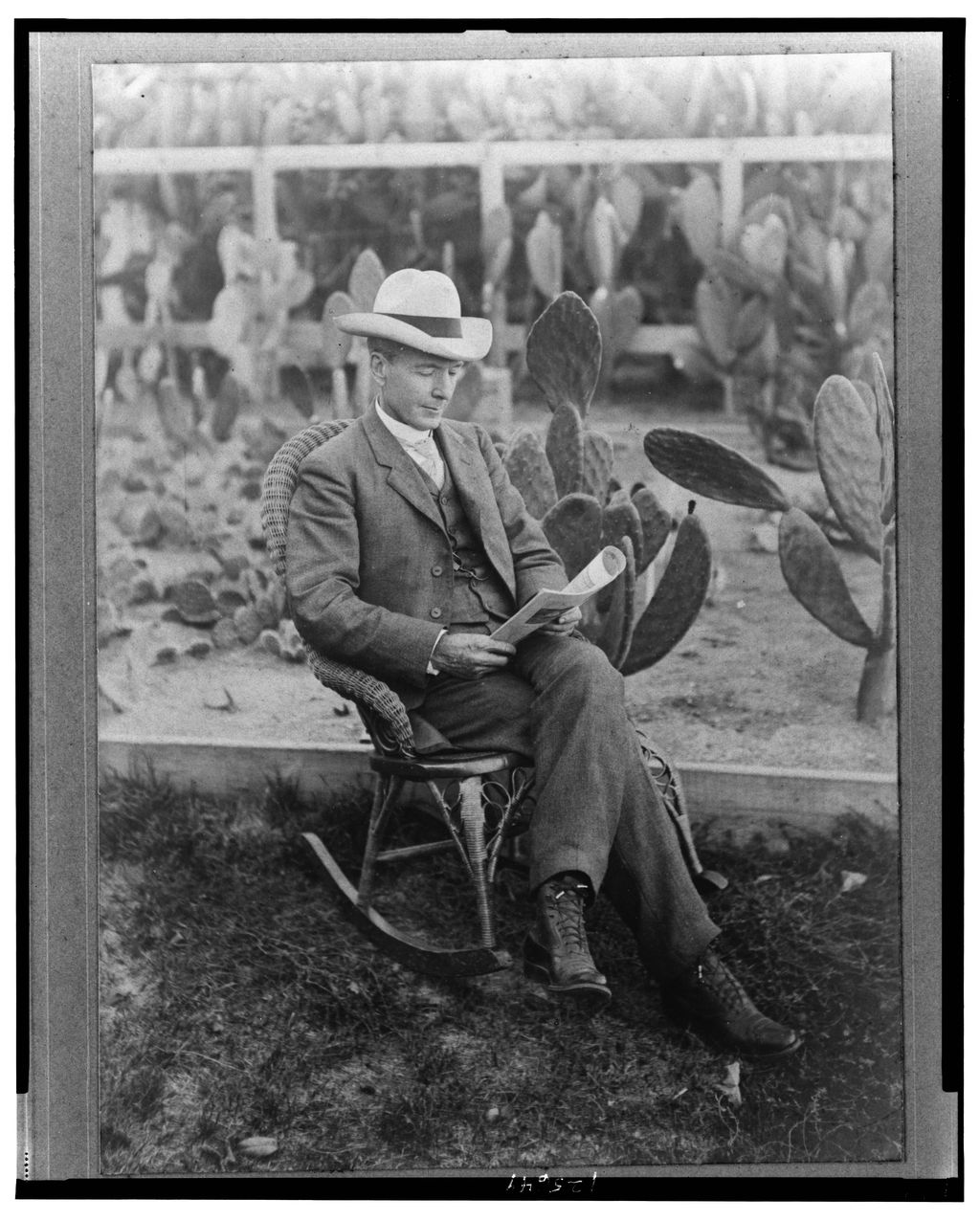
Historical photographs of Burbank in horticultural settings survive in the Library of Congress. They illuminate how he was pictured during life, but none has been established as the source Kahlo held. The painted face can be described as a likeness on documentary grounds without pretending that a visual match has solved the photographic question. [3] [13]
Burbank was buried beneath a Cedar of Lebanon near his Santa Rosa home, according to the home-and-gardens association. That biographical fact makes the painting's connection of a dead body and living tree especially suggestive, but the picture does not label its trunk as a cedar or document Kahlo's knowledge of Burbank's burial wishes. A resemblance between life and art is not a verified account of the artist's decision. [3] [6] [12]
Portrait of Luther Burbank in Kahlo’s career
The Two Fridas
1939Timeline source: Museo Frida Kahlo chronology [28].
Why a Human Tree?
Burbank’s professional association with plant breeding gives the bodily transformation a specific subject. Rather than show him using a grafting knife or working in a greenhouse, Kahlo makes his body itself the site of growth. The flanking fruit trees and the plant he holds reinforce that relation, but the painting provides no labels from which to name the crops or judge an actual experiment. [2] [3] [5]
The Casa de México account, based on Museo Dolores Olmedo documentation, describes a figure whose legs become a trunk and whose roots hold a cadaver that could be Burbank. It reads a life-and-death exchange in which the earth sustains a person and receives the body back. The conditional wording is important: the picture contains one named upright subject and one unlabelled body, not an independently identified second sitter. [2]
The owner-linked 2022 catalogue develops this into an axis mundi reading, a connection between sky, earthly surface and underworld. Its interpretation responds closely to the three zones visible in the painting. Yet that term is a curator’s conceptual account, not a title, inscription or statement by Kahlo that fixes every possible meaning. [1] [3]
Andrea Kettenmann reads the roots and remains as a cycle in which death becomes the condition for life. Her Spanish-language discussion also treats the portrait as a step beyond copying the external appearance of a photographic subject. Both points help explain why the recognisable Burbank head can coexist with a body no photograph could have supplied. [8]
Itsuka Komatsu’s Japanese study examines plants and human bodies across Kahlo’s art and includes this painting in a wider account of mimicry and recurrence. That comparison is productive because the tree is not mere scenery: it replaces anatomy and connects two bodies across the ground. The available PDF’s defective font extraction limits exact quotation and fine-grained translation, so the study informs the comparative reading without being treated as an unproblematic complete text. [14]
Botanical Names and Competing Meanings
Even the central plant has not received one secure name in the consulted art-historical sources. The Fine Arts Museums label calls it a philodendron; Helga Prignitz-Poda proposes Monstera; an owner-linked description speaks of a tuber with leaves and roots. The available image establishes large, deeply divided leaves and substantial stems, not a specimen-level identification that can resolve those terms. [1] [3] [5] [9]
Prignitz-Poda also offers a less celebratory reading of the picture. She relates exaggerated or constrained growth to Burbank’s programme of improvement and considers the work capable of criticism rather than simple homage. That is a named historian’s argument, not evidence that Kahlo wrote an anti-Burbank manifesto or depicted a precisely identified failed cultivar. [9]
Her discussion brings later reproductive experience into the interpretation. Events in 1932 cannot have caused a painting securely dated 1931, even if a later viewer finds continuities across Kahlo’s treatment of bodies and generation. The distinction between a retrospective thematic comparison and a documented cause protects this painting’s chronology. [1] [9]
Carlos Omar Segoviano Rodríguez places the buried body in a history of decomposition imagery and colonial vanitas, while Luis Roberto Vera develops earth-body, pre-Columbian and agricultural-political associations. These readings enlarge the painting’s cultural field, but neither proves a single iconographic programme written down by Kahlo. Vera’s proposed commission and identification of Burbank with a citrus industry have not been corroborated by the object and sitter records consulted here. [15] [16]
Charlie Damour’s French-language study makes a sharper counterargument to Prignitz-Poda: it treats the tree as a regenerative Maya world-tree and sees continuity between Burbank’s cultivation and older American traditions, rather than a denunciation of his work. Damour compares the painting with the Popol Vuh and selected codices, but those are proposed iconographic analogies, not demonstrated sources in Kahlo’s studio. His paper also dates the Santa Rosa visit to 1931, which Kahlo’s November 1930 letter contradicts, and its suggestions about the artist’s reproductive decisions and a broken bone in the corpse cannot be promoted to established making history or secure observation. [4] [9] [26]
Taken together, the sources are not a vote on one secret meaning. The portrait’s visual facts—human head, plant body, fruiting landscape, roots and remains—make questions of cultivation and mortality unavoidable. Its precise moral balance, whether memorial, tribute, renewal, ambivalence or critique, remains open to argument and should be attached to those who make each argument. [1] [2] [3] [8] [9] [15] [16]
A Drawing and an Artistic Conversation
A graphite drawing dated 1931 survives as a separate object in the Juan Rafael Coronel Rivera collection. The Fine Arts Museums’ label for it explains the photographic basis and reproduces the finished painting as a reference; the label does not establish that the painting itself hung in that exhibition. The New York Botanical Garden’s 2015 checklist lists drawing and painting independently, with different media, sizes and owners. [5] [7]
The available reproductions show that Kahlo had planned the large plant-human structure and buried body before completing the oil painting. They are not adequate for a confident inventory of every changed leaf, finger or branch, and no technical examination has been read to reveal revisions beneath the paint. The drawing demonstrates preparation, not a fully recovered step-by-step working process. [3] [5] [7]
Damour proposes more specific changes from drawing to oil painting, including an emphasis on fruiting trees and a clearer skeleton. These observations merit a properly scaled comparison, but the research plates used here do not independently verify every claimed alteration or his identification of a shroud in the graphite sheet. The proposal is useful as a question to test with better images, not as a settled technical account. [3] [26]
The owner catalogue places this work beside images of growth and fertility by Diego Rivera and Tina Modotti. Rivera’s Allegory of California includes Burbank, and SFMOMA holds a distinct 1931 graphite study for that mural. These are useful contemporaneous parallels in the couple’s artistic environment; they do not establish that Kahlo copied Rivera’s study or that his mural supplied her precise composition. [1] [17]
Kahlo’s picture also resists a simple style label. The fusion of a dressed man and a tree, with an underground body visible at the same time as the landscape, is physically impossible but carefully described. The owner catalogue cautiously raises a surrealist possibility; it does not turn the image into proof that Kahlo adopted a movement label or that the work had no basis in the visit, photograph and horticultural subject. [1] [3] [4] [5]
Collection, Exhibitions and What Is Unknown
The painting belongs to Museo Dolores Olmedo. The owner-linked catalogue’s collection convention and the work’s checklist entry support that attribution, as do later institutional exhibition credits. The catalogue’s broader story of Dolores Olmedo assembling Kahlo works does not identify who first bought this particular painting, when it passed out of Kahlo’s possession or how it entered Olmedo’s collection. [1] [7]
There is likewise no verified commission, price, accession number or complete chain of earlier owners in the public records reviewed. The Santa Rosa visit and a photograph-based portrait do not establish that Elizabeth Burbank requested it or received it. Copyright credits to a museum trust concern rights and cannot supply the missing ownership transactions. [1] [5] [18]
The painting and drawing were both shown in the New York Botanical Garden’s Frida Kahlo: Art, Garden, Life in 2015, a particularly apt setting for a work about a plant breeder. The painting also appeared in Frida Kahlo: Timeless at the Cleve Carney Museum of Art in 2021, where curator Justin Witte described its root and life-death structure as pivotal for later work. His assessment is a reception claim, not proof of a direct formal sequence from this object to every later self-portrait. [7] [19] [20]
The Virginia Museum of Fine Arts’ 2025 Frida: Beyond the Myth guide lists the preparatory drawing, not the painting. In 2026, the Museum of Fine Arts, Houston presented Frida: The Making of an Icon from 19 January to 17 May; contemporary Spanish reporting specifically names the Burbank painting among Museo Dolores Olmedo loans. Those are different evidentiary routes, and a broad exhibition page alone should not be made to certify an individual loan. [21] [22]
Museo Dolores Olmedo reopened on 30 May 2026, and a press-visit account names the painting in the reopened display. The exhibition Frida Kahlo en dos tiempos was announced through 31 August. With no verified item-level notice for the period after that date, present ownership is clear but present display is not; visitors should confirm directly before making a trip to see this specific work. [10] [23]
Nickolas Muray photographed the painting in 1938, according to a George Eastman Museum catalogue record. That is a point in its documentation history, not a licence to reproduce Muray’s image here or proof of an otherwise complete early exhibition record. The documented shows above are selected appearances rather than a lifetime-to-present catalogue of every loan. [19] [24]
Books and Further Study
The most consequential outstanding book is Luis-Martín Lozano, Andrea Kettenmann and Marina Vázquez Ramos’s Frida Kahlo: The Complete Paintings. Its 624-page catalogue is known from the publisher record, but its exact Burbank entry and apparatus have not been read for this article. Kettenmann’s earlier Spanish object page and Prignitz-Poda’s complete relevant preview pages were read; neither makes the unseen catalogue entry available by implication. [8] [9] [25]
The full relevant chapters and notes of Celia Stahr’s Frida in America, the museum registrar file, the original source photograph and a high-resolution technical record of both drawing and painting would sharpen the account. Those unavailable materials are not evidence for claims made here. Until then, the strongest answer is bounded: a documented visit, a posthumous photographic likeness, a surviving study and a painting whose linked bodies invite several serious but non-identical interpretations. [3] [4] [5] [18] [25]
Lucretia Hoover Giese’s object-specific article, “A Rare Crossing: Frida Kahlo and Luther Burbank,” is a further priority. Its journal record and bibliographic abstract identify a 2001 study of hybridisation, Rivera and later self-portraits, but the article itself is behind subscription access and has not been read here. Its abstract identifies the topic but cannot supply a page-specific argument or quotation for this account. [27]
Related Reading
Frida Kahlo in San Francisco follows the Bay Area visit that preceded this portrait. Frieda and Diego Rivera is a distinct 1931 painting, while Roots offers a later and different conjunction of body and vegetation.
Frequently Asked Questions
No. Burbank died in 1926, and Kahlo’s letter documents a visit to his Santa Rosa property in November 1930. The 1931 painting is a posthumous portrait, not a record of a meeting. [4] [5] [6]
It may be, as Casa de México’s owner-derived account suggests, and Luther Burbank Home & Gardens describes it that way. Nothing visible labels the buried body individually, so the identification should remain an interpretation rather than an observed fact. [2] [3] [12]
The broad divided leaves are clear, but the precise botanical designation is not. Museum and catalogue sources variously use philodendron, Monstera and a tuber description; this article leaves those as attributed identifications. [1] [3] [5] [9]
Discussion
Use the cited evidence and your own close looking to explain your view. The prompts below are starting points, not fixed interpretations.
Reader Insights
How does the underground cutaway turn a portrait into a human-tree hybrid?
What did Kahlo record about her visit to Burbank?
Which botanical identifications are documented and which are later interpretations?
Join the Conversation
Which reading best fits the evidence, and where does uncertainty remain?
References
- Museo Dolores Olmedo / Fundación Casa de México en España, Frida Kahlo: alas para volar complete catalogue (2022), PDF pp.10–15, 38–40 and 64: collection introduction, essay, plate and the 1931 Luther Burbank object card with oil-on-Masonite medium and 87 × 62 cm size. The catalogue's interpretation remains attributed. View source text.
- Fundación Casa de México en España, “Retrato de Luther Burbank”, Spanish and English object account, especially the conditional cadaver identification and life-death interpretation; documentation credited to Museo Dolores Olmedo. View source text.
- Editorial close-looking of the Casa de México owner-documentary object image, compared with the Museo Dolores Olmedo/Casa de México catalogue plate (reference 1). The available reproduction supports broad visible composition, not physical examination, precise botanical identification or image-publication rights. View source text.
- National Museum of Women in the Arts, Frida Kahlo Papers, letter 2 from Kahlo to Matilde Calderón de Kahlo, 21 November 1930, complete Spanish transcription, paragraphs 1–18 and object metadata. The Sunday-to-16-November conversion is an inference. View source text.
- Fine Arts Museums of San Francisco, Frida Kahlo: Appearances Can Be Deceiving, label 49, “Drawing for Portrait of Luther Burbank” entry and painting reference caption; Spanish label 49. The labelled exhibition object is the drawing. View source text 1; View source text 2.
- Luther Burbank Home & Gardens, “About Luther Burbank”, life and plant-breeding summary; institutional chronology and home history for 11 April 1926 death and burial. View source text.
- New York Botanical Garden, Frida Kahlo: Art, Garden, Life art-gallery checklist, PDF physical p.1 drawing entry and p.2 painting entry, each with separate medium, dimensions and collection; official exhibition release, pp.1–3, for 16 May–1 November 2015 dates. View source text 1; View source text 2.
- Andrea Kettenmann, Frida Kahlo: dolor y pasión, relevant Spanish object page consulted at PDF p.28 / printed p.25 in the university-library copy: portrait, photographic departure and life-through-death account. The full commercial book is not represented as read. View source text.
- Helga Prignitz-Poda, Frida Kahlo: The Painter and Her Work, relevant publisher-preview entry consulted at PDF pp.9–10 / printed pp.76–77; the linked edition page does not itself expose those pages: dimensions variant, proposed Monstera and critical interpretation. Later events discussed there are not treated as causes of a 1931 painting. View source text.
- Mexico City government, Frida Kahlo en dos tiempos, official exhibition notice, 30 May–31 August 2026; Sistema de Información Cultural, Museo Dolores Olmedo reopening record, 30 May 2026. Neither is a post-closing item-level checklist.
- Museo Frida Kahlo, institutional chronology photograph caption “Frida Kahlo and Diego Rivera in the home of Luther Burbank, California,” dating that image 1931; compare dated primary letter in reference 4. View source text.
- Luther Burbank Home & Gardens, “Burbank & Famous Friends,” “Burbank and Frida Kahlo”: Elizabeth Burbank, probably-given photograph, Rivera mural and burial account. The route is explicitly tentative on the photograph. View source text.
- Library of Congress catalogue records for Burbank seated with cactus (circa 1895), tending cactus (circa 1890), and selecting corn in a greenhouse. These are comparison images; none is identified as Kahlo's source photograph. View source text 1; View source text 2; View source text 3.
- Itsuka Komatsu, “Frida Kahlo's Circle of Life: Mimicry through Plants and the Human Body”, original Rikkyo University journal article, printed pp.28–34, 37, 41, 44, 49 and 51; the Luther Burbank figure is on p.32. Defects in the available PDF's embedded fonts prevent a reliable exact translation, so no precise Japanese wording is quoted. View source text.
- Carlos Omar Segoviano Rodríguez, La fridomanía: difusión y comunicación de la imagen de Frida Kahlo, UNAM thesis (2011), PDF pp.58–59 / printed pp.43–44 and PDF p.246 / printed p.231 object card. Its isolated 1930 prose date is rejected against its own 1931 card and institutional records. View source text.
- Luis Roberto Vera, “Raíz mesoamericana: Octavio Paz, Efraín Huerta y Frida Kahlo”, Impossibilia 4 (2012), PDF pp.4–6 / printed pp.205–207: earth-body and political comparisons. Its uncorroborated commission and citrus assertions are not adopted as facts. View source text.
- Museo Dolores Olmedo / Casa de México catalogue, reference 1, physical p.38 on Rivera and Modotti comparisons; SFMOMA, Untitled (Luther Burbank), study for Allegory of California, distinct Rivera 1931 graphite object record. View source text.
- Comparison of the owner-linked catalogue, Kahlo's dated letter, the object account and exhibition records in references 1, 2, 4, 5 and 7. None supplies a commission contract, first-buyer receipt or complete transfer history, so the circumstances of the portrait's earliest ownership remain unverified. View source text 1; View source text 2.
- Cleve Carney Museum of Art, archived Frida Kahlo: Timeless page, 5 June–12 September 2021; Columbia Chronicle and Chicago Gallery News contemporary item-level reports identifying the Burbank painting. The earlier College of DuPage release’s 6 September closing date is superseded by the archived page. View source text.
- Newcity Art's 2021 Frida Kahlo: Timeless review, item caption and curator Justin Witte paragraph on the work’s role in later life-death imagery. This is attributed curatorial reception. View source text.
- Virginia Museum of Fine Arts, Frida: Beyond the Myth large-print guide, physical p.47, “Sketch for Luther Burbank’s Portrait” entry; official VMFA release, 5 April–28 September 2025. The guide identifies the drawing, not a loan of the painting. View source text.
- Museum of Fine Arts, Houston, official Frida: The Making of an Icon overview, 19 January–17 May 2026; El Universal, 21 January 2026, report listing fourteen Museo Dolores Olmedo loans including Retrato de Luther Burbank. View source text.
- El Universal, 29 May 2026, Museo Dolores Olmedo press-visit report naming the painting in its two-room reopened installation; official dates and reopening records in reference 10. A later item display has not been verified. View source text.
- George Eastman Museum, Nickolas Muray catalogue record 1977.0188.3121A, 1938 photograph of the painting, with print measurements and accession metadata. Research documentation only; Muray imagery remains on hold under the publication register. View source text.
- Luis-Martín Lozano, Andrea Kettenmann and Marina Vázquez Ramos, Frida Kahlo: The Complete Paintings (TASCHEN, 2021), publisher record. Its exact Luther Burbank entry has not been consulted. Gannit Ankori's Frida Kahlo and Celia Stahr's Frida in America are further unconsulted complete books; no object claim relies on their unseen pages. View source text.
- Charlie Damour, “Le Portrait de Luther Burbank de Frida Kahlo et l’arbre de vie maya,” Nuevo Mundo Mundos Nuevos (2018), complete 16-page HAL-hosted French PDF read, physical pp.3–12 / article pp.1–10, especially paragraphs 1–4, 13–20 and 22–34; notes on physical pp.13–15. Open repository copy. The 1931 visit date and proposed biographical causes are not adopted against the contemporary 1930 letter or without independent support. View source text 1; View source text 2.
- Lucretia Hoover Giese, “A Rare Crossing: Frida Kahlo and Luther Burbank,” American Art 15, no. 1 (2001), pp.53–73 in the journal issue; article and references subscription-restricted. Bibliographic abstract in the Bibliography of the History of Art identifies its scope only; full text not read. View source text 1; View source text 2.
- Museo Frida Kahlo, Frida interactive chronology, selected work dates used for the comparison timeline. The current work's date follows its cited object record. View source text.
Image Credits
- Photographer unidentified. No known restrictions. Source: Library of Congress (Luther Burbank sitting by cactus). 1024px proportional sRGB JPG derivative; no crop. Licence. Source record.
