


 by Tom Gurney
Tom Gurney BSc (Hons) is an art history expert with over 20 years experience
Page created on March 2, 2018 / Page updated on October 6, 2026
Email: tomgurney1@gmail.com / Phone: +44 7429 011000
Introduction
Frida Kahlo's Portrait of Tina Modotti survives in the literature as a reproduced image, although the painting itself has not been located. In her illustrated study Hidden Frida Kahlo, Helga Prignitz-Poda dates it 1927/28 and identifies it as oil on canvas, with its dimensions and whereabouts unknown. [1] Her attribution rests in part on what she reports as a handwritten note by Kahlo in the Blue House archive, saying she gave the painting to her friend Tina Modotti. That archival connection is a reported finding, not a direct quotation from Kahlo's note.
The portrait has a more complicated history than a simple picture of one artist's friend. Prignitz-Poda says a photograph of it had previously been published as the work of Diego Rivera; she reproduces the composition and explains why she assigns it to Kahlo. [1] That former attribution, together with the original's unknown location, makes it important to separate what the published image shows from what can be established about the absent physical painting.
At a Glance
- Subject: Tina Modotti, identified in Prignitz-Poda's illustrated catalogue. [1]
- Date and medium in the catalogue: 1927/28, oil on canvas. [1]
- Physical dimensions and present location: Unknown in the 2017 catalogue; the original remains untraced. [1]
- Attribution evidence: Prignitz-Poda reports finding a handwritten Kahlo note in the Blue House archive recording a painted gift to Modotti. [1]
- What can be viewed: A published photograph of the composition, not the original painting. [1]
Contents
- Introduction
- A Face Against an Angular City
- A Portrait with Two Attributions
- Tina Modotti in Kahlo's Circle
- How the Portrait Entered the Record
- Related Reading
Portrait of Tina Modotti (untraced) in Kahlo’s career
Portrait of Tina Modotti (untraced)
1927/28; original untracedThe Two Fridas
1939Timeline source: Museo Frida Kahlo chronology [8].
Watch: Frida Kahlo
Five perspectives to view here alongside the article.
Frida Kahlo’s The Two Fridas: Great Art Explained
A focused visual introduction to the painting and its context.
A Face Against an Angular City
The reproduced portrait places Modotti close to the viewer, visible from the chest upward. Her dark hair is parted in the centre and gathered low behind her head. She turns her face slightly but meets the viewer's gaze, while her broad, open collar and the seams of her dark jacket form a strong frame around her face. [1]
Behind her, pale and dark planes suggest a sharply constructed urban setting. A small walking figure appears to her right, at a scale far below that of the sitter. Prignitz-Poda reads him as a worker carrying a shovel and identifies a tiny hammer-and-sickle pin on Modotti's collar. [1] The figure and the architectural contrast can be seen in the surviving reproduction; the pin is difficult to verify in a small digital copy and is therefore best understood as the scholar's more detailed reading of the published photograph.
The stark difference in scale gives the picture an unsettled relationship between portrait and setting. Modotti's direct, substantial presence dominates, while the tiny figure suggests a wider social world behind her. It would be tempting to turn the background into a scene from a particular political event, but the consulted sources do not identify one. Nor does a monochrome reproduction reveal the painting's original colours, surface or condition.
A Portrait with Two Attributions
Prignitz-Poda's account is unusually specific about the picture's attribution. She says that the photograph had been published as a Rivera work, partly because it resembles his 1926 drawing of Modotti, and that she found Kahlo's handwritten reference to the gift in the Blue House archives. [1] Her endnote directs readers to a fuller discussion in the 2010 Berlin/Vienna exhibition catalogue; that earlier account and the original note have not been inspected here. The strongest responsible formulation is thus that Prignitz-Poda attributes the reproduced portrait to Kahlo on the basis of her archival finding.
The distinction from Rivera's securely catalogued work is also essential. The Philadelphia Museum of Art records a separate Portrait of Tina Modotti by Rivera, dated 1926. [2] Its object details belong to his picture and cannot provide dimensions, provenance or a current owner for Kahlo's untraced painting. A shared sitter and title do not make the two works interchangeable.
The 2017 catalogue labels Kahlo's portrait oil on canvas but lists neither dimensions nor whereabouts. [1] Prignitz-Poda proposes that the work disappeared amid the upheavals around Modotti's departure from Mexico, yet no located original or documented destruction is supplied. “Untraced” is more exact than “destroyed.” It also explains why formal description here remains a reading of a published photograph rather than a direct examination of paint, support or scale.
Tina Modotti in Kahlo's Circle
Modotti was a photographer whose work and political commitments placed her within the Mexican artistic circles that also included Kahlo and Rivera. Mexico's Secretaría de Cultura and INBAL describe her photographic practice and connections with both artists. [3] Prignitz-Poda discusses the women's friendship in the late 1920s, including Modotti's association with the left-wing milieu and her role in the social history around Kahlo and Rivera's marriage. [1] This setting makes a painted gift intelligible, though it does not establish the circumstances of a sitting or a commission.
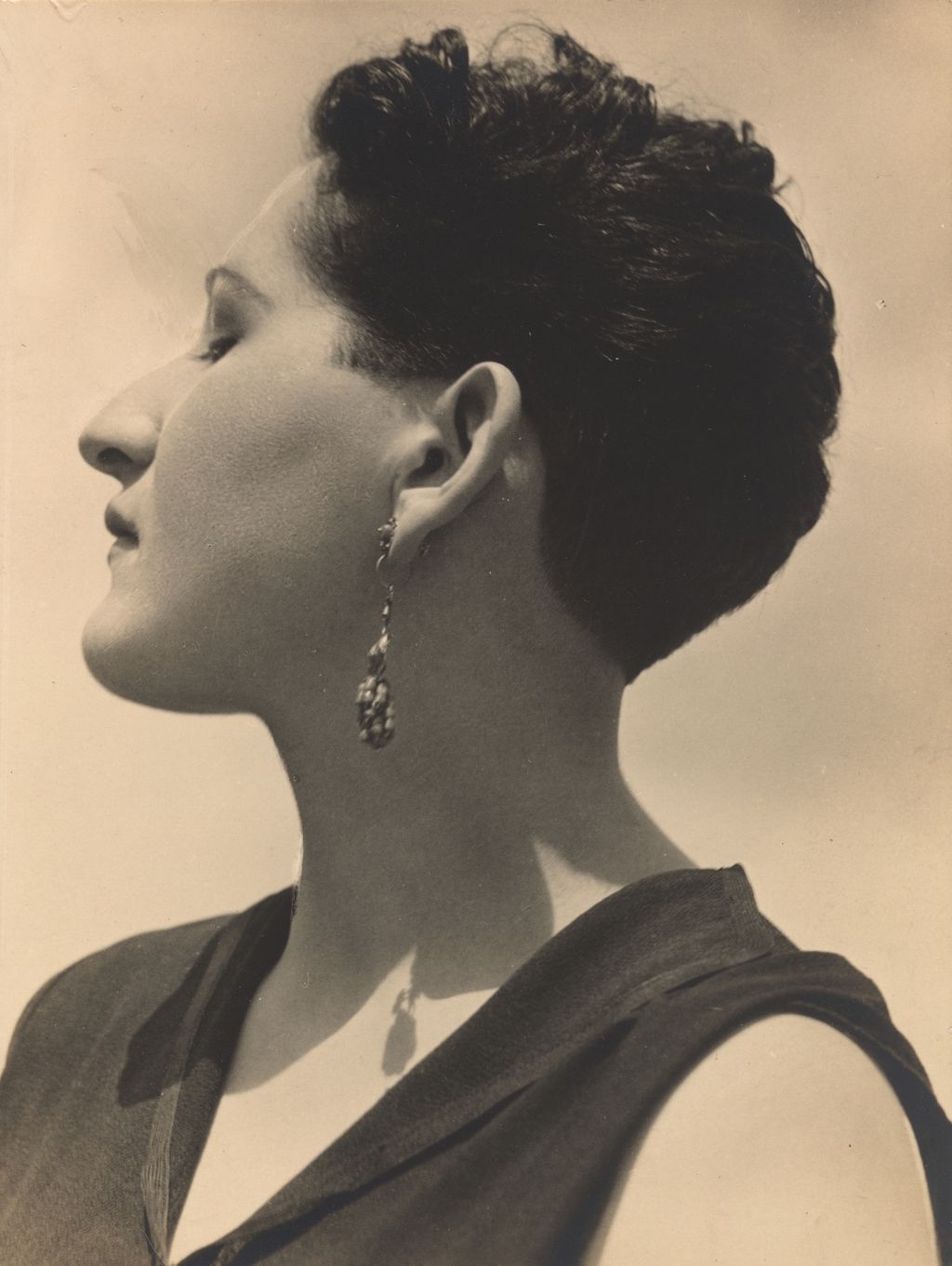
Prignitz-Poda also points to Modotti's letter of 17 September 1929 to Edward Weston, in which she tells him that Rivera has married Kahlo and identifies Kahlo as an artist. [1] The letter is evidence of Modotti's contemporary knowledge and description of her friend, not a reference to this particular portrait. The catalogue's suggestion that Modotti's camera influenced Kahlo's own photographic experiments is an art-historical interpretation about their interaction, not proof of what Kahlo intended every detail of the painting to mean.
Their images are especially easy to confuse because Modotti herself made photographs involving Kahlo's public image. A Spanish scholarly study describes Modotti's photograph of Rivera's El arsenal mural and a crop that centred Kahlo's figure. [4] In that case Modotti photographed an image of Kahlo painted by Rivera; in the portrait discussed here, Prignitz-Poda attributes the painted image of Modotti to Kahlo. Keeping the maker, medium and direction of portrayal clear protects the history of both women.
How the Portrait Entered the Record
Prignitz-Poda's 2017 book supplies the most useful object-specific evidence: a matching full-page plate, caption, description, attribution argument and archival-note report. [1] Its photo-credit page names the Tina Modotti Archive as supplier of the p. 43 image, a credit for the reproduction rather than a present location for Kahlo's painting. [1] A 2019 Ghent University thesis lists a Portrait of Tina Modotti under 1927/1928, showing that the title and approximate date circulated before the 2021 complete-paintings volume. [5] That list does not reproduce the work or cite a source for its individual row, however, and cannot replace the specialist's illustrated discussion.
The 2021 Frida Kahlo: The Complete Paintings is another exact-entry acquisition route, but its proposed catalogue entry has not been read for this article. [6] Similarly, a Whitechapel Gallery archival record confirms a 1982 exhibition involving Kahlo and Modotti, not that this particular lost portrait appeared in it. [7] Exhibition association should not be claimed without an actual checklist entry.
What remains is an evocative, historically complicated portrait. The published image allows us to see how Modotti's face, open collar and sharply divided setting are arranged; the 2017 specialist account explains why the work is attributed to Kahlo and why its earlier Rivera label needs care. [1] Its unknown dimensions, untraced original and unread underlying archive note remain part of the work's history, not blanks to fill with confident invention.
Related Reading
- Frida Kahlo and Photography explores the photographic networks and images around her career.
- La Adelita, Pancho Villa and Frida examines an earlier image of Kahlo's youthful political and artistic circle.
Discussion
Use the cited evidence and your own close looking to explain your view. The prompts below are starting points, not fixed interpretations.
Reader Insights
What does the published photograph permit us to observe, and what would require the missing original?
How did Prignitz-Poda distinguish this portrait from a work formerly attributed to Rivera?
Why are dimensions, present custody and the painting's later history left open?
Join the Conversation
Which reading best fits the evidence, and where does uncertainty remain?
References
- Helga Prignitz-Poda, Hidden Frida Kahlo: Lost, Destroyed or Little-Known Works (Prestel, 2017), printed p. 42 (caption), p. 43 (plate), pp. 45–46 (portrait, prior attribution, Modotti context), p. 206 n. 24 (2010 catalogue reference) and p. 216 (p. 43 image credit to Tina Modotti Archive). These pages were directly read through an Internet Archive lending copy; the book as a whole, the Blue House note and the 2010 catalogue p. 88 were not. View source text.
- Philadelphia Museum of Art, “Portrait of Tina Modotti,” object 71120, naming Diego Rivera and the date 1926. This is a distinct picture. View source text.
- Secretaría de Cultura/INBAL, “La obra de Tina Modotti, aportación fotográfica a la memoria histórica del país,” passages on her practice and artistic network. This is subject context, not a Kahlo-object record. View source text.
- “Fotografías inéditas de Tina Modotti,” Anales del Instituto de Investigaciones Estéticas (2008), discussion of Modotti's photograph and crop of Rivera's El arsenal. View source text.
- Emily Janssens, Sociaal engagement in de kunsten. Case: Kahlo (Ghent University master's thesis, 2018–19), printed p. 99/PDF p. 106, appendix 10.1, item 13; list methodology printed p. 29/PDF p. 36. The item lacks a plate and individual source. View source text.
- TASCHEN, publisher record for Frida Kahlo: The Complete Paintings (2021). Publisher metadata only; its proposed entry for this work was not read. View source text.
- Whitechapel Gallery, archival finding aid for Frida Kahlo and Tina Modotti, exhibition file WAG/EXH/2/338 (1982). The archive heading does not identify this specific painting. View source text.
- The Museo Frida Kahlo chronology supplies comparison-work dates. The 1927/28 label for this untraced portrait follows Prignitz-Poda's illustrated catalogue (reference 1), not an examination of the missing original. View source text.
Image Credits
- Anita Brenner (c. 1927) — Tina Modotti; National Portrait Gallery, Smithsonian Institution, NPG.2020.3. CC0. Resized and converted to JPEG/sRGB; no crop.
