


 by Tom Gurney
Tom Gurney BSc (Hons) is an art history expert with over 20 years experience
Page created on March 2, 2018 / Page updated on October 6, 2026
Email: tomgurney1@gmail.com / Phone: +44 7429 011000
Introduction
Frida Kahlo sits in a grey evening dress beneath a small portrait of Pancho Villa. To one side, a train passes a snow-capped volcano; to the other, angular planes form a second, less certain space. [1] [2] The lower gathering and upper fragments do not join into one straightforward room, and parts of the painting remain visibly unresolved. This circa-1927 oil, now associated with the Museo de Arte de Tlaxcala, is an unusually open record of Kahlo's early experiment with a group scene. [1] [3]
Its familiar title, Pancho Villa y la Adelita, does not settle what the picture is about. James Oles argues that Villa is too small to be its principal subject and that Kahlo's fashionable dress does not make her a literal revolutionary soldadera; a San Francisco museum label instead reads her as deliberately playing the mythic Adelita. [3] [4] That disagreement is more illuminating than a single symbolic answer, provided the visible composition, historical evidence and later interpretation remain separate.
At a Glance
- Artist and preferred titles: Frida Kahlo, Pancho Villa y la Adelita / Pancho Villa and Adelita. An expanded title also circulates, but is not established as Kahlo’s own. [1] [3] [4] [5]
- Date and medium: Circa 1927, oil on canvas. Two catalogue descriptions add “mounted on wood,” but a current registrar record has not confirmed that support construction. [1] [4] [5] [6]
- Reported dimensions: 65 × 45 centimetres in the Margarucci catalogue and a UNAM thesis; the owner-partner page does not provide a measurement. [1] [5] [6]
- Collection and display: Museo de Arte de Tlaxcala, historically credited to the Instituto Tlaxcalteca de la Cultura. A contemporary review places the painting in a Puebla exhibition in December 2024; current display remains unverified. [1] [4] [7] [8]
Contents
- Introduction
- A Lower Gathering and an Upper Montage
- The Title Is Part of the Argument
- Is Kahlo the Adelita?
- Los Cachuchas and an Imagined Café
- A Drawing with More People
- Tlaxcala Ownership and an Unsettled Transfer
- Exhibitions and the Latest Located Appearance
- What the Sources Still Cannot Establish
A Lower Gathering and an Upper Montage
The vertical painting has two broad zones separated by a pale green horizontal band. Beneath it, Kahlo occupies the centre of a café-like gathering, with a suited man at right and a cropped or partly obscured figure at left. [2] Above, a train-and-mountain scene, Villa's inset portrait and a dark constructed space at right behave more like fragments or pictures within a picture than a continuous extension of the lower room.
Kahlo's head and upper body are comparatively distinct. Her wide-necked, pale-trimmed dress exposes the shoulders; a large dark grey skirt sweeps across the lower left. [2] The skirt is the largest continuous form in the lower half, giving the seated woman visual weight even though the upper zone contains more separate incidents. Her likeness is supported by owner and exhibition texts, not inferred solely from screen pixels. [1] [3] [4]
The man at right has a grey suit but no resolved facial features. An orange-brown support beneath him could be a bench, stool or part of a piano seat; the image does not make the furniture certain. [2] Oles's Spanish account tentatively associates a bald man at the piano with Ángel Salas, one of Kahlo's school friends, but neither that name nor the exact activity is an unambiguous visual fact. [9] The clipped left figure is still less secure as an individual.
At upper left, small people cluster by or upon a railcar against a pale-topped volcanic mountain. The Fine Arts Museums of San Francisco call them soldiers and soldaderas and relate the motif to Casasola photographs; no exact source photograph has been matched. [4] [10] The mountain's specific name is also disputed: the museum label says Citlaltépetl, while an essay accompanying a related drawing says Popocatépetl. [4] [11] “Snow-capped volcano” is the supportable neutral description.
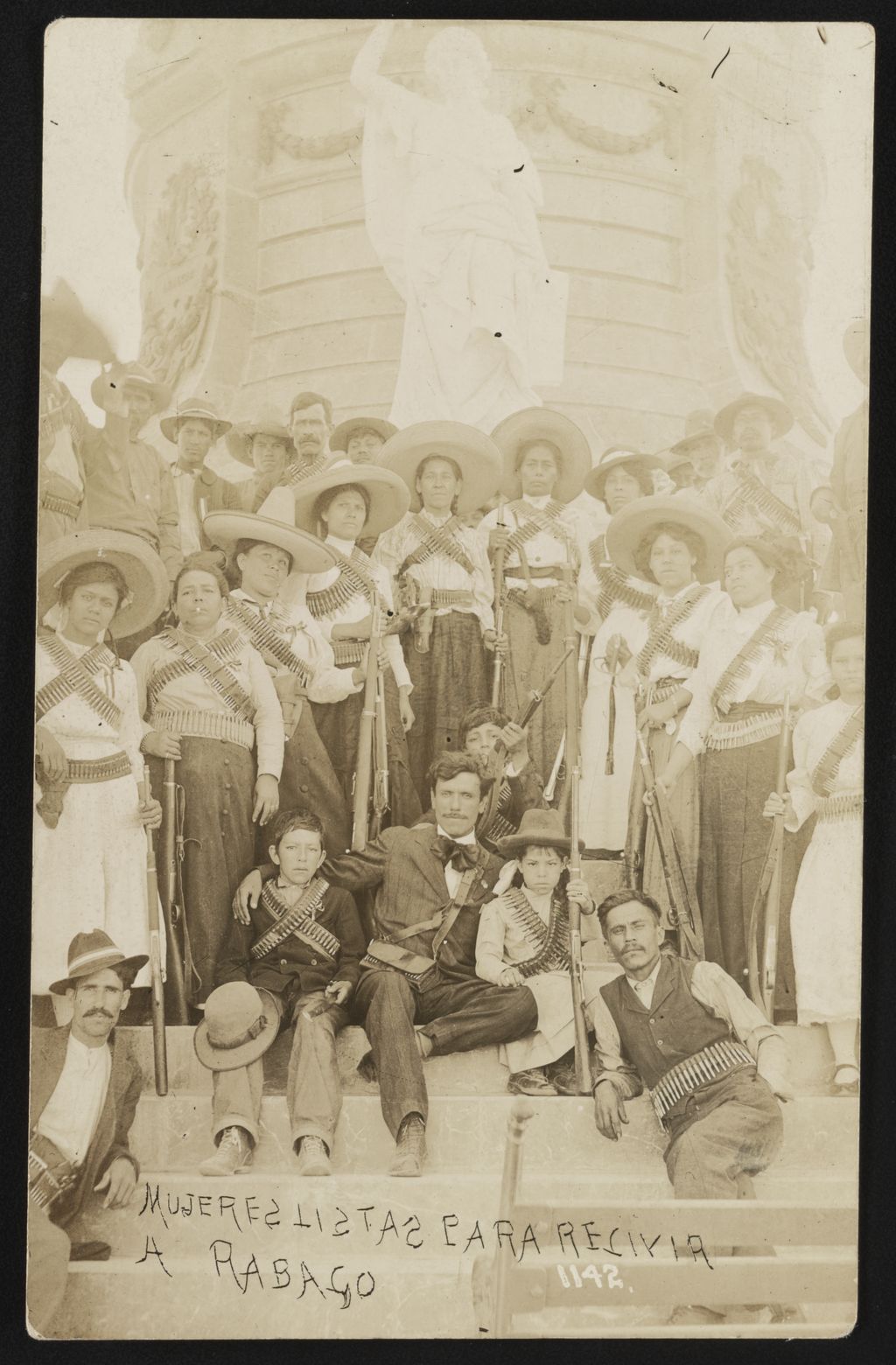
Villa appears as a small moustached face under a broad hat in a tilted, framed inset above Kahlo. Multiple institutional and scholarly sources agree on his identity, but they do not agree about his place in the picture's hierarchy. [1] [3] [4] The dark, angular zone at upper right has a brick-like receding plane and abrupt edges, rather than a reliably identifiable building or scene. Diagonals from these upper elements lead the eye down toward the central figure without proving that Kahlo copied a particular European painting. [2] [4]
Watch: Frida Kahlo
Five perspectives to view here alongside the article.
Frida Kahlo’s The Two Fridas: Great Art Explained
A focused visual introduction to the painting and its context.
The Title Is Part of the Argument
The Tlaxcala-contributed collection page calls the work Pancho Villa y la Adelita, and the de Young label translates it as Pancho Villa and Adelita. [1] [4] A catalogue entry instead prints La Adelita, Pancho Villa y Frida. The expanded wording belongs to this object's title history, but no contemporary Kahlo inscription or artist-given title has been located to decide which formulation she used. [5] [12]
Oles calls the customary name mistaken and frames the picture as an imagined Café de los Cachuchas. His peer-reviewed article's abstract explicitly opposes a fundamentally revolutionary subject to an urban, avant-garde group of Kahlo and her former schoolmates. [3] [13] That is a substantial scholarly claim, but only the abstract of the journal article has been obtained; Oles's complete English and Spanish institutional essays carry the available detailed object discussion. Café de los Cachuchas is therefore his interpretive reframing, not a silent replacement for the collection title.
The painting must also be separated from Si Adelita… o Los Cachuchas, a different oil listed next to it in a catalogue and described separately by Andrea Kettenmann. [5] [14] Similar words in two titles are not evidence for a second name or state of the same canvas. The closely related preparatory sheet is a third, separate object, made in pencil rather than oil. [11]
An approximate date matters too. The owner, Oles and the de Young use circa 1927, whereas some catalogue lines print 1927 without qualification. [1] [3] [4] [5] The picture is described as unfinished, so “completed in 1927” would say more than the evidence permits. Neither an exact month nor the date of its later reported reworking is known.
Pancho Villa and Adelita in Kahlo’s career
Timeline source: Museo Frida Kahlo chronology [28].
Is Kahlo the Adelita?
The central woman is Kahlo, but calling her “the Adelita” assigns a role rather than merely identifying a face. Oles argues against a literal soldadera depiction: her elegant urban evening dress differs sharply from the plain clothing and equipment of women pictured with revolutionary forces. [3] The San Francisco label accepts the mismatch yet reads it as intentional self-fashioning, with bare-shouldered Kahlo performing the beloved mythic Adelita. [4] A Spanish UNAM thesis similarly emphasises the Adelita figure while connecting the café to Mexican identity and a woman among male intellectual companions. [6]
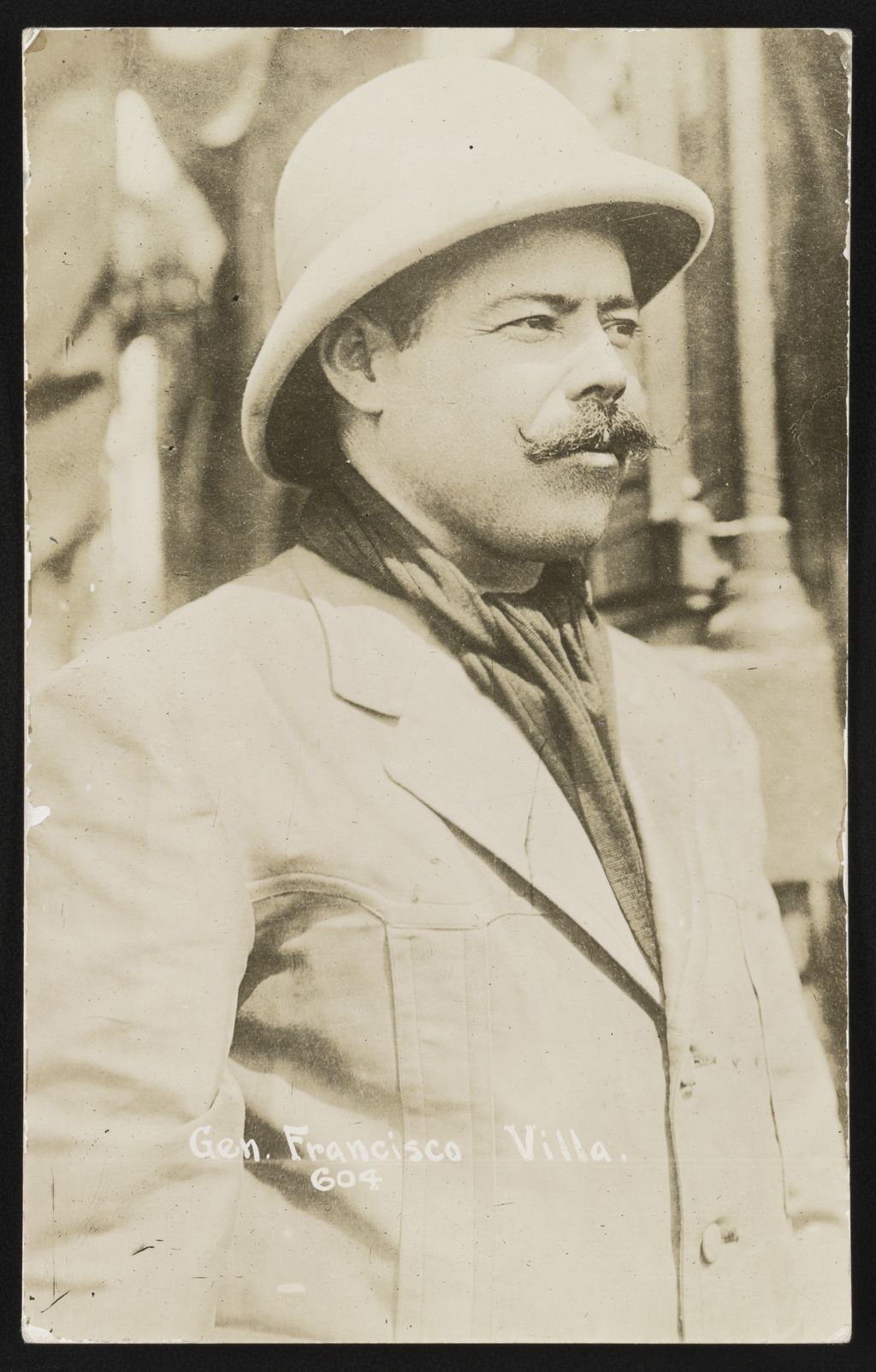
The historical term needs care. Soldaderas travelled with armies and performed varied work, including provisioning, cooking and care; some women also fought. Historian Martha Eva Rocha Islas distinguishes categories of soldaderas and women soldiers and warns that the images through which they became known are themselves constructed representations. [15] “Adelita” was a popular or regional name and a cultural type, not a precise rank or a description of every woman on a train. [15] [16]
The pictured train, Villa portrait and familiar title make revolutionary association impossible to ignore. They do not automatically convert Kahlo's dress into a soldier's uniform, nor does the dress erase the train. [2] [3] [4] Oles and the de Young label disagree about how these pieces meet: an urban group looking toward revolutionary images, or a Kahlo who imaginatively joins an Adelita story while still dressed for a modern evening. No located Kahlo letter or diary entry explains the juxtaposition in her own words. [12]
The Margarucci catalogue goes further than the de Young label by characterising the painting as an early political or mexicanismo subject and applying the phrase “primitive Cubist” to its experiment. [5] Those are historically useful descriptions of one catalogue's reception, not neutral labels for the work. They show how strongly the revolutionary imagery can direct a viewer even while Oles argues that the café group is the more consequential subject. [3] [5]
The museum's link to photographs by Agustín Casasola should likewise remain attributed. The INAH archive preserves railway and soldadera imagery from the Revolution, but no specific photograph has been matched to the painted group; the broader Archivo Casasola contains work by more than one photographer. [10] [16] Treating an archive name as personal authorship of an unidentified source image would add certainty the evidence cannot bear.
Los Cachuchas and an Imagined Café
Los Cachuchas were Kahlo's circle from the Escuela Nacional Preparatoria, named for the caps they wore. Oles describes a group whose members went into literature, politics, law, medicine and the arts, and places their imagined sociability beside Mexico City's Stridentist and Contemporáneos circles. [17] That context helps explain why an early picture of friends might mix portraiture, theatrical spaces and public cultural symbols, rather than depict an actual evening at a securely identified café.
Kahlo's 1925 traffic accident interrupted her studies, and Oles says friends visited during her convalescence. [17] In his account, the café pictures imagine a rich public intellectual life that may have felt newly distant from Coyoacán. This is a source-attributed explanation for the work's social ambition, not evidence that any individual train, sitter or angular wall is a direct illustration of trauma. [3] [17]
Miguel N. Lira, a friend in that circle, matters as more than a possible sitter. Oles reports that Lira held several Kahlo works on paper and two paintings, including this unfinished canvas and his own 1927 portrait; with one watercolour exception, he says Kahlo gave those works to Lira herself. [17] The social tie is documented at source level, but it does not mean every partial figure in the painting can be named as a Cachucha. Oles's account of the group's café ambitions is an interpretation of the works and their milieu, not an artist's recorded programme. [13] [17]
That uncertainty is visible in the lower half. The central face is developed, the right man's face is blank, and broad brown passages at the bottom remain vague. [2] Oles calls the painting unfinished and unsigned and reports evidence that Kahlo repainted the central self-portrait years later. [3] The visible unevenness is compatible with his account, but a digital image cannot date paint layers or show whether every angular upper passage was meant to receive further work.
A Drawing with More People
A surviving pencil Sketch for Pancho Villa and Adelita provides a valuable comparison. Christie's describes it as a circa-1927 sheet measuring 20 × 23.2 centimetres, dedicated on its reverse to Lira's nickname “Chong Lee.” [11] Its essay says the drawing contains a larger intended gathering than the surviving painted scene. The difference supports a process of selection, omission or reconsideration, though it does not reveal a fixed final plan that Kahlo failed to execute.
The drawing's later sitter names also need a date attached. Christie's says Alejandro Gómez Arias identified members of the group roughly sixty years after the work was made. [11] His recollection may preserve real social knowledge, but it is not a contemporary key written on the canvas. The sketched assembly can help explain why the painted gathering appears sparse without turning every unresolved outline into a named friend.
The two objects have different media, proportions, inscriptions and ownership paths. Christie's provenance begins with Lira, passes through Rubén García Vadillo and a 2000 sale, and ends with a private owner in its 2025 catalogue; none of that later sheet history transfers to the Tlaxcala painting. [11] Conversely, the oil's reported 65 × 45-centimetre measurement and unfinished surface cannot be attached to the small pencil drawing. Older printed drawing data conflict with the auction's exact sheet record, another reason to keep their catalogues separate. [5] [11]
Christie's essay compares the painting's inset spaces with Giorgio de Chirico's Metaphysical compositions. The de Young label cautiously invokes Cubism and de Chirico as possible formal influences. [4] [11] Tilted images, abrupt planes and multiple spaces make those comparisons understandable, but they do not document Kahlo's direct encounter with a named work or commit the entire painting to one movement. Oles's urban-café argument also reminds us that modern form and Mexican subject matter need not be opposing halves of the picture. [3] [4] [13]
Writing from the 2018 Milan exhibition, Spanish critic África Cabanillas Casafranca places this canvas and the Lira portrait near the Stridentist avant-garde and argues against reading Kahlo's art as a transparent record of private suffering. [27] This adds a third critical emphasis, not a documented Stridentist membership or a technical finding. It is especially useful here because the picture's assembled spaces, school circle and public imagery offer reasons to examine artistic choices before projecting a later life story onto them.
Tlaxcala Ownership and an Unsettled Transfer
Oles's Tlaxcala essay says Kahlo gave the painting directly to Lira and that the Instituto Tlaxcalteca de la Cultura acquired it from Lira's heirs in 1982. [17] This is the clearest object-connected route found, but no gift document, accession entry, price or purchase instrument has been inspected. The current owner-partner page associates the work with the Tlaxcala institution, while older exhibition labels credit the state government and former institute. [1] [4]
A 2018 Mexican government release tells a longer and partly incompatible story: after Lira, it mentions Rebeca Torres and a priest before the painting came to the state. [18] The available wording does not establish how those intermediaries fit with an acquisition directly from heirs in 1982. Both accounts should remain visible as a provenance conflict rather than being spliced into a seamless chain. Tlaxcala's later cultural-administration changes explain shifting institutional names, but not the missing legal transaction details. [18] [19]
The repository is the Museo de Arte de Tlaxcala; that fact is different from saying the painting is presently hanging in a particular room. Government descriptions from 2021 to 2024 discuss a permanent display of early Kahlo works without consistently itemising this canvas. [19] [20] The 2012 museum reopening release did name it among seven Kahlo-related objects, while later descriptions count six works. Different counting of the accompanying signature board is a plausible explanation, not a documented disappearance or acquisition. [20] [21]
Exhibitions and the Latest Located Appearance
An official release names Pancho Villa y la Adelita in the 2014 Frida Kahlo exhibition at Rome's Scuderie del Quirinale. [22] A 2018 federal lending announcement names it among four Tlaxcala works sent to Frida. Más allá del mito at Milan's Museo delle Culture. [18] The same announcement anticipated a further loan to London's Victoria and Albert Museum, but the public V&A exhibition page inspected here does not provide an item list, so London remains announced rather than independently checklist-verified. [18] [23]
The de Young's online exhibition label supplies item-level evidence for its 2020–21 Frida Kahlo: Appearances Can Be Deceiving presentation. [4] [24] Its reading of the dress, revolutionary train and possible stylistic influences is part of the work's exhibition history, not a timeless verdict on Kahlo's intention. Neither this label nor the preceding tour's general history proves that every venue showed the identical selection of paintings. [23] [24]
The latest located item-level appearance is later than the de Young. An opening report names the painting in Kahlo, Carrington y Varo: Mujeres en México at Puebla's Palacio Municipal in November 2024; a contemporary reviewer describes it on the walls there in December. [7] [8] The review is direct exhibition testimony, not a Tlaxcala lender checklist, and reports differ on the proposed closing date. The safe claim is a late-2024 Puebla showing, not an exact 2025 endpoint or a current gallery location.
The 2007 national-homage catalogue may add an earlier appearance and a valuable object essay by Oles. A later academic source cites his discussion at page 71, but that page and the actual exhibition checklist have not been obtained. [25] It would be misleading to promote the catalogue's existence to proof that this specific canvas was installed in Mexico City in 2007. A complete exhibition history also awaits Tlaxcala loan files.
What the Sources Still Cannot Establish
The published 65 × 45-centimetre size and wooden mounting should be checked against a current Tlaxcala registrar record. So should the accession, acquisition chain, reverse markings and the painting's current display status. [5] [6] [19] No object-specific conservation report or imaging has been located, so the image cannot establish pigments, canvas structure, treatment, underdrawing or exactly when the reported central repainting occurred. [2] [3]
The full 2007 Oles journal article, the exact 2007 national-homage catalogue page, the FAMSF/Hirmer exhibition entry and the Pancho Villa and Adelita entry in Frida Kahlo: The Complete Paintings remain unread sources. [13] [24] [25] [26] The complete specialist argument or provenance apparatus in those books must not be inferred from abstracts, excerpts or bibliography. No complete commercial Kahlo monograph has been read for this page.
What remains is a painting whose formal experiment is more specific than a general label of “early Frida.” Kahlo is central but not alone; Villa is named but small; the train invokes revolution while an evening-dressed group occupies the foreground. [1] [2] [3] Oles's café reading and the museum's Adelita reading disagree because those relationships genuinely permit different emphases. The unfinished state preserves that tension rather than authorising a confident story about why Kahlo stopped. [3] [4]
Related Reading
The Bus examines a different early scene shaped by public transport, while the fashion and Tehuana dress study follows Kahlo's later self-presentation without equating her evening dress here with an Adelita costume. The style and Surrealism study places the painting's divided pictorial space within a wider discussion of labels and visual sources.
Frequently Asked Questions
She portrayed herself at the centre, but the role is disputed. Oles says her fashionable dress argues against a literal soldadera; the de Young label reads her as a mythic Adelita in evening dress. [3] [4] No located artist statement resolves the disagreement.
Oles calls it unfinished and unsigned, pointing to the vague lower area, and the right-hand sitter's face is visibly unresolved. [2] [3] He also reports a later repainting of Kahlo's face, whose date and material extent cannot be established from the available digital image.
It belongs with the Museo de Arte de Tlaxcala collection, but a current item-level on-view notice has not been found. [1] [19] Its latest located individual appearance was in Puebla in late 2024; ask the museum before travelling specifically to see it. [7] [8]
Discussion
Use the cited evidence and your own close looking to explain your view. The prompts below are starting points, not fixed interpretations.
Reader Insights
Does the title accurately describe the picture's principal subject?
How does Kahlo's dress complicate the Adelita identification?
Which parts of the composition remain unresolved?
Join the Conversation
Which reading best fits the evidence, and where does uncertainty remain?
References
- Instituto Tlaxcalteca de la Cultura, owner-partner record for Pancho Villa y la Adelita, current title, circa-1927 date, artist and institution. The record does not give a registrar measurement or accession. View source text.
- Editorial close-looking based on the Instituto Tlaxcalteca de la Cultura owner-partner image (reference 1), compared with James Oles's institutional essay (reference 3). It records visible arrangement and uneven finish, not a physical examination or image-publication permission. View source text.
- James Oles, “The Early Work of Frida Kahlo”, Tlaxcala institutional essay, “Pancho Villa and Adelita” and “Paintings” sections; author-attributed title challenge, unfinished state, reported later facial repainting and café interpretation. View source text.
- Fine Arts Museums of San Francisco, Frida Kahlo: Appearances Can Be Deceiving exhibition labels, label 102, lines 164–72; circa 1927, oil on canvas, historical Tlaxcala lender and the museum's Adelita, Casasola, volcano and tentative style readings. View source text.
- Ivanna Margarucci, Frida Kahlo: una vida a través del arte (Museo Roca, 2016), printed p.72, entries 014–016. Entry 015 gives the expanded title, 1927, oil on canvas mounted on wood and 65 × 45 cm; entries 014 and 016 concern separate works. View source text.
- Carlos Omar Segoviano Rodríguez, La fridomanía: difusión y comunicación de la imagen de Frida Kahlo (UNAM, 2011), printed p.14 and illustration caption 26. The former offers an attributed Adelita-and-identity reading; the latter gives 65 × 45 cm and canvas mounted on wood. View source text.
- Alberto Fong, “Las Fridas de Tlaxcala que llegaron a Puebla”, Intolerancia Diario, 15 December 2024; first-person review naming this painting on the walls of the Puebla exhibition, not an owner loan checklist. View source text.
- Guadalupe Juárez, “Pepe Chedraui inaugura la exposición Kahlo, Varo, Carrington, Mujeres en México”, ContraRéplica Puebla, 14 November 2024; item-named opening report. Its projected end date is not used as a verified closing day. View source text.
- James Oles, “Pancho Villa y la Adelita”, Spanish Tlaxcala object story, tentative Ángel Salas identification. View source text.
- INAH, “El ferrocarril y las soldaderas en la Revolución Mexicana”, 17 July 2023, on railway and soldadera history. Related INAH photographic-archive search records contain analogous scenes but do not establish the exact source photograph or photographer for this painting. View source text.
- Christie's, Sketch for Pancho Villa and Adelita lot record and essay, details lines 9–22 and essay lines 34–40; distinct pencil sheet, date, size, dedication, provenance, revised group and attributed later recollections or stylistic comparison. The painting's object fields do not transfer to this sheet. View source text.
- Editorial comparison of the owner-partner record and Oles's Tlaxcala essays (references 1, 3 and 9). None supplies an inspected artist-given title, verified front signature or Kahlo statement defining this picture's subject; absence in these sources is not proof that such evidence never existed. View source text.
- James Oles, “At the Café de los Cachuchas: Frida Kahlo in the 1920s”, Hispanic Research Journal 8.5 (2007), pp.467–89; abstract and metadata only. The complete article and notes have not been obtained. View source text.
- Andrea Kettenmann, Frida Kahlo: 1907–1954: Dolor y pasión (TASCHEN, 2003), discussion and caption for the separate Si Adelita… o Los Cachuchas, consulted in the Universidad Central del Ecuador library copy. Only that bounded passage, not the complete book, was read. View source text.
- Martha Eva Rocha Islas, “Soldaderas y soldados en la Revolución Mexicana”, Dimensión Antropológica 25.73 (2018), pp.159–84, on differing roles, names and photographic representation. View source text.
- INAH's railway-and-soldadera historical note (reference 10) and FAMSF's exhibition label (reference 4) give context and an attributed Casasola association. INAH's photographic-archive records include analogous railway and soldadera scenes, but no exact source photograph or personally named photographer has been verified for this painting. View source text.
- James Oles, “Frida y los Cachuchas”, Tlaxcala institutional essay; group, café context, Lira gifts and 1982 acquisition account. An apparent birth-year error elsewhere in the text is excluded. View source text.
- Mexican Secretaría de Cultura, 2018 Milan lending announcement, 27 January 2018; four Tlaxcala objects including Pancho Villa and Adelita, projected London travel and a longer, unreconciled provenance narrative. View source text.
- INBAL's 2021 Museo de Arte de Tlaxcala reopening release and the Mexican cultural directory updated in 2023 (reference 20) describe a permanent Kahlo room at collection level. A Tlaxcala government feature of 27 December 2024 likewise names early Kahlo holdings without itemising this painting; none verifies its current individual display. View source text.
- INBAL, 2021 Museo de Arte de Tlaxcala reopening release; Mexican cultural directory, updated 2023; neither lists Pancho Villa and Adelita as currently on view. View source text 1; View source text 2.
- CONACULTA, 2012 Museo de Arte de Tlaxcala reopening release; names Pancho Villa and Adelita among seven Kahlo-related displayed objects. Later six-work descriptions are not proof of loss. View source text.
- Mexican Secretaría de Cultura, 2014 Rome exhibition release, naming Pancho Villa and Adelita at the Scuderie del Quirinale. View source text.
- Victoria and Albert Museum, Frida Kahlo: Making Her Self Up, 16 June–18 November 2018; page confirms the exhibition, not this painting's item presence. The intended loan is documented by ref.18. View source text.
- Berit Potter, “Frida Kahlo: Appearances Can Be Deceiving”, Panorama 7.1 (2021), exhibition development and catalogue context; object presence comes from ref.4, not from this general review. View source text.
- Frida Kahlo 1907–2007: Homenaje Nacional (Editorial RM, 2007), publisher catalogue record and Museo de Bellas Artes de Bilbao library metadata; the cited Oles p.71 and exact item checklist remain unread. The publisher and library records identify the volume, not the contents of its unconsulted item entry. View source text.
- Luis-Martín Lozano, Andrea Kettenmann and Marina Vázquez Ramos, Frida Kahlo: The Complete Paintings (TASCHEN, 2021), publisher record; and FAMSF/Hirmer, Frida Kahlo: Appearances Can Be Deceiving (2020), catalogue record. The exact entry for this painting in either catalogue and the complete volumes have not been consulted; no object claim here rests on their unseen contents. View source text.
- África Cabanillas Casafranca, “Frida Kahlo, más allá del mito”, M-Arte y Cultura Visual, 12 May 2018, object caption and critical discussion, especially paragraphs corresponding to lines 118–19 and 131–40. An unrelated inserted advertisement at lines 120–21 is excluded. View source text.
- Museo Frida Kahlo's chronology supplies comparison-work dates. The Tlaxcala owner-partner record and Fine Arts Museums of San Francisco's exhibition label (references 1 and 4) date this unfinished painting circa 1927; the marker does not imply an exact completion date. View source text 1; View source text 2.
Image Credits
- Bain News Service. No known restrictions. Source: Library of Congress (Gen. Francisco Villa). 1024px proportional sRGB JPG derivative; no crop. Licence. Source record.
- Mujeres listas para recivir a Rabago (1911) — Walter H. Horne; Library of Congress, Prints and Photographs Division, item 2013645909, ppmsca.35143. Library of Congress: No known restrictions on publication. Resized and converted to JPEG/sRGB; no crop.
