


 by Tom Gurney
Tom Gurney BSc (Hons) is an art history expert with over 20 years experience
Page created on March 2, 2018 / Page updated on October 6, 2026
Email: tomgurney1@gmail.com / Phone: +44 7429 011000
Introduction
In Frida Kahlo's Weeping Coconuts (1951), a pair of dark, fibrous coconuts rises from a tightly packed group of fruit. Two pale drops fall beneath the pores of the larger coconut, turning features already present in the shell into an unmistakably face-like image. A green-white-red banner carries words of affection across the centre, making the small still life both a picture of things and an apparently personal address. [1] [2]
The Los Angeles County Museum of Art (LACMA) owns the painting under the bilingual title Weeping Coconuts (Cocos gimientes). Its text, the possible dedication to Kahlo's former schoolmate Elena Boder, and the work's later passage through the Bernard and Edith Lewin collection can be documented to different degrees. Each adds to the painting without making the tears a straightforward confession of what Kahlo felt. [1] [3]
At a Glance
- Artist and date: Frida Kahlo, 1951. [1]
- Title and medium: Weeping Coconuts (Cocos gimientes); oil on board, not the canvas stated in a 1997 newspaper graphic. [1] [4]
- Size: Painted board 9 1/8 × 12 in. (23.2 × 30.5 cm); LACMA lists the frame separately. [1] [5]
- Collection: LACMA, Bernard and Edith Lewin Collection; accession M.2004.283.2. [1]
- Last checked on view: LACMA, BCAM third-floor Modern Art galleries, 3 October 2026. [1]
Contents
- Introduction
- Looking at the Painting
- How a Coconut Acquires a Face
- What the Flag Says
- Elena Boder and the Faint Dedication
- Was It a Returned Gift?
- Titles and the Crocodile Tears Reading
- Weeping Coconuts Is Not Los cocos
- Health, Work and an Active Still Life
Looking at the Painting
The painted field is horizontal and shallow. A mottled green upper area meets a narrow dark burgundy band below, without a visible room, landscape or deep horizon. Round fruits crowd the space so closely that several are cropped or concealed by their neighbours. [2]
Two coconuts occupy the centre. The left one is smaller or more obliquely turned; its reddish-brown husk is built from directional light and dark strokes. The larger right coconut shows three dark pores near its viewer-facing end, and two white-grey drops hang beneath the upper pair. The left coconut has no equally clear matched tears in the available image. [2]
Red-orange, yellow and pale-green round forms emerge behind the coconuts. A long cut wedge crosses the lower middle with orange-yellow flesh, a green outer edge and clusters of dark seeds; LACMA identifies it as papaya. Smaller citrus and green fruit surround the central pair, but the owner's collective labels do not let us confidently name every orange, lemon, pear or apple-like shape to species. [1] [2]
At the front left, a narrow support for the banner appears to enter or cross a green fruit. At the front right, a yellow-orange fruit has an irregular opening that exposes a pale interior. LACMA's teaching text describes piercing, tearing and wounded fruit; the visible cuts and opening support that descriptive starting point, but a specific human injury is an interpretation. [2] [6]
The banner threads between fruit and coconuts, carrying green, white and red through colours already present elsewhere in the picture. Its lettering becomes a second light-and-dark focus beside the tears. No eagle-and-serpent emblem is visible, yet LACMA identifies the element as a Mexican flag; “tricolour banner in Mexican national colours” describes what the image independently shows. [1] [2] [6]
Watch: Frida Kahlo
Five perspectives to view here alongside the article.
Frida Kahlo’s The Two Fridas: Great Art Explained
A focused visual introduction to the painting and its context.
How a Coconut Acquires a Face
Coconuts have three natural germination pores at one end of their hard inner layer. The Royal Botanic Gardens, Kew explains that those openings have long suggested facial features and that the Portuguese and Spanish word coco carries a head- or skull-like association. Botanically the coconut fruit is a drupe, not a true nut, but the everyday name is entirely suitable here. [7] [8]
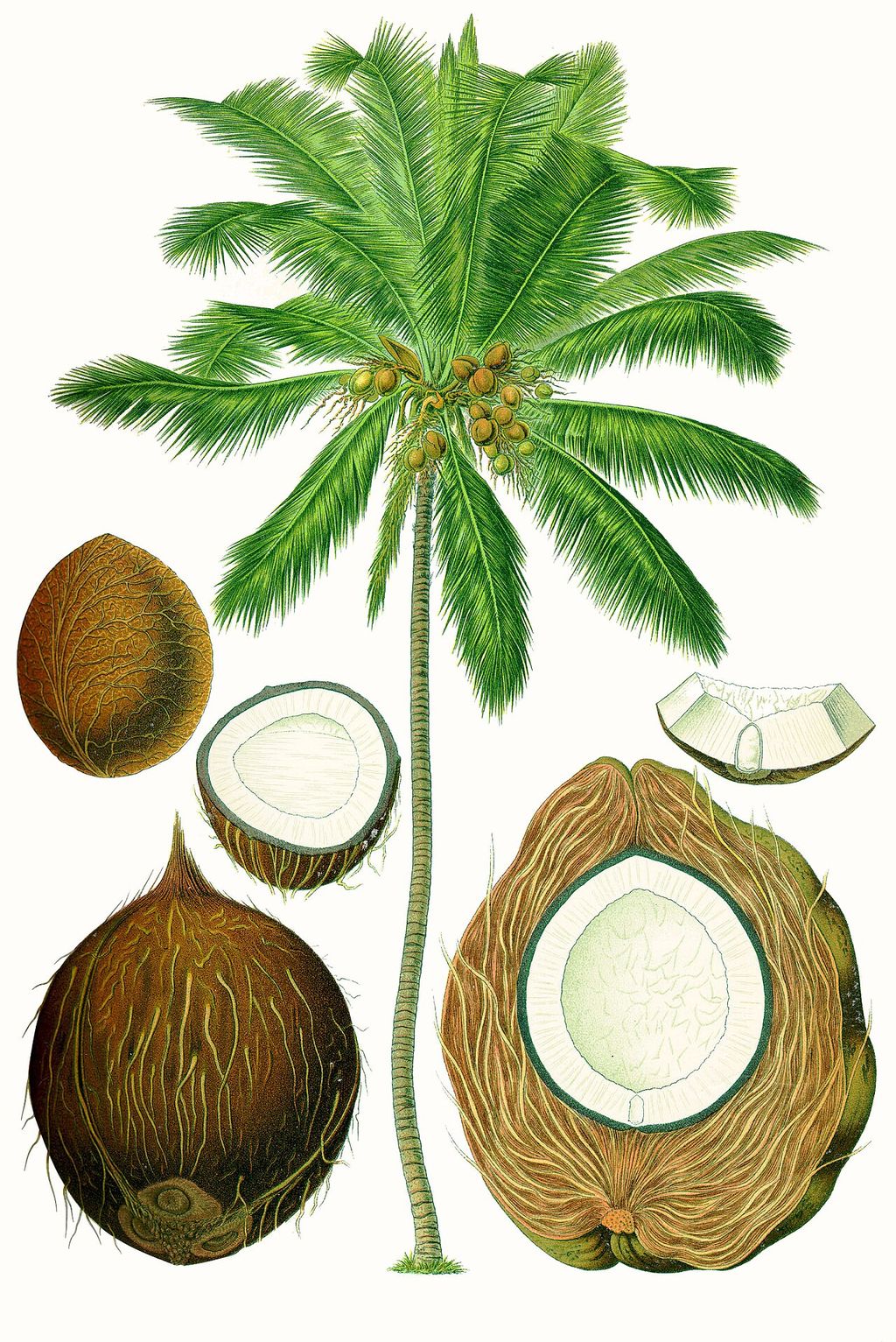
Kahlo uses that familiar resemblance economically. The upper pores read as eyes once two painted pale drops descend beneath them; the third can read as a mouth or nose depending on the viewer's grouping. No complete human face is drawn. The tears look liquid, but the image cannot establish that they represent actual coconut water rather than an invented visual sign. [2] [7]
LACMA curator Ilona Katzew calls the result a disturbing animation of fruit. That phrase directs attention to a pictorial event rather than a settled identity: an ordinary food seems able to look back, suffer or weep. The effect is intensified because the other fruits press around the pair, giving the larger coconut company without telling us whether it is protected, crowded or trapped. [1] [2] [6]
Weeping Coconuts in Kahlo’s career
Timeline source: Museo Frida Kahlo chronology [28].
What the Flag Says
LACMA's searchable description transcribes the dark central words as PINTO CON TODO CARIÑO. FRIDA KAHLO. A museum educator guide prints Pintó con todo cariño, Frida Kahlo and translates the phrase as “Painted with all my affection, Frida Kahlo.” At the resolution of the owner image an accent over the final letter of PINTÓ appears possible, but folds and compressed writing make a complete diplomatic transcription uncertain. [1] [2] [6]
The difference between pinto (“I paint”) and pintó (“painted”) is not merely decorative Spanish punctuation. It affects tense, even though the signature makes the intended personal address clear. The museum's unaccented metadata and accented educational transcription are therefore best kept distinct; both convey the affectionate address without settling every painted mark. [1] [6]
The artist's name is part of this central text, not a separate signature clearly located in a corner. No date can be read with confidence on the front in the available owner image, and the reverse has not been inspected for inscriptions or labels. Those limits matter especially because a further, fainter dedication has entered the work's history. [2] [3]
Elena Boder and the Faint Dedication
Art historian Luis-Martín Lozano's 2019 Christie's essay identifies Elena Boder as a schoolmate of Kahlo at Mexico City's Escuela Nacional Preparatoria. Born in 1907 and arriving from Odessa via Japan in 1919, Boder studied many of the same subjects and shared an ambition to enter medicine. Kahlo's 1925 accident interrupted her studies, while Boder continued into the profession. [3]
Boder's later medical work is independently documented. A 1973 paper on developmental dyslexia places her in paediatrics at the University of California's Los Angeles medical school; a 1976 paper lists paediatric and neurology affiliations in Los Angeles. Those records support describing her as a physician and paediatric neurologist more securely than repeating the auction essay's uncorroborated label “neurosurgeon.” [9] [10]
Lozano says a small late Kahlo still life bore a faint dedication to Boder. The illustrated Christie's catalogue identifies that work as Cocos gimientes and describes Para Elena Boder as indistinct on its central flag. LACMA's current public transcription includes the affection phrase and Kahlo's name, but not Boder's: her name is not independently legible in the available owner image. [1] [2] [3] [11]
This does not make the catalogue reading worthless, nor does it prove that Kahlo erased it. Faint paint, ageing, abrasion, conservation and photographic limits would require technical examination to distinguish. Lozano uses the dedication as one clue in a separate hypothesis that Boder might be the sitter in an unfinished early portrait; the still life cannot settle that portrait's identity. [3] [11]
Was It a Returned Gift?
A LACMA educator guide says Kahlo intended the still life for a friend who returned it because she found the picture unsettling. It does not name that friend. Lozano and the Christie's catalogue supply the Boder dedication but do not, in the passages available, say that she commissioned or returned the board. Combining those two strands into a certain account of Boder's response would go beyond either source. [3] [6] [11]
A review of Salomón Grimberg's specialist book adds a further version: a woman physician reportedly commissioned the picture, returned it, and Kahlo later hung it beside her bed. The book itself and the photograph said to show the bedside painting have not been examined. There is no direct letter, invoice, recipient statement or conservation report here proving a replacement request, immediate sale or deliberate overpainting of Boder's name. [12]
The ambiguity suits the picture's mixture of affection and unease without explaining it away. A signed gift can be warmly meant and still strike a viewer as disturbing. Whether Kahlo intended the tears as a joke, reproach, comfort or something less easily named remains unrecorded in the sources checked. [1] [6]
Titles and the Crocodile Tears Reading
LACMA's controlled bilingual title is Weeping Coconuts (Cocos gimientes). Other Spanish wording includes Cocos llorando and Lágrimas de coco; Bernard Lewin called it “Tears of the Coconut” in a 1997 interview, and Centre Pompidou has used Noix de cocos en pleurs in French. These are documented title or reception variants, not evidence that Kahlo repeatedly retitled the board. [1] [4] [13]
In an audio guide LACMA introduces Lágrimas de coco as a play on lágrimas de cocodrilo, “crocodile tears,” and asks whether the gift might carry a pointed message. The Museo de Arte Moderno in Mexico attributes a similar pun to Grimberg when discussing another Kahlo painting. Grimberg's exact specialist-book passage remains unread here, so the pun is best reported as an institutional and Grimberg-attributed interpretation, not a statement of Kahlo's proven intention. [12] [14] [15]
The pun changes the emotional possibilities. “Crocodile tears” can imply insincerity, which complicates the impulse to treat the weeping coconut as a transparent self-portrait of pain. It can also introduce wit into a picture whose cut fruit and dark central forms some viewers find disturbing. Neither irony nor grief has to cancel the other. [2] [14]
Weeping Coconuts Is Not Los cocos
Kahlo made another coconut still life in 1951, now held by the Museo de Arte Moderno in Mexico City as Los cocos. The museum describes three pairs of fruit—watermelons, oranges and coconuts—and says its coconut face alludes to another still life with weeping coconuts. That wording confirms a relationship between the pictures while distinguishing their compositions and collections. [15]
LACMA's Weeping Coconuts has two dominant coconuts, a cut papaya, smaller fruit and the central inscribed tricolour; it has no visible watermelon. The Museo de Arte Moderno's statements about the making place or personal circumstances of Los cocos cannot be borrowed for the LACMA board. Similar titles, the same year and a crying coconut are insufficient to merge two objects. [1] [2] [15]
Health, Work and an Active Still Life
The Museo Frida Kahlo records that Kahlo spent much of 1950 in and out of the British Hospital in Mexico City and underwent seven spinal operations. In 1951 limited movement kept her at home more often, and the museum describes her increasing production of exuberant still lifes. This is relevant working context for a painting made that year, though no source cited here fixes its completion day or proves it was painted in a hospital bed. [16]
LACMA's educator guide offers a more sombre account, associating the fruit's apparent wounds with pain, medication and a change in Kahlo's skills. Its text is valuable evidence of museum interpretation, but it does not cite an object-specific medical or conservation analysis that diagnoses the brushwork. The painting's green, orange, red and yellow remain varied and forceful in the owner image; small scale and visible strokes are not proof of intoxication, lost ability or lack of artistic ambition. [2] [6]
It is possible to acknowledge disability without letting biography replace visual analysis. A restricted body of movement and an active painting practice coexisted. The late still-life form let Kahlo compress fruit, face, text and national colour on a small board; the sources do not show that she chose fruit simply because it was easy, or that she abandoned portraiture altogether. [2] [16] [17]
Living Nature and Mexican Popular Art
The Museum of Fine Arts, Boston exhibited Weeping Coconuts in its 2019 Frida Kahlo and Arte Popular exhibition. Its section “Living Still Lifes / Naturalezas Vivas” placed the LACMA board alongside Pitahayas, Still Life with Parrot and Fruit and María Izquierdo's Cupboard. The curators described Kahlo's fruits and rocks as acquiring eyes, skin and feelings, crossing the boundary between things and living beings. [17]
LACMA's educator guide recalls the historical ranking of still life as a supposedly lesser, domestic genre often considered suitable for women painters. That broad hierarchy should not be mistaken for a rule that women could paint only fruit, or for Kahlo's reason for choosing this subject. It helps explain the force of her transformation: a small arrangement of food carries a human face, a charged written address and unstable relations among things. [2] [6]
The MFA also set Kahlo's paintings beside examples of Mexican arte popular, or popular art, within a post-revolutionary discussion of Mexican identity. A contemporary exhibition review reports carved coconuts with eyes and teeth near this painting. Such a pairing makes the formal resemblance tangible, but an exhibited carving is not automatically Kahlo's model for the 1951 board. [17] [18]
The museum expressly distinguishes Kahlo from a folk artist making the same objects. It presents her as a modern painter who drew on ceramics, carvings, toys and devotional images while inventing her own pictorial solutions. Here, natural coconut anatomy, two added drops, densely overlapping fruit and a written banner create a personified still life without requiring an unseen folk prototype. [2] [17]
The flag participates in that cultural setting. Its green-white-red colours and LACMA's identification as Mexican can support a reading of mexicanidad, but there is no emblem or written political programme. A personal address to a possible friend and a national visual register can coexist; neither makes the other disappear. [1] [2] [17]
Are These Fruits Native to Mexico?
LACMA's educator guide says the fruits in the picture are native to Mexico. Kew's botanical records make that too broad: it places coconut's native range in central Malesia and the south-west Pacific, and the genus Citrus across parts of Asia and the Pacific. Papaya, by contrast, has a native range extending from southern Mexico through tropical America. [6] [8] [19] [20]
These origins do not make the fruits foreign to Mexican culture in 1951. Native range, cultivation, trade, everyday consumption and symbolic use are different histories. The painted tricolour and Kahlo's place in a Mexican still-life tradition can be discussed without claiming that every depicted species originated in Mexico. [1] [17] [19]
From the Lewins to LACMA
Bernard and Edith Lewin began collecting Mexican art after Bernard's 1958 Mexico City visit, but the sources examined do not say when, from whom or on what terms they acquired this painting. In October 1997, they transferred a much larger collection to LACMA through an annuity arrangement while retaining lifetime ownership of Weeping Coconuts and a Diego Rivera portrait of Kahlo. Both were lent to the museum; the 1997 arrangement did not yet make this specific board an outright owned accession. [4] [21]
Weeping Coconuts appeared in LACMA's Mexican Masterpieces from the Bernard and Edith Lewin Collection, which ran from November 1997 to February 1998. Contemporary criticism called the small fruit picture a surrogate self-portrait, recording one strand of reception rather than a portrait Kahlo herself identified. A later gallery review places it in LACMA's Latin American art galleries around 2000–01 while the lifetime-retention arrangement still mattered. [22] [23]
After Bernard Lewin died in January 2003, contemporary reporting said the two retained paintings reverted to LACMA. The museum now credits Weeping Coconuts to the Bernard and Edith Lewin Collection and assigns accession M.2004.283.2. That accession number is a present catalogue identity, not enough on its own to reconstruct an exact legal transfer day; the pre-Lewin ownership chain remains open. [1] [24]
The MFA Boston loan in 2019 and LACMA's current on-view statement show different chapters of the painting's public life. No lifetime exhibition has been established for this particular board, and a 2023 immersive presentation that listed its image was not a loan of the physical painting. Selected secure appearances are more useful than an artificially complete exhibition list. [1] [17] [25]
Later Readings Without a Single Key
LACMA's educator guide asks whether the fruit near the coconuts protects, supports or smothers them. Christopher Knight's 1997 self-portrait comparison, Katzew's 2008 anthropomorphism, and the MFA's 2019 living-still-life framework all begin from the painted forms but emphasise different things. None establishes that the large crying coconut is literally Kahlo, Boder or another person. [1] [6] [17] [22]
LACMA has more recently included the painting in queer- and disability-history responses, including a 2026 article that reads pain through anthropomorphic fruit. These are part of the work's continuing reception, not evidence that Kahlo encoded those later categories in a fixed way. The tears, the affectionate text and the possible crocodile-tears joke leave room for sympathy, discomfort and humour at once. [14] [26]
Further Reading and Open Questions
Salomón Grimberg's Frida Kahlo: The Still Lifes is the most urgent unread specialist source for the pun, recipient, commission and possible bedside photograph. The exact entry in Frida Kahlo: The Complete Paintings, LACMA's 2003 collection volume and the 1997 Lewin exhibition catalogue remain unconsulted; they may clarify title history, support, inscriptions, provenance and exhibition lists. [12] [27]
LACMA's object and conservation files could clarify the faint dedication, reverse, precise board construction and legal accession history. Original correspondence or a recipient statement could connect—or separate—the Boder dedication and the unnamed returned gift. Until those records are available, the painting can be read closely without turning a plausible story into a documented transaction. [3] [6] [27]
Related Reading
Compare the separate Museo de Arte Moderno painting Coconuts with the different fruit arrangements in Pitahayas, Fruits of the Earth and Still Life with Parrot and Fruit.
Frequently Asked Questions
The larger coconut at the viewer's right has two pale drops beneath its upper pores. The other coconut does not show an equally clear pair in the available owner image. The drops make a face-like reading easy, but their exact depicted substance and the artist's intention remain uncertain. [2] [7]
LACMA says an unnamed friend returned a gift because it felt unsettling, while a Christie's catalogue reports a faint dedication to Boder. Those records suggest a possible connection but do not by themselves prove Boder was the person who returned it. Claims that Kahlo then painted out Boder's name or immediately sold the board lack the needed direct evidence. [3] [6] [11]
LACMA's collection page listed it on view in BCAM's third-floor Modern Art galleries when checked on 3 October 2026. Because display can change, consult LACMA's object record before travelling. The museum owns the painting; the similarly themed Los cocos belongs to a different institution. [1] [15]
Discussion
Use the cited evidence and your own close looking to explain your view. The prompts below are starting points, not fixed interpretations.
Reader Insights
How do the coconuts acquire faces without becoming literal portraits?
What is secure in the visible flag and faint dedication?
How does the returned-gift account differ from owner-documented provenance?
Join the Conversation
Which reading best fits the evidence, and where does uncertainty remain?
References
- Los Angeles County Museum of Art, Weeping Coconuts (Cocos gimientes), object record, curatorial note by Ilona Katzew, credit, accession, rights and on-view statement; last checked 3 October 2026. View source text.
- Author's visual observations from LACMA's owner object image and its museum education reproductions (references 5–6). The image supports visible composition and a cautious reading of the inscription, not condition, making sequence or permission to republish the painting. View source text.
- Luis-Martín Lozano, Christie's essay for Portrait of a Lady in White, 2019, school-record and Boder-dedication passages; the proposed portrait sitter is a hypothesis. View source text.
- Suzanne Muchnic, “For Donors, a Bittersweet Parting With Beloved Works,” Los Angeles Times, 3 October 1997, Lewin arrangement and title phrase; its oil-on-canvas graphic is superseded by LACMA. View source text.
- LACMA, Surrealism: Evenings for Educators, physical PDF p. 19, Weeping Coconuts object caption and 9 1/8 × 12 in. unframed size. View source text.
- LACMA, Creativity: Evenings for Educators (2015–16), physical PDF pp. 8–10, inscription, returned-gift account and attributed fruit interpretations. View source text.
- Royal Botanic Gardens, Kew, “Coconut palm”, fruit, pores, drupe and coco name. View source text.
- Kew, Cocos nucifera, native range and three basal germination pores. View source text.
- Elena Boder, “Developmental Dyslexia: a Diagnostic Approach Based on Three Atypical Reading-spelling Patterns”, Developmental Medicine & Child Neurology 15 (1973), 663–687, DOI 10.1111/j.1469-8749.1973.tb05180.x; publisher's author-affiliation record, not a fully read article. View source text.
- Elena Boder, “School Failure: Evaluation and Treatment”, Pediatrics 58.3 (1976), 394–403, DOI 10.1542/peds.58.3.394; the publisher's author-affiliation field names paediatrics and neurology appointments. View source text.
- Christie's, Latin American Art auction catalogue, November 2019, physical p. 77, caption for Cocos gimientes describing
Para Elena Boderas indistinct. The original catalogue page was consulted in research; no official open scan of that page was verified for a public link. - Midwest Book Review, July 2008 arts shelf, review of Salomón Grimberg's Frida Kahlo: The Still Lifes. Its report of a commission, return and bedside photograph is mediated; the complete book remains unread. View source text.
- Centre Pompidou, Frida Kahlo artist page, Noix de cocos en pleurs title variant; separate from LACMA's controlled title. View source text.
- LACMA audio guide, “Revolution and Rebellion”, Weeping Coconuts stop, Lágrimas de coco, crocodile-tears pun, gift and uncertain intent. View source text.
- Museo de Arte Moderno de México, Los cocos, Spanish museum object text for a distinct 1951 painting and Grimberg-attributed pun. View source text.
- Museo Frida Kahlo, life-and-work chronology, 1950–51 entries on operations, mobility, visitors and still lifes. View source text.
- Museum of Fine Arts, Boston, Frida Kahlo and Arte Popular, 2019 exhibition and “Living Still Lifes / Naturalezas Vivas” section. View source text.
- Harvard Crimson, 5 March 2019 review of the MFA exhibition, description of the carved-coconut pairing; visitor reception, not proof of direct influence. View source text.
- Kew, Citrus, genus native-range record. View source text.
- Kew, Carica papaya, species native-range record; southern Mexico to Venezuela. View source text.
- Los Angeles Times, “Mexico's Masters,” 3 October 1997, Lewin collecting and the collection announcement. Read with Muchnic's separate account in reference 4 for the annuity, lifetime retention and loan. View source text.
- Christopher Knight, “Mixed Blessings,” Los Angeles Times, 24 November 1997, review of Mexican Masterpieces from the Bernard and Edith Lewin Collection and an attributed surrogate-self-portrait reading. The 1997 exhibition-catalogue record gives 23 November 1997–16 February 1998; the complete catalogue has not been consulted. View source text 1; View source text 2.
- Collette Chattopadhyay, ArtNexus review of LACMA's Latin American art wing, circa 2000–01, names Weeping Coconuts as a nearby Lewin loan and offers a surrogate-self-portrait reading. View source text.
- Los Angeles Times, “Bernard Lewin, 96; Art Dealer, Donor,” 5 February 2003, death and return of retained works. View source text.
- Hanoi cultural exhibition licence for the 2023 immersive This Is Not a Dream, consulted in research: an image-list entry, not evidence of a physical loan of LACMA's board. A public original-document URL was not verified; contemporary Vietnamese coverage of the digital exhibition describes its digital format but does not reproduce the licence list. View source text.
- Alexander Schneider, “Queer Histories of Modern Art,” LACMA, 8 June 2026, Weeping Coconuts passage; contemporary interpretation, not artist intent. View source text.
- Salomón Grimberg, Frida Kahlo: The Still Lifes; Luis-Martín Lozano, Andrea Kettenmann and Marina Vázquez Ramos, Frida Kahlo: The Complete Paintings; LACMA's 2003 collection volume; and the 1997 Lewin exhibition catalogue. Linked records establish editions, not access to their unconsulted object entries or LACMA's file. View source text 1; View source text 2.
- Museo Frida Kahlo, Frida interactive chronology, selected work dates used for the comparison timeline. The current work's date follows its cited object record. View source text.
Image Credits
- Franz Eugen Köhler, Köhler's Medizinal-Pflanzen. Public domain. Source: Wikimedia Commons (File:Cocos nucifera - Köhler–s Medizinal-Pflanzen-187.jpg). 1024px proportional sRGB JPG derivative; no crop. Licence. Source record.
