


 by Tom Gurney
Tom Gurney BSc (Hons) is an art history expert with over 20 years experience
Page created on March 2, 2018 / Page updated on October 6, 2026
Email: tomgurney1@gmail.com / Phone: +44 7429 011000
Introduction
Frida Kahlo’s The Suicide of Dorothy Hale presents a woman three times in one narrow image: high against a New York building, head-down among clouds and lying beneath it. A painted inscription names the woman, the place and the date of her death, while red marks pass from the body over the inscription and onto the frame. The work is a memorial commission, but it records the death rather than offering a consoling portrait. [1] [2] [3] [4]
Dorothy Hale was an actor and a participant in New York social life, not merely the subject of a dramatic anecdote about Kahlo’s patron. She died by suicide on 21 October 1938; no inspected source proves that a particular career, financial or relationship difficulty caused her death. This article discusses the painting’s depiction of that event and its visible blood without reproducing the artwork. [3] [4] [8] [9]
At a Glance
- Work: El suicidio de Dorothy Hale (The Suicide of Dorothy Hale).
- Date: worked on in December 1938 and January 1939; reported delivered in summer 1939. Institutions variously date it 1938, 1938–39 or 1939.
- Medium and size: oil on Masonite with painted wooden frame; Tate lists 58.4 × 49.5 centimetres. MoMA's 1993 exhibition checklist gives a smaller 50.8 × 40.6 centimetres without specifying why.
- Commission and owner: commissioned by Clare Boothe Luce in 1938; in Phoenix Art Museum’s collection since a 1960 transfer from the Luces. The owner’s caption credits an anonymous donor.
- Inscription: Luce’s name no longer appears in the painted text; who made the change remains unresolved. [3] [4] [18] [19] [20]
Contents
- Introduction
- Three Appearances in a Painted Frame
- Dorothy Hale Beyond the Headline
- Newspaper Spectacle and a Private Memorial
- Clare Boothe Luce and the Memorial Commission
- Kahlo Plans the Fall in New York
- The Inscription and Its Unresolved Alteration
- A Retablo Without Rescue
- Space Fashion and the Limits of a Style Label
Three Appearances in a Painted Frame
The object is a vertical panel inside a painted frame, not a scene enclosed by a neutral border. Pale blue, grey-blue and white clouds fill much of the field and continue over its upper and side edges. A stepped white building rises in the centre, topped by a muted gold or olive roof and thin projecting elements; its identification as Hampshire House comes from the inscription and records, not from architectural recognition alone. [2] [3] [4]
A tiny dark figure appears near the façade. Lower down, a larger version turns head-first through the clouded sky, its arms away from the torso. The third and largest figure lies across the shallow brown-grey lower field, with feet toward the viewer’s left and head toward the right. These are three selected positions, not a continuous or forensic record of every instant of a fall. [3] [4] [12]
The recumbent woman wears a dark sleeveless dress and a pale floral corsage. Her hair spreads near her head, while red marks appear around the head and arm, cross the inscription band and run down the ochre lower rail. The reproduction supports that restrained description; it does not establish the dress’s maker or occasion, the woman’s expression, her consciousness or medical details. [3] [4]
One foot seems to project across the light-blue inscription band and casts an illusionistic shadow. The clouds at the top and blood at the bottom likewise pass between pictorial space and painted surround. Fiona Gregory and Sanford Schwartz read those crossings as part of the painting’s constructed space, where the image refuses to remain neatly inside its frame; the visual features are observable, but that account of their effect is interpretation. [3] [4] [13]
Watch: Frida Kahlo
Five perspectives to view here alongside the article.
Frida Kahlo’s The Two Fridas: Great Art Explained
A focused visual introduction to the painting and its context.
The Suicide of Dorothy Hale in Kahlo’s career
Timeline source: Museo Frida Kahlo chronology [31].
Dorothy Hale Beyond the Headline
Dorothy Hale was born in 1905 and worked as an actor while moving in New York’s social circles. Gregory traces a Broadway chorus appearance in the early 1920s and, after the death of Hale’s husband, muralist Gardner Hale, in 1931, a continuing pursuit of stage and screen roles. Her account includes a Hollywood test, an uncredited part in Cynara (1932), a small role in The Rise of Catherine the Great (1934) and a regional tryout for Abide with Me before Hale was replaced for the New York production; the individual production records have not been independently inspected here. [4] [8] [9]
Hale died after falling from the Hampshire House on 21 October 1938, aged thirty-three. A contemporary newspaper route confirms that her death became immediate public news, while later accounts dwell on her finances, acting prospects and reported relationship with Harry Hopkins. These circumstances help explain the stories told about Hale, but neither the inspected contemporary material nor the museum and scholarly accounts establish one of them as the cause of her suicide. [4] [9] [22]
The Fine Arts Museums of San Francisco and the Virginia Museum of Fine Arts recount a gathering on 20 October and a proposed trip. Those details belong to the reported chronology, not to an account of Hale’s private thoughts on her final night. Treating her as a person with a career and relationships, rather than as an anonymous figure falling through Kahlo’s picture, also keeps the painting’s named memorial purpose in view. [8] [9]
Newspaper Spectacle and a Private Memorial
Hale’s death became news almost immediately. A 22 October 1938 Associated Press report in the Daily Iowan names her and describes a fall from a New York high-rise; Gregory’s study follows further contemporary clippings that emphasise Hampshire House, the trajectory and the social setting. Their emphasis helps explain why the building is more than a neutral backdrop in Kahlo’s painting: the work takes an already publicised location and reorganises it into an inscribed memorial. [4] [22]
The press record is not a transparent account of Hale’s reasons. Gregory shows how reports and later retellings assembled career, money, dress and relationship details into competing explanations, while the VMFA guide marks the Hopkins relationship narrative as rumour. The original New York clippings and the Detroit News item identified by VMFA have not been fully inspected here; their unread text cannot supply quotations or an independent verdict on motive. [4] [9] [22]
Kahlo’s painted sequence also differs from the newspaper form. It repeats the recognisable building and the fatal descent, yet expands Hale across three positions and joins the event to a dedication whose patron later sought to remove names. That combination of public specificity and contested private address helps explain why the picture can be both a record of a reported death and a difficult memorial, without making the image a forensic reconstruction. [3] [4] [19]
Clare Boothe Luce and the Memorial Commission
Clare Boothe Luce commissioned the painting in 1938. She had been a Vanity Fair managing editor until 1934 and was a writer and playwright when Hale died; her later congressional and ambassadorial careers should not be projected back onto the commission. Tate’s loan record establishes Luce’s role, but it does not say who first proposed the work or specify the format she requested. [2] [10]
The origin stories conflict. In the account Sylvia Jukes Morris draws from Luce, Kahlo proposed a memorial; in the version Hayden Herrera records, Luce asked for a more conventional portrait to be given to Hale’s mother. Gregory places these later stories beside one another rather than treating either as the contract that has not been found. Luce’s reported shock on seeing the completed painting and the often-repeated story about scissors likewise belong to later recollection, not an inspected contemporary reaction. [4] [18] [19]
The original painted text offered the retablo to Hale’s mother, so the recipient was part of the work’s stated purpose. Whether she could have received it is unsettled: Gregory notes a contrary claim that Hale’s mother had died years earlier, but the underlying family record has not been verified. The secure formulation is that the inscription named Hale’s mother as recipient; it does not establish delivery to her. [4] [18]
Kahlo’s direct treatment of the death was not necessarily a simple surprise that Luce had never encountered in her art. Gregory reports Luce at Kahlo’s 1938 Julien Levy Gallery opening, where graphic work was on view, and notes a later account that Luce expected something closer to a Kahlo self-portrait she owned. The conflict concerns what this particular memorial was to show, not a documented general ignorance of Kahlo’s imagery. [4]
Kahlo Plans the Fall in New York
Kahlo was in New York from November 1938 into February 1939. In a letter to Diego Rivera dated 5 December 1938, transcribed in Alicia Azuela de la Cueva’s Spanish-language study, she explains that she wants to omit most of the building’s windows, keep the one associated with Hale’s fall and show one large figure in mid-air with the dead body below. She asks Rivera for help with problems of space and composition; the published excerpt gives unusually direct evidence of planned selection rather than an image made without deliberation. [5] [7]
The work was still advancing in January. A 9 January 1939 letter, reproduced in Nuria Rodríguez Calatayud’s doctoral thesis through Raquel Tibol’s anthology, says the painting of the dead woman was going well but describes trouble spacing the figures, establishing distance and keeping the building from looking squat. The complete original letters and any associated drawing have not been inspected, so these transcriptions establish the stated problems but not every stage of revision. [6]
Together the letters explain why the high-rise has so few details and why Hale’s three appearances change so sharply in scale. They also place substantial design and painting work in New York across December and January, although the place of final completion is not secure; Tate’s single “Mexico” manufacture field cannot settle that question against the correspondence. A later report on the Casa Azul archive mentions a further letter about whether to represent what Hale saw or thought, with a drawn alternative, but gives neither the full document nor a date, so it remains a lead rather than a narrated decision. [2] [5] [6] [23]
The Inscription and Its Unresolved Alteration
The Spanish inscription is part of the painted object, not a later explanatory label. Gregory transcribes an earlier wording that names Hale, Hampshire House in New York and 21 October 1938, then says Kahlo painted the retablo at Mrs Clare Boothe Luce’s request for Hale’s mother. The present inscription retains the memorial’s name, place, date and offering to Hale’s mother, but Luce’s name is no longer visible. [2] [3] [4]
The difference was consequential to Luce. A 1939 letter to Nickolas Muray, quoted by Sylvia Jukes Morris and Gregory, asks for both Luce’s and Hale’s names to be covered and for the request to remain secret. An Ann Brokaw diary entry dated 12 September 1939, available here through the same scholarly route, says Isamu Noguchi had covered names associated with Hale and her mother; Hale’s name nevertheless remains visible, and Noguchi later denied making the alteration. The documents establish a request and a changed inscription, not the exact hand, date, extent or technique of the intervention. [4] [18] [19] [20]
Tate’s current retail account says Noguchi revised the inscription, but its certainty exceeds the conflicting evidence. Tate’s separate object transcription also gives the death year as 1933, whereas the visible year, Hale’s documented death and Gregory’s transcription give 1938. These are reasons to compare the record with the object and other sources, not to discard Tate’s independently valuable dimensions and provenance. [2] [3] [4] [29]
Without Phoenix’s conservation file or technical imaging, it is not possible to tell whether other painted words were covered, reworked or removed. The unresolved names matter because the retablo’s dedication has been edited: a commissioned memorial that once named its patron now leaves the patron unnamed, even as Hale and the event remain explicit. That visible asymmetry supports a question about control of the public memorial, not a definitive reconstruction of the alteration. [3] [4]
A Retablo Without Rescue
The inscription calls the painting a retablo, linking it to the Mexican ex-voto tradition Kahlo and Rivera collected in large numbers. Museo Frida Kahlo describes these objects as combining a painted incident with written testimony, often on metal, to commemorate danger, intervention and gratitude. Kahlo uses an image-and-text structure but paints this work on Masonite; more importantly, no sacred figure appears and the sequence ends in Hale’s death, not deliverance. [1] [3] [11]
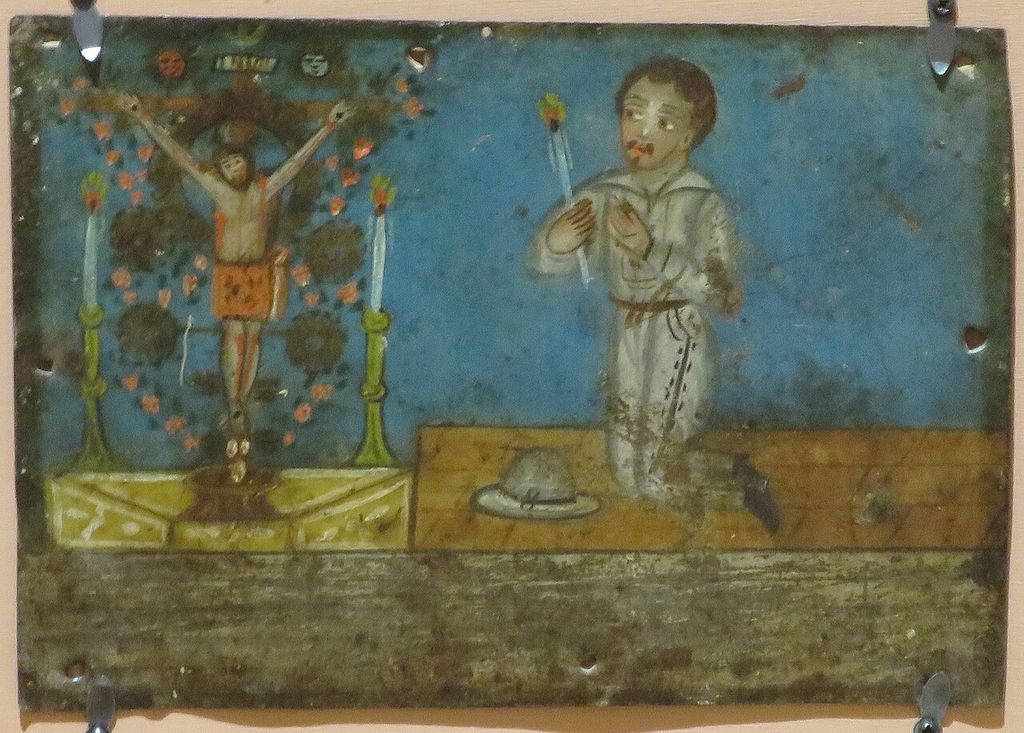
The work is therefore neither a conventional votive thanks nor simply a factual illustration of a newspaper report. Its exact name, date and place give the event documentary specificity, while the repeated figure, radically compressed scale and blood crossing the frame are constructed visual choices. The Museum of Fine Arts, Boston placed the painting among devotional ex-votos in its 2019 Frida Kahlo and Arte Popular exhibition, a curatorial comparison that sharpens the difference between its memorial offering and a traditional account of rescue. [3] [4] [11] [30]
Irene Zoe Alameda reads the three positions and the inscribed lower band as concrete narration rather than a dream image. Her Spanish-language argument does not make the scene a literal frame-by-frame record; it helps explain how the painting can be visually strange yet narratively exact about whom it commemorates. Kahlo’s letters, with their questions about windows, distance and spacing, make that distinction more than a matter of style labels. [5] [6] [12]
Space Fashion and the Limits of a Style Label
The three positions enlarge as they descend, from a dark mark near the building to a full-length falling figure and then a body that occupies much of the lower width. Kahlo’s letters show her working on precisely the problems of distance and proportion that this telescoping creates. Sanford Schwartz’s Spanish translation attends to the small panel’s ambitious scale shift and to the foot seeming to cross the inscription, while Gregory reads the painted frame as a boundary the clouds and blood refuse to respect. [3] [4] [5] [6] [13]
Gregory also asks what Hale’s dress and corsage do in an image of violent death. Her reading connects the composed, fashionable presentation of the lower figure with Hale’s public image and the contemporary press’s attention to social appearance; the red marks that cross the frame disturb that composure. The dark sleeveless dress and pale flowers are visible, but its maker, exact identity and occasion have not been established, so the painting cannot be used as a costume inventory. [3] [4]
The low brown-grey field does not unequivocally identify a pavement, stage or grave. Gregory notes those possible readings, which depend on the viewer’s interpretation of a deliberately shallow space. Calling the painting Surrealist can describe part of its exhibition reception—it appeared in LACMA’s In Wonderland—but it should not erase Kahlo’s documented calculation of windows, figures and distance or reduce the death to a private dream. [3] [4] [5] [6] [15]
A later interpretation discussed by Gregory relates the picture to Kahlo’s own reported thoughts of suicide. That is an attributed critical position, not a statement by Kahlo that she used Hale to portray herself, and no inspected document establishes it as the motive for this commission. The work names Hale and locates her death with unusual precision; a reading centred only on Kahlo’s psychology would obscure that explicit subject. [4] [26]
From Luce to Phoenix
Gregory reports delivery to Luce in summer 1939, but an exact delivery date, invoice and payment record have not been found. Later accounts describe temporary custody by Vanity Fair editor Frank Crowninshield; that story may concern where the painting was kept, yet it is not an inspected legal-provenance chain. Tate’s current record gives the firmer sequence: Luce commissioned it in 1938, and Phoenix Art Museum acquired it directly from Clare and Henry R. Luce on 1 January 1960. [2] [4] [18]
Phoenix’s public caption calls the work a gift of an anonymous donor. That caption can coexist with Tate’s more explicit account of the transfer, but it should not be used to replace the named Luce provenance or to invent a missing intermediary. An accession number reported in a retired third-party object route remains unconfirmed in the current owner record and is not needed to identify the painting. [1] [2]
Phoenix says that, of more than 20,000 works in its collection, this is the one most frequently requested for loan. That is a measure of institutional borrowing demand, not proof that it is the museum’s most viewed picture or that it is on display in Phoenix at any given moment. Its movement into a public collection also changed the audience for an object first conceived as a memorial within Hale’s social circle. [1] [2]
Selected Exhibitions and Changing Reception
The documented exhibition trail is international but incomplete. MoMA's 1993 Latin American Artists of the Twentieth Century checklist records the painting and gives dimensions smaller than Tate’s current measurement; neither source explains whether one figure excludes the frame. Separately, Mexican newspaper coverage documents a Phoenix loan shown in an acrylic case in a 2007 centenary exhibition, while LACMA’s In Wonderland checklist places the work in gallery seven among Surrealist women artists in Mexico and the United States. [2] [14] [15] [24]
The Fine Arts Museums of San Francisco included it in Frida Kahlo: Appearances Can Be Deceiving, with parallel English and Spanish interpretation that describes its ex-voto form. In Boston, the Museum of Fine Arts showed it among nineteenth- and twentieth-century ex-votos from 27 February to 19 June 2019; the Virginia Museum of Fine Arts presented it in Frida: Beyond the Myth in Richmond from 5 April to 28 September 2025, placing contemporary death reporting beside the object. These displays frame the painting through dress, memorial form, folk art and the press without resolving the disputed commission or alteration documents. [8] [9] [30]
Tate’s Frida: The Making of an Icon lists the object for its exhibition dated 25 June 2026 to 3 January 2027. The current loan record establishes its inclusion in the list, but a live display claim would require a separate check of the gallery or lender status. Phoenix’s complete loan history, as distinct from these selected appearances, has not been inspected. [2] [16]
Phoenix’s 2018 In the Company of Women release asks viewers to recognise a woman in acute physical and psychological pain. That is a curatorial reading of the painting, not access to Hale’s final experience or a diagnosis. Across these exhibitions, the work has served several frameworks—Surrealism, dress and public identity, modern myth and memorial—without any one of them exhausting its named, dated account of Hale. [4] [8] [9] [15] [17]
Further Reading and Open Questions
The most useful next book for object-specific questions is Luis-Martín Lozano, Andrea Kettenmann and Marina Vázquez Ramos’s 624-page Frida Kahlo: The Complete Paintings. Its publisher record is available, but its entry for this painting has not been read; a catalogue number, complete exhibition history or technical conclusion must not be inferred from the title. Gannit Ankori’s Frida Kahlo is a relevant critical biography, and the 2026 Tate exhibition catalogue is a likely source for current reception, but neither complete volume has been read here. [16] [25] [27]
The present account rests more directly on Gregory’s full peer-reviewed article, the museum records, the observed institutional image and published excerpts of Kahlo’s Spanish letters. Exact follow-up targets include the Casa Azul originals and any drawing, the Luce–Muray correspondence and related art files in the Library of Congress Clare Boothe Luce papers, the Ann Brokaw diary and Phoenix’s object and conservation records. The Library of Congress finding aid identifies two Kahlo folders in box 41 and three Phoenix Art Museum folders in box 38, but does not disclose the content of those uninspected files. [3] [4] [5] [6] [19] [20] [21]
Original October 1938 New York newspaper clippings and the complete university scan would help separate contemporary reporting from later stories about Hale’s motives. Herrera’s relevant biography pages, Morris’s documentary citations, Misemer’s interpretation and Orianna Baddeley’s dress analysis also have not been consulted directly where Gregory's account supplies their arguments. These gaps limit certainty on the commission’s first proposal, the altered lettering and Hale’s press image; they do not require those questions to be answered falsely. [4] [18] [19] [22] [26]
Phoenix's record and institutional photograph support the account of the painting's present collection and visible design, but not a complete technical or conservation history. [1] [3] [28]
Questions About the Painting
Kahlo was planning the composition by 5 December 1938 and still working on it on 9 January 1939; Gregory reports delivery in summer 1939. Phoenix dates the work 1939 and Tate 1938, so “1938–39” explains the process more responsibly than treating either institutional date as the only possible one. The place of final completion has not been established. [1] [2] [4] [5] [6]
Clare Boothe Luce commissioned the work in 1938. The original inscription offered it to Hale’s mother, but later accounts disagree about who proposed the commission and whether Luce asked for a portrait or a narrative memorial. Neither the actual delivery to Hale’s mother nor her status at the time has been verified. [2] [4] [18] [19]
Luce requested that identifying names be covered, and the present painting no longer names her. A diary reported Noguchi’s involvement, but Hale’s name survives despite the diary’s wording, and Noguchi later denied altering the work. The alteration’s maker and exact method remain open pending original correspondence and technical records. [3] [4] [19] [20] [29]
Phoenix Art Museum owns it, having acquired it from Clare and Henry R. Luce in 1960. It is frequently requested for loan and is listed in Tate’s 2026–27 exhibition records, but those facts do not establish its live location on a given day. A museum visit should be checked against the current display notice before travelling. [1] [2] [16]
The painting’s exact dates and names give Hale a place in its memorial account, while its repeated figure and unsettled frame make that account difficult to view as consolation. The surviving dedication also records a history of contested control: Luce commissioned the work, requested a change, and eventually transferred it to a museum, but the image continues to identify Hale. Its force lies in that tension between a named person, a constructed visual narrative and the attempt to revise who could be named alongside her. [1] [2] [3] [4] [19]
Related Reading
The Frida Kahlo overview places the New York months in her wider career. The style and Surrealism study explores a debate this memorial tests in a specific case. [5] [6] [7] [15]
Discussion
Use the cited evidence and your own close looking to explain your view. The prompts below are starting points, not fixed interpretations.
Reader Insights
How do the repeated figure and painted frame complicate a conventional memorial?
Which elements of Hale's life are documented independently of Kahlo's image and later headlines?
How did Luce's response and the altered inscription change the object's history?
Join the Conversation
Which reading best fits the evidence, and where does uncertainty remain?
References
- Phoenix Art Museum, Frida Kahlo artist and object record, caption for El suicidio de Dorothy Hale and paragraph on loan requests; English and Spanish owner captions checked. View source text.
- Tate, Frida: The Making of an Icon immunity-from-seizure list, object X102248: title, medium, 584 × 495 mm, 1938 commission and 1 January 1960 acquisition. Its inscription transcription says 1933, in conflict with the visible 1938. View source text.
- Phoenix Art Museum, Frida Kahlo artist and object record, institutional image of The Suicide of Dorothy Hale consulted for the painting's visible design. The photograph does not establish condition, reverse details or Kahlo's intentions. View source text.
- Fiona Gregory, “Death, Fashion, and Feeling: Reading around The Suicide of Dorothy Hale (1939),” Affirmations: of the modern 1, no. 2 (2014): 39–55, especially pp. 39–43 and 47–49 and notes. Complete article read; journal record and Monash author record. View source text 1; View source text 2.
- Alicia Azuela de la Cueva, “Diego y Frida. La invención de una imagen”, complete ten-page paper, pp. 6–7 for the Spanish excerpt of Kahlo’s 5 December 1938 letter to Rivera. The Casa Azul original was not inspected. View source text.
- Nuria Rodríguez Calatayud, Archivo y memoria femenina: Los textos de la mujer artista durante las primeras vanguardias (1900–1945) (doctoral thesis, Universitat Politècnica de València, 2007), printed p. 470/PDF p. 469, transcribing Kahlo’s 9 January 1939 letter through Raquel Tibol. The original letter and exact anthology page remain uninspected. View source text.
- Museo Frida Kahlo, artist chronology, 1938–39 entries for Kahlo’s New York stay, letters and the painting. The chronology’s commission phrasing is one account, not a settlement of disputed origin stories. View source text.
- Fine Arts Museums of San Francisco, Frida Kahlo: Appearances Can Be Deceiving exhibition labels, English and Spanish entries for The Suicide of Dorothy Hale, 1938–39. View source text.
- Virginia Museum of Fine Arts, Frida: Beyond the Myth large-print bilingual guide, Hale painting and contemporary-press context; relationship explanations are reported as rumours. View source text.
- U.S. House of Representatives, Clare Boothe Luce biography, editorial, literary and later public-service chronology. View source text.
- Museo Frida Kahlo, museum and ex-voto collection account, description of the large Kahlo–Rivera ex-voto collection and votive form. Public totals vary, so no precise count is used. View source text.
- Irene Zoe Alameda, “Frida Kahlo: La frente y el perfil”, Arte y Parte 57 (2005), paragraph on the three-position narrative and inscribed band. The formal reading is attributed. View source text.
- Sanford Schwartz, “El valor de Frida Kahlo”, Letras Libres (July 2008), printed pp. 28–29 for scale, building, frame and projecting foot; Spanish translation of a critical essay. View source text.
- Museum of Modern Art, Latin American Artists of the Twentieth Century master checklist (1993), PDF p. 13, El suicidio de Dorothy Hale, 1938–39, oil on Masonite, 20 × 16 inches. The record does not specify whether this measurement includes the frame. View source text.
- Los Angeles County Museum of Art, In Wonderland press kit and official checklist, gallery 7 entry for the Phoenix painting. View source text.
- Tate, Frida: The Making of an Icon exhibition and catalogue records, scheduled 25 June 2026–3 January 2027; the 224-page catalogue by Beatriz García-Velasco and Tobias Ostrander, ISBN 9781917055307, remains unread. View source text.
- Phoenix Art Museum, In the Company of Women press release, 8 June 2018, object paragraph and 7 July–12 August 2018 exhibition dates. Its account of pain is curatorial reception, not biographical diagnosis. View source text.
- Hayden Herrera, Frida: A Biography of Frida Kahlo, pp. 290–93 and 478, commission, reaction and Crowninshield story as routed through Gregory’s article. These pages and the complete commercial book have not been consulted directly; Gregory's article supplies the mediated account.
- Sylvia Jukes Morris, Rage for Fame: The Ascent of Clare Boothe Luce, pp. 237 and 330, Luce-to-Muray letter and Brokaw diary as quoted and cited by Gregory. The original documents and full book pages have not been consulted directly.
- Clare Boothe Luce to Nickolas Muray, 1939 letter; Ann Brokaw diary, 12 September 1939; and Isamu Noguchi’s later denial, all read through Gregory, pp. 41–42 and notes, with Morris pp. 237 and 330 as her documentary route. These mediated, conflicting records do not identify the alterer conclusively.
- Library of Congress, Clare Boothe Luce Papers finding aid, pp. 21–22: box 38 Phoenix Art Museum folders and box 41 Kahlo folders; correspondent index on p. 1. The folders were not inspected. View source text.
- Daily Iowan, 22 October 1938, p. 1, contemporary report of Hale’s death. The institutional scan and indexed text were checked, but a complete high-resolution transcription was not made. View source text.
- Loreley Gaffoglio, “El archivo secreto de Frida y Diego”, La Nación, 8 October 2007, reporting an additional letter and drawn composition without reproducing the complete dated original. View source text.
- “Desde hoy se abren las puertas a todo el universo de Frida Kahlo”, La Jornada, 13 June 2007, report of the Phoenix loan and acrylic-case display in Mexico. View source text.
- Luis-Martín Lozano, Andrea Kettenmann and Marina Vázquez Ramos, Frida Kahlo: The Complete Paintings (TASCHEN), publisher record, 624 pages, English ISBN 9783836574204. The book and this painting’s entry have not been read. View source text.
- Sarah M. Misemer, Secular Saints: Performing Frida Kahlo, Carlos Gardel, Eva Perón, and Selena, pp. 27 and 34, interpretive position reported through Gregory; complete book and exact pages not independently read.
- Gannit Ankori, Frida Kahlo (Reaktion Books, Critical Lives), publisher record. The full critical biography has not been read for this page. View source text.
- Phoenix Art Museum, official object presentation, image and caption for The Suicide of Dorothy Hale. The institutional page offers an independent view; citation of it does not confer publication rights for the image. View source text.
- Tate Shop, The Suicide of Dorothy Hale artwork text associated with the 2026 exhibition. Its Noguchi attribution conflicts with the denial reported by Gregory and does not settle who altered the inscription. View source text.
- Museum of Fine Arts, Boston, “First-Ever Frida Kahlo Exhibition at MFA Boston Explores Artist’s Lasting Engagement with Traditional Mexican Folk Art”, 25 January 2019, especially “Painted Miracles / Milagros Pintados” at lines 26–31. The official release places the painting among ex-votos in the 27 February–19 June 2019 exhibition; it is exhibition and curatorial evidence, not proof of Kahlo’s specific intent. View source text.
- Museo Frida Kahlo, Frida interactive chronology, selected work dates used for the comparison timeline. The current work's date follows its cited object record. View source text.
Image Credits
- Anonymous Unknown author , Mexican painter. Public domain. Source: Wikimedia Commons (File:Anonymous Mexican ex-voto, El Paso Museum of Art 2007.5.8.JPG). 1024px proportional sRGB JPG derivative; no crop. Licence. Source record.
