


 by Tom Gurney
Tom Gurney BSc (Hons) is an art history expert with over 20 years experience
Page created on March 2, 2018 / Page updated on October 6, 2026
Email: tomgurney1@gmail.com / Phone: +44 7429 011000
Introduction
Three prickly pears sit on a white plate in Frida Kahlo's Naturaleza muerta con tunas, or Still Life with Prickly Pear Fruit. One is pale and apparently whole; the two in front have exposed, increasingly red surfaces. Small red-orange marks cross from the plate onto the blue fabric beneath it, making an ordinary arrangement of food unexpectedly difficult to contain in a simple description. [1] [2]
The work is often called Tunas or Cactus Fruits. Tate's 2026 exhibition label dates it to 1938, but two substantial catalogues give 1937. The disagreement matters especially when writers propose that Kahlo painted it alongside Memory (The Heart): visual kinship is observable, but simultaneous production is not established. [1] [3] [4]
At a Glance
- Artist and title: Frida Kahlo, Naturaleza muerta con tunas / Still Life with Prickly Pear Fruit; also Tunas and Cactus Fruits. [1] [3] [4]
- Date: 1938 in Tate's current label and several other records; also catalogued as 1937 by Ivanna Margarucci and Maggie Borowitz. No inscription or primary dating document available here resolves the difference. [1] [3] [4] [5]
- Material and size: Oil paint on tin plate according to Tate; older sources say oil on metal. Margarucci and Borowitz give 20 × 24 cm; a reported 2022 exhibition label gives 7.75 × 9.75 inches, approximately 19.7 × 24.8 cm. [1] [3] [4] [6]
- Collection and display: U.S. private collection, according to Tate; listed for Tate’s Frida: The Making of an Icon through 3 January 2027. Individual display may change. [1] [7]
Contents
- Introduction
- Looking Closely at the Plate and Fruit
- What Does Tunas Mean?
- Hearts, Wounds and the Limits of a Metaphor
- A Date and Collection History That Do Not Quite Align
- Display, Dreams and Recent Reception
- Books and What Remains to Be Checked
- Related Reading
Looking Closely at the Plate and Fruit
The small picture is horizontal, its plate occupying most of the frame. Two green rings hold the plate's white interior against a mottled blue-grey setting, while soft folds gather around its lower edge. Above the plate, the field looks almost cloudy, but no horizon fixes it as a sky or separates it cleanly from the fabric below. [2] [4]
The three fruits make an uneven triangle rather than a tidy row. A yellow-green fruit stands behind the others, near the centre; at left, a shorter orange-red fruit lies diagonally, interrupted by pale, opened-looking patches. The right-hand fruit is larger, more intensely red and more extensively split or peeled-looking, with an irregular lobe extending toward the edge of the plate. [2]
These distinctions are visible, but the reproduction cannot establish precisely how each fruit was cut or peeled. Nor can it show whether the granular-looking parts of the red fruit are seeds, rind, shadow or painted texture. The work's title and repeated object descriptions identify prickly pears; the small image alone could not securely identify a species or cultivar. [1] [2] [8]
Red-orange smears appear on the plate in front of the right fruit. Similar marks reach the fabric below, crossing the otherwise emphatic boundary of the green rim. They look like fruit juice in the context of this still life, but the first observable fact is the placement of painted colour, not an event of cutting, dripping or injury that a viewer can reconstruct. [2]
The arrangement sets firm curves against unstable organic edges. The plate's repeated green arcs and shallow grey shadows give it a plausible volume; the fruit is modelled and overlapped, yet the surrounding space remains compressed and oddly open. This visual tension helps explain why the painting can be received as both a close study of ordinary food and something more unsettling. [2] [4]
Look again at the lower edge: the cloth's pale folds move in from the left and seem to gather under the heavy oval, while the warm stains move away toward the right. The picture does not show a knife, hand or person who prepared the fruits. It offers the consequences of an action without the action itself, leaving the cuts and marks to animate an otherwise stationary arrangement. [2] [4]
Watch: Frida Kahlo
Five perspectives to view here alongside the article.
Frida Kahlo’s The Two Fridas: Great Art Explained
A focused visual introduction to the painting and its context.
What Does Tunas Mean?
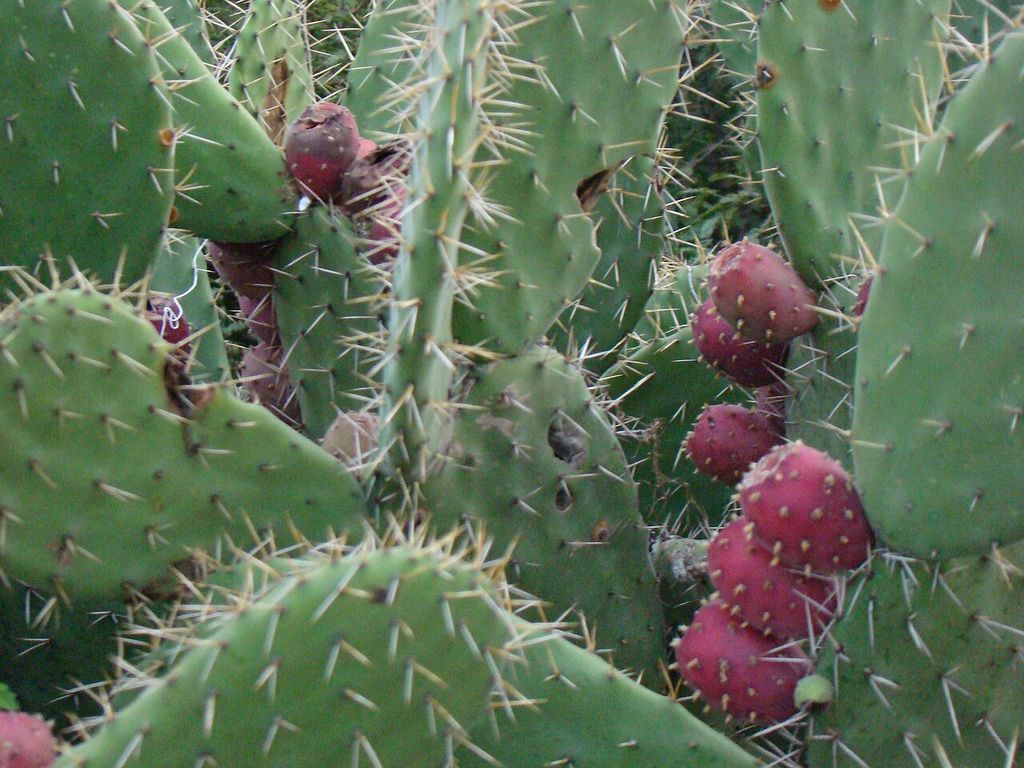
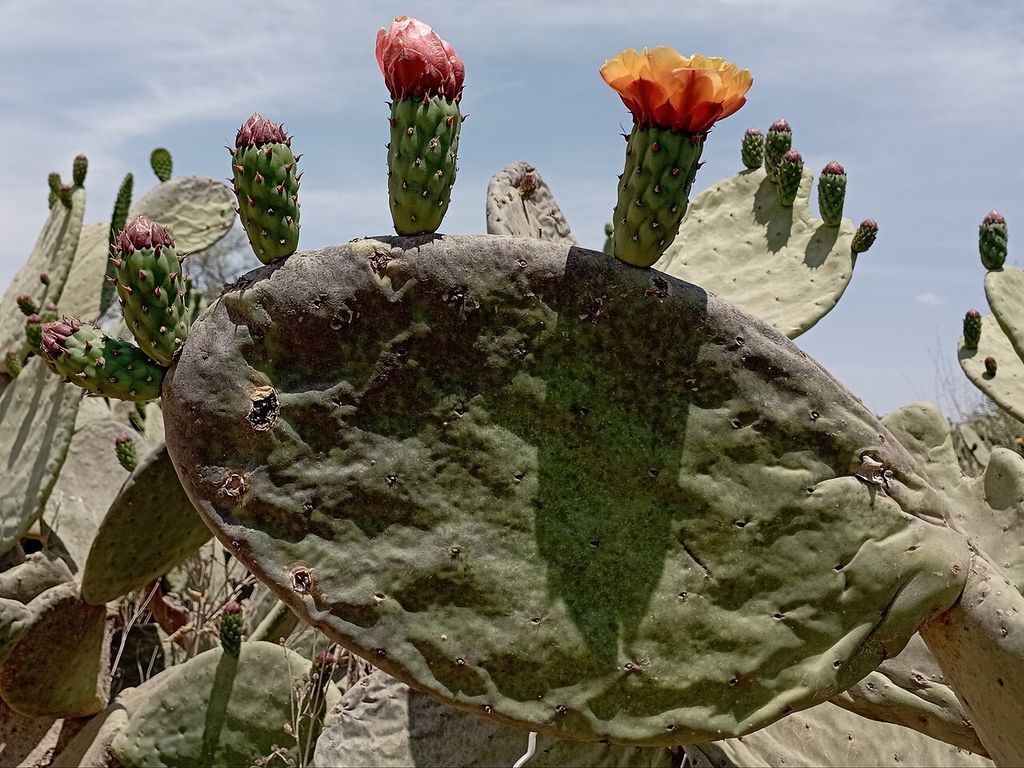
Here tunas means the fruits of a nopal, or prickly-pear cactus, not the English fish name. Mexico's biodiversity agency CONABIO distinguishes the juicy, seed-filled tuna from the more acidic xoconostle and describes considerable diversity within Opuntia. The Spanish plural also matters: there are three fruits, even though Tate's English title uses “Fruit” collectively. [1] [8]
The different colours invite a story about time. Borowitz describes the rear fruit as least ripe, the left one as intermediate and the red right-hand one as nearly overripe; an account of the Dalí Museum's display likewise describes three stages. [4] [6] Their reading follows the progression of colour and exposure across the plate, but it should not be offered as a botanical diagnosis.
Official Mexican agricultural information records naturally red, green, white and yellow tunas, with different varieties and maturation patterns. [9] Without a known species, cultivar or specimen, colour alone cannot prove that these three fruits came from one plant or represent successive stages of a single variety. Kahlo's arrangement suggests transformation without obliging the viewer to treat it as a scientifically ordered sequence. [2] [8] [9]
Victor Zamudio-Taylor offers another way into Kahlo's still lifes. In a PBS interview, he describes the detailed cactus fruits, papayas and watermelons as ordinary Mexican-market objects whose enlargement and close attention can become marvellous, even sensual; he resists using that effect alone to classify Kahlo as a Surrealist. [10] The market connection is his curatorial account, not an artist statement documenting where this plate of fruit was bought or painted.
The market reading keeps the fruit familiar, but no stall, basket, seller or place name appears in the painting. The white plate instead moves the food into a domestic register, where it is set out for looking rather than shown growing on a nopal. [2] [10] Kahlo's close framing gives small, everyday things the scale of a whole pictorial world without requiring them to cease being food.
Cactus Fruits in Kahlo’s career
Timeline source: Museo Frida Kahlo chronology [27].
Hearts, Wounds and the Limits of a Metaphor
The right fruit's open red form and the stains below it have repeatedly prompted bodily language. Delfina Cabrera compares two half-cut fruits opening like a heart, while Margarucci describes the cut fruit as resembling Kahlo's bleeding wounds. [3] [11] A recent reviewer likewise imagines organs on a domestic plate and the folds beneath them as waves. [12] These are different acts of interpretation, not three pieces of evidence that a literal heart appears in the picture.
Borowitz gives the comparison a more sustained basis by placing Tunas beside Kahlo's 1937 Memory (The Heart). She notes related pale blues, green accents, concentrated reds and rippling lower spaces, and transmits Salomon Grimberg's proposal that the two paintings may be companion pieces. In Memory, an anatomical heart and streams of blood are directly represented; here there are fruits, a plate and red juice-like marks. [4] [13]
That distinction makes the analogy more, rather than less, interesting. A viewer can recognise how colour and composition recall the other painting without changing this one into a disguised self-portrait. Grimberg's exact discussion on pages 50–52 of his specialist still-life book has not yet been read here, and Borowitz's suggestion of simultaneous work assumes the 1937 dating that Tate's current 1938 label disputes. [1] [4] [14]
There is also a historically specific Mexican context for the fruit-heart resemblance. The Museo Nacional de Antropología explains a Mexica account in which a nopal grows from Cópil's heart and describes tunas represented as hearts on the Teocalli de la Guerra Sagrada. [15] That institutional record establishes an older cultural association, but no letter, preparatory drawing or statement found for this painting shows Kahlo deliberately citing the myth or the monument.
The Mexica association should not be turned into a universal key for every red prickly pear in Mexican painting. The museum's account concerns particular narratives and objects; Kahlo's work presents a plate of fruit without an accompanying inscription identifying either Cópil or the Teocalli. [2] [15] The comparison enriches the heart reading by giving it a precise historical context, while preserving the gap between cultural availability and demonstrated intention.
Cabrera, drawing on Nancy Deffebach's still-life scholarship, warns that accounts focused on Kahlo's marriage or physical suffering can eclipse the specificity of her pictures. [11] That caution need not erase the red fruit's bodily resonance; it requires the claim to start from the visible cuts, colour and smears, to name its interpreter and to stop short of assigning a particular accident, operation or emotional crisis. The picture remains a still life even when it becomes a powerful vehicle for thinking about a body.
A Date and Collection History That Do Not Quite Align
Tate's current label calls the work Naturaleza muerta con tunas / Still Life with Prickly Pear Fruit, dates it 1938 and specifies oil paint on tin plate. [1] The 1938 date also appears in a 2005 PBS/WETA list, Cabrera's 2020 discussion and the reported 2022 Dalí label. [5] [6] [11] These sources do not disclose an original inscription or a full dating argument, but the present exhibition host gives a sound reason to lead with 1938.
Margarucci's Spanish-language catalogue and Borowitz's dissertation instead print 1937, oil on metal and 20 × 24 cm. [3] [4] “Metal” is broader than “tin plate” and need not indicate another work, whereas the difference in year should be shown openly. Averaging the two dates into an unsupported “1937–38” would conceal the actual catalogue disagreement rather than explain it.
The metal support is a material fact, not a ready-made genre label. Kahlo used small metal surfaces in works that critics sometimes relate to Mexican retablos and ex-votos, but this still life has no painted saint, supplicant, miraculous rescue or narrative inscription. [1] [2] [10] The available image and catalogue records do not show why she chose this particular sheet or how it was prepared, so the support cannot by itself explain the painting's meaning or technique.
Measurements also deserve their own small qualification. The reported Dalí label's 7.75 × 9.75 inches converts to approximately 19.7 × 24.8 cm, close to but not identical with the repeated 20 × 24 cm metric entry. [3] [4] [6] No owner's remeasurement or registrar sheet has been inspected, so neither figure should be silently “corrected” to the other.
The ownership credits have changed over time. PBS, Margarucci and Borowitz associate the picture with the Robert Holmes à Court or Robert Holmes collection in Perth, Australia; the 2022 Dalí report and Tate's 2026 guide instead identify an unnamed private collection in the United States. [1] [3] [4] [5] [6] Mary-Anne Martin Fine Art presented the picture at a 2022 art fair, and Tate includes a Pablo Goebel Fine Arts courtesy credit, but neither dealer mention proves a sale, transfer or beneficial ownership. [1] [16]
The work is distinct from two other Kahlo fruit paintings that generic English labels might confuse with it. Pitahayas presents five dragon-fruit forms and a small skeleton on a different support; Los frutos de la tierra has its own collection and Paris exhibition history. [17] A shared year, fruit subject or red colour cannot carry one object's provenance or measurements onto another.
Display, Dreams and Recent Reception
The earliest item-specific public display secured in the available records is the Art Dealers Association of America's 2022 Art Show in New York. Its official release names Mary-Anne Martin Fine Art's presentation of Tunas (Still Life with Prickly Pear Fruit) and a Best in Show Object award. [16] This documents an exhibition and a fair's judgment, not the painting's first-ever showing or a transaction.
The Dalí Museum's The Shape of Dreams ran from November 2022 to April 2023. A contemporary report identifies the painting, gives the private-US credit and says the original arrived shortly before opening after a reproduction had initially been planned. [6] [18] The museum's dream theme offers one way to view fruit that seems to change into bodily matter, but inclusion in that exhibition does not establish that Kahlo painted a dream. [10] [18]
Tate's 2026 guide supplies an exact object label in a different setting. [1] In a critical review of the wider show, Robin Simon nonetheless singled this picture out as a “lovely little still life”; another reviewer found spliced organs and bleeding in the same small composition. [12] [19] Such divergent responses are useful evidence of reception, not a vote that settles what Kahlo meant.
An earlier lifetime exhibition is possible, but the exact Tunas line in the 1938 Julien Levy checklist has not been read. A later Parrish Art Museum checklist documents a facsimile of that catalogue's cover, while Christie's identifies Survivor as a numbered work in the show; neither source places Tunas there. [20] [25] [26] The three recent item-level appearances are therefore a selected history, not a complete provenance or exhibition chronology.
Books and What Remains to Be Checked
Salomon Grimberg's Frida Kahlo: The Still Lifes is the priority specialist book for this picture, particularly the pages Borowitz cites for the Memory (The Heart) comparison. Deffebach's chapter “Picantes pero sabrosas” offers a different, methodological account of Kahlo's still lifes; Cabrera's open essay allows its critical relevance to be reported, but not its unread pages to be quoted as firsthand research. [11] [14] [21]
The exact Tunas entry in Lozano, Kettenmann and Vázquez Ramos's Frida Kahlo: The Complete Paintings, Grimberg's separate journal article and the 2026 Tate/Yale exhibition catalogue have not been consulted. [22] [23] Those complete books have not been read. These books may sharpen the date, caption, exhibition and provenance questions, but their unavailable entries cannot be used to fill them by guesswork.
An owner or museum registrar record, authorised photographs of the front and reverse, a reliable inscription transcription and a conservation study would be especially valuable. [24] The accessible 400-pixel image supports composition and broad colour, not conclusions about brushwork, pigments, corrosion, condition or the physical tin plate. The limits are part of the object story: they tell a reader which parts can currently be seen, which have been documented and which are still interpretation. [2]
Related Reading
Memory (The Heart) provides the documented comparison for the heart analogy without making the two pictures one work. Pitahayas and Fruits of the Earth have separate materials, collections and histories despite their fruit subjects.
Frequently Asked Questions
Yes. The titles are English and Spanish variants attached to the same three-fruit painting. Tate's current bilingual label uses Naturaleza muerta con tunas / Still Life with Prickly Pear Fruit. [1] [3] [4]
Tate and several other sources date it 1938, while Margarucci and Borowitz give 1937. The present evidence does not establish why the records differ, so both should remain visible. [1] [3] [4] [5]
Scholars and reviewers have made those comparisons, and the cuts and red smears help explain them. There is no known artist statement tying this picture to a particular heart, injury or operation; the fruits remain recognisable as fruit. [2] [3] [4] [11]
Discussion
Use the cited evidence and your own close looking to explain your view. The prompts below are starting points, not fixed interpretations.
Reader Insights
How do the cut fruits invite, but not compel, a wounded-heart metaphor?
What does *tunas* name in this painting?
Why do the 1937 and 1938 dates remain a genuine catalogue conflict?
Join the Conversation
Which reading best fits the evidence, and where does uncertainty remain?
References
- Tate Modern, Frida: The Making of an Icon large-print guide (2026), physical and printed p.52, Naturaleza muerta con tunas / Still Life with Prickly Pear Fruit, 1938, oil paint on tin plate, private collection USA, courtesy Pablo Goebel Fine Arts. The original Tate large-print guide supplies the item-level label. View source text.
- Editorial close-looking of Tate Modern's 2026 guide, printed p.52, and the Museo Roca plate, physical p.76. These reproductions support visible forms, not physical condition or publication rights. View source text 1; View source text 2.
- Ivanna Margarucci, Frida Kahlo: una vida a través del arte, Museo Roca (2016), physical p.76, entry 085: Tunas, 1937, oil on metal, 20 × 24 cm, historical Perth credit and wound analogy. View source text.
- Maggie Borowitz, Caught by Surprise: Affect and Feminist Politics in the Art of Magali Lara, University of Chicago PhD dissertation (2022), physical p.10 fig.4.15 and physical pp.180–182 / printed pp.165–167: 1937 metadata, historical collection credit, close reading and mediated Grimberg comparison. View source text.
- PBS/WETA, Where to Find Frida's Paintings and Spanish list (2005), Tunas row, 1938 and Robert Holmes à Court collection, Perth. The bilingual rows are one publisher's records, not independent witnesses. View source text 1; View source text 2.
- Creative Pinellas, “The Art of Dreaming”, 2022, item report and Dalí label quoted at lines 62–68: 1938, oil on tin, 7.75 × 9.75 inches, private collection USA, reported late arrival of original and three-stage reading. Not an owner registrar sheet. View source text.
- Tate, Frida: The Making of an Icon, announced 25 June 2026–3 January 2027, read with guide p.52. Event dates do not guarantee daily presence of an individual loan. View source text.
- CONABIO, “Nopales”, especially the section defining tuna and distinguishing xoconostle; the page explains Opuntia diversity and taxonomic complexity, not the exact painted species. View source text.
- Secretaría de Agricultura y Desarrollo Rural, “Como la tuna ninguna”, 5 August 2018, red, green, white and yellow varieties and different maturation patterns. View source text.
- PBS/WETA, interview with Victor Zamudio-Taylor, relevant still-life passage, lines 51–53 in saved extraction; attributed curator interpretation, not Kahlo testimony. View source text.
- Delfina Cabrera, “Confined Weathers”, Cultural Inquiry 17 (2020), printed pp.300–301, heart analogy and critique of biographical over-reading, partly in dialogue with Deffebach. View source text.
- M—A, “Frida Kahlo: A Space Between Hearing and Seeing”, relevant 2026 Tunas passage, lines 102–115 in saved extraction; poetic review rather than technical documentation. View source text.
- Tate's Memory (The Heart) object record identifies the separate comparison painting. Its object data, owner and exhibition history do not transfer to Tunas. View source text.
- Salomon Grimberg, Frida Kahlo: The Still Lifes (Merrell, 2008), ISBN 9781858944371, pp.50–52 identified by Borowitz; the book itself has not been read. Borowitz's original dissertation, printed pp.165–167, is the inspected source for this locator; the Grimberg edition record does not make his unread pages available. View source text 1; View source text 2.
- Museo Nacional de Antropología / INAH, stone-heart feature, account of Cópil and the Teocalli's tuna-heart imagery. This is bounded cultural context, not evidence of Kahlo's intention. View source text.
- Art Dealers Association of America, The Art Show 2022 end-of-fair release, physical p.2, Tunas item and Best in Show Object award; the release establishes fair presentation, not a sale. View source text.
- Editorial comparison of Tate's Tunas label, the Madison Museum's Pitahayas record and Fomento Cultural Banamex's collection record for the separate Fruits of the Earth. Similar fruit subjects do not make their objects interchangeable. View source text 1; View source text 2; View source text 3.
- The Dalí Museum, The Shape of Dreams, 25 November 2022–30 April 2023, exhibition context; this painting's item-specific inclusion and loan story are reported by reference 6. View source text.
- Robin Simon, “The cult of Kahlo”, The Spectator, 4 July 2026, item caption and brief positive assessment within a negative general review. View source text.
- Museo Frida Kahlo's 1938 chronology records the Julien Levy exhibition but does not provide an item list for Tunas. The Parrish checklist records a facsimile cover, and Christie's Survivor entry concerns another work; neither establishes Tunas' inclusion. View source text 1; View source text 2; View source text 3.
- Nancy Deffebach, María Izquierdo and Frida Kahlo: Challenging Visions in Modern Mexican Art (University of Texas Press, 2015), chapter 7, pp.135–148 identified from publisher contents; relevant pp.135–139 cited by Cabrera but not read directly here. View source text.
- Luis-Martín Lozano, Andrea Kettenmann and Marina Vázquez Ramos, Frida Kahlo: The Complete Paintings (TASCHEN, 2021), exact Tunas entry has not been consulted. View source text.
- Salomon Grimberg, “Frida Kahlo's Still Lifes: ‘I Paint Flowers So They Will Not Die’”, Woman's Art Journal 25, no.2 (Autumn 2004–Winter 2005), pp.25–30, DOI 10.2307/3566514; article unread. Beatriz Garcia-Velasco and Tobias Ostrander, Frida: The Making of an Icon (Tate/Yale, 2026), exact Tunas catalogue entry has not been consulted. View source text 1; View source text 2.
- Tate's 2026 label, the Museo Roca entry and Creative Pinellas's report give published material descriptions, not an owner conservation study. The complete book and catalogue entries identified in references 21–23 have not been consulted. View source text 1; View source text 2; View source text 3.
- Parrish Art Museum, Frida Kahlo: An Expanded Body checklist (2022), physical p.8, item 28, recording a facsimile cover of the 1938 Julien Levy exhibition catalogue in the Museo Frida Kahlo Archive; not its item list. View source text.
- Christie's, Survivor lot record, exhibition line and catalogue discussion, lines 25–30 in current web rendering: Survivor was no.25 in the 1938 Julien Levy show. This does not document Tunas' inclusion. View source text.
- Museo Frida Kahlo, Frida interactive chronology, selected work dates used for the comparison timeline. The current work's date follows its cited object record. View source text.
Image Credits
- Juan Carlos Fonseca Mata. CC BY-SA 4.0. Source: Wikimedia Commons (File:Nopal (Opuntia ficus-indica), flores.jpg). 1024px proportional sRGB JPG derivative; no crop. Licence. Source record.
- Slevinr. CC BY 3.0. Source: Wikimedia Commons (File:Nopal con tunas rojas.JPG). 1024px proportional sRGB JPG derivative; no crop. Licence. Source record.
