


 by Tom Gurney
Tom Gurney BSc (Hons) is an art history expert with over 20 years experience
Page created on March 2, 2018 / Page updated on October 6, 2026
Email: tomgurney1@gmail.com / Phone: +44 7429 011000
Introduction
In My Birth, Frida Kahlo places a delivery at the centre of a small, enclosed bedroom. A sheet hides the woman’s face and upper body while a large head emerges between her legs; above the bed hangs a Virgin of Sorrows, and below it a blank scroll waits for words that never appear. The painting’s force comes partly from what it shows without settling: neither person is named, and the visible blood does not establish who survives. [1] [2]
The work was made in 1932, the year of Kahlo’s pregnancy loss and her mother Matilde Calderón’s death. A reported 1939 interview connects the picture to Kahlo’s imagined birth and her mother’s death, although its original notes have not been inspected. Its changing exhibition titles and borrowed votive structure still make a richer account possible than treating either visible body or its fate as a settled biographical fact. [1] [3] [5] [26] [27]
At a Glance
- Work: My Birth; exhibited as Birth in New York in 1938 and Naissance in Paris in 1939.
- Date, medium and size: 1932; oil on metal; 30.5 × 35 centimetres (12 × 13¾ inches). The exact metal is not established.
- Catalogue location: “Private collection, United States” in Helga Prignitz-Poda’s 2022 published entry; current legal owner and physical display unverified.
- Visible structure: a covered upper body, exposed delivery and blood in a blue bedroom, a framed Mater Dolorosa above, and an empty scroll below.
- Materials and making: no cited conservation study establishes the metal's composition, pigments or making sequence. [1] [2] [17]
Contents
- Introduction
- An Unfinished Delivery in a Blue Room
- Why the Early Titles Matter
- A Votive Painting Without a Written Rescue
- The Events of 1932 and Their Limits
- The Mother and Child Are Not Named
- Medical Viewpoint and Feminist Readings
- The Disputed Tlazolteotl Comparison
- Early Exhibitions and Responses
An Unfinished Delivery in a Blue Room
The horizontal painting measures only 30.5 by 35 centimetres. Floorboards recede toward a blue wall with a darker lower band, enclosing a simple reddish-brown bed that fills most of the space. Pale linen and rose-coloured trim carry the eye from the headboard to the lower edge; these are approximate descriptions of a publisher’s colour reproduction, not technical findings about the original paint. [1] [2]
A woman lies on her back with her head, shoulders, chest and arms hidden under a gathered sheet. Her abdomen, pubic area and legs remain exposed, with knees raised and feet turned outward. The covering can suggest a shroud to a viewer, but the picture does not establish that it is funerary cloth or that the woman is dead. [1] [2]
Between the legs, an unusually large head and long neck protrude downward from the body. The face turns sideways, and blood marks the pale sheet beneath it. The image holds delivery at a threshold: it does not show a child safely apart from the mother, but neither does a still painting certify miscarriage, stillbirth, infant death or maternal death. [1] [2]
Above the bed, a small framed image presents a veiled sorrowful woman identified in the catalogue as the Mater Dolorosa, or Virgin of Sorrows. It remains a picture within the room rather than a figure appearing beside the bed, and no attendant, doctor or relative stands nearby. The lower edge carries a pale unfurled scroll whose central field has no visible name, date, prayer or account of the event. [1] [2]
The framed Virgin, covered head, opening of the body and emerging head form a compressed vertical line, while the bed, spread legs and scroll make strong horizontal bands. The viewer faces the birth from the foot of the bed, close to the exposed body. That position invites comparison with obstetric illustration, but no specific medical diagram has been identified as Kahlo’s source. [2] [5] [11]
Watch: Frida Kahlo
Five perspectives to view here alongside the article.
Frida Kahlo’s The Two Fridas: Great Art Explained
A focused visual introduction to the painting and its context.
My Birth in Kahlo’s career
Timeline source: Museo Frida Kahlo chronology [30].
Why the Early Titles Matter
Prignitz-Poda’s catalogue uses My Birth, but the accessible title history is less fixed. Eva Zetterman cites the 1938 Julien Levy Gallery catalogue’s Birth, number 17, and the 1939 Paris Mexique catalogue’s French Naissance, number 78. A letter Kahlo wrote in February 1940 calls the picture “Child birth” in the excerpt published by Anne Umland; the original exhibition leaves and complete letter have not been directly consulted, so the historical forms rest on the cited secondary excerpts. [1] [5] [9]
The earlier public titles name an event without assigning it unambiguously to one person. Zetterman argues that they open the image beyond an autobiography in paint, while Prignitz-Poda notes that no accessible early title calls it Miscarriage or Death of My Mother. Neither point prevents a personal reading, but it stops a later possessive title from becoming proof that both depicted bodies are identified. [1] [5]
Nickolas Muray photographed the painting in 1938, and George Eastman Museum catalogues his print under a “Child Birth” form with My Birth supplied in brackets. That institutional photograph confirms another route by which the work was documented in Kahlo’s circle, not who owned the painting then. The museum's indexed record documents the historical photograph but does not license its reproduction or that of the painting shown. [21]
A Votive Painting Without a Written Rescue
Kahlo collected hundreds of Mexican ex-votos, many on metal and concerned with illness, accidents, beds and women. The wider painted-votive tradition also extended through Catholic Europe and the Americas; it is not an exclusively Mexican formula. Such pictures often place a sacred helper above a worldly danger and add a written account of protection or thanksgiving beneath it. [1] [4] [5]
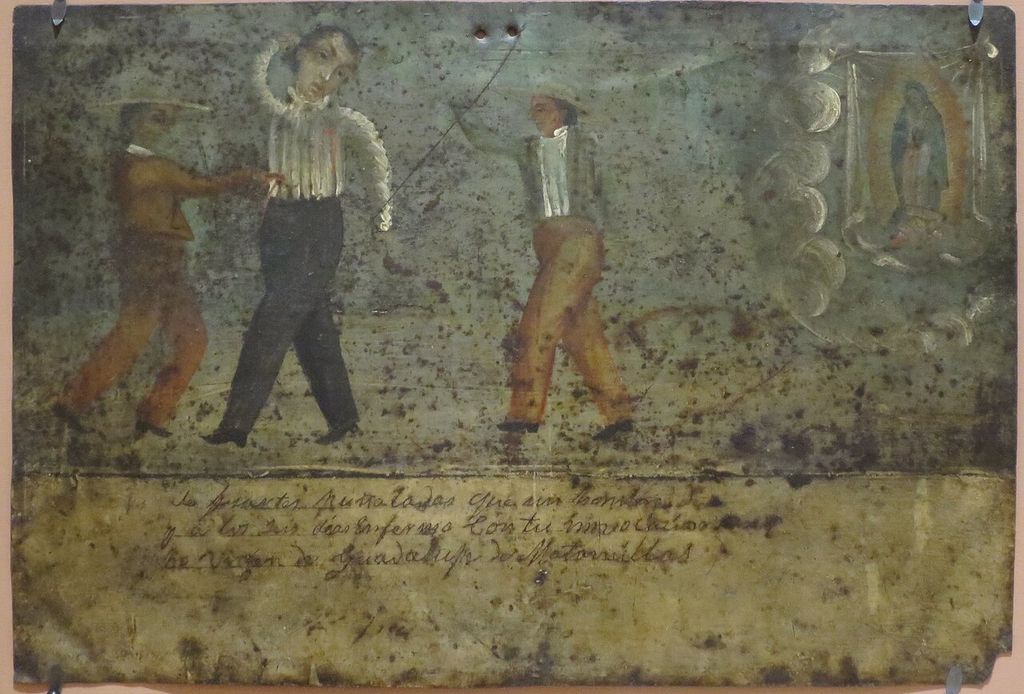
My Birth sets out those three registers—the Virgin, the dangerous bodily event and the lower text band—then alters their expected relationship. The Virgin is confined to a frame on the wall, no helper enters the room, and the scroll provides no named witness or grateful account. That formal withholding makes the blankness important; it does not reveal whether Kahlo intended to finish the text later or wanted viewers to understand a precise divine refusal. [1] [2] [5]
Prignitz-Poda compares the picture with ex-votos in which a covered mother, an attendant or a safely placed child helps make a fortunate ending legible. Here the mother’s face and upper body are hidden, the infant’s passage remains unfinished, and blood interrupts the pale linen. Her description of the woman as dead is an interpretation rather than a visual certainty, but the comparison explains why this image resists the customary closing sentence of a rescue story. [1] [2]
The framed Mater Dolorosa brings sorrow into the upper part of the room without stepping into the action. Scholars disagree even on the small image’s count of swords or daggers, and the available reproduction is too slight to decide it. What matters for this painting is the relation between a represented sacred witness and an exposed human body whose outcome the scroll declines to narrate. [1] [2] [5]
The reported Lesley interview adds a productive complication: Kahlo apparently described the Virgin as part of a remembered image rather than as a religious symbol she consciously installed. That artist-linked account does not erase the painting’s ex-voto structure or a viewer’s religious reading, but it cautions against presenting the framed Virgin as proof of Kahlo’s stated theology. The form and the reported intention should remain distinguishable. [1] [26] [27]
The Events of 1932 and Their Limits
Museo Frida Kahlo records that Kahlo and Rivera moved to Detroit in April 1932. Kahlo lost a pregnancy in July, and the museum associates that event with her painting Henry Ford Hospital. In September she travelled back to Mexico with Lucienne Bloch because her mother was ill; Matilde Calderón died on 15 September after complications following gallbladder surgery. [3]
My Birth belongs to the same year, but its catalogue entry gives no execution month. Zetterman places its making in Detroit after Kahlo returned from Mexico, while the reported Lesley notes connect Matilde’s death with the act of painting. Neither route yields an independently dated completion record or fixes whether the work was begun before the journey and completed after it. The pregnancy loss and maternal death are closely relevant contexts, not a one-to-one explanation for every figure and stain. [1] [3] [5] [26] [27]
Even the medical history of the July loss requires careful language. The museum calls it a spontaneous abortion, and the clinical history quoted by Zetterman uses the same term after four months of pregnancy despite bed rest and treatment. Zetterman argues for an induced event, but her own article also presents Kahlo’s May letter about medication followed by slight bleeding and a pregnancy that continued; the evidence does not justify repeating one cause as settled. [3] [5]
A letter from Kahlo’s friend Mariana dated 9 July says Lucienne had reported Kahlo in hospital and in pain. It records a friend’s concern, not the diagnosis or treatment. This page can therefore speak plainly of a pregnancy loss and direct the fuller clinical and documentary dispute to the separate Henry Ford Hospital study. [5] [8]
The Mother and Child Are Not Named
The modern title and the adult-like scale of the emerging face invite a reading of Kahlo giving birth to herself. Herrera’s later biography helped establish the further story that the head is Kahlo’s own and that the covering hides Matilde’s dead face. Prignitz-Poda objects that Herrera supplied no evidence for those precise identifications; neither person is named on the picture. Yet the reported interview evidence complicates a categorical dismissal of every artist-linked account. [1] [2] [26] [27]
The Smithsonian Archives of American Art catalogues Parker Lesley’s interview with Kahlo and Rivera on 27 May 1939 in the Hayden Herrera papers, box 9, folder 29. A Portuguese doctoral study by So Ra Lim reproduces Lesley’s unpublished notes through Gannit Ankori’s book: they describe Kahlo’s imagined birth, say the bed belonged to her mother and was where Kahlo and her sister were born, call the Virgin a memory image, and connect the covering to her mother’s death while the painting was made. This is substantial reported artist-linked testimony, not merely an inference from the later title. [26] [27]
The original interview notes and Ankori’s full book have not been read here, and the transmitted English shifts between first- and third-person phrasing. The report therefore cannot certify exact verbatim wording, assign a single literal identity to the covered figure or establish that either painted body is dead. It does require correcting a categorical “no artist statement” claim: Kahlo’s personal memory is part of the sourced discussion, with the transmission clearly marked. [1] [26] [27]
A later phrase in Kahlo’s diary about “the one who gave birth to herself” is not a 1932 caption. The cited diary entry does not identify My Birth, and the complete diary edition has not been consulted. Unlike the reported Lesley notes, it cannot be used as a painting-specific explanation; keeping the two sources apart avoids making the diary do work it cannot do. [1] [26] [27]
The claim that Matilde rejected Kahlo at birth fares no better as a controlled fact. In a January 1932 letter, Kahlo asks affectionately after her mother’s health, offers her a home and closes with love; Matilde’s August letter to her daughter also uses an affectionate address and farewell. These exchanges cannot prove that their relationship was never difficult, but they prevent an unsupported rejection story from being treated as the painting’s documented motive. [6] [7]
Grief is more than a free association now that the Lesley account reportedly ties the covering to Matilde’s death, but its precise pictorial role remains open. Other viewers may see the woman as Kahlo, Matilde or an unnamed mother, and the head as a symbolic second self rather than a literal newborn portrait. Those readings should be named as interpretations of the work, not silently inserted into a description of what the image certifies. [1] [2] [5] [12] [26] [27]
Medical Viewpoint and Feminist Readings
Zetterman places Birth among Kahlo’s 1932 reproductive works, alongside Henry Ford Hospital, the miscarriage lithograph and the unfinished caesarean picture. Rebeca Sánchez and Luis Roberto Vera compare this painting’s frontal view with the standpoint of an obstetrician or medical illustration. Such comparisons account for the unusual exposure of the body, but no scholar in the inspected record identifies a specific diagram, book page or doctor’s instruction that Kahlo copied. [5] [10] [11]
The angle refuses the discreet side view or safely swaddled child familiar from more reassuring birth scenes. Minae Inahara argues that making genitalia and delivery visible challenges both idealised female nudes and cleaned-up images of Marian motherhood. For her, covering the woman’s face also lets the figure signify beyond one named person, while the blood and interrupted delivery hold birth and possible loss together. [2] [12]
Inahara’s argument is a reading of how the image positions a viewer, not a clinical report that the bodies are dead. Zetterman similarly resists reducing Kahlo’s 1932 works to a disappointed mother’s private distress and places them beside public debates over women’s bodies and sexual education in post-revolutionary Mexico. That wider setting is useful, provided her disputed account of the July pregnancy loss is not adopted as a certainty about this painting. [5] [12]
Dina Comisarenco Mirkin proposes a different Spanish-language reading: intimate portraits of bodily rupture can also figure Mexico’s troubled remaking after the Revolution and women’s changing place in it. The political analogy expands the questions a viewer can ask, but My Birth carries no written declaration that it represents the nation. Holly Barnet-Sanchez questions proof of Sarah Lowe’s proposed completed codex-like sequence; the reported Lesley notes now provide evidence of Kahlo’s wish to make pictures for years of her life, but an intention does not establish a completed series or a fixed four-work canon. [13] [14] [26] [27]
These approaches disagree about emphasis rather than about the painting’s basic objects. The blank scroll can be considered through votive testimony, the exposed body through feminist visibility, and the unusually direct viewpoint through medical imagery. Holding those registers apart preserves the image’s complexity without explaining away every mark as an episode of the artist’s suffering. [1] [5] [12] [13] [14]
The Disputed Tlazolteotl Comparison
Writers have often placed My Birth beside a compact squatting birth figure at Dumbarton Oaks, traditionally called the Aztec goddess Tlazolteotl. Vera treats that juxtaposition as especially relevant to Kahlo’s interest in pre-Hispanic art, while Prignitz-Poda discusses it among visual comparators. Similarity in a frontal presentation of childbirth is worth noticing, but no inspected photograph, letter, inventory or preparatory drawing proves Kahlo used that figure as her model. [1] [10]
The supposed ancient source is itself disputed. Jane MacLaren Walsh’s study of the Dumbarton Oaks figure examines its materials, tool marks and collecting history and challenges its pre-Hispanic authenticity; the collecting institution now catalogues it as “Aztec style, nineteenth century.” To call it a secure sixteenth-century Aztec sculpture would repeat an out-of-date attribution. [15] [16]
The correction does not prohibit comparing two images of birth. It changes the historical claim: viewers have paired Kahlo’s picture with a contested object that helped shape later ideas of Mexican antiquity. Vera also proposes a formal comparison with Courbet’s The Origin of the World, but the acquired evidence does not show Kahlo saw that painting or borrowed from it; resemblance and influence are different assertions. [10] [15] [16]
Early Exhibitions and Responses
The earliest title-specific exhibition entries established by the cited evidence are the Julien Levy Gallery’s Birth, number 17, in New York in 1938 and Naissance, number 78, in the Paris Mexique exhibition of 1939. Both numbers and titles come through Zetterman’s peer-reviewed endnote, not directly inspected original catalogue leaves. They are selected early appearances, not proof that no preceding display took place. [5]
Diego Rivera wrote about Kahlo in an October 1943 article, Frida Kahlo y el arte mexicano. The International Center for the Arts of the Americas identifies its author, periodical and page span, while Vera reports the passage about the birth painting through Raquel Tibol’s later transcription. That layered route shows a near-contemporary autobiographical reading of the sorrowful Virgin and emerging child, but the exact 1943 page and Tibol edition still need direct checking before Rivera’s wording is treated as freshly verified. [10] [22]
Tate Modern included Birth in its 9 June–9 October 2005 Kahlo exhibition. In a contemporary review, Zetterman identifies Madonna as lender of this work and Self-Portrait with a Monkey. The complete 2005 Tate exhibition catalogue has not been consulted, so its possible object entry and checklist cannot supplement the cited evidence. [18] [25]
From Kaufmann to a Private Collection
An unusually useful purchase record appears in Kahlo’s 28 February 1940 letter to dealer Julien Levy. Anne Umland’s official MoMA excerpt reports Kahlo saying that Edgar Kaufmann Jr. had recently visited and bought the painting she called “Child birth.” The full letter, invoice and transaction file were not acquired, leaving the exact day, price, delivery arrangements and any intermediary unknown. [9]
A passage from Kahlo’s 15 December 1941 letter to Emmy Lou Packard, transcribed by Vera from Raquel Tibol’s Escrituras, says the birth picture was with Kaufmann. It independently fits the 1940 purchase account in substance, although the original letter was not read here. Neither published extract supplies an uninterrupted chain of custody after Kaufmann. [9] [10]
Madonna’s association was public by September 1995, when Vanity Fair named her in connection with the painting; another contemporary feature observed it on a shelf in her home in 2002. She publicly named My Birth among works she wished to lend to Tate in February 2005, and the Tate review records the loan. An August 2005 Vogue profile places it at a mantel in her London home. These dated reports establish possession, public association and lending, not when or from whom she acquired it, who holds legal title now, or where it physically rests in 2026. [18] [19] [20] [28] [29]
Prignitz-Poda’s 2022 catalogue lists the location more neutrally as “Private collection, United States.” The dated catalogue description is the more cautious current location statement; Madonna’s 2005 evidence documents an earlier public association and loan. A closet-acquisition anecdote, insurance figures and attempted-loan stories circulating in later reporting have no inspected transaction documents behind them and are not needed to understand the picture. [1]
Books and Open Questions
For a focused account of the painting, Helga Prignitz-Poda’s Frida Kahlo: The Painter and Her Work is the most immediately useful book. Its official twenty-two-page sample was examined, especially printed pages 84–86, which provide object metadata and a pointed check on the familiar Herrera story; the complete 264-page volume has not been read. The sample supports only the claims drawn from those inspected pages. [1]
Luis-Martín Lozano, Andrea Kettenmann and Marina Vázquez Ramos’s Frida Kahlo: The Complete Paintings could provide an exact entry, catalogue number, technical notes and fuller bibliography. Gannit Ankori’s Frida Kahlo is especially relevant because a scholarly thesis traces the Lesley interview passage to its page 28. Dexter and Barson’s 2005 Tate catalogue may clarify the exhibition record. The three complete books have not been consulted. The original 1939 interview notes, 1938 and 1939 checklist leaves, two artist letters and Rivera's 1943 article are likewise unavailable for direct comparison. [1] [9] [10] [22] [23] [24] [25] [26] [27]
No examined conservation study identifies the metal, preparation, pigments, revisions, condition or treatment of My Birth. Nor is there a stable, authoritative public artwork-view page in the current record for a painting catalogued in a private collection. Published reproductions and Muray's documentary photograph help identify the composition, but none provides the technical evidence that direct examination could establish. [1] [2] [17] [21]
Related Reading
The Henry Ford Hospital study handles the July 1932 pregnancy loss and its medical sources in greater depth. The Frida Kahlo overview sets the Detroit year within a longer life, while its essential-works section places the 1932 paintings in a broader career. [3] [5]
Frequently Asked Questions
The painting does not name her. A reported account of Kahlo’s 1939 interview with Parker Lesley links the covering to Matilde Calderón’s death, which strengthens the personal reading, but the original notes have not been checked and the image does not certify a corpse or a single literal identity. Prignitz-Poda’s objection concerns Herrera’s unsupported precision, not the nonexistence of every interview trail. [1] [2] [3] [26] [27]
Its unusual scale and the modern title have encouraged a self-birth reading. Lesley’s 1939 interview, reported through later scholarship, describes Kahlo’s imagined birth, but the original notes have not been inspected and the picture does not label the face. A later diary phrase about self-birth does not refer specifically to this painting and cannot be used as its caption. [1] [2] [5] [26] [27]
The image depicts a delivery threshold with blood, but it does not state a diagnosis or outcome. Kahlo did lose a pregnancy in July 1932, and scholars place the picture among her reproductive works. Their association is important context, not proof that the painted scene is a literal record of that event. [2] [3] [5]
Its lower position recalls the written testimony in many votive paintings, while its surface contains no legible explanation or thanks. The omission changes the structure of a rescue image by leaving the event unnarrated. Kahlo’s exact reason for leaving it empty has not been documented. [1] [2] [4] [5]
Madonna’s public association goes back at least to 1995; domestic display was reported in 2002 and 2005, and her Tate loan in 2005. The accessible 2022 catalogue instead gives the neutral location “Private collection, United States,” and no inspected record completes the transfer chain or confirms present legal title. A dated public association should not become an unqualified 2026 ownership claim. [1] [18] [19] [20] [28] [29]
Discussion
Use the cited evidence and your own close looking to explain your view. The prompts below are starting points, not fixed interpretations.
Reader Insights
How does the painting's unresolved delivery challenge a straightforward account of birth?
Which sources connect the image to Kahlo's memory, and how secure is their transmission?
What is gained and lost by treating the work as a votive painting without a written rescue?
Join the Conversation
Which reading best fits the evidence, and where does uncertainty remain?
References
- Helga Prignitz-Poda, Frida Kahlo: The Painter and Her Work (Prestel, 2022), official publisher sample, printed pp. 84–86, especially the catalogue entry on p. 86. The sample was read; the full book was not. Publisher record. View source text.
- Helga Prignitz-Poda, Frida Kahlo: The Painter and Her Work official publisher preview, printed p. 84 colour plate. The published view supports description of the room, bed, bodies and blank scroll, but not physical condition or a right to reproduce the image. View source text.
- Museo Frida Kahlo, artist chronology, entries for April, July and September 1932. View source text.
- Museo Frida Kahlo, museum and ex-voto collection account, collection description. View source text.
- Eva Zetterman, “Frida Kahlo’s Abortions: With Reflections from a Gender Perspective on Sexual Education in Mexico,” Konsthistorisk tidskrift 75, no. 4 (2006): 230–243, especially pp. 231–35, 240–42 and note 30. Complete author-uploaded text read; its conflicting medical evidence is treated critically. Journal DOI. View source text.
- Frida Kahlo to Matilde Calderón de Kahlo, 14 January 1932, complete Spanish transcript, National Museum of Women in the Arts archive. View source text.
- Matilde Calderón de Kahlo to Frida Kahlo, 15 August 1932, complete Spanish transcript, National Museum of Women in the Arts archive. View source text.
- Mariana to Frida Kahlo, 9 July 1932, complete Spanish transcript and archival description identifying Mariana as Kahlo’s friend, National Museum of Women in the Arts archive. View source text.
- Anne Umland, “Frida Kahlo,” in MoMA’s Modern Women course material, pp. 100–103, especially note 5 on Kahlo’s 28 February 1940 letter to Julien Levy. The full letter was not acquired. MoMA PDF. View source text.
- Luis Roberto Vera, “Octavio Paz y Frida Kahlo: La herencia precolombina,” Casa del Tiempo 2 (December 2007–January 2008): 41–56, especially pp. 43–44 and notes on pp. 52–53. Complete Spanish article read; the 1941 Packard letter and Rivera passage are mediated through this publication and Tibol. Universidad Autónoma Metropolitana PDF. View source text.
- Rebeca Sánchez, “El cuerpo como espacio de resistencia en Frida Kahlo,” Revista de Teoría del Arte, especially printed pp. 162–63 and 169–70. Complete Spanish article read in the University of Chile journal PDF. View source text.
- Minae Inahara, “The Art of Pain and Intersubjectivity in Frida Kahlo’s Self-Portraits,” in Encountering Pain (UCL Press, 2021), chapter 12, pp. 219–29, especially pp. 227–29. UCL Press DOI. View source text.
- Dina Comisarenco Mirkin, “‘Aquí nos pintamos nosotras’: el autorretrato femenino en el México moderno,” Revista de la Universidad Cristóbal Colón 28 (2012): 45–67, especially pp. 56–57. University journal PDF. View source text.
- Holly Barnet-Sanchez, “Frida Kahlo: Her Life and Art Revisited,” Latin American Research Review 32, no. 3 (1997): 243–57, especially pp. 254–55. The discussed book-length interpretations remain second-hand. Journal DOI. View source text.
- Jane MacLaren Walsh, “The Dumbarton Oaks Tlazolteotl: Looking Beneath the Surface,” Journal de la Société des Américanistes 94, no. 1 (2008): 7–43. The abstract and substantial indexed scholarly account were checked; access to the complete official article was limited. Journal DOI. View source text.
- Dumbarton Oaks, “Birthing Figure,” object 23088, current “Aztec style, nineteenth century” attribution; the institutional object interface was access-limited. See also Harvard’s institutional account for the attribution history. View source text 1; View source text 2.
- Helga Prignitz-Poda, Frida Kahlo: The Painter and Her Work publisher preview, printed pp. 84–86. Its plate and object caption give no technical study of the metal support, pigments, revisions or condition; no such conclusions are inferred from the reproduction. View source text.
- Eva Zetterman, “Frida Kahlo at Tate Modern,” Konsthistorisk tidskrift 75, no. 3 (2006): 193–99, especially the exhibition dates and loan discussion. Complete author-uploaded review read. Journal DOI. View source text.
- Madonna, official public statement on lending works to Tate, 23 February 2005. View source text.
- Hamish Bowles, “From the Archives: A Visit to Madonna’s English Country Estate”, Vogue, original August 2005 feature, archived 5 July 2026; painting described on the London mantel. This is dated display evidence, not a title deed. View source text.
- George Eastman Museum, Nickolas Muray’s 1938 photograph of My Birth, object 1977.0188.3115A. The museum's indexed metadata identifies the photograph; its object page did not load during this check, and no reproduction permission is assumed. View source text.
- Diego Rivera, “Frida Kahlo y el arte mexicano,” October 1943: bibliographic record at the International Center for the Arts of the Americas. The relevant passage is known through Vera and Tibol, not a directly checked 1943 page. View source text.
- Luis-Martín Lozano, Andrea Kettenmann and Marina Vázquez Ramos, Frida Kahlo: The Complete Paintings (TASCHEN), publisher record. The complete 624-page catalogue and its My Birth entry have not been consulted. View source text.
- Gannit Ankori, Frida Kahlo (Reaktion Books), publisher record. The complete critical biography remains unread. View source text.
- Emma Dexter and Tanya Barson, eds., Frida Kahlo (Tate Gallery Publishing, 2005), exhibition catalogue. The Bibliothèque nationale de France catalogue record describes 231 pages; the complete volume and any My Birth checklist entry have not been consulted. View source text.
- Parker Lesley, interview with Frida Kahlo and Diego Rivera, 27 May 1939, catalogued in the Smithsonian Archives of American Art’s Hayden Herrera papers, series 1.2, box 9, folder 29. Finding aid checked; original notes not acquired or read. View source text.
- So Ra Lim, Da imagem à palavra: medo e ousadia em Hye Seok Rha, Tarsila do Amaral e Frida Kahlo (doctoral thesis, Universidade Federal do Rio Grande do Sul, 2005), printed pp. 258–62, especially p. 259 and note 416. These pages were read in the official repository PDF; the complete 420-page thesis was not. Lim transmits Lesley’s unpublished notes, p. 2, through Ankori, p. 28, so the interview content is reported rather than a directly verified primary quotation. View source text.
- Amy Fine Collins, “Frida Kahlo’s Diary: A Glimpse Inside Her Tortured, Scribble-Happy World”, Vanity Fair, September 1995. Relevant contemporary passage associates My Birth with Madonna; its confident identification of the pictured woman is criticism, not object documentation. View source text.
- “Madonna Marlene”, Vanity Fair, October 2002. Contemporary profile reports the painting on a shelf in Madonna’s home; this is dated display evidence, not an acquisition record. View source text.
- Museo Frida Kahlo, Frida interactive chronology, selected work dates used for the comparison timeline. The current work's date follows its cited object record. View source text.
Image Credits
- Anonymous Unknown author , Mexican painter. Public domain. Source: Wikimedia Commons (File:Anonymous Mexican ex-voto, El Paso Museum of Art 2007.5.7.JPG). 1024px proportional sRGB JPG derivative; no crop. Licence. Source record.
