


 by Tom Gurney
Tom Gurney BSc (Hons) is an art history expert with over 20 years experience
Page created on March 2, 2018 / Page updated on October 6, 2026
Email: tomgurney1@gmail.com / Phone: +44 7429 011000
Introduction
Frida Kahlo's Window Display on a Detroit Street turns a holiday shop window into a disconcerting arrangement of a roaring lion, pale horse, national emblems and a tilted portrait of George Washington. It is a small painting, but the decorated front and nearly bare room behind it make an ordinary commercial display feel strange. [1] [2] Its Spanish title, Aparador en una calle de Detroit, is painted along the lower edge; Shop Window in Detroit is another English name for the same work. [1]
The painted signature says 1931, while the documented Detroit encounter belongs to 1932. Christie's catalogues the work as painted in 1931–32, a range that preserves rather than solves the discrepancy. [1] [3] The picture is best read with that uncertainty visible, and with the difference between what the small image shows and what later witnesses and critics say it means.
At a Glance
- Artist and titles: Frida Kahlo, Window Display on a Detroit Street / Aparador en una calle de Detroit; Shop Window in Detroit is a familiar English variant. [1]
- Date: Catalogued 1931–32. It is signed and dated “Frida Kahlo 1931.” at lower left, but Kahlo and Diego Rivera arrived in Detroit in April 1932. [1] [3]
- Material and size: Oil on metal, 12 × 15 inches (30.5 × 38.1 cm) in Christie's 2025 catalogue. Earlier publications give approximately 30.3 × 38.2–38.3 cm; the particular metal alloy has not been established. [1] [4] [5]
- Current status: Sold at Christie’s on 17 November 2025; buyer and present location undisclosed. The last pre-sale provenance entry names a Miami private collection. [1] [6]
Contents
- Introduction
- Looking Through the Painted Window
- A Date Written Before the Detroit Encounter
- Bloch's Shop Window Story
- Washington, the Eagle and the White Horse
- An Ordinary Display Made Uncanny
- Metal Support and the Limits of Looking
- Owners, Exhibitions and the 2025 Sale
- Books and Unresolved Records
Looking Through the Painted Window
The display crowds the front of a horizontal picture. Red, white and blue decoration runs along its base and rises around a large oval portrait at the right, while a comparatively sparse brown interior stretches behind it. [2] The front forms a bright barrier rather than a floor opening smoothly into depth; objects overlap and loom at different scales, like props placed on a narrow stage.
A dark lion occupies the left foreground. Its mouth opens toward the viewer, showing a red interior and pale teeth, and its heavy mane makes it appear almost animate despite its setting among display objects. [2] Behind it, a smooth pale horse stands in profile facing right; the small available image cannot establish whether the represented object was a toy, statue, sign or weathervane.
The portrait leans diagonally above the decorated base. A pale-haired man in red faces back toward the horse and lion, and the surrounding red-white-blue units make his oval the picture's most concentrated colour accent. [2] Between them, a small circular plaque contains an eagle-like form. Its position is clear, but its fine heraldic details cannot be counted from a 400-pixel-wide available image. [2]
The back of the shop is not empty. A ladder stands at the left; suspended lamp-like forms descend from above; small vessels and brush-like marks line a shelf; and a long counter or bench occupies the right rear. [2] A pale framed or map-like patch sits behind the portrait, though no border, place name or outline of Mexico can be securely read from the reproduction.
This division between ornamental front and work-like back is a formal fact before it is a metaphor. The lion and horse face toward the tilted portrait, while horizontal bands of wall, shelf and decorated ledge resist those diagonals. [2] The arrangement creates visual tension without requiring the window to have been a political allegory, a mural studio or an actual deserted shop.
Watch: Frida Kahlo
Five perspectives to view here alongside the article.
Frida Kahlo’s The Two Fridas: Great Art Explained
A focused visual introduction to the painting and its context.
A Date Written Before the Detroit Encounter
Christie's records the lower-left signature and “1931.” and the lower-right Spanish title as painted inscriptions; the small image shows two writing zones but does not permit a palaeographic check of every letter. [1] [2] Its catalogue date is 1931–32. Ivanna Margarucci prints 1931, whereas a Detroit Institute of Arts partner label gives 1932. [3] [4]
The relevant travel chronology is firmer than the reason for the inscription. Christie's states that Kahlo and Rivera reached Detroit on 21 April 1932, when Rivera had been commissioned to paint the Detroit Institute of Arts' Detroit Industry frescoes. [3] [7] A recollection attributed to their friend Lucienne Bloch locates the shop encounter in Detroit. If that location is correct, the encounter cannot have happened there during 1931. [3]
No artist's dated note, contemporary shop record or technical examination cited here explains the mismatch. The 1931 inscription might reflect an error, a later addition, a more complicated making sequence or a problem in the transmitted story, but none has been demonstrated. [1] [3] Its date therefore remains 1931–32 rather than a confidently corrected signature or an invented New York encounter.
Window Display on a Detroit Street in Kahlo’s career
Window Display on a Detroit Street
signed 1931; Detroit 1932The Two Fridas
1939Timeline source: Museo Frida Kahlo chronology [20].
Bloch's Shop Window Story
The familiar account comes from Lucienne Bloch, an artist and friend who was with Kahlo in Detroit. In a later recollection reproduced by Hayden Herrera and transmitted in Christie's catalogue, Bloch places the encounter on John R Street while the two were looking for sheet metal. [3] She remembers Kahlo's delight in a musty shop and in the odd combination of display pieces. It is valuable testimony about the encounter, but the original interview or contemporaneous transcript has not been read for this page.
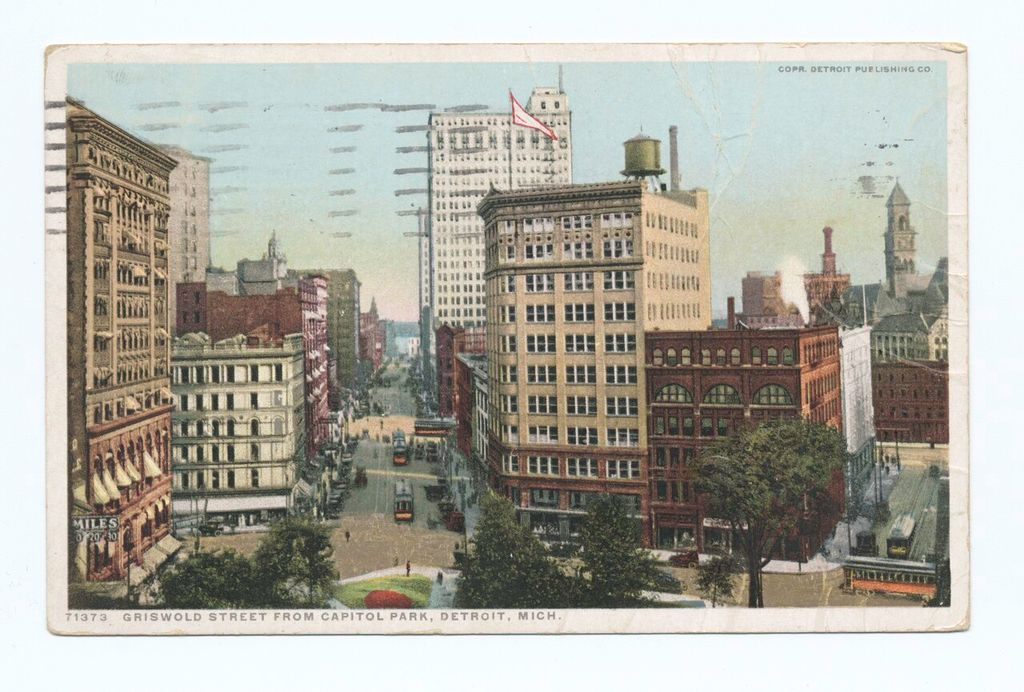
Another transmitted passage says the garlands and papier-mâché figures reminded Kahlo of Mexico, and that Rivera encouraged her to paint the scene. [3] This reported response complicates any claim that the American emblems simply disgusted her. It also explains why the window's improvised, popular character can matter as much as its patriotic content, while leaving Bloch's exact wording and the painting's sequence open to verification in the original sources.
Christie's and a Detroit Institute of Arts partner label identify the display as a Fourth of July window. [3] [8] The holiday setting makes sense of the red, white and blue, Washington portrait and eagle emblem, yet neither the controlled image nor a surviving shop invoice identifies its decorator, goods or original commercial purpose. [2] The painting is an image of an encountered display, not a neutral inventory of the shop as it physically stood.
The contrast with Rivera's Detroit work is one of situation and scale, not a dependency claim. The Henry Ford's archival set documents his commissioned fresco cycle at the Detroit Institute of Arts, an eight-month undertaking comprising twenty-seven frescoes; Kahlo was making small paintings during the same stay. [7] The ladder and brush-like marks at the back of her shop image may invite a mural-workshop analogy, but they cannot be identified as Rivera's actual equipment. [2] [3]
Washington, the Eagle and the White Horse
Christie's identifies the oval picture as a reproduction of Gilbert Stuart's unfinished Athenaeum portrait of George Washington. [3] The National Portrait Gallery dates Stuart's original to 1796 and notes its later use as the model for the one-dollar-bill engraving. [9] Christie's essay appears to print “1976” for the portrait; the museum's object record supplies the correct date, not a correction to Kahlo's painted year.
The circular emblem is identified by Christie's as the Great Seal of the United States. [3] The National Archives documents the seal's eagle, shield and other constituent signs in the design approved in 1782, but the small image cannot verify all of those details in Kahlo's painted plaque. [10] [2] Calling it a Great Seal emblem is a documentary identification; reading it as either endorsement or accusation would be a further interpretation.
The pale horse is less securely identified. Christie's suggests a possible resemblance to a nineteenth-century weathervane produced by A. L. Jewell & Co., while the image itself shows only a smooth, stylised horse-shaped display object. [3] [2] No exact prototype or maker record has been acquired, and a possible source of a form is not the same as a verified shop prop.
Likewise, the lion's material and symbolic role have separate evidence levels. Its open mouth, heavy mane and front-facing force are visible; Bloch's mediated recollection and Raquel Tibol describe papier-mâché; Luis-Martín Lozano proposes that the animal could stand for Rivera. [2] [3] [11] The suggestion is worth considering because Rivera was a conspicuous figure in Detroit, but no statement from Kahlo identifies the lion as his portrait.
At the right rear, a sheet or map-like form has drawn a further national reading. Carlos Omar Segoviano Rodríguez reports a map of the United States with a small part of Mexico still visible, linking it with estrangement in a foreign country. [5] Carlos Segoviano's later essay also points to the faint Mexican geography, but the 400-pixel reference cannot independently confirm its lines. [12] Both descriptions are scholarly readings of a tiny feature, not evidence that a clearly labelled map announces Kahlo's settled judgement about the United States.
An Ordinary Display Made Uncanny
The store window is unusual partly because its objects refuse a single natural scale. The lion, horse, presidential portrait and emblem are arranged to compete for attention, while the relatively unoccupied rear makes the grouping feel staged. [2] A portrait of a person, objects shaped like animals and national insignia occupy the same shallow foreground; none behaves as a living actor, yet the lion seems to roar and the horse seems poised to move.
Teresa del Conde's Spanish-language study argues that Kahlo used popular visual sources deliberately, gathering unlike objects into pictorial arrangements with their own internal logic. [13] She places metal supports within the tradition of Mexican ex-votos, but carefully distinguishes Kahlo's personal paintings from traditional votive accounts of a miracle. [13] Shop Window in Detroit may therefore recall popular display and the material context of retablos without itself being called an ex-voto.
Del Conde and Segoviano offer a useful counterweight to the auction essay's description of the picture as proto-Surrealist. [3] [5] [13] The ladder, abrupt scales, white horse and isolated signs can evoke Giorgio de Chirico's mysterious spaces, but a real shop-window encounter and deliberate arrangement also help account for them. A comparison with metaphysical painting is an art-historical argument, not proof that Kahlo adopted a Surrealist programme in 1932.
Segoviano's 2024 UAM essay places the picture in a wider Mexican reception of de Chirico before André Breton's celebrated arrival. [12] His brief Shop Window in Detroit discussion singles out the prop-like white horse and barely perceptible map as sources of unease. This later framework strengthens the case for reading the painting's spatial strangeness, while the exact cartographic detail and any direct influence on Kahlo remain unverified.
Tibol later associated the lion with a 1944 note in which Kahlo described Surrealism as the surprise of finding a lion in a cupboard where shirts were expected. [11] That is an intriguing retrospective echo, not a dated explanation for a painting made around 1932. The window already had a lion according to the visible image and transmitted account; the later note cannot make the commercial encounter an invented dream.
The emotional readings are similarly plural. A DIA partner text suggests that the festive sight may have comforted a homesick Kahlo, while Segoviano and Ramón Favela emphasise dislocation among United States symbols. [8] [5] Bloch's recollection gives the more direct, though mediated, response of delighted recognition of Mexican garlands and figures. [3] Pleasure, longing and ambivalence need not cancel one another, but none is a recovered private declaration explaining every object.
Metal Support and the Limits of Looking
Christie's identifies oil paint on metal, but does not publish an object-specific conservation account of the support, ground, paint sequence or condition. [1] The word “metal” should not quietly become “aluminium” because a biographer describes Kahlo buying or preparing sheet aluminium for some Detroit paintings. [3] Nor does a smooth-looking 400-pixel JPEG permit a diagnosis of surface texture, corrosion, repair or whether the signature was added in a separate campaign. [2]
The catalogue's 30.5 × 38.1 cm measurement is the most current directly read figure. Margarucci gives 30.3 × 38.3 cm and Segoviano's thesis caption 30.3 × 38.2 cm. [1] [4] [5] These small differences may reflect measurement practice or transmission, but there is no technical file here to decide which physical edge each author measured. They should be recorded as variants, not averaged into a fictitious precision.
Material and genre should remain equally distinct. The metal panel is relevant to del Conde's discussion of Kahlo's engagement with the visual world of Mexican ex-votos, yet this particular composition contains no documented miracle narrative or thanksgiving inscription. [13] [1] It is also still-life-like in its presentation of objects, while the shop display, portrait and animal imitations make “window display” a more exact description of its organising subject.
Owners, Exhibitions and the 2025 Sale
Christie's published provenance begins with Eduardo Morillo Safa in Mexico City in 1953, describing his acquisition as direct from Kahlo. [1] It then names Dolores Olmedo by 1978, Mary-Anne Martin Fine Art, a New York private collection, the Robert Holmes à Court Collection in Perth, Mr and Mrs Abel Holtz in Miami and a Miami private collection in 2012. [1] Several intervening transfer dates and terms are not given; a list of names is not a complete legal chain of title.
A DIA partner item credits Francisco and Fiorella Pérez Díaz. [8] That courtesy does not identify the owner today, particularly after Christie's sold the work as lot 56A on 17 November 2025 for US$7,151,000. [1] [6] The price is a historical auction result rather than a current valuation, and the purchaser remains undisclosed in the public record examined here.
The sale catalogue lists the painting at Primicias para un homenaje a Frida Kahlo in Mexico City in April 1953, while Kahlo was alive. [1] It also lists the 1977 national homage, a 1978–79 United States tour, 1990 Australian exhibitions and later appearances in Venice, Miami, London, Ponce, Mexico City, Berlin, Vienna, Rome and Genoa. [1] These entries are a substantial selected public history, but the complete venue-by-venue registrar records and catalogue pages have not all been read. April 1953 is the first appearance on this list, not a proved first exhibition.
A contemporaneous 26 April 1953 article by José Moreno Villa is catalogued in the MFA Houston's ICAA archive as a response to Kahlo's exhibition. [19] Its public synopsis discusses the show rather than identifying this painting, and the article itself requires access; it cannot be cited as Shop Window in Detroit's contemporary reception yet. It is an exact acquisition lead for the exhibition's critical climate, not an independent checklist entry.
The Detroit return in 2015 has stronger item-level support. Christie's identifies the painting as no. 28 in Diego Rivera and Frida Kahlo in Detroit, and the DIA dates that exhibition from 15 March to 12 July 2015; the museum partner label provides a separate Shop Window in Detroit text. [1] [8] [14] The DIA's promotional summary says Rivera embraced Detroit and Kahlo rejected it, a useful exhibition framing but too blunt to settle this picture's mixed testimony and visual attraction. [14] [3]
One proposed later appearance should not be added. Christie's November 2025 sale-room notice says MoMA had requested the picture for Frida and Diego: The Last Dream, but the museum's final eleven-page checklist dated 13 March 2026 does not list it. [1] [15] The request is a matter of record; actual inclusion is not established by the available final checklist. The painting should therefore not appear in a 2026 MoMA exhibition timeline.
Books and Unresolved Records
The most useful book for further study is Luis-Martín Lozano, Andrea Kettenmann and Marina Vázquez Ramos's Frida Kahlo: The Complete Paintings. Christie's bibliography points to pages 88–89 and 499–500, catalogue no. 36, and its essay cites pages 69 and 500. [1] [16] Those exact pages could refine the making account, object data and formal interpretation, but the complete volume and item apparatus have not been read here.
Celia Stahr's Frida in America has a different task: to test the Detroit chronology, Bloch friendship and larger American context. Christie's pinpoints pages 116, 181, 184 and 372, no. 10, but the complete book is also unread. [1] [17] Hayden Herrera's pages 151–52 and Salomon Grimberg's “The Lost Desire,” page 148, are especially important for tracing Bloch's recollection back through its transmission; the underlying testimony is still preferable to any chain of repeated quotation. [1] [3]
Grimberg's Frida Kahlo: The Still Lifes, pages 34–35, and the 2015 DIA exhibition catalogue, pages 59 and 146–48, no. 28, are further object-specific targets. [1] [14] [18] Yale University Press identifies the latter as a 248-page catalogue distributed for the museum, with Grimberg among its contributors; publisher metadata does not supply his exact essay or the Shop Window in Detroit entry. [18] These books are relevant further reading, but their full arguments have not been consulted for this account. Current owner, technical and conservation files, the original shop record, exact horse prototype and complete exhibition checklists remain unavailable.
Related Reading
Self-Portrait on the Borderline Between Mexico and the United States offers a different 1932 treatment of national symbols. My Dress Hangs There develops an American urban setting across several years, while Henry Ford Hospital belongs to the same Detroit stay but addresses a separate experience.
Frequently Asked Questions
The lower-left inscription gives 1931, but the documented Detroit arrival and the Bloch shop encounter belong to 1932. [1] [3] No acquired artist, technical or archival record resolves the conflict, so the responsible date is 1931–32 with the discrepancy explained.
Yes, according to Christie's comparison with Gilbert Stuart's unfinished Athenaeum likeness; the painted window does not itself name the sitter. [3] The National Portrait Gallery dates the source work to 1796 and records its later use for the dollar-bill engraving, helping explain its familiarity as a United States emblem. [9]
The lion is visibly present, but its proposed role as Rivera is Luis-Martín Lozano's interpretation, reported in Christie's catalogue. [2] [3] No artist's note or contemporary witness examined here confirms it as a portrait substitute.
Discussion
Use the cited evidence and your own close looking to explain your view. The prompts below are starting points, not fixed interpretations.
Reader Insights
What makes the painted shop window more than a literal street record?
How should the signed 1931 date be held against the 1932 Detroit arrival?
What does Bloch's recollection establish, and what remains later transmission?
Join the Conversation
Which reading best fits the evidence, and where does uncertainty remain?
References
- Christie's, Window Display on a Detroit Street (Aparador en una calle de Detroit), lot 56A, 20th Century Evening Sale, 17 November 2025; Details, Provenance, Literature, Exhibited, Further Details, Sale Room Notice and Lot Essay. Object fields and listed history are distinguished from essay interpretations. View source text.
- Editorial observation of the illustration in Christie's object catalogue, limited by the 400 × 346-pixel research copy. Visible forms are distinguished from later catalogue identifications; no physical examination is claimed. View source text.
- Christie's, lot essay, paragraphs on 21 April 1932 arrival, Bloch's later John R Street recollection as transmitted through Herrera and Grimberg, Fourth of July display, display objects and attributed Lozano readings. Bloch's underlying record and complete cited books were not read directly. View source text.
- Ivanna Margarucci, Frida Kahlo: una vida a través del arte, Museo Roca (2016), entry 048; 1931, oil on metal and 30.3 × 38.3 cm are retained as historical variants. View source text.
- Carlos Omar Segoviano Rodríguez, La Fridomanía, UNAM thesis (2011), printed pp.27–28 and figure caption. The map, national-displacement and de Chirico readings are attributed; dimensions vary slightly. View source text.
- Christie's, November 2025 New York sale guide, “A roaring display of Surrealism,” reporting the 17 November 2025 US$7,151,000 result. The price is a past sale result, not a current valuation. View source text.
- The Henry Ford, Detroit Industry Frescoes: The Backstory, archival-set overview and photograph entries, particularly lines 52–57 and 119–154; context for Rivera's Detroit commission, not an object file for Window Display on a Detroit Street. View source text.
- Detroit Institute of Arts partner item, Window Display on a Detroit Street, dated 1932 and describing a July Fourth window with a tentative homesickness reading and Pérez Díaz courtesy. The latter is not a current ownership claim. View source text.
- National Portrait Gallery, Gilbert Stuart, George Washington (The Athenaeum Portrait), object NPG.80.115; 1796, jointly owned with the Museum of Fine Arts, Boston. Corrects the apparent “1976” typo in Christie's essay. View source text.
- US National Archives, Original Design of the Great Seal of the United States, final design approved 20 June 1782; contextual identification of emblem components, not Kahlo's intended meaning. View source text.
- Raquel Tibol, Frida en París 1939, printed p.170 and notes 31–34. The 1944 lion-and-cupboard note is a retrospective comparison, not a 1932 making document. View source text.
- Carlos Segoviano, “Antes de Breton, Giorgio de Chirico”, Tiempo en la casa 14, Universidad Autónoma Metropolitana (April–May 2024), PDF physical p.13, lines 317–321; brief interpretation of Window Display on a Detroit Street in a wider study of de Chirico's Mexican reception. The faint map detail is not independently legible in the controlled image. View source text.
- Teresa del Conde, “Lo popular en la pintura de Frida Kahlo”, Anales del Instituto de Investigaciones Estéticas 13, no.45 (1976), pp.195–203, especially pp.195, 197–98 and 202–03; deliberate popular sources, ex-voto distinction and metal support. The article's 1931 Detroit and 1926 accident dates are not adopted. View source text.
- Detroit Institute of Arts, Diego Rivera and Frida Kahlo in Detroit, 15 March–12 July 2015, overview lines 20–30. Christie's item listing, reference 1, supplies catalogue no.28 and pages 59, 146–48. View source text.
- Museum of Modern Art, Frida and Diego: The Last Dream final checklist, dated 13 March 2026, complete physical pp.1–11, especially Kahlo entries pp.7 and 9–11; Window Display on a Detroit Street is absent despite Christie's earlier loan-request notice. View source text.
- Luis-Martín Lozano, Andrea Kettenmann and Marina Vázquez Ramos, Frida Kahlo: The Complete Paintings (TASCHEN, 2021), 624 pp.; exact pages for this painting and catalogue no.36 are identified by Christie's but the complete volume is unread. View source text.
- Celia Stahr, Frida in America: The Creative Awakening of a Great Artist (St. Martin's Press, 2020), pages 116, 181, 184 and 372, no.10 identified through Christie's bibliography. The publisher page identifies the edition; those pages and the complete book have not been consulted. View source text.
- Salomon Grimberg, Frida Kahlo: The Still Lifes (Merrell, 2008), pp.34–35 identified through Christie's bibliography; unread. Detroit Institute of Arts, Diego Rivera and Frida Kahlo in Detroit (distributed by Yale University Press, 2015), 248 pp., ISBN 9780300211603; exact pages for this painting, pp.59 and 146–48, no.28 identified through Christie's, while the complete catalogue remains unread. View source text.
- ICAA/Museum of Fine Arts, Houston, record 753110 for José Moreno Villa, “La realidad y el deseo en Frida Kahlo”, Novedades: México en la Cultura, 26 April 1953, record lines 44–85 and 108–14. The public synopsis concerns the exhibition; the full newspaper article and any mention of this painting have not been read. View source text.
- Museo Frida Kahlo, Frida interactive chronology, selected work dates used for the comparison timeline. The current work's date follows its cited object record. View source text.
Image Credits
- Detroit Publishing Company. Public domain. Source: Wikimedia Commons (File:Griswold Street from Capitol Park, Detroit, Mich (NYPL b12647398-74276).tiff). 1024px proportional sRGB JPG derivative; no crop. Licence. Source record.
