


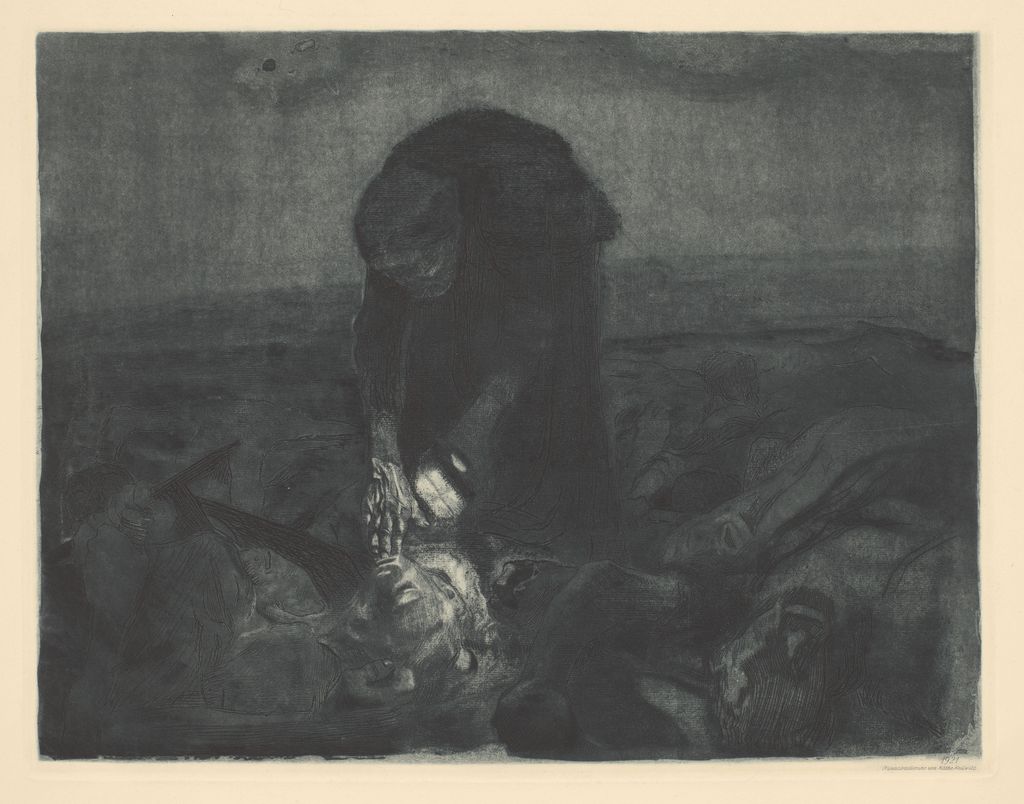
Battlefield, plate 6 of Peasants’ War. Rijksmuseum, RP-P-2011-36-320, impression dated 1921. Image source. Public domain. Resized and exported as JPEG.
 by Tom Gurney
Tom Gurney BSc (Hons) is an art history expert with over 20 years experience
Email: tomgurney1@gmail.com / Phone: +44 7429 011000
Battlefield by Käthe Kollwitz: Introduction
A woman bends over the dead, holding a lantern close enough to pick out a young man’s face. Her free hand reaches towards his chin. Other bodies emerge unevenly from the dark. In Battlefield (Schlachtfeld), the sixth plate of Käthe Kollwitz’s Peasants’ War, the fighting is already over. What remains is the slow work of finding someone among the fallen. Kollwitz had first imagined a mother digging her son’s grave. In the 1907 design, she takes the story back to the moment when the light reaches him. [1] [2]
At a Glance
- ArtistKäthe Kollwitz
- TitleBattlefield (Schlachtfeld), also catalogued in English as Battle Field
- Date1907 for the lantern composition
- SeriesPlate 6 of 7 in Peasants’ War (Bauernkrieg), published in 1908
- MediumLine etching, drypoint, aquatint, sandpaper work and soft-ground etching with impressions of ribbed laid paper and Ziegler’s transfer paper, as recorded for the Cologne impression
- Cologne impressionKollwitz Museum Köln, inventory 70300/23009, Knesebeck 100 X b, recorded at 410 × 531 mm [1] [3]
This work across Käthe Kollwitz’s career
A Weavers’ Revolt
1893–97The six sheets take a revolt from household distress to collective action and its aftermath. [4]
Separate impressions and hand-worked proofs show how Kollwitz developed the image. [5]
Peasants’ War
1901–08The seven plates combine the revolt with the aftermath in Battlefield and The Prisoners. [3]
War
1921–22, published 1923The woodcuts give sustained attention to the experience of those left behind. [6]
The Grieving Parents
1932 installationTwo kneeling figures face the graves in the memorial’s later location at Vladslo. [7]
Mother with Her Dead Son
1937–39 modelThe small sculpture precedes the 1993 enlargement at the Neue Wache. [9]
Contents
- What the lantern reveals
- From digging a grave to finding the dead
- How Kollwitz built the darkness
- Cologne, Amsterdam and Strasbourg impressions
- From the charge to the prisoners
What the lantern reveals
In the Rijksmuseum impression, the woman’s back makes a dark arch against the lighter, grainy sky. Her head hangs to the left of the arch, just far enough forward that the faint contours of her face can be made out. Her clothing then descends in a nearly continuous dark mass. Follow it down and the image changes abruptly. The lantern is a pale, tilted shape, and beside it the searching hand breaks into a series of narrow lights and shadows. Below the fingers, the young man’s head tilts back. A short distance on the paper separates a face we can barely see, a hand we can see quite distinctly and the face that hand is trying to identify. [1] [2] [10]
The two faces receive very different amounts of light. The mother has brought the lamp low, where it can serve her search, leaving her own expression largely in shadow. Her lowered head tells us where she is looking. The long reach of her arm tells us how carefully she is trying to get close. At the end of that reach, her fingers seem to test what the light has disclosed. The Getty draws attention to the weathered hand at the young man’s chin. The sharpness of its joints beside the softer modelling of his cheek gives that small meeting much of its force. We are close enough to follow the action of her fingers while her reaction remains difficult to read. [2] [10]
The faint horizon passes well above the foreground faces, leaving the lower part of the print crowded. At the lower left, the contour of another head can be followed into the shadow. At the lower right, a bent form cuts diagonally across the bodies behind it. Further back, especially to the right of the woman, outlines are faint enough that a fold, a limb and an irregularity in the earth can be hard to tell apart. The rounded back is the one strong shape rising out of these overlapping forms. Its curve brings the eye back down towards the lantern, while the horizontal spread of the bodies continually draws attention outwards again. [1] [10]
Cologne describes a mother finding her fallen son. The encounter has the duration of a search even when we know its outcome. Each neighbouring shape offers just enough information to keep us looking, and the different degrees of visibility make it possible to imagine the light passing over other faces before it came to rest here. The edge of the print cuts off the field with bodies still visible. Nothing in the picture gives the woman a clear route through them. She has managed to bring the light to one face, and the faces beyond it suggest how many other searches could begin in the same ground. [1] [2] [10]
From digging a grave to finding the dead
Kollwitz began exploring the aftermath in 1903, before the commission for the cycle. In the early narrative described by the Kollwitz Museum Köln, Black Anna buries her fallen son on the battlefield at night. Cologne’s Woman Digging, a 1903 charcoal drawing on Ingres laid paper, isolates the labouring woman (NT 254, inventory 70200/04009). Detroit’s Burial, dated about 1903, places the digging figure with the dead child. Detroit’s account points to the touches of yellow and white that pick out both faces. Even in the grave-digging conception, light allows the two figures to be read together. The work of burial places the action after recognition, when the mother has already found the person she came for and must decide what to do with his body. [1] [11]
A second 1903 design brings the mother directly over the child. The Germanisches Nationalmuseum’s preparatory drawing Mother and Dead Son (Mutter und toter Sohn), Hz10493, shows him stretched along the ground with one arm bent. The woman gathers his head in both hands and kisses him. Two further studies of his face appear along the lower edge of the sheet. The German museum records pinholes, tracing marks and traces of studio colour as evidence that the design was transferred to a printing plate. Those marks give the drawing a place in the making of a specific print. They also show how much attention Kollwitz gave to the head before settling on the searching gesture of Battlefield. [12]
MoMA holds a proof from that rejected design, accession 112.2024, state II of IV. It is one of six known proofs across the four states. The plate measures 22.8 × 33.6 cm, considerably smaller than the plate used for the lantern scene. MoMA records line etching, drypoint, soft ground, work with a bundle of needles and a burnisher, and brown ink and gouache applied directly to the printed sheet. The proof thus carries evidence of two working surfaces. The metal supplied the repeatable image, and Kollwitz could adjust this particular sheet with ink and opaque paint after it came off the press. The four-state sequence belongs to this rejected plate, listed as Knesebeck 78 in the Nuremberg drawing record’s bibliography. [12] [13]
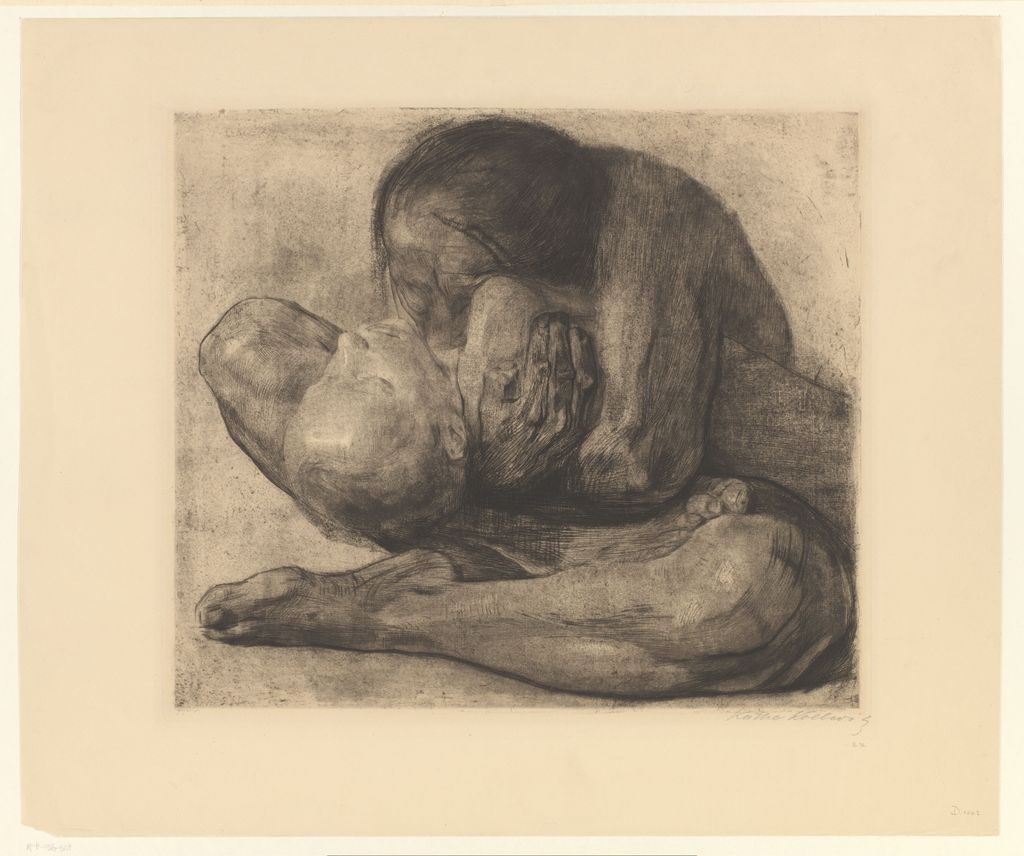
The independent 1903 print Woman with Dead Child, Knesebeck 81, grew out of the work on plate six and takes the encounter in another direction. The seated mother folds around the child, with his body drawn into the space enclosed by her arms and legs. Kollwitz later recalled posing for it with her seven-year-old son Peter. The 2024 MoMA checklist documents how differently individual proofs of that print were worked. A state III impression lent by the British Museum has gold-coloured wash, graphite and charcoal applied to the sheet. Its state VI impression has a gold-sprayed lithographic tone overprinted on the intaglio. The exhibition placed these experiments within the working history of the independent print. In the lantern design, Kollwitz would use the space between two bodies to make a different action visible. [14] [15]
The Cologne museum places the move towards the final composition probably towards the end of 1906. Its drawings preserve different ways of working out that scene. The tall Battlefield study of about 1907, NT (411a), inventory 70200/14003, measures 763 × 443 mm. The German catalogue calls the medium charcoal heightened with white chalk on grey-green laid paper. The English entry calls the dark medium black chalk. Both identify the same sheet. Its upright format gives the stooping figure room to develop vertically, while the eventual print gives more room on either side to the fallen. [1]
A separate horizontal study, NT 410, measures 435 × 542 mm. The National Gallery of Art’s 1992 catalogue describes charcoal and chalk heightened with white on charcoal-grey paper. It calls attention to the smudging that gives the scene its misty night air and to the stooping mother breaking the horizontal arrangement. The two studies show that Kollwitz could consider the figure in a tall sheet and the figure’s relation to the field in a wide one. Cologne’s Dead Boy, a separate charcoal study of 1907 on white Ingres laid paper (NT 413, inventory 70200/84005), isolates the fallen figure. Across these sheets, the weight of the body, the bend of the woman and the depth of the surrounding dark can each become the chief problem of a drawing. [1] [16]
The choice of a lantern brought those problems together. In Detroit’s burial study, both faces receive touches of colour and light. In Nuremberg’s drawing, the woman’s hands cup the face she kisses. In the finished design, one hand carries the light and the other reaches down. The face that matters most is lit, but the woman’s face remains indistinct. This gives the viewer part of her experience. We can see what she has found more clearly than we can see what the discovery has done to her. [1] [2] [11] [12] [10]
How Kollwitz built the darkness
The Cologne impression combines several ways of making a plate hold ink. Acid bites the lines exposed through an etching ground. A drypoint needle cuts directly into the metal and can raise a burr that prints with a soft edge. Aquatint gives a field of small ink-holding marks that read together as tone. Soft ground can take the impression of a material pressed into it. The ribbed laid paper and Ziegler’s transfer paper in Cologne’s description are textures worked into the plate. The paper on which the picture was ultimately printed is a separate part of the process. That distinction matters because a grain seen in the image may have originated in a material that never formed part of the finished sheet. [1] [17] [18]
The Getty Research Institute’s 2019–20 exhibition checklist records two working stages of the lantern design. Its state IV of XV impression is in black ink on light-green chine collé, a thin paper mounted on a heavier copperplate printing paper. The state X of XV example is in green-black on copperplate printing paper. The checklist names the laid-paper texture in both entries and adds Ziegler’s transfer paper in the later one. The Getty’s fuller collection finding aid also lists Ziegler’s paper for the earlier proof, so those descriptions alone cannot establish when that texture first entered the image. They do establish differences in ink and support between the two impressions. [17] [18]
A note on the early Getty proof gives a more direct indication of where Kollwitz was looking. The finding aid transcribes her pencilled remarks in the top margin about heightening part of the sky, strengthening the central figure and doing relatively little elsewhere. The National Gallery of Art’s 1992 catalogue discusses a proof on pale-green chine collé under the older Klipstein state III designation and describes the fine, regular dot screen that appears in later states. The catalogue reads that screen as a practical way to cover an extensive background and argues that it flattens the tone of the edition impression. The relatively even sky in the Amsterdam image helps explain what was at stake. It lets the woman’s bowed back register as a single shape while the foreground remains dense with broken contours. [16] [10] [18]
The Berlin Kupferstichkabinett records another kind of intervention on impressions of the lantern design. Its seventh- and eighth-state records both describe black ink overwork on the woman’s right hand. A revision made with ink on a proof is specific to that sheet unless it is subsequently carried into the plate. Here the Berlin entries establish that the hand was an area of repeated attention. The records do not identify a corresponding cut, bite or other alteration in the metal. The place where the narrative comes down to a few lit fingers was also a place Kollwitz went back over on paper. [19]
Cologne, Amsterdam and Strasbourg impressions
The history of Battlefield involves several kinds of dates and numbers. The design date places the composition in Kollwitz’s work on the cycle. A printing date concerns a particular impression. An edition groups impressions issued together, while a state identifies a stage in the history of the plate. A date printed from the plate, a collector’s annotation and a museum’s acquisition date each have their own evidentiary value. The surviving impressions make these distinctions concrete. [1] [3] [10] [20] [21] [18]
Cologne dates 70300/23009 to 1907 and catalogues it as Knesebeck 100 X b. The Städel’s SG 4346 D carries the same Knesebeck designation and is also listed as Klipstein 96 IX. Its edition field describes it as one of approximately 300 impressions, and its inscription field records Kollwitz’s pencil signature below the image at right. The Getty’s green-black Knesebeck 100 X a impression, by contrast, is specifically catalogued as a proof before the 1908 edition. The Getty finding aid assigns that proof Klipstein 96 IV. The shared Knesebeck numeral X is therefore only part of the identification. The suffix, the individual record and the catalogue system matter when distinguishing a proof from an edition impression. [1] [21] [18]
The Rijksmuseum’s RP-P-2011-36-320, catalogued as Slachtfeld, is dated 1921 in the museum’s dating field. Its material and technique fields list etching and soft-ground etching. Separately, the museum transcribes a Dutch inscription that identifies the design as the sixth sheet of the 1907 cycle, cites Klipstein 96 XII, proposes a printing range of 1921–31 and includes a price in guilders. The record leaves the writer unidentified. The state and wider date range can therefore be attributed to the inscription, while 1921 is the museum’s date for the object. In the digitised impression, a small line of lettering is visible along the lower right edge. The Dutch description is evidence supplied by the catalogue transcription. [10]
Tokyo’s National Museum of Western Art records G.2003-0056 as a 1907 work printed in 1921 in its Japanese dating field. It describes a date at lower right and a pencil signature in the same area, and gives Klipstein 96 X and Knesebeck 100 XI. The museum purchased the impression in 2004. For a further comparison, the Getty’s Knesebeck 100 XV a, catalogued as Klipstein 96 XII, has lettering engraved into the plate that includes the date 1921. The Getty identifies its own sheet as a posthumous printing, either 1946–48 or 1963–65, based on Alexander von der Becke’s embossed seal. The printed date could thus recur on sheets pulled decades apart. The seal belongs to the Getty impression and provides no dating evidence for the Amsterdam sheet. [10] [22] [18]
Strasbourg’s 5.916 supplies a particularly early fixed point. The French national collections database, Joconde, records it as Schlachtfeld, blatt 6 and Le champ de bataille, planche 6, dates the work to 1907 and gives 27 June 1908 as the date of acquisition by gift. It records a pencilled marginal mark as `S.B.DR.` and supplies no state designation. Its measurements are given as height 55.8 and width 72.5, with the unit and the distinction between plate and sheet left unstated. The gift establishes that an impression had reached the Strasbourg collection in the year of the portfolio’s publication. The record alone leaves its precise state open. [20]
The Städel gives a sense of how much the dimensions can differ within a single object. Its SG 4346 D has a 560 × 725 mm sheet and a 410 × 531 mm plate. The Kunstmuseum Basel impression shown at MoMA in 2024 is recorded with a 48.5 × 64 cm sheet and a 40.8 × 53 cm plate. Those two plate measurements are close, while the papers leave appreciably different margins around the image. The MoMA checklist identifies Basel’s lender, medium and measurements without giving a state for the impression. Comparing the two shows why a measurement must be tied both to the object and to the part of it that was measured. [20] [21] [15]
From the charge to the prisoners
Kollwitz’s reading of Wilhelm Zimmermann’s history of the German peasants’ uprising of 1524–25 set the project in motion. Cologne notes that Zimmermann was sympathetic to the peasants’ demands and that the uprising had become an important historical precedent in German social democratic circles. Kollwitz initially considered a series of colour lithographs. By 1904 she was seeking support from the Verbindung für historische Kunst, with backing from Max Lehrs of the Dresden print room. The association published the seven-sheet Peasants’ War with Emil Richter in 1908. The finished narrative order differs from the order in which the plates were made. Cologne dates plate five, Charge, to 1902–03, several years before plate one, The Ploughmen, and the final design for Battlefield. [3]
The cut between plates five and six is the cycle’s sharpest change of pace. In Charge, a woman seen from behind raises both arms and the mass of peasants surges forward. Christian Weikop, writing in Tate Papers, situates that print within Kollwitz’s portrayal of peasants as people capable of collective political action and cites her recollection of reading about Black Anna in Zimmermann. In Battlefield, the woman bends and brings one arm down. The mass of bodies has changed from a force moving together into a field she must search one person at a time. The movement between the two plates invites comparison without settling the identity of the woman in the later image. The fighting itself takes place in the gap between the sheets. [1] [3] [2] [23]
The Strasbourg museum’s 2019 exhibition dossier draws a connection between the ploughed field at the beginning of the series and the battlefield near its end. The association is visible in the pressure Kollwitz places on bodies near the ground. In the first plate the ploughmen’s bowed bodies are still exerting force. In the sixth the dead lie along the earth, and the searching woman bends towards them. The ground that sustained the peasants’ labour has become the surface on which their defeat is registered. Strasbourg’s account also calls attention to the shift back to a horizontal format after the large, nearly square Charge. The change in shape gives the aftermath room to spread across the sheet. [3] [24]
Battlefield was originally intended to close the cycle. The addition of The Prisoners, dated 1908, moves the final encounter from those who died to those who survived and were taken captive. Cologne traces motifs in both sheets to an abandoned ending for A Weavers’ Revolt, which included bound figures and a stooping figure reaching towards a body. In the finished Peasants’ War, the gesture and the captives occupy separate sheets. The mother can reach the dead man’s chin. In the final plate, the barrier keeps the captives at a distance, but the eyes of one prisoner, just left of centre in the second row, meet the viewer’s gaze. The addition carries the story beyond the field and gives its last moment to someone still able to look back. [2] [25]
Strasbourg continued to exhibit its impression, including in a 2002 Kollwitz exhibition and the 2006 survey of German prints documented in Joconde. In Britain, the British Museum grouped Peasants’ War in its 2019–20 exhibition Portrait of the Artist: Käthe Kollwitz. The museum traces much of its Kollwitz collection to Campbell Dodgson, who bought her prints in Germany before the First World War under the influence of Lehrs. The early Strasbourg gift and the British collecting history show how quickly the prints found audiences beyond Germany. Later exhibitions have also made it possible to see the work in two ways, as a turn in a seven-sheet narrative and as an image whose small differences from impression to impression reward sustained attention. [17] [20] [26] [15]
Käthe Kollwitz artworks directory
Selected documented works, including the complete published sequences of the five cycles discussed here. Catalogue links identify the specific record behind each row.
Frequently Asked Questions
The Kollwitz Museum Köln reads her as a mother finding her fallen son. It identifies the woman in the early burial conception as Black Anna. Kollwitz also associated Black Anna with the woman who rallies the peasants in Charge. The finished Battlefield offers a view of the mother’s search, with her own face largely in shadow. The named identification is documented most securely for the earlier conception and the charge. [1] [23]
The lantern composition dates to 1907, and the full seven-sheet portfolio appeared in 1908. Strasbourg’s impression was acquired in June of that year. 1921 is the Rijksmuseum’s dating for its impression and the printing date explicitly given for Tokyo’s example. A date engraved into the plate can also appear on a later impression, as the Getty’s posthumous example shows. [1] [3] [10] [20] [22] [18]
It is a separate 1903 intaglio design that Kollwitz considered for plate six. The preparatory drawing in Nuremberg shows the mother taking the child’s head in both hands and kissing him. MoMA’s state II of IV is a proof from that rejected plate, with brown ink and gouache applied to the sheet. The 1907 Battlefield belongs to a different plate and places the encounter among the fallen at the edge of a lantern’s light. [1] [12] [13]
Discussion
Look again at the images and ideas explored in Battlefield by Käthe Kollwitz. These editorial prompts invite your observations.
Reader Insights
What does the shift from an embrace to a lantern-lit search change in the scene?
How does Battlefield function differently once The Prisoners follows it?
How does the lantern’s light link the near body to the rest of the field?
Join the Conversation
Share a detail, comparison or question about Battlefield by Käthe Kollwitz below.
References
- Kollwitz Museum Köln, Schlachtfeld, Kn 100 X b, 70300/23009, and Studien captions for NT 254, NT (411a) and NT 413. English record, Battle Field, including the medium given for NT (411a). View source 1. View source 2.
- Getty Research Institute, Käthe Kollwitz: Prints, Process, Politics, exhibition texts, printed pp. 8–10, especially Battlefield on p. 10. View source.
- Kollwitz Museum Köln, The Peasants’ War Cycle, account of Zimmermann, the 1904 funding application, the 1908 publication and the numbered plate list. View source.
- Kollwitz Museum Köln, A Weavers’ Revolt, cycle catalogue. View source.
- Museum of Modern Art, Woman with Dead Child, state VIII/X, 1903. View source.
- Museum of Modern Art, Käthe Kollwitz, 2024 extended gallery labels. View source.
- Flemish Heritage Inventory, Treurend ouderpaar (Vladslo – WOI). View source.
- Kollwitz Museum Köln, Death, series catalogue. View source.
- Kollwitz Museum Köln, Pietà (Mutter mit totem Sohn), Seeler 37, with the Neue Wache enlargement. View source.
- Rijksmuseum, Slachtfeld, RP-P-2011-36-320, digitised impression, Inscriptions / marks, Dating and Material and technique. View source.
- Detroit Institute of Arts, Burial, 70.308, date and artwork description. View source.
- Germanisches Nationalmuseum, Mutter und toter Sohn, Hz10493, Beschreibung and Literatur, including the references to Knesebeck 78 and Yasmin Doosry’s 2017 catalogue, pp. 80–83, no. 24. View source.
- Museum of Modern Art, Mother and Dead Son, 112.2024, Medium, Dimensions, Edition and Object number. View source.
- Kollwitz Museum Köln, Frau mit totem Kind, Kn 81 VIII a, catalogue entry and account of Peter posing. View source.
- Museum of Modern Art, Käthe Kollwitz, 2024 exhibition master checklist, printed pp. 12–13 for the British Museum proofs of Woman with Dead Child and p. 22 for the Basel Battlefield. View source.
- National Gallery of Art, Käthe Kollwitz (1992), annotated checklist, printed p. 158, nos. 63–64, NT 410 and the Klipstein 96 III proof. View source.
- Getty Research Institute, Käthe Kollwitz: Prints, Process, Politics, exhibition checklist, printed p. 6, Battlefield, states IV and X of XV. View source.
- Getty Research Institute, finding aid for the Dr. Richard A. Simms collection, 2016.PR.34, printed pp. 56–57, Box 7, Knesebeck 100 IV, X a and XV a. View source.
- Staatliche Museen zu Berlin, Kupferstichkabinett, Schlachtfeld, seventh-state record, object 1718788. Eighth-state record, object 1920264, technique and overwork description. View source 1. View source 2.
- Joconde, Le champ de bataille, planche 6, Strasbourg 5.916, Mesures, Précisions sur les inscriptions, Date d’acquisition, Exposition and Bibliographie. View source.
- Städel Museum, Battlefield, SG 4346 D, Blatt, Platte, Edition, Label at the Time of Manufacture and Work Catalogues. View source.
- National Museum of Western Art, Battlefield, G.2003-0056, Japanese date field, inscriptions, standard references and provenance. View source.
- Christian Weikop, “August Sander’s ‘Der Bauer’ and the Pervasiveness of the Peasant Tradition,” Tate Papers 19 (2013), p. 7 and notes 20–21. View source.
- Musée d’Art moderne et contemporain de Strasbourg, Käthe Kollwitz. Je veux agir dans ce temps, 2019 exhibition dossier, printed p. 6, Salle 4. La Guerre des paysans et la critique sociale. View source.
- Kollwitz Museum Köln, The Prisoners, Kn 102 IX a, catalogue discussion of the revised ending and the abandoned Weavers design. View source.
- British Museum, Portrait of the Artist: Käthe Kollwitz, 2019 exhibition press release, passage on Campbell Dodgson, Max Lehrs and the exhibition groupings. View source.
More KOLLWITZ Works
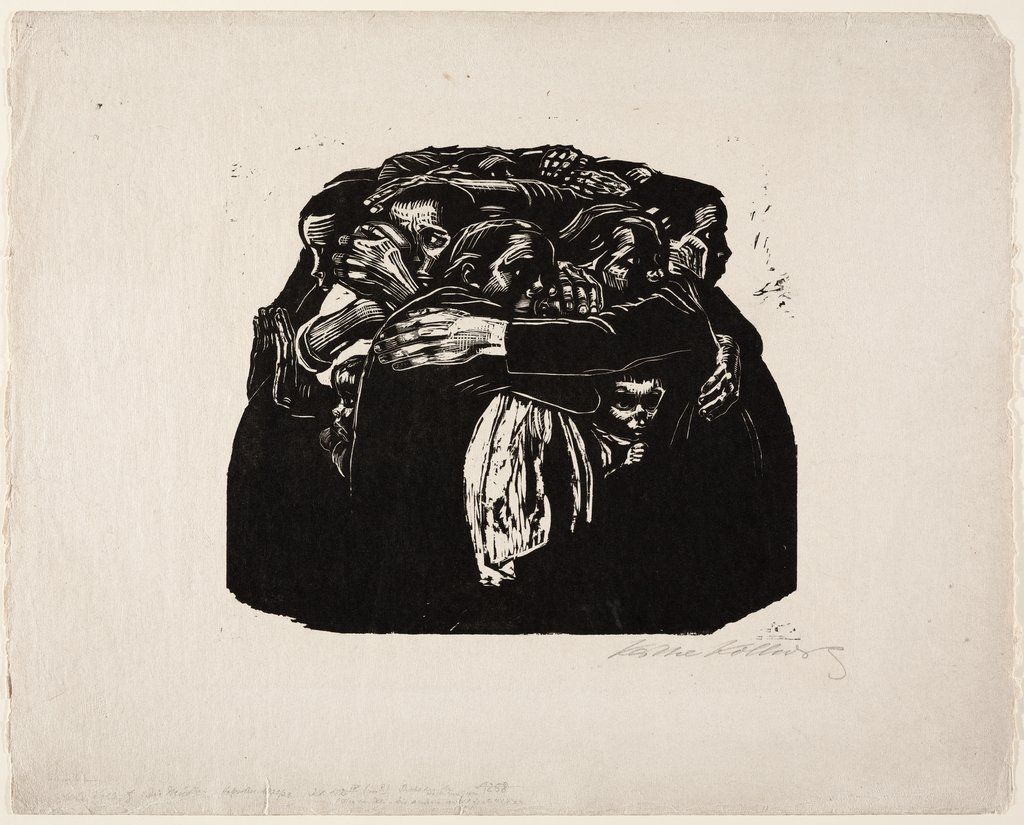
The Mothers
The Mothers, 1921–22. Städel Museum, Frankfurt am Main, SG 4289A D. Image source. Public domain. Resized and exported as JPEG.
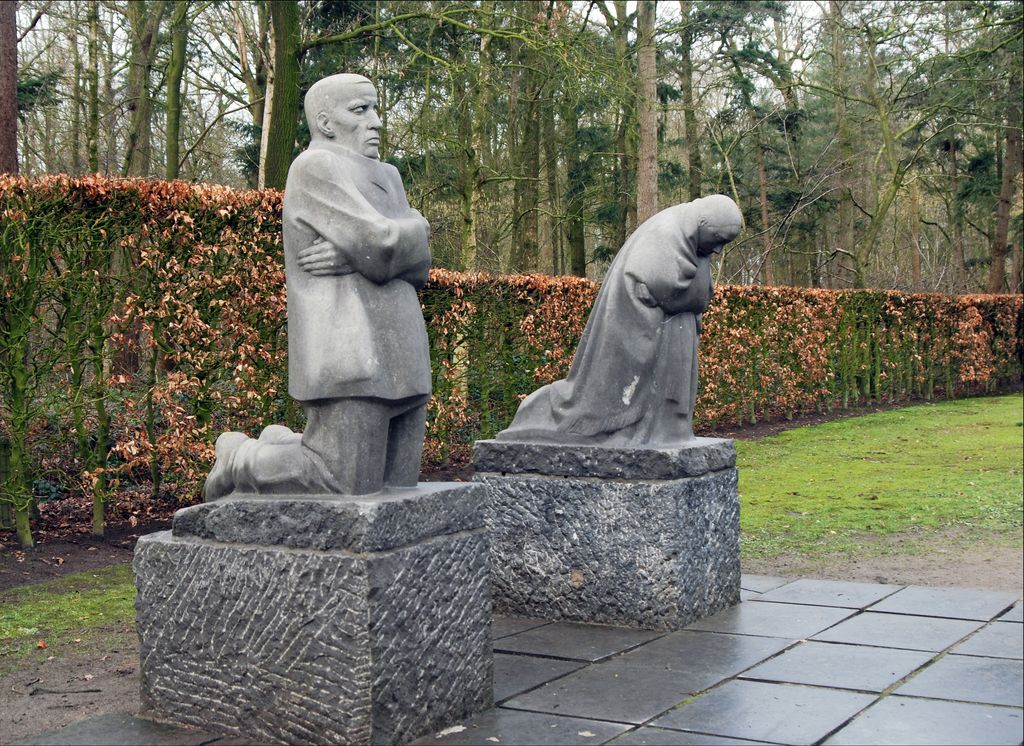
The Grieving Parents
The Grieving Parents at Vladslo, the memorial’s location since 1956. Photograph by Bva, resized. Image source. CC BY-SA 3.0. Resized and exported as JPEG.
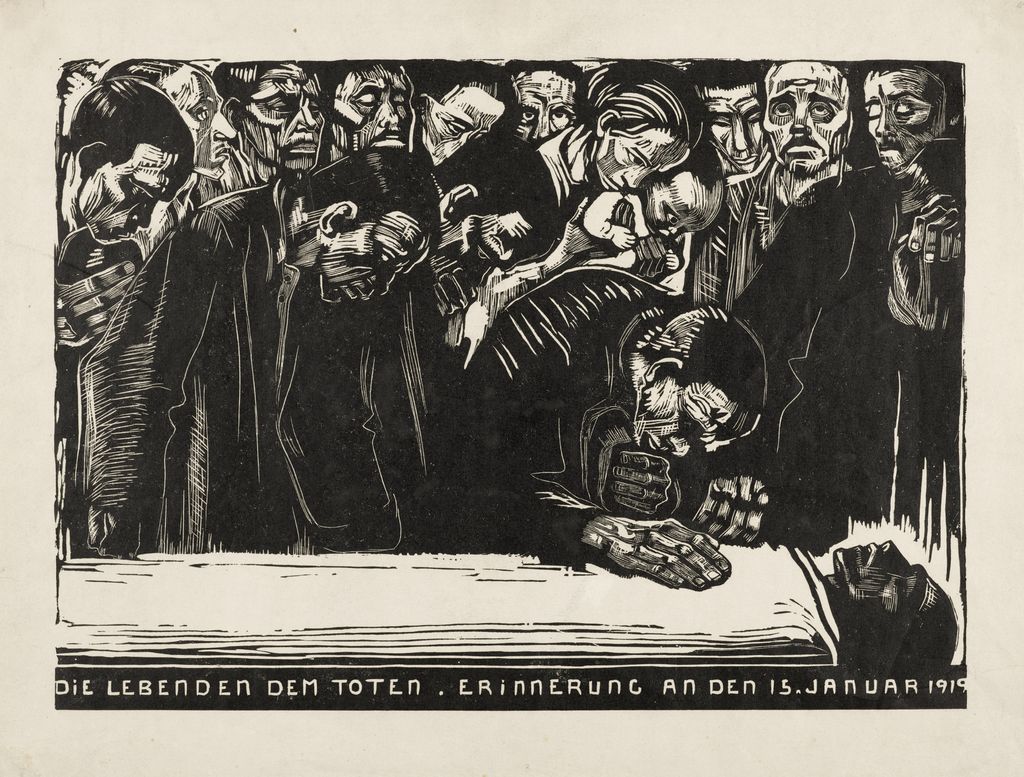
Memorial for Karl Liebknecht
Memorial for Karl Liebknecht, 1920. Kunstsammlungen Chemnitz, 86-47, Kn 159 VI. Photo: Kunstsammlungen Chemnitz/PUNCTUM/Bertram Kober. Image source. Public domain. Resized and exported as JPEG.